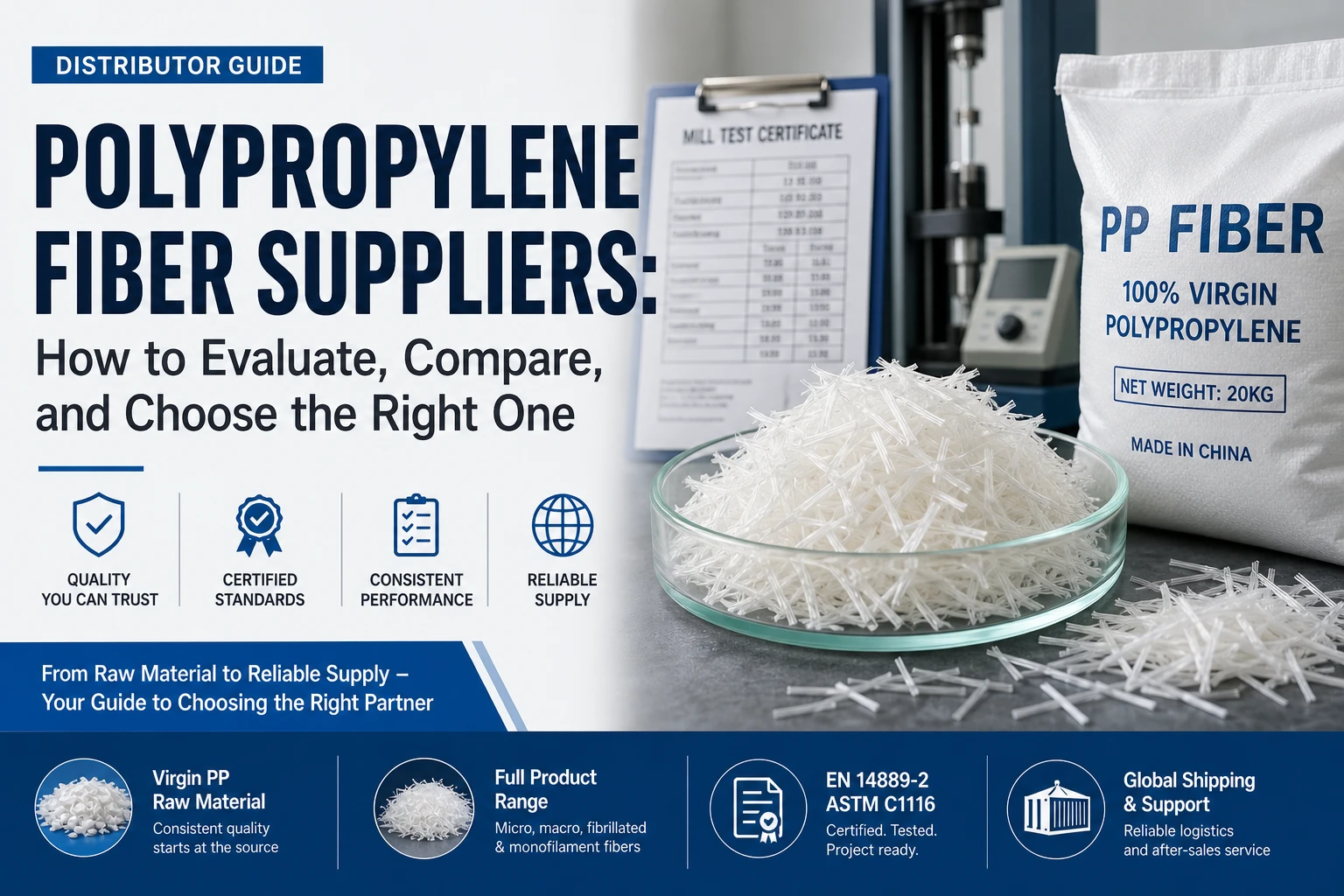
Finding reliable polypropylene fiber suppliers is harder than it looks. The market is crowded with manufacturers claiming quality certifications and competitive prices. But not all suppliers deliver what they promise. This guide shows you how to evaluate suppliers, verify their claims, and avoid the common mistakes that cost distributors time and money.
What to Look For in Polypropylene Fiber Suppliers
Raw Material Quality — Virgin vs. Recycled PP
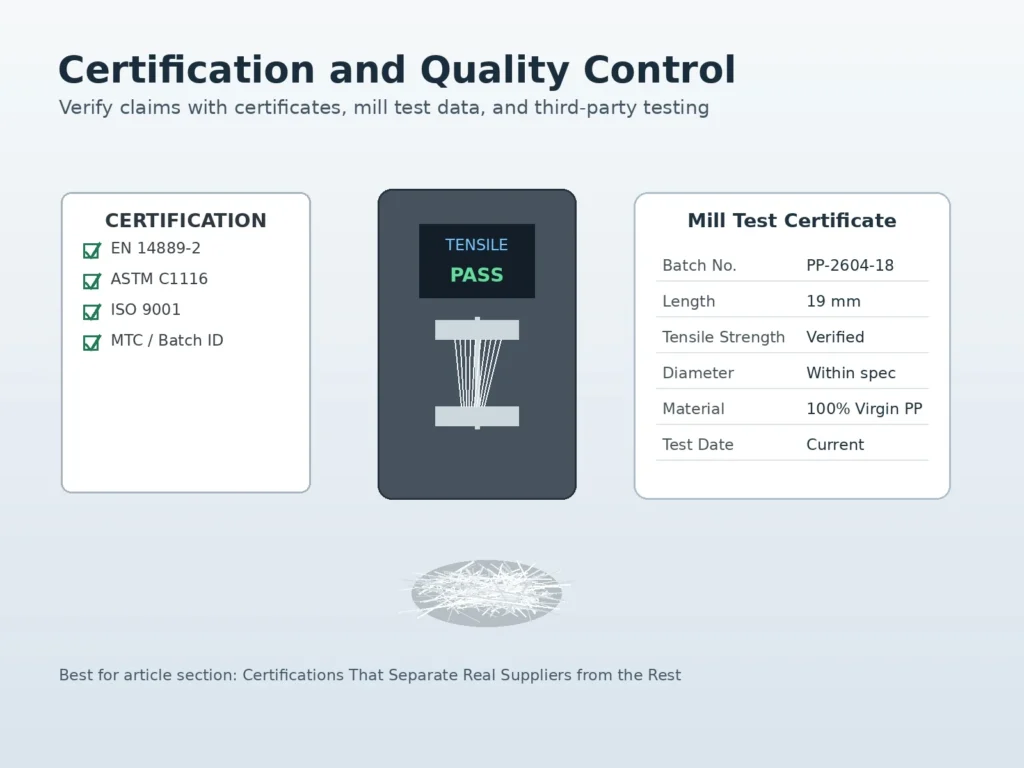
The raw material determines everything about the fiber’s performance. Polypropylene fiber starts as PP resin pellets. The quality of those pellets sets the ceiling for tensile strength, consistency, and durability in concrete.
Virgin PP is made from fresh petrochemical feedstock. It has consistent melt flow index, predictable mechanical properties, and reliable performance batch after batch. Virgin fiber meets certification standards like EN 14889-2 and ASTM C1116 without issue.
Recycled or reprocessed PP comes from post-industrial or post-consumer waste. It’s cheaper, but inconsistent. The melt flow index varies. Mechanical properties fluctuate. One batch performs differently from the next. This creates problems for your customers, and complaints come back to you.
Some suppliers blend virgin and recycled material without disclosure. Others claim “premium recycled” that doesn’t exist. Ask directly: “Is this 100% virgin PP?” Request material certification. If a supplier is vague about raw material sourcing, that’s a red flag.
For distributors selling into certified projects, virgin material is non-negotiable. Recycled PP might work for non-structural applications where price is the only concern. But most of your customers need consistency more than they need the lowest possible price.
Manufacturing Consistency and Batch Control
Consistency means the fiber you receive in shipment three matches the fiber you approved in shipment one. Same tensile strength. Same denier. Same length distribution. Same performance in concrete.
Inconsistent fiber creates real problems:
- Mix designs that worked before suddenly fail
- Customers complain about variable performance
- Projects require re-testing or remediation
- Your reputation takes a hit
Good suppliers control consistency through process discipline. They monitor extrusion parameters. They test every batch. They keep statistical process control charts. They can show you data.
Ask potential suppliers: “How do you ensure batch-to-batch consistency?” Look for specific answers about testing frequency, control limits, and corrective action procedures. Vague answers like “we have quality control” mean nothing. For more on how PP fiber performs in concrete, see our guide on polypropylene fiber for concrete.
Product Range (Micro, Macro, Fibrillated, Monofilament)
Suppliers with broader product ranges simplify your supply chain. Instead of managing relationships with three different manufacturers (one for micro fiber, one for macro, one for specialty blends), you work with one supplier who covers everything.
Micro fiber (6–19 mm length, 15–50 microns diameter) controls plastic shrinkage cracking. It’s used in slabs, pavements, and precast products where surface cracks are the concern.
Macro fiber (40–65 mm length, 0.5–1.0 mm diameter) provides structural reinforcement. It can replace or supplement steel fiber in certain applications. Higher performance, higher price point.
纤化纤维 has a mesh-like structure that bonds well with concrete. It’s common in shotcrete and repair applications.
单丝纤维 is a single continuous strand. It disperses easily and is widely used in ready-mix concrete.
A supplier who manufactures all four types can support your full product line. They can also advise on hybrid blends and custom formulations. That’s value beyond the product itself.
Certifications That Separate Real Suppliers from the Rest
EN 14889-2 — What It Means and Why It Matters
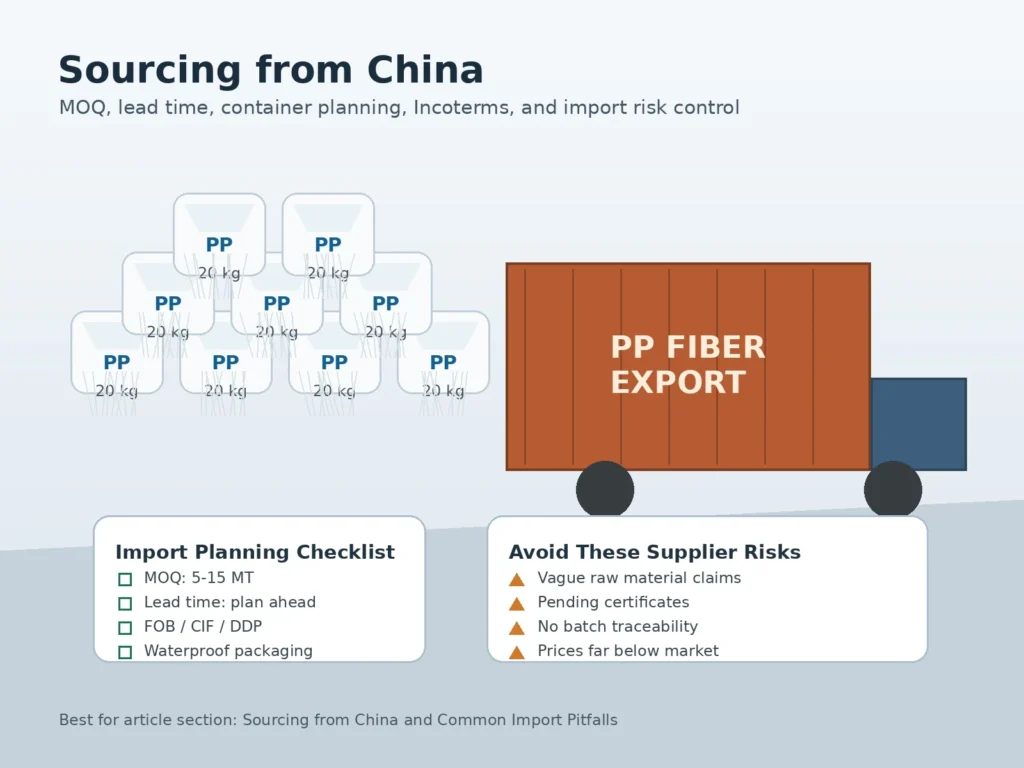
EN 14889-2 is the European standard for polymer fibers in concrete. It defines requirements, specifications, and conformity assessment for synthetic fibers, including polypropylene.
The standard divides polymer fibers into two classes:
- Class I (non-structural): Fibers intended for crack control only. They reduce plastic shrinkage cracking but are not designed to carry structural loads.
- Class II (structural): Fibers that contribute to the load-bearing capacity of concrete. These must demonstrate residual flexural strength through standardized testing.
If you sell into the EU or UK, EN 14889-2 compliance is required for CE marking under the Construction Products Regulation (CPR). Without it, your customers cannot use the fiber in projects that require CE-marked materials. That eliminates most public infrastructure work.
Ask suppliers for their EN 14889-2 certificate. Not a brochure. Not a website claim. The actual certificate, issued by a notified body, showing the product class and the scope of certification.
ASTM C1116 and ASTM C1579
ASTM standards govern the US market. Two are particularly relevant for polypropylene fiber suppliers.
ASTM C1116 is the standard specification for fiber-reinforced concrete. It covers all fiber types (steel, glass, synthetic) and defines requirements for the concrete itself, not just the fiber. Contractors reference C1116 in project specifications. If you’re supplying fiber for a C1116-specified project, you need to know what the standard requires.
ASTM C1579 is specific to synthetic fiber for concrete pavement. It defines test methods for evaluating fiber performance in slab applications. Not all PP fiber suppliers test to C1579, but those serving the pavement market should.
US public projects almost always reference ASTM standards. State DOTs, federal agencies, and large commercial developers specify them. Suppliers without ASTM compliance documentation cannot bid on those projects. Learn more about how PP fiber performs in our article on the effect of polypropylene fiber in concrete.
ISO 9001 — Necessary but Not Sufficient
Every supplier claims ISO 9001 certification. It’s table stakes. ISO 9001 proves a company has a quality management system — documented processes, management review, corrective action procedures. It does not prove their product performs to specification.
A supplier can have perfect ISO 9001 documentation and still ship inconsistent fiber. The standard covers process, not outcomes.
Treat ISO 9001 as a hygiene factor, not a differentiator. If a supplier doesn’t have it, that’s a problem. But having it doesn’t mean much on its own. Look for product-specific certifications — EN 14889-2, ASTM C1116 — that actually test the fiber’s performance.
How to Verify a Supplier’s Certifications
Don’t take certification claims at face value. Verify them.
Step 1: Request the certificate. Ask for a PDF of the actual certification document, not a screenshot from a website. The certificate should show:
- The product name and scope
- The standard (EN 14889-2, ASTM C1116, etc.)
- The issuing body (TUV, SGS, Bureau Veritas, etc.)
- The expiration date
Step 2: Check the scope. Does the certificate cover the specific product you’re buying? Some suppliers hold certification for one product line but claim it applies to everything they sell.
Step 3: Verify with the issuing body. Most certification bodies have online verification tools. Enter the certificate number and confirm it’s valid and current.
Step 4: Watch for red flags. “Certification in progress” that never completes. Certificates issued by unknown bodies with no accreditation. Expired certificates with “renewal pending” excuses.
For a specific checklist on evaluating macro PP fiber manufacturers, see our guide on how to choose a macro PP fiber manufacturer.
Quality Control: What Suppliers Should Prove Before You Buy
Mill Test Certificates and Batch Documentation
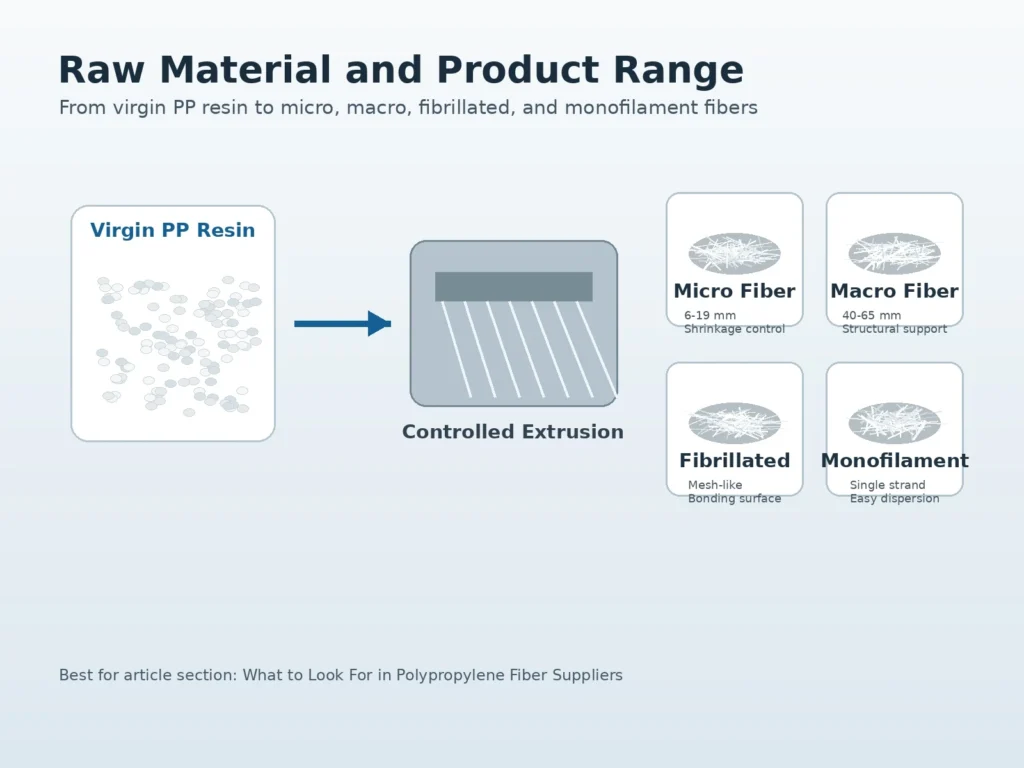
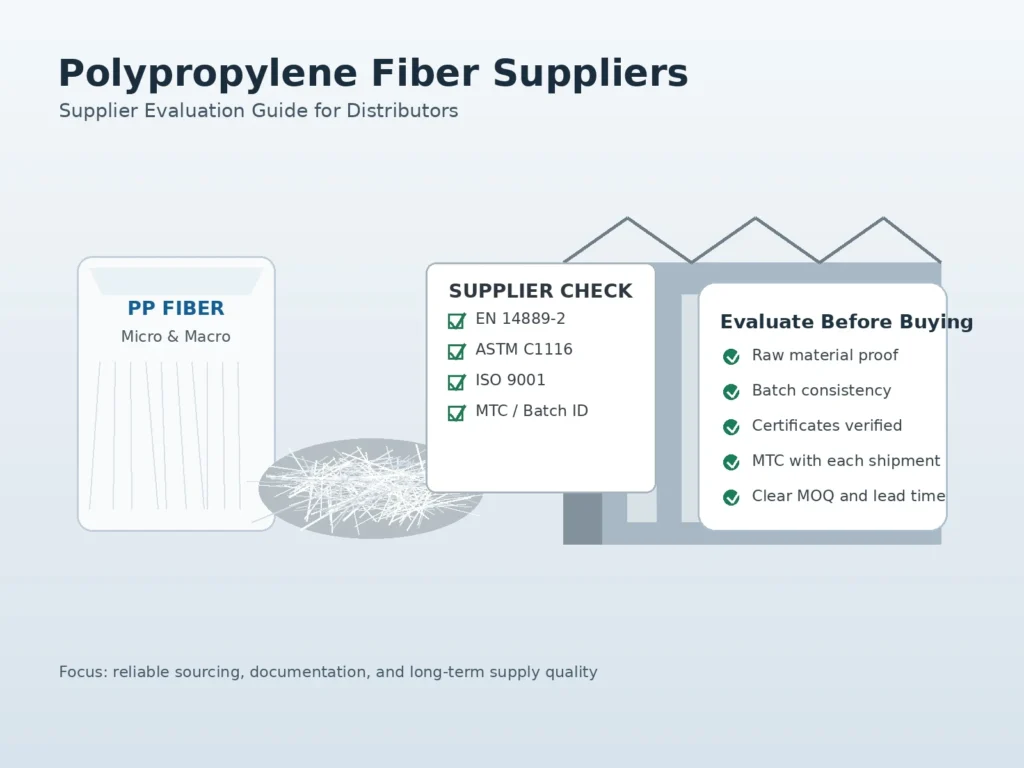
A mill test certificate (MTC) is a document that accompanies each batch of fiber. It proves the product meets specification. Every reputable supplier provides one.
What a proper MTC includes:
- Tensile strength (MPa)
- Denier or diameter (microns or mm)
- Length (mm)
- Material composition (virgin PP grade)
- Batch number and production date
- Test date and testing laboratory
Per-batch documentation is essential. If a supplier offers “sample approval” but can’t provide MTCs for every shipment, that’s a problem. The sample you approved may not match the bulk order you receive.
Keep MTCs on file. If a customer has a quality issue, you’ll need them. If there’s a project dispute, you’ll need them. They’re your proof that the product met specification when it left the factory.
Third-Party Testing — When to Request It
Mill test certificates come from the supplier’s own lab. For critical applications or first orders from a new supplier, independent third-party testing adds credibility.
Request third-party testing when:
- You’re placing your first order with a new supplier
- The project has strict performance requirements
- The customer requires independent verification
- You’re qualifying a supplier for a long-term contract
What to test:
- Tensile strength (per EN 14889-2 or ASTM D3822)
- Melt flow index (raw material consistency)
- Alkali resistance (performance in concrete’s high-pH environment)
- Length and diameter distribution
Use an accredited laboratory — SGS, Bureau Veritas, Intertek, or a national testing institute. The cost is typically $200–500 per test suite. For orders worth thousands of dollars, this is cheap insurance.
Consistency Across Shipments (The Real Test)
Sample quality is easy. Shipment quality is hard. The real test of a supplier is whether the fifth shipment matches the first.
Track test results across multiple orders. Keep a spreadsheet of tensile strength, denier, and length measurements. Look for trends. If measurements drift over time, the supplier’s process is not under control.
What to do when a batch falls out of spec:
- Stop shipment acceptance
- Request the supplier’s internal test data for that batch
- Send samples for independent testing
- Document everything
- Negotiate replacement or credit
- Decide whether to continue the relationship
Ecocretefiber™ provides mill test certificates with every shipment and supports third-party verification for key accounts. This is the standard you should hold all suppliers to.
Sourcing from China: What Importers Need to Know
MOQ, Lead Times, and Container Planning
Chinese polypropylene fiber manufacturers typically set minimum order quantities (MOQ) between 5 and 15 metric tons. Some offer smaller trial quantities for new customers, but standard pricing kicks in at the MOQ threshold.
Production lead time is usually 15–20 working days after order confirmation and deposit. Add 25–35 days for ocean freight to the US West Coast, 30–40 days to Europe. Total time from order to delivery: 6–8 weeks.
PP fiber is lighter than steel fiber, roughly 0.91 g/cm³ vs. 7.85 g/cm³. Volume, not weight, is often the constraint in container loading. A 20-foot container holds about 20–25 metric tons of PP fiber by weight, but you may run out of space before you hit the weight limit.
Plan your ordering around container optimization. Ordering 18 tons when a container holds 22 means you’re paying for shipping capacity you don’t use. Consolidate orders. Coordinate with your supplier on production scheduling.
FOB vs. CIF vs. DDP — Which Incoterm Works for You
FOB (Free On Board): The supplier delivers goods to the port and loads them on the vessel. You arrange and pay for ocean freight, insurance, and destination handling. FOB gives you control over shipping costs and carrier selection. It’s the standard for experienced importers.
CIF (Cost, Insurance, Freight): The supplier arranges ocean freight and insurance to your destination port. You pay a bundled price. CIF is convenient but often more expensive — suppliers may use their preferred freight forwarder at rates you can’t verify.
DDP (Delivered Duty Paid): The supplier handles everything — freight, insurance, customs clearance, duties, delivery to your door. Most convenient. Most expensive. Best for importers who want minimal logistics involvement.
Recommendation: Use FOB if you have logistics experience and want cost control. Use DDP if you’re new to importing and want simplicity. Avoid CIF unless you trust the supplier’s freight arrangements.
Common Pitfalls When Importing PP Fiber
Moisture damage: PP fiber is hydrophobic — it doesn’t absorb water. But the packaging does. Cardboard boxes and paper bags can get wet during transit, leading to mold and degradation. Specify waterproof packaging for ocean shipments.
Customs classification errors: PP fiber can be classified under multiple HS codes depending on form and end use. The most common are 5503.20 (synthetic staple fibers) and 5506.10 (synthetic filament yarn). Wrong classification leads to delays and potential duty disputes.
Underdeclared quantities: Some suppliers under-declare container contents to reduce duties. This is fraud. If customs discovers it, your shipment gets seized. Always verify that declared quantities match actual quantities.
For more on distributor-specific sourcing considerations, see our polypropylene fiber distributor’s guide.
Pricing: What Drives Cost and How to Protect Your Margins
Raw Material (PP Resin) Price Index
Polypropylene resin is a petrochemical product. Its price tracks crude oil and natural gas markets. When oil prices rise, PP resin follows. When oil falls, resin prices drop, usually with a 30–45 day lag.
Virgin PP resin typically trades between 1,000and1,000和1,600 per metric ton, depending on grade and market conditions. You can track prices through ICIS, Platts, or local petrochemical indices.
For distributors, this means fiber pricing is not static. A quote valid for 30 days may not hold for 90. Suppliers adjust prices when resin costs move significantly. Build this volatility into your pricing strategy.
How Fiber Type and Length Affect Pricing
Micro fiber (6–19 mm) has the lowest cost per kilogram but the highest cost per dose. You need more kilograms per cubic meter of concrete to achieve crack control. Typical dosage: 0.6–0.9 kg/m³.
Macro fiber (40–65 mm) costs more per kilogram but requires lower dosage. Typical dosage: 3–6 kg/m³. The total material cost per cubic meter may be similar to micro fiber, but the performance is different.
Fibrillated vs. monofilament: Fibrillated fiber requires different extrusion equipment and post-processing. It typically costs 10–20% more than equivalent monofilament fiber.
Custom lengths and blends: Any deviation from standard specifications carries a premium. If you need 33 mm instead of 30 mm, or a specific blend ratio, expect to pay more and order larger quantities.
Volume Tiers and Negotiation Leverage
Manufacturer pricing follows volume tiers:
- Trial orders: 1–5 metric tons. Highest per-kilogram price. Standard for new relationships.
- Standard orders: 5–20 metric tons. Standard pricing. Most common tier.
- Volume commitments: 20+ metric tons per quarter or annual contracts. 5–15% discount vs. spot pricing.
Annual supply agreements offer the best pricing but require volume commitments. Don’t commit to quantities you can’t sell. It’s better to pay slightly more per kilogram than to hold inventory you can’t move.
Payment terms are also negotiable. Suppliers prefer wire transfer (TT) in advance. Experienced buyers negotiate 30% deposit, 70% against bill of lading. Letter of credit (LC) offers security but adds cost — typically $200–500 per transaction plus bank fees.
The cheapest price is rarely the best deal. A supplier offering 20% below market is cutting corners somewhere: material quality, consistency, or documentation. You get what you pay for, and your customers will notice.
Red Flags: When to Walk Away from a Supplier
No Certifications or “Pending” Claims
A supplier who claims certification “in progress” for more than six months is either disorganized or dishonest. Real certification takes time, but it doesn’t take forever.
Suppliers who show you ISO 9001 certificates but can’t produce EN 14889-2 or ASTM documentation are selling uncertified product. ISO 9001 is not a substitute for product-specific testing.
Self-certification without third-party audit is worthless. Anyone can print a certificate. What matters is verification by an accredited body.
Prices Far Below Market
If a supplier’s price is 30–50% below competitors, something is wrong. Possible explanations:
- Recycled material sold as virgin
- Incorrect specifications (shorter fiber, lower tensile strength)
- Short weight (you receive less than you paid for)
- No quality control or batch testing
You get what you pay for. Your customers expect consistent, certified fiber. Saving 20% on material cost doesn’t help if the product fails on the jobsite and you have to replace it. Or worse, face a liability claim.
Inconsistent Specs Between Samples and Bulk Orders
This is the classic bait-and-switch. The sample you test is perfect. The bulk shipment is different. Tensile strength is lower. Length distribution is wider. The fiber doesn’t perform the same way in concrete.
Prevent this by testing every shipment, not just the sample. Keep samples from approved batches. Compare new shipments against the standard. If you catch inconsistency, document it and demand corrective action. If it happens twice, find a new supplier.
No Traceability or Batch Records
A supplier who can’t tell you which batch your order came from has no quality system. Among polypropylene fiber suppliers, this is the most dangerous warning sign. They can’t trace problems. They can’t recall defective product. They can’t prove consistency.
Every package should have a lot number. Every lot should have test records. Every shipment should have a mill test certificate. If these are missing, you’re buying from a trader, not a manufacturer. You have no idea what you’re actually getting.
Polypropylene vs. 钢纤维: Supplier Strategy
Why Distributors Source Both
Polypropylene fiber and steel fiber serve different markets but often the same customers. A contractor who buys PP fiber for crack control may also need steel fiber for structural reinforcement. A precast manufacturer who uses macro PP fiber for thin sections may use steel fiber for heavy-duty elements.
Sourcing both from the same supplier simplifies your supply chain:
- One relationship to manage
- One quality system to audit
- Consolidated shipping and container optimization
- Unified documentation and certification
Hybrid fiber concrete (blends of PP and steel) is a growing specification. Engineers specify both fiber types in the same mix to get crack control and structural performance together. If you can supply both, you capture that market.
Cross-Selling from One Fiber Category to the Other
The cross-selling opportunity is real:
- A customer calls about PP fiber for a warehouse floor. Ask about their structural reinforcement needs. Offer steel fiber for the heavy-duty areas.
- A customer orders steel fiber for a tunnel lining. Ask about crack control for the surface finish. Offer micro PP fiber.
Steel fiber has higher per-kilogram margins but lower volume. PP fiber has lower margins but higher volume and repeat orders. Carrying both balances your product mix.
Learn about steel fiber options in our guide to the different types of steel fiber. For more on PP fiber applications, see polypropylene fiber reinforced concrete.
常见问题
How do I find reliable polypropylene fiber suppliers? Start with trade shows, industry associations, and referrals from other distributors. Verify certifications before requesting samples. Test samples independently. Place a small trial order before committing to volume.
What’s the difference between virgin and recycled PP fiber? Virgin PP fiber is made from fresh petrochemical feedstock with consistent properties. Recycled PP fiber uses post-industrial or post-consumer waste with variable performance. Virgin fiber is required for certified applications. Recycled fiber is cheaper but inconsistent.
What certifications should I require? For EU/UK markets: EN 14889-2 with CE marking. For US markets: ASTM C1116 compliance. ISO 9001 is table stakes but doesn’t prove product performance. Always verify certificates with the issuing body.
What’s the typical MOQ for PP fiber from Chinese manufacturers? 5–15 metric tons is standard. Some suppliers offer smaller trial quantities at premium pricing. Container optimization usually makes 20-ton orders most cost-effective.
How can I test fiber quality on arrival? Request mill test certificates for every shipment. Keep samples from approved batches. Measure tensile strength, length, and diameter. Send samples to an independent lab for critical applications.
Can one supplier provide both PP and steel fiber? Yes. Some manufacturers produce both fiber types. Sourcing from a single supplier simplifies logistics, consolidates documentation, and enables cross-selling opportunities.
结论
Choosing the right polypropylene fiber supplier is a business decision, not just a purchasing decision. The cheapest price often costs more in the long run through inconsistency, failed certifications, and customer complaints.
Focus on what matters: virgin raw materials, consistent manufacturing, proper certifications, and complete documentation. Verify claims. Test shipments. Track performance over time. Hold suppliers to the same standard you hold yourself.
Ecocretefiber™ manufactures polypropylene fiber and steel fiber for concrete reinforcement. Every shipment includes mill test certificates and full certification documentation. 山东建邦化纤有限公司. operates under ISO 9001 quality management with EN 14889-2 and ASTM C1116 compliant products. Contact us for samples, certification documents, or pricing.