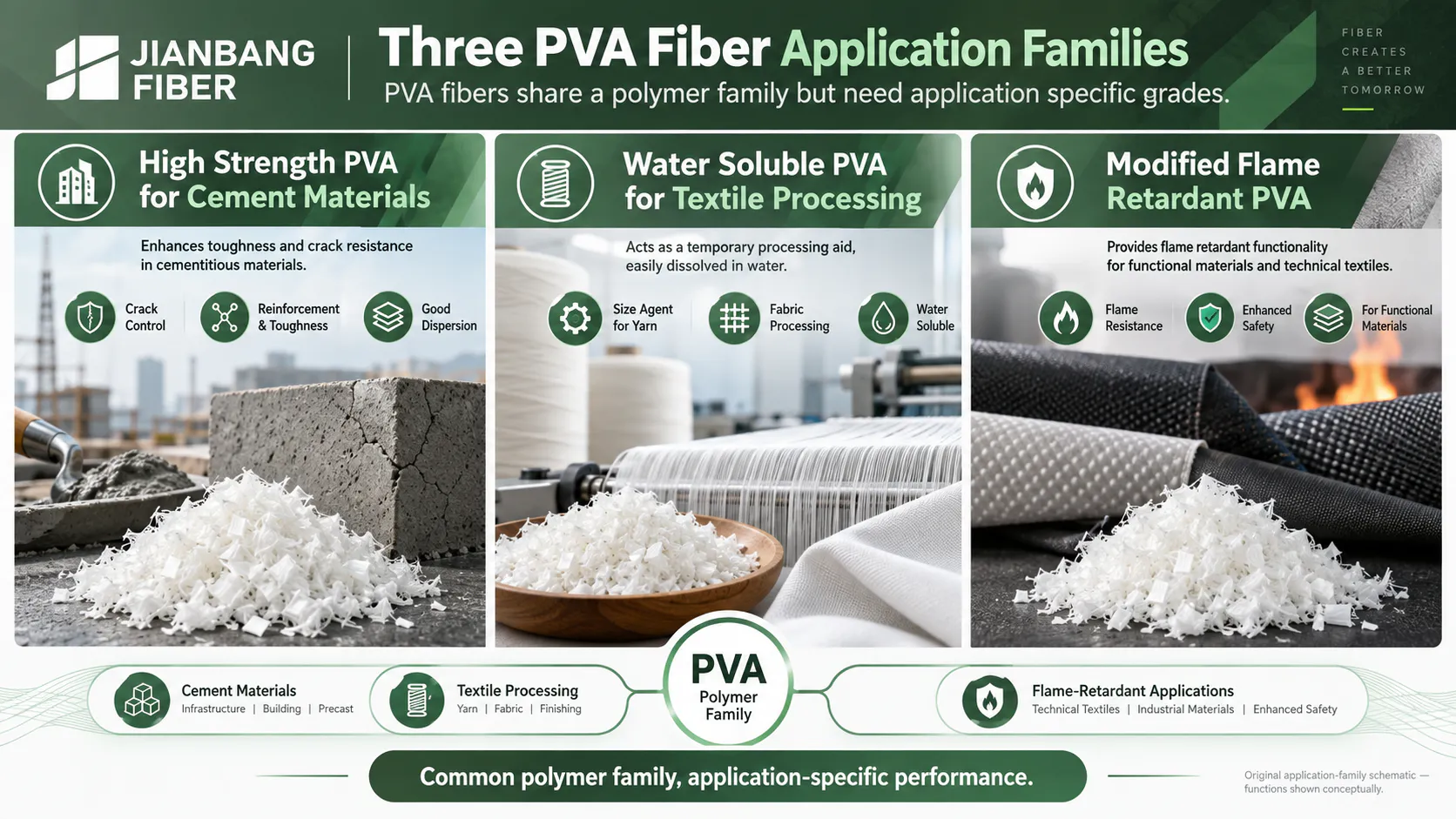
Polyvinyl alcohol, or PVA, is a useful example of why a polymer name alone cannot define a fiber specification. One PVA fiber is drawn for strength and remains in a cement composite to bridge cracks. Another is designed to dissolve during textile processing. A third is modified for a flame retardant textile application. These grades can share a chemical starting point while serving entirely different jobs.
For a concrete producer, the useful question is specific: which PVA grade, at what dosage, in which binder and process, delivers the measured crack response and durability required by the project? At Shandong Jianbang Chemical Fiber Co., Ltd., we use that question to guide selection of our Ecocretefiber™ PVA fiber and the trial program around it. This guide connects the manufacturing and application research behind PVA with decisions a mortar, precast, or concrete buyer can make today.
One Polymer, Three Different Fiber Families
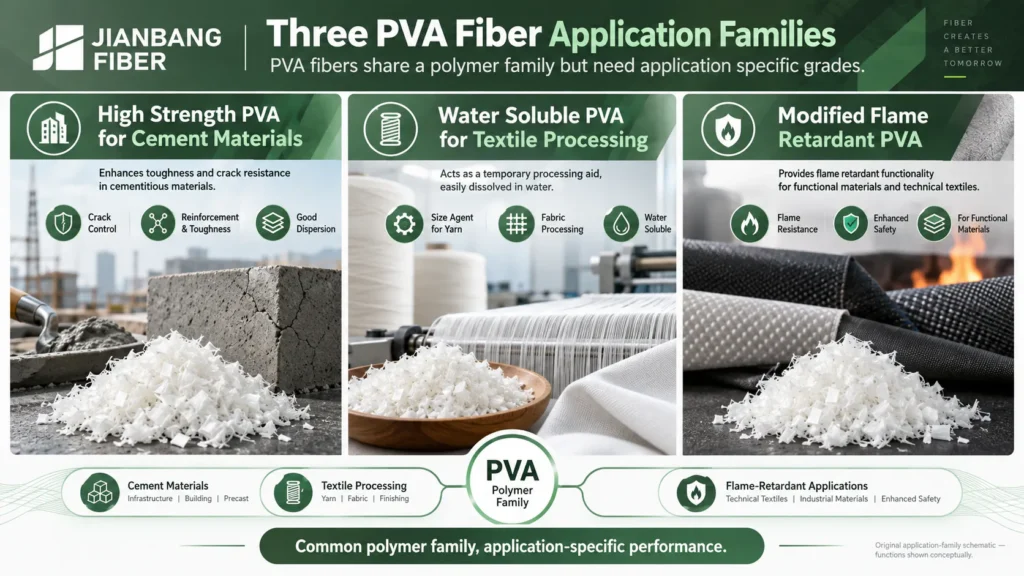
PVA contains hydroxyl groups that influence its affinity for water and for many mineral surfaces. Processing can change its molecular orientation, crystallinity, surface, and behavior in use. The resulting fibers should be specified by grade and function, not by the words “PVA fiber” alone.
| Fiber family | Intended role | Selection warning |
| High strength, high modulus PVA | Remain in a cement or polymer composite and transfer load across small cracks | Confirm wet and alkaline stability, dimensions, dispersion, and composite test results for the selected grade |
| Water soluble PVA | Temporary yarn, carrier, or sacrificial fiber in textiles and nonwovens | Its controlled dissolution is a feature in processing and a potential failure mode for permanent reinforcement |
| Flame retardant modified PVA | Textile or other specifically formulated products with fire behavior requirements | Do not assign a flame rating to an ordinary construction fiber from its polymer name |
This distinction is visible in commercial product families as well. Kuraray describes separate PVA fiber grades for industrial reinforcement, water soluble processing, and flame retardant uses. A cement grade must be qualified for its own intended exposure; “PVA can dissolve in water” is too broad a claim, and “PVA never dissolves” is equally unreliable.
How Processing Builds High Strength PVA Fiber
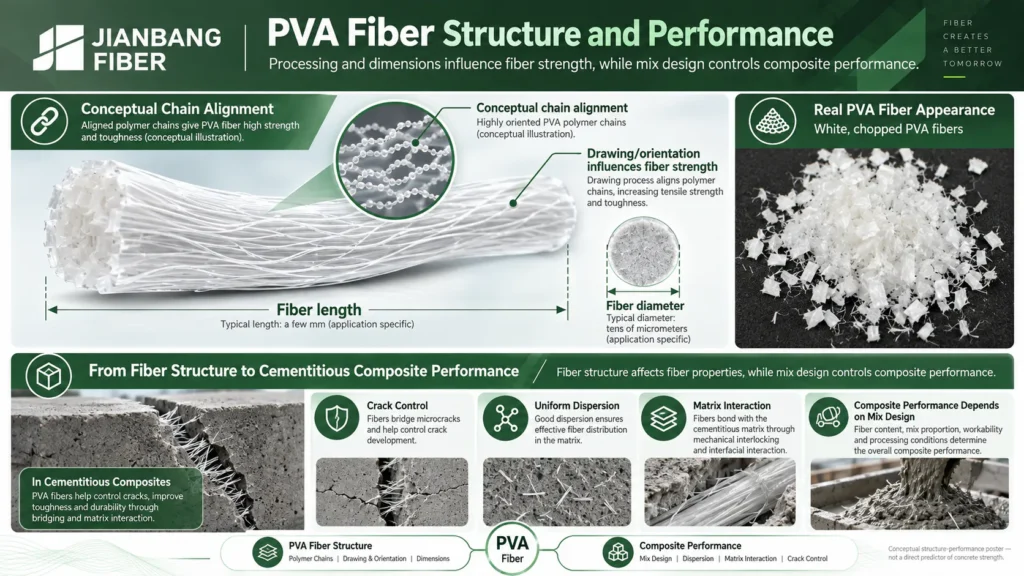
Fiber strength depends in part on how many polymer chains can carry load along the filament. Higher molecular weight, more uniform chain orientation, and suitable crystallinity can help. A spinning process first forms a filament; subsequent drawing and heat treatment can align chains and develop the structure needed for a higher strength, higher modulus product.
Researchers have investigated wet spinning, gel spinning, phase separation, crosslinking, and other routes. The manufacturing route matters because it affects fiber uniformity, drawability, diameter, tensile behavior, and cost. Yet a high single fiber tensile number does not establish what a cement beam will do after cracking. The matrix, interface, orientation, distribution, and fiber length all influence the composite result.
Kami Ecocretefiber™ PVA product page lists a tensile strength of at least 1,200 MPa, modulus of at least 30 GPa, approximate equivalent diameter of 13 ± 3 micrometers, and standard cut lengths of 4, 6, and 12 mm for its listed grade. These are product specifications and selection inputs. They are not a promise of any particular concrete tensile strain, residual beam load, or service life. Request the current data sheet and confirm the grade and test method for a purchase specification.
Why the Cement Interface Needs Balance
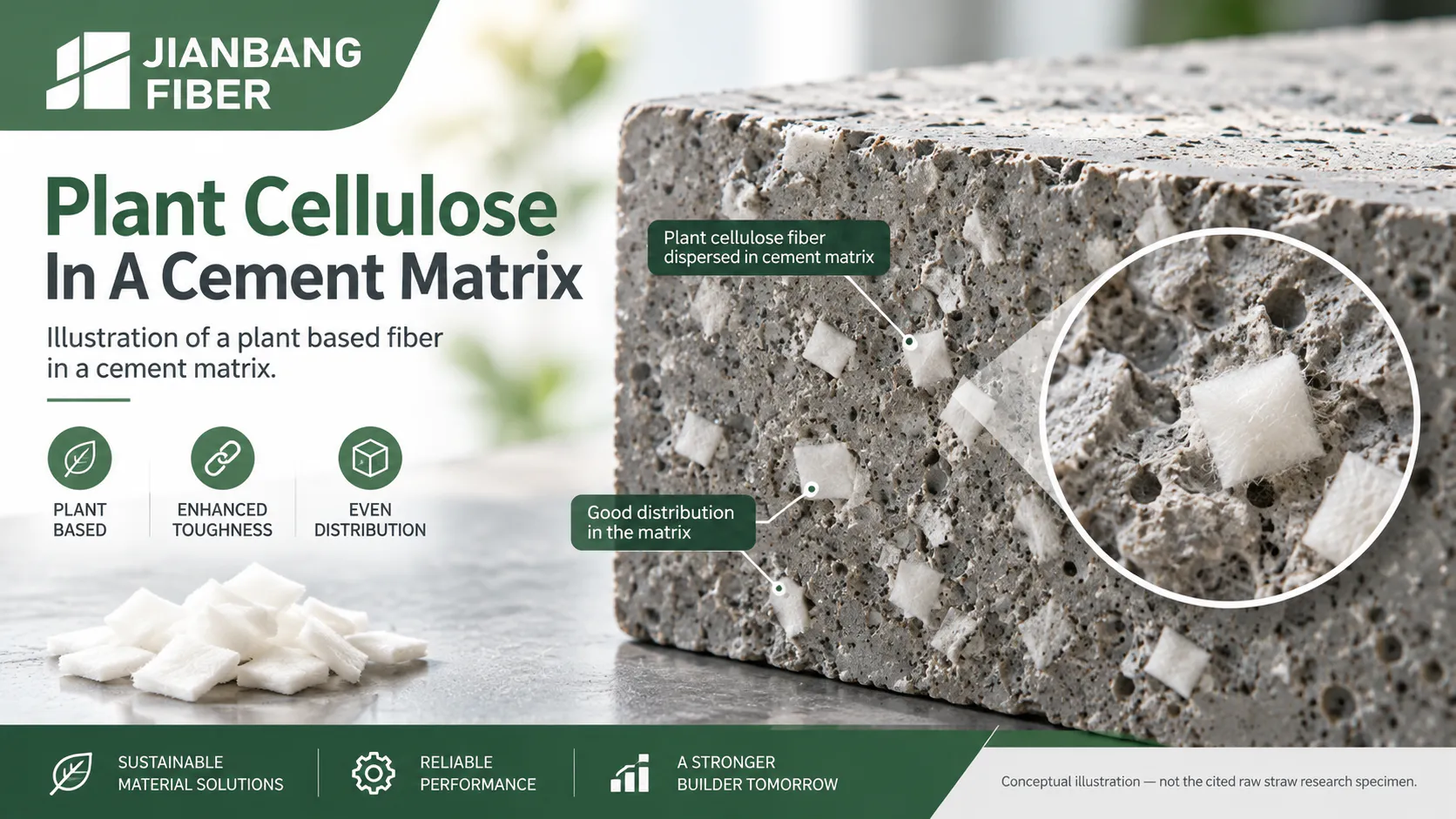
A fiber can bridge a crack only if the surrounding paste transfers force into it. PVA’s surface affinity can improve contact with cementitious materials, and short fibers can distribute through mortar or concrete when the feed and mixing process are controlled. This helps explain the interest in PVA for crack control, impact resistance, thin panels, and engineered composites.
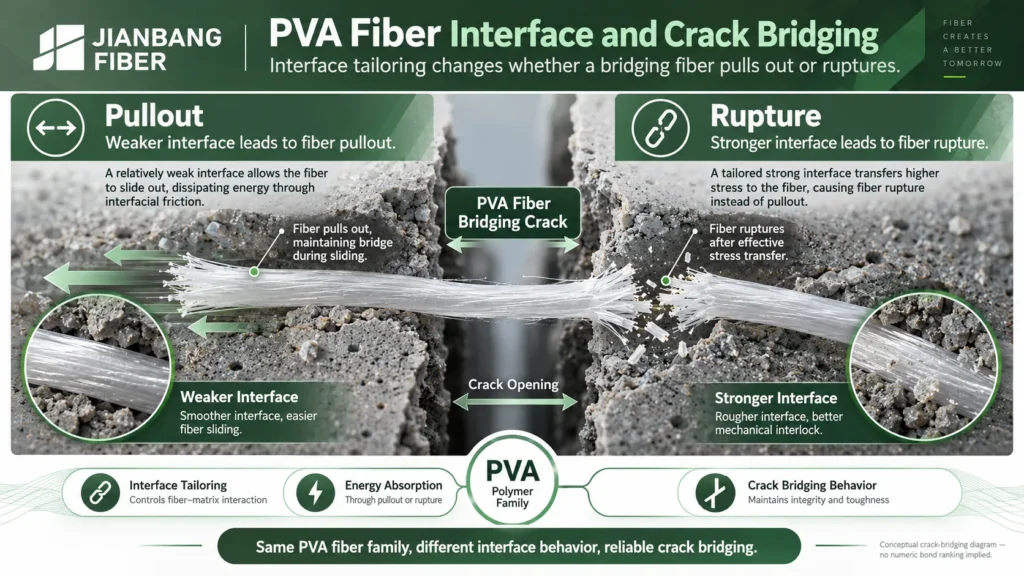
The bond can also be too strong for a particular design. If a high strength PVA filament snaps across a crack before useful slip occurs, the composite may lose the multiple cracking behavior sought in an engineered cementitious composite, or ECC. Researchers have tailored the PVA surface, including controlled oiling, to adjust the balance between chemical adhesion, friction, fiber pullout, and rupture. The original interface tailoring research summarized by the American Concrete Institute demonstrates why fiber surface treatment and matrix design belong in the same qualification program.
More bond is therefore not a universal performance target. A patch mortar designed to restrain fine early cracks, a thin precast element designed for residual flexural load, and an ECC designed to form many tight tensile cracks may need different fiber and interface choices. The specification should describe the required composite behavior, then test candidate fibers in that exact binder.
Where PVA Can Fit in Cement Products
PVA fibers are considered in mortars, renders, grouts, concrete, precast panels, dan fiber cement products. A short, fine fiber may help distribute small cracks and improve cohesion if it remains well dispersed. A designed cement composite with a higher fiber content can provide a different post crack response. Neither outcome follows automatically from adding any PVA grade.
For conventional mortar, grout, or concrete, start with the supplier’s application range and a control mix. Our product page gives illustrative mass dosing windows of 0,6-1,0 kg/m³ for mortar or grout and 0,6-1,9 kg/m³ for concrete. These are starting ranges for the listed grade, not a universal optimum. Aggregate size, mixing equipment, paste content, admixtures, placement, finishing, and performance requirements can change the suitable amount. Do not substitute the numbers into a project specification without trial results.
For a fiber cement sheet or thin panel, examine fiber retention and distribution across the finished section, bending response, moisture exposure, and the chosen manufacturing route. An historical claim that PVA can replace another reinforcement by a fixed mass ratio cannot establish equivalence. Different fibers have different density, geometry, bond, and post crack response. Likewise, a possible reduction in permeability or reinforcement corrosion cannot be promised from fiber selection alone; the complete concrete design and exposure still govern those outcomes.
Conventional PVA Fiber Concrete and ECC Are Different Designs
A low mass dose for kontrol retak and a purpose designed ECC recipe may both contain PVA, but they use different performance targets. ECC seeks distributed tensile cracking and strain hardening through the combined selection of matrix, fiber, and interface. A mix with a little PVA added to ordinary concrete should not be marketed as ECC merely because both use the same polymer.
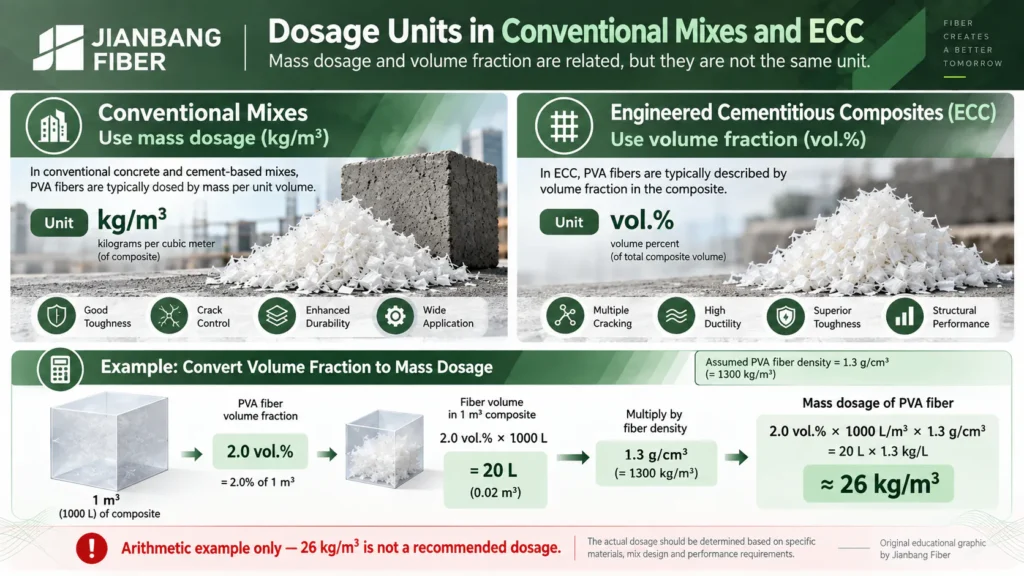
ECC studies often express fiber content as volume percent. Conventional ready mix quotations usually state kilograms per cubic meter. These units cannot be compared directly without fiber density. For illustration, a 2.0% fiber volume fraction and an assumed PVA density of 1.3 g/cm³ correspond to about 26 kg/m³ of fiber: 0.02 × 1,000 L/m³ × 1.3 kg/L. That is an arithmetic example, not a recommendation for our product or a suitable ECC recipe. The actual density and design target must be verified.
A beam test provides valuable information about flexural strength and residual response, but it does not by itself prove uniaxial tensile strain hardening. If ECC behavior is the purchase requirement, request direct tension results with a defined specimen, curing regime, matrix, fiber grade, and crack measurement procedure. Also check workability and production repeatability at the intended batch size. Small laboratory batches can hide feeding and dispersion problems that emerge at plant scale.
Water Soluble PVA Has a Different Job
A water soluble PVA fiber can serve as a temporary processing aid. Manufacturers tailor grades to dissolve at specified temperatures, enabling removable yarns and supports in textiles or nonwovens. This can create soft, low twist fabrics or open structures after the sacrificial component is washed out. The dissolution point is a deliberate design feature.
A permanent cement reinforcement needs a different qualification: it must retain the intended fiber integrity in the mixing water, pore solution, curing process, and expected service conditions. Do not purchase an unspecified “PVA fiber” for concrete on the assumption that textile grade water solubility is harmless. Ask the supplier for the construction grade, processing history, water stability, alkali resistance method, and retained properties after relevant exposure. A long term durability claim needs a suitable test program for the actual application.
This is also why descriptions of PVA as simply “water resistant” or “water soluble” can confuse procurement. Formulation and manufacturing set the behavior. The right question is what the particular delivered fiber does under the temperatures, moisture, alkalinity, and time scale relevant to the project.
Flame Retardant PVA Is a Separate Formulation
Flame retardant PVA families have been developed through grafting, blending, additives, or textile finishing. Their performance depends on composition and the test used. A standard PVA construction fiber should not inherit a flame retardant label from those specialized products.
Fire performance of a concrete element is a system property. Aggregate, binder, moisture, section thickness, reinforcement, exposure curve, and test method all matter. Fibers may have different roles in fire exposed concrete, but they do not independently give a structure a fire resistance rating. If a project has a fire requirement, specify the assembly and the appropriate fire test instead of inferring an outcome from the word “PVA.”
What New PVA Research Means for Selection
PVA research extends well beyond ordinary concrete reinforcement. Surface chemistry can tune bonding. Electrospinning can form very fine fibers for functional materials. Blending, grafting, or other modifications can target absorbency, ion exchange, filtration, or flame behavior. These developments show how much performance can change within one polymer family.
For cement buyers, the most useful lesson is practical: an advanced fiber description must be translated into a measurable product and composite requirement. Ask which treatment was used, whether it survives mixing, how it changes the fresh mix, and which test verifies its claimed effect. A laboratory result from an ultrafine membrane or textile coating does not qualify a short cut fiber for cement. Conversely, a construction fiber’s strength does not qualify it for a filtration or sacrificial textile process.
The publication history behind PVA also illustrates how to read older claims. Early industrial reports documented promising uses and production routes, but numbers from a particular fiber, binder, or test should remain attached to that system. Current purchase decisions should use current product specifications and project relevant tests. That keeps useful research insights while avoiding a misleading universal dosage or performance claim.
A Practical Grade and Trial Checklist
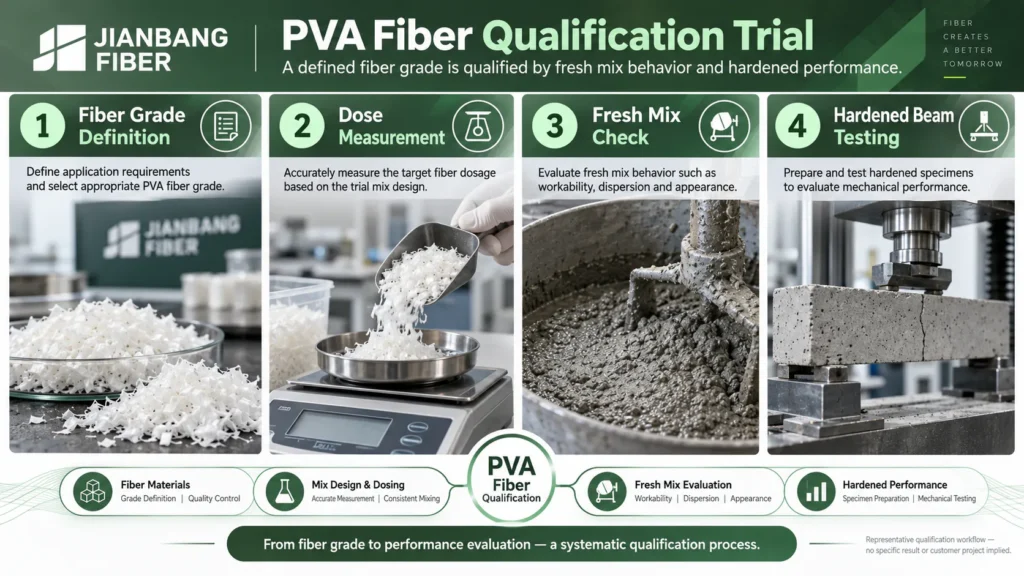
Start by naming the function: control early small cracks, improve a measured residual flexural response, make a thin panel, or develop an ECC with tensile strain hardening. Then agree on the test criteria before selecting a fiber. A supplier specification describes the input; the trial proves the output.
| Item to specify | Mengapa hal ini penting | Bukti yang perlu diminta |
| Grade and water stability | Separates permanent reinforcement from soluble processing fiber | Current data sheet and wet or alkaline exposure evidence relevant to the binder |
| Length, diameter, and surface treatment | Affect distribution, bond, pullout, and fiber count | Lot specification and stated dimensional or finish tolerances |
| Mass or volume dosage | Avoids false comparisons between conventional mixes and ECC | Unit, density, conversion, and a defined trial range |
| Fresh mix process | Clusters, flow loss, and finishability can defeat the design | Feed order, mixing time, flow or slump, air, and photographs of dispersion |
| Hardened performance | Peak strength alone does not describe post crack behavior | Control comparison, residual beam test, and direct tension where required |
| Durability and production | Exposure and scale can change a laboratory result | Retained properties after relevant ageing and a plant trial |
ASTM C1116/C1116M-23 classifies synthetic beton bertulang serat, including PVA under its synthetic fiber category, and addresses requirements such as uniform mixing and freedom from fiber balls. Listing that standard in a plan does not establish automatic compliance for a product or a batch. For specified flexural residual performance, ASTM C1609/C1609M-24 provides a third point loading beam method with load and deflection measurements. Choose specimen size and acceptance criteria with the project engineer.
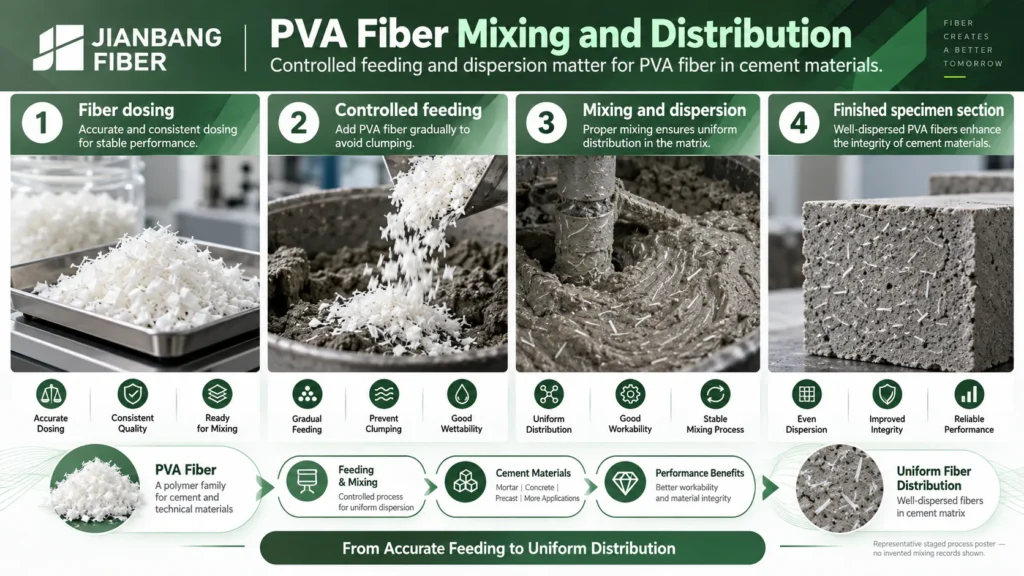
Run side by side mixes with identical binder, water, admixture, aggregate, curing, and test age. Add fiber at a controlled point in the mixing sequence, observe distribution and flow, and avoid adding water merely to recover an attractive slump. Test the selected doses against the control. Review fracture surfaces for pullout, rupture, clustering, and voids. Repeat the preferred recipe at the intended production scale before locking in a purchasing specification.
Pertanyaan yang Sering Diajukan
Is Every PVA Fiber Water Soluble
No. PVA product families are engineered for different dissolution and service behaviors. Ask for the delivered grade’s water stability under the intended exposure. A water soluble textile fiber and a permanent cement reinforcing fiber have different jobs.
Will PVA Fiber Make Ordinary Concrete an ECC
No. ECC requires an intentionally designed matrix, fiber, and interface, followed by direct tensile evidence of the target behavior. A conventional low dose PVA mix may have useful crack control without exhibiting tensile strain hardening.
Is a Higher Single Fiber Tensile Strength Always Better
Not by itself. Fiber strength matters, but length, dispersion, bond, pullout, matrix strength, and crack opening also matter. An overly strong bond can cause rupture when controlled pullout is needed. Specify the composite performance measure that matters to the job.
Can the Same PVA Dosage Be Used in Mortar and Concrete
Do not assume so. Aggregate grading, paste volume, mixer energy, placement, and performance targets differ. Treat the supplier’s windows as starting points and qualify each mix with its own controls and acceptance tests.
Does PVA Fiber Give Concrete a Fire Rating or Prevent Corrosion
No such rating or corrosion guarantee follows from a fiber name. Fire resistance and corrosion risk depend on the full concrete or assembly design, exposure, and relevant testing. Specialized flame retardant PVA textile products are separate formulations.
Kesimpulan
PVA is a family of engineered fibers, not a single interchangeable ingredient. High strength grades can be valuable in cement products when dimensions, surface, dosage, mix design, and test method work together. Water soluble grades perform a different temporary role, and flame retardant grades require their own formulation and qualification. The strongest specification links a defined fiber grade to a measured result in the actual product.
Shandong Jianbang Chemical Fiber Co., Ltd. can help you evaluate an Ecocretefiber™ PVA grade for mortar, concrete, or precast trials. Hubungi tim kami with your binder, target application, mixing process, and required performance so we can discuss a practical sample and test plan.