Why These Three Terms Cause Confusion
Fiber, cellulose, and cellulose ether sound closely related, but they describe different materials.
The confusion is especially common in construction materials. A mortar producer may call HEMC or HPMC “cellulose.” A concrete supplier may talk about cellulose fiber. A coating formulator may ask for HEC. These products share a connection with plant-based cellulose, but their physical form and technical function are not the same.
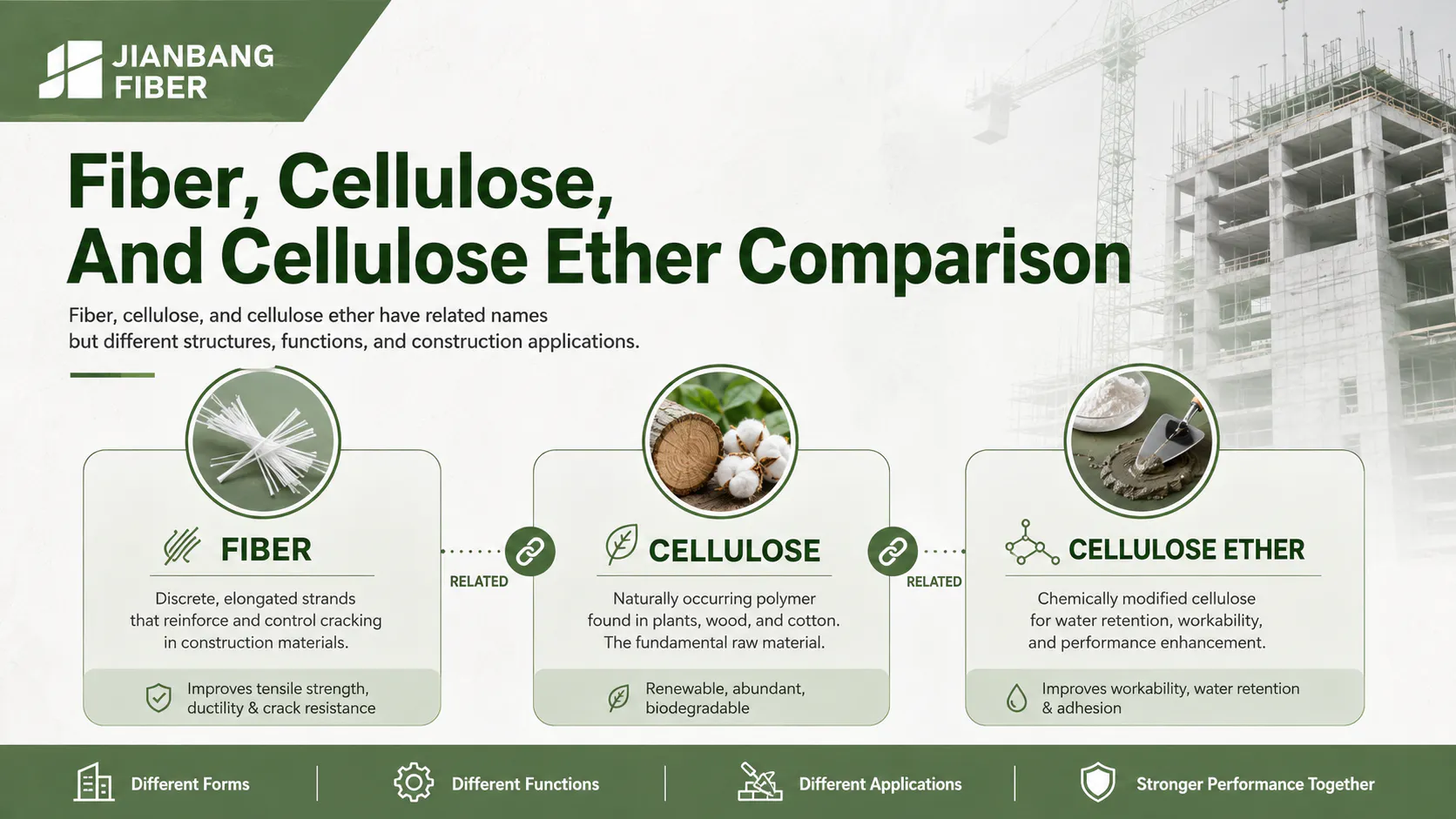
Fiber is a broad material category. Cellulose is a natural polymer found in plant structures. Cellulose ether is a chemically modified cellulose derivative that changes the flow and water behaviour of a formulation.
This distinction matters because the wrong material cannot solve the right problem.
A concrete crack-control fiber cannot replace a cellulose ether in tile adhesive. A cellulose ether cannot provide the same post-crack reinforcement as steel, polypropylene, basalt, or cellulose fiber. Natural cellulose also cannot be added directly to every water-based formulation and expected to dissolve.
Shandong Jianbang Fiber finds that many purchasing mistakes begin with an unclear product name. Buyers should first identify the function they need. They can then select a physical fiber, a cellulose-based fiber, or a cellulose ether grade.
What Is Fiber?
Fiber is a general term for a material made of thin and elongated elements. Those elements may be continuous filaments or short individual strands.
Fibers can come from many sources:
- Plants
- Animals
- Synthetic polymers
- Стекло
- Basalt rock
- Carbon
- Сталь
- Cellulose pulp
The word describes the shape and structure of the material rather than one chemical composition.
In construction, fibers are normally dispersed through concrete, mortar, asphalt, plaster, or composite materials. Their elongated shape allows them to cross weak zones and developing cracks.
A fiber may restrain a microcrack before it becomes visible. Larger fibers can continue carrying stress after the cement matrix cracks. Other fibers mainly hold moisture, improve cohesion, or reduce segregation.
Shandong Jianbang Chemical Fiber supplies several construction fiber types through the Ecocretefiber™ brand. The product range includes polypropylene fiber, macro synthetic fiber, steel fiber, базальтовое волокно, ПВА-волокно, PAN fiber, AR glass fiber, and cellulose fiber.
Each one solves a different engineering problem.
Polypropylene microfiber is commonly selected for early plastic shrinkage cracking. Macro synthetic and steel fibers provide stronger post-crack reinforcement. Basalt and Стеклянные волокна AR offer mineral reinforcement for selected cement-based systems. Целлюлозное волокно provides a natural fibrous structure and can support moisture management, cohesion, and crack distribution in suitable formulations.
What Is Cellulose?
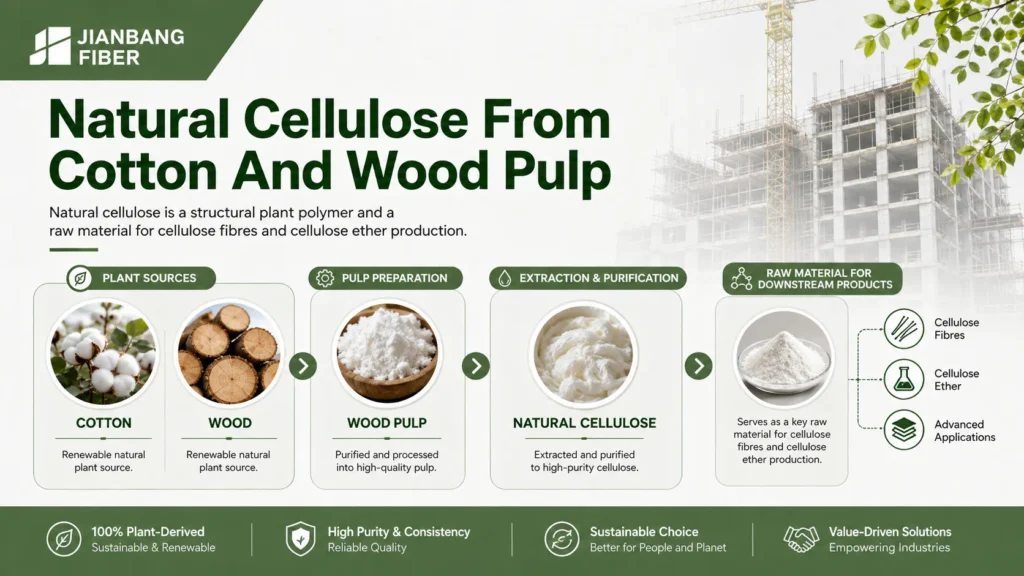
Cellulose is a natural polysaccharide. Plants use it as a key structural material in their cell walls.
Its long molecular chains contain glucose units connected through beta-1,4 glycosidic bonds. These straight chains associate closely with one another and form strong internal hydrogen-bond networks. This structure gives cellulose stiffness and makes native cellulose difficult to dissolve in water.
Cotton contains a very high percentage of cellulose. Wood also contains cellulose together with hemicellulose, lignin, and other natural components. These raw materials can be purified and processed into pulp, paper, regenerated fibers, chemical derivatives, and industrial additives.
Natural cellulose is not automatically a thickener for every aqueous formula. Its native molecular structure limits water solubility.
Chemical modification changes that behaviour. Manufacturers introduce new functional groups onto the cellulose chain. The resulting derivative may disperse, swell, or dissolve in water. Cellulose ether is one of the most important derivative families.
Cellulose And Starch Are Not The Same
Cellulose and starch are both built from glucose, but their molecular arrangements are different.
Starch mainly uses alpha glycosidic bonds. Its chains may be linear or branched. Cellulose uses beta-1,4 bonds and forms long, straight chains.
This structural difference changes the behaviour of both materials.
Starch can swell and gelatinise in hot water. Many enzymes can also break down starch relatively easily. Cellulose remains far more resistant under the same conditions.
The source article correctly highlights the alpha and beta linkage difference. However, it also includes a statement that cellulose can decompose into starch. That statement is not used here because it does not accurately describe the normal chemical relationship between the two polymers.
What Is Cellulose Ether?
Cellulose ether is made by chemically modifying cellulose.
During production, purified cellulose reacts with one or more etherifying agents. Hydroxyl groups on the cellulose chain are partly replaced by functional groups such as methyl, hydroxyethyl, hydroxypropyl, or carboxymethyl groups.
This modification changes several properties:
- Water solubility
- Hydration speed
- Thickening efficiency
- Thermal gel behaviour
- Salt tolerance
- Surface activity
- Compatibility with binders and surfactants
Cellulose ethers may be ionic or non-ionic.
CMC is an anionic cellulose ether. HEC, HEMC, and HPMC are commonly treated as non-ionic cellulose ethers.
These materials are normally supplied as white or off-white powders. When added correctly to water or a dry-mix formulation, they hydrate and change the viscosity and flow behaviour of the system.
Cellulose ethers are widely used in mortar, wall putty, tile adhesive, coatings, detergents, personal care products, oilfield fluids, inks, and many other water-based products.
How Cellulose Ether Builds Viscosity
A cellulose ether does not thicken a formula in the same way as a mineral filler.
After wetting, the polymer chains hydrate and expand in the water phase. The chains also interact and become entangled. This creates resistance to flow.
The effect changes the movement of water, pigment, filler, cement particles, latex particles, and other suspended solids.
A stable polymer network may slow sedimentation. It may also reduce bleeding and segregation. In a coating, the same rheological control affects brush feel, roller behaviour, levelling, sag resistance, and storage stability.
The final result depends on much more than the product name.
Molecular weight, substitution level, viscosity grade, particle treatment, concentration, temperature, salt content, pH, mixing energy, and formulation chemistry all influence performance.
This is why a high-viscosity grade is not always the best grade. A tile adhesive, a wall putty, a detergent, and a drilling fluid need different viscosity profiles and hydration behaviour.
Cellulose Fiber Vs Cellulose Ether
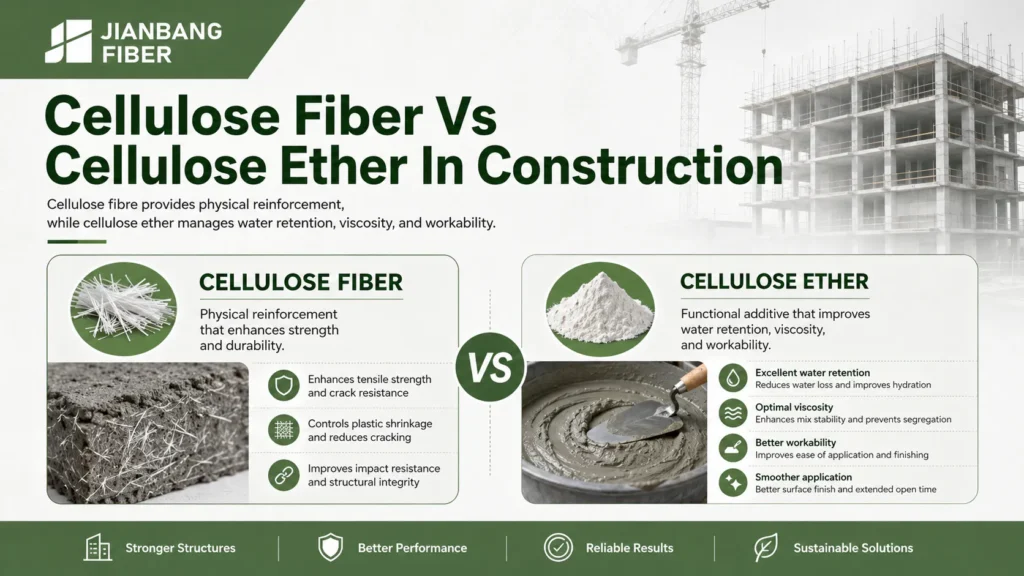
Cellulose fiber and cellulose ether come from cellulose, but their working mechanisms are different.
| Comparison | Целлюлозное волокно | Cellulose Ether |
|---|---|---|
| Physical form | Visible or microscopic short fibers | Fine polymer powder |
| Main mechanism | Physical network and fiber bridging | Hydration, dissolution, and polymer-chain entanglement |
| Main construction role | Crack distribution, cohesion, moisture management, structural reinforcement support | Water retention, viscosity control, rheology, open time, and fresh stability |
| Behaviour in water | Absorbs or holds water but normally retains fiber form | Hydrates, swells, or dissolves depending on grade |
| Типичные области применения | Concrete, mortar, asphalt, plaster, boards, reinforcement systems | Tile adhesive, wall putty, plaster, grout, waterproof mortar, coatings |
| Typical supplier | Concrete and construction fiber producer | Cellulose ether chemical manufacturer |
| Product example | Ecocretefiber™ cellulose fiber | Zhiwei HEC, HEMC, or HPMC |
A cellulose fiber remains a fiber inside the mix. The physical strands form part of the material structure.
A cellulose ether behaves as a soluble or hydratable polymer. It changes the liquid phase and fresh-state rheology.
The two products may sometimes appear in one dry-mix formula, but they cannot be exchanged on an equal-weight basis.
Why Construction Workers Often Call Cellulose Ether “Cellulose”
In dry-mix mortar markets, workers often shorten product names.
HPMC may be called “cellulose.” HEMC may also be sold under the same informal description. This wording is convenient in daily conversation, but it is technically incomplete.
The term may refer to:
- HPMC
- HEMC
- HEC
- CMC
- Another modified cellulose ether
- A physical cellulose fiber
These products do not have the same performance.
A buyer who only asks for “cellulose” may receive the wrong chemistry, viscosity, surface treatment, or application grade.
A professional request should state the full product type and the intended application. For example:
- HEMC for cement-based tile adhesive
- HEMC for exterior wall putty
- HEC for architectural latex paint
- HEC for drilling fluid
- HPMC for gypsum plaster
- Cellulose fiber for concrete or mortar
Clear names make technical communication much easier.
Main Cellulose Ether Types
CMC
Carboxymethyl Cellulose is normally supplied as sodium carboxymethyl cellulose.
CMC is water-soluble and can provide thickening, suspension, binding, film formation, and water management. The source page lists uses in ordinary interior putty, coatings, food, medicine, ceramics, printing, detergents, and many other industries.
Its ionic character affects compatibility with salts, cement, pigments, and other additives. A CMC grade used in one industry should not automatically be transferred into another formulation.
HEC
HEC means Hydroxyethyl Cellulose.
It is a non-ionic, water-soluble cellulose ether used in coatings, daily chemical products, oilfield fluids, inks, cleaners, and other water-based formulations.
Zhiwei describes HEC as a polymer that builds viscosity and controls flow. Its principal application groups are coatings, daily chemical products, and oilfield fluids.
In water-based coatings, HEC supports viscosity build, application feel, pigment suspension, and storage stability.
In personal and home care products, it helps create a stable and controlled texture.
In drilling, workover, completion, and production fluids, HEC functions as a viscosifier and fluid-control component.
HEC should not be confused with HEMC. The source webpage makes this naming error in one section.
HEMC
HEMC means Hydroxyethyl Methyl Cellulose.
HEMC is widely used in cement-based construction materials. Its combination of thickening and water-retention performance helps control the fresh mortar during mixing, spreading, trowelling, and setting.
In tile adhesive, HEMC supports water retention, open time, adjustment time, trowelling feel, slip control, adhesion, and shear strength. The final result still depends on cement, sand grading, fillers, redispersible polymer, temperature, and mixing order.
In wall putty, HEMC helps slow rapid moisture loss, stabilise the fresh mixture, improve spreading, and produce a more even applied layer.
Other applications include plaster, render, EIFS base coats, repair mortar, grout, waterproof mortar, and masonry mortar.
HPMC
Hydroxypropyl Methyl Cellulose is another common non-ionic cellulose ether.
Construction grades are used in cement- and gypsum-based formulations. HPMC can improve water retention, open time, workability, rheology, and resistance to sedimentation or bleeding.
Different HPMC grades may have different viscosity, substitution, gel temperature, dissolution, and air-entrainment behaviour. A grade intended for tile grout may not be suitable for a high-build plaster or self-levelling compound.
How Cellulose Ether Works In Tile Adhesive
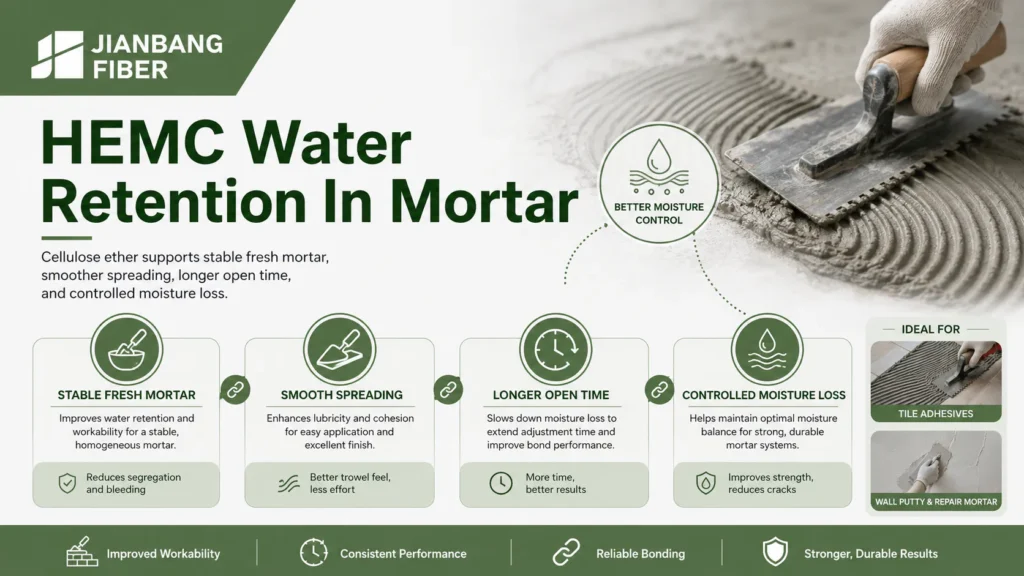
Tile adhesive must remain workable while maintaining enough body to hold the trowel ridges.
If water leaves the mortar too quickly, cement hydration and adhesive wetting may suffer. The installer may also lose the ability to adjust the tile.
HEMC or HPMC slows water movement and improves fresh-state stability. The mortar spreads more consistently across the substrate. The installer gains more time for tile placement and adjustment.
On vertical surfaces, a suitable rheology profile limits tile slip without making the mortar excessively sticky.
The cellulose ether must work with the complete formulation. Cement chemistry, aggregate grading, redispersible polymer powder, starch ether, filler, water demand, temperature, and resting time all influence the final result.
Zhiwei recommends evaluating open time, slip, adjustment time, trowelling behaviour, and adhesion instead of selecting a grade from viscosity alone.
How Cellulose Ether Works In Wall Putty
Wall putty needs smooth spreading and a clean finish.
Fast water loss creates drag during trowelling. The surface may become rough, powdery, or difficult to correct. Poor fresh stability may also lead to bleeding, separation, or uneven thickness.
HEMC helps retain water and maintain a stable consistency. The applicator can spread and scrape the putty with less resistance. The layer remains workable for surface correction.
Better fresh stability supports a more uniform finish. However, cellulose ether cannot compensate for an unsuitable binder, coarse filler, excessive water, poor substrate preparation, or an unbalanced polymer system.
Grade selection should consider interior or exterior use, filler fineness, application thickness, hand or machine application, climate, and the required surface feel.
How HEC Works In Water-Based Coatings
Water-based coatings require a controlled viscosity at several stages.
The coating must stay stable in the container. It must pour without excessive splashing. It must spread under a brush or roller. After application, the viscosity needs to recover enough to reduce sagging while still allowing the surface to level.
HEC is widely used to manage this balance.
It also supports pigment and filler suspension during storage. Surface-treated grades may hydrate more slowly, which helps avoid lumps during addition.
The Sohu article includes useful descriptions of HEC flow, spreading, anti-splash, dispersion, and storage behaviour. Zhiwei also positions HEC for architectural coatings, high-PVC paints, industrial waterborne coatings, textured coatings, and water-based inks.
Can Concrete Fiber And Cellulose Ether Work Together?
Yes, but they perform different tasks.
A fiber may control cracks or create a reinforcing network. The cellulose ether manages the fresh phase before the material hardens.
Consider a repair mortar.
Macro or micro fibers may improve crack distribution and toughness. HEMC may improve water retention and trowelling. Redispersible polymer powder may support adhesion and flexibility. A defoamer may manage unwanted air.
Each component has its own function.
The formula still needs testing because additives can interact. Higher cellulose ether viscosity may affect fiber dispersion. Excessive air can lower density. Too much water retention may change setting and early strength. Long fibers may reduce workability.
A laboratory trial should check:
- Dry blending and fiber distribution
- Water demand
- Mixing time and lump formation
- Trowelling or pumping behaviour
- Open time and setting
- Air content
- Crack behaviour
- Adhesion and mechanical performance
How To Choose The Correct Product
1. Define The Main Problem
Use cellulose ether when the main target is water retention, viscosity, open time, workability, suspension, or fresh stability.
2. Identify The Binder System
Cement, gypsum, lime, polymer dispersion, detergent surfactants, and oilfield brines respond differently to cellulose ethers.
The product grade must match the binder and liquid phase.
3. Compare Performance, Not Only Viscosity
Two products with a similar laboratory viscosity may behave differently in mortar.
Substitution chemistry, molecular weight, particle size, surface treatment, gel temperature, and air entrainment can change application performance.
4. Use A Trial Formula
A supplier recommendation is a starting point.
The producer should test the material with its own cement, sand, filler, polymer, water, temperature, and mixing equipment.
5. Request Batch Documents
TDS, SDS, COA, viscosity method, moisture, ash content, fineness, and appearance help confirm batch consistency.
Zhiwei states that its routine quality controls include viscosity, fineness, moisture, ash content, appearance, and batch COA support.
Распространенные ошибки при закупках
- Ordering “cellulose” without a full chemical name
The supplier cannot know whether the buyer needs HEC, HEMC, HPMC, CMC, or cellulose fiber. - Confusing HEC with HEMC
HEC is hydroxyethyl cellulose. HEMC is hydroxyethyl methyl cellulose. - Selecting only by viscosity
Application behaviour depends on more than one viscosity result. - Using coating-grade HEC in a construction formula without testing
The hydration, rheology, salt tolerance, and binder compatibility may not match. - Replacing cellulose fiber with cellulose ether
One retains a fibrous structure. The other modifies the aqueous phase. - Copying an online putty recipe directly
Cement, filler, climate, production equipment, and local raw materials vary. - Adding extra water when the mortar feels difficult
More water may reduce strength, adhesion, sag resistance, and surface quality. - Assuming a higher dosage always performs better
Excess cellulose ether may delay setting, increase air, or change mechanical performance.
Shandong Jianbang Fiber And Zhiwei Serve Different Needs
Shandong Jianbang Chemical Fiber Co., Ltd. focuses on physical reinforcement fibers through the Ecocretefiber™ бренд.
These fibers serve concrete, mortar, торкретирование, asphalt, precast products, floors, roads, bridges, tunnels, and other infrastructure applications.
Zhiwei (Jinan) is the cellulose ether manufacturer and supply partner referenced in this article. Its product range includes HEC, HEMC, and HPMC grades for construction materials, water-based coatings, daily chemical products, and oilfield formulations. The company also provides grade recommendations, samples, batch testing, and quality documents.
A customer who needs crack-control fiber should speak with Shandong Jianbang Fiber.
A customer who needs water retention, viscosity control, open time, or rheology adjustment should evaluate cellulose ether with Zhiwei.
Some dry-mix producers need both product families. In that case, both suppliers should understand the same application targets and testing plan.
Контрольный список для покупателя
| Вопрос | Product Direction |
|---|---|
| Do you need to control cracks after hardening? | Concrete or mortar fiber |
| Do you need higher post-crack toughness? | Steel or macro synthetic fiber |
| Do you need plastic shrinkage control? | Polypropylene microfiber or suitable cellulose fiber |
| Do you need better water retention? | HEMC or HPMC for construction systems |
| Do you need longer open time? | Construction-grade cellulose ether |
| Do you need coating viscosity control? | HEC or suitable HEMC |
| Do you need oilfield fluid viscosity? | Oilfield-grade HEC |
| Do you need a fibrous natural additive? | Целлюлозное волокно |
| Do you need a water-soluble polymer modifier? | Cellulose ether |
| Are you unsure about the grade? | Run a laboratory sample trial |
Заключение
Fiber, cellulose, and cellulose ether are connected terms, but they do not describe the same product.
Fiber refers to an elongated material form. In concrete and mortar, fibers create a physical network and help control cracks, distribute stress, or improve toughness.
Cellulose is a natural plant polymer. It provides the raw material for cellulose fibers and many chemically modified derivatives.
Cellulose ether is produced by modifying cellulose through etherification. The resulting polymer can hydrate or dissolve in water and change viscosity, water retention, workability, open time, suspension, and fresh stability.
Shandong Jianbang Fiber finds that the most important difference is the working mechanism. Fibers act mainly through physical structure and crack bridging. Cellulose ethers act mainly through water interaction and polymer rheology.
The correct choice begins with the problem that the formulation must solve.
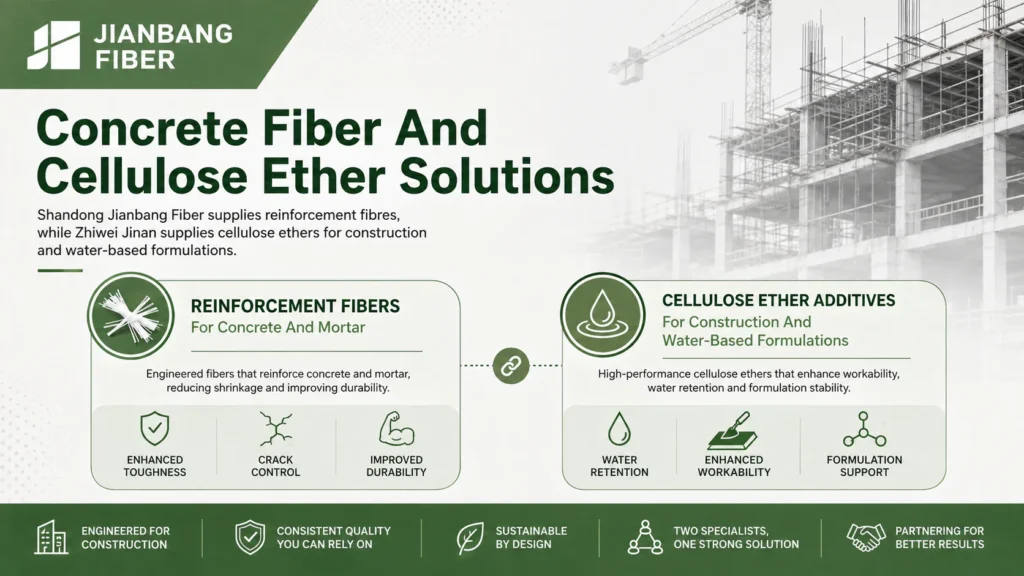
Ecocretefiber™ supplies physical reinforcement fibers for concrete, mortar, asphalt, shotcrete, and infrastructure materials.
Zhiwei (Jinan) supplies cellulose ethers for construction, coatings, daily chemical products, and oilfield formulations.
When fiber reinforcement and cellulose ether are selected for their correct roles, manufacturers can achieve better crack control, smoother application, more stable production, and more consistent finished products.