A clear definition that matches jobsite reality
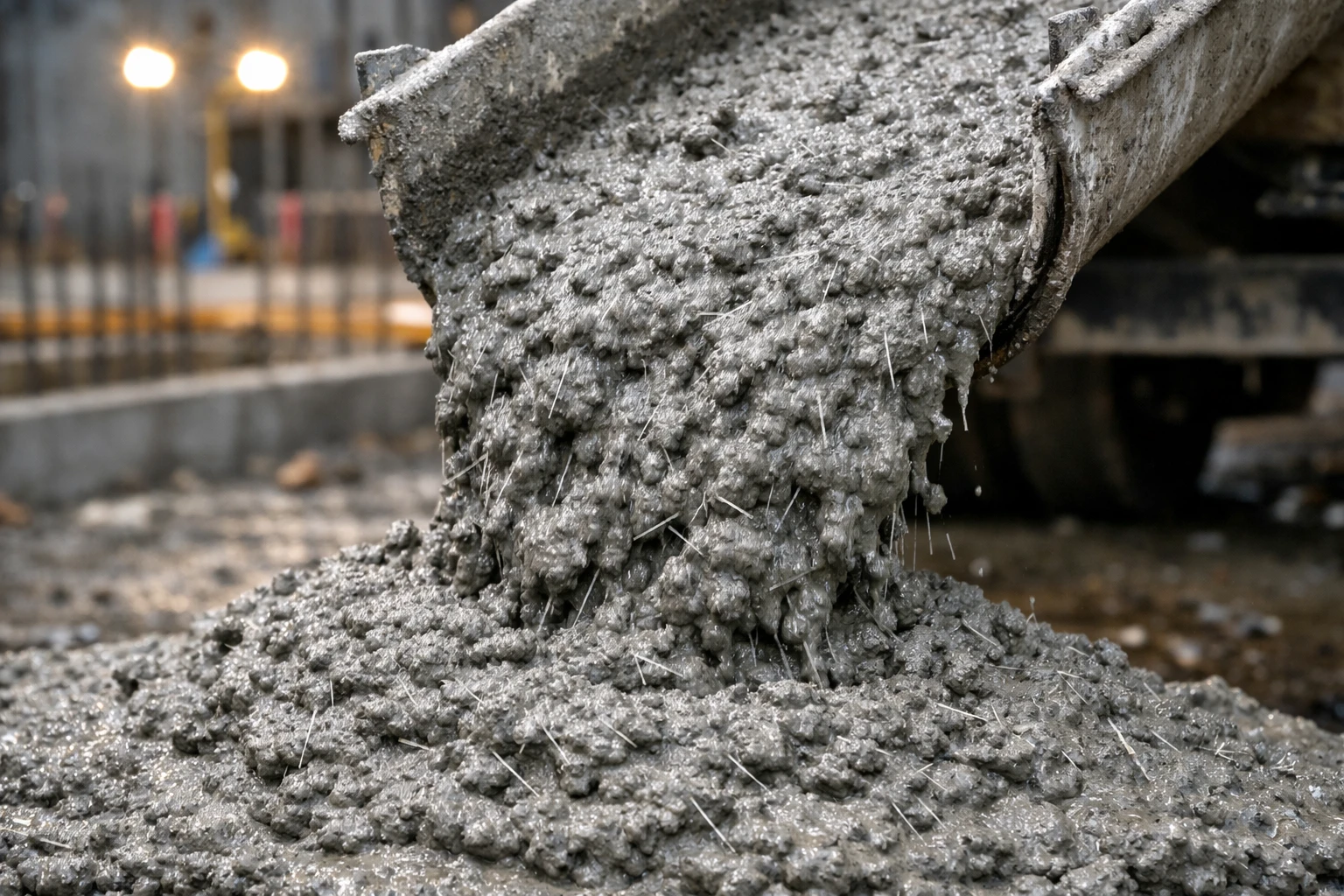
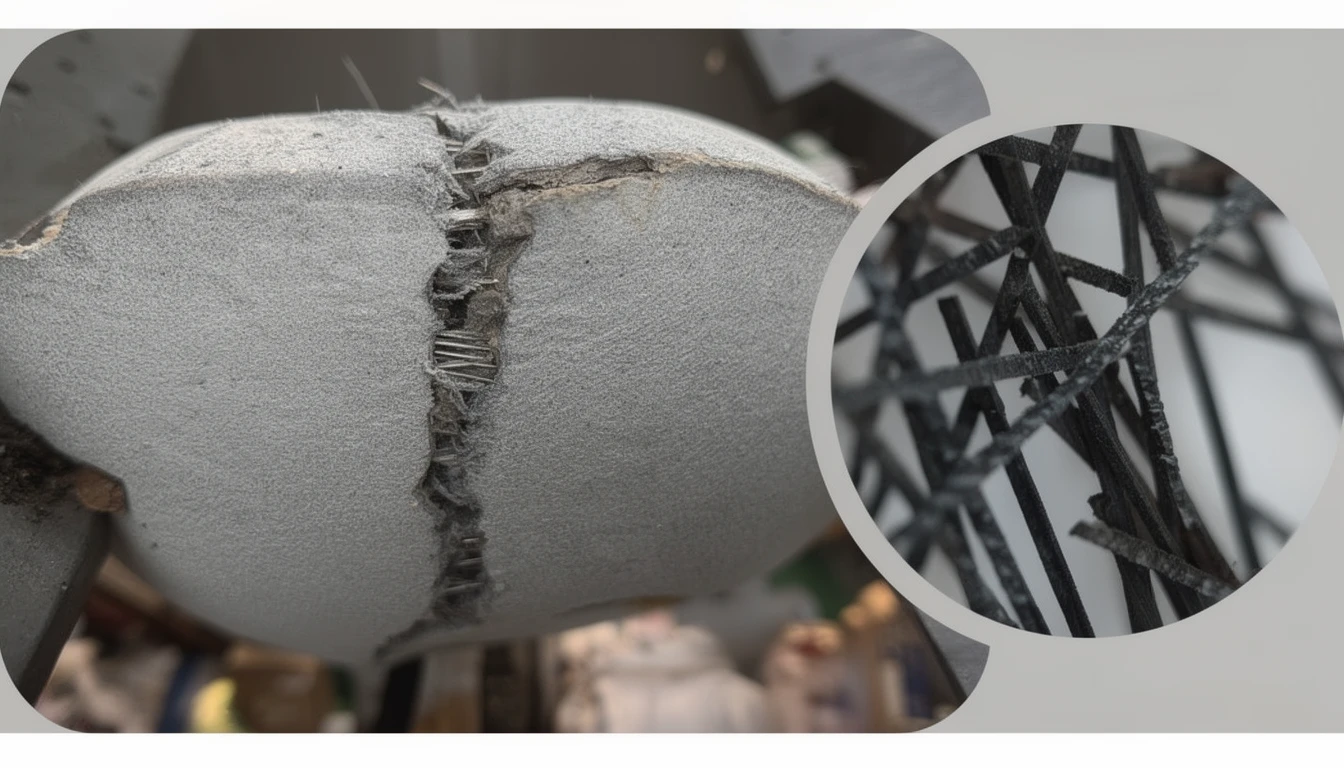
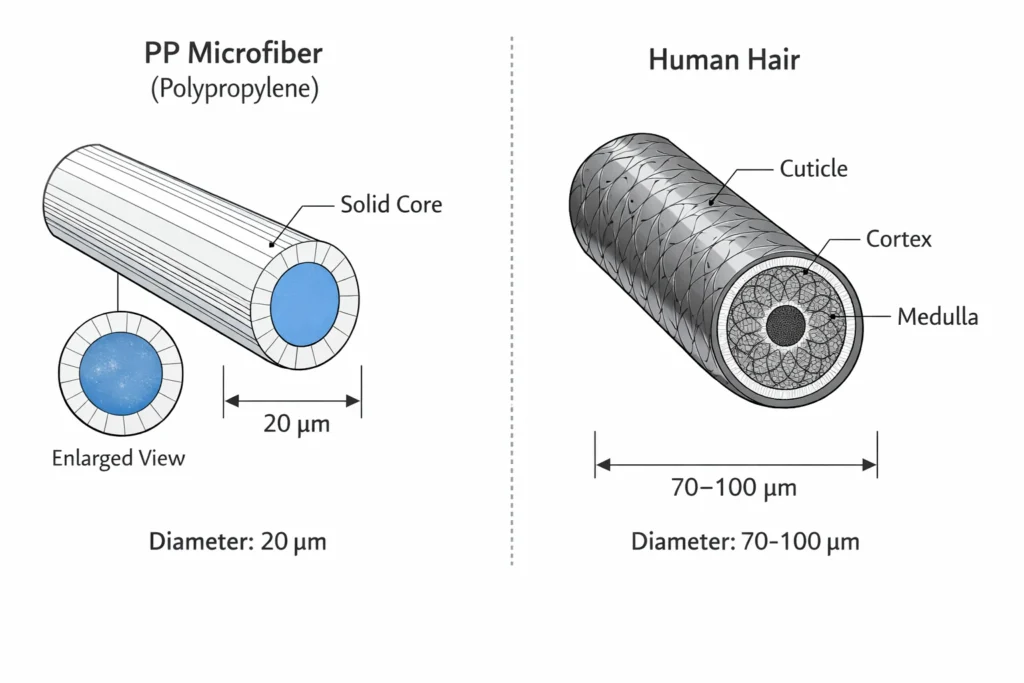
Micro PP fiber concrete is concrete that contains micro synthetic fibers made from polypropylene. A crew adds the fibers during mixing, and the crew spreads the fibers through the paste and aggregate. The word “micro” describes fiber size, and the word “PP” describes the polymer, and the word “concrete” describes the matrix that holds the fibers. ACI guidance defines microsynthetic fibers as fibers with diameters, or equivalent diameters, less than 0.3 mm, and the same ACI guide defines macrosynthetic fibers as larger than 0.3 mm. The ASTM D7508 specification uses a matching idea through linear density, and it describes micro polyolefin fiber as below the 580 denier cutoff that lines up with an equivalent diameter below 0.3 mm. Many micro PP fibers come as monofilament strands, and some micro PP fibers come as fibrillated film that opens into a net shape during mixing. A ready-mix team usually buys micro PP fibers for early crack control in flatwork, and that use shows up in industry guidance that explains why synthetic fibers are added to concrete.
What micro PP fibers do during the first hours after placement
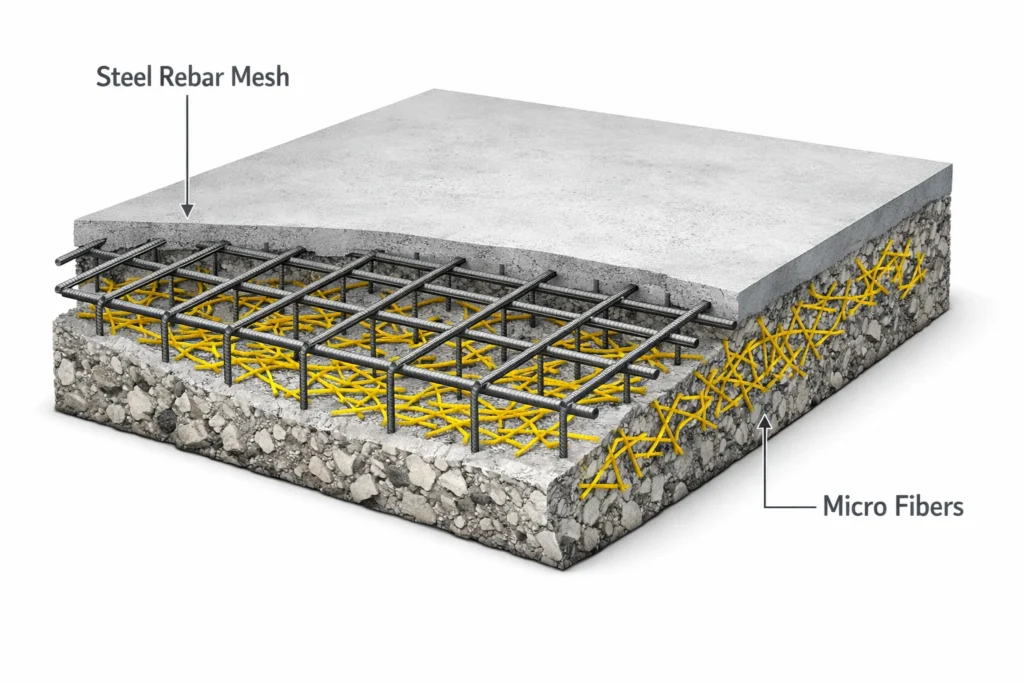
Micro PP fibers mainly work in the plastic stage of concrete. A fresh slab can lose surface water fast when the air is hot and dry and windy, and that fast loss can pull the surface into tension. A fresh slab can also settle around rebar and around large aggregate, and that settlement can leave small lines on the surface. A micro PP fiber network helps because many small fibers hold the paste together while the concrete is still weak. The National Ready Mixed Concrete Association describes synthetic fibers as a way to bridge and spread cracks, and it describes common use at typical addition rates for plastic shrinkage crack control. A micro fiber does not “stop” shrinkage, and a micro fiber helps lower the number and width of early cracks. A crew still needs curing and wind breaks and fogging when conditions get harsh, and a crew still needs good finishing timing. A crew gets the best result when the fiber works with good placement practice, and the fiber helps the crew reduce surface repairs and callbacks.

What micro PP fibers do not do, and why that matters for specs
Micro PP fibers do not act like rebar, and micro PP fibers do not replace structural steel design. A buyer sometimes hears “fiber replaces mesh,” and that message fits better with structural macro fibers, not with micro fibers. Industry guidance explains that macro fibers target post-crack flexural strength and that designers often verify that effect with a beam test like ASTM C1609, and that guidance also shows micro fibers as a different category. The micro PP fiber job is early-age crack control and surface integrity, and the macro fiber job is load support after cracking. A spec writer can still place micro fibers in many projects, and the spec writer should still keep normal reinforcement rules for the member. A slab still needs joints and correct spacing and base prep, and a slab still needs thickness for load. A contractor still needs curing, and a contractor still needs good finishing practice. Micro PP fiber concrete gives a real benefit, and the benefit stays realistic when the spec matches the fiber’s role.
Standards and labels that buyers should look for
A buyer should treat micro PP fiber concrete as a spec-driven product, not as a generic additive. ASTM C1116 defines Type III synthetic fiber reinforced concrete or shotcrete, and it requires evidence that the fibers resist long-term deterioration in contact with cement paste and moisture and common admixtures. A buyer often sees “ASTM C1116 Type III” on micro fiber product pages and data sheets, and those claims help a spec writer align products across suppliers. A European project often uses EN 14889-2, and the EN standard states that it covers polymer fibers for structural or non-structural use in concrete, mortar, and grout. A buyer can also use ASTM D7508 as a fiber definition and classification reference for polyolefin chopped strands, and the standard includes micro and macro classes through linear density. A responsible procurement team asks for the current technical data sheet, and the team asks for compliance statements, and the team asks for test reports that match the job’s performance goal.
Performance testing that fits micro fibers, not macro fibers
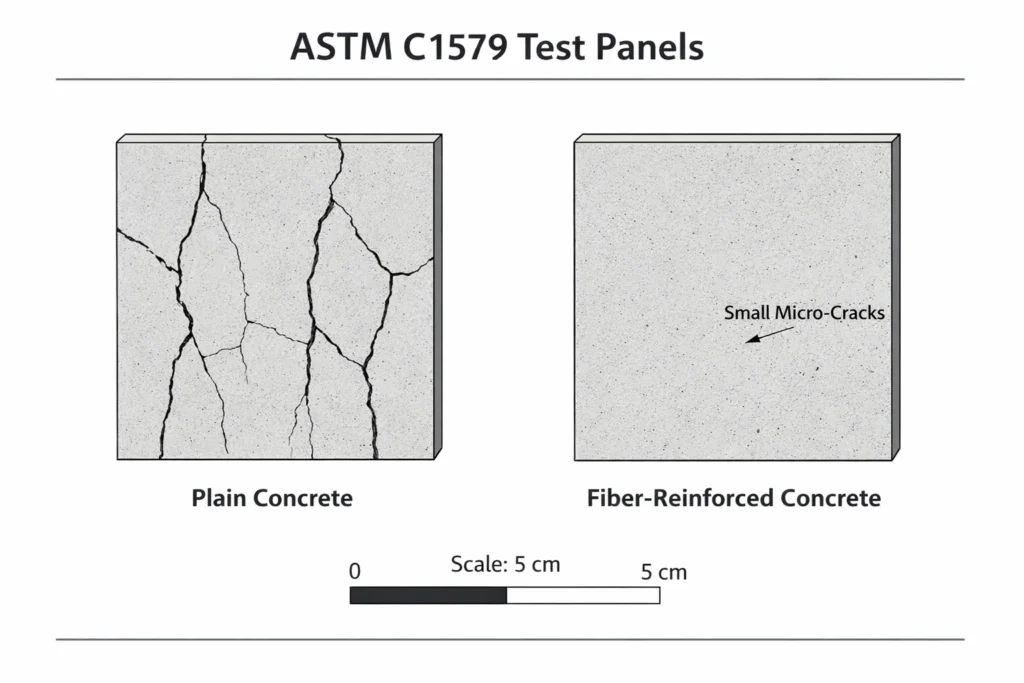
A buyer should test micro fibers with the right test method. Micro fibers target plastic shrinkage cracking and plastic settlement cracking, so a buyer should look at tests that stress early-age behavior. ASTM C1579 compares surface cracking in fiber reinforced panels with cracking in control panels under severe moisture loss and restraint, and the method is designed to produce cracking before final set. A buyer can use that test to compare different fiber products and dosages, and the buyer can use the cracking reduction ratio to compare mixes in a simple way. A research thesis on plastic shrinkage cracking describes ASTM C1579 as a method used mainly to compare plastic shrinkage cracking behavior of mixes with fiber reinforcement under prescribed conditions. A buyer should also treat lab results as guidance, and the buyer should still consider site factors like curing timing and evaporation rate. A buyer should not expect micro fibers to give large post-crack strength values in flexure, because that role belongs to macro fibers in most cases. A buyer can still ask for compressive strength and finish quality notes, and the buyer can still ask for pumpability notes, because those topics affect real placement success.
Typical dosage ranges, and what drives the right choice
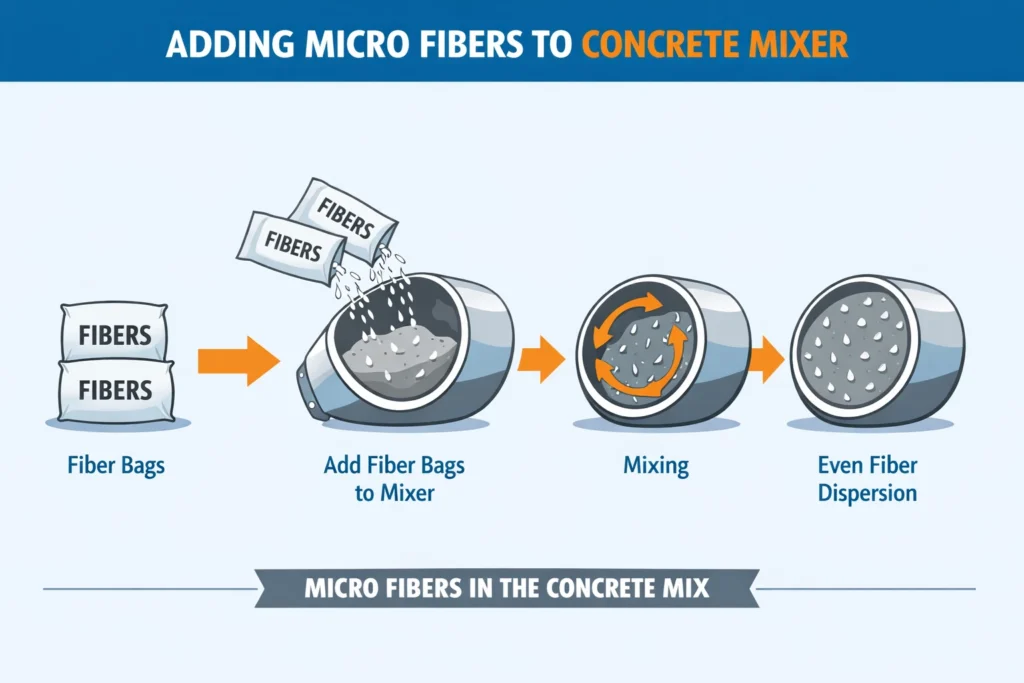
A mix designer usually starts with a standard dosage range and then adjusts for risk level. NRMCA guidance states that synthetic fibers are used at typical addition rates of 1 to 2 lb per cubic yard, and the guidance notes that these rates generally do not require major changes to the mix. A buyer can treat that as a practical starting point for many flatwork jobs. A buyer should still adjust dosage based on weather, slab thickness, finishing window, and crack risk. A buyer should also adjust dosage based on fiber type, because a fibrillated fiber can behave differently than a monofilament fiber in dispersion and in surface look. A technical data sheet from a fiber supplier can also include a recommended dosing range and a mixing time note, and one example data sheet states that the mix needs an extended mixing time of about 5 minutes for even distribution. A site team should not chase a high dosage without a plan, because high fiber content can change slump feel and finishing feel. A site team should run a trial mix when the slab is high value or when the schedule is tight, and the trial should happen under similar transport time and placement methods.
Mixing, placing, and finishing notes that prevent common failures
A crew gets better results when the crew follows a simple process. A batching operator should add fibers into moving concrete, and the operator should avoid dumping a full dose into one dry pocket. A driver should keep drum speed high enough for dispersion during the added mixing period. A crew should also confirm that the mix stays workable and cohesive, because fibers can slightly change bleed behavior, and that change can affect finishing timing. NRMCA guidance states that synthetic fibers are added before or during mixing, and it frames fiber use as part of normal concrete production, not as an unusual process. A crew should also keep curing plans ready before the pour starts, because curing still drives the final crack result even when fibers are present. A finishing team should watch the surface and not close the surface too early, and the team should not overwork the surface during high evaporation. A contractor should also train the crew on fiber visibility, because some mixes show small fibers at the surface, and the crew can reduce that look with timing and tool choice. A contractor should ask the supplier for mixing notes and finishing notes, and a contractor should treat those notes as part of quality control.
Where micro PP fiber concrete fits best
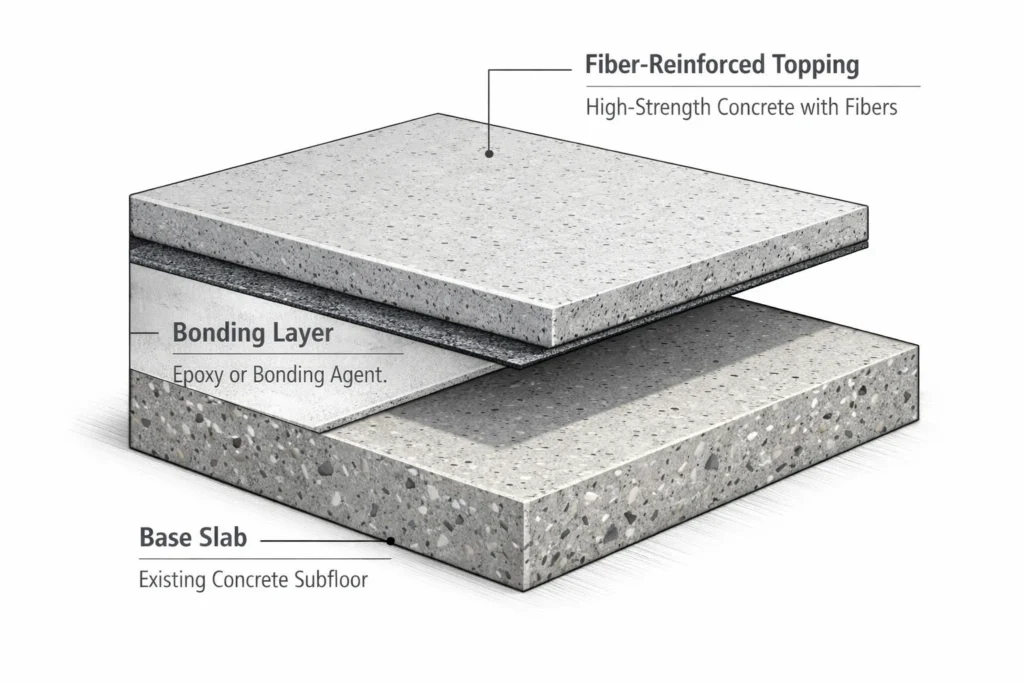
Micro PP fiber concrete fits best in slabs and toppings and pavements that face early-age cracking risk. A DOT survey report states that polymeric microfibers mainly aim to reduce plastic shrinkage cracking, and the report contrasts that role with macrofibers that target other performance goals. A contractor can use micro fibers in residential flatwork, and the contractor can use micro fibers in commercial floors, and the contractor can use micro fibers in overlays and repairs when surface cracking is a cost driver. A precast plant can use micro fibers to improve surface integrity on thin edges, and the plant can also use micro fibers to reduce handling damage on green products. A shotcrete crew can also use polypropylene fibers in sprayed mixes, and the EN 14889-2 scope includes sprayed concrete as a covered use type for polymer fibers. A project team should still match the fiber type to the job. A team should choose micro fibers for early cracks, and the team should choose macro fibers or steel fibers for post-crack load performance. A team can also combine micro and macro fibers in some projects, and ASTM D7508 recognizes hybrid fiber combinations as a category.
Fire and spalling questions, and what micro PP fibers can contribute
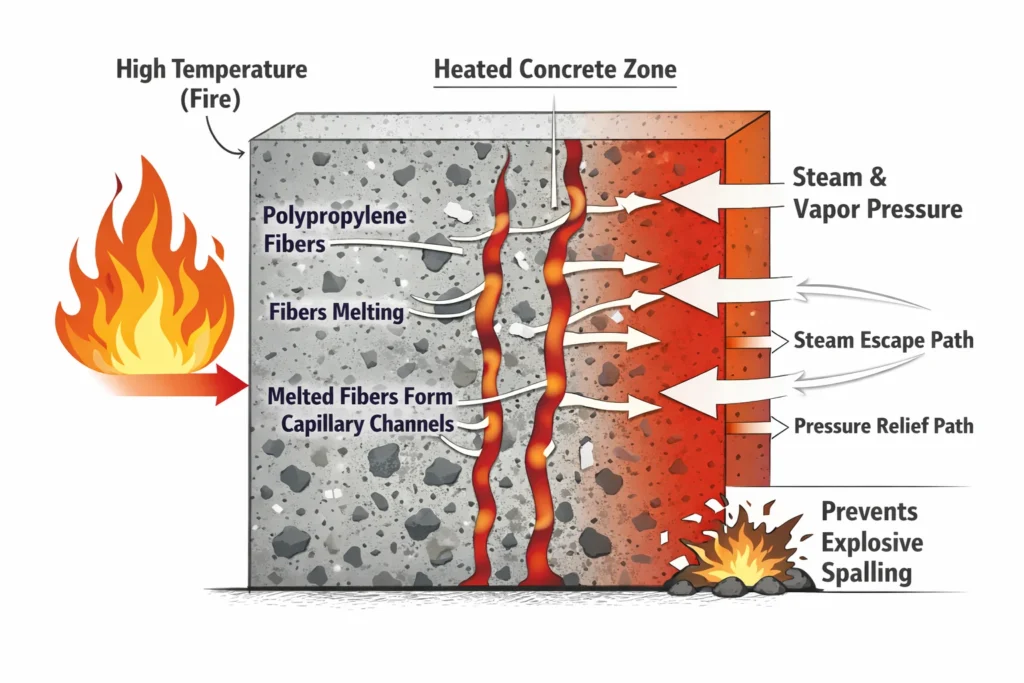
Some buyers ask about fire performance because they hear that polypropylene melts. A project team should treat fire safety as a full system topic, and the team should follow local code. A project team can still understand why polypropylene fibers appear in fire-related concrete discussions. Some technical papers and research reviews describe that polypropylene fibers can reduce explosive spalling in fire exposure because fibers melt and leave channels that help vapor pressure escape. Many spalling-focused fiber applications use small fibers, and those fibers behave like micro fibers in size and dispersion. A spec writer should still be precise, because a spalling control fiber and a plastic shrinkage control fiber can have different lengths and shapes and dosages. A spec writer should ask for the exact fire test basis when a project needs that performance. A buyer should also remember that smoke from any burning material can be harmful, and a buyer should keep fire protection design and ventilation design in scope. A buyer should treat micro PP fibers as one tool that can support safety goals in the right context, and the buyer should still rely on the full fire design of the structure.
Handling and safety on site
A site team should treat micro PP fibers as low hazard, and a site team should still follow basic handling rules. A fiber data sheet and many SDS documents focus on mechanical irritation and dust control, and those documents recommend basic PPE during dusty steps. A crew should wear eye protection when a crew opens bags in wind, and a crew should use gloves when a crew handles many bags. A plant should keep good housekeeping because any fine dust can irritate eyes and airways in the right conditions. A site should also keep bags dry and sealed until use, because wet bags can clump and cause dosing errors. A procurement team should keep the SDS on file and the team should train crews with short and clear points. A crew should also treat slips as a risk, because loose fibers on the ground can act like fine string under boots. A foreman should plan a clean work area, and a foreman should plan waste bag control, and a foreman should plan a simple disposal route.
Buying and specifying micro PP fibers with fewer surprises
A buyer can reduce risk by asking a short set of questions. A buyer should ask which standard the product claims, and the buyer should ask for the supporting documents. A buyer should ask if the fiber meets ASTM C1116 Type III, and the buyer should ask if the fiber is within EN 14889-2 classes for polymer fibers when the project is in that system. A buyer should ask for the fiber geometry, including length and denier and form, because those details affect dispersion and finish. A buyer should ask for a recommended dosage range for the target application, and the buyer should ask for mixing time guidance, because guidance often names an added mixing time for even distribution. A buyer should ask how the product behaves with common admixtures, because ASTM C1116 links durability to concrete alkalis and to admixtures. A buyer should also ask for performance data that matches the job goal, and ASTM C1579 is a direct match for plastic shrinkage cracking comparison. A buyer should then run a small trial when the placement method is unusual, like long pump lines or long haul times.
Why Ecocretefiber™ supports micro PP fiber concrete projects
Ecocretefiber™ is a fiber brand from Shandong Jianbang Chemical Fiber Co., Ltd., and our team focuses on concrete reinforcement fibers for professional use. Our team supports contractors and ready-mix plants that want fewer early-age cracks and fewer surface repairs. Our team also supports spec writers who want standard alignment, because standards like ASTM C1116 and EN 14889-2 help projects compare products across suppliers. Our team supports performance-based discussion for early crack control, and the ASTM C1579 method gives buyers a clear way to compare plastic shrinkage cracking behavior across mixes. Our team also supports practical production needs, like controlled dispersion and predictable mixing steps, because industry guidance frames synthetic fibers as a normal addition when crews follow basic mixing practice. A buyer can use this support to shorten trial time and reduce jobsite uncertainty, and a buyer can turn “fiber in the mix” into a repeatable standard detail.
Conclusion
Micro PP fiber concrete is concrete that includes polypropylene microsynthetic fibers, and ACI guidance places micro fibers below the 0.3 mm diameter line. Micro PP fibers mainly help during the first hours after placement, and the fibers help reduce plastic shrinkage cracking and plastic settlement cracking when crews also use good curing and good finishing practice. A good project spec often references standards like ASTM C1116 Type III and EN 14889-2, and a good performance check for early cracking often uses ASTM C1579. A buyer who wants stable crack control and a smoother workflow can use Ecocretefiber™ from Shandong Jianbang Chemical Fiber Co., Ltd. as a professional supply option for micro PP fiber concrete projects.