Primero una respuesta clara
La fibra de vidrio puede reaccionar con el ácido, pero el resultado depende del tipo de ácido, el tipo de fibra de vidrio, el sistema de resina y las condiciones de exposición. La fibra de vidrio no es un único material. Puede significar fibra de vidrio suelta, malla de fibra de vidrio, plástico reforzado con fibra de vidrio o fibra de vidrio utilizada en productos a base de cemento.
Los ácidos más comunes no atacan al vidrio de sílice de forma tan agresiva como lo hacen los álcalis o el ácido fluorhídrico. Owens Corning explica que los ácidos tienen poco efecto sobre los vidrios de sílice, con la importante excepción del ácido fluorhídrico y, a altas temperaturas, del ácido fosfórico. Esto constituye una regla general útil, pero no significa que todos los productos de fibra de vidrio sean seguros en todos los ácidos.
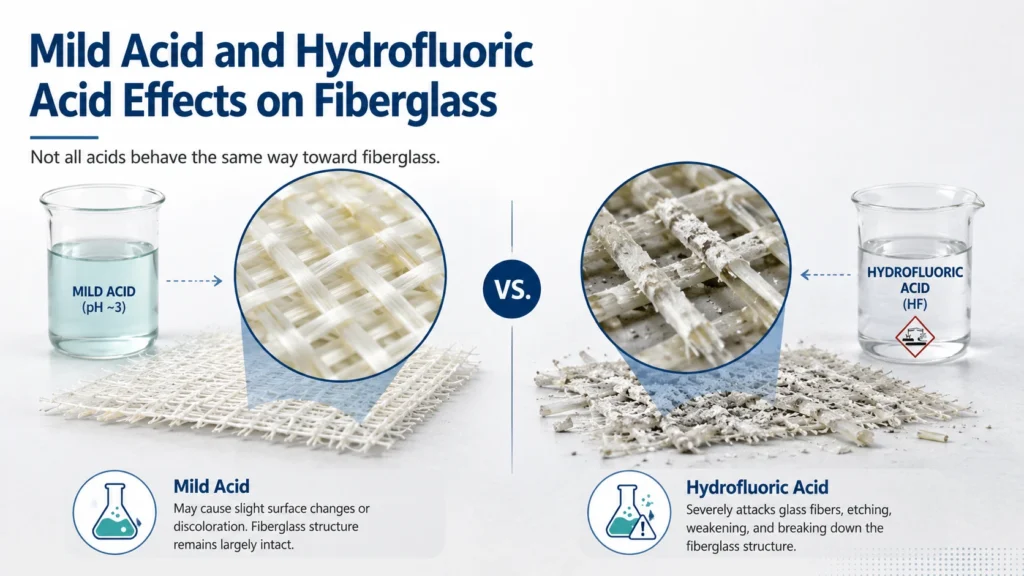
El ácido fluorhídrico es un caso especial. Puede atacar el vidrio porque reacciona con el dióxido de silicio y forma fluoruros de silicio solubles o gaseosos. ScienceDirect describe esta reacción como la razón por la que el ácido fluorhídrico ataca al vidrio.
Así que la respuesta corta es ésta: La fibra de vidrio puede resistir muchos ácidos suaves, pero puede resultar dañada por ácidos fuertes, exposiciones prolongadas, altas temperaturas o ácido fluorhídrico. Si la fibra de vidrio forma parte de FRP, la resina y la barrera anticorrosión también importan tanto como el fibra de vidrio.
Qué significa realmente la fibra de vidrio
Fibra de vidrio significa normalmente fibras de vidrio utilizadas como refuerzo. Las fibras pueden tejerse en forma de malla, cortarse en hebras, convertirse en esterilla o incrustarse en resina para fabricar plástico reforzado con fibra de vidrio. En la construcción, la palabra “fibra de vidrio” se utiliza para muchos productos diferentes.
Esto es importante porque la exposición al ácido cambia de un producto a otro. Una fibra de vidrio suelta está expuesta directamente al ácido. Una malla de fibra de vidrio puede tener un revestimiento de polímero. Un tanque de plástico reforzado con fibra de vidrio puede tener una barrera anticorrosión rica en resina antes de que el ácido llegue a la fibra de vidrio. Un producto de cemento con fibras de vidrio también puede tener una matriz de cemento alrededor de las fibras.
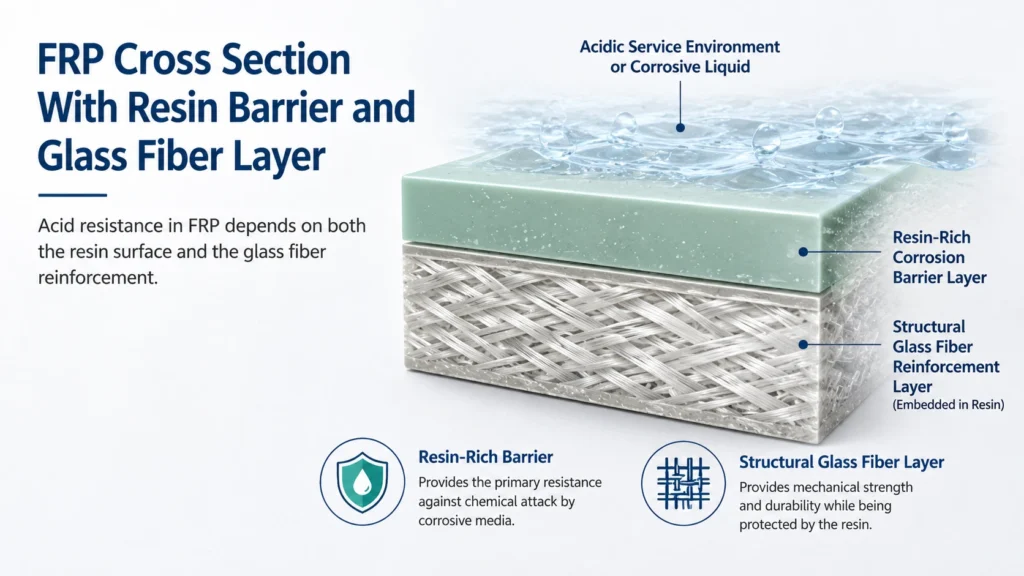
Las guías de resistencia química de los FRP dejan claro este punto. INEOS explica que los materiales FRP están diseñados con una barrera resistente a la corrosión para mejorar el rendimiento y la vida útil. Esto significa que el ácido entra primero en contacto con la capa superficial rica en resina, no con la propia fibra de vidrio.
Así que cuando un comprador pregunta si la fibra de vidrio reacciona con el ácido, la mejor pregunta es ésta: ¿Qué producto de fibra de vidrio está expuesto y cuál es la concentración de ácido y la temperatura?
Lata de ácido Fibras de vidrio de ataque Mediante lixiviación
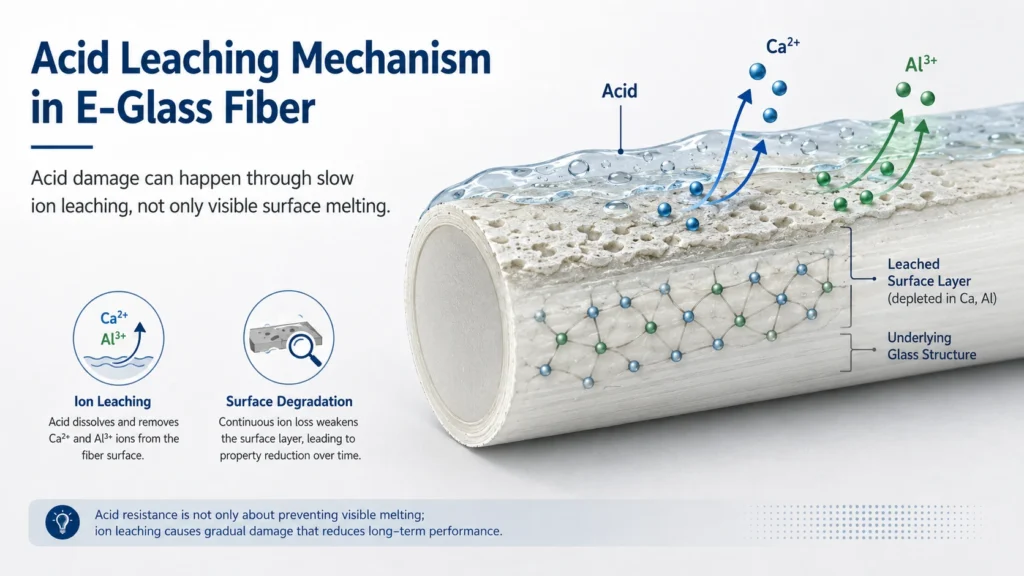
Muchas fibras de vidrio son materiales a base de silicato. Los ácidos no siempre disuelven toda la estructura del vidrio con rapidez, pero pueden lixiviar ciertos iones del vidrio. Esto puede reducir su resistencia con el tiempo.
Un conocido estudio sobre fibras de vidrio E en ambientes ácidos expuso el vidrio E a los ácidos oxálico, clorhídrico, nítrico y sulfúrico. El estudio descubrió que la corrosión ácida de las fibras de vidrio E estaba relacionada principalmente con el agotamiento de los iones calcio y aluminio, y que el resultado dependía no sólo de la concentración de iones hidrógeno, sino también del tipo de anión ácido.
Este es un punto importante para los compradores. Dos ácidos con el mismo pH pueden no causar el mismo daño. El ácido clorhídrico, el ácido sulfúrico, el ácido nítrico, los ácidos orgánicos y el ácido fluorhídrico pueden comportarse de forma diferente. La temperatura también cambia el resultado. El tiempo también cambia el resultado.
Un producto puede tener buen aspecto tras un contacto breve, pero perder resistencia tras una exposición prolongada. Esta es la razón por la que las tablas de resistencia química y las pruebas específicas del proyecto son importantes en el servicio de ácidos industriales.
El ácido fluorhídrico es el más peligroso para la fibra de vidrio
El ácido fluorhídrico requiere una atención especial. Es diferente de muchos otros ácidos porque ataca la red de sílice del vidrio. Puede disolver el vidrio, grabarlo y dañar el refuerzo de fibra de vidrio si llega a las fibras.
ScienceDirect afirma que el ácido fluorhídrico ataca el vidrio al reaccionar con el dióxido de silicio y formar fluoruros de silicio. Un artículo de Nature Communications de 2020 también explica que el HF ataca los enlaces Si-O del vidrio y rompe la red vítrea.
Esta es la razón por la que la fibra de vidrio no suele ser la elección por defecto para la exposición al ácido fluorhídrico. Algunos sistemas FRP pueden diseñarse para determinadas condiciones de HF con sistemas de resina y revestimientos especiales, pero esa es una decisión de diseño especializada en corrosión. Una malla de fibra de vidrio general, fibra de vidrio o un producto FRP básico no deben considerarse seguros para el ácido fluorhídrico.
El ácido fluorhídrico es también un grave peligro para la salud. Sólo debe ser manipulado por personas formadas y con los controles de seguridad adecuados. Para seleccionar el material, el comprador debe utilizar siempre una guía de resistencia química y confirmarlo con el proveedor de la resina o el composite.
El plástico reforzado con fibra de vidrio depende de la resina
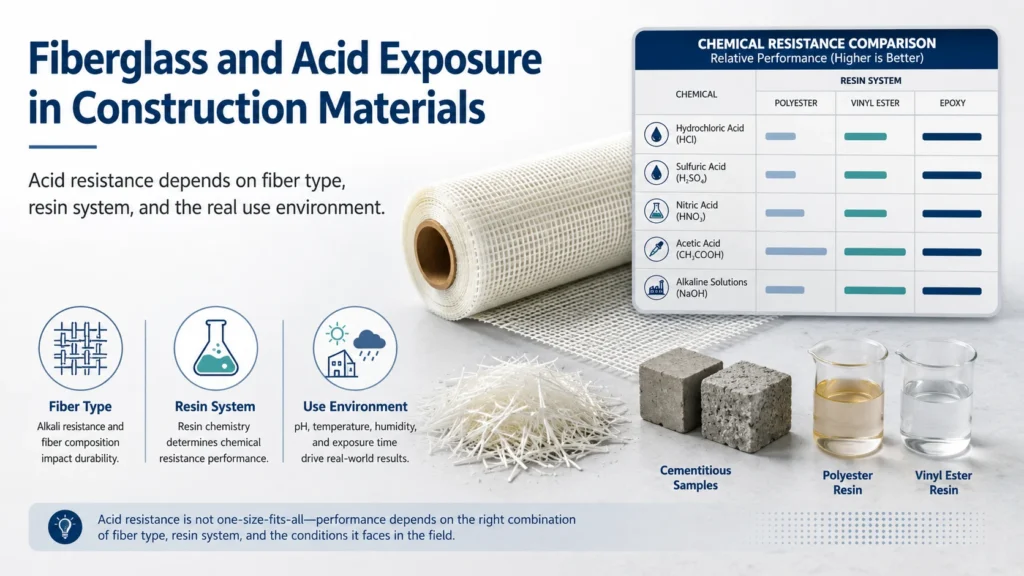
Cuando la gente pregunta por la fibra de vidrio y el ácido, suele referirse a depósitos de FRP, tuberías de FRP, rejillas de FRP o productos de GRP. Estos productos no son sólo fibra de vidrio. Son fibra de vidrio más resina. La resina determina gran parte de la resistencia química.
Las resinas de éster vinílico se utilizan a menudo en FRP resistentes a la corrosión porque resisten una amplia gama de ácidos, álcalis, lejías y disolventes. La guía Derakane de Ashland describe las resinas de la serie Derakane 411 como una reconocida serie de resinas epoxi de éster vinílico con resistencia a una amplia gama de ácidos, álcalis, lejías y disolventes.
Por eso, dos productos de fibra de vidrio pueden tener un rendimiento muy diferente en el mismo ácido. Un producto poliéster FRP producto puede no durar en un ambiente ácido fuerte. Un producto FRP de éster vinílico correctamente diseñado con una barrera anticorrosión puede durar mucho más. Un producto con grietas, mal curado, capas finas ricas en resina o fibras expuestas puede fallar más rápidamente.
El comprador no sólo debe preguntar: “¿Es de fibra de vidrio?”. El comprador debe preguntar:
| Pregunta | Por qué es importante |
|---|---|
| ¿Qué resina se utiliza? | La resina controla gran parte de la resistencia a los ácidos. |
| ¿Existe una barrera anticorrosión? | La barrera protege las fibras de vidrio del contacto directo con el ácido. |
| ¿Qué velo de cristal se utiliza? | El vidrio C o el velo sintético pueden mejorar la resistencia a la corrosión en algunos sistemas. |
| ¿Qué ácido está presente? | Los distintos ácidos atacan al vidrio y a la resina de maneras diferentes. |
| ¿Qué concentración y temperatura? | Una mayor concentración y temperatura suelen aumentar el riesgo. |
| ¿La exposición es continua o sólo salpicaduras? | La inmersión continua es mucho más dura que la exposición a salpicaduras cortas. |
El vidrio E, el vidrio ECR, el vidrio C y el vidrio AR no se comportan igual
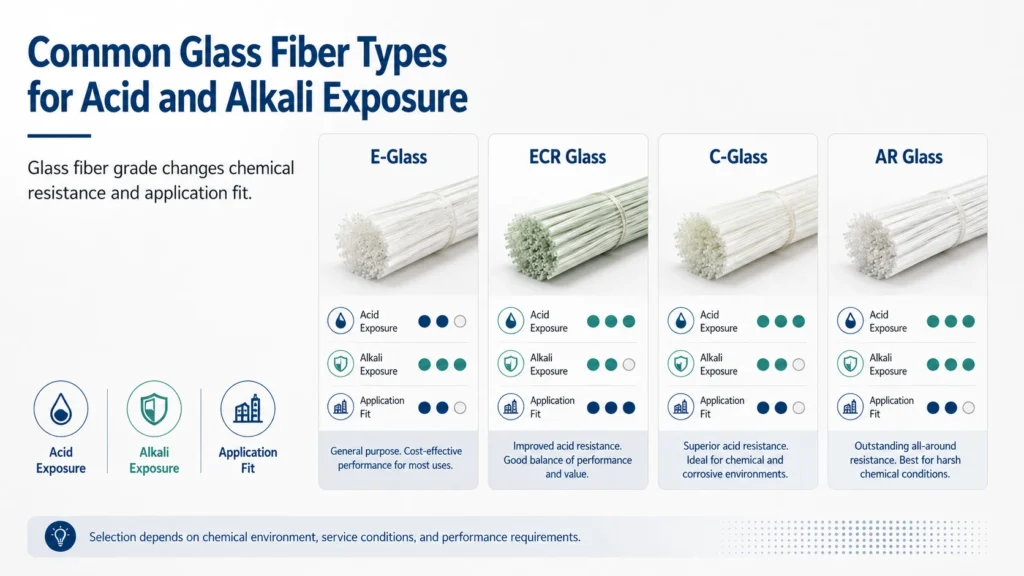
La resistencia a los ácidos de la fibra de vidrio también depende del tipo de vidrio. El vidrio E es común y rentable, pero no siempre es la mejor opción en servicios ácidos. El vidrio ECR se fabrica para ofrecer una mayor resistencia química. El vidrio C se utiliza a menudo como velo de vidrio resistente a la corrosión en las barreras anticorrosión FRP. El vidrio AR se diseña principalmente para la resistencia a los álcalis en entornos a base de cemento.
Una referencia sobre el grado de la fibra de vidrio indica que el vidrio E tiene una resistencia relativamente baja a los ácidos, mientras que el vidrio ECR se utiliza cuando se desea fuerza, resistencia eléctrica y resistencia a la corrosión ácida. La misma referencia describe el vidrio AR como vidrio resistente a los álcalis utilizado en sustratos de cemento y hormigón.
Un documento de investigación sobre el vidrio ECR también afirma que el vidrio ECR tiene mucha mejor resistencia a los ácidos que el vidrio E porque los productos de la corrosión pueden formar una fina película protectora que ralentiza la corrosión posterior.
Este punto es útil para los compradores del sector de la construcción. Una malla de fibra de vidrio para cemento puede elegirse por su resistencia a los álcalis, no a los ácidos. Un producto de fibra de vidrio para tanques químicos puede elegirse por su resistencia a los ácidos, no a los álcalis del cemento. La misma palabra “fibra de vidrio” no lo dice todo.
El vidrio AR es principalmente para álcalis, no para todos los problemas de ácidos
Vidrio AR significa vidrio resistente a los álcalis. Se utiliza en GFRC, productos de cemento y aplicaciones relacionadas con el hormigón porque el cemento es altamente alcalino. La EOTA afirma que las fibras de vidrio AR se fabrican con dióxido de circonio para conseguir una alta resistencia a los álcalis.
Esto es diferente del servicio ácido. El vidrio AR puede tener una buena durabilidad química, y algunos proveedores de vidrio AR también describen una buena resistencia a los ácidos. Pero la razón principal de la existencia del vidrio AR es la resistencia al álcali del cemento. El comprador no debe suponer que el vidrio AR resuelve automáticamente todos los problemas de exposición a los ácidos.
Si el proyecto es de GFRC, enlucido de cemento, hormigón o mortero, el vidrio AR o la malla de fibra de vidrio recubierta resistente a los álcalis suele ser la opción adecuada. Si el proyecto es de almacenamiento de ácidos, escape de ácidos, aguas residuales ácidas o procesamiento químico, el comprador debe pasar al diseño de corrosión FRP. Ese debate incluye el tipo de resina, el diseño del revestimiento, el velo, la temperatura, la concentración de ácido y los datos de las pruebas.
Para Ecocretefiber™., Esta distinción es importante. El refuerzo con cemento y el servicio de corrosión química no son el mismo problema de mercado. La elección de la fibra debe seguir el entorno.
¿Reacciona la malla de fibra de vidrio con el ácido?
La malla de fibra de vidrio puede reaccionar con el ácido si el hilo de vidrio o el revestimiento no son resistentes a ese ácido. Una malla utilizada en enlucidos o revocos suele estar diseñada para la exposición alcalina del cemento, no necesariamente para la inmersión en ácido. Puede tener un revestimiento resistente a los álcalis. Ese revestimiento ayuda en el cemento. No hace que la malla sea automáticamente adecuada para los ácidos industriales.
Una malla expuesta a un ácido de limpieza suave durante poco tiempo puede sobrevivir. Una malla expuesta a ácido fuerte, lavado repetido con ácido, vapor de ácido o servicio de ácido húmedo puede perder resistencia con el tiempo. El revestimiento puede ablandarse, hincharse o degradarse. Entonces el ácido puede llegar a las fibras de vidrio y atacarlas.
Esto es importante en sistemas de paredes, impermeabilización, áreas de plantas químicas, plantas alimentarias, áreas de aguas residuales y suelos industriales. El comprador debe confirmar el entorno químico antes de utilizar malla de fibra de vidrio. Si se prevé una exposición a los ácidos, el comprador debe pedir datos sobre la resistencia química, no sólo el peso de la malla y su resistencia a la tracción.
Si la malla está embebida en cemento, la primera preocupación suele ser la resistencia a los álcalis. Si la pared o el revestimiento acabados van a ser sometidos a lavados ácidos o a vapores ácidos, el sistema necesita una segunda comprobación de su resistencia a los ácidos.
¿Reacciona la fibra de vidrio con el ácido del hormigón o del cemento?
En los materiales a base de cemento, la principal preocupación química para la fibra de vidrio suele ser el álcali, no el ácido. La pasta de cemento es muy alcalina, por lo que el vidrio E normal puede degradarse en ese entorno. Por eso se utiliza el vidrio AR con zirconia en los productos de GFRC y cemento. La EOTA establece que el vidrio AR utiliza dióxido de circonio para conseguir una alta resistencia a los álcalis.
La exposición al ácido es un problema diferente. El ácido puede atacar a la propia matriz del cemento. Si el agua ácida, la lluvia ácida, el ácido industrial o las aguas residuales ácidas llegan al hormigón, la pasta de cemento puede degradarse. Entonces las fibras pueden quedar expuestas. Si las fibras son de vidrio, la resistencia al ácido depende del tipo de vidrio. Si las fibras son de polipropileno, la resistencia a los ácidos dependerá del polímero y de las condiciones de exposición.
Para los proyectos de hormigón, esto significa que el diseño debe tener en cuenta tanto la matriz como el refuerzo. Una fibra resistente no puede proteger por sí sola una matriz de cemento de un ataque ácido severo. Pueden ser necesarios revestimientos resistentes a los ácidos, morteros resistentes a los productos químicos, sistemas de resina o diseños especiales de hormigón.
¿Qué ocurre cuando la fibra de vidrio se expone al ácido durante mucho tiempo?
La exposición prolongada a los ácidos puede causar varios problemas.
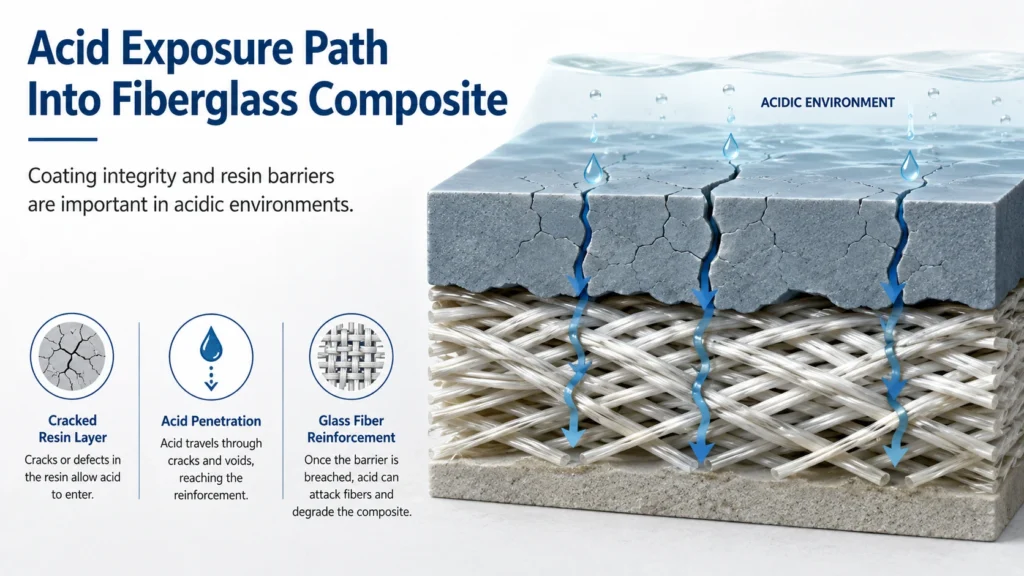
En primer lugar, el ácido puede atacar la resina, el revestimiento o el apresto. Las fibras de vidrio suelen tener un apresto en la superficie para mejorar la unión con la resina o el cemento. Si el apresto se rompe, la unión puede debilitarse.
En segundo lugar, el ácido puede lixiviar iones del vidrio. El estudio de E-glass sobre ambientes ácidos descubrió que el agotamiento de calcio y aluminio desempeñaba un papel principal en la corrosión ácida.
En tercer lugar, la resistencia de la fibra puede disminuir. El refuerzo de fibra de vidrio depende de la resistencia continua de las fibras. Si las fibras de vidrio se debilitan, todo el compuesto puede perder resistencia a la tracción.
En cuarto lugar, las grietas o microgrietas pueden dejar entrar más ácido. En el FRP, una vez que el ácido atraviesa la barrera de resina, las capas de vidrio pueden ser atacadas más rápidamente. Esta es la razón por la que el FRP resistente a la corrosión utiliza barreras ricas en resina y un cuidadoso diseño de los laminados. INEOS describe las barreras FRP resistentes a la corrosión como una forma de mejorar el rendimiento y la longevidad.
Así que el daño por ácido puede ser lento al principio, pero puede volverse grave al aumentar el tiempo de exposición.
¿Es la fibra de vidrio resistente al ácido?
La fibra de vidrio no debería denominarse a prueba de ácidos en sentido amplio. Un término mejor es resistente a los ácidos en condiciones definidas. Las condiciones incluyen el tipo de ácido, la concentración, la temperatura, el tiempo de exposición, la estructura del producto, el tipo de vidrio, el tipo de resina y la protección de la superficie.
Esta distinción es importante porque “a prueba de ácido” suena a absoluto. La mayoría de los materiales de construcción e industriales no son absolutos. Se seleccionan para una condición de servicio. Un material puede resistir el ácido sulfúrico 5% a temperatura ambiente pero fallar en ácido concentrado caliente. Un material puede resistir salpicaduras pero fallar en inmersión total. Un material puede resistir el ácido clorhídrico en un sistema de resina pero fallar en otro.
Por esta razón existen guías de selección de resinas FRP. INEOS y Ashland publican guías de resistencia química para ayudar a los ingenieros a especificar sistemas de resinas para equipos FRP resistentes a la corrosión.
Para los compradores, esto significa que la pregunta correcta no es “¿Es la fibra de vidrio resistente al ácido?”. La pregunta correcta es “¿Qué sistema de fibra de vidrio está clasificado para este ácido, a esta concentración y temperatura, durante este tiempo de exposición?”.”
¿Qué ácidos suelen ser más preocupantes?
El ácido fluorhídrico es el peligro más evidente para la fibra de vidrio porque ataca directamente la red de sílice del vidrio.
Los ácidos minerales fuertes también pueden ser preocupantes, especialmente con una exposición prolongada o a altas temperaturas. El estudio sobre la corrosión ácida del vidrio E incluyó los ácidos clorhídrico, nítrico, sulfúrico y oxálico y demostró que los distintos ácidos lixivian los componentes del vidrio de maneras diferentes.
El ácido fosfórico también puede volverse más preocupante a alta temperatura. Owens Corning señala el ácido fosfórico a alta temperatura como una excepción para la durabilidad del vidrio de sílice.
Tampoco deben ignorarse los ácidos orgánicos. Su comportamiento depende de la concentración, la temperatura y la capacidad de formar complejos con los iones lixiviados. Esta es una de las razones por las que el servicio químico debe revisarse caso por caso.
Una clasificación práctica del riesgo de acidez para los compradores sería la siguiente:
| Tipo de exposición al ácido | Riesgo para la fibra de vidrio |
|---|---|
| Salpicaduras de ácido leves a corto plazo | A menudo manejable si la resina o el revestimiento son adecuados. |
| Inmersión continua en ácido | Necesita datos de resistencia química y diseño del sistema. |
| Exposición al ácido caliente | Mayor riesgo y necesita revisión especializada. |
| Exposición al ácido fluorhídrico | Riesgo muy elevado para la fibra de vidrio y requiere una selección especial del material. |
| Exposición a los ácidos en los sistemas de cemento | Es posible que primero se degrade la matriz de cemento y después queden expuestas las fibras. |
Cómo deben elegir los compradores la fibra de vidrio para ambientes ácidos
El comprador debe empezar por la condición de servicio químico. El comprador debe indicar el nombre del ácido, la concentración, la temperatura, el tiempo de exposición, el ciclo de limpieza, la presión, la abrasión y si el ácido es líquido, vapor o salpicadura.
A continuación, el comprador debe confirmar el sistema de fibra de vidrio. Si el producto es FRP, pregunte por el tipo de resina, el grosor de la barrera anticorrosión, el tipo de velo de vidrio, el diseño del laminado estructural y la tabla de resistencia química. Si el producto es malla, pregunte por el tipo de vidrio, el tipo de revestimiento, la resistencia a la tracción tras la exposición química y la compatibilidad del sistema. Si el producto es fibra de cemento, pregunte si el entorno es alcalino, ácido o ambos.
Para el servicio de ácido industrial, el comprador no debe fiarse sólo de una afirmación general sobre la fibra de vidrio. El comprador debe utilizar una guía de selección de resinas o pedir al proveedor una confirmación por escrito. Tanto INEOS como Ashland proporcionan guías de resistencia química para la selección de resinas en equipos FRP resistentes a la corrosión.
Para la construcción a base de cemento, el comprador no debe utilizar vidrio E general sin comprobar su idoneidad. Si el trabajo es de refuerzo de GFRC o cemento, el vidrio AR o la malla resistente a los álcalis suele ser la ruta adecuada. Si también se prevé una exposición a los ácidos, el comprador deberá comprobar tanto la resistencia a los álcalis como la resistencia a los ácidos.
Por qué este tema es importante para Ecocretefiber™.
Esta pregunta es importante porque muchos compradores utilizan “fibra de vidrio” en sentido amplio. Pueden referirse a malla de fibra de vidrio, fibra de vidrio AR, hebras de vidrio picado o compuesto FRP. Cada producto reacciona de forma diferente en el ácido y en el cemento.
Ecocretefiber™ de Shandong Jianbang Chemical Fiber Co. apoya la selección de fibras para hormigón y construcción. El objetivo no es sólo vender una fibra. El objetivo es adaptar la fibra al entorno real. Los sistemas de cemento necesitan resistencia a los álcalis. Los sistemas industriales expuestos a ácidos necesitan resistencia química. Las losas de hormigón pueden necesitar microfibras de polipropileno o macrofibras sintéticas. El GFRC necesita fibra de vidrio AR.
Un comprador que comprende esta diferencia toma mejores decisiones de compra. El comprador evita utilizar la fibra de vidrio equivocada en el cemento. El comprador evita asumir que toda la fibra de vidrio es resistente a los ácidos. El comprador también sabe cuándo pedir datos sobre resinas, revestimientos o envejecimiento químico.
Conclusión
La fibra de vidrio puede reaccionar con el ácido, pero la reacción depende del ácido y del sistema de fibra de vidrio. Muchos vidrios de sílice resisten razonablemente bien muchos ácidos comunes, pero el ácido fluorhídrico es una excepción importante porque ataca la red de sílice del vidrio. Los ácidos fuertes, los ácidos calientes y la exposición prolongada también pueden debilitar las fibras de vidrio por lixiviación y corrosión.
En los FRP, el sistema de resina y la barrera contra la corrosión son fundamentales. El ácido puede atacar primero a la resina y, si alcanza el refuerzo de vidrio, el daño a la fibra puede reducir la resistencia. Por ello, la resistencia química del FRP depende de la selección de la resina, el diseño de la barrera, la elección del velo de vidrio y las condiciones de servicio.
En los materiales a base de cemento, el principal problema de las fibras de vidrio suele ser el álcali, no el ácido. Las fibras de vidrio AR utilizan dióxido de circonio para resistir los entornos alcalinos del cemento. Si también hay exposición al ácido, el comprador debe comprobar la resistencia al ácido por separado.
La regla práctica es sencilla. No trate la fibra de vidrio como resistente a los ácidos. Considérela resistente a los ácidos sólo cuando el tipo de vidrio, la resina o el revestimiento y las condiciones de exposición así lo demuestren. Para los compradores de construcción, Ecocretefiber™ puede ayudar a conectar la elección del material con el entorno real, desde cuestiones de fibra de vidrio AR y malla de fibra de vidrio hasta soluciones de polipropileno y macrofibras sintéticas para hormigón.