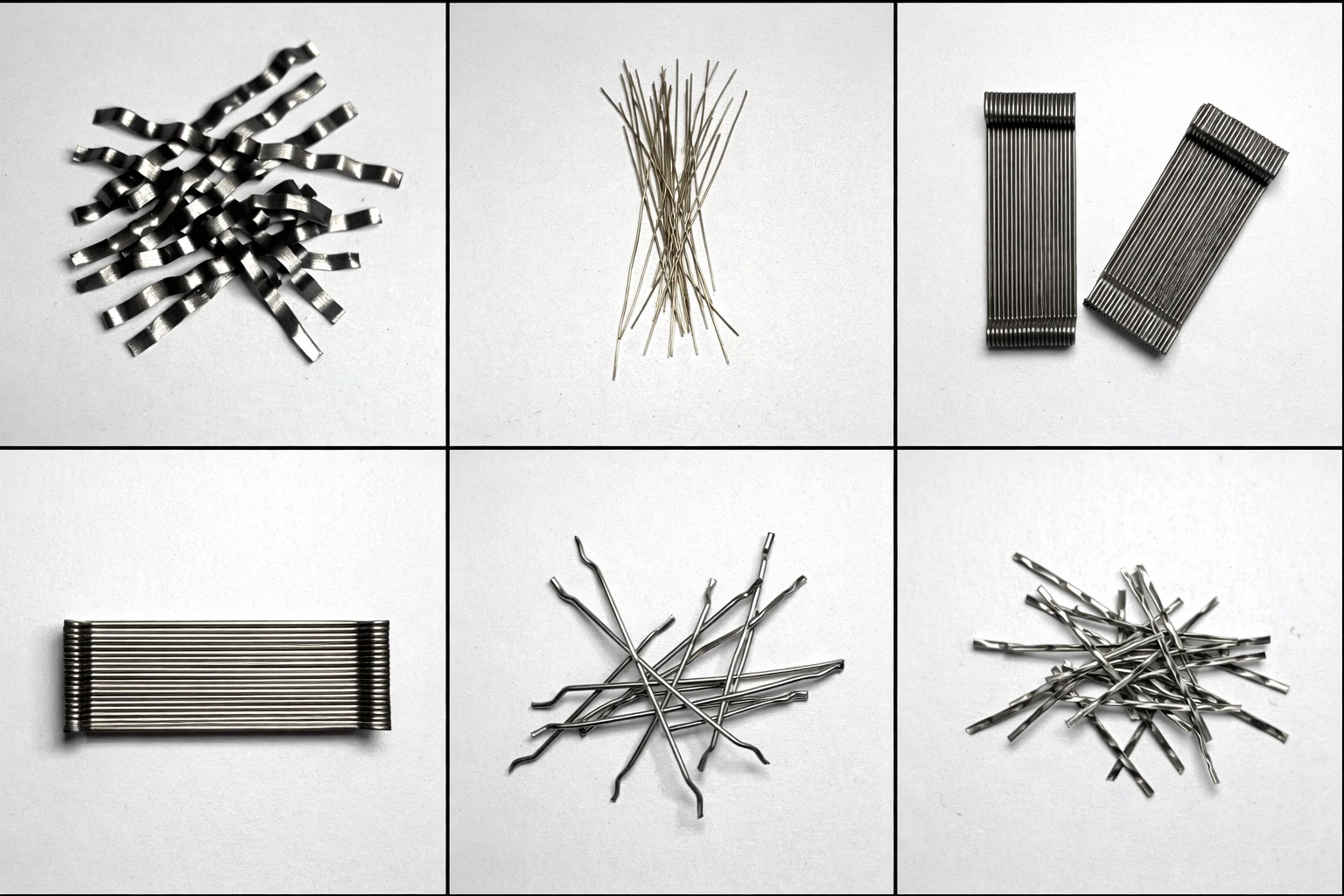
When people ask “What are the different types of steel fiber?”, they usually mean one of two things. They may want the standard classifications used in ASTM or EN standards. Or they may want the common market shapes they see in catalogs, such as hooked-end, crimped, straight, or twisted fibers. Both ways are correct. The standards classify steel fibers mainly by how they are made. The market often describes them by shape and anchorage style.
This is why the topic can feel confusing at first. A fiber may be called cold-drawn wire steel fiber under a standard, but the same product may also be sold as hooked-end steel fiber because that is the shape buyers notice first. So, the best answer is to explain both systems in a simple way.
Kısa Cevap
The main types of steel fiber are usually grouped in two ways:
- By manufacturing method: cold-drawn wire, cut sheet, melt-extracted, mill-cut or shaved cold-drawn wire, and modified cold-drawn wire or milled-from-block fibers, depending on which standard you follow.
- By shape: straight, hooked-end, crimped or corrugated, flat-end or enlarged-end, twisted, and other deformed forms made to improve anchorage in concrete.
If you remember just one thing, remember this: standards focus on where the fiber comes from and how it is produced, while engineers and buyers often focus on the fiber shape and how it grips the concrete.
Steel Fiber Types by Standard Classification
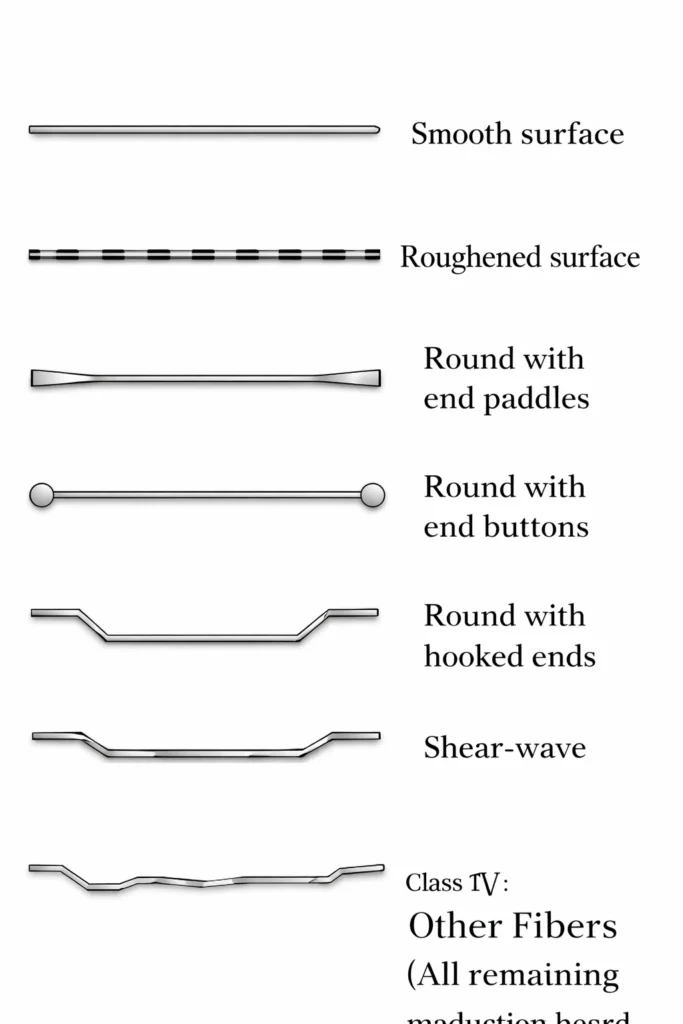
The most widely used standard in North America is ASTM A820/A820M. It defines five steel fiber types for fiber-reinforced concrete. These are Type I cold-drawn wire, Type II cut sheet, Type III melt-extracted, Type IV mill-cut, and Type V modified cold-drawn wire. ASTM also states that these fibers may be straight or deformed.
The main European classification is EN 14889-1. It also uses five groups, but the last categories are named a little differently. EN 14889-1 lists Group I cold-drawn wire, Group II cut sheet, Group III melt-extracted, Group IV shaved cold-drawn wire, and Group V milled from blocks. The same standard also says the fibers may be straight or deformed.
So, when you compare ASTM and EN, the first three groups are easy to match. The difference usually appears in the last two categories. ASTM uses mill-cut ve modified cold-drawn wire, while EN uses shaved cold-drawn wire ve milled from blocks. In real buying work, many suppliers will still describe the product first by shape, because that is easier for contractors to understand.
1. Cold-Drawn Wire Steel Fiber
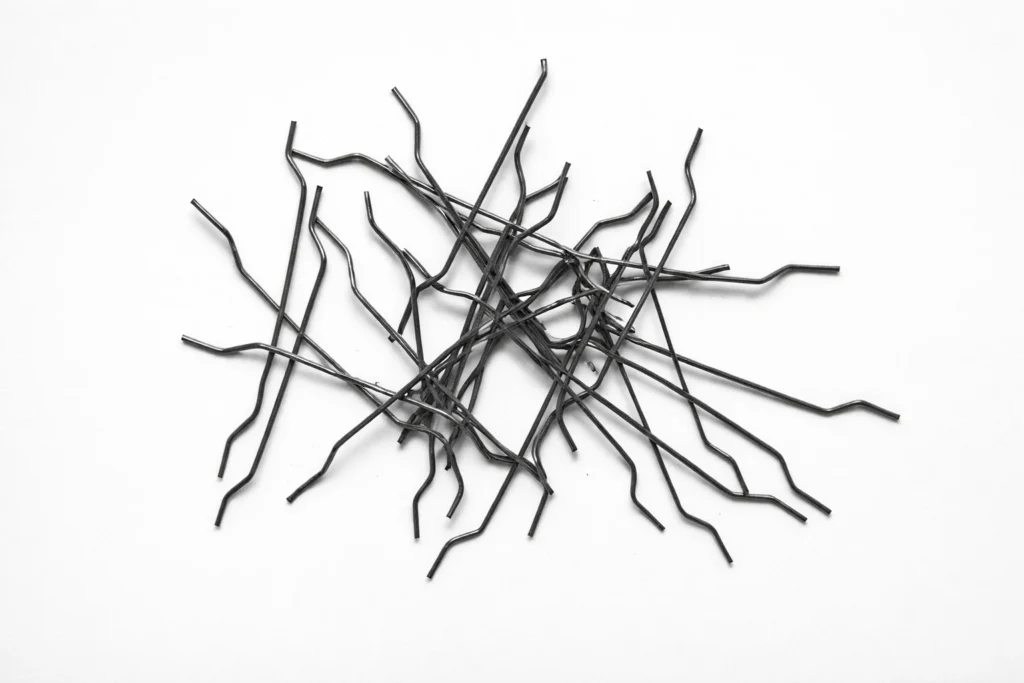
Cold-drawn wire steel fiber is one of the most common categories in the market. Under ASTM it is Type I. Under EN it is Group I. These fibers come from steel wire that is drawn down to the required size, then cut to length, and often deformed for better bonding. Industry guidance from NPCA says cold-drawn wire is the most common steel fiber used in precast concrete because of the high tensile strength of the source wire.
This category covers many of the products that buyers already know, especially hooked-end and some straight fibers. It is very common in precast, slabs, and shotcrete. If you open many steel fiber catalogs, a large part of the product range will be based on cold-drawn wire.
2. Cut Sheet Steel Fiber
Cut sheet steel fiber is made from sheet steel that is slit or cut into narrow fiber pieces. ASTM lists this as Type II. EN lists it as Group II. These fibers can be smooth or deformed, just like other categories.
Cut sheet fibers are a recognized standard type, but they are discussed less often than cold-drawn wire in many everyday product conversations. Even so, they remain part of both major standards, and they are still used where the product geometry and price point fit the job.
3. Melt-Extracted Steel Fiber
Melt-extracted steel fiber is produced directly from molten steel. ASTM lists it as Type III. EN lists it as Group III.
These fibers often have a different surface and cross-section than wire-based products. EN 14889-1 notes that Group III fibers have irregular cross-sections, which is one reason the testing method for tensile strength is handled differently from the first two groups.
4. Mill-Cut Steel Fiber or Shaved Cold-Drawn Wire
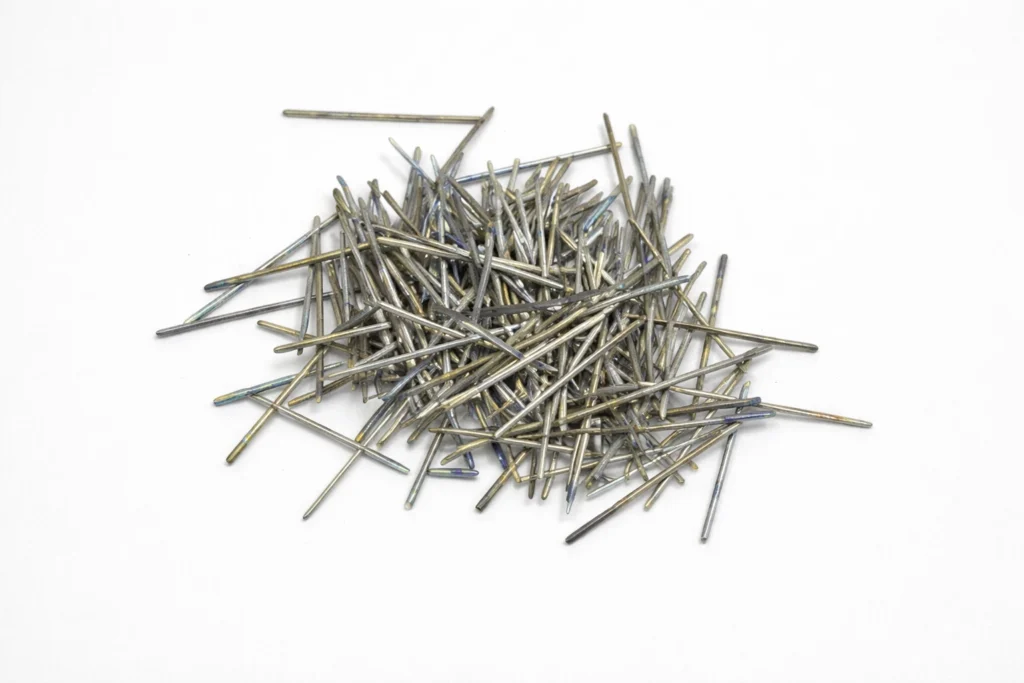
Here the naming changes depending on the standard. ASTM uses Type IV mill-cut. EN uses Group IV shaved cold-drawn wire.
These names do not mean every product is identical across the two standards. Still, both describe fibers that are not the typical basic cold-drawn wire shape. In practical terms, this is one reason engineers check both the standard type and the product sheet before they approve a fiber. The standard type tells you the source and production route. The product sheet tells you the actual geometry, length, aspect ratio, and anchorage shape.
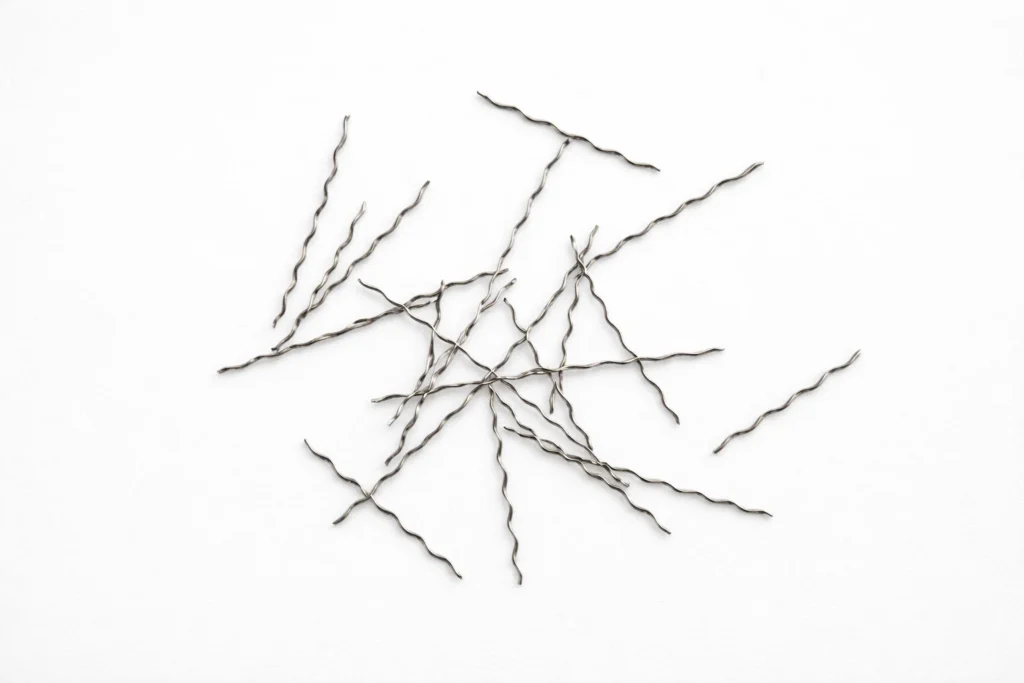
5. Modified Cold-Drawn Wire or Milled-From-Block Steel Fiber
ASTM Type V is modified cold-drawn wire. EN Group V is milled from blocks.
This is another place where buyers need to read carefully. The label is not just a small wording change. It reflects a different standards language. In the market, though, many people will still describe these fibers by the final shape they see, such as deformed, twisted, or another anchorage style, because that helps them judge how the fiber may behave in concrete.
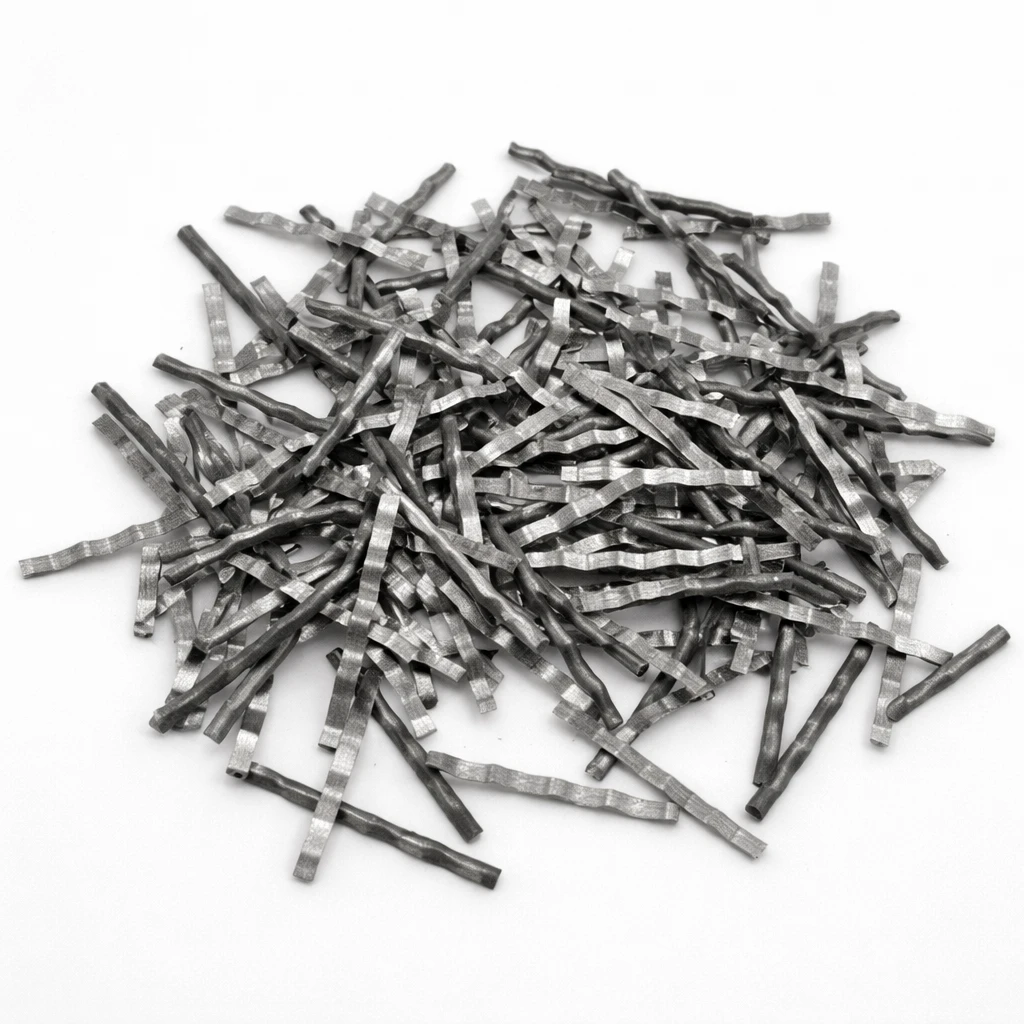
Steel Fiber Types by Shape
For most contractors, designers, and buyers, the shape-based answer is easier to use. That is because the fiber shape affects anchorage, pull-out resistance, mixing behavior, and the final crack-bridging effect. Sika’s handbook lists the main steel macro-fiber shapes as hooked end, flat end, undulating or continuously deformed, and straight fibers. Iowa State’s pavement overview also notes that steel fibers in the market are commonly straight, hooked-end, deformed, or enlarged-end.
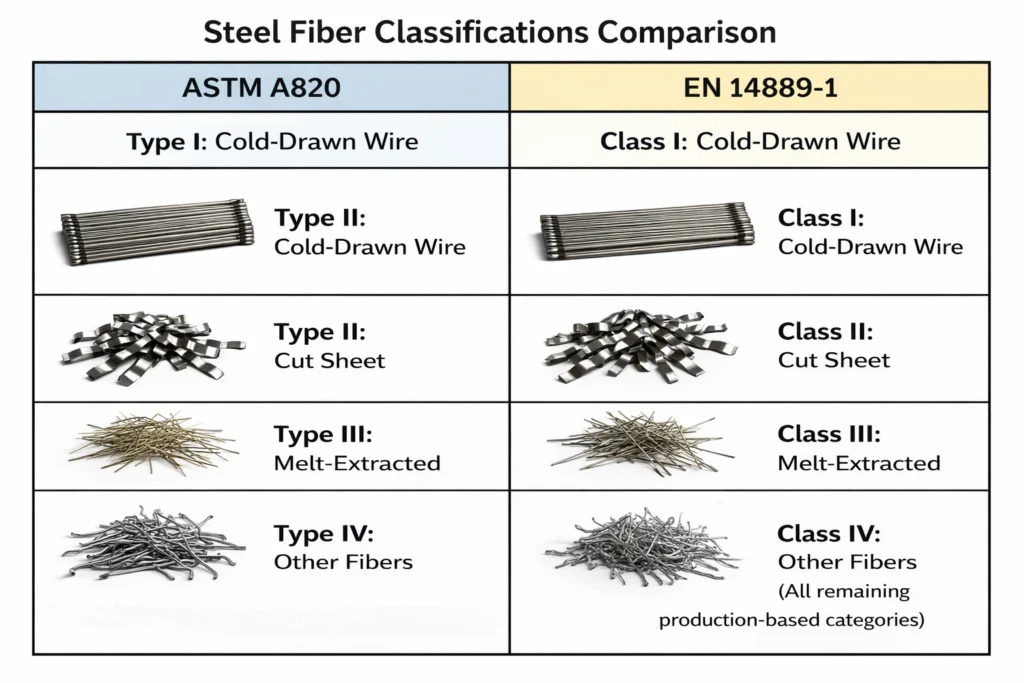
Straight Steel Fiber
Straight steel fiber is the simplest shape. It does not have a hook or a wave. Some straight fibers may still have a roughened surface or a special cross-section, but the body of the fiber remains straight.
Straight fibers are easy to understand, but they usually rely more on bond and friction than on a mechanical end anchor. That is why many modern commercial steel fibers are no longer plain smooth straight wires. Many products now use some kind of deformation to improve pull-out resistance and post-crack performance.
Hooked-End Steel Fiber
Hooked-end steel fiber is one of the best-known commercial shapes. The ends are bent into hooks to improve anchorage inside the concrete. Sika notes that many steel fibers use hooked or flat ends for better anchorage. ETH Zurich teaching material also notes that hooked-end fibers are standard for many applications because the hook gives mechanical anchorage, while straight fibers depend much more on bond alone.
This is one reason hooked-end fibers are so common in industrial floors, precast products, tunnel linings, and structural SFRC work. Buyers like them because the shape is easy to identify and the performance idea is easy to understand: the hook helps the fiber stay engaged across a crack.
Crimped or Corrugated Steel Fiber
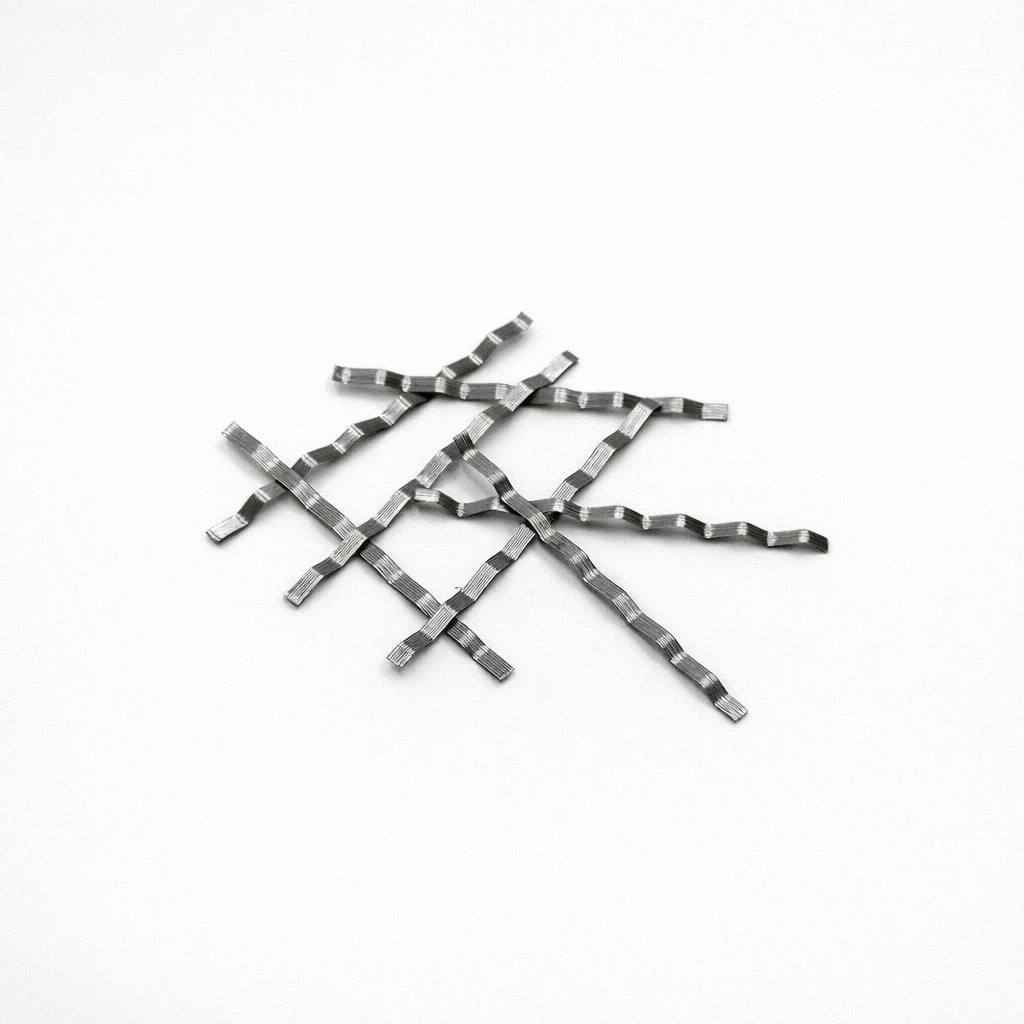
Crimped steel fiber has a wavy or corrugated body. Some documents also call this a deformed or undulated shape, depending on the exact geometry. Iowa State’s pavement overview notes that steel fibers can be deformed, and Sika describes undulating or continuously deformed steel fibers as one of the main steel macro-fiber shapes.
This shape is used to improve bonding and pull-out resistance along the full fiber length, not just at the ends. In project reports and research, crimped fibers often appear as a separate test category beside hooked-end and twisted fibers. A recent bridge deck study funded through transportation research, for example, tested hooked-end, crimped, and twisted steel fibers as three distinct shapes.
Flat-End or Enlarged-End Steel Fiber
Flat-end steel fiber is another common market type. These fibers stay mostly straight, but the ends are enlarged, flattened, or otherwise shaped to increase anchorage. Sika lists flat-end fibers as one of the main steel macro-fiber shapes and notes that flat ends help anchorage. Iowa State’s overview also uses the term enlarged-end for common market forms.
This type can be useful when the supplier wants a straight body but still wants stronger mechanical hold at the crack. In simple terms, it is a middle ground between a plain straight fiber and a more visibly deformed one.
Twisted Steel Fiber
Twisted steel fiber is another important type in the market, especially in higher-performance concrete systems. Transportation research reports show twisted fibers being tested as a separate shape alongside hooked-end and crimped fibers. Academic and technical literature also treats twisted fibers as a distinct geometry because the twist changes bond and pull-out behavior.
Twisted fibers are not always the first choice for every standard concrete slab, but they are well known in advanced fiber-reinforced concrete design. In market language, they are often chosen when stronger mechanical interlock and higher post-crack contribution are desired.
Other Deformed Steel Fibers
Not every product fits neatly into only one popular label. Industry and research sources describe many other deformed forms, including spiral, embossed, paddled, button-ended, coiled, and other special shapes made to improve bond or anchorage. A classic review by Naaman notes that fibers can be smooth, indented, deformed, crimped, coiled, twisted, or made with end hooks, paddles, or buttons. A recent ASCE preview also lists straight, crimped, spiral, twisted, and hooked-end as common geometric categories.
This matters because steel fiber design is not just about the metal itself. It is also about how the fiber grips the cement matrix after cracking starts. That is why so many commercial products use a modified geometry instead of a plain wire shape.
Typical Sizes and Properties
Steel fibers are also described by length, diameter, aspect ratio, tensile strength, and cross-section, not only by type name. The Concrete Society notes that common steel fibers typically fall in the range of about 19 to 60 mm in length, with aspect ratios around 30 to 100, and tensile strengths around 345 to 1700 N/mm². It also notes common cross-sections such as round and flat, plus deformations such as straight, wavy, and end hook.
So, two fibers can both be called hooked-end steel fibers and still behave differently in the concrete. One may be longer. One may have a higher aspect ratio. One may use a stronger steel wire. One may disperse better in the mixer. This is why good suppliers give more than just a shape name. They also provide the size, tensile strength, dosage guidance, and performance data.
Which Type Is the Most Common?
If you ask which type is most common in real concrete work, the answer is usually cold-drawn wire steel fiber, often sold in a deformed shape such as hooked-end. NPCA says cold-drawn wire is the most common steel fiber in precast concrete. Sika’s handbook also says Group I or Type I fibers are the most widely used steel fibers in concrete, and that they are often supplied as straight or deformed products in loose or glued format.
This does not mean the other types are unimportant. It simply means that cold-drawn wire gives the market a strong balance of strength, availability, and manufacturability. That is why many of the fibers that buyers see most often are based on this route.
How to Choose the Right Steel Fiber Type
The best type of steel fiber depends on the job. If the project needs a familiar and widely available option, cold-drawn wire hooked-end fiber is often a strong starting point. If the project needs a different pull-out behavior or a specific performance target, crimped, flat-end, or twisted products may be worth comparing. The shape matters because anchorage controls how the fiber bridges cracks and how much residual strength remains after cracking.
It is also smart to check the standard first. If the project spec is written to ASTM A820, the fiber should match the ASTM type system. If the project is written to EN 14889-1, the product should match the EN group system. After that, the buyer should check the actual product geometry, size, tensile strength, corrosion protection if needed, and the supplier’s test data.
At Ecocretefiber™, this is the practical way to read the market. A buyer should not choose only by one photo or one short label. The right choice comes from matching the fiber type, shape, and performance data to the real job. That is how Shandong Jianbang Kimyasal Elyaf Co, Ltd. approaches steel fiber selection for floors, precast, shotcrete, and other demanding concrete uses.
Sonuç
So, what are the different types of steel fiber? The clearest answer is this: by standard, steel fibers are mainly divided into cold-drawn wire, cut sheet, melt-extracted, mill-cut or shaved cold-drawn wire, and modified cold-drawn wire or milled-from-block fibers. By shape, they are commonly divided into straight, hooked-end, crimped, flat-end, twisted, and other deformed forms.
For most buyers, the most useful approach is to learn both systems. The standard type tells you how the fiber is made. The shape tells you how it is likely to anchor in the concrete. Once you understand both, choosing the right steel fiber becomes much easier. And in most day-to-day concrete projects, the fiber you will see most often is still the cold-drawn wire product, especially in hooked-end form.