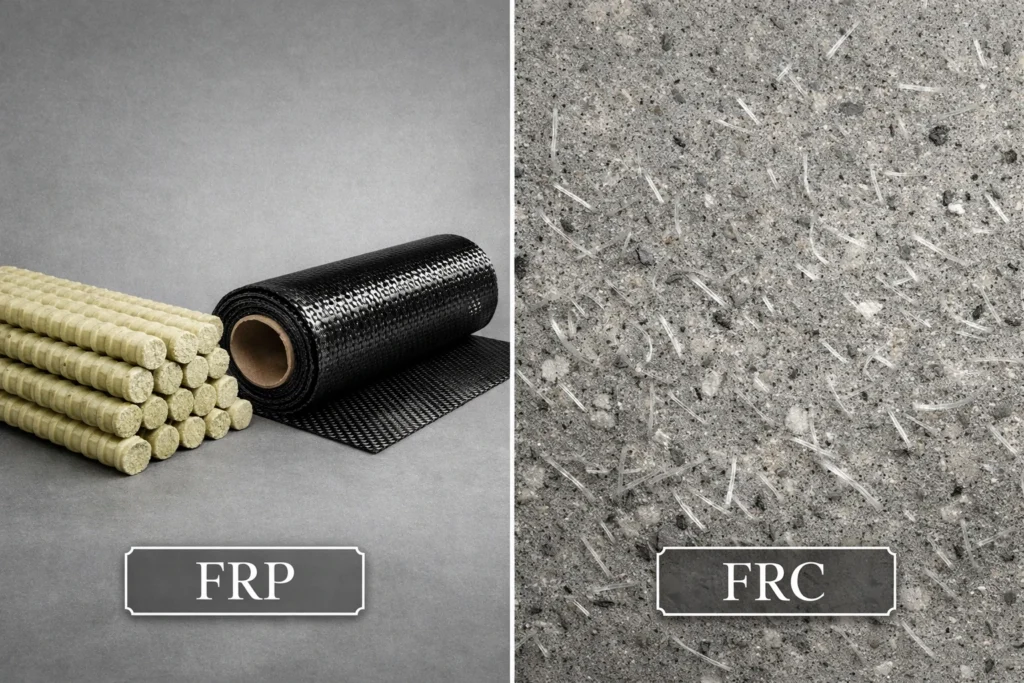
The difference between FRP and FRC is simple once you separate the letters. FRP means fiber-reinforced polymer. It is a composite material made from strong fibers inside a resin matrix. In concrete work, FRP usually appears as bars, tendons, sheets, strips, grids, or near-surface-mounted elements used to reinforce or strengthen concrete members. ACI explains that FRP materials are composite materials that typically consist of strong fibers embedded in a resin matrix, and it notes that the most common fibers are glass, carbon, and synthetic fibers. ACI also has separate documents for GFRP bars in concrete and for externally bonded FRP systems used to strengthen concrete structures.
FRC means fiber-reinforced concrete. It is concrete that contains discrete reinforcing fibers mixed into the concrete itself. ACI defines FRC as concrete made primarily of hydraulic cements, aggregates, and discrete reinforcing fibers. ASTM C1116 also classifies FRC by the type of fiber used: steel, alkali-resistant glass, synthetic, or natural cellulose fibers.
So the short answer is this: FRP is a reinforcement product or strengthening system added to concrete. FRC is the concrete material itself after fibers have been mixed into it.
FRP is usually a bar, sheet, strip, or strengthening system
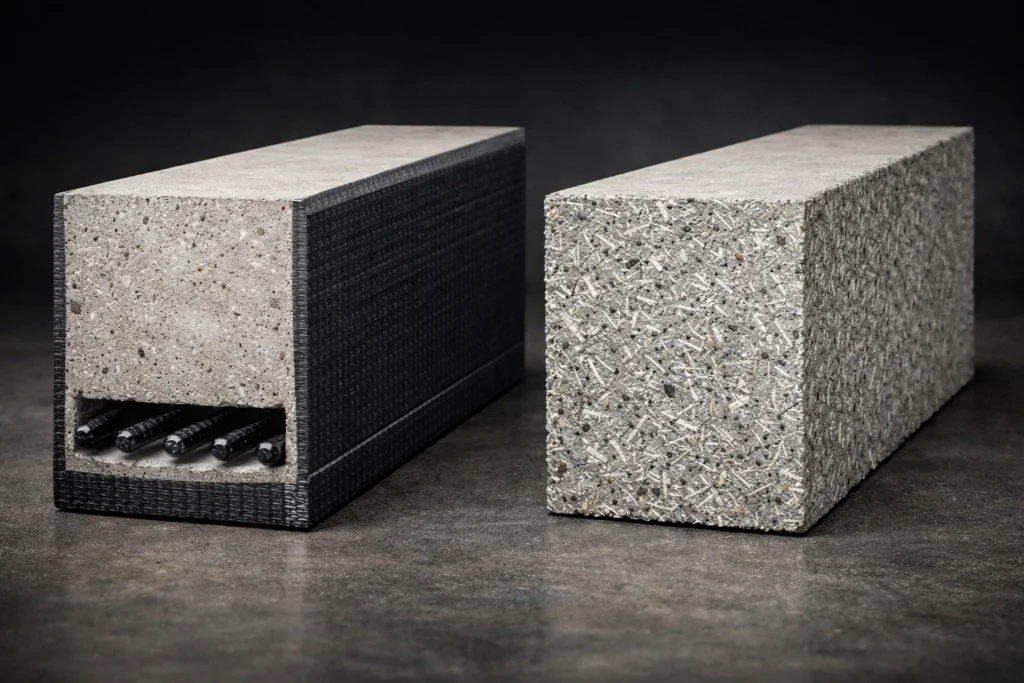
In concrete practice, FRP is usually treated as a reinforcement system. It can be used inside the concrete, such as GFRP reinforcing bars, or outside the concrete, such as externally bonded FRP sheets or laminates for strengthening existing members. ACI CODE-440.11-22 states that it provides minimum requirements for the materials, design, and detailing of structural concrete reinforced with GFRP bars that conform to ASTM D7957-22. ACI PRC-440.2-23 says FRP strengthening systems use FRP composite materials as supplemental externally bonded or near-surface-mounted reinforcement for concrete structures.
This is a big point because FRP behaves more like rebar, prestressing material, or retrofit material than like a concrete ingredient. ACI 440.1R says FRP reinforcing bars offer advantages over steel because they are noncorrosive, and some are nonconductive as well. ACI 440.2-23 also says externally bonded FRP systems are lightweight, relatively easy to install, and noncorroding.
So, when someone says “FRP concrete,” they usually mean concrete reinforced with FRP bars or concrete strengthened with FRP systems. The FRP remains a separate structural product with its own design rules and detailing rules.
FRC is concrete with many short fibers mixed through the whole volume
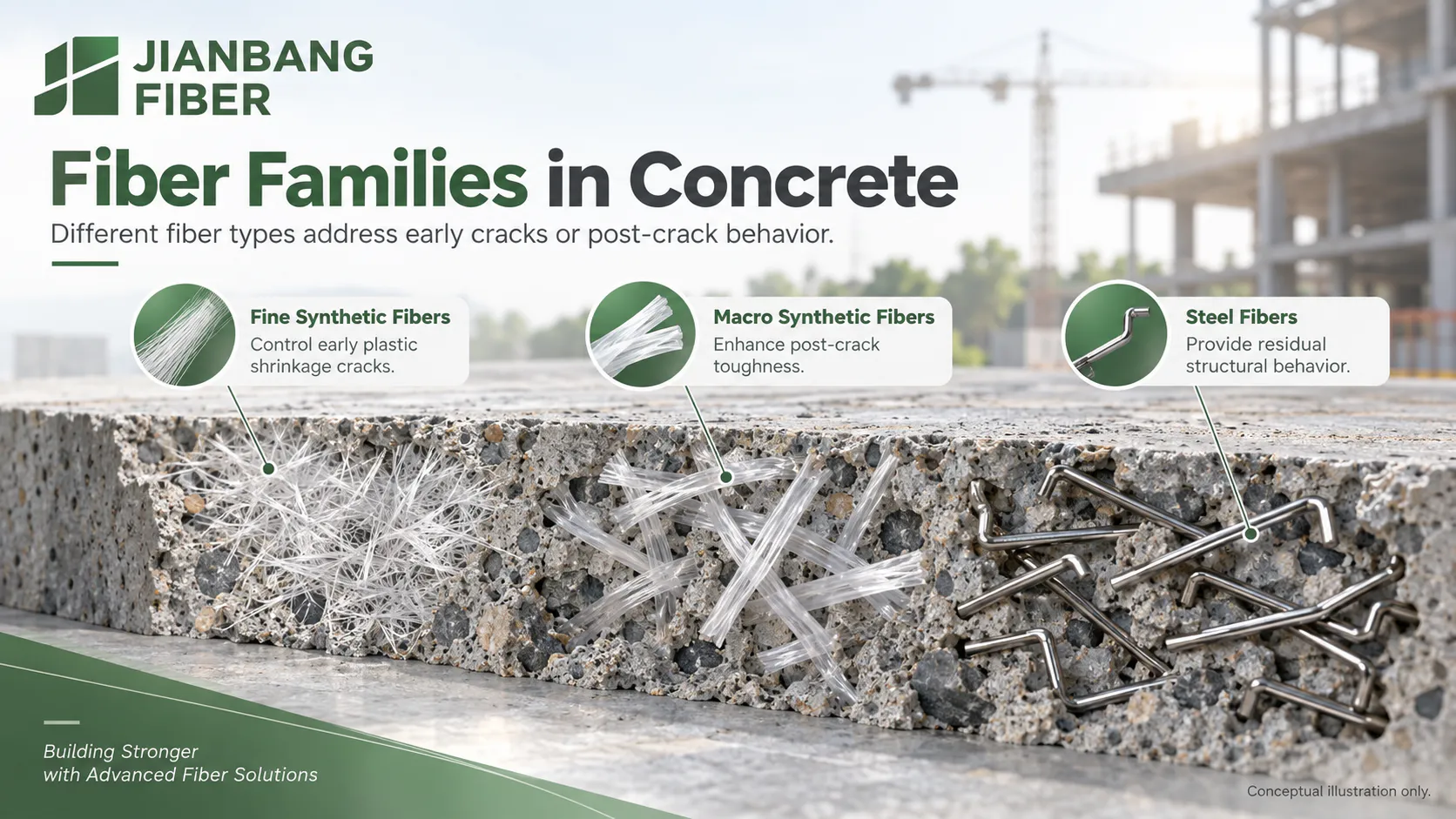
FRC works in a different way. Instead of placing one reinforcement element in one location, FRC uses many short fibers distributed through the concrete volume. ACI’s FRC topic says fiber-reinforced concrete is concrete made primarily of hydraulic cements, aggregates, and discrete reinforcing fibers. ACI’s FAQ on FRC says the fibers are typically cut or formed to lengths up to 2.5 in. (64 mm), and that they can be made from synthetics, steel, natural fibers, or glass.
ASTM C1116 makes the same distinction in specification language. It says fiber-reinforced concrete is delivered with the ingredients uniformly mixed, and it classifies the material by the fiber type incorporated: Type I steel, Type II alkali-resistant glass, Type III synthetic, and Type IV natural cellulose fibers.
This is why FRC is usually discussed as a concrete material system, not as a bar or laminate product. The fibers become part of the mix. They change cracking behavior, toughness, and sometimes structural performance, depending on the fiber type and dosage. ACI 544.4R also notes that fibers can be used in design for slabs-on-ground, composite slabs-on-metal decks, precast units, shotcrete, and hybrid systems with reinforcing bar plus fibers.
FRP and FRC reinforce concrete in different ways
The clearest technical difference is how the reinforcement is delivered into the section.
FRP reinforces concrete through continuous or semi-continuous structural elements. These elements are designed to carry force directly, like bars in tension zones or sheets bonded to the outside of a beam. ACI’s FRP topic says the fibers in FRP composites provide strength and stiffness and generally carry most of the applied loads, while the resin matrix bonds and protects the fibers and transfers stress between them.
FRC reinforces concrete through many discrete short fibers that are dispersed through the concrete. ACI’s terminology and FRC topic define FRC as concrete containing dispersed, randomly oriented fibers. The result is not a single reinforcing line like a bar. The result is a distributed crack-bridging system inside the matrix. fib’s 2022 FRC bulletin summary describes FRC as a composite material characterized by enhanced post-cracking tensile residual strength because fibers bridge crack faces through pull-out mechanisms.
So, FRP acts more like a placed reinforcement member. FRC acts more like a distributed crack-control and toughness-enhancing concrete material.
FRP is often chosen for corrosion resistance and retrofit work
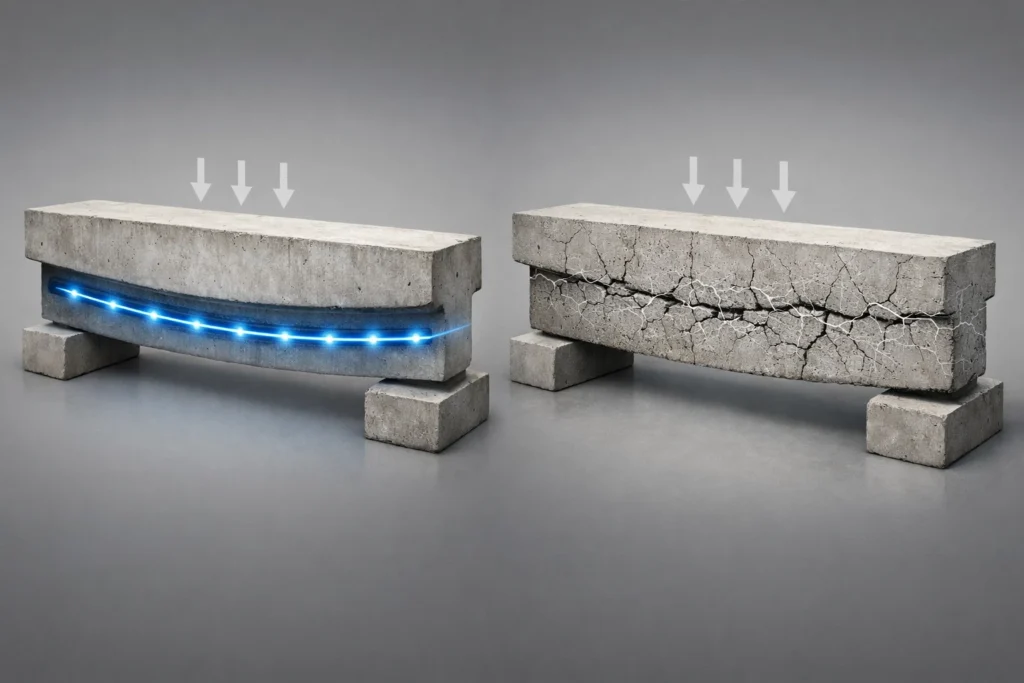
FRP is often selected when the project needs a noncorroding reinforcement alternative or when an existing structure needs strengthening. ACI 440.1R and ACI CODE-440.11-22 both center FRP bar design in structural concrete. ACI PRC-440.2-23 centers FRP sheets, laminates, and near-surface-mounted systems in strengthening and rehabilitation work. The guide states that FRP strengthening systems are alternatives to steel plate bonding, section enlargement, and external post-tensioning.
This is why FRP is common in marine structures, bridge decks, parking structures, water facilities, and rehabilitation projects where steel corrosion is a major concern. The main value case is often durability, low maintenance, low weight, and retrofit convenience. ACI’s FRP topic page shows that the ACI document family for FRP includes bars, externally bonded systems, and circular concrete-filled FRP tubes, which also shows how broad the FRP structural category is.
FRC can also help durability, but it is usually not the first answer when the project needs a rebar replacement material or an external strengthening laminate. That is the FRP side of the market.
FRC is often chosen for crack control, toughness, and some structural applications
FRC is often selected when the project needs better crack control, better post-crack behavior, better toughness, or simpler reinforcement workflows in applications like slabs, shotcrete, overlays, and precast elements. ACI 544.4R says standard tests are used to characterize FRC performance for design purposes, including flexure, shear, and crack-width control, and it lists applications such as slabs-on-ground, composite slabs-on-metal decks, pile-supported ground slabs, precast units, shotcrete, and hybrid reinforcement.
ASTM C1116 and ACI 544 also show that FRC is a broad family. It can use steel fibers, synthetic fibers, glass fibers, or natural fibers, depending on the application. ACI’s FAQ also says the addition of fibers improves crack resistance, toughness, and durability under various loading conditions.
So, if the project question is “How can I improve concrete cracking and residual behavior inside the mix itself?” the answer often moves toward FRC. If the question is “How can I reinforce or strengthen this member with bars, grids, or bonded systems?” the answer often moves toward FRP.
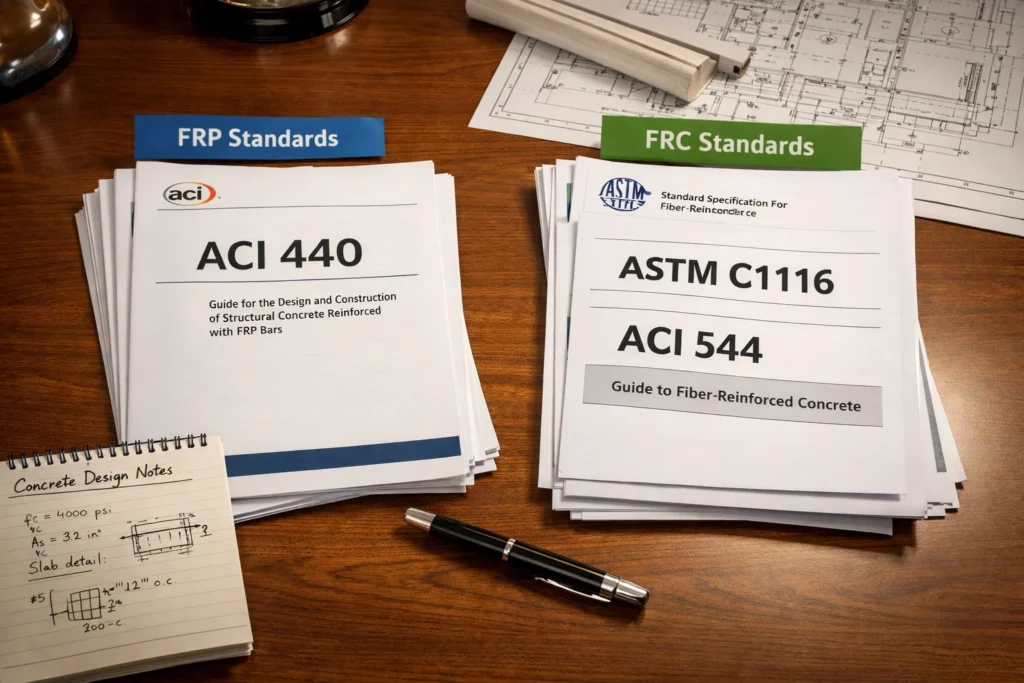
FRP and FRC follow different design documents
Another major difference is the design framework.
FRP in concrete usually follows the ACI 440 family or other FRP-specific codes and standards. ACI CODE-440.11-22 addresses structural concrete reinforced with GFRP bars. ACI PRC-440.2-23 addresses externally bonded FRP systems for strengthening concrete structures. These are dedicated FRP documents because FRP bars and FRP systems do not behave like steel, and they need different design and detailing rules.
FRC usually follows ASTM C1116 for material specification and ACI 544 documents for behavior, testing, and design. ASTM C1116 defines the FRC material families. ACI 544.4R covers design with FRC and points to applications and methods for flexure, shear, and crack-width control. fib Model Code 2020 even separates members with FRC from members with FRP reinforcement in its contents, which shows that modern code development treats them as distinct structural subjects.
This matters to buyers and engineers because you should not expect one product family to fit the other family’s design logic. FRP and FRC may both include the word “fiber,” but they do not sit under one single design path.
FRP is usually directional, and FRC is usually distributed
FRP reinforcement is usually placed where the designer wants force to flow. FRP bars are placed in tension zones. FRP sheets are bonded where flexural or shear demand must be increased. FRP laminates and NSM bars are oriented to resist a specific stress path. ACI PRC-440.2-23 gives examples such as flexural strengthening of reinforced concrete beams and strengthening with near-surface-mounted FRP bars.
FRC is different because the fibers are dispersed through the whole concrete mass. ACI defines FRC as concrete with dispersed, randomly oriented fibers. That does not mean fibers are equally effective in every direction in every test, but it does mean the reinforcement concept is volumetric and distributed, not placed only at a few bars or strips.
This difference leads to a simple rule: FRP is usually placed reinforcement; FRC is usually mixed-in reinforcement. That is one of the easiest ways to explain the difference to a buyer or spec writer.
FRP and FRC also differ in failure behavior and structural role
FRP reinforcement has its own mechanical behavior, and designers need special rules because FRP does not behave like steel. ACI 440.1R says FRP bars offer advantages over steel, but it also notes that their physical and mechanical behavior differs enough that unique guidance is necessary. The same distinction appears again in ACI CODE-440.11-22, which is a dedicated FRP concrete code instead of a simple steel-rebar substitution rule.
FRC, by contrast, is often discussed in terms of post-cracking residual strength, crack-width control, and toughness. fib’s FRC bulletin summary describes FRC as a composite material with enhanced post-cracking tensile residual strength due to fiber bridging. ACI 544.4R also describes fibers as supplements that can reduce reinforcing bar demand in some applications, though the preview notes that in many structural members reinforcing bars are still used to support the total tensile loads.
So, FRP often serves as a primary reinforcing or strengthening element. FRC often serves as a distributed crack-control and post-crack performance material, and in some applications it can also contribute to structural design. The roles can overlap in advanced systems, but they are not the same role by default.
Can FRP and FRC be used together?
Yes. They are different systems, but they are not mutually exclusive. ACI’s International Concrete Abstracts Portal recently listed research on FRCC beams reinforced with FRP bars, and newer research also discusses the combination of FRP bars with fiber-reinforced cementitious composites to improve stiffness and crack behavior. That tells you something important: engineers can combine an FRP reinforcement system with a fiber-reinforced concrete or cementitious matrix when the application and design justify it.
This is helpful because some buyers assume they must choose one and reject the other. In reality, the two systems answer different questions. A project can use FRP bars to solve corrosion and reinforcement placement issues, and also use FRC to improve crack control and residual performance in the matrix.
Still, that does not mean you should blur the terms. The systems can work together, but FRP is still FRP and FRC is still FRC.
A simple way to remember the difference
If you want the fastest practical rule, use this one:
FRP = a fiber composite reinforcement product made from fibers and resin.
It is usually a bar, sheet, laminate, grid, or tendon used to reinforce or strengthen concrete.
FRC = concrete with short fibers mixed into the concrete itself.
It is a concrete material system used to improve cracking behavior, toughness, and sometimes structural performance.
That difference is simple, but it prevents many specification mistakes.
Why this difference matters for buyers
For a buyer, the FRP vs FRC difference is not only academic. It changes the supplier category, the design path, the installation method, the documents you ask for, and the performance you expect.
If you are buying FRP, you are often buying a shaped product with bar properties, laminate properties, bond properties, resin properties, and code-specific detailing requirements. If you are buying FRC, you are often buying a fiber type, dosage concept, material specification, and test-backed concrete performance package. ASTM C1116, ACI 544, and ACI 440 do not ask the same questions because the systems are not the same.
This is why clear terminology matters in procurement. If a customer asks for “fiber reinforcement,” you should not guess. You should ask whether the need is FRP reinforcement, FRP strengthening, or FRC concrete performance. That one step can prevent the wrong quote, the wrong data sheet, and the wrong test basis.
Why this topic matters for Ecocretefiber™
For Ecocretefiber™, this topic is valuable because many searchers confuse these two terms at the start of the buying journey. They see “fiber-reinforced” in both names and assume the products are comparable. They are not. A clear article like this helps move a buyer from broad search language to correct product language.
It also helps qualify demand. A buyer looking for FRP bars or FRP strengthening is on a different path from a buyer looking for fiber-reinforced concrete. If your brand mainly serves the concrete-fiber side, then educating the market on the FRP vs FRC difference is a practical way to bring the right customers closer to the right product discussion.
Conclusion
The difference between FRP and FRC is direct once the terms are unpacked. FRP means fiber-reinforced polymer, which is a composite reinforcement material made from fibers in a resin matrix and used as bars, sheets, laminates, or strengthening systems in concrete structures. FRC means fiber-reinforced concrete, which is concrete that contains discrete fibers mixed throughout the material.
FRP is usually a placed reinforcement or retrofit system. FRC is usually a concrete material system with distributed fibers. FRP follows the ACI 440 family and related FRP standards. FRC follows ASTM C1116, ACI 544, and other FRC-specific design and test frameworks.
So, the best practical rule is this: FRP is reinforcement made from polymer composite. FRC is concrete made better by discrete fibers. They can be used for related goals, and in advanced systems they can even be combined, but they are different materials, different systems, and different design conversations.