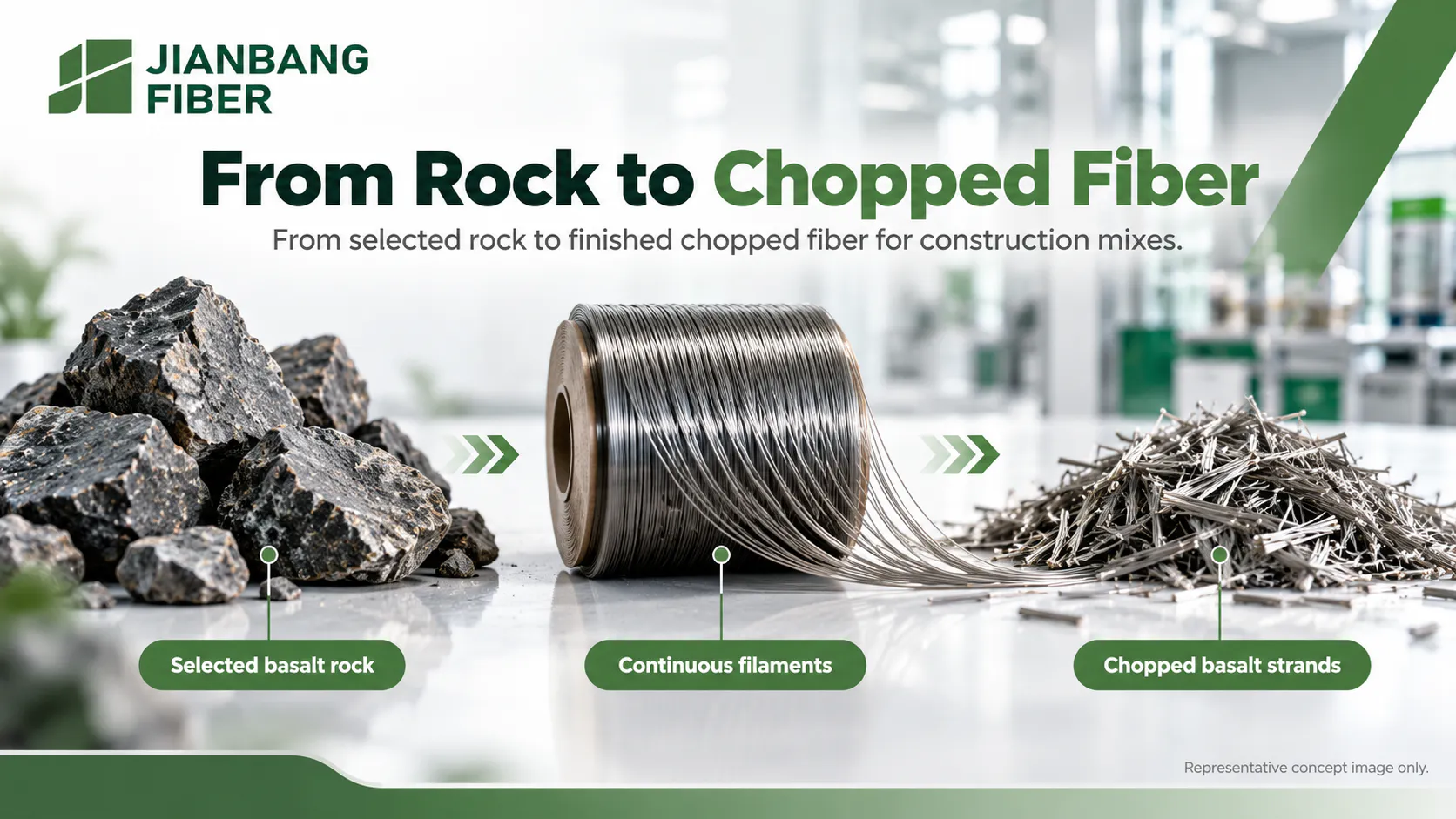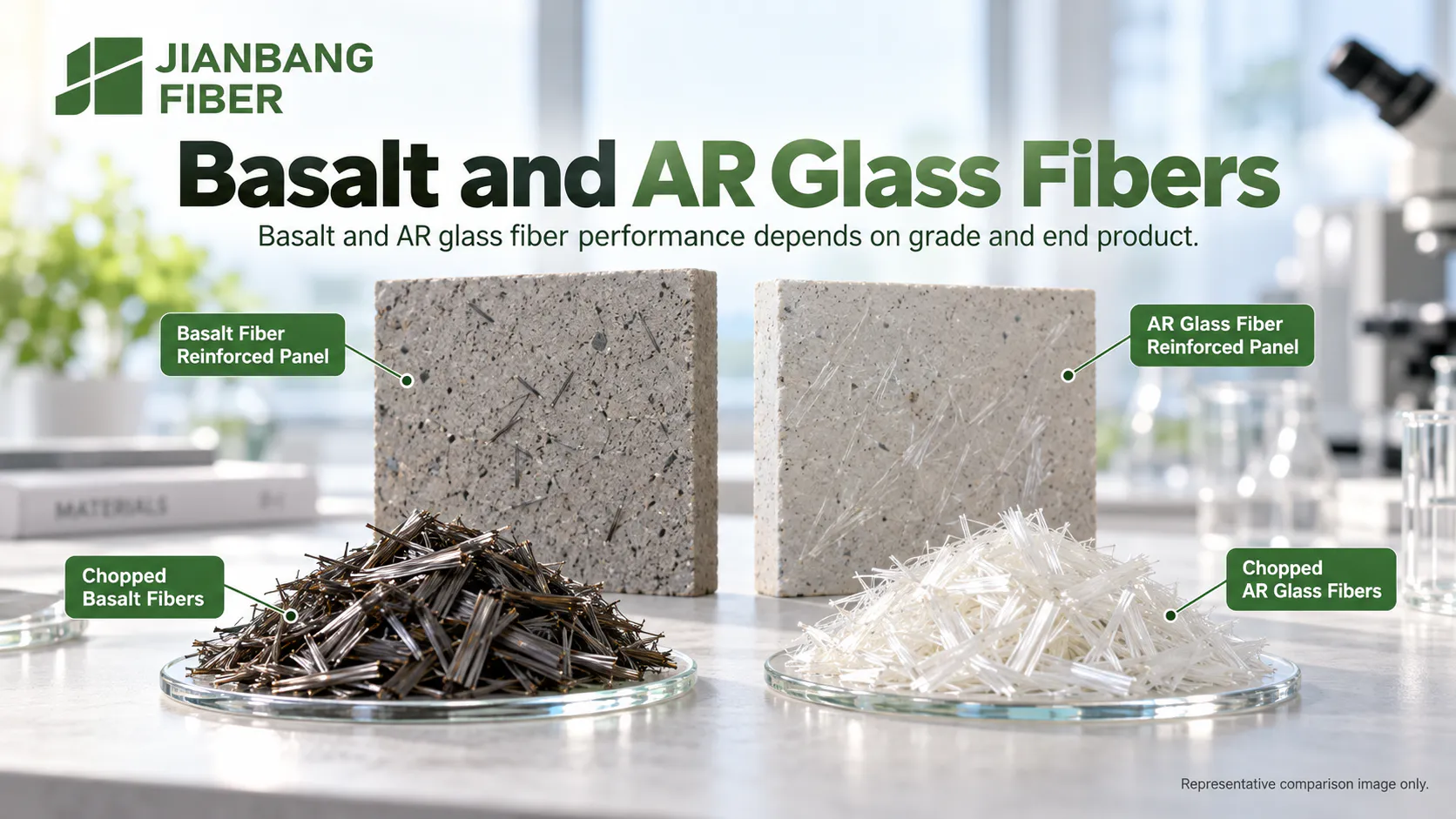
Fibre reinforced concrete, often shortened to FRC, is concrete made with cement, aggregates, and discrete reinforcing fibres mixed through the material. ACI defines fibre reinforced concrete as concrete made mainly of hydraulic cements, aggregates, and discrete reinforcing fibres. ASTM C1116 also treats it as concrete delivered with the ingredients uniformly mixed, and it classifies it by the fibre used: steel, alkali-resistant glass, synthetic, or natural cellulose fibres.
In simple words, fibre reinforced concrete is ordinary concrete that contains many small fibres spread through the whole mix. These fibres are not placed like rebar in one fixed line. They are distributed through the volume of the concrete, so they help the material resist cracking in many directions. That is why FRC is often chosen when a project needs better crack control, better toughness, and better post-crack behavior than plain concrete can offer.
At Ecocretefiber™, we explain FRC in a very practical way. It is not a completely different material family from concrete. It is still concrete. The difference is that short fibres are added to improve how the concrete behaves before cracking, during cracking, and after cracking, depending on the fibre type and dosage. This is why Shandong Jianbang Chemical Fiber Co., Ltd. treats fibre selection as a performance decision, not just a material label.
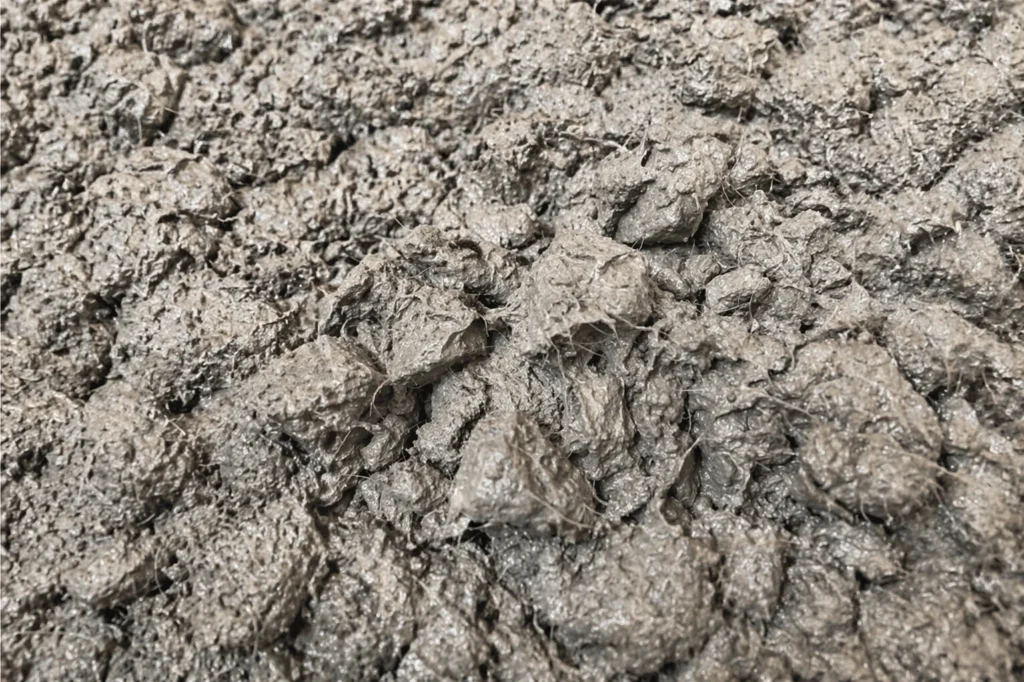
What Fibre Reinforced Concrete Means
The easiest way to understand FRC is to compare it with plain concrete. Plain concrete is strong in compression, but it is brittle in tension and does not have much post-crack ductility. ACI’s report explains that brittle matrices such as plain concrete have no significant post-cracking ductility, and that adding fibres causes post-elastic property changes that can range from small to very large depending on the matrix and the fibres used.
This is why fibres are added. When cracks start to form, the fibres can bridge across those cracks and help the concrete hold together better. The exact effect depends on the fibre material, length, shape, aspect ratio, surface bond, and dosage. ACI highlights all of these as important variables in how fibre reinforced concrete performs.
So, when someone asks “What is fibre reinforced concrete?”, the best direct answer is this: it is concrete with many short fibres distributed through the mix to help control cracking and improve toughness or residual strength. Some fibres are used mainly for early-age crack control. Others are used mainly to improve post-crack load capacity. Good FRC design depends on knowing which role is needed.
How Fibre Reinforced Concrete Works
FRC works because the fibres act inside the concrete after stresses begin to create microcracks and larger cracks. Instead of letting one crack open freely, the fibres help bridge the crack and share stress across the damaged zone. ACI explains that fibres change the post-elastic response of concrete, and this is the key reason they are used in practice.
This does not mean fibres make concrete uncrackable. Concrete still cracks. The real value is that fibres can help control crack width, delay crack growth, improve energy absorption, and help the section keep carrying load after the matrix cracks. That is why FRC is linked so closely with toughness and residual strength in engineering use. A recent Concrete Society leaflet also explains that fibres greatly increase the toughness of concrete and allow it to sustain load after cracking.
Different fibres do this in different ways. Fine microfibres often help most in the early stage by reducing plastic shrinkage cracking. Larger steel or macro synthetic fibres are more often chosen when the project needs stronger post-crack performance in hardened concrete. The Concrete Society notes that short polypropylene fibres are mainly used to reduce early crack formation in young concrete, while larger macro synthetic fibres can give post-cracking strength similar to steel fibres in some uses.
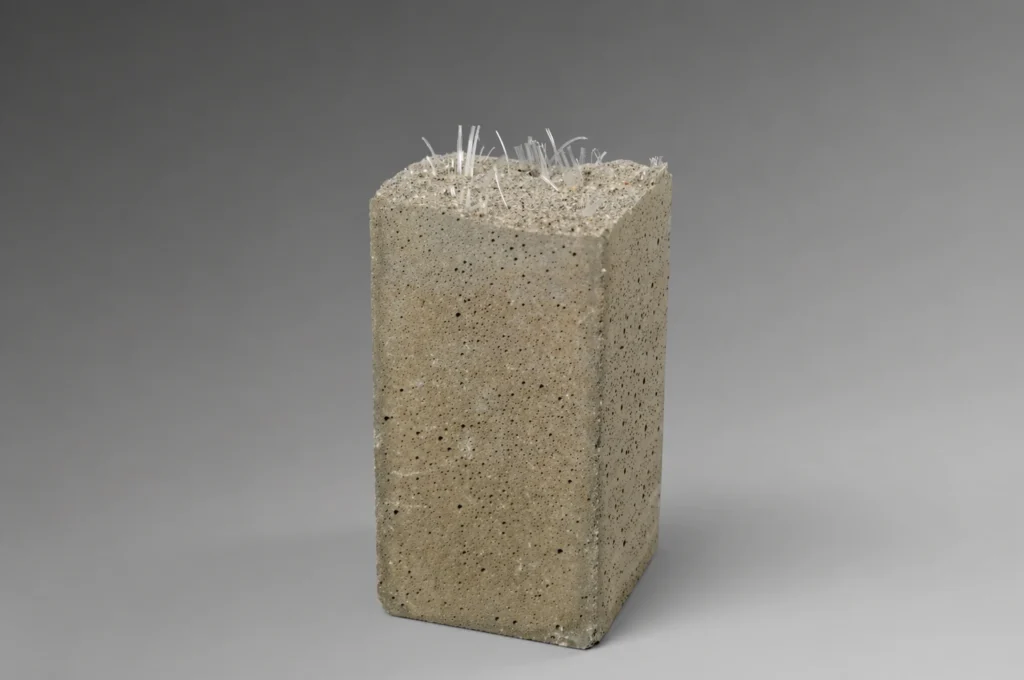
The Main Types of Fibre Reinforced Concrete
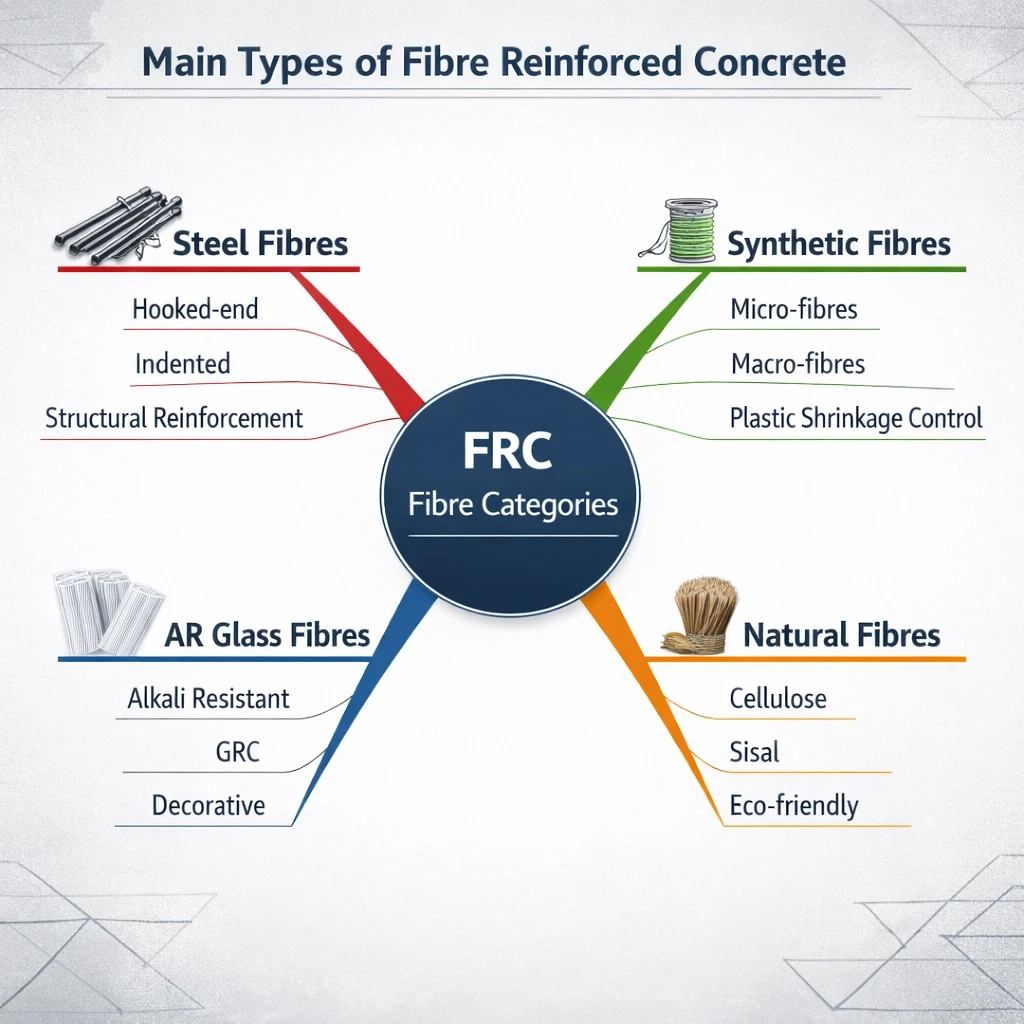
One of the clearest ways to understand FRC is by fibre type. ASTM C1116 divides fibre-reinforced concrete into four material classes: Type I steel fibre-reinforced concrete, Type II glass fibre-reinforced concrete with alkali-resistant glass fibres, Type III synthetic fibre-reinforced concrete, and Type IV natural fibre-reinforced concrete with cellulose fibres. ACI’s general review uses a similar structure and discusses steel, glass, synthetic, and natural fibres as the main groups.
Steel Fibre Reinforced Concrete
Steel fibre reinforced concrete is one of the best-known FRC types. It is often used where the project needs strong post-crack capacity, impact resistance, fatigue performance, or high toughness. ACI’s fibre report includes a full section on steel FRC, and ACI’s FAQ says FRC is widely used in slabs-on-ground, floors, and pavements because the three-dimensional reinforcement improves crack resistance and service life.
Synthetic Fibre Reinforced Concrete
Synthetic fibre reinforced concrete usually uses polypropylene, polyolefin, or similar polymers. This family includes both micro synthetic fibres and macro synthetic fibres. The Concrete Society explains that short polypropylene fibres are used mainly for plastic crack control, while larger macro synthetic fibres are used in paving, sprayed concrete, and precast units because they can provide post-cracking strength similar to steel fibres in some cases.
Glass Fibre Reinforced Concrete
Glass fibre reinforced concrete uses alkali-resistant glass fibres, not ordinary glass fibres. ASTM C1116 specifically says Type II glass fibre-reinforced concrete contains alkali-resistant glass fibres, and ACI’s review has a separate section on glass fibre reinforced concrete because its behavior and durability issues are different from steel or synthetic systems. This type is used widely in thin architectural products and GFRC panels.
Natural Fibre Reinforced Concrete
Natural fibre reinforced concrete uses fibres such as cellulose and other plant-based materials. ASTM includes natural cellulose fibre concrete as Type IV. ACI also lists vegetable fibres such as sisal and jute as reinforcement options in its general definition of FRC. This group is less common in mainstream heavy concrete work, but it is still part of the broader FRC family.
What Fibre Reinforced Concrete Improves
The first major benefit of FRC is crack control. This is the reason many buyers first look at concrete fibres. ACI and the Concrete Society both show that fibres are used to reduce cracking, though the type of cracking depends on the fibre selected. Fine synthetic fibres are especially associated with reduced plastic shrinkage cracking in young concrete.
The second major benefit is toughness. Toughness means the concrete can absorb more energy and keep working better after cracks form. This is especially important in slabs, pavements, shotcrete, and impact-prone concrete. ACI states that adding fibres changes the post-elastic response of concrete, and the Concrete Society notes that fibres can greatly increase toughness and post-crack load retention.
The third major benefit is better post-crack performance. Not all fibres do this equally. Microfibres are often chosen for early-age crack control, but macro synthetic fibres and steel fibres are more often used when the structure must still carry useful load after cracking. This is why engineers pay close attention to fibre type, geometry, and test results instead of looking only at raw fibre strength.
Some FRC systems can also offer gains in impact resistance, fatigue resistance, abrasion behavior, and durability-related performance. The exact improvement depends on the matrix and the fibre system, so buyers should avoid treating all FRC as the same product. Good performance comes from the composite, not just from the fibre alone.
Where Fibre Reinforced Concrete Is Used
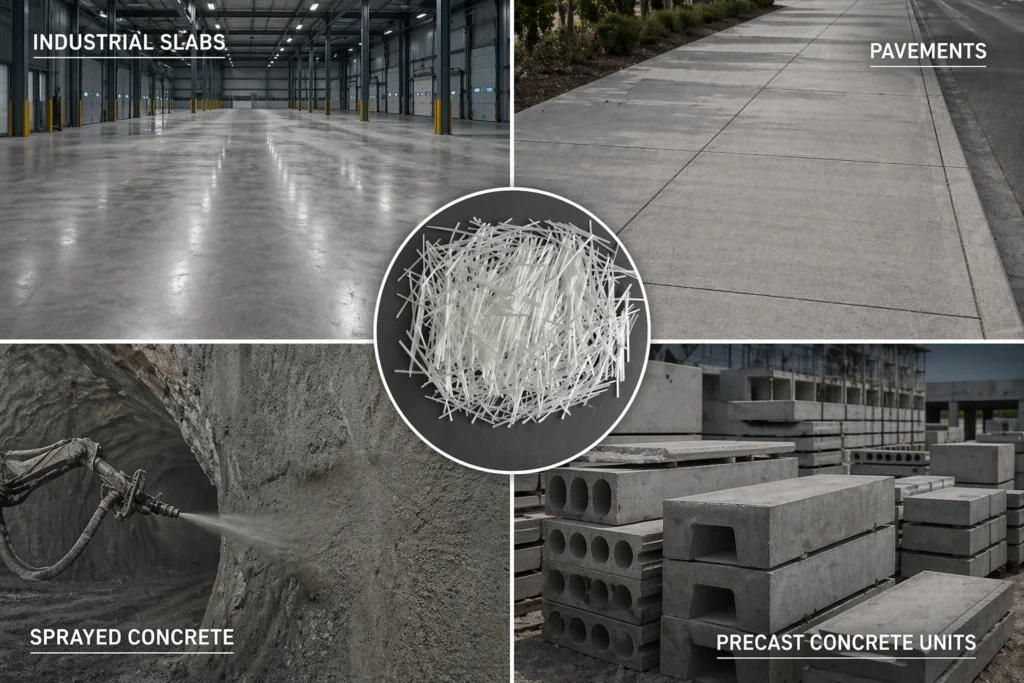
In practice, one of the biggest use areas for FRC is slabs-on-ground. ACI’s FAQ says a primary application area is slabs-on-ground, including residential and commercial floors and pavements. The same source notes that fibres improve crack resistance near the surface and help extend service life.
FRC is also widely used in pavements and external paved areas. These zones see repeated wheel loads, shrinkage stress, and long-term wear, so crack control and toughness matter. The Concrete Society says larger macro synthetic fibres are used in similar applications to steel fibres, including paving.
Another key application is sprayed concrete or shotcrete. The Concrete Society states that short steel fibres are used in sprayed concrete to improve cohesion, reduce rebound, and control cracking. Macro synthetic fibres are also used in sprayed concrete, especially when durability concerns affect the fibre choice.
FRC is also common in precast units. The Concrete Society mentions precast units among the applications for macro synthetic fibres, and many industry references also point to tunnel segments, bridge decks, composite slabs, and other specialized precast or semi-structural uses.
This range of applications is one reason FRC has become so important in modern concrete design. It is not limited to one niche market. It is used in everyday industrial floors as well as in more demanding engineering systems, provided the fibre type and the design method match the job.
What Fibre Reinforced Concrete Is Not
FRC is often misunderstood in two ways. The first mistake is to think fibres prevent all cracks. They do not. Concrete still shrinks, still moves, and still cracks. Fibres help control crack formation and crack width, but they do not make concrete immune to cracking. That is why good joint design, curing, and overall structural design still matter.
The second mistake is to think fibres automatically replace all steel reinforcement. That is also not true. In some applications, fibres can replace nominal reinforcement or simplify reinforcement layouts. The Concrete Society notes approved use of steel or macro synthetic fibres in some composite slabs on metal decking, but it also says only specific combinations have been approved. In other words, replacement depends on tested systems and proper design, not on a general claim.
So the best way to view FRC is not as a miracle product. It is a performance tool. When the right fibres are chosen and the concrete is designed well, FRC can solve real crack-control and toughness problems. When the wrong fibre is chosen, the material may not deliver the needed result.
How Fibre Reinforced Concrete Is Mixed and Placed
One useful practical point is that FRC is usually placed and finished in ways that are close to conventional concrete practice. The Concrete Society says concretes containing fibres can be placed, compacted, and finished using the same methods as concrete without fibres, though vibration and proper distribution still matter. It also warns that when fibres are added at the truck, they must be fully distributed through the load.
This matters for buyers and contractors because FRC is not meant to create unnecessary site difficulty. Good fibre products should disperse well in the mix and avoid fibre balls. ASTM C1116 also says the fibre-reinforced concrete should be free of fibre balls when delivered. That is a simple but important quality point in real production.
At Ecocretefiber™, this is how we explain the value of good fibre supply. A concrete fibre is not useful only because it exists on a data sheet. It has to mix well, distribute well, and perform in the real concrete system. That is why Shandong Jianbang Chemical Fiber Co., Ltd. focuses on concrete use conditions, not only on fibre material names.
Why Fibre Reinforced Concrete Matters
FRC matters because it addresses one of concrete’s oldest problems: brittleness after cracking. ACI’s basic discussion of FRC is built around this point. Plain concrete is brittle, and fibres are used to improve the way it behaves after cracking begins. That makes fibre reinforcement valuable in modern construction, where durability, surface performance, service life, and crack control are all important.
It also matters because different fibre systems let engineers tune the concrete for different goals. A project may need early-age plastic crack control, better post-crack slab performance, better sprayed-concrete cohesion, or a noncorrosive reinforcement option. Fibre reinforced concrete gives the design team more ways to reach those targets than plain concrete alone.
For a brand like Ecocretefiber™, this is the core message behind FRC. The goal is not to add fibres for marketing only. The goal is to produce concrete that works better on the actual job, whether that means fewer early cracks, stronger post-crack behavior, or a more durable slab or pavement. That practical view is why fibre reinforced concrete continues to grow across flooring, paving, sprayed concrete, and precast markets.
Conclusion
Fibre reinforced concrete is concrete that contains short, discrete reinforcing fibres distributed through the mix. These fibres can be steel, alkali-resistant glass, synthetic, or natural fibres, depending on the standard and the application. The main purpose of FRC is to improve crack control, toughness, and post-crack performance compared with plain concrete. Its most common applications include slabs-on-ground, floors, pavements, sprayed concrete, and precast units.
The most useful way to think about FRC is simple. It is still concrete, but it is concrete designed to behave better when cracking begins. Some fibre systems are best for early-age crack control. Others are best for residual strength after cracking. When the fibre type matches the job, fibre reinforced concrete becomes a very practical way to build more reliable concrete. That is the approach we support at Ecocretefiber™, and it is how Shandong Jianbang Chemical Fiber Co., Ltd. views modern concrete fibre reinforcement.