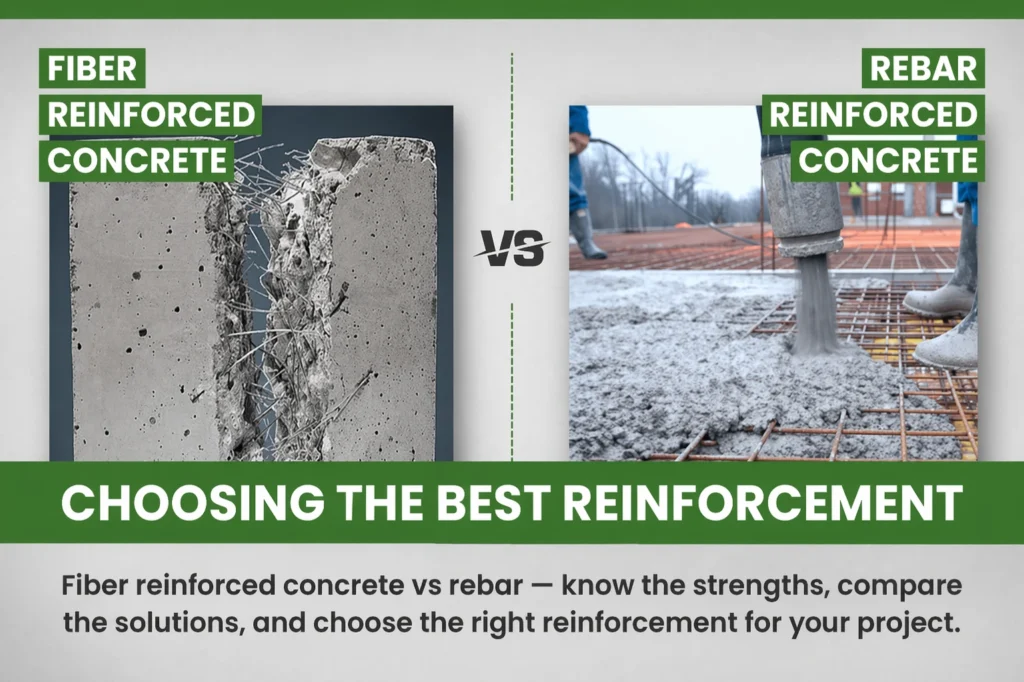
Fiber-reinforced concrete is not simply better than rebar, and rebar is not simply better than fiber-reinforced concrete. They do different jobs. In the clearest engineering sense, rebar is still the better choice for continuous primary tension reinforcement in many beams, walls, columns, and suspended slabs, because ACI explains that reinforcement is used to provide additional strength where it is needed and that steel provides the tensile strength in beams and slabs, supplements compression in columns and walls, and adds shear strength in beams. At the same time, ACI’s guide to FRC explains that fibers can supplement and reduce reinforcing bars in various structural members and, in some applications such as slabs-on-ground, pavements, overlays, shotcrete linings, slabs-on-piles, and some precast units, fibers may be used as the sole reinforcement.
So the right answer to the title is this: fiber-reinforced concrete is better when the project needs distributed crack control, toughness, post-crack residual strength, faster installation, or less conventional mesh handling; rebar is better when the structure needs continuous, anchored, code-familiar tensile reinforcement across supports and through critical sections. In many real projects, the best answer is not one or the other. It is both. ACI 544.4R explicitly includes hybrid reinforcement, which means reinforcing bar plus fibers, as a defined application area for design.
They Are Not Competing in Exactly the Same Way
One reason this question causes confusion is that “fiber-reinforced concrete” covers several different materials. ASTM C1116 classifies FRC by fiber type: steel, alkali-resistant glass, synthetic, and natural cellulose fibers. These do not all perform the same way. A low-dosage synthetic microfiber used for plastic shrinkage control is not equivalent to a high-performance steel macrofiber used to replace welded wire reinforcement in a slab. The ASTM standard also makes clear that FRC is still concrete delivered as a mixed material, not a separate structural system that automatically replaces rebar everywhere.
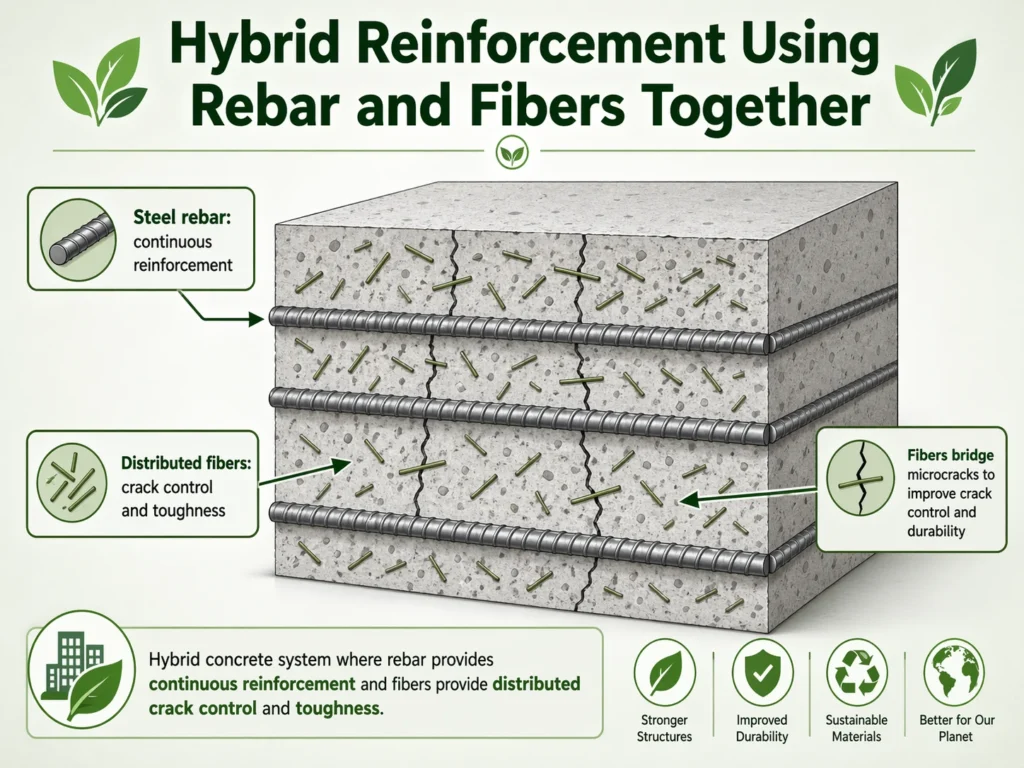
Rebar is also a very specific kind of reinforcement. It is continuous, placed before the pour, and detailed at exact locations so that it can cross supports, anchor into critical regions, provide continuity through joints, and resist known tensile forces. That is why it is still the default for many structural members. Fibers are different. They are short, discrete elements mixed throughout the concrete, so they provide three-dimensional distributed reinforcement rather than one continuous reinforcement path. That difference is the heart of the comparison.
Where Rebar Is Clearly Better
Rebar is clearly better when the structure needs continuous primary tensile reinforcement. ACI 544.4R says that, as a conservative and justifiable approach, in structural members such as beams, columns, walls, and elevated suspended slabs, reinforcing bars should be used to support the total tensile loads. That one sentence already answers a big part of the question. If the project is a normal structural frame member, rebar is still the safer default answer.
This is also true when the design depends on reinforcement continuity through supports, joints, edges, and localized stress zones. The Concrete Society’s guidance for steel/concrete suspended floors explains that fibers may replace nominal steel fabric in some composite slabs, but any additional reinforcement required for structural purposes, such as U-bars for edge beams, still has to remain, and reinforcement is also still required to provide continuity through construction joints. That is a practical way to see the issue. Fibers can do some of the job, but they do not automatically remove the need for properly placed bars where continuity matters.
Rebar is also the better answer when the project team wants the most familiar code path and the least ambiguity about long-term behavior. The Concrete Society notes that macro synthetic fibers do not replace structural steel, that their long-term structural performance under sustained higher stress is not as well understood, and that creep becomes a significant design issue where service performance depends on post-cracking fiber capacity. It also warns that macro synthetic fibers soften and melt in fire, losing structural capacity. That is a strong reason why rebar remains the better answer for many permanent building members under sustained load and fire design requirements.
Where Fiber-Reinforced Concrete Is Better
Fiber-reinforced concrete is better when the project needs distributed reinforcement through the full concrete volume, especially for crack control and toughness. ACI 544.4R says fibers reliably control cracking and improve resistance to deterioration caused by fatigue, impact, shrinkage, and thermal stresses. It also explains that fibers improve performance in two main ways: by resisting tensile stresses and playing a structural role, or by controlling crack development and improving durability. That is the real strength of FRC. Rebar is strong where it is placed. Fibers help everywhere in the section.
FRC is also often better from a constructability point of view. Because fibers are mixed into the concrete, they avoid many of the problems linked to placing welded wire mesh or light conventional reinforcement in the right location. The Concrete Society notes that, in ground-bearing slabs, replacing conventional welded fabric with steel fibers can offset fiber cost through labor savings and can avoid problems caused by misplacement of conventional steel in the slab depth. FRCA also highlights faster construction, fewer trip hazards, more flexible discharge methods, and lower in-place cost as common benefits when fibers are used instead of conventional secondary reinforcement.
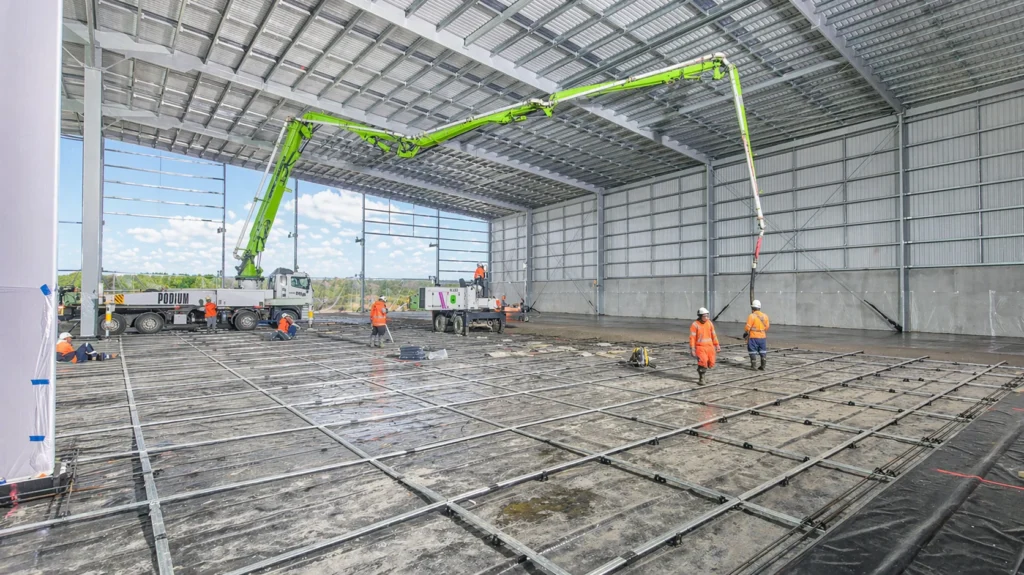
Another area where FRC is often better is slab and pavement performance. FRCA says the use of fiber reinforcement in place of welded-wire reinforcement and small-diameter bars used for temperature and shrinkage reinforcement has proven to be economically viable, and that high-volume steel and synthetic macrofibers have been used successfully to increase joint spacing in slabs-on-ground, sometimes eliminating contraction joints. ACI’s FRC design guide and its 2023 specification also point directly to slabs-on-ground and overlays as core applications where steel, synthetic, and glass macrofibers can replace reinforcing steel bars and welded-wire reinforcement when performance requirements are met.
When Fibers Can Replace Some Rebar
The most honest answer is that fibers can replace some rebar in some applications, not all rebar in all concrete. ACI SPEC-544.12-23 is especially useful here because it is current and very specific. It covers performance-based fiber-reinforced concrete for slabs-on-ground and overlays and says it applies to steel, synthetic, and glass macrofiber used to replace reinforcing steel bars and welded-wire reinforcement. That is a direct standards-based statement that fibers can replace conventional reinforcement in those applications.
ACI 544.4R says the same idea in a broader design way. It states that where continuous reinforcement is not essential to the safety and integrity of the structure, such as slabs-on-ground, pavements, overlays, shotcrete linings, slabs-on-piles, and some precast units, fibers may be used as the sole means of reinforcement. This is why industrial floors, external paved areas, sprayed concrete, and some precast products are such strong markets for steel fibers and macro synthetic fibers.
There are also special cases where FRC can replace traditional reinforcement even in more demanding applications. ACI’s report on precast concrete tunnel segments says fiber reinforcement has emerged as an alternative to traditional reinforcing bars and welded wire mesh in that field because of improved post-cracking behavior and crack control. That is important because it shows fibers are not limited to light-duty uses. But it is still a specialized, designed application with its own guidance, not a blanket rule for all structural concrete.
Not All Fibers Can Replace Rebar
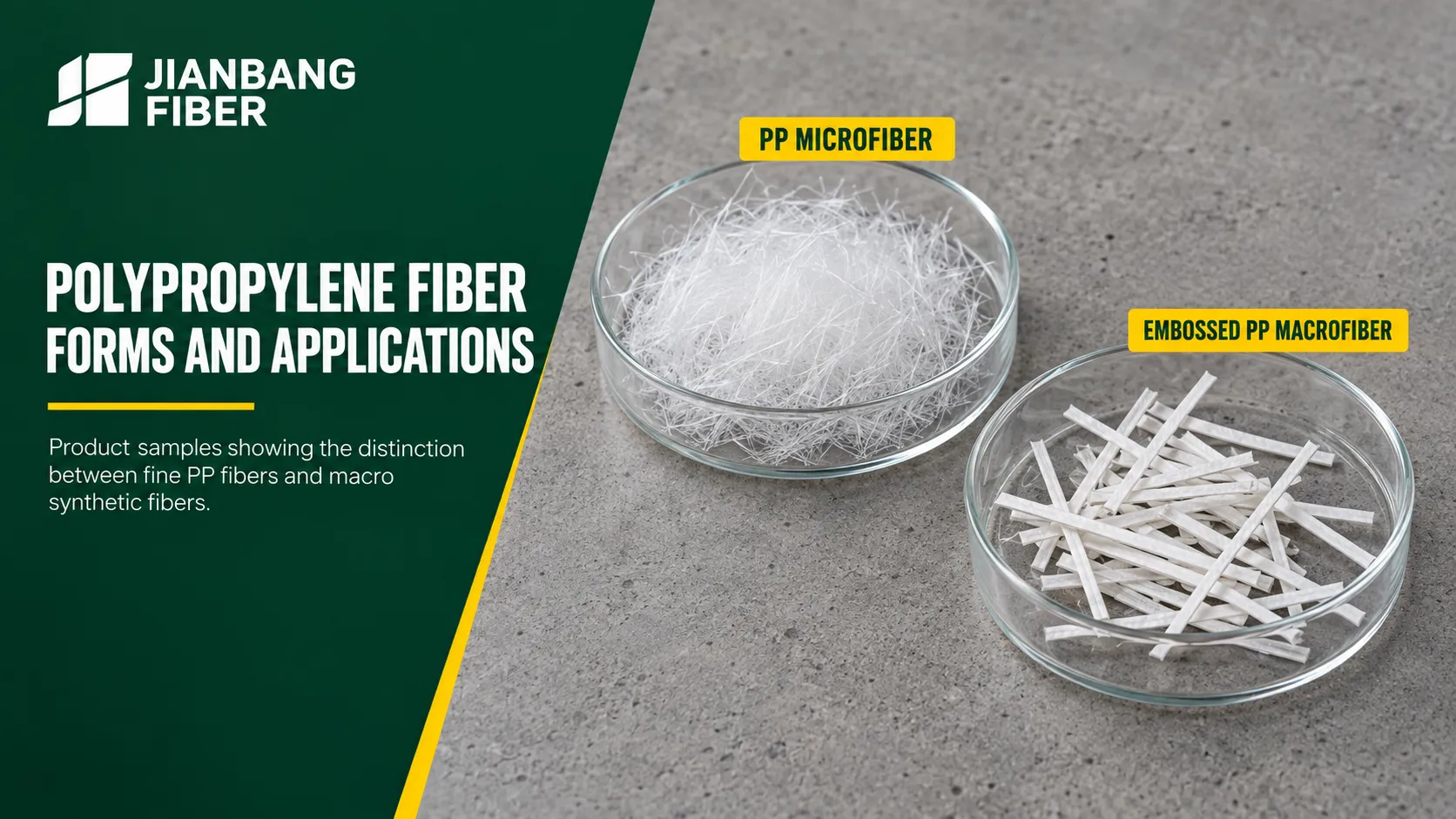
This is one of the most important parts of the article. Not all fibers are rebar replacements. FRCA explains that low-volume synthetic microfibers and natural fibers are mainly used to control plastic shrinkage cracking and usually provide little, if any, benefit in hardened concrete, except in some limited fibrillated microfiber cases replacing the lightest-gage welded wire reinforcement in slabs-on-ground. ACI’s performance-based slab specification also makes this distinction very clearly by saying it applies to macrofibers used to replace reinforcing steel bars and welded-wire reinforcement, and that microfibers for plastic shrinkage crack-width control are not covered.
So if someone compares “fiber-reinforced concrete” to rebar without naming the fiber type, the comparison is incomplete. A slab with a low dosage of micro polypropylene fiber is not competing head-to-head with a slab reinforced by structural rebar. A properly designed steel fiber or macro synthetic fiber slab may compete with welded wire reinforcement or nominal bar reinforcement in the right application. The fiber type, dosage, and test data decide the answer.
When Rebar Should Still Stay
Even where fibers are used, rebar often still needs to stay in the design when the structure has concentrated tensile forces, strong continuity demands, or critical edge and support conditions. The Concrete Society’s suspended floor guidance is very practical on this point: fibers may replace nominal fabric, but extra structural reinforcement and continuity reinforcement still remain where needed. This matches the broader ACI position that rebar should support total tensile loads in beams, walls, columns, and many elevated slabs.
There is also a simple reason related to design confidence. Rebar is placed exactly where the designer wants tensile strength. Fibers are randomly distributed, even if well mixed. That random distribution is a strength for crack control, but it is not always the best answer where force paths are very specific. FRCA’s “Fibers vs. Conventional Reinforcement” note says that under current technology, structural steel designed in accordance with ACI 318 in girders, columns, suspended decking systems, and cantilever sections cannot be reduced or replaced by macrofibers, although ACI 318 does permit qualifying steel fibers as shear reinforcement in certain cases. That is a good example of the real boundary line: fibers are gaining structural roles, but rebar still controls most primary reinforcement design.
Why the Best Answer Is Often Both
In many modern concrete designs, the strongest answer is hybrid reinforcement. ACI 544.4R explicitly lists hybrid reinforcement, meaning reinforcing bar plus fibers, among the main application areas discussed in its design guide. It also says fibers can supplement and reduce reinforcing bars in various structural members. This is usually the most balanced way to use FRC in building work. The rebar handles the known continuous tensile path. The fibers improve crack control, toughness, shrinkage resistance, and post-crack behavior across the whole section.
This hybrid logic also shows up in bridge-deck cracking research. ACI-published research on reinforced concrete bridge decks found that adding fibers without changing the internal steel reinforcement details reduced crack severity and extent, raised cracking load, and produced smaller crack widths compared with identical specimens without fiber. That does not mean the bars were removed. It means the fibers improved the performance of a rebar-reinforced system. For many engineers, that is the most realistic way to compare FRC and rebar: not as enemies, but as materials that often perform best together.
At Ecocretefiber™, this is the practical way we explain the market. Customers often ask whether they should “switch from rebar to fiber.” The better question is usually, “Which part of the reinforcement job can fiber do well on this project, and which part still needs bars?” Shandong Jianbang Chemical Fiber Co., Ltd. supports that performance-first way of choosing materials because it leads to better slabs, better shotcrete, better precast units, and fewer wrong substitutions.
The Most Practical Buying and Design Rule
A good rule is very simple. If the job is mainly about plastic shrinkage control, distributed crack control, improved toughness, faster slab construction, reduced mesh handling, or replacing nominal reinforcement in slabs-on-ground, overlays, shotcrete, and some precast elements, fiber-reinforced concrete may be better than rebar for that purpose. If the job is mainly about continuous structural tension, support continuity, cantilever action, frame-member design, or high-confidence primary load paths, rebar is usually better. If the job needs both crack control and strong structural continuity, the best answer is often a hybrid system.
That is also why design documents matter more than slogans. ACI, ASTM, and the Concrete Society all point to performance-based selection, not blanket substitution. Fibers can be excellent reinforcement. But they are not a universal shortcut around structural design, and rebar is not always the smartest choice for every slab or tunnel lining. The right choice depends on the function of the reinforcement in that exact element.
Conclusion
Fiber-reinforced concrete is not better than rebar in a general sense. It is better for some jobs, and rebar is better for others. Rebar remains the stronger choice for primary continuous tensile reinforcement in many beams, walls, columns, cantilevers, and elevated suspended slabs. Fiber-reinforced concrete is often the better choice for distributed crack control, toughness, impact and fatigue resistance, and for replacing welded wire or nominal reinforcement in many slabs-on-ground, pavements, overlays, shotcrete linings, and some precast or tunnel applications.
So the most accurate final answer is this: fiber-reinforced concrete is not a universal replacement for rebar, but it can outperform rebar for specific reinforcement functions, especially in slab and crack-control applications. In many real projects, the best design uses both. That is the position supported by current ACI and industry guidance, and it is also the position we support at Ecocretefiber™. Shandong Jianbang Chemical Fiber Co., Ltd. believes the best reinforcement solution is the one that matches the exact role the concrete needs to perform.