What macro fiber means in simple words
Macro fiber in concrete means a larger fiber that is added to a concrete mix so the concrete can perform better after cracking starts. In today’s concrete industry, the term usually points to macro synthetic fibers, often made from polypropylene or other polyolefins. ACI 544.3R defines macrosynthetic fibers as synthetic fibers with an equivalent diameter greater than 0.3 mm, and it notes that polypropylene fibers can be either micro or macro depending on size. EN 14889-2 uses the same 0.30 mm line and says macro polymer fibers are generally used where residual flexural strength is needed.
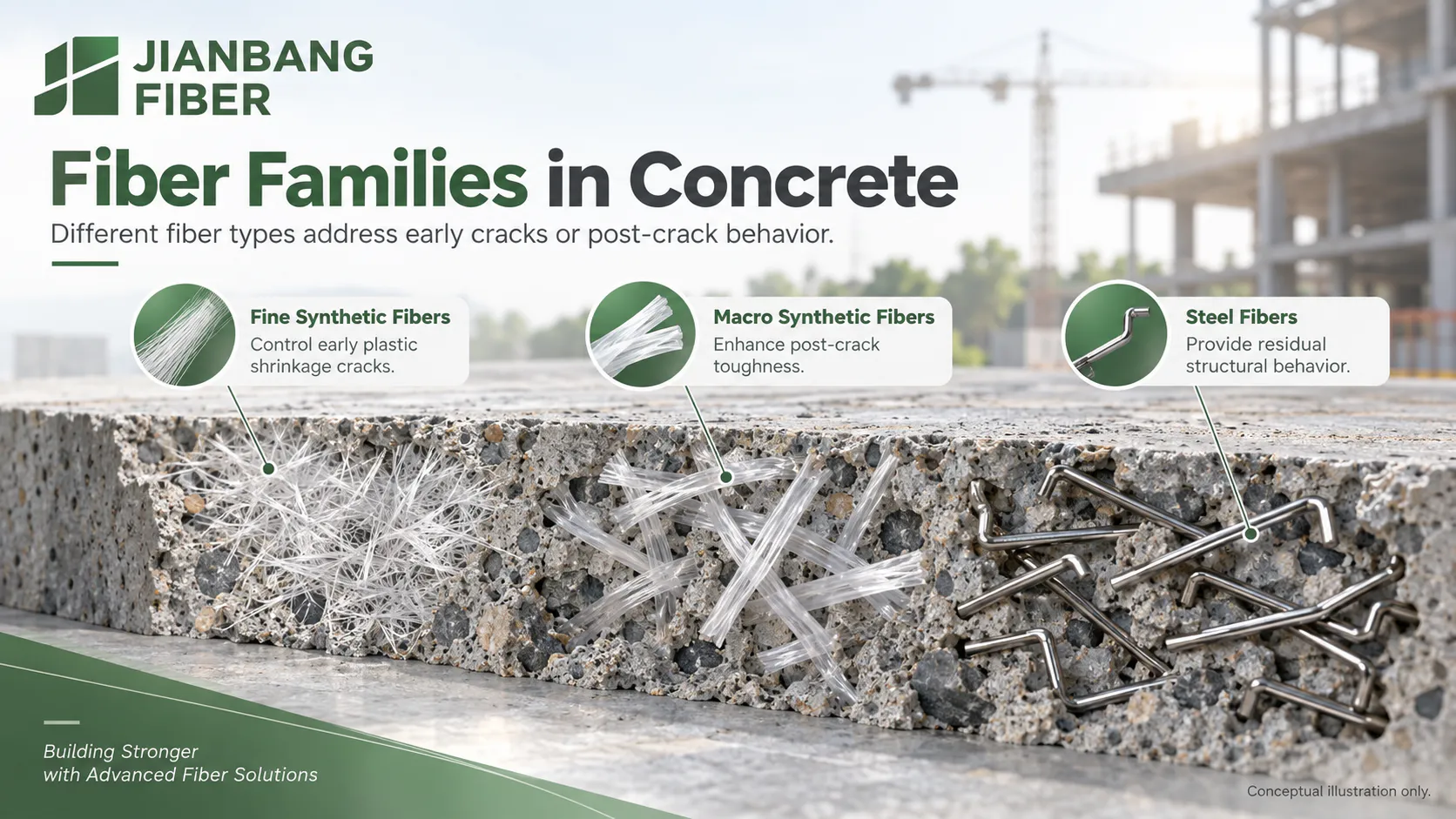
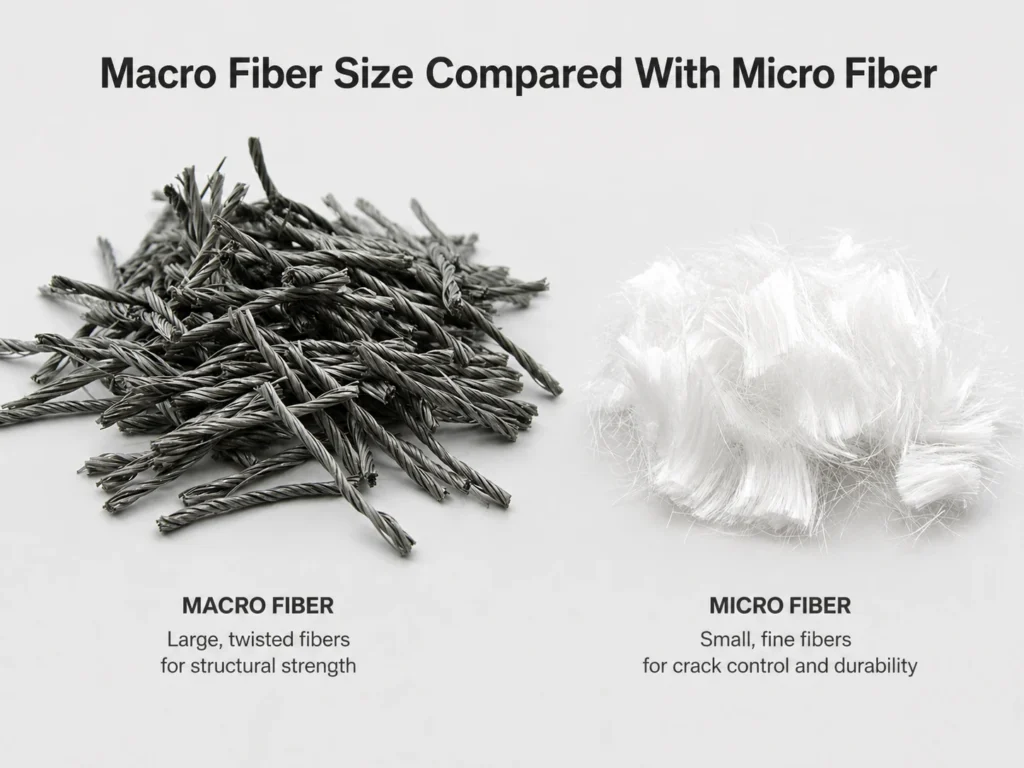
That simple size split matters because not all concrete fibers do the same job. Micro fibers are usually chosen to reduce very early cracking in fresh concrete. Macro fibers are chosen for a later stage. They are chosen for the stage where the concrete has already cracked and still needs to hold load, limit crack opening, and keep more toughness than plain concrete. NRMCA says macro-synthetic fibers are thicker fibers used at higher dosage and are used to reduce both early-age and post-hardening crack formation.
So the shortest correct answer is this: macro fiber in concrete is a larger fiber reinforcement used to improve post-crack behavior. It is not only there to help the first few hours of curing. It is there to help the concrete stay useful after cracks appear. fib also describes fiber-reinforced concrete as a composite material with improved post-cracking residual tensile strength because fibers bridge crack faces.
How macro fiber works inside concrete
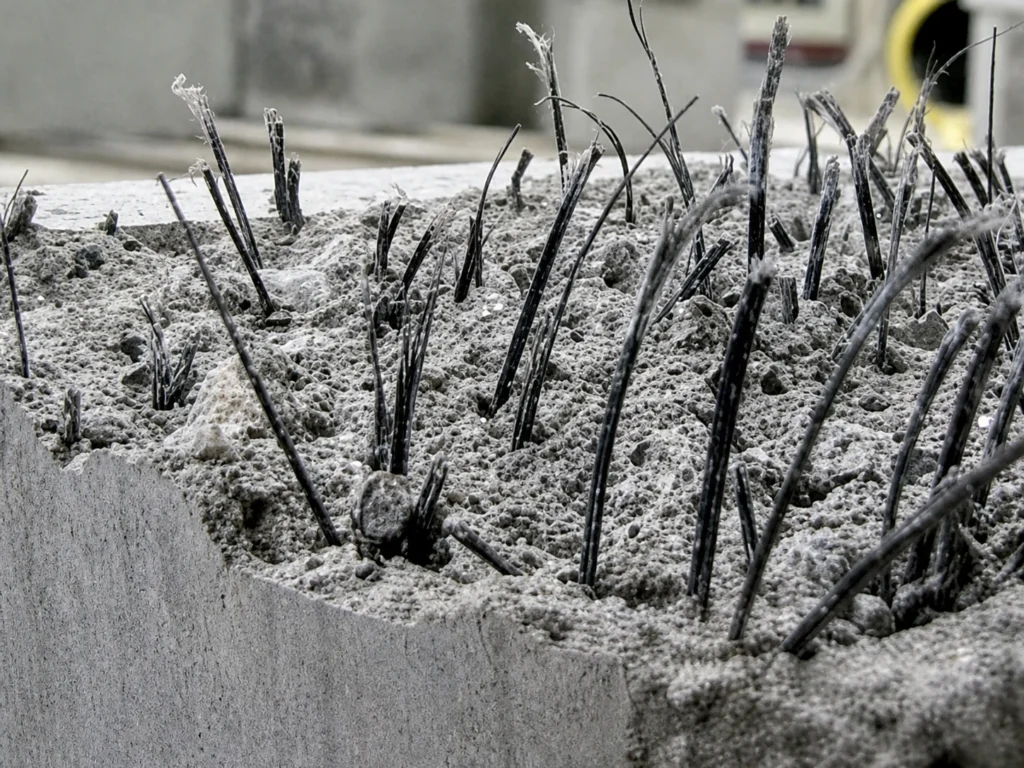
Plain concrete is strong in compression, but it is weak in tension. Once a crack forms, plain concrete loses continuity fast. Macro fibers change that failure pattern. They cross the crack and hold the two sides together for longer. That does not make the crack disappear, and it does change what happens after the crack begins. Instead of a sudden brittle drop, the section can carry more load and more movement than plain concrete would. ASTM C1609 focuses on exactly this kind of behavior. It evaluates flexural performance by using values from the load-deflection curve of a beam tested under third-point loading.
This is why words like residual strength, toughness, ductility, and energy absorption appear so often in macro fiber discussions. These are not decorative words. They describe what the concrete can still do after the first crack. ACI 544.4R says standard tests are used to characterize FRC performance for design, including flexure, shear, and crack-width control. fib says the key value in FRC is enhanced post-cracking tensile residual strength through crack bridging and fiber pull-out.
For a buyer, this means macro fiber should be treated as a performance material, not only as a mix additive. The buyer is not only buying a bag of fibers. The buyer is buying a post-crack behavior package. That is why the right test data matters as much as the fiber name. ASTM C1609 is one of the most common ways to prove that behavior in ASTM-based work, and EN 14889-2 links macro polymer fibers to declared residual flexural strength in standard beam testing in EN-based work.
Macro fiber is not the same as micro fiber
This is one of the most important points in the whole topic. A project can make a wrong specification very easily if it buys a microfiber when the real design need is a macrofiber. ACI 544.3R draws the line at 0.3 mm. Fibers below that line are micro. Fibers above that line are macro. ASTM D7508 uses the same logic for polyolefin fibers and says macro polyolefin fibers have linear density greater than or equal to 580 denier, which matches an equivalent diameter of 0.3 mm or more.
The function split is just as important as the size split. NRMCA says micro synthetic fibers mainly help with plastic shrinkage and settlement cracking in fresh concrete. The same NRMCA guidance says macro-synthetic fibers are thicker and are used at higher dosage to reduce both early-age and post-hardening cracking. That means the buyer should always ask one direct question: Is this fiber meant for early crack control, or is it meant for post-crack performance?
This is why serious concrete specifications do not stop at the word “fiber.” They name the class, the dosage logic, and the test method. A project that only says “add fiber” is leaving too much room for the wrong product. A project that says “macro synthetic fiber with residual flexural strength proven by beam testing” is much closer to the right buying decision.
What types of macro fiber are used in concrete
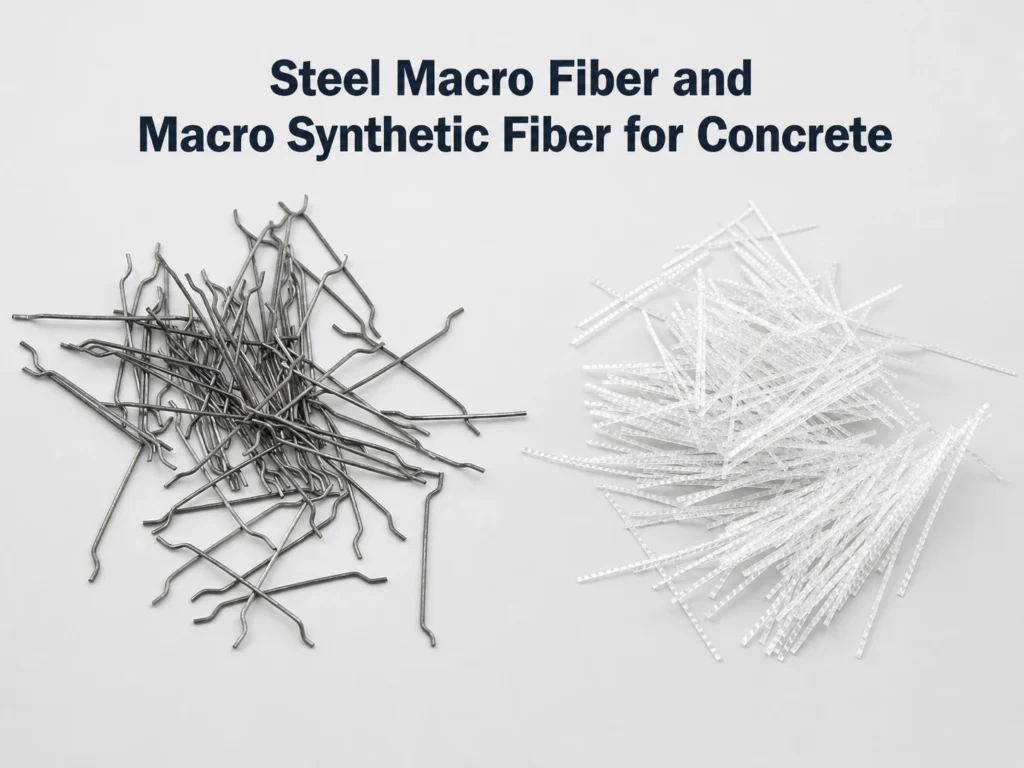
In broad concrete language, the main macro-scale fiber families are macro synthetic fibers and steel fibers. Steel fibers are covered by ASTM A820/A820M, which lists several steel fiber types for use in fiber-reinforced concrete. Those types include cold-drawn wire, cut sheet, melt-extracted, and other forms.
Macro synthetic fibers sit in the synthetic side of fiber-reinforced concrete. ASTM C1116 is the core ASTM specification for fiber-reinforced concrete, and it classifies synthetic fiber-reinforced concrete as Type III. ASTM D7508 then gives the detailed specification path for polyolefin chopped strands used in concrete and covers macro, micro, and hybrid polyolefin fibers.
In real project talk, though, many people use the phrase macro fiber as shorthand for macro synthetic polypropylene or polyolefin fiber. The Concrete Society describes macro synthetic fibers as sometimes being called structural synthetic fibers, and it says they were first developed as an alternative to steel fibers in some applications. It also says they now have a clear role in ground-supported slabs and a wide range of other applications.
So the title question can be answered in two layers. In the wide technical sense, macro fiber can include steel fibers and macro synthetic fibers. In everyday commercial concrete language, it often means macro synthetic polypropylene or polyolefin fiber used for slab, pavement, and shotcrete performance.
Where macro fiber is used most often
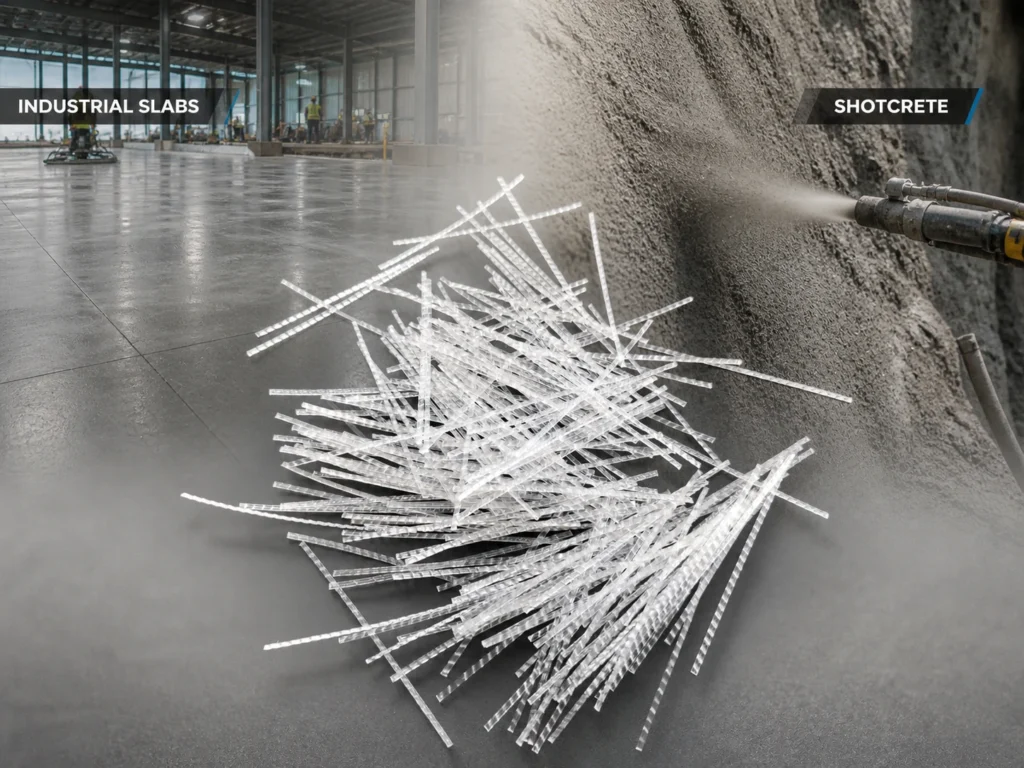
Macro fiber is used where distributed post-crack reinforcement gives clear value. ACI 544.4R lists applications such as slabs-on-ground, composite slabs-on-metal decks, pile-supported ground slabs, precast units, and shotcrete. EN 14889-2 says polymer fibers covered by the standard are intended for all types of concrete and mortar, including sprayed concrete, flooring, precast, in-situ, and repair concretes.
This is why macro fibers show up again and again in industrial floors, warehouse slabs, hardstands, pavements, shotcrete, sprayed concrete for rock support, precast elements, and repair or overlay work. These are the jobs where crack width control, toughness, and labor efficiency all matter at the same time. The Concrete Society says macro synthetic fibers can be used in some designs based on plastic analysis, such as ground-supported slabs and rock support using sprayed concrete.
Suppliers and industry guidance also point to these same use cases. Sika describes macro fibers as cost-effective three-dimensional reinforcement alternatives to secondary wire mesh or rebar and steel fibers in certain slab and shotcrete applications. Master Builders notes that common applications include slab-on-ground and sprayed concrete and that fiber form and size can change fresh and hardened performance.
For a practical buyer, this means macro fiber is most useful where the project wants distributed crack control through the whole section, not only reinforcement in one plane. That is why it fits slab and shotcrete work so well. It can shorten placement time and improve safety on site, but only when the product and design are matched correctly.
Can macro fiber replace mesh or rebar?
This is the question many buyers care about most, and the right answer is careful. Macro synthetic fibers can replace nominal bar or fabric reinforcement in some systems, but they do not automatically replace primary structural steel in the usual reinforced concrete design sense. The Concrete Society says this very directly. It says macro synthetic fibres are typically used in structural concrete as replacement for nominal bar or fabric reinforcement, but they do not replace structural steel and cannot be part of design in accordance with the Eurocodes in the same way.
At the same time, the same source says macro synthetic fibers can provide significant post-cracking capacity and can therefore be used in some designs based on plastic analysis, such as ground-supported slabs and rock support in sprayed concrete. That means the real question is not “Can fiber replace all rebar?” The real question is “Which reinforcement function is the fiber replacing?”
Supplier guidance often says macro fibers can reduce or replace secondary wire mesh or nominal reinforcement in selected applications. Sika uses that kind of wording for slab products and highlights lower labor demand, better safety, and shorter construction time. That kind of claim can be true in the right slab or shotcrete system, but it should always be backed by the right design method and the right residual strength data.
So the safest and most professional answer is this: macro fiber can replace some traditional reinforcement functions in some concrete systems, but it is not a blanket one-to-one replacement for all steel reinforcement. The design method decides that, not the sales phrase alone.
What standards and test data buyers should check
A buyer should not specify macro fiber only by name. The buyer should check the material standard, the performance test, and the application fit.
The first standard is ASTM C1116 for fiber-reinforced concrete. ASTM says this specification covers all forms of fiber-reinforced concrete delivered with ingredients uniformly mixed. For synthetic macro fibers, ASTM D7508 adds the polyolefin-specific requirements and defines macro polyolefin fibers by denier and equivalent diameter. For steel fibers, ASTM A820/A820M is the main specification path.
The second standard is the performance test. In ASTM-based work, ASTM C1609 is one of the main test methods because it measures flexural performance from the beam load-deflection curve. In EN-based work, EN 14889-2 links polymer macro fibers to declared residual flexural strength in standard beam testing. The Concrete Society says the supplier must declare the unit volume of fibers needed to achieve specific residual flexural strengths.
The third point is the application document. ACI 544.4R is important because it connects FRC test results to design use in applications such as slabs-on-ground, precast units, and shotcrete. If a supplier cannot show where the product fits in actual design logic, the data package is incomplete.

What site teams should expect in mixing and finishing
Macro fibers do not only affect hardened concrete. They also affect fresh concrete behavior. Master Builders notes that macrofibers come in different forms and sizes, and that they can change placement, consolidation, and finishing behavior. The same bulletin says admixture demand may need adjustment because fresh concrete rheology can vary from one macrofiber to another.
This means the site team should expect a few practical checks. The team should confirm how the fibers are added, how long the mix should turn after fiber addition, whether pumpability changes, and whether finish timing needs adjustment. A Florida DOT report also notes that some stiffer fibers can create clumping or blocking issues in very flowable mixes when handling is not right.
NRMCA also gives a useful field reference by saying macro-synthetic fibers are typically used at higher dosage than micro fibers, around 5 lb/yd³ in its guidance example. That is not a universal dosage rule, but it reminds buyers that macro fiber is a more performance-driven product and not just a token additive. The exact dosage has to match the target residual behavior.
So a project should not say only “add macro fiber.” It should say which product class, what dosage basis, and what performance level the mix needs to achieve. That is how macro fiber moves from a marketing phrase to a specification-grade reinforcement solution.
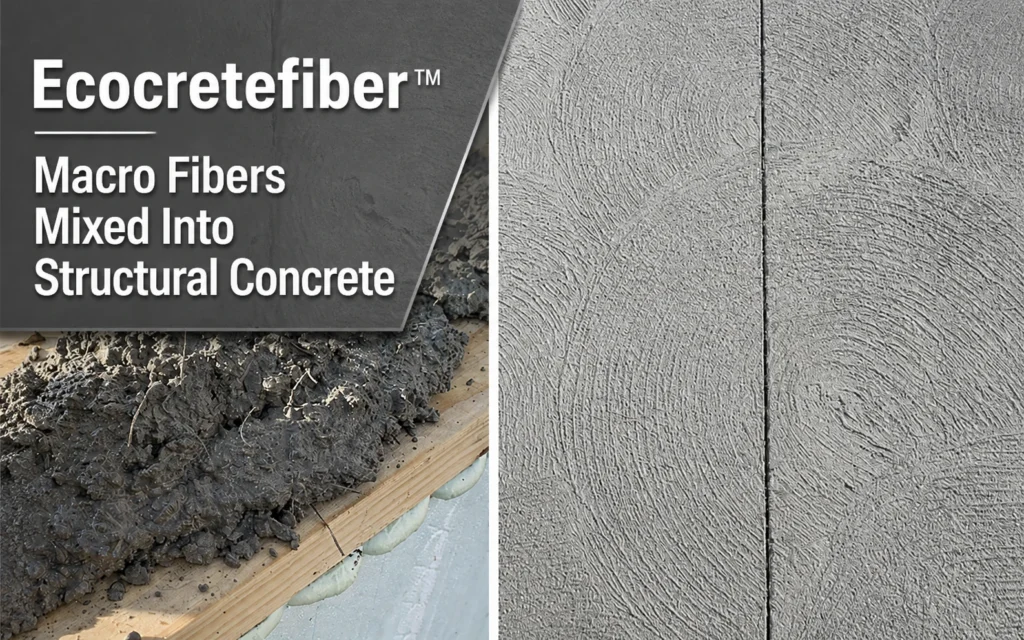
Why buyers choose Ecocretefiber™
Ecocretefiber™ is built for buyers who need concrete fibers for real slab, pavement, and shotcrete work. The market now expects more than a simple product name. The market expects a clear size class, a clear application path, and a clear test basis. That is exactly why macro fiber content should be explained through ACI, ASTM, EN, and real design use instead of through vague sales claims.
Shandong Jianbang Chemical Fiber Co., Ltd. can support that kind of buying process because the product conversation is already aligned with what serious project teams ask for: macro or micro class, crack-control role, post-crack role, and standard-backed documentation. For many buyers, that is the difference between a general inquiry and a project-ready specification discussion.
Conclusion
Macro fiber in concrete is a larger reinforcement fiber used to improve concrete behavior after cracking starts. In modern concrete practice, the term often points to macro synthetic fibers, especially polypropylene or other polyolefins, though steel fibers are also macro-scale reinforcement products used for similar post-crack purposes. ACI defines macrosynthetic fibers as above 0.3 mm in equivalent diameter, and ASTM D7508 uses the same basic size boundary for polyolefin macro fibers.
The most useful way to understand macro fiber is by function. Macro fiber bridges cracks, improves toughness, and helps concrete keep carrying load after the first crack instead of failing in a brittle way. ASTM C1609 is one of the key tests for this, and EN 14889-2 ties polymer macro fibers to declared residual flexural performance in standard testing.
In practice, macro fiber is widely used in slabs, industrial floors, pavements, shotcrete, precast elements, and similar applications where distributed post-crack reinforcement has real value. It can replace nominal bar or fabric reinforcement in some systems, but it does not automatically replace primary structural steel. That decision has to be made through the right design method and the right tested data.
For a buyer, that is the real takeaway. Macro fiber in concrete is not only a material name. It is a performance category. And when it is specified with the right standards, the right testing, and the right application logic, it becomes one of the most practical reinforcement options in modern concrete work.