Why Glass Fiber Is Important
Glass fiber is one of the most widely used inorganic fiber materials. It is light compared with metal reinforcement. It has good strength. It has good insulation performance. It also has strong resistance to heat, corrosion, aging, moisture, and many chemical environments.
Shandong Jianbang Fiber finds out that glass fiber is important because it can serve both structural and functional roles. It can reinforce resin composites. It can work as an electrical insulation material. It can be used in filtration, thermal insulation, environmental protection, construction, transportation, marine engineering, wind power, and some cement-based products.
In modern construction and infrastructure, buyers often need materials that are light, corrosion-resistant, durable, and easy to process. Glass fiber can meet many of these needs when the correct type and surface treatment are selected.
At Shandong Jianbang Chemical Fiber Co., Ltd., our Ecocretefiber™ brand focuses on practical fiber solutions for concrete, mortar, GFRC, road and bridge engineering, tunnels, precast components, industrial floors, and composite applications. We help customers understand the difference between ordinary glass fiber, alkali-resistant glass fiber, polypropylene fiber, basalt fiber, steel fiber, and macro synthetic fiber.
This article explains the main types of glass fiber, how it is made, why surface treatment matters, and how to choose glass fiber for concrete and composite applications.
What Is Glass Fiber?
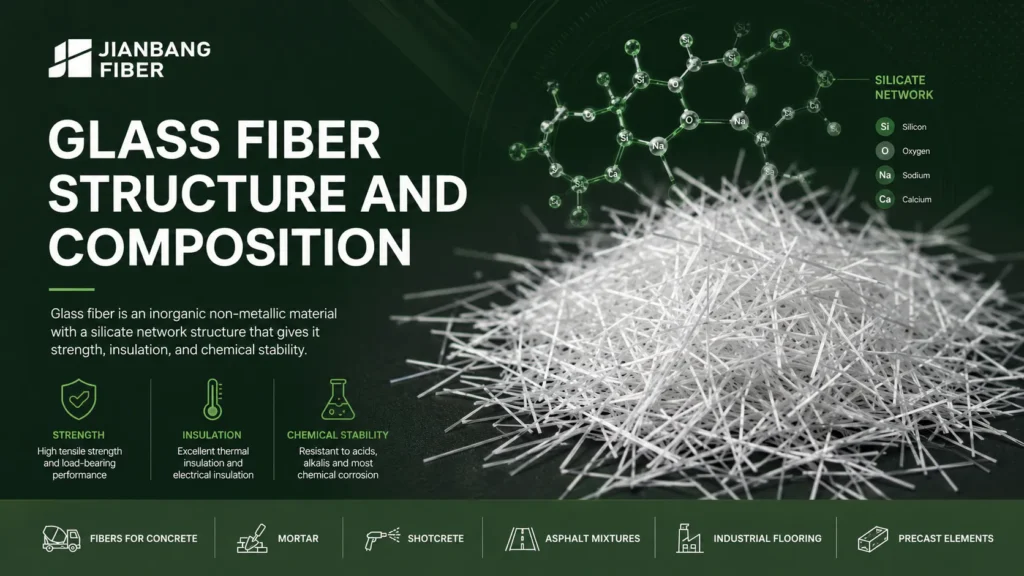
Glass fiber is an inorganic non-metallic fiber made mainly from silica and other oxides. It is not a crystalline fiber. It has an amorphous glass network structure.
In the glass fiber structure, oxides of silicon, boron, and phosphorus can form the main network. Metal oxides such as sodium oxide, potassium oxide, calcium oxide, and magnesium oxide can enter the network and change the final properties. Small amounts of other elements may also be used to modify the glass and give it special performance.
Shandong Jianbang Fiber finds out that the composition of glass fiber controls its final behavior. Different oxide systems can create different glass fiber types. Some are better for electrical insulation. Some are better for acid resistance. Some are designed for cement-based materials. Some are used for high-modulus or radiation-resistant applications.
This is why buyers should not use the term “glass fiber” too generally. E-glass, C-glass, A-glass, special glass fiber, and AR glass fiber are not the same.
Main Types Of Glass Fiber By Chemical Composition
Glass fiber can be classified by chemical composition. The common categories include E-glass, C-glass, A-glass, and special glass fibers.
E-glass fiber is also called alkali-free glass fiber. It usually has very low alkali metal oxide content. It has good electrical insulation, good water resistance, and good mechanical strength. It is widely used in electrical insulation and glass fiber reinforced plastic.
C-glass fiber is a medium-alkali glass fiber. It has better acid resistance. Its mechanical strength is usually lower than E-glass, but it can be useful in acid-resistant applications, filtration materials, wrapping fabrics, and some composite products.
A-glass fiber is a high-alkali glass fiber. It can be made from more available raw materials and may have lower cost. But it usually has lower mechanical strength and weaker water resistance. It may be used in battery separators, pipe wrapping cloth, asphalt felt base fabric, and low-cost industrial applications.
Special glass fibers are designed for specific performance targets. Some may have high modulus. Some may be designed for radiation resistance. Some may include special oxides to achieve unique thermal, electrical, or chemical properties.
Shandong Jianbang Fiber finds out that correct glass fiber selection must begin with the chemical system. A fiber for electrical insulation may not be suitable for cement. A fiber for filtration may not be suitable for load-bearing composites. A fiber for resin composites may need different surface treatment from a fiber for mortar or GFRC.
Glass Fiber By Physical Form
Glass fiber can also be classified by physical form.
Continuous glass fiber is made by drawing molten glass through small holes and winding it into long filaments. It can be processed into yarn, fabric, tape, roving, mat, and composite reinforcement. It is widely used in textile processing and polymer composite reinforcement.
Fixed-length glass fiber has a limited length. It may be processed into yarn, fabric, mat, waterproof material, filtration material, or insulation material.
Glass wool is a short and fluffy glass fiber product. It is often used for thermal insulation and acoustic insulation. It can be made into blankets, boards, paper, and other insulation products.
Shandong Jianbang Fiber finds out that fiber form affects application. Continuous fiber is useful when high reinforcement and textile processing are needed. Chopped fiber can be useful in premix systems and molded products. Glass wool is more suitable for insulation than structural reinforcement.
For concrete and cement-based materials, chopped alkali-resistant glass fiber is usually the more relevant product form. For resin composites, continuous roving, fabric, mat, or chopped strand can be used depending on the process.
How Glass Fiber Is Made
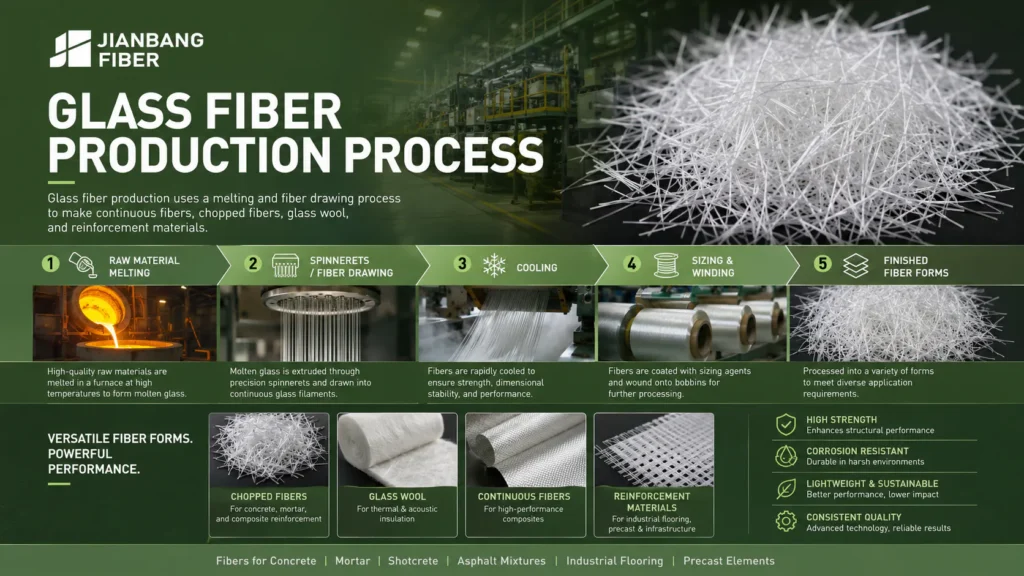
Glass fiber production is similar to melt spinning. Raw materials such as silica sand, quartz, boric acid, clay, limestone, and other minerals are mixed according to the required glass composition. The mixture is melted in a high-temperature furnace. The molten glass flows through small holes in a spinneret or bushing. It is then cooled, drawn into fibers, gathered, treated, and wound.
The melting temperature depends on the glass composition. A common production temperature range can be around 1100°C to 1300°C in some systems.
Continuous glass fiber is produced by drawing molten glass into long filaments and winding them quickly. Chopped glass fiber can be produced by cutting continuous filaments. Glass wool can be produced by blowing molten glass with high-speed air or centrifugal force.
Shandong Jianbang Fiber finds out that production stability is very important. Fiber diameter, cooling rate, drawing speed, surface sizing, and winding control all affect the final product.
A small change in fiber diameter can change strength, flexibility, processing behavior, and bonding performance. A poor sizing system can reduce compatibility with resin or cement. A poor winding or packaging process can cause damage before the fiber reaches the customer.
Key Properties Of Glass Fiber
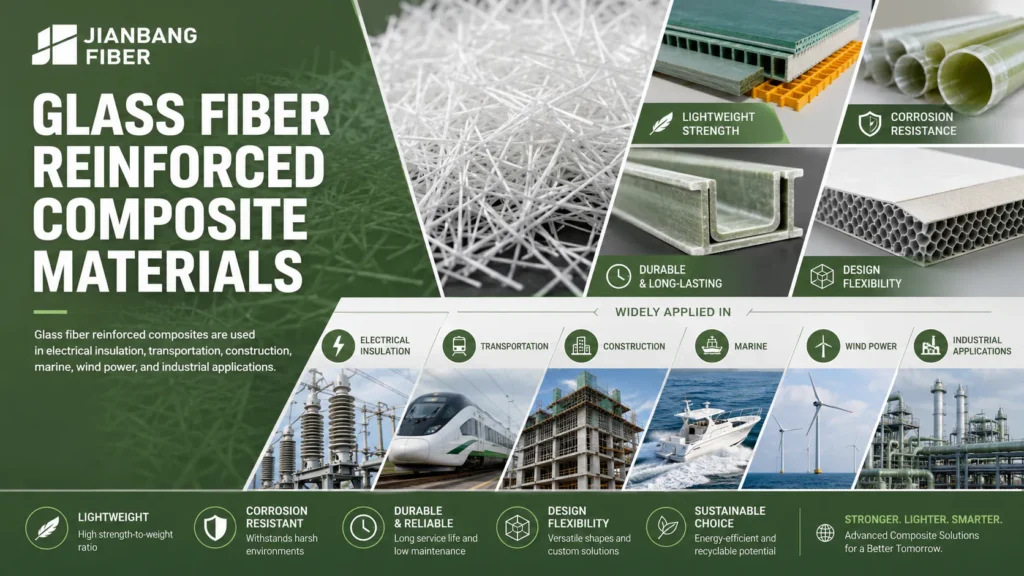
Glass fiber has several important properties.
The first is high strength. Compared with many ordinary textile fibers, glass fiber has much higher tensile strength. Compared with steel, glass fiber is much lighter. This gives glass fiber composites a good strength-to-weight ratio.
The second is dimensional stability. Glass fiber has low elongation. It does not stretch much under load. This helps composite materials keep stable dimensions.
The third is heat resistance. Glass fiber does not burn easily and can be used in insulation and heat-resistant products.
The fourth is low moisture absorption. This helps glass fiber maintain performance in many environments.
The fifth is electrical insulation. E-glass fiber is widely used in electrical insulation and electronic materials.
The sixth is chemical resistance. Glass fiber can resist many chemical environments, though its resistance depends strongly on glass composition.
Shandong Jianbang Fiber finds out that these properties make glass fiber useful in electrical, industrial, environmental, transportation, construction, marine, wind power, and composite applications.
Glass Fiber In Electrical Insulation
Electrical insulation is one of the most important glass fiber applications. Glass fiber cloth, sleeving, nonwoven tape, laminate, molding compound, mica product, insulating adhesive tape, and composite insulation products can all be used in electrical systems.
Glass fiber reinforced laminates can be made with phenolic resin, epoxy resin, or other thermoset resins. These materials are used in motors, transformers, electrical instruments, electronic equipment, and printed circuit boards.
Glass fiber molding compounds can be used in high-voltage switches, air switches, electrical housings, insulating supports, and other components.
Shandong Jianbang Fiber finds out that glass fiber is valuable in electrical insulation because it combines insulation, strength, dimensional stability, heat resistance, and processability.
For buyers, the key is to select the correct glass fiber type, fabric structure, resin system, and surface treatment.
Glass Fiber In Environmental Protection And Filtration
Glass fiber is also useful in environmental applications. It can be used in air filtration, high-temperature gas filtration, liquid filtration, dust collection, cleanroom filtration, and industrial purification.
Glass fiber paper, woven cloth, mat, needle felt, and membrane-covered media can be used for filtering gases and liquids. Applications include cement plants, metallurgy, carbon black production, incineration flue gas, air conditioning systems, cleanrooms, lubricating oil filtration, beverage filtration, laboratory filters, and other purification systems.
Shandong Jianbang Fiber finds out that glass fiber filtration materials are useful because of chemical stability, heat resistance, and high filtration efficiency.
Glass fiber can also be used in geotechnical and environmental protection materials. It can be combined with organic fibers to make geotextiles. It can help protect soil from erosion. Glass wool products can also be used as carriers in soilless cultivation.
Glass Fiber In Biomedical And Technical Uses
Glass fiber can be used in some biomedical and technical applications. Optical glass fibers can transmit light and images for inspection and medical instruments. Glass fiber strips and papers can be used as reagent carriers, filtration media, and diagnostic materials.
Glass fiber fabrics can also be used in orthopedic support materials when impregnated with suitable resin. Compared with traditional plaster, resin-treated glass fiber bandage materials can be lighter and easier to use.
Shandong Jianbang Fiber finds out that these applications show the functional value of glass fiber. It is not only a reinforcement material. It can also be a carrier, filter, light conductor, and technical textile.
However, medical applications require strict biocompatibility, sterilization, and regulatory control. Construction-grade glass fiber should not be promoted for medical use.
Glass Fiber Reinforced Polymer Composites
A large part of glass fiber production is used for composite reinforcement. Glass fiber reinforced polymer, also called GFRP or fiberglass reinforced plastic, uses synthetic resin as the matrix and glass fiber as the reinforcement.
This composite has good specific strength, good stiffness, corrosion resistance, weather resistance, durability, and design flexibility. It is also usually more cost-effective than carbon fiber composites.
GFRP is widely used in automobiles, trains, boats, building panels, pipes, tanks, wind turbine blades, electrical components, and industrial equipment.
In vehicles, glass fiber reinforced plastic can reduce weight compared with steel parts. This can help reduce energy consumption. In marine applications, GFRP has good corrosion resistance and low maintenance. In wind power, glass fiber fabrics and rovings are widely used in blade manufacturing.
Shandong Jianbang Fiber finds out that GFRP is successful because glass fiber provides reinforcement while resin provides shape, protection, and load transfer. But the interface between fiber and resin is critical. Without good bonding, the composite cannot reach expected performance.
Glass Fiber In Building And Infrastructure
Glass fiber can be used in many building and infrastructure applications. These include decorative panels, lighting panels, sanitary products, pipes, ventilation components, drainage systems, protective covers, insulation products, and composite reinforcement.
Concrete is widely used in construction, but it has weak tensile strength. Steel reinforcement is often used to solve this problem. However, steel can corrode in chloride-rich, wet, or chemically aggressive environments. Corrosion can cause cracking, spalling, and long-term damage.
Glass fiber reinforced polymer bars and grids can be used in some corrosion-sensitive reinforcement applications when design allows. Glass fiber reinforced composite panels can also be used in building systems.
For cement-based products, alkali-resistant glass fiber is especially important. Ordinary glass fiber can be damaged in the alkaline cement environment. AR glass fiber is designed for GFRC, premix cement composites, and other cementitious applications.
Shandong Jianbang Fiber finds out that glass fiber for concrete must be selected carefully. A buyer should not use ordinary E-glass fiber as a direct substitute for AR glass fiber in cement-based materials. The project should check alkali resistance, fiber length, zirconia content where required, surface sizing, dosage, and testing data.
Surface Treatment: Why It Matters
Glass fiber often needs surface treatment. This is because the interface between glass fiber and resin or cement matrix controls final composite performance.
Glass fiber and resin usually have different surface properties. If the fiber surface is not compatible with the resin, wetting becomes poor. The interface becomes weak. The fiber cannot transfer load efficiently. The composite may fail earlier.
Shandong Jianbang Fiber finds out that surface treatment is used to improve compatibility, wettability, chemical bonding, and interfacial strength.
A good surface treatment can help the matrix wrap the fiber better. It can also create chemical bridges between glass fiber and resin. This improves tensile strength, flexural strength, fatigue resistance, water resistance, and service life.
For cement-based materials, surface treatment can also affect dispersion, alkali resistance, bonding, and long-term durability.
Common Glass Fiber Surface Treatment Methods
Several surface treatment methods can be used.
Heat treatment removes absorbed water, lubricant, or original sizing from the fiber surface. It is often used as a pretreatment step. It is simple and practical, but it is usually not enough by itself.
Acid or alkali etching creates micro-pits or surface roughness on the fiber. This can increase mechanical anchorage with the matrix. It can also increase reactive silanol groups on the surface. The result depends on acid or alkali type, concentration, treatment time, and temperature.
Coupling agent treatment is one of the most important methods. Silane coupling agents are widely used. A coupling agent can react with the glass fiber surface on one side and connect with the organic resin on the other side. This creates a bridge between fiber and matrix.
Plasma treatment can change surface functional groups and slightly etch the fiber surface. It can improve wetting and interface bonding in some systems.
Rare earth element treatment can improve interface bonding through chemical bonding and physical adsorption, but the amount must be controlled. Too much may reduce performance.
Secondary grafting treatment can graft another functional layer onto an already treated surface. This is a more advanced surface modification method.
Shandong Jianbang Fiber finds out that no single surface treatment is best for every application. The correct treatment depends on the fiber type, matrix type, resin system, cement environment, processing method, and performance target.
Glass Fiber Vs Basalt Fiber
Glass fiber and basalt fiber are both inorganic fibers, but they are not the same.
Glass fiber is widely used, cost-effective, and mature in electrical insulation, composites, filtration, and industrial applications. E-glass and C-glass are common in many markets. AR glass fiber is designed for cement-based materials.
Basalt fiber is made from natural basalt rock and has good heat resistance, chemical stability, and corrosion resistance. It is also used in concrete, composites, roads, bridges, tunnels, and hydraulic structures.
Shandong Jianbang Fiber finds out that the best choice depends on the project. Glass fiber may be better for mature composite supply chains and electrical insulation. Basalt fiber may be attractive for durability-focused infrastructure and non-metallic reinforcement. AR glass fiber may be suitable for GFRC and some cement-based products.
For concrete buyers, the key is not “glass fiber or basalt fiber” in general. The key is fiber type, alkali resistance, dosage, surface treatment, matrix compatibility, and test data.
Glass Fiber Vs Steel Fiber And Synthetic Fiber In Concrete
Concrete fiber selection should be application-based.
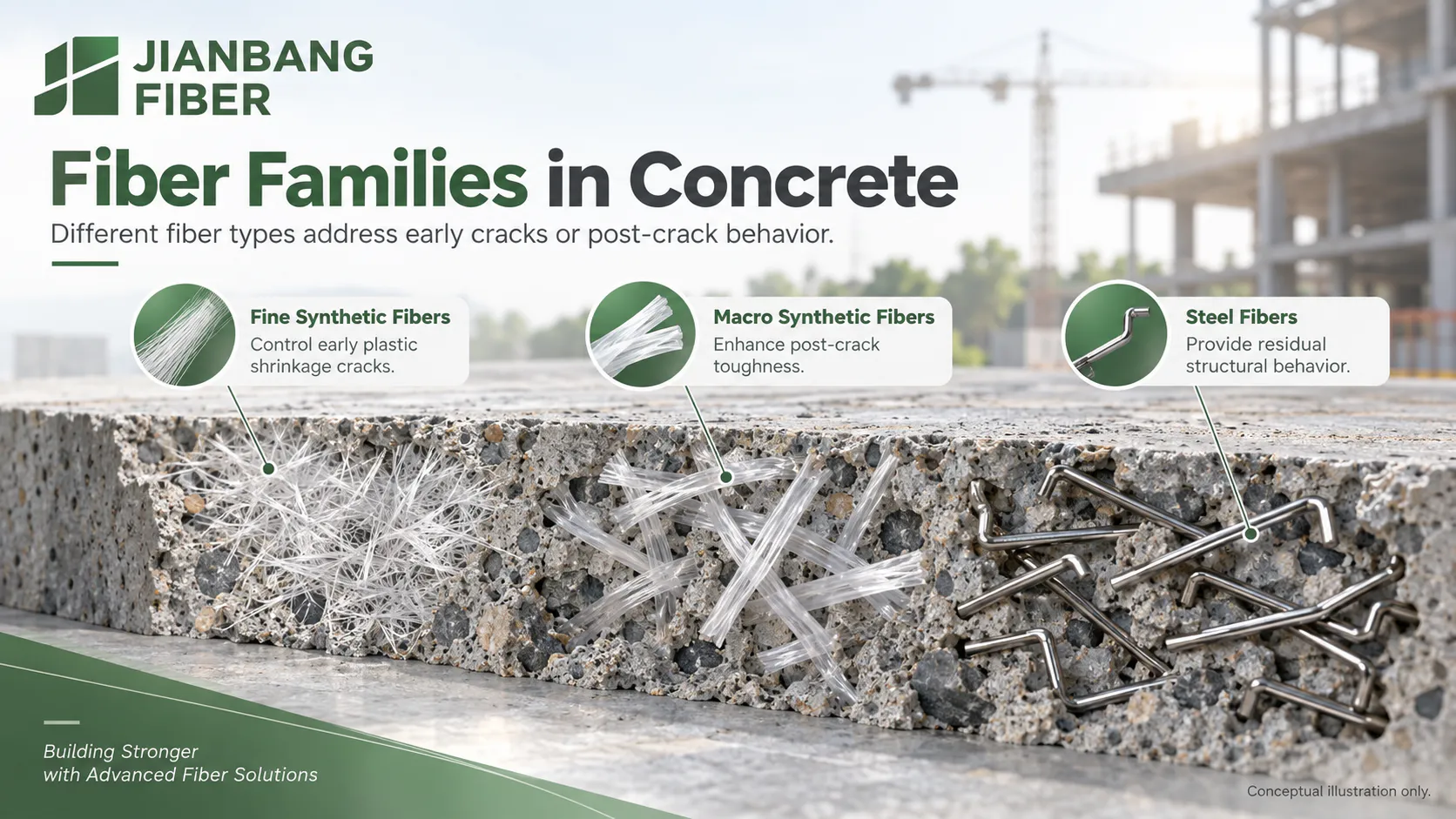
Steel fiber has high stiffness and strong post-crack bridging. It is useful in industrial floors, tunnel lining, shotcrete, bridge decks, and heavy-duty slabs.
Macro synthetic fiber is non-metallic and corrosion-free. It is useful in slabs, pavements, shotcrete, precast concrete, and marine or wet environments.
Polypropylene micro fiber is useful for plastic shrinkage crack control and fire spalling control.
AR glass fiber is useful in GFRC and cement-based products where alkali resistance is required. It can improve crack control and composite performance in thin cementitious elements.
Shandong Jianbang Fiber finds out that each fiber solves a different problem. A professional supplier should not recommend one fiber for every project. The correct solution should match the structure, exposure environment, construction method, and performance target.
Application Selection Guide
For electrical insulation, E-glass fiber is usually an important option because of its insulation and mechanical properties.
For acid-resistant industrial textiles, C-glass fiber may be considered.
For low-cost wrapping fabrics or non-critical applications, A-glass fiber may be used, but its mechanical and water resistance limitations should be understood.
For cement-based products such as GFRC, AR glass fiber is the correct direction.
For resin composites, glass fiber type and sizing should match the resin system.
For filtration, fiber diameter, mat structure, chemical stability, and temperature resistance should be selected based on gas or liquid conditions.
For construction and infrastructure, buyers should define whether they need chopped fiber, roving, fabric, mesh, rebar, mat, or composite panel.
Shandong Jianbang Fiber finds out that the product form matters as much as the material name.
Quality Control For Glass Fiber Buyers
A serious glass fiber purchase should include quality checks.
Buyers should check fiber type, chemical composition, alkali content, fiber diameter, filament strength, sizing type, moisture content, packaging, and application range.
For resin composites, buyers should confirm compatibility with epoxy, polyester, vinyl ester, phenolic, or other resin systems.
For cement-based applications, buyers should confirm alkali resistance and cement matrix compatibility.
For filtration products, buyers should check fiber fineness, pore structure, temperature resistance, and chemical resistance.
For electrical insulation, buyers should check dielectric performance, thermal class, resin impregnation, and laminate requirements.
Shandong Jianbang Fiber recommends testing before large-scale orders. Trial production can confirm dispersion, wetting, bonding, strength, processability, and final product performance.
Why Choose Ecocretefiber™ Fiber Solutions
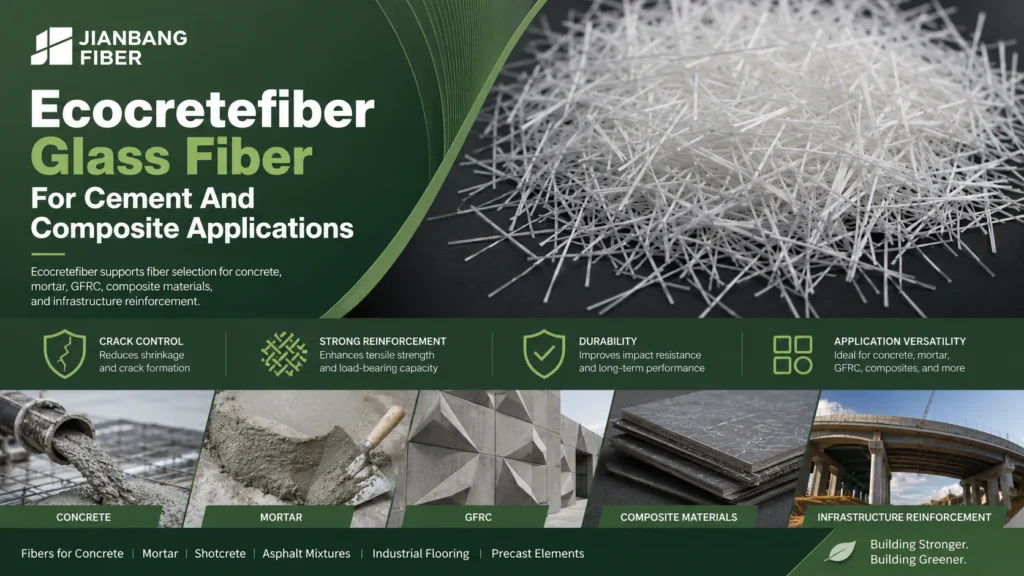
Ecocretefiber™ is the concrete and construction fiber brand of Shandong Jianbang Chemical Fiber Co., Ltd. We supply fiber solutions for concrete, mortar, GFRC, road pavement, bridge deck, tunnel lining, shotcrete, precast products, industrial floors, and composite applications.
Our product direction includes glass fiber, basalt fiber, polypropylene fiber, macro synthetic fiber, steel fiber, PVA fiber, PAN fiber, and other reinforcement fibers.
For glass fiber applications, we focus on correct fiber selection, alkali resistance, surface treatment, matrix compatibility, crack control, and durability. We help customers choose the right product based on the application, not only the fiber name.
We support contractors, distributors, ready-mix plants, precast factories, composite producers, and infrastructure buyers with product selection, packaging options, OEM service, and technical communication.
Buyer Checklist Before Ordering Glass Fiber
Before ordering glass fiber, buyers should confirm several details.
| Question | Why It Matters |
|---|---|
| What is the final application? | Electrical insulation, filtration, GFRC, resin composite, and concrete products need different fibers. |
| Which glass fiber type is required? | E-glass, C-glass, A-glass, special glass fiber, and AR glass fiber have different properties. |
| Is the matrix resin or cement-based? | Resin systems and cement systems need different surface treatment and compatibility. |
| Is alkali resistance required? | Cement-based products need alkali-resistant glass fiber. |
| What fiber form is needed? | Chopped strand, roving, fabric, mat, glass wool, and mesh have different uses. |
| What surface treatment is used? | Sizing and coupling agents affect bonding and durability. |
| What performance data is required? | Strength, diameter, moisture, chemical resistance, and dielectric data may be needed. |
| Will trial production be done? | Trial testing reduces quality and application risk. |
This checklist helps buyers avoid wrong product selection and improves project communication.
Conclusion
Glass fiber is a mature and widely used inorganic fiber material. It has high strength, low elongation, good dimensional stability, heat resistance, insulation performance, chemical resistance, and broad processability.
Shandong Jianbang Fiber finds out that glass fiber can be classified by chemical composition and physical form. E-glass is important for electrical insulation and general composites. C-glass has better acid resistance. A-glass is lower cost but has performance limitations. Special glass fibers are designed for special environments. AR glass fiber is the correct direction for cement-based products such as GFRC.
Shandong Jianbang Fiber also finds out that surface treatment is critical. Heat treatment, acid or alkali etching, coupling agent treatment, plasma treatment, rare earth treatment, and secondary grafting can all improve the interface between glass fiber and matrix when used correctly.
For concrete and infrastructure buyers, the main lesson is clear. Do not use “glass fiber” as one simple category. The correct fiber must match the matrix, exposure environment, application method, and performance target.
Shandong Jianbang Chemical Fiber Co., Ltd. supplies Ecocretefiber™ fiber solutions for customers who need better crack control, better durability, and more reliable reinforcement materials. If your project needs glass fiber, AR glass fiber, basalt fiber, polypropylene fiber, macro synthetic fiber, steel fiber, or another construction fiber, Ecocretefiber™ can help you choose a suitable solution.