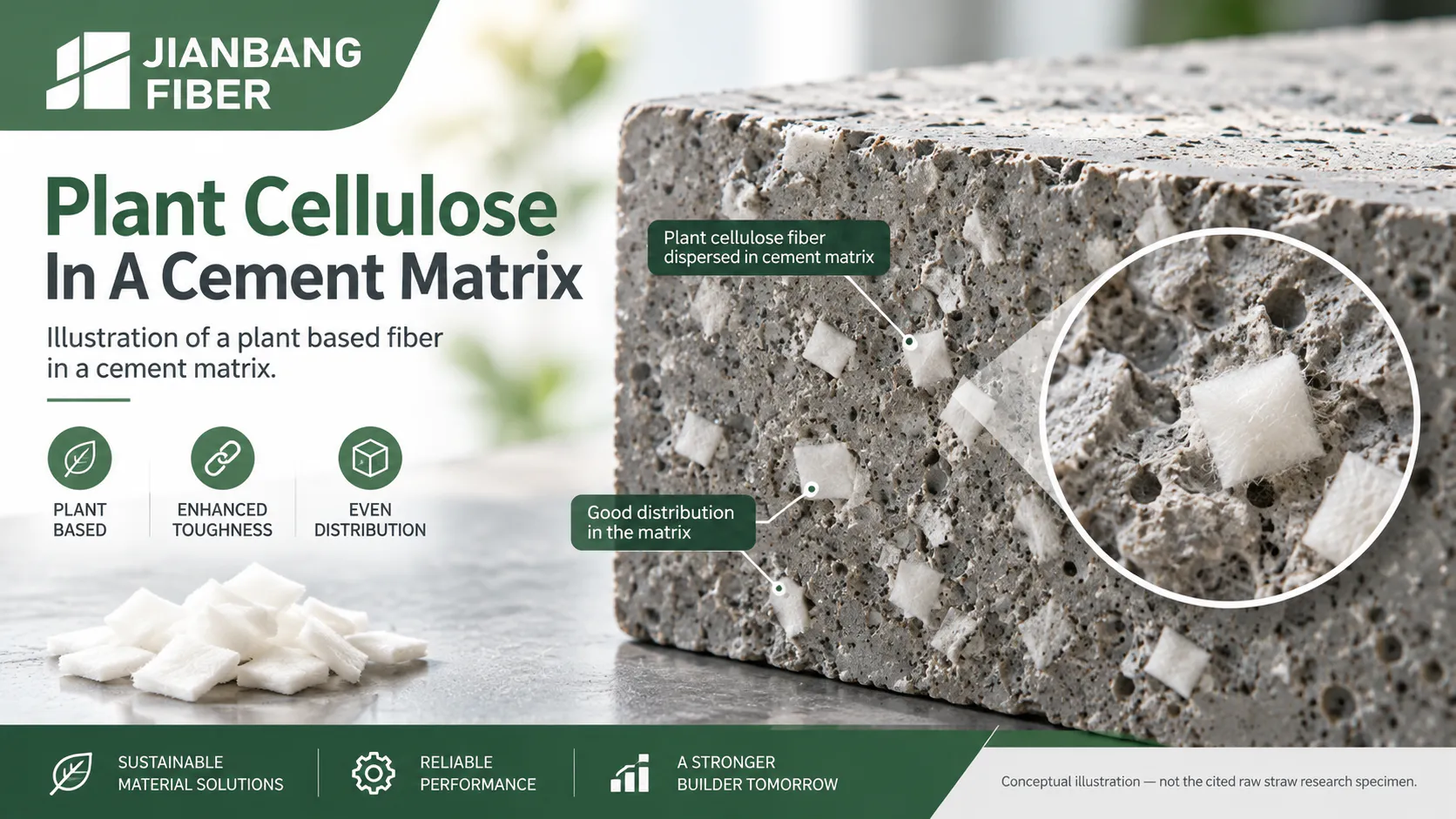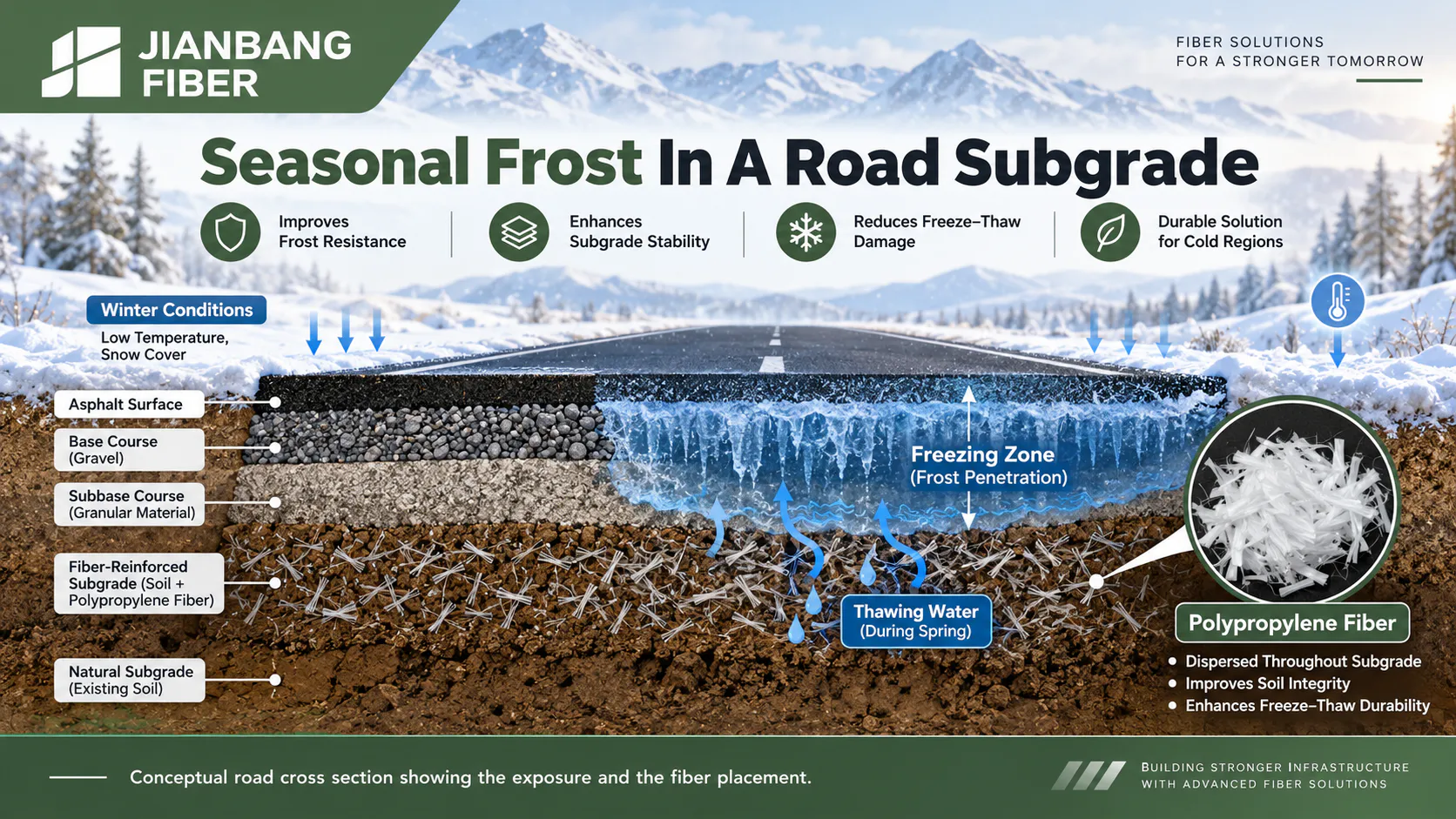
Plant fibers can give cement products a different mix of properties. They may help distribute small cracks, reduce density, and improve the thermal performance of some wall materials. They also absorb water, and many natural fibers change in the highly alkaline environment of Portland cement. A useful design starts by deciding what the product must do, then testing a defined fiber grade in the actual binder.
At Shandong Jianbang Chemical Fiber Co., Ltd., we supply Ecocretefiber™ fibers for cement based materials. Our cellulose fiber range is one option when a producer wants a plant based fiber. The choice still needs a clear application and a controlled trial. A survey of straw, bamboo, rapeseed stalk, and other plant fiber research shows why there is no single “plant fiber concrete” recipe.
What Counts As A Plant Fiber In Concrete
A plant fiber is a strand or short fragment from a natural source such as straw, bamboo, sisal, jute, coconut coir, or processed cellulose. Its main constituents are cellulose, hemicellulose, lignin, and smaller amounts of waxes and other compounds. Their proportions change with species, harvest, processing, and storage. Two products labeled “cellulose fiber” can therefore have very different dimensions, absorbency, and behavior in cement.
The form matters as much as the origin. Chopped stalks, milled straw particles, and purified short cellulose filaments do not provide the same reinforcement. A long strand may bridge a larger crack, while a fine fibril offers more contact area and can influence fresh mix cohesion. Neither description proves a structural capacity on its own. Length, aspect ratio, tensile strength, bonding, dosage, and dispersion must be measured for the selected grade.
Plant fibers also differ from polypropylene microfibers and from soluble cellulose ethers. PP monofilament has a different water uptake profile, while cellulose ether changes the water and flow behavior of mortar as a powder. Our guide to cellulose fiber and cellulose ether explains why they cannot be swapped by weight.
| Material form | Main role to evaluate | Main qualification concern |
| Raw chopped straw or stalk | Low density, crack distribution, or insulation in selected products | Variable composition, water uptake, extractives, and long term stability |
| Processed cellulose fiber | Fine scale crack control and mix cohesion | Grade consistency, dosage, dispersion, and compatibility |
| Bamboo or other longer plant strands | Potential crack bridging in a matched composite | Bond, orientation, moisture movement, and alkali ageing |
| PP microfiber | Early crack control with low fiber water uptake | Specified grade, dose, and project performance tests |
The comparison describes possible design roles, not guaranteed results. A specification should name the actual product and its tested performance, not only its botanical family.
How Fibers Change Strength And Crack Behavior
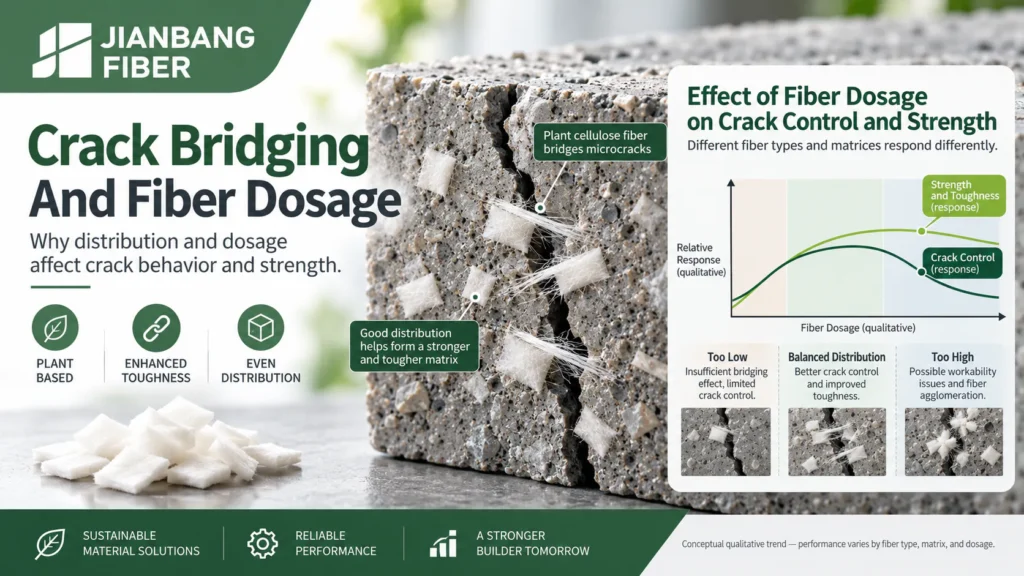
Fibers can cross a developing crack and carry tensile force as the cement matrix opens. This bridge may change how a beam fails and how many cracks form. A fine, well distributed network can help hold a crack narrow. The useful force depends on whether the fiber remains intact and whether the interface transfers load without excessive slip or early rupture.
A 2020 review by Bai Shiqi in China New Technologies and Products compared several research examples. A straw fiber concrete series reported lower compressive, splitting tensile, and flexural strengths as its straw content increased. A separate bamboo fiber experiment reported a marked improvement in splitting tensile strength. These outcomes can coexist because the fibers, mix designs, dosage ranges, and test methods were different. We would not use the bamboo result to predict the strength of a straw mix.
The review also describes a low dose rapeseed stalk experiment with 0.1%, 0.2%, 0.3%, and 0.4% fiber levels. Several strength measures first increased and then decreased. The reported splitting tensile and flexural peak occurred around 0.2% by volume with 20 to 30 mm fiber. That is a result for a particular rapeseed stalk system. It is not an Ecocretefiber™ cellulose dosage, and a volume percentage should not be copied into a mass based production sheet without fiber density and mix calculations.
Why can too much fiber hurt? More plant material can draw water from the fresh paste, reduce workability, and make clusters. The mix may then trap air or leave zones with too little paste around the aggregate and fibers. A lower density can be useful for a wall unit, yet extra voids may reduce compressive strength. The engineer must decide which property is the priority and keep the other properties within acceptable limits.
For structural decisions, ask for measured compressive strength and the full bending response at the chosen age. Peak flexural strength and post crack residual load answer different questions. ASTM C39/C39M-26 covers compressive strength of applicable cylindrical concrete specimens. ASTM C78/C78M-22 measures flexural strength by third point loading. Where residual beam performance is important, ASTM C1609/C1609M-24 evaluates fiber reinforced concrete from its load and deflection curve. The project method and specimen type must match the product being qualified.
Thermal Insulation Benefits Need The Right Comparison
Some plant fiber composites have lower thermal conductivity because their structure holds more air and has a lower bulk density. The 2020 review describes rapeseed stalk concrete with larger pores than a reference mix and a trend toward lower conductivity as fiber content increased. That same pore change can affect strength and water movement. Insulation and strength therefore need to be tested together.
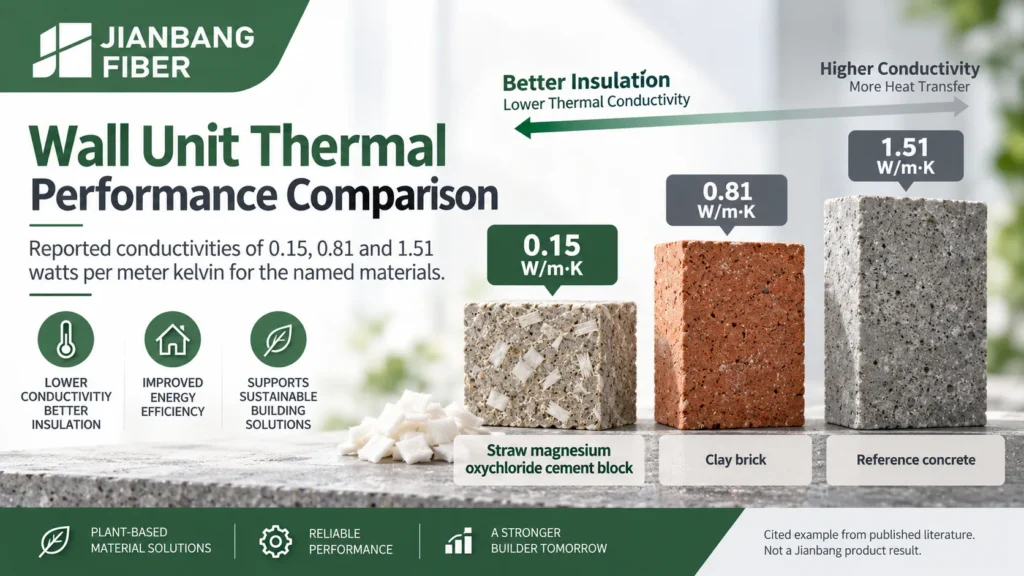
One quoted comparison gives a thermal conductivity of 0.15 W/(m·K) for a straw magnesium oxychloride cement block, against 0.81 W/(m·K) for a clay brick and 1.51 W/(m·K) for a reference concrete in that source. The 0.15 figure belongs to that particular wall block and its test context. It does not describe ordinary Portland cement concrete, every plant fiber mix, or any Ecocretefiber™ product.
A wall product can be attractive when the target is lower heat flow and modest structural demand. A pavement or heavily loaded element has a different balance. Ask for the conductivity at stated moisture and density, the unit’s dimensions, and the relevant compressive and durability tests. Moisture can change the thermal result, so a dry laboratory value may not represent an exposed wall.
Where a producer targets thermal performance, compare full finished units or panels under one agreed method. ASTM C518-21 is a heat flow meter method for steady state thermal transmission properties. Choose a suitable test setup and record conditioning, specimen size, density, and moisture.
Water Absorption Is The First Mix Design Challenge
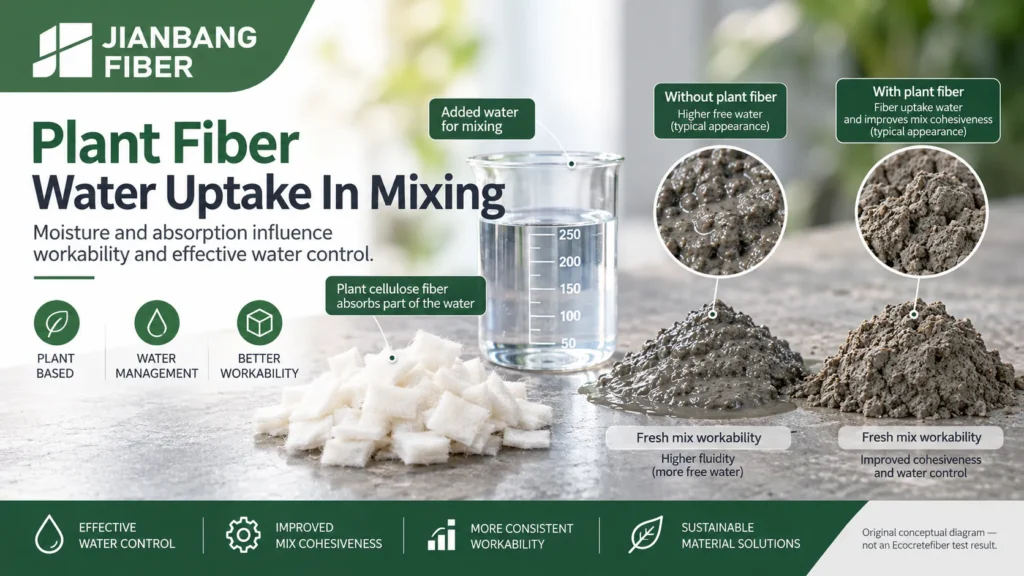
Plant fibers often contain pores and hydrophilic groups. They can take up water before or during mixing. That can lower the free water available to wet cement and aggregate, change slump or flow, and cause a plant batch to behave differently from a small laboratory batch. During service, wetting can swell a fiber and drying can shrink it. Repeated changes can weaken the fiber and matrix interface.
The cited review describes a straw fiber composite whose water absorption rose with fiber content. A particular treatment trial found that washing or alkali treatment reduced absorption relative to its untreated versions. One reported lowest value was 9.32% after a 12 hour immersion for a mix using 5% fiber treated in 4% sodium hydroxide solution. This is a narrowly defined experimental result. It is not a general prediction for all plant fiber concrete, nor a recommended chemical recipe for a factory.
In production, record the fiber’s as received moisture and its absorption behavior. A prewetting plan, a controlled water adjustment, or a different fiber grade may improve consistency, but each change must be tested. Adding water until a mix looks workable can raise the effective water to binder ratio and reduce strength. A superplasticizer adjustment may be more suitable in some mixes, provided it is checked for compatibility.
Measure concrete water ingress separately from fiber absorption. ASTM C1585-20 measures the rate of water absorption by hydraulic cement concrete through an exposed surface. It is useful when the application needs a defined sorptivity comparison. It does not replace a fiber moisture measurement or a project durability program.
Why Cement Hydration Can Slow Down
A plant fiber carries more than cellulose. Some stalks and other raw fibers can release soluble sugars and compounds from hemicellulose or lignin into mixing water. Those extractives may delay cement reactions. The 2020 review cites heat release research in which straw lowered the maximum hydration rate and reduced the heat released in the first seven days. That observation applies to the tested straw and binder. A cleaned or processed cellulose grade may behave differently.
A slower setting mix can hold up demolding, finishing, or early loading. It can also complicate cold weather production. A factory should compare plain and fiber mixes with the same binder, water, admixture, temperature, and curing method. Track fresh flow, setting time, early strength, and later strength. If the mix uses supplementary cementitious materials, qualify that full binder system instead of assuming that a change in cement content fixes incompatibility.
ASTM C403/C403M-23 can measure setting time by penetration resistance for applicable concrete mixes or mortar fractions. Isothermal calorimetry can add information about the heat release profile. These tests tell the team whether the fiber preparation and binder work together under the planned production conditions.
The Alkali Durability And Bond Problem
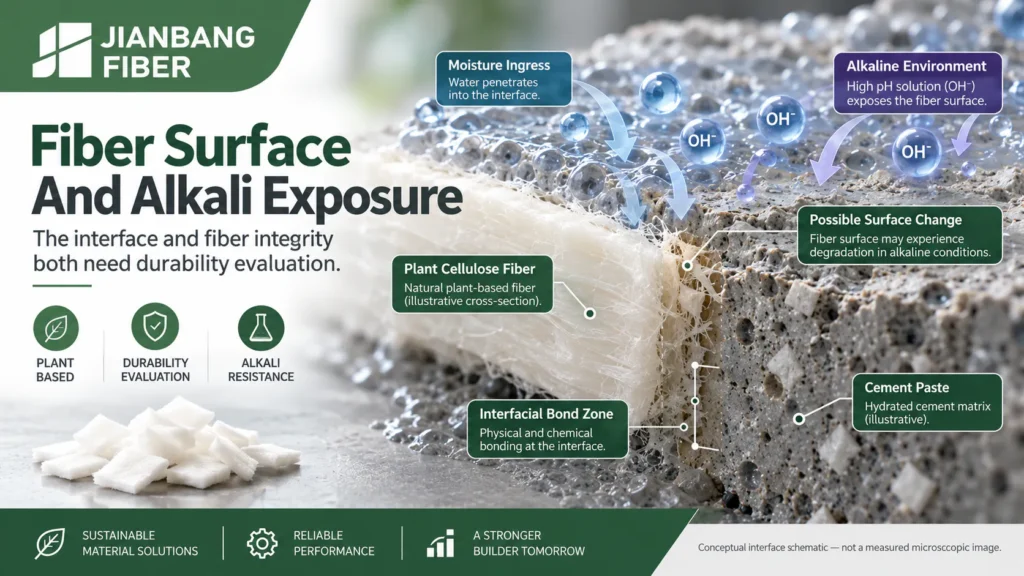
Ordinary Portland cement pore solution is alkaline. Over time, that environment can attack components of some natural fibers. Moisture and repeated wetting and drying may add further damage. A study of sisal in cement matrices examined degradation under alkaline, mineral rich conditions, while other experimental work has measured natural fiber ageing under alkaline exposure. The service life of a composite depends on the actual fiber and matrix, so an attractive 28 day strength result is only a starting point. Read the cement matrix degradation study and experimental ageing research.
The fiber surface can also make bonding difficult. Waxes or residues may limit contact with cement paste. A fiber that pulls out too easily cannot transfer much load across a crack. Yet a very strong bond with a fragile fiber may lead to fiber breakage. The best interface depends on the required crack width and the loading stage.
Cleaning, controlled alkali treatment, coating, and mechanical or plasma surface treatment are possible approaches. They have different costs and effects. Treatment must be assessed for fiber damage, residual chemicals, water absorption, mix compatibility, and long term performance. The review discusses cold plasma as a way to alter surface chemistry, but it does not establish a universal process or an economic benefit for every plant fiber grade.
A producer can also examine binder changes, including appropriate supplementary cementitious materials, as part of a durability design. That does not automatically make a material safe in every exposure. Pair accelerated conditioning with retained fiber and composite properties, and confirm the service conditions with the engineer.
Where Plant Fibers Fit And Where To Test Further
Wall boards, lightweight blocks, some precast units, plaster, and selected mortars may value a combination of lower density, cohesion, or thermal performance. Each product still needs its own strength and moisture criteria. A heavily loaded structural concrete element needs a much stronger case, especially if the design relies on residual load after cracking. Do not treat every plant fiber as a direct replacement for steel reinforcement or an engineered macro synthetic fiber.
We offer an Ecocretefiber™ cellulose fiber option with published cut lengths and grade information. It is a processed product, not the raw straw or bamboo specimen from the cited studies. Its product page can start a grade discussion, while the chosen mix needs its own verification. We also offer a broader fiber portfolio when PP, PVA, steel, or another material better matches the performance target.
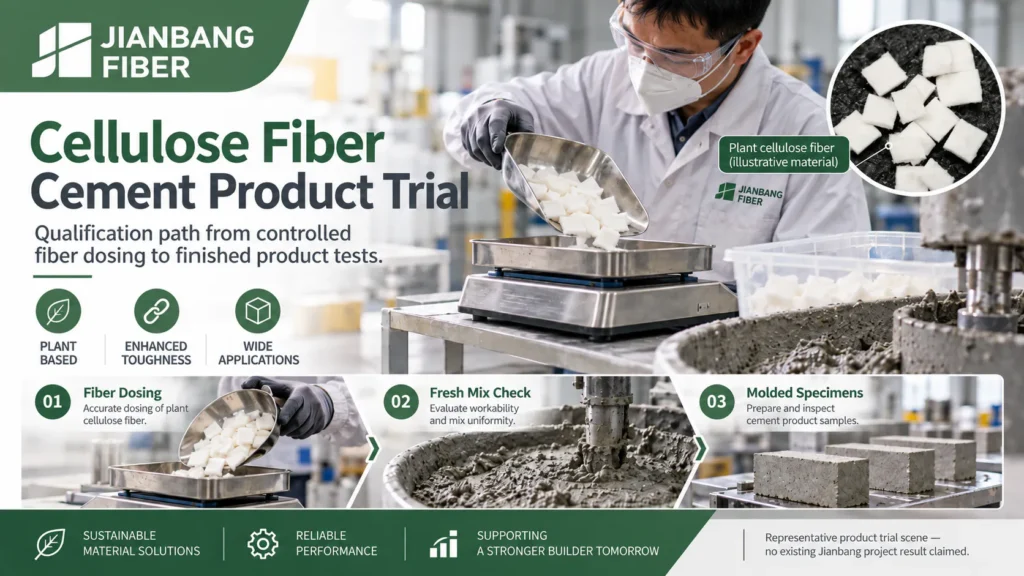
For a useful trial, define the end product first. Select an untreated reference and at least two fiber levels. Use the same binder, aggregate, curing, and water control for each set. Record fiber moisture, dispersion, fresh flow, air content, unit weight, setting, compressive strength, and bending behavior. Add absorption, thermal, and ageing tests where those claims will matter in service. Photograph the fractured specimens and note whether fibers pulled out, broke, or clustered.
Then run a plant scale mixing and placement trial. The fiber must feed consistently, disperse without balls, and keep the intended finish. If workability needs more water, redesign and retest rather than quietly changing the approved mix. The winning recipe is the one that meets every required property at a repeatable cost and process.
Frequently Asked Questions
Is Plant Fiber Concrete Always Stronger Than Plain Concrete
No. Some fibers and low dosages improve particular tensile or flexural measures, while other mixtures lose strength. Extra water, air, or poor dispersion can reduce compression. Compare the chosen grade against a plain control under the same test method.
Does Every Plant Fiber Improve Thermal Insulation
No. Density, pore structure, moisture, binder, and product geometry matter. The 0.15 W/(m·K) example belongs to one straw magnesium oxychloride block and cannot be assigned to another product.
Can We Use A Reported 0.2 Percent Dose For Cellulose Fiber
Not directly. That number was a volume fraction in a specific rapeseed stalk experiment. Ask for the grade density, decide whether your production uses volume or mass dosing, and qualify a trial range in your binder.
Will Alkali Treatment Solve Long Term Durability
Treatment may improve one property and damage another. Choose a defined process, then measure water uptake, fiber integrity, setting, strength, and retained properties after relevant ageing. Follow appropriate chemical handling procedures at the plant.
Is Processed Cellulose Fiber The Same As Cellulose Ether
No. A cellulose fiber remains a physical strand that can participate in crack bridging. A cellulose ether is a soluble or hydratable powder used mainly to change water retention and fresh mix flow. The two materials need different specifications.
Conclusion
Plant fibers can be useful in cement products, especially when crack distribution, mix cohesion, weight, or thermal performance matters. Their water uptake, surface chemistry, hydration effects, and alkali durability can also limit performance. The named research examples point to a practical rule: qualify a defined fiber grade in a defined binder and measure the properties your customer will actually use.
Shandong Jianbang Chemical Fiber Co., Ltd. can supply Ecocretefiber™ cellulose fiber samples and discuss other fiber options for your product. Contact our team with the target application, binder, mixing method, and required tests so we can help you select a sensible trial grade.