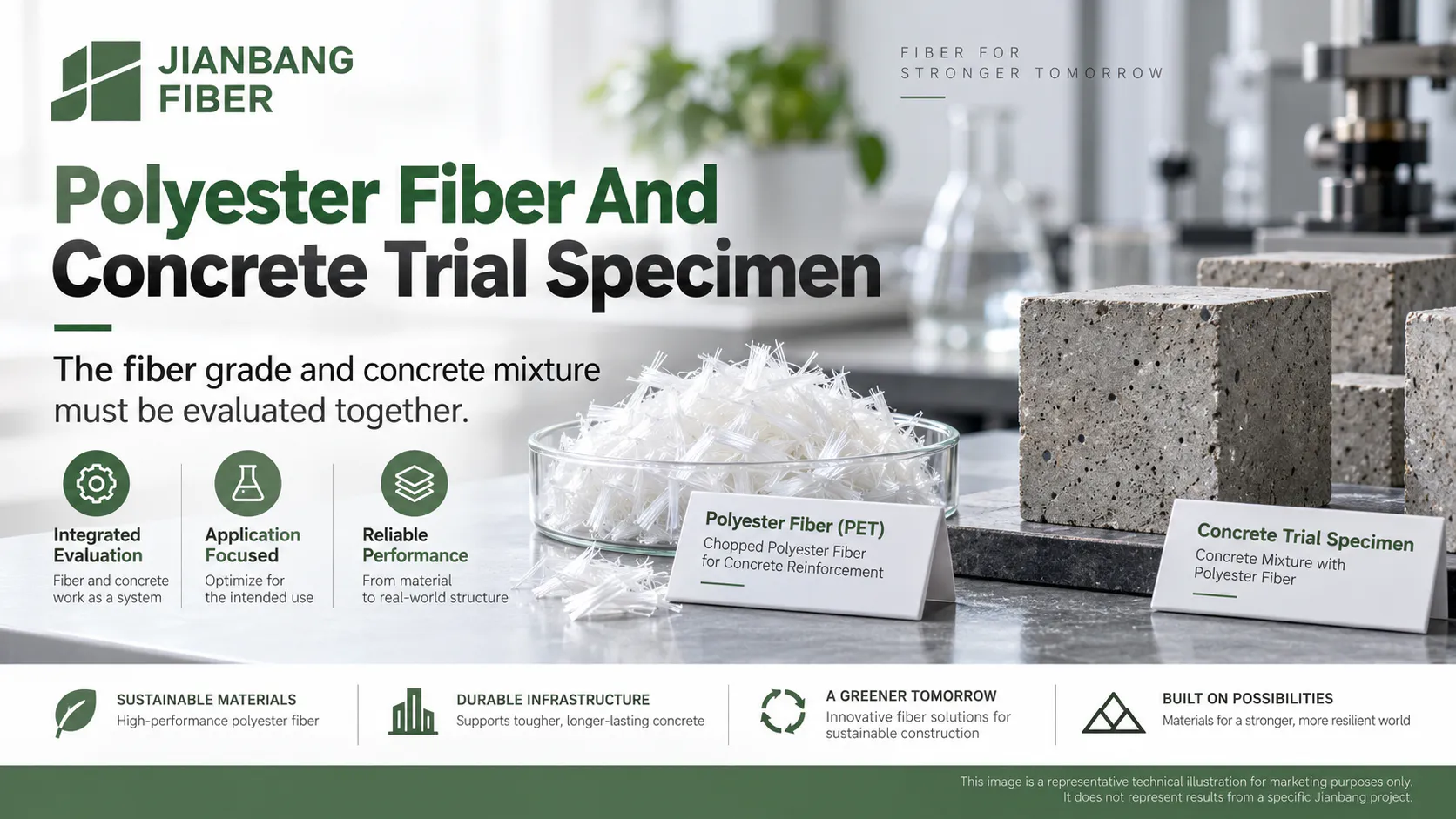
Polyester fiber can help a concrete mixture bridge cracks and retain useful behavior as the material deforms. Its effect depends on the fiber grade, shape, amount, dispersion, and bond with the cement matrix. For contractors and producers, the useful question is which measurable property the finished mixture needs to achieve.
At Shandong Jianbang Chemical Fiber Co., Ltd., we supply Ecocretefiber™ reinforcement fibers and help customers compare materials for their application. This guide explains the potential benefits of polyester fiber in cement concrete, how to define its dosage, and what to verify during mixing and testing. It also addresses the long-term alkaline exposure that matters when polyester is embedded in a cementitious material.
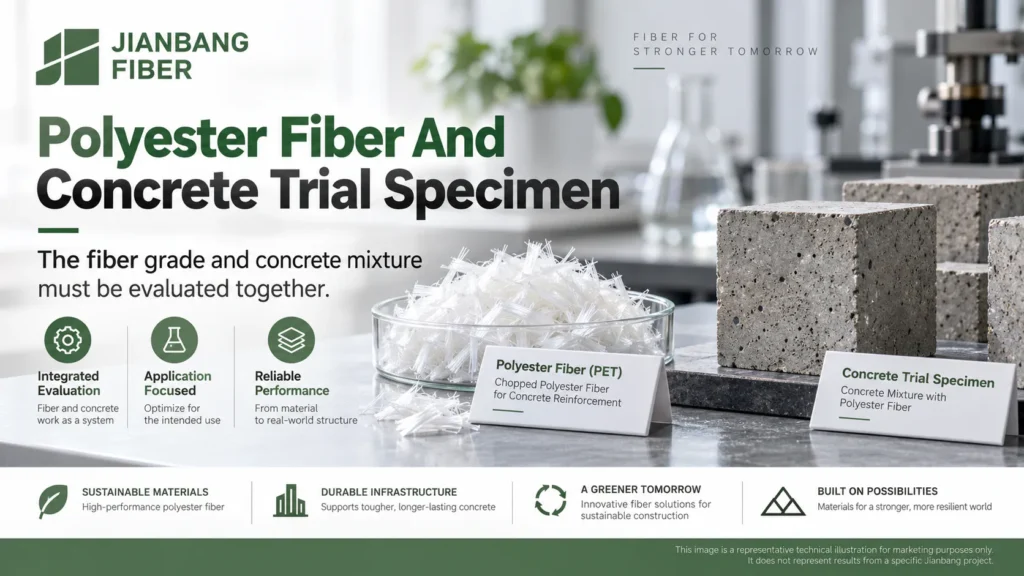
What is polyester fiber for concrete?
Polyester fiber commonly refers to polyethylene terephthalate, or PET, in this application. It may be manufactured as a fine chopped filament, a larger engineered reinforcing fiber, or a processed recycled material. Those forms have different dimensions, surfaces, and mechanical properties. A fiber cut from a PET bottle should not be treated as the same product as a purpose-made filament with a controlled grade.
Polyester and polypropylene are also different polymers. Avient’s PET fiber data gives a specific gravity of about 1.38 for its listed PET grades. That corresponds to approximately 1380 kg/m³, above the density of water. PET is much lighter than steel, but a small fiber addition does not automatically turn ordinary concrete into lightweight concrete. Aggregate, air, paste, and overall mixture proportions determine the concrete’s density.
Compare fiber tensile strength, stiffness, elongation, geometry, and bond together. A high tensile-strength label alone does not justify a claim that PET can replace reinforcing bars. Distributed fibers and continuous steel reinforcement act differently, and a substitution needs an approved structural design and suitable composite performance data.
What benefits can polyester fiber provide?
Crack bridging and tensile behavior
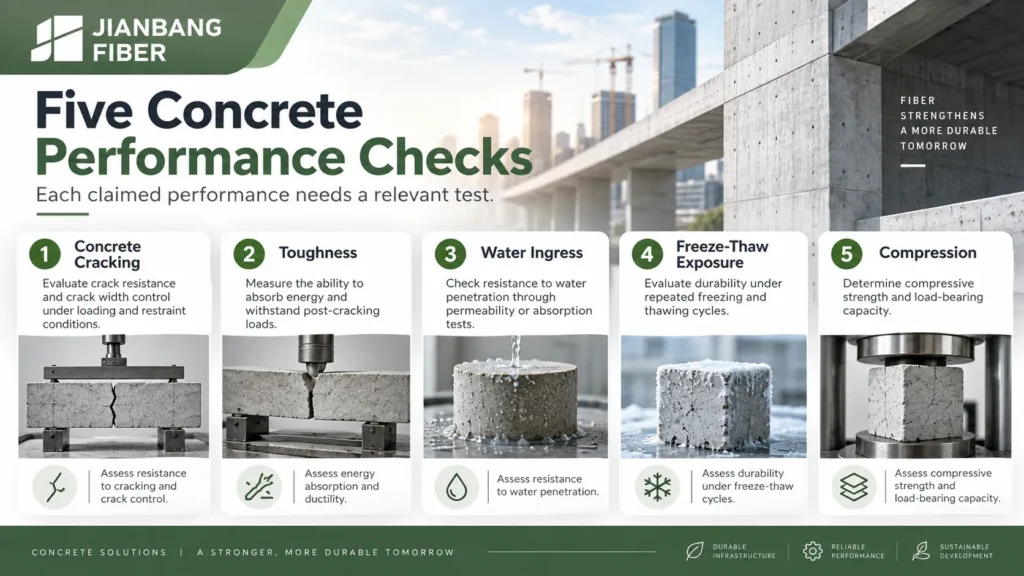
Fibers crossing a developing crack can transfer stress between its faces. Depending on the system, this can limit crack opening or change the way damage spreads. Fine filaments and larger reinforcing fibers do not necessarily perform the same job. Identify whether the project targets early shrinkage cracking, tensile behavior in hardened concrete, or residual capacity after a flexural crack forms.
Choose a test that matches that target. A splitting tensile result, a restrained-shrinkage result, and a residual flexural-strength result describe different behavior. None should be presented as a universal percentage improvement in “crack resistance.” Fiber orientation, embedment length, and dispersion can all change the response.
Toughness and impact response
Fiber pullout, extension, and debonding may allow a cracked specimen to absorb additional energy. This makes toughness and impact response useful areas for a PET trial. A material can become more tolerant of cracking without a large increase in its first-crack strength.
Use a representative impact or repeated-load test when that performance matters. Record the specimen, support, loading procedure, age, and failure criterion. A static flexural beam test cannot establish every impact or fatigue claim. For load-bearing or sustained-load applications, the design must also consider creep and long-term crack opening.
Water absorption and resistance to ingress
Crack control may help limit some routes for water movement. Published research comparing steel, polyester, polypropylene, and plain concrete found the polyester series had the lowest capillary absorption among the mixtures studied. That is a result for those materials and proportions, rather than a guarantee for all PET mixtures. See the researchers’ study record.
Fiber addition can also reduce workability or introduce defects if the mix is poorly consolidated. Test the actual water-related property required by the project. Absorption, water penetration under pressure, and chloride transport are different measurements. Retain the required joints, waterstops, cover, curing, and waterproofing details.
Freeze-thaw behavior
PET may be evaluated as part of a concrete mixture intended for cold exposure. The result depends on saturation, aggregate, air-void system, curing, and fiber-matrix condition. The presence of fibers does not establish frost durability or replace specified air entrainment.
Use the adopted freeze-thaw procedure and its acceptance limits. Check fresh air content and relevant hardened properties before and after exposure. A laboratory cycle count should not be converted into a promised number of winters. Also distinguish resistance to repeated freezing in service from protection of newly placed concrete during cold weather.
Compressive strength
Compression remains a matrix-dominated property. Changes in water-to-binder ratio, entrapped air, compaction, and curing can outweigh the effect of a small PET addition. A trial may show an increase, little change, or a decrease in measured compression. Do not assume that adding more polyester will raise the concrete strength grade.
Keep compression and post-crack behavior as separate acceptance requirements. This avoids approving a mixture for residual capacity simply because its cubes or cylinders passed a strength test.
Why alkaline durability needs its own evidence
PET does not rust like carbon steel. Its long-term behavior in cement nevertheless requires assessment because polyester can undergo alkaline hydrolysis. The exposure severity, temperature, moisture, fiber processing, surface treatment, and time influence the outcome.
A study of recycled PET fibers in Portland-cement materials tested mortar through 164 days. It reported no significant influence on strength or elastic modulus, while toughness indices declined with time as the PET degraded. These findings show why early-age strength alone cannot qualify a long-term fiber role. Read the original PET durability study.
A separate 2024 investigation of post-consumer carpet fibers found losses in PET-family fiber properties under severe alkaline exposure. The material was a mixed waste-fiber system, so its results should not be assigned directly to every engineered PET product. It does reinforce the need to identify the polymer and test retained properties. Read the alkaline-exposure experiment.
Ask the supplier for the exposure solution, pH, temperature, duration, and retained tensile properties behind an alkali-resistance statement. Where fibers have a design role, request aged composite tests as well. An accelerated bath is a screening tool whose relationship to the intended service environment must be justified. A pass after short exposure does not establish the full design life of an element.
Define polyester fiber dosage in clear units
A percentage is incomplete until its basis is stated. Fiber amount may be reported by concrete volume, cement mass, binder mass, or total mixture mass. Those quantities can produce very different batch weights.
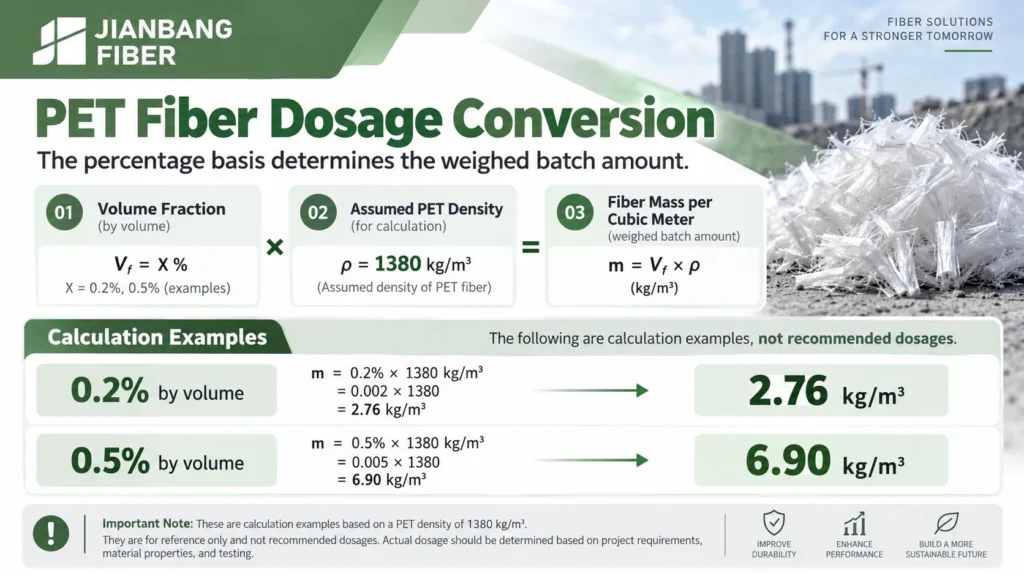
For a specified volume fraction, the conversion is:
Fiber mass per cubic meter = fiber volume fraction × fiber density.
For example, if a trial uses PET with an assumed density of 1380 kg/m³, a 0.2% concrete-volume fraction gives 2.76 kg/m³ and a 0.5% fraction gives 6.90 kg/m³. These are arithmetic examples, not a recommended dosage window. Use the actual grade density and the project’s trial levels. The fiber’s dimensions and intended function can make a different amount appropriate.
| Dosage statement | Information still needed | Correct batch record |
| 0.5% fiber | Percentage of what quantity? | State concrete volume, binder mass, or another defined basis. |
| 0.5% by concrete volume | Exact fiber density and batch yield | Convert to weighed fiber per actual batch. |
| 0.5% by binder mass | Binder mass in the batch | Multiply binder mass by 0.005. |
| A fixed kg/m³ amount | Grade, mix, and performance objective | Record fiber identity and verify the result in trials. |
Run a control and selected fiber mixtures with the same documented materials. Measure fresh behavior and hardened performance, and keep the range of results rather than only the best specimen. Increasing fiber amount can worsen dispersion or compaction, so it should follow evidence of a useful benefit.
Mix polyester fibers for even distribution
Qualify the addition sequence
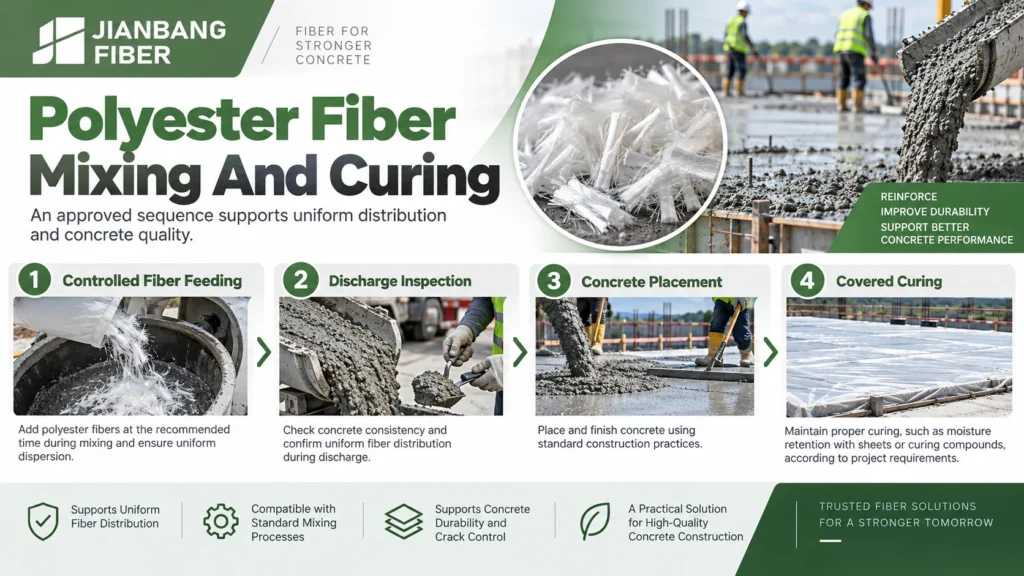
The correct sequence depends on whether fibers arrive loose, bundled, surface-treated, or in another package. Some systems use gradual dry addition into a moving mix. Others may use a separately qualified pre-dispersion step. Do not assume that stirring PET into water always separates it or that a procedure developed for asphalt suits a cement mixer.
Use the supplier’s grade-specific instructions as a starting point and confirm the process in the actual equipment. Record batch size, mixer fill, feed rate, sequence, and time. Inspect discharge samples from different parts of the batch for balls or uneven concentration. Verify that bundles have opened as intended.
Control workability without uncontrolled water
Fibers can change flow, cohesion, and finishing behavior. Adjust paste, grading, and compatible admixture through controlled trials where necessary. Keep the approved water-to-binder ratio and account for water introduced with any pre-dispersion liquid. An unrecorded water addition changes the mixture being qualified.
For pumped concrete, test the intended pipeline, bends, delivery rate, and discharge behavior. A successful pump trial without fibers does not qualify a revised fiber mixture. Check workability retention over the expected transport and placing period.
Consolidate and cure the mixture
Use consolidation suited to the element and fresh concrete. Insufficient compaction can leave voids; excessive vibration can disturb a mixture. Check exposed surfaces for fiber clusters or unacceptable finishing marks. Retain the joint and reinforcement details required by the design.
Start curing promptly and follow the project moisture and temperature requirements. Fibers do not remove the need for hydration or protection from drying. Make laboratory specimens and representative trial elements with recorded placing and curing conditions so the comparison remains meaningful.
Match each claim to an acceptance test
Agree on the test methods, age, specimen preparation, and limits before selecting the production amount. A trial plan should connect the required benefit to a measured result and include the long-term compatibility evidence relevant to PET.
| Project question | Evidence to request | What it does not establish |
| Does it reduce early cracking? | Suitable restrained plastic-shrinkage or other specified cracking test | Structural residual capacity |
| Does cracked concrete retain load? | Flexural load-deflection response and specified residual strengths | Every impact, fatigue, or creep condition |
| Does the mix meet its strength grade? | Compression tests under the governing standard | Waterproofing or fiber durability |
| Does it resist the exposure? | Specified water-ingress or freeze-thaw tests | Performance under unrelated exposures |
| Will the fiber retain its role? | Alkali-aging data and appropriate aged composite tests | A design life inferred from a short soak |
ASTM C1609/C1609M-24 is one option where the contract requires flexural characterization of fiber-reinforced concrete. It distinguishes first-peak response from residual strengths at specified deflections. The engineer should select the relevant values and interpret them within the member design.
For an impact or fatigue requirement, use a separately stated method. For structural replacement of conventional reinforcement, verify the applicable design route and obtain approval for the exact fiber system. Laboratory improvements do not automatically authorize removal of reinforcing bars or mesh.
Keep cement concrete and asphalt applications distinct
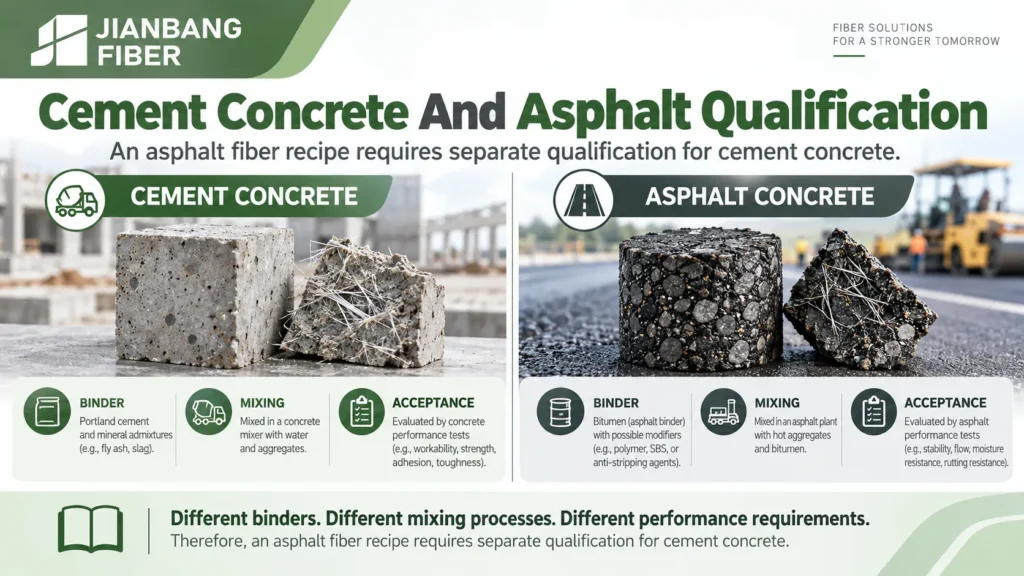
The word “concrete” appears in both cement concrete and asphalt concrete. Their binders, processing temperatures, fiber interaction, and exposure differ. A PET grade developed for asphalt needs separate evidence before use in a cementitious structural application.
Our Ecocretefiber™ polyester fiber product page presents an asphalt-oriented chopped PET grade. Its asphalt dosage and dry mixing procedure should be used only within the relevant asphalt specification and trial. Ask our team to confirm current data and suitability for your cement-concrete proposal rather than transferring that recipe.
Thermal properties need the same care. A melting point around 256–257°C is a material characteristic, not a continuous structural service-temperature rating. Temperature can affect shrinkage, stiffness, and retained strength before melting. A claim for performance at 200°C needs the actual exposure duration and composite test. A PET fiber addition alone does not establish fire resistance or a fire-spalling solution.
For a cement-based project, compare qualified polyester with other appropriate concrete reinforcement fibers. Micro PP, macro synthetic fiber, and steel fiber serve different targets and also require the correct grade and evidence. Select through the project function, exposure, and trial results.
A buyer checklist for project trials
Send the supplier the binder type, fiber function, concrete strength, aggregate grading, element thickness, mixer, delivery route, placement method, and exposure. State any residual-strength, impact, permeability, or frost requirement. Identify whether the project needs virgin engineered fiber or a controlled recycled product.
Request the current grade data sheet, dimensions and tolerances, density, mechanical properties, surface treatment, batch traceability, and relevant aging reports. For recycled materials, confirm polymer identity, cleanliness, and consistency. Agree on who supplies samples, who performs testing, and which result approves the production grade and amount.
At Ecocretefiber™, we can discuss the application and provide information on candidate products for trial selection. We recommend completing that qualification before bulk purchase, especially when a fiber is expected to contribute to long-term structural performance.
Frequently asked questions
Is polyester fiber lighter than water?
Typical PET is denser than water. A specific gravity near 1.38 corresponds to about 1380 kg/m³. Use the actual product data sheet for dosage calculations. Low-dose PET addition should not be described as a method for making structural lightweight concrete.
Is 0.2–0.5% the correct dosage for every mixture?
No. First define the percentage basis, then select trial levels for the exact fiber and required function. Confirm workability, distribution, and the required hardened performance.
Will polyester always increase compressive strength?
No. Compression can increase, remain similar, or decline depending on the mix and construction. Test it separately from tensile, crack-control, and residual-performance requirements.
Can an asphalt PET fiber be used directly in cement concrete?
The cementitious application requires its own grade approval, mixing trial, and compatibility evidence. Asphalt performance does not establish alkaline durability in cement.
Does a non-rusting fiber guarantee long-term durability?
No. PET does not rust, but alkaline hydrolysis and the retained fiber-matrix response still require evaluation. Ask for evidence relevant to the service environment and intended design role.
Plan your fiber evaluation with Shandong Jianbang
Polyester fiber is worth evaluating when a defined crack-control or toughness objective matches the grade and service conditions. Shandong Jianbang Chemical Fiber Co., Ltd. supplies Ecocretefiber™ fiber solutions and helps buyers compare product form, application, and trial requirements. Contact our team with your binder system, placement method, and acceptance targets to discuss a suitable candidate and sample.