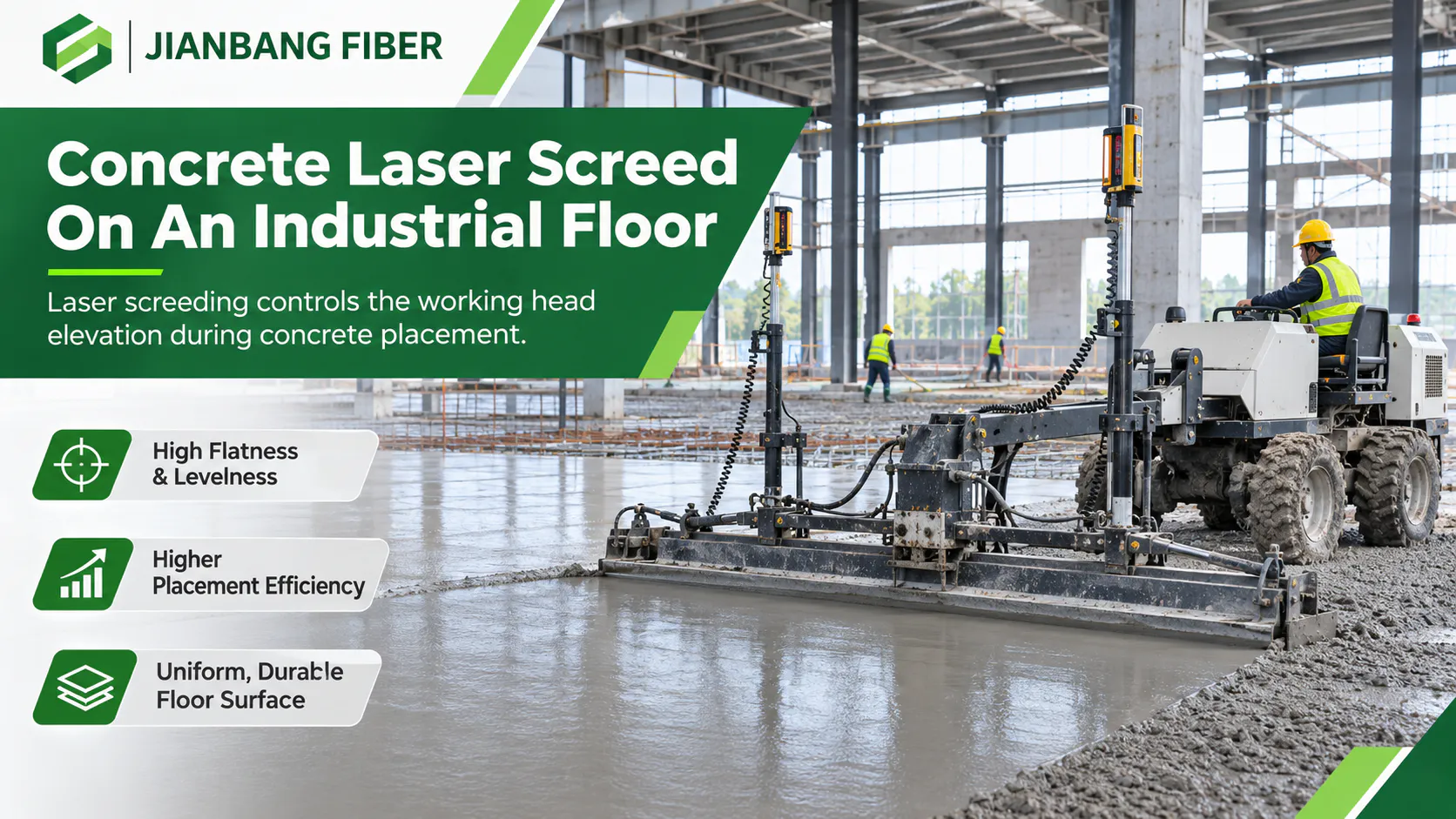
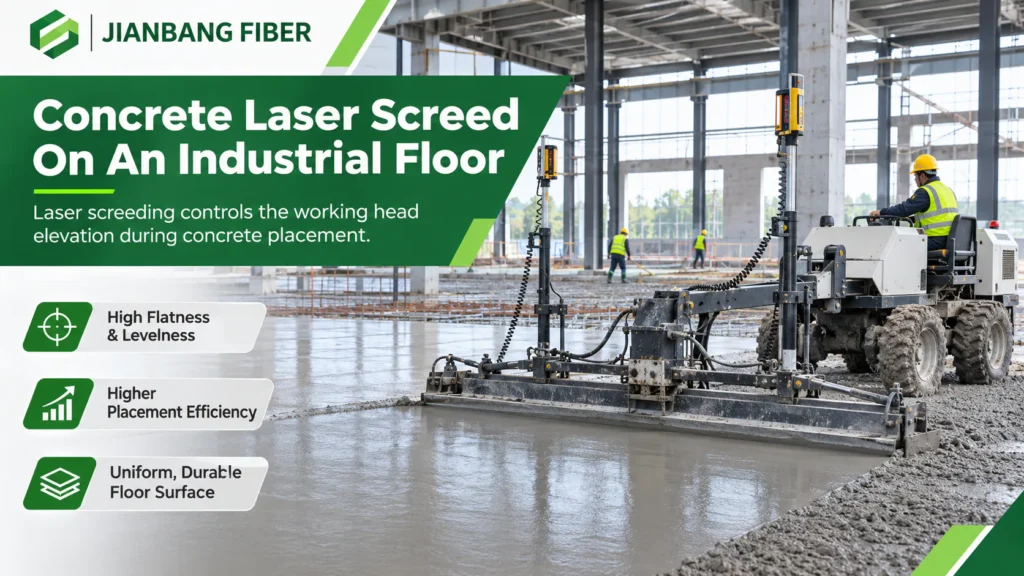
A concrete laser screed is a machine that uses a laser reference and automatic height control to strike fresh concrete to the required surface elevation. Its screed head levels the material and, on equipped models, combines spreading and vibration in the same pass. Contractors use this equipment to place large concrete floors with consistent grade control.
The machine is especially useful where a floor must support frequent traffic, storage racks, production equipment, or a planned drainage slope. Its value comes from controlling the surface during placement. The concrete mixture, floor design, finishing, and curing still determine many of the floor’s other properties.
At Shandong Jianbang Chemical Fiber Co., Ltd., we supply Ecocretefiber™ concrete fibers for different reinforcement needs. When a project uses laser screeding, fiber selection should fit the mixture and placement process. A floor needs both an accurate surface and the concrete performance specified for its use.
How Does A Concrete Laser Screed Work
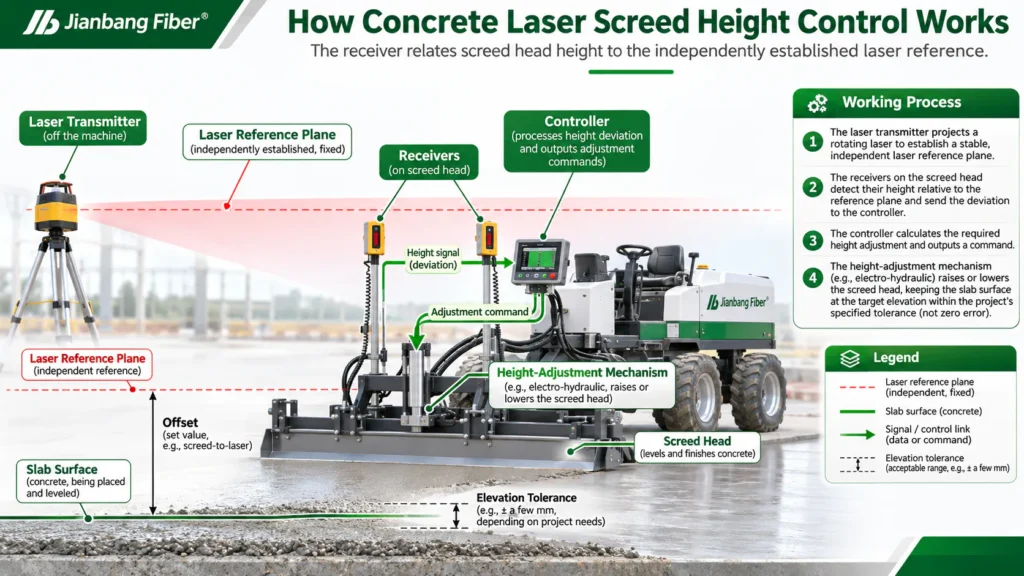
The system connects a site reference to a moving screed head. The laser provides height information, and the head performs the work on the fresh concrete.
The Laser Establishes A Reference
A laser transmitter stands separately from the machine. It creates a reference plane over the work area. The crew relates that plane to the project benchmark and sets the required offset for the slab surface.
Receivers on the machine detect the laser signal. The controller uses that information to adjust the screed head height as the machine moves through its working pass. This arrangement lets the head follow the reference even when the machine’s supporting surface varies within its operating limits. The control principle is described in Somero’s screed head control patent.
Automatic control follows the reference that the crew establishes. A wrong benchmark or disturbed transmitter can therefore affect a whole placement. The operator needs independent checks at known points, especially after a setup change.
The Screed Head Levels And Vibrates The Concrete
An integrated head can include a plow or strike-off blade, an auger, and a vibrating member. The components move excess concrete, bring the surface to grade, and assist consolidation. Their arrangement varies by machine.
For example, Somero’s integrated screed head description explains how one boom machine combines plowing, leveling, and consolidation. Its auger moves surplus material sideways. This shows why the crew should feed a controlled amount of concrete ahead of the head.
The auger handles material around the screeding pass. Fiber dispersion and full mixture uniformity must already be achieved in the concrete mixer. Operators should use the selected machine’s vibration settings and operating procedure, and provide any additional consolidation required by the placement detail.
The Operator Controls Travel And Position
Handle or joystick controls let an operator position the machine and manage its movement. Automatic head control reduces repeated manual height adjustment during screeding. The operator still watches material supply, clearance, receiver signal, and the surface left behind.
One person may operate the machine controls, depending on the model. A complete floor placement still requires people for delivery, spreading, edge work, finishing, and inspection. Crew planning should cover the full operation.
What Are The Main Benefits Of Laser Screeding
Consistent Elevation Across A Large Placement
A separate laser reference reduces dependence on intermediate screed rails for height control. The machine can work across an open bay while maintaining the selected surface reference.
Boundary forms, construction joint details, and local restraints remain part of the floor plan. The benefit is fewer temporary internal guides where the chosen system allows them to be omitted. The crew should confirm the work area and obstructions before deciding the placement layout.
Several Operations In One Pass
An integrated head reduces the handling needed between initial spreading, leveling, and vibration. A steady machine pass can replace several repeated manual movements over the same strip.
This advantage is most useful when delivery and finishing keep pace. If the machine waits for trucks, or the finishing crew cannot manage the area already placed, its rated capacity will not describe the day’s output. Contractors should plan the pour around the slowest part of the actual process.
Greater Freedom To Plan Large Bays
Laser control can support wider open placements than methods that rely on closely spaced screed guides. A contractor may be able to reduce the number of planned placement breaks.
Joint locations still follow the approved design and construction sequence. A larger placement does not remove the need to control shrinkage, accommodate movement, or provide load transfer where required. Changes to bay size should be reviewed with those requirements in mind.
Better Control Of Repeated Work
Once the reference and working procedure are verified, the crew can repeat passes with the same setup. This makes it easier to identify a change in the surface or machine response and investigate it promptly.
There is no single percentage saving that applies to every project. Access, slab thickness, delivery rate, floor geometry, and finish requirements affect the result. Compare a proposed method using the same project scope and acceptance criteria.
Which Type Of Concrete Laser Screed Fits The Job
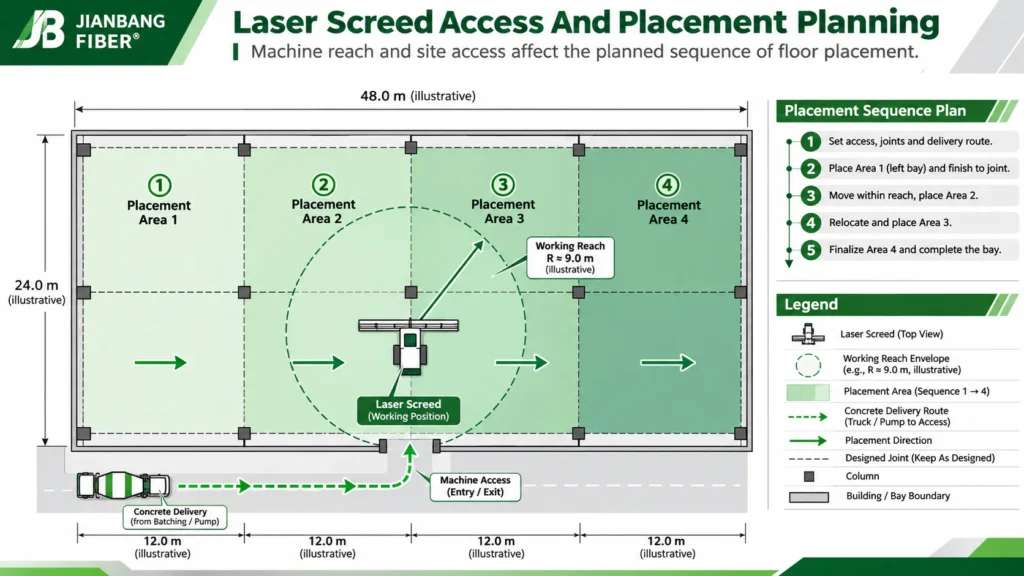
Machine size should match the placement layout. A long boom is useful over an open area, while a smaller machine can be easier to position through restricted access. Check the actual model specifications and support conditions before selection.
| Machine arrangement | Useful project conditions | Items to confirm |
| Compact or walk-behind unit | Smaller bays and restricted maneuvering areas | Access width, working width, operator space, and travel route |
| Ride-on unit | Open placements with room for repeated travel | Turning space, ground contact conditions, and reinforcement clearance |
| Boom unit | Large bays where reach can reduce repositioning | Working radius, obstacles, setup positions, and support capacity |
These are selection prompts, rather than fixed rules for each category. Features overlap between models. For instance, some compact systems have specialized heads or grade-control options that change their application range.
Suspended slabs require a separate review of machine weight, wheel or support loads, and the temporary construction condition. Confirm the structure’s capacity before bringing equipment onto the deck.
Where Is A Concrete Laser Screed Used
Large industrial floors and warehouse slabs are common applications because they provide space for repeated machine passes. Distribution areas, workshops, and commercial floor placements can also benefit when their access and layout suit the equipment.
The floor’s use should guide the specification. A storage floor may need one surface profile, while a forklift route or area with drainage falls may need another. Identify those needs before choosing the machine and placement method.
Sloped work needs the appropriate transmitter and control system. Somero’s slope setup guidance emphasizes aligning the transmitter axes with the placement and checking calculated elevations at key points. Confirm the required drainage direction as well as the slope value. For multiple falls, drains, or changing profiles, verify the selected system’s capability before the pour.
How Should A Laser Screed Placement Be Planned
Define The Surface Requirements
Record the design elevation, thickness, slopes, finish, and applicable surface tolerances. Agree who will measure the completed surface and which method will be used. A description such as a smooth warehouse floor is too vague for equipment planning or acceptance.
Flatness describes local surface variation. Levelness concerns departure from horizontal over a longer distance. Specified elevation is another check. A floor can satisfy one measure and still miss another requirement.
ASTM E1155/E1155M-23 provides a method for determining FF floor flatness and FL floor levelness numbers. Its stated use includes randomly trafficked floors. The standard excludes using those results to enforce contract tolerances on floors primarily intended for fixed-path vehicles, such as narrow aisle systems. Those applications need the specified assessment for their traffic paths.
Agree applicable limits and inspection arrangements before placement. A machine display reports its control condition during work; the completed floor still needs the agreed acceptance checks.
Check The Base And Machine Access
Inspect the prepared base and verify that the reinforcement, services, and embedded items match the approved layout. Plan where the machine will stand or travel and how the concrete will reach the work.
Laser height control acts on the top surface. Slab thickness also depends on the base elevation. Check both surfaces when thickness matters, and allow for the specified construction tolerances.
Match The Mixture To The Placement
The concrete must suit delivery, spreading, vibration, and the required finish. Review workability and consistency with the concrete producer and equipment operator. Follow the selected machine’s limits for the intended mixture.
Use a representative trial when the combination of mixture, fibers, equipment, or finish is new to the team. The trial should include the actual sequence through final finishing. Record any approved changes so production loads follow the same procedure.
Coordinate Delivery And Finishing
As a planning example, 400 m² of floor at a uniform 0.15 m thickness requires 60 m³ of concrete before allowances. If the crew intends to place that area in one hour, the supply plan must support roughly 60 m³ during that hour. This calculation is illustrative; it is not a machine output rating.
Include access delays, truck discharge, pump movements, and planned breaks in the schedule. Arrange a response to interrupted supply before concrete arrives. The screeding area should remain within the finishing team’s capacity and the concrete’s workable period.
What Happens After Laser Screeding
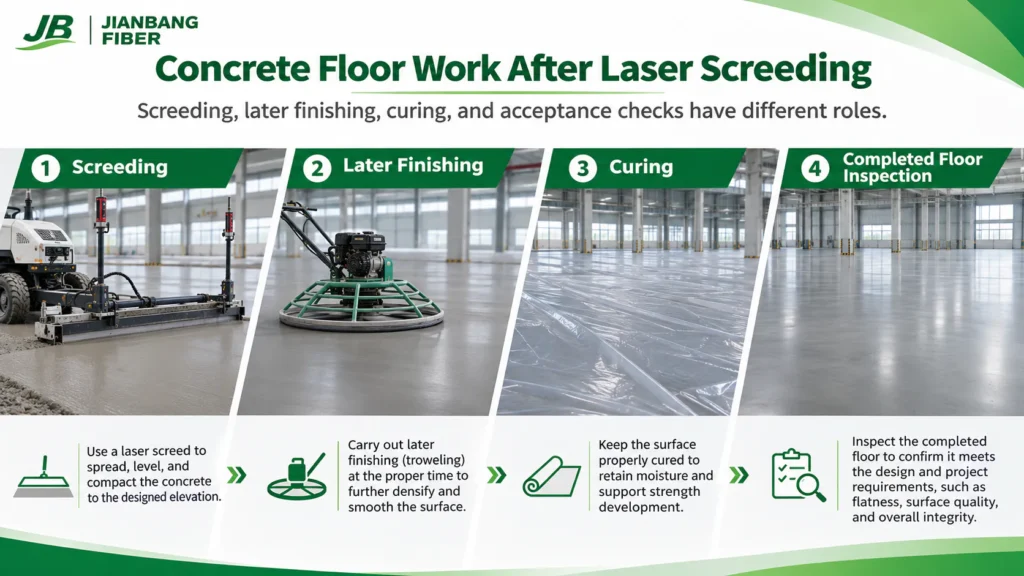
The screeded surface needs the specified finishing process. Edge areas and details around columns, openings, or drains may require separate attention. The crew should inspect transitions between machine passes and those local areas.
NRMCA’s finishing guidance separates strike-off from later finishing. It calls for early leveling before bleed water appears and for subsequent finishing to wait until bleeding has stopped and the surface water sheen has gone. Correct timing helps avoid surface defects. Workers should not sprinkle water or cement onto the surface to make finishing easier.
After finishing, apply the approved curing method. NRMCA’s curing guidance explains that moisture and temperature support strength and durability development. Plan protection against rapid drying during placement and finishing, and continue curing as required for the mixture and conditions.
Complete the joint work to the approved layout and timing. Keep records of placement areas, concrete deliveries, surface checks, and curing. These records help connect a later observation to the conditions during construction.
Can A Concrete Laser Screed Be Used With Fiber Concrete
Fiber concrete can be placed with laser screeding equipment when the fiber, mixture, machine, and finishing method are suitable together. The trial should confirm how the fresh concrete moves under the head and what surface remains after finishing.
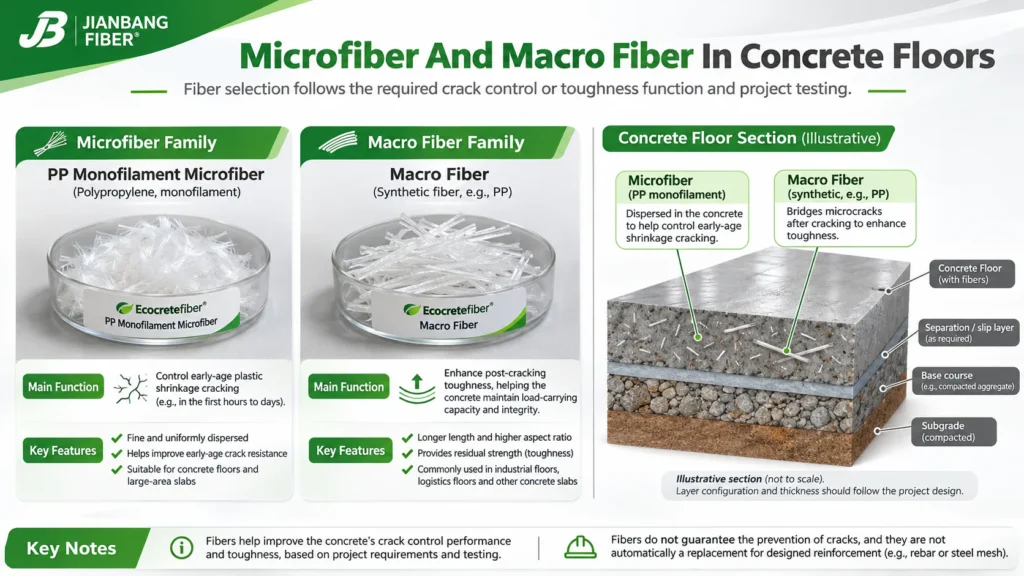
The fiber’s purpose must be clear. ACI’s fiber selection guidance distinguishes plastic shrinkage control with microfibers from performance after cracking provided by appropriate macrofiber or steel fiber systems. The required function determines the fiber and performance test.
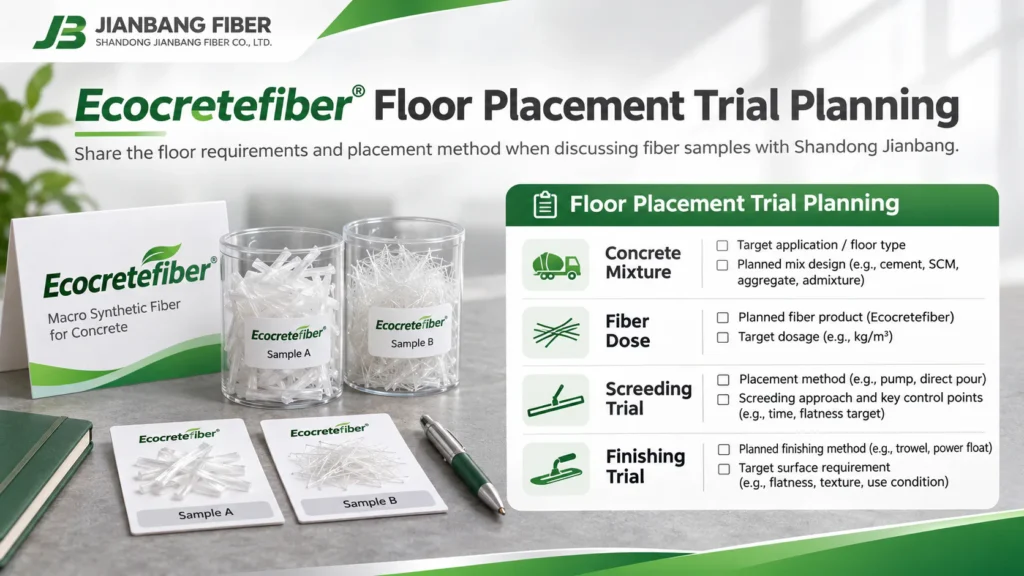
Our Ecocretefiber™ PP monofilament fiber offers a microfiber option for projects requiring early crack control. Our Macro Fiber range provides synthetic reinforcement options for projects requiring toughness after cracking. Select the grade and dosage against the project requirements and trial evidence. Any reinforcement substitution needs the responsible designer’s approval.
Uniform dispersion needs attention before placement. The Fiber Reinforced Concrete Association’s batching guidance links the addition procedure to fiber type, dosage, and mixing equipment. Agree the dosing sequence and mixing procedure with the supplier, and inspect trial discharge for clumps.
For the laser screed trial, record the fiber grade, dose, mixing procedure, mixture workability, machine settings, and finish. Review visible fibers or clumps with the technical team. A smooth surface alone cannot demonstrate the specified reinforcement performance.
What Problems Should The Crew Watch For
Use surface observations to guide investigation. Several causes can produce a similar defect, so check the records and operating conditions before changing a setting.
| Observation | Checks to make | Response to verify |
| Surface elevation changes across a bay | Benchmark, transmitter position, receiver setup, and grade checks | Restore the verified reference and assess the affected area |
| Ridges or low strips between passes | Material feed, pass alignment, head condition, and speed | Adjust the procedure through a checked trial pass |
| Mixture moves unevenly under the head | Delivery consistency, workability, fiber dispersion, and settings | Confirm the mixture and equipment procedure with the technical team |
| Surface blisters or separates during finishing | Bleeding, finishing timing, and surface treatment | Investigate the cause before applying a repair or repeating the process |
Machine output should be recorded alongside the accepted floor area and any rework. That gives a more useful comparison than an hourly area figure alone. Keep the conditions comparable when reviewing different methods or crews.
Frequently Asked Questions
Does A Concrete Laser Screed Finish The Entire Floor
It performs the screeding stage and can combine related spreading and vibration operations. The project still needs its specified floating, troweling or texturing, joint work, and curing.
Can One Operator Complete The Whole Pour
One trained person may operate the machine controls. Concrete supply, local spreading, finishing, and quality checks still need a coordinated crew sized for the placement.
Does Laser Screeding Guarantee A Crack Free Floor
Cracking also depends on mixture properties, restraint, joints, loading, and curing. Laser control addresses surface elevation during screeding. Fiber reinforcement should be selected for the required crack-control or toughness function.
How Many Square Meters Can A Machine Place Each Day
Output depends on the model and job conditions. Ask for a plan based on the actual floor layout, thickness, delivery capacity, and finish. Compare the completed area that meets the agreed requirements.
Does Laser Screeding Increase Concrete Strength By A Fixed Amount
There is no fixed strength increase for every laser screeded floor. Strength should be established using the specified mixture and tests. Effective consolidation and curing remain part of the construction process.
Conclusion
A concrete laser screed uses an independent laser reference to control the height of a working screed head. It helps crews place large floor areas with consistent grade control and can combine several operations in one pass. Successful use starts with the floor specification and a coordinated placement plan.
For fiber concrete floors, bring the reinforcement requirements into that plan early. Share your slab application, mixture, screeding equipment, and required finish with Shandong Jianbang. Explore our Ecocretefiber™ concrete fiber range and contact us to discuss suitable grades and samples for your project trial.