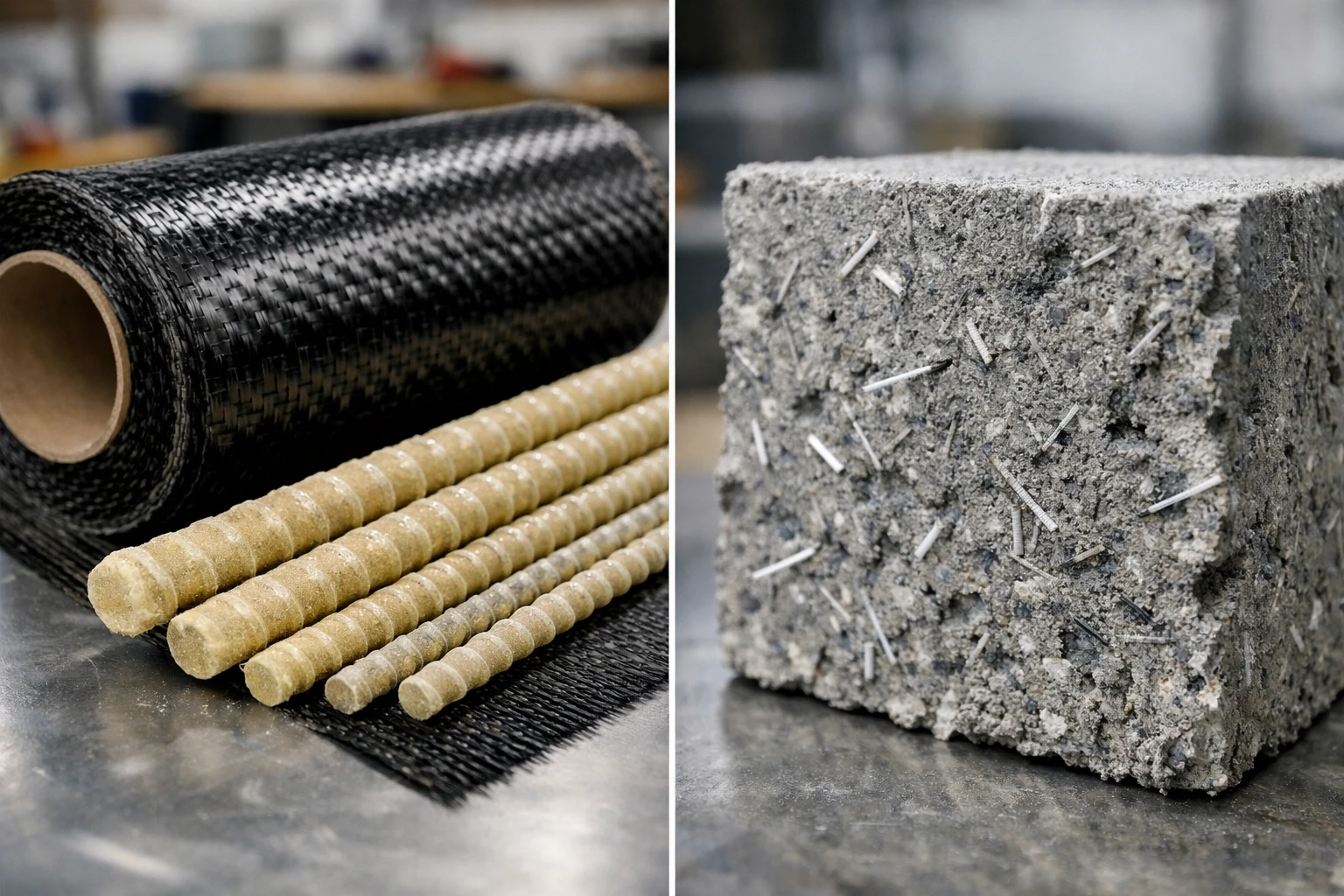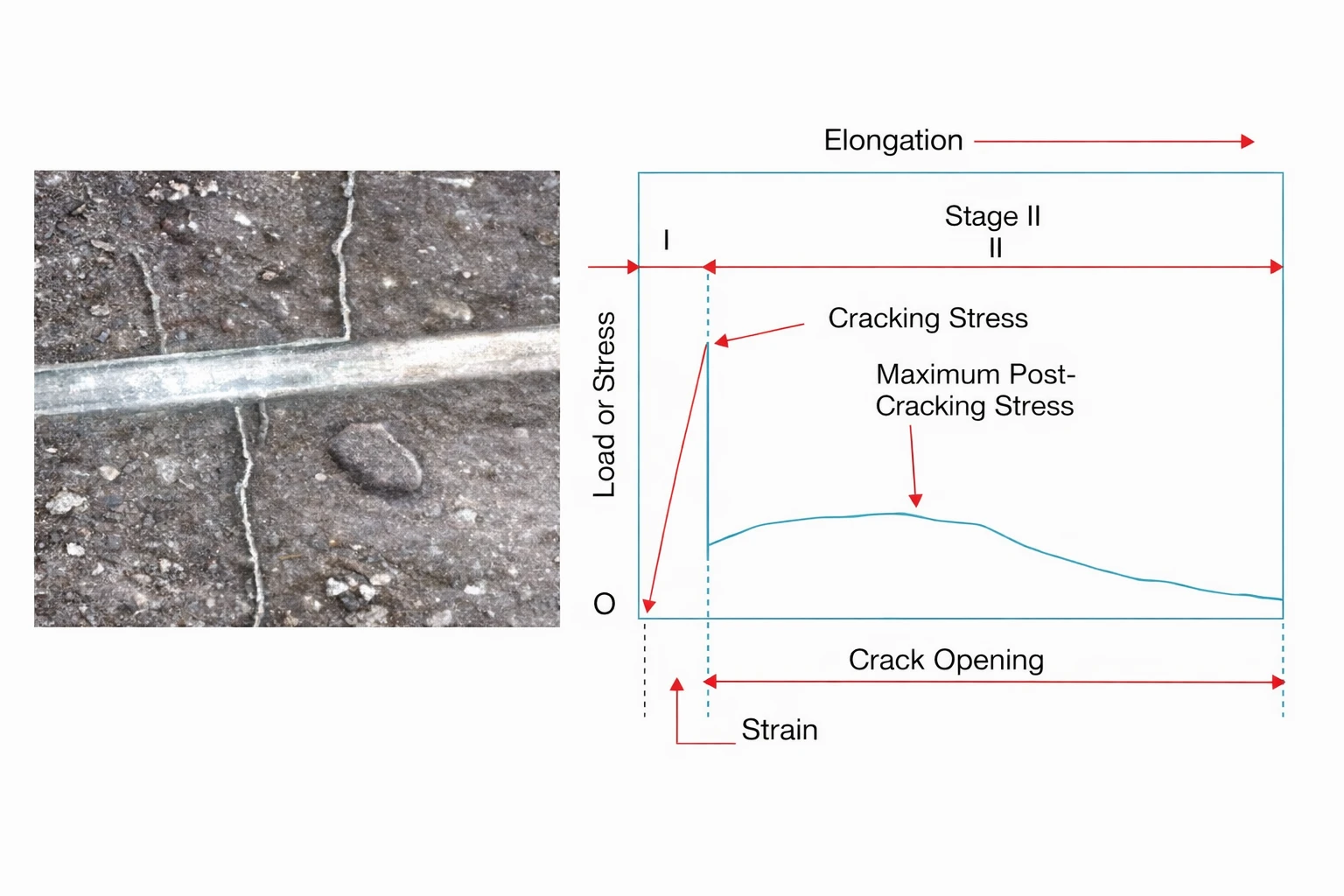
Polypropylene (PP) fiber is a synthetic fiber that you mix into fresh concrete. Its main effect is crack control, especially at early age. It also improves toughness and impact resistance in many mixes. It can improve cohesion during placement. At higher performance levels, it can also help reduce explosive spalling risk in fire, mainly in dense, high-strength concrete.
The right expectations matter. PP fiber is not a magic strength booster. It is not a full replacement for structural steel reinforcement. Industry guidance is clear on this point.
Polypropylene fiber in concrete: a quick definition
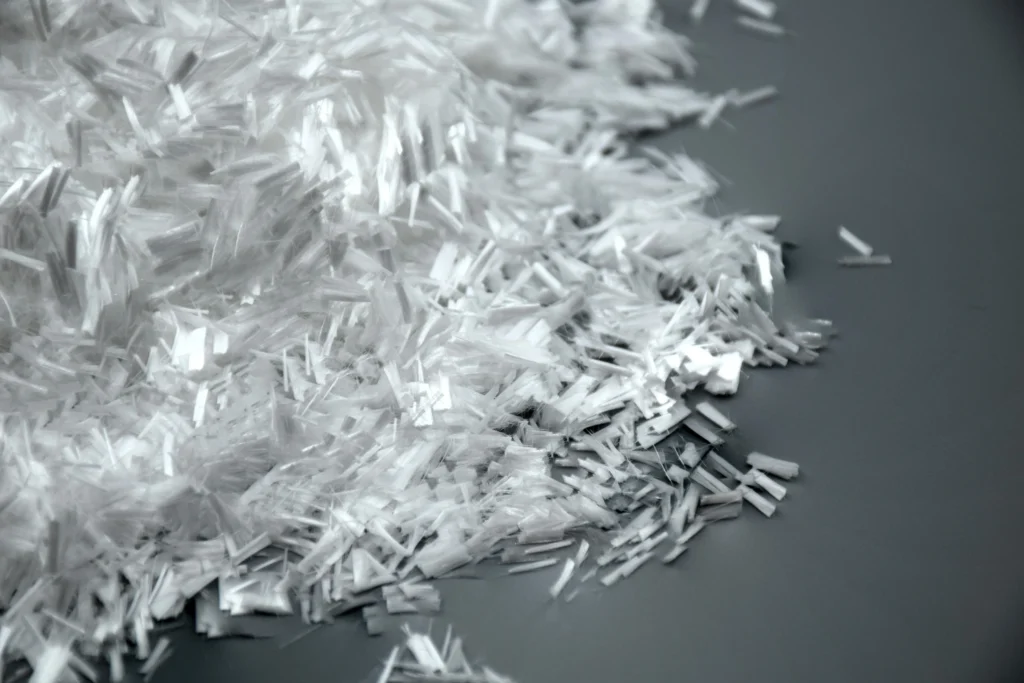
Polypropylene fiber in concrete means short PP fibers dispersed through the batch. The fibers form a distributed reinforcement network. This network works in the plastic state and the hardened state. NRMCA notes synthetic fibers can reduce plastic settlement cracks, reduce plastic shrinkage cracks, and increase toughness plus impact resistance.
PP fibers are usually supplied as microfibers (thin, short fibers) or macrofibers (thicker, longer fibers). Microfibers mainly target early cracking. Macrofibers can contribute to post-crack control at higher dosage, with supporting documentation and testing.
Effect 1: Less plastic shrinkage cracking at early age
Plastic shrinkage cracks appear soon after placement, while concrete is still plastic. They are more likely when evaporation is high, so the surface dries before the concrete sets.
PP fiber helps in this weak window. NRMCA explains that synthetic fiber reinforcement can help resist early tension when the concrete is very weak.
A TRB paper also notes polypropylene fibers became popular mainly because they reduce cracking at early ages under restrained plastic shrinkage.
What you typically see on site is simple:
- fewer early hairline cracks on slabs and pavements
- tighter crack patterns when cracks still occur
- fewer cosmetic complaints from owners
These benefits show up most clearly on wide flatwork pours, hot weather pours, and mixes with reduced bleeding.

Effect 2: Better toughness and impact resistance
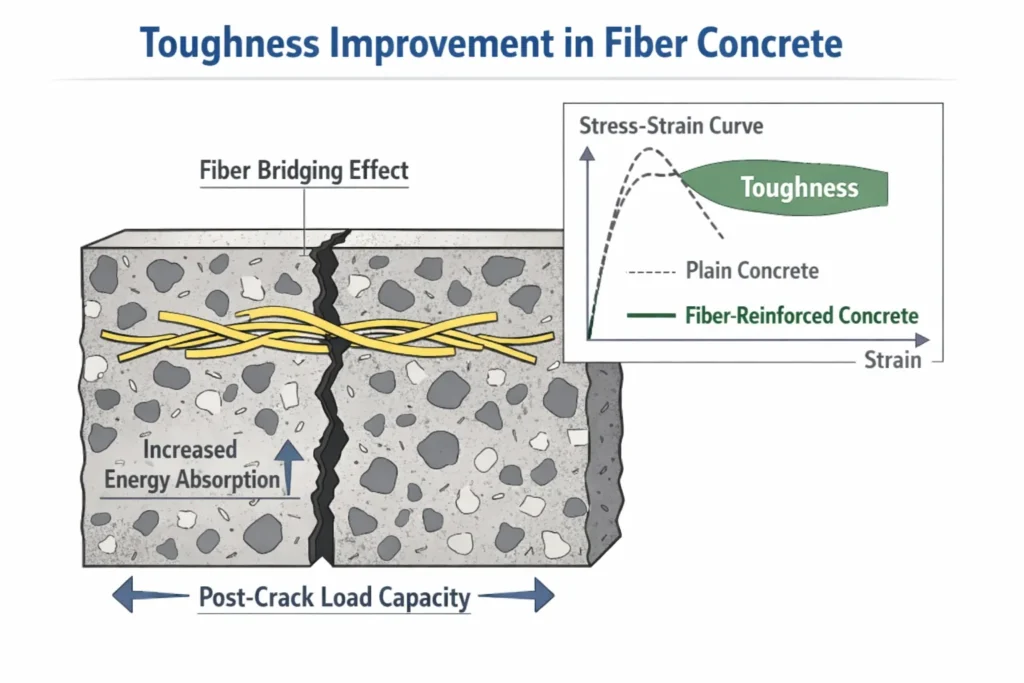
Concrete is strong in compression, but brittle in tension. When a crack forms, plain concrete can lose capacity quickly. Fibers change that behavior because fibers bridge cracks and help the matrix hold together.
NRMCA lists increased toughness, energy absorption, and resistance to impact forces as key benefits of synthetic fibers.
This matters in:
- warehouse floors with forklift traffic
- hardstands with repeated wheel loads
- pavements with joint stress
- precast units that chip during handling
Micro PP fibers give modest toughness benefits at low dosage. Macro PP fibers can give a stronger post-crack effect when the dosage and fiber type are selected for that goal.
Effect 3: Improved cohesion, reduced bleed channels, better placement stability
PP microfibers can make fresh concrete feel more “together.” This is a practical effect that crews notice.
NRMCA explains that uniformly distributed synthetic fibers discourage large capillary channels caused by bleed water migration to the surface. Those channels can become weak locations for later cracking.
NRMCA also describes an “internal support system” that helps inhibit plastic settlement cracks.
So in real placement work, PP fiber can help:
- reduce segregation in some placements
- reduce plastic settlement cracking around bars or inserts
- stabilize shotcrete or slip-formed placements where cohesion matters
This does not remove the need for good curing or good finishing timing. It only reduces risk.

Effect 4: Changes to strength and permeability
PP fiber can change strength results, but the direction depends on dosage, mix, and testing method.
One open-access research study tested polypropylene fiber volume fractions of 0.10% to 0.30%. It reported a minor compressive strength reduction at 0.1% fiber content, while tensile strength increased significantly at that same content. It also reported strong reductions in plastic shrinkage cracking.
The same study also reported that water and gas permeability coefficients increased with polypropylene fiber addition in their test program. It concluded the mix worked better for plastic shrinkage–susceptible flat elements, but it needed careful judgment for water-retaining structures.
How to use this in practice:
- If your main target is early cracking on slabs, PP microfiber is usually a net positive.
- If your structure is water-retaining, or watertightness is critical, you should validate permeability and crack control together, not only “fiber yes or no.”

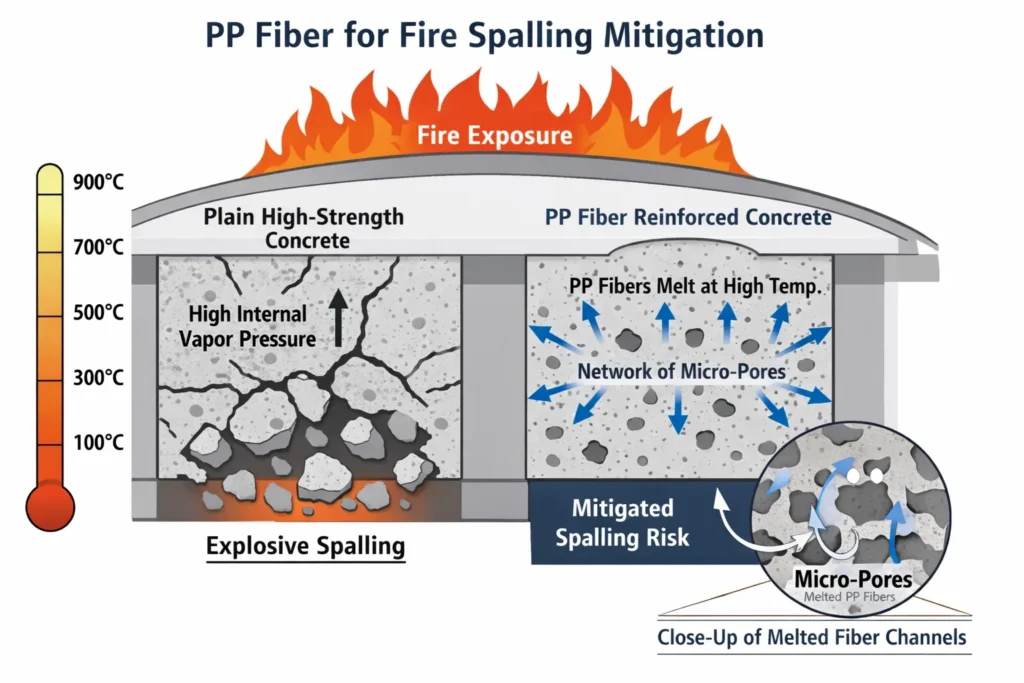
Effect 5: Reduced explosive spalling risk in fire
This is one of the most valuable “special effects” of PP fiber, but it applies to specific concretes.
In fire, dense concretes can build up water vapor pressure. This can trigger spalling. A review article explains that adding polypropylene fibers is a promising method to prevent spalling. It describes the common mechanism: as temperature rises, fibers melt and create a network of pores. This increases permeability, releases vapor pressure, and mitigates spalling risk.
A separate technical note also states polypropylene fibers are used globally for their ability to reduce explosive spalling, especially in tunnels.
Practical takeaways:
- This benefit is most relevant for high-strength or low-porosity concretes.
- PP fiber dosage for spalling mitigation is typically specified in fire design specs. It should not be guessed.
- Fiber does not replace fire engineering. It supports the material response.
What polypropylene fiber cannot do
PP fiber improves concrete performance, but it has clear limits.
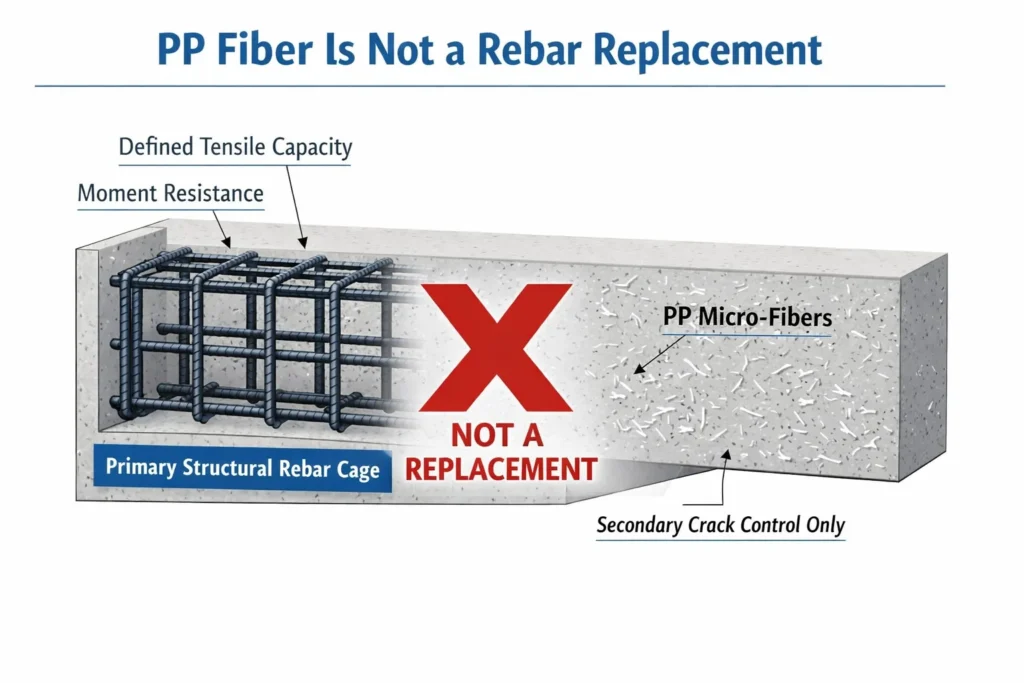
NRMCA guidance lists several “do not use” items for synthetic fibers. It states synthetic fibers should not be used for replacement of moment-resisting or structural steel reinforcement. It also states they should not be used to increase structural compressive or flexural strength development.
So the correct positioning is:
- PP microfiber is a crack-control tool, plus a surface-performance tool.
- Macro PP fiber can be a post-crack control tool when supported by test data and design method.
- Structural rebar remains the primary solution for defined tensile capacity in most structural members.
Typical dosage and mixing tips
Dosage depends on your target.
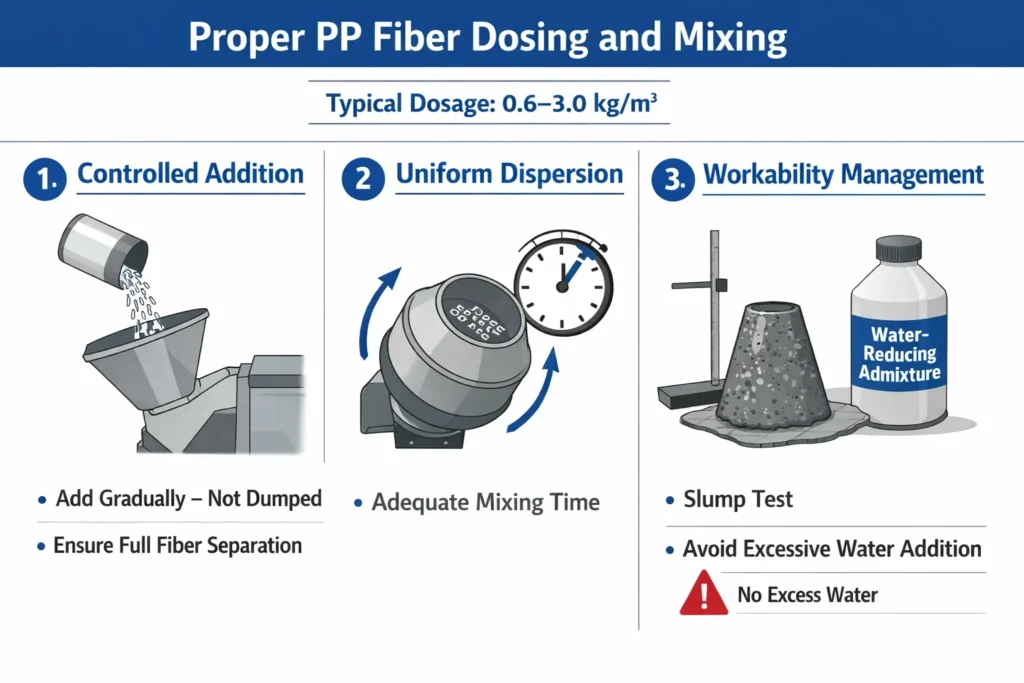
For PP microfibers used mainly for plastic shrinkage cracking, several major suppliers and handbooks commonly reference 0.6–0.9 kg/m³ as a typical dosing band.
For macro-synthetic fibers, NRMCA notes they are used at higher dosage. It gives a typical dosage around 5 lb/yd³, which is about 3.0 kg/m³.
Mixing and workability rules:
- Add fibers in a controlled way, not as one fast dump.
- Keep mixing long enough for full dispersion.
- Expect workability to change at higher addition rates. NRMCA notes workability may be reduced at higher rates, so water-reducing admixtures may be needed to retain slump.
- Do not “fix” workability by adding water without control. That increases shrinkage risk.
Where polypropylene fiber brings the most value
PP fiber delivers the best value when the problem is expensive and common.
Best-fit applications:
- slabs-on-ground with high evaporation risk
- toppings, screeds, thin repairs that dry fast
- industrial floors where impact resistance matters
- shotcrete and slip-form placements that benefit from added cohesion
- high-strength concrete where fire spalling mitigation is required by spec
Lower-fit applications:
- structural members where the main need is tensile capacity from steel
- watertight tanks without trial validation, since permeability effects can vary by mix

Expert guidance: how to choose the right PP fiber for your mix
Start with one question: What failure are you paying for today?
If it is early cracks on slabs, micro PP fiber is usually the first step.
If it is impact damage or post-crack performance, you may need macro PP fiber, plus performance test data.
If it is tunnel fire spalling risk, you need a fire-driven specification and validation pathway.
A practical selection workflow:
- define placement type (slab, shotcrete, precast)
- define the cracking risk window (plastic stage, drying stage, service load stage)
- select microfiber vs macrofiber based on that window
- set dosage based on technical guidance, then confirm with trials
![## Expert guidance: how to choose the right PP fiber for your mix
Start with one question: **What failure are you paying for today?**
If it is early cracks on slabs, micro PP fiber is usually the first step.
If it is impact damage or post-crack performance, you may need macro PP fiber, plus performance test data.
If it is tunnel fire spalling risk, you need a fire-driven specification and validation pathway.
A practical selection workflow:
- define placement type (slab, shotcrete, precast)
- define the cracking risk window (plastic stage, drying stage, service load stage)
- select microfiber vs macrofiber based on that window
- set dosage based on technical guidance, then confirm with trials
[Image Placeholder]
**Image Title:** Selecting PP Fiber by Project Goal
**Image Alt Text:** Engineer reviewing slab cracking risk and selecting microfiber or macrofiber polypropylene reinforcement based on performance targets](https://ecocretefiber.com/wp-content/uploads/2026/01/Selecting-PP-Fiber-by-Project-Goal-1024x683.webp)
Ecocretefiber™ polypropylene fiber support
If you want stable results, you need stable fiber quality, stable dosing, plus clear mixing guidance.
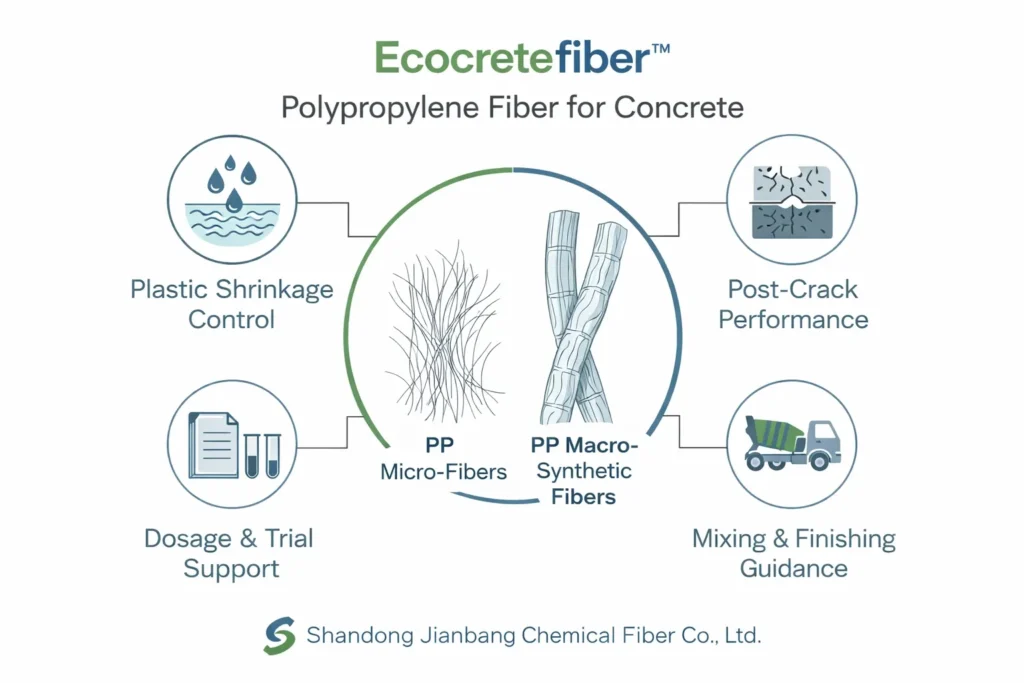
Ecocretefiber™ is the fiber brand of Shandong Jianbang Chemical Fiber Co., Ltd. We support distributors, ready-mix plants, precast factories, and contractors with:
- PP microfiber options for plastic shrinkage and settlement crack control
- PP macro-synthetic options for post-crack control goals, supported by the right documentation pathway
- dosage suggestions aligned with common field practice ranges, then verified in trials
- mixing and finishing guidance that reduces clumping risk and protects surface quality
Related Products
- PP Microfiber (Monofilament / Fibrillated)
- PP Macro-Synthetic Fiber
- PVA Fiber for Cement-Based Composites
- Glass Fiber for GRC Applications

Conclusion
The effect of polypropylene fiber in concrete is mainly performance improvement in areas that cost time and money on site. It reduces plastic shrinkage cracking risk. It supports cohesion and reduces settlement cracking risk. It improves toughness and impact resistance in many mixes.
In dense, high-strength concretes exposed to fire, PP fiber can also reduce explosive spalling risk because melting fibers create permeability pathways that release vapor pressure.
At the same time, PP fiber is not a replacement for structural steel reinforcement. Industry guidance states it should not be used to replace moment-resisting reinforcement, or to target higher structural strength by itself.