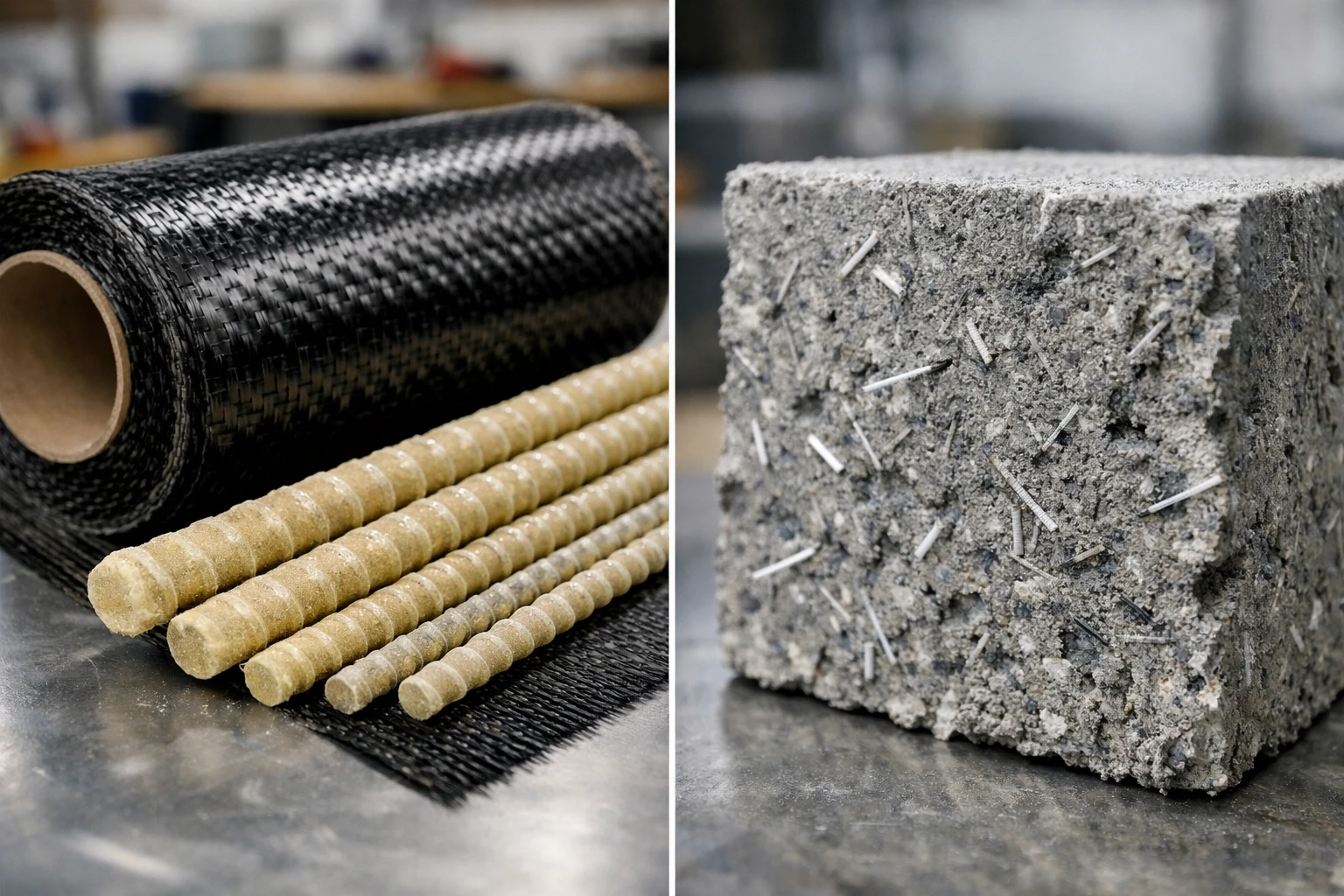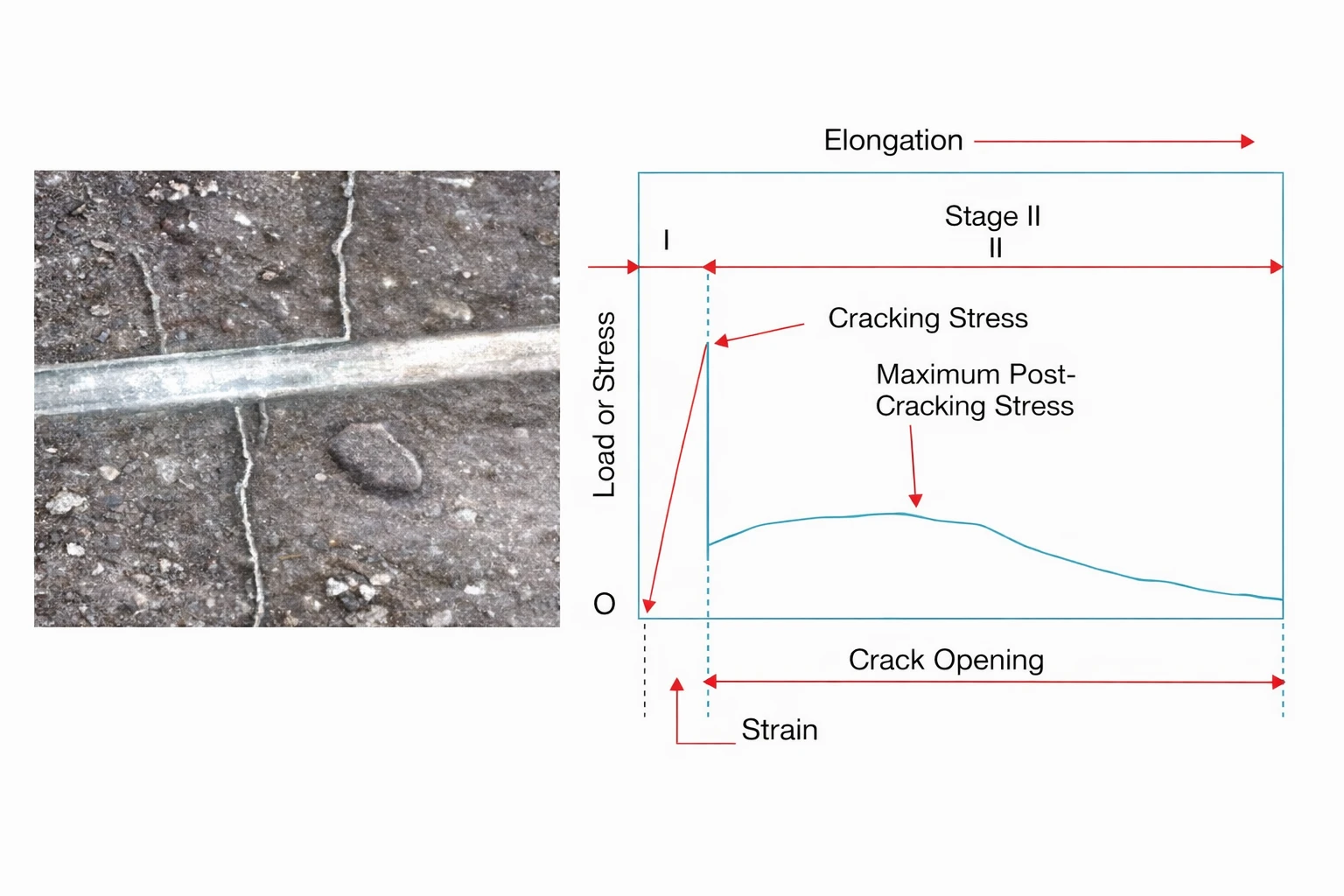
PP fiber (polypropylene) and PVA fiber (polyvinyl alcohol) are both synthetic fibers for cement-based materials. Each fiber solves a different problem.
PP fiber is usually the first choice for early-age crack control. PP fiber is also widely used for fire spalling mitigation in dense concrete because PP melts at about 170°C, which helps release vapor pressure.
PVA fiber is often chosen for high bond strength with cement. PVA fiber is hydrophilic, so it forms strong adhesion to the matrix. This supports tight crack widths in high-ductility mixes such as ECC.
What is PP fiber?

PP fiber is a polypropylene synthetic fiber mixed into concrete. The mix carries fibers through the full volume. This creates distributed reinforcement.
American Concrete Institute defines two practical size groups for synthetic fibers. Microsynthetic fibers are below 0.3 mm equivalent diameter. Macrosynthetic fibers are above 0.3 mm equivalent diameter. The same guidance states polypropylene fibers can be micro or macro. It also lists PP specific gravity as 0.91.
PP fiber is used mainly for early-age performance:
- reduced plastic settlement cracks
- reduced plastic shrinkage cracks
- improved toughness and impact resistance (stronger at higher dosage)
National Ready Mixed Concrete Association explains the site logic. Fibers block microcrack growth. Fibers also discourage large bleed-water channels. This lowers weak planes that later become cracks.
What is PVA fiber?

PVA fiber is a polyvinyl alcohol synthetic fiber used in cement-based materials. Many buyers choose PVA because it bonds strongly with cement paste.
Kuraray lists key PVA fiber traits that matter in concrete: high strength, high modulus, strong adhesion to cement, plus good alkali resistance.
PVA fiber is also known for hydrophilicity. Academic literature describes PVA as hydrophilic, which creates strong chemical bonding with cementitious matrices in ECC-type systems.
This strong bond is a double-edged tool:
- It supports tight crack widths.
- It can also push fibers toward rupture if the bond is too strong for the mix design approach.
Bonding is the biggest difference

Bonding controls how fibers work after a crack forms. Bonding also controls how the crack pattern develops.
PP fiber is usually described as hydrophobic. Some research focuses on improving the interface because hydrophobic PP has weaker bonding without surface treatment.
PVA fiber is typically described as hydrophilic. Research on ECC highlights strong chemical bonding between PVA fiber and cementitious matrix due to hydrophilicity.
What this means on site:
- PP fiber tends to act like a “blocking” network that slows early microcracks.
- PVA fiber tends to act like a “high grip” bridge that holds cracks tight, especially in engineered mixes.
Mechanical role is different

PP fiber is often chosen for early cracking control because it is easy to dose, easy to disperse, plus cost-effective for large pours. NRMCA lists reduced plastic settlement cracking and reduced plastic shrinkage cracking as primary benefits, with tougher behavior at higher dosage.
PVA fiber is often chosen when the buyer wants strong crack bridging in hardened material. This is common in ECC-style overlays, repair layers, thin panels, plus high-performance mixes that target fine crack patterns. Research describes PVA fiber as hydrophilic with strong chemical bonding, which changes crack behavior and tensile strain capacity in engineered cementitious composites.
A practical summary:
- PP fiber is usually a “first hours” tool.
- PVA fiber is often a “service life crack width” tool.
Fire behavior is not the same

PP fiber has a special value in fire scenarios. A peer-reviewed review explains that PP fibers melt at about 170°C. This is below the temperature range where maximum water vapor pressure occurs in concrete. This melting helps create paths for vapor release, which reduces spalling risk.
PVA fiber does not have the same standard spalling-mitigation role as PP in most specifications. Many fire-driven spalling approaches focus on PP because melting temperature is well aligned with vapor pressure timing.
Buyer takeaway:
- A tunnel or fire-rated lining spec often calls for PP microfibers.
- A crack-width-driven overlay spec often calls for PVA in engineered mixes.
Dosage ranges are usually very different

Dosage depends on fiber type and performance goal. You should treat dosage as a design parameter, not a habit.
ACI guidance gives typical dosage bands by fiber size:
- Microsynthetic fibers: 0.05% to 0.2% by volume, which is about 0.44 to 1.8 kg/m³.
- Macrosynthetic fibers: 0.2% to 1% by volume, which is about 1.8 to 9 kg/m³.
NRMCA notes macro-synthetic fibers are used at higher dosage than typical microfiber dosages. NRMCA also states macro-synthetic fibers are thicker fibers, with dosage around 5 lb/yd³ in their guidance context.
For PVA in ECC-style materials, many published studies use fiber volume fractions around 1% to 2% in engineered cementitious composites, because ECC design needs sustained bridging and strain capacity.
Practical interpretation:
- PP microfiber dosages are usually low. The goal is early crack control.
- PVA dosages in ductile systems can be much higher by volume. The goal is post-crack tensile behavior.
Best use cases: PP vs PVA

PP fiber best-fit uses
- slabs-on-ground that need fewer plastic shrinkage cracks
- toppings, screeds, plus thin layers that dry fast
- shotcrete placement where cohesion matters
- fire spalling mitigation in dense concrete, especially tunnels
PVA fiber best-fit uses
- ECC-style overlays and repair layers that target tight crack width
- thin, lightweight cement panels and high-performance precast concepts
- UHPC-style systems where strong fiber bonding and alkali resistance matter (system dependent)
How to choose between PP fiber and PVA fiber

Use a simple decision logic. This approach avoids wrong expectations.
- When do cracks start? If cracks start in the first hours, PP microfiber is often the easiest win. NRMCA lists reduced plastic shrinkage cracking as a core benefit.
- Do you need tight crack widths in service? If you need tight cracks in hardened material, PVA is often chosen in engineered composites because of hydrophilic bonding and crack bridging.
- Is fire spalling risk a design driver? If fire spalling is a known risk, PP has a clear advantage because it melts around 170°C and helps relieve vapor pressure.
- Is the mix engineered for ductility? If the mix is ECC-style, PVA is common, but the bond level must be controlled. Literature highlights that PVA can bond very strongly, which impacts pullout behavior.
- What does the code path require? Fiber does not replace structural rebar in most structural members. NRMCA lists this clearly under “Do Not Use Synthetic Fibers For,” including replacement of moment-resisting steel reinforcement.
Expert guidance

A fiber project succeeds when fiber choice matches the failure mode.
Good support includes:
- fiber selection based on crack timing and crack width target
- dosage suggestion tied to performance goal, plus trial batching
- mixing guidance to protect dispersion and workability
- documentation support for procurement specs and project submittals
- clear boundaries for structural reinforcement needs
Ecocretefiber™ provides general selection support first. Then we match fiber type to the job target. We also support stable supply for repeat orders.
Brand: Ecocretefiber™
Company: Shandong Jianbang Chemical Fiber Co., Ltd.
Related Products

- Polypropylene Microfiber (crack control in fresh concrete)
- Polypropylene Macro-Synthetic Fiber (post-crack control for slabs, project dependent)
- PVA Fiber (high-bond fiber for engineered cement composites)
- Steel Fiber (industrial floors, pavements, shotcrete)
- AR Glass Fiber (GRC applications)
Conclusion
PP fiber and PVA fiber can both improve crack control, but they do it in different ways. ACI defines PP fibers within micro and macro synthetic categories, with typical dosage bands tied to fiber size.
PP fiber is widely used for early crack control, plus fire spalling mitigation because PP melts around 170°C and helps release vapor pressure.
PVA fiber is often used for high bonding with cement. Literature describes strong chemical bonding due to hydrophilicity, which supports tight crack widths in engineered cementitious composites when the mix is designed correctly.