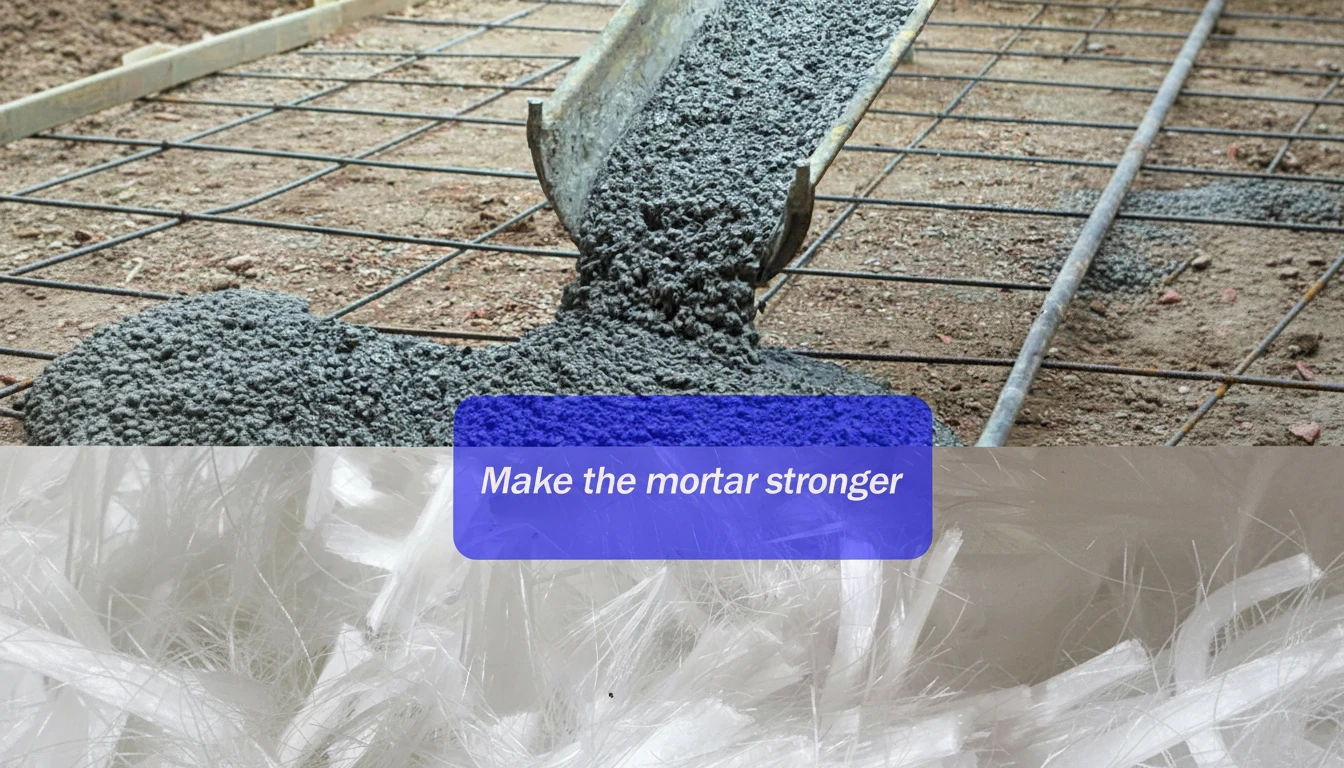
PP fibers mean polypropylene fibers
PP fibers are polypropylene fibers. People in construction often shorten “polypropylene” to “PP.” A team adds PP fibers into concrete during mixing. The team adds fibers to reduce cracking and to improve concrete behavior in specific ways.
Many buyers ask one simple question. Buyers ask what PP fibers do that plain concrete cannot do. Plain concrete cracks easily in tension. The surface of fresh concrete also cracks when the surface loses water fast. A fiber network helps because fibers bridge small crack paths. Fibers also help hold the mix together while the concrete is still gaining strength.
NRMCA describes synthetic fibers as engineered polymer-based materials, and it lists polypropylene as a common material choice. NRMCA also states that synthetic fibers are added before or during mixing.
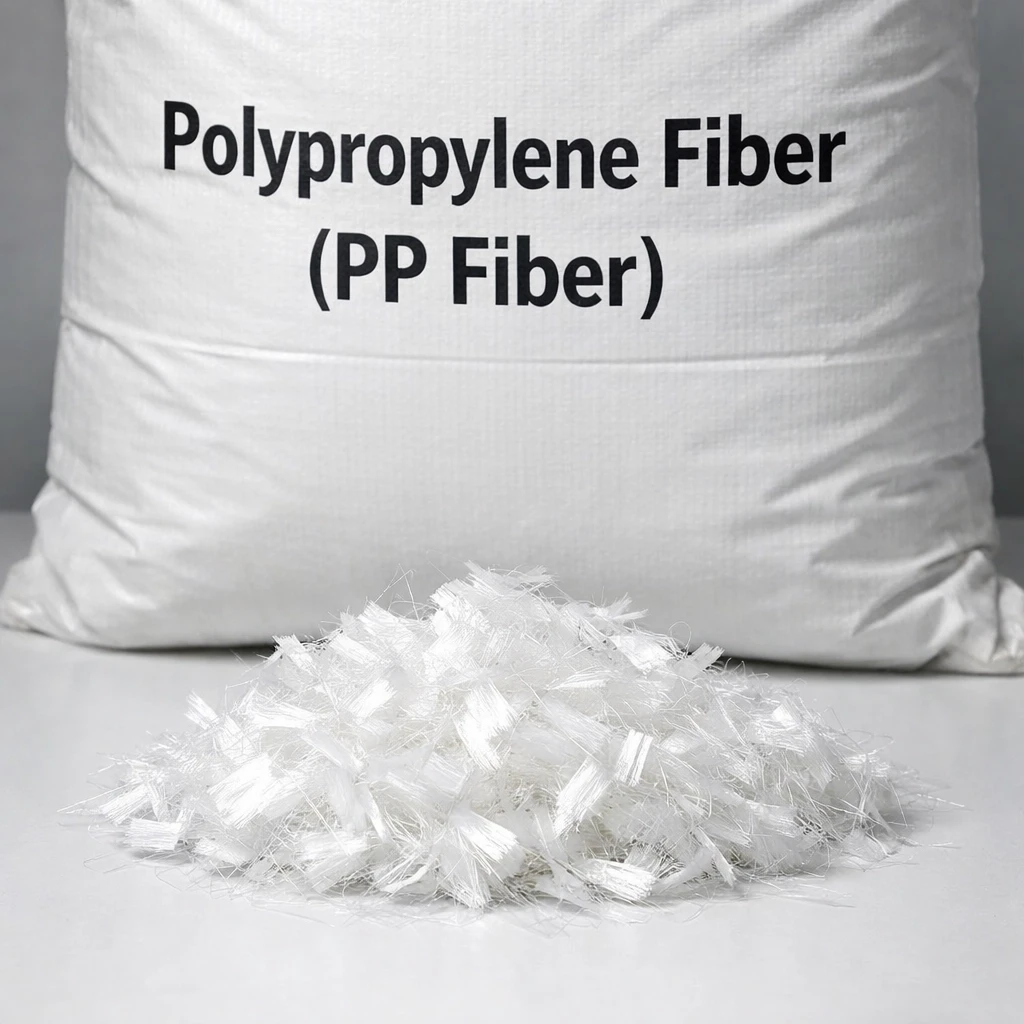
PP fibers split into micro and macro fibers
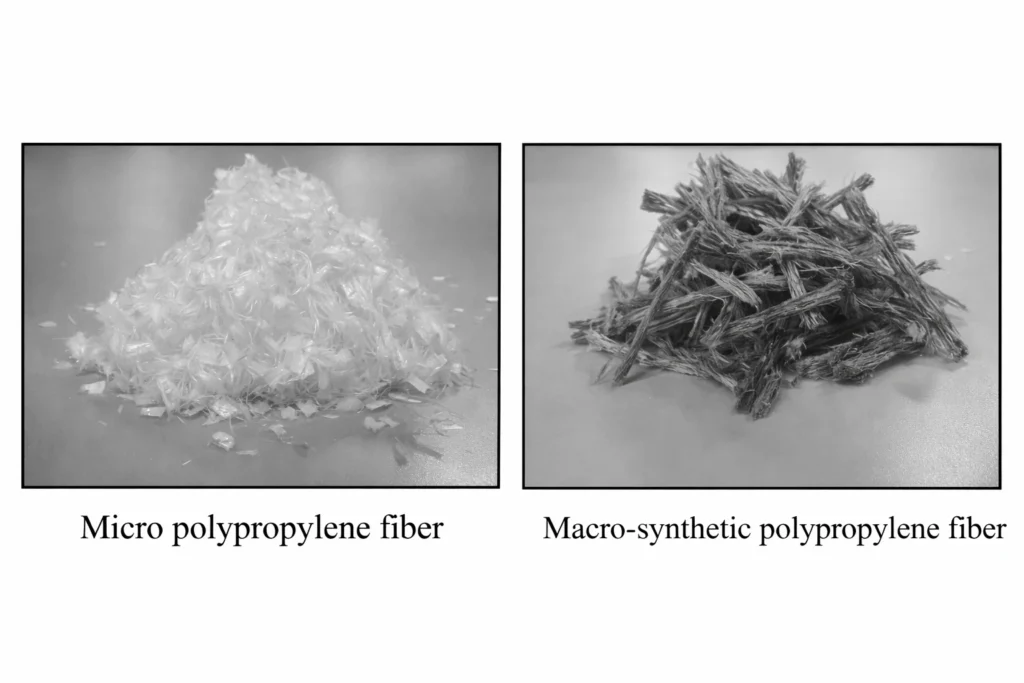
A buyer gets better results when a buyer starts with the main classification. PP fibers split into micro PP fibers and macro PP fibers. The split depends on fiber size and on fiber function in concrete.
ACI guidance uses a clear size line. ACI defines microsynthetic fibers as below 0.3 mm in diameter (or equivalent), and ACI defines macrosynthetic fibers as above 0.3 mm in diameter (or equivalent). ACI also states that polypropylene fibers can be either microsynthetic or macrosynthetic.
This split also matches how projects use fibers. Micro fibers mainly target early-age cracking, and macro fibers mainly target post-crack performance. A buyer should choose the group first, and the buyer should choose the exact form second.
Micro PP fibers: what they are and what they do
Micro PP fibers are small fibers that spread through the paste and fine voids in a fresh mix. These fibers mainly help during the first hours after placement. These fibers mainly reduce plastic shrinkage cracking and plastic settlement cracking.
NRMCA describes synthetic fibers as a tool that helps reduce plastic shrinkage cracking, and it also states that typical addition rates of 1 to 2 lb per cubic yard do not require mix modifications in many cases.
A buyer can treat that range as a common starting point for micro fiber use, and the buyer should still follow supplier guidance for each product.
A buyer should also understand what micro fibers do not do. Micro PP fibers do not replace structural reinforcement. A micro fiber mainly supports surface integrity and early crack control. A designer still uses normal steel and joint design when the slab needs those systems.
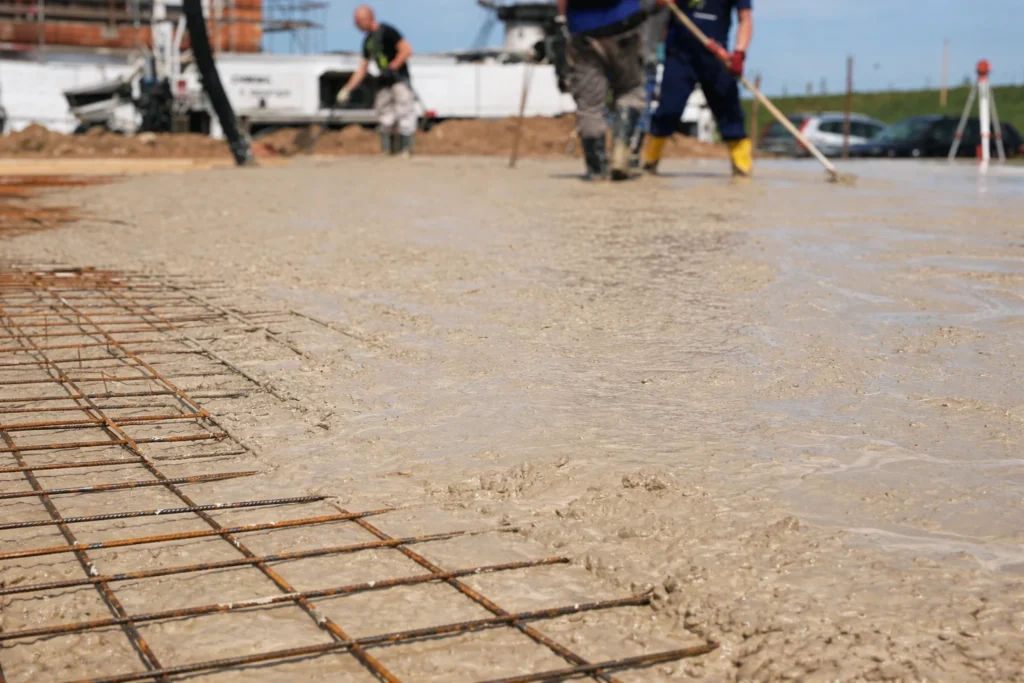
Micro PP fiber forms you will see in the market
A buyer will see different micro fiber forms, and each form can change mixing feel and finish feel.
Monofilament micro PP fiber
A monofilament micro fiber is a single strand style. A crew often chooses it for clean dispersion and simple finishing. Sika’s fiber handbook lists monofilament micro fibres as one of the main synthetic micro-fibre types.
Fibrillated micro PP fiber
A fibrillated micro fiber starts as a film and it opens into a net shape during mixing. Sika’s fiber handbook lists fibrillated fibres as another main micro-fibre type.
Many teams like the net effect because the net can grip paste in a different way.
Multifilament polypropylene fiber
Many buyers search “multifilament polypropylene fiber.” A buyer should use the term with care. Sika’s fiber handbook states that the textile industry sometimes refers to fibrillated fibres as “multifilament” because of the extrusion process through a multi-headed die head.
A buyer should ask the supplier what the supplier means. A buyer should ask if the product is a net-opening fibrillated film, or if the product is a yarn-like bundle made from many filaments. A buyer should also ask for length and linear density and the target use, so the job gets the right performance.
Macro PP fibers: what they are and what they do
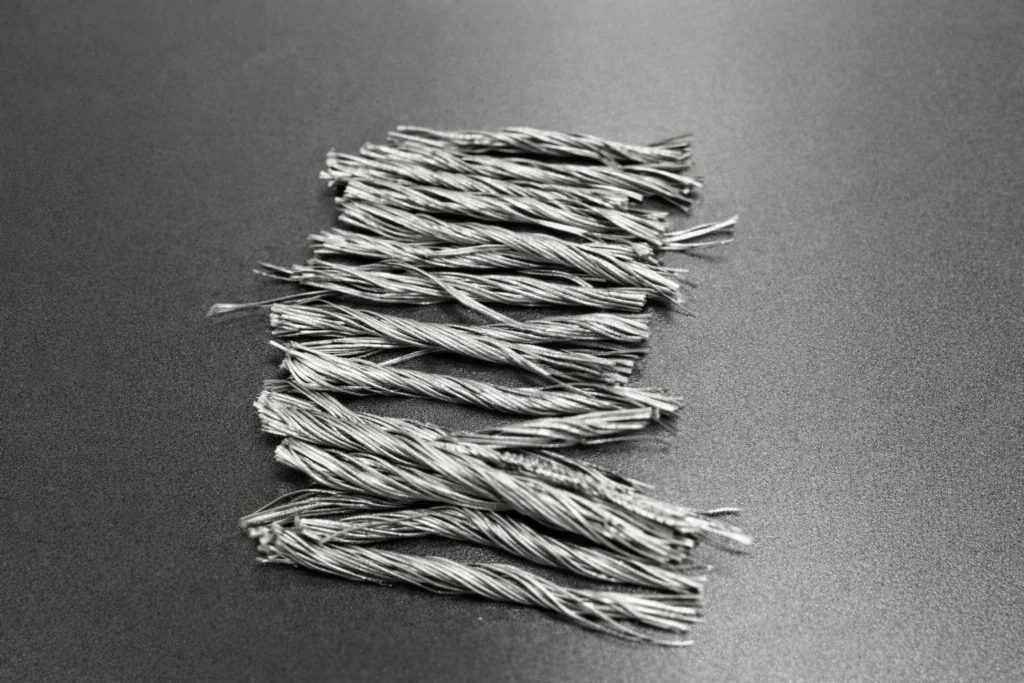
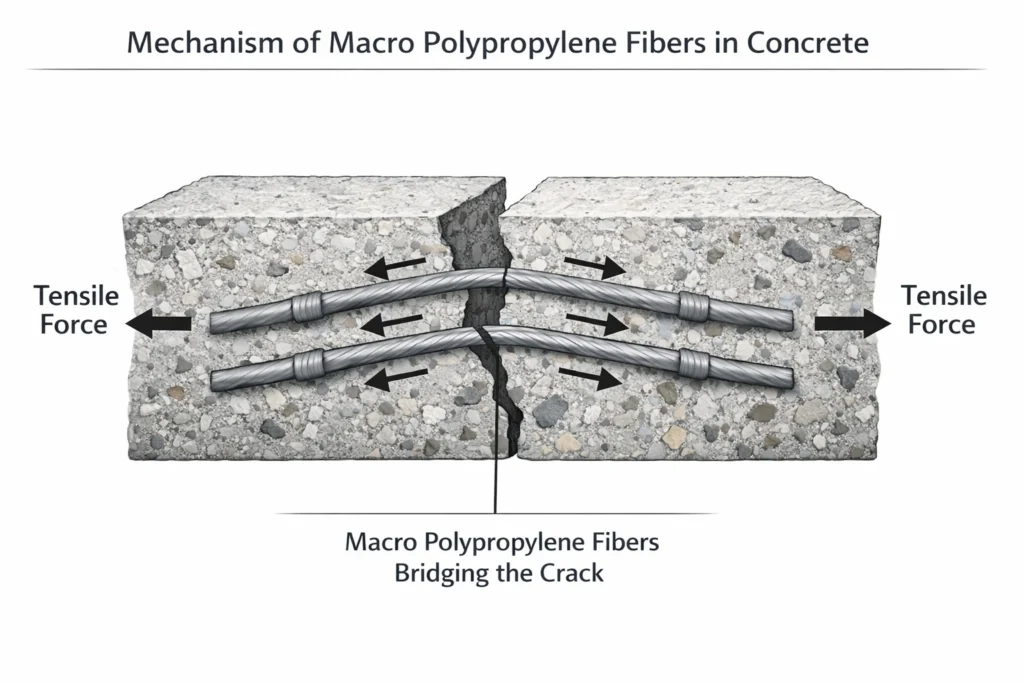
Macro PP fibers are larger fibers that help concrete after cracking starts. These fibers support residual strength and toughness and energy absorption. A buyer usually uses macro PP fibers in slabs, pavements, and shotcrete when the project needs measurable post-crack performance.
ACI defines macrosynthetic fibers as above 0.3 mm in diameter (or equivalent).
Sika’s “Understanding Fiber Reinforced Concrete” document states that macro fibers are used where an increase in residual (post-cracking) flexural strength is required, and it links this need to ASTM C1609.
A buyer can also see macro fiber requirements in European style compliance. EN 14889-2 includes a requirement for the supplier to declare a unit volume of fibres that achieves stated residual flexural strength levels at defined crack openings in a standard beam test framework.
A buyer can use this type of declaration to compare products on performance and not only on dosage.
Standards that matter when a buyer specifies PP fibers
A buyer should not rely only on marketing claims. A buyer should anchor the selection to common standards and tests.
ASTM C1116 for synthetic fibers (Type III)
ASTM C1116 defines Type III Synthetic Fiber-Reinforced Concrete. ASTM C1116 requires documentary evidence that the synthetic fibers resist deterioration in contact with moisture and alkalis in cement paste and with substances present in admixtures over the useful life. ASTM C1116 also notes that polyolefins such as polypropylene have been shown to be durable in concrete.
ASTM C1579 for plastic shrinkage cracking comparison
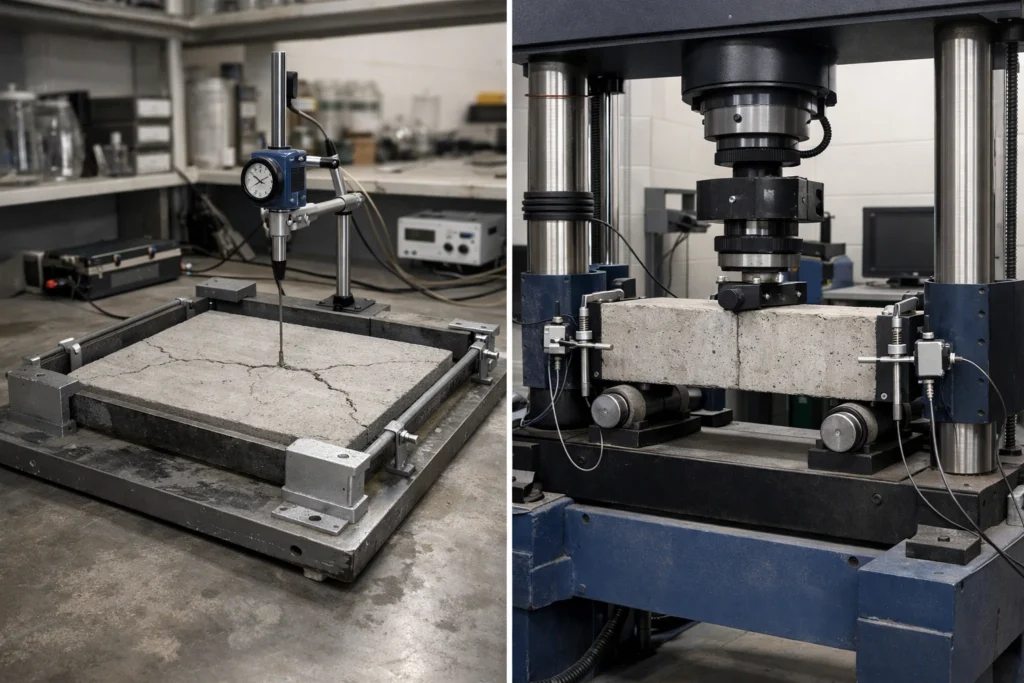
ASTM C1579 compares the surface cracking of fiber reinforced concrete panels with control panels under prescribed restraint and moisture loss that is severe enough to crack before final setting. ASTM also states that the method can compare plastic shrinkage cracking behavior of different mixes with fiber reinforcement.
ASTM C1609 for flexural performance of FRC
ASTM C1609 evaluates flexural performance using parameters from the load-deflection curve of a beam test.
Designers often use this test for macro fibers because it captures post-crack behavior.
EN 14889-2 for polymer fibers in Europe and many export specs
EN 14889-2 covers polymer fibres for structural or non-structural use, and it includes conformity rules for declared performance.
How a buyer should choose PP fibers for a concrete job
A buyer should match fiber type to the problem the buyer wants to reduce.
- A buyer should choose micro PP fibers when the job has early surface cracks and when the weather pushes evaporation. NRMCA describes synthetic fibers as used for plastic shrinkage crack control, and it gives a common dosage range for typical use.
- A buyer should choose macro PP fibers when the job needs post-crack performance and toughness, and the buyer should ask for ASTM C1609 style flexural data.
- A buyer should ask for ASTM C1116 Type III evidence when long-term durability confidence matters, because the standard centers on resistance to deterioration in the concrete environment and admixture exposure.
- A buyer should use EN 14889-2 declarations when the project follows European conformity practice, because the standard links declared performance to residual strength targets under defined testing.
A buyer should also run a trial batch for a high value pour. A trial batch reduces risk in pumping and finishing and curing timing.
What a jobsite team should expect in mixing and finishing
A jobsite team should expect a small process change, and the team should expect stable work when the team follows simple steps.
NRMCA states that synthetic fibers are added before or during mixing.
A crew should add fibers into moving concrete and the crew should avoid dumping a full dose into one spot. A crew should mix long enough for even dispersion. A crew should also plan curing and finishing timing because curing still drives the final crack result.
A crew should also plan cleanup. A crew should keep loose fibers off the ground because loose fibers can increase slip risk in some areas. A crew should keep bags controlled and removed from the pour zone.
Safety and handling notes for PP fibers
PP fibers are widely used, and PP fibers are usually treated as low hazard materials in normal handling. A team should still follow the SDS for the exact product.
A PP fiber SDS often focuses on irritation control, and it often advises a team to avoid breathing dust and to use gloves and eye protection in dusty steps.
A team should also avoid heating fibers near open flame because heated polymer can release fumes that irritate airways.
A site team can manage these risks with basic PPE and good housekeeping.
Why Ecocretefiber™ is built for PP fiber buyers
Ecocretefiber™ is a fiber brand from Shandong Jianbang Chemical Fiber Co., Ltd. Our team supports buyers who want repeatable performance and simple placement.
Our approach stays aligned with common standards and common proof points. ACI defines micro and macro synthetic fibers with a clear size split, and our product planning follows that split so buyers can match function and size with less confusion.
NRMCA describes synthetic fiber use as a normal practice step in concrete production, and our team supports that workflow with clear dosing guidance and packaging that suits jobsite handling.
ASTM C1116 Type III focuses on durability in the concrete environment, and our team supports documentation that fits professional procurement and project files.
Conclusion
PP fibers are polypropylene fibers added to concrete to reduce cracking and to improve concrete behavior. A buyer should split PP fibers into micro and macro groups because size and function drive results. ACI defines micro and macro synthetic fibers using a 0.3 mm diameter (or equivalent) line, and polypropylene fibers can fit both groups.
A buyer should use micro PP fibers for early cracking risk and the buyer should use macro PP fibers for post-crack performance needs. A buyer should also use standards like ASTM C1116 for durability confidence, and the buyer should use ASTM C1579 and ASTM C1609 to compare performance in the right way for each fiber group.
If you want a supplier that supports clear selection and stable supply for real concrete production, Ecocretefiber™ from Shandong Jianbang Chemical Fiber Co., Ltd. is ready to support your next project.