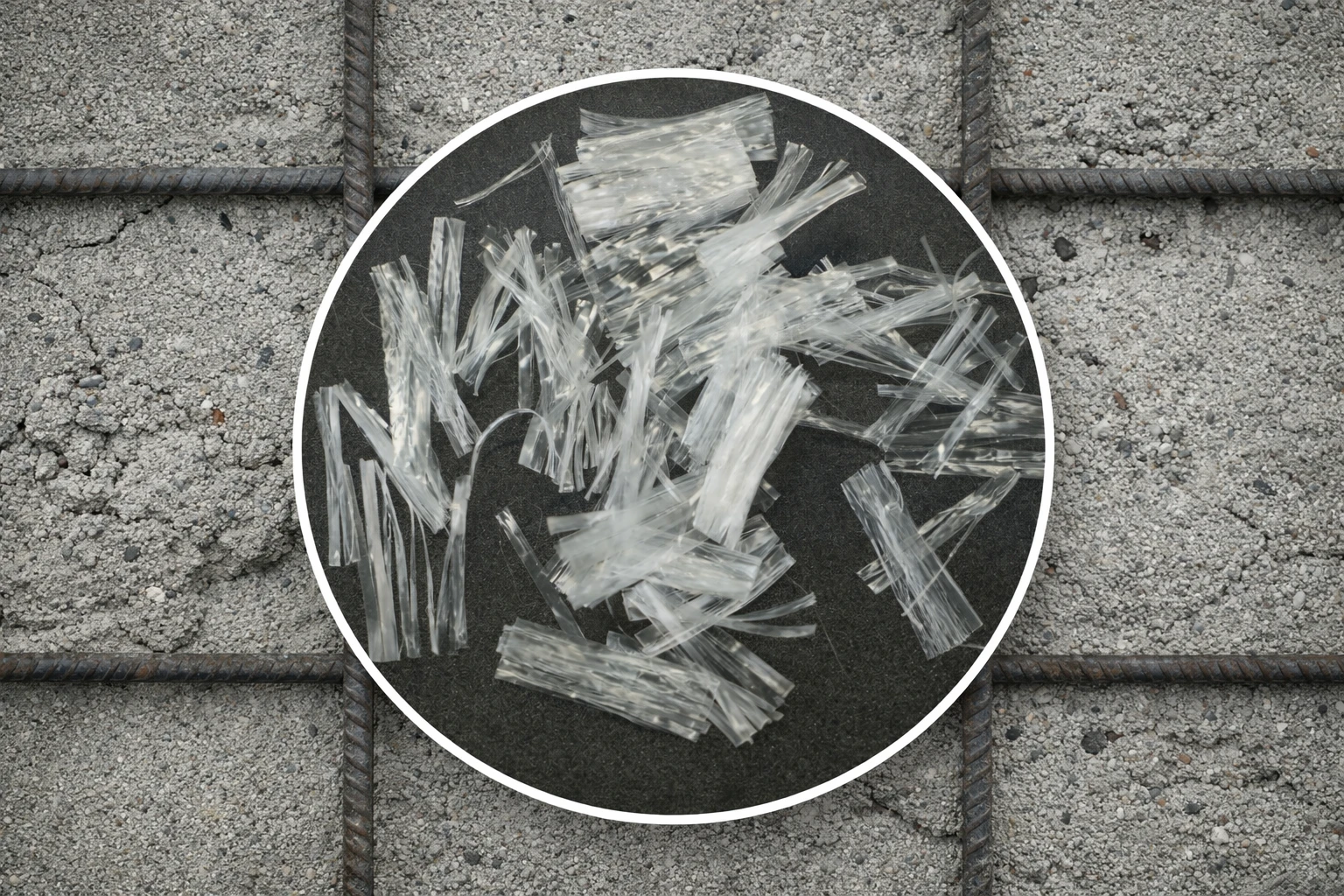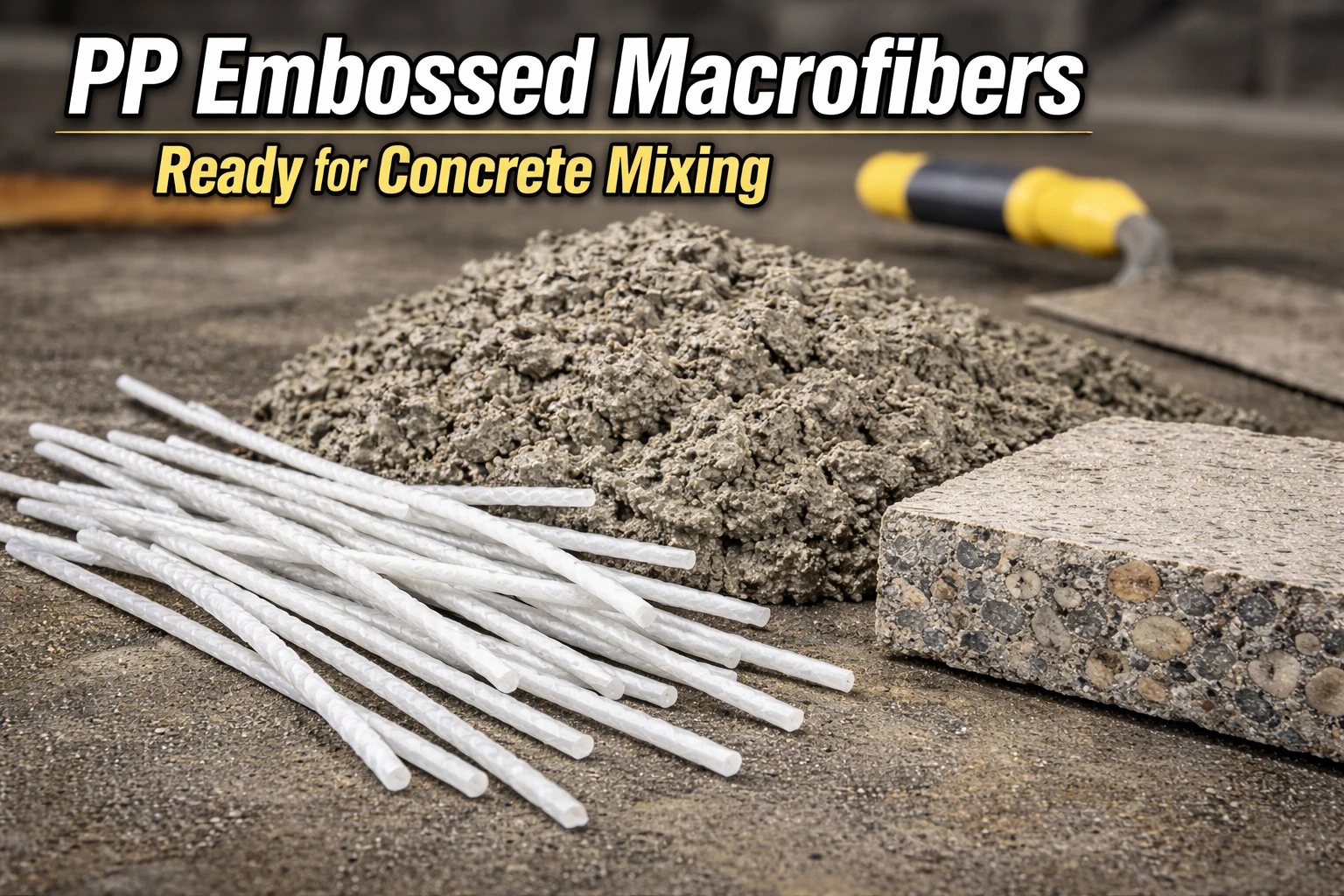
Fibrillated polypropylene is a polypropylene fiber made in a slit-film form that opens into many small branching fibrils. In concrete, it usually means a micro synthetic fiber used to reduce early cracking and improve cohesion in the fresh mix. The National Precast Concrete Association explains that fibrillated fibers are a slit-film fiber where parts of the fiber peel away and form branching fibrils. The same white paper says these synthetic microfibers are commonly used for secondary reinforcing of concrete. Sika’s current fiber handbook also shows that fibrillated fibers sit in the micro-fibre group under EN 14889-2, while macrofibres are a separate class.
That definition matters because many buyers hear the word “polypropylene” and think all PP fibers are the same. They are not. In concrete, the form of the fiber changes the job it does. A fibrillated PP fiber is different from a monofilament PP fiber, and both are different from a macro PP fiber. Sika Australia’s product page for a fibrillated PP fiber states that it complies with EN 14889-2 Class 1b, which is the fibrillated micro-fibre class, and it also states compliance with ASTM C1116/C1116M Type III for synthetic fiber-reinforced concrete.
What the term really means
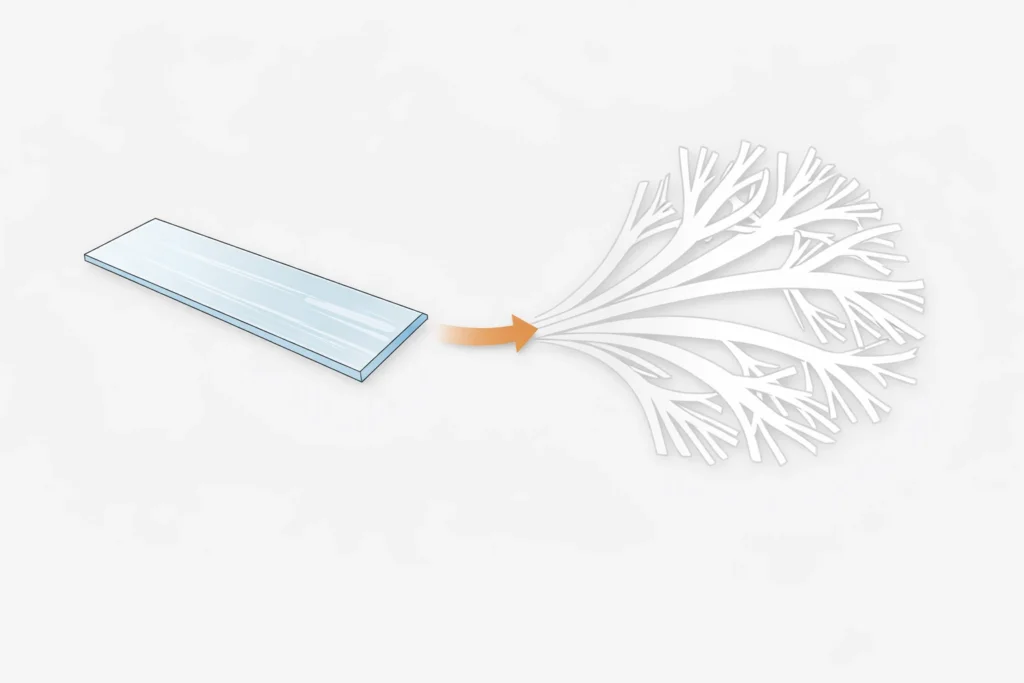
The term has two parts. Polypropylene is the base polymer. Fibrillated describes the shape. ASTM D7508 defines polyolefin chopped strands for use in concrete, and it explains that these fibers are chopped strands mixed into concrete or mortar. The same ASTM standard also defines yarn, in this concrete-fiber context, as a narrow slit extruded film. That matters because fibrillated polypropylene usually starts from this slit-film idea rather than from a smooth round monofilament.
The fibrillation part is the key visual difference. NPCA says fibrillated fibers are slit-film fibers where sections peel away and form branching fibrils. In practice, this creates a small mesh or net-like structure instead of a single solid strand. Sika’s PPF-300 product sheet describes the result in performance terms. It says the fibrillated pattern optimizes the mechanical bond between the mortar matrix and the fiber network. GCP’s Sinta F sheet uses similar language and says the small fibrillated fibres mechanically lock into the fresh concrete matrix.
So, when someone asks “What is fibrillated polypropylene?” the practical answer is this: it is a net-like polypropylene fiber form designed to spread through the mix and create many small contact points with cement paste. That extra contact area is the reason it is popular in concrete and mortar. It is not a decorative texture. It is a working geometry.
In concrete, fibrillated polypropylene usually means a micro synthetic fiber
In concrete work, fibrillated polypropylene is usually classified as a micro synthetic fiber, not a macrofiber. Sika’s fiber handbook summarizes EN 14889-2 by dividing polymer fibers into Class Ia micro-fibres, monofilament, Class Ib micro-fibres, fibrillated, and Class II macro-fibres above 0.30 mm. The same handbook also summarizes ASTM D7508 by separating micro polyolefin fibers from macro polyolefin fibers at the 580 denier and 0.3 mm equivalent diameter line.
That classification matters because micro and macro fibers do different jobs. NRMCA says synthetic fibers help in both the plastic and hardened state, but it also notes that macro-synthetic fibers are thicker and used at higher dosage for crack control in hardened concrete or as temperature and shrinkage reinforcement in some applications. The same NRMCA document explains that early-age concrete benefits from synthetic fibers because the fibers mechanically block crack growth and help stop plastic settlement crack formation.
This is why fibrillated polypropylene is usually chosen for early-age crack control, secondary reinforcement, and mix cohesion, rather than for structural post-crack flexural design. Sika’s PPF-300 sheet states that the product is primarily used for secondary or temperature-shrinkage reinforcement and for better control of plastic shrinkage cracking and plastic settlement cracking. GCP’s Sinta F sheet says essentially the same thing and places the benefit in the first 24 hours after placement, when concrete is most vulnerable to cracking.
What fibrillated polypropylene does in fresh concrete
Fresh concrete changes volume very early. Water moves. Bleed channels form. The surface dries. Settlement happens around aggregate and reinforcement. If these stresses rise faster than the young concrete gains strength, cracks form. NRMCA explains this clearly. It says early-age volume changes create weakened planes and cracks, and it says the growth of these micro shrinkage cracks is inhibited by the mechanical blocking action of synthetic fibers. It also says the internal support system of synthetic fibers inhibits plastic settlement cracks and discourages the formation of large capillary channels caused by bleed water migration.
Fibrillated polypropylene fits this job well because the branching fibrils create a multidimensional network in the mix. Sika’s PPF-300 sheet says the fiber acts mechanically by reinforcing the concrete with a multidimensional fiber network coated with mortar. The same sheet says it can reduce plastic and drying shrinkage cracking, reduce bleeding, improve impact and abrasion resistance, and enhance durability and toughness. GCP’s Sinta F sheet also says the fibres distribute multi-dimensionally throughout the mix and improve surface characteristics, impact, and toughness while reducing permeability.
This is also why fibrillated PP fiber is often used in slabs, toppings, pavements, shotcrete, stucco, and precast. These are jobs where a contractor wants fewer early cracks and a tighter, more cohesive mix without moving into a full macrofiber structural design. Sika Australia lists floor slabs, driveways, tilt slabs, floor toppings, precast elements, coloured concrete, and both dry and wet shotcrete among typical uses for its fibrillated PP product.

How it differs from monofilament polypropylene
A buyer often compares fibrillated polypropylene with monofilament polypropylene. The difference is shape first, then bond behavior, then finish feel. NPCA says traditional synthetic microfiber use in concrete has been limited mainly to monofilament forms and fibrillated forms of polypropylene fibers. It then explains that fibrillated fibers are the slit-film form with branching fibrils. That means the market has long treated these as two separate product forms, even when both are polypropylene microfibers.
Sika’s fiber handbook makes the split even cleaner by listing monofilament and fibrillated as the two micro-fibre forms under EN 14889-2. So a buyer should not treat “PP microfiber” as a full specification by itself. The supplier still needs to identify whether the product is monofilament or fibrillated, because the geometry affects dispersion, bond pattern, and sometimes finish appearance.
In practical jobsite terms, fibrillated polypropylene is often chosen when the buyer wants a stronger network effect and a better mechanical lock in the paste. Sika’s PPF-300 sheet directly ties the fibrillated pattern to optimized bond between mortar matrix and fiber networks. GCP’s Sinta F sheet says the small fibrillated fibres mechanically lock into the fresh matrix and reduce early cracking caused by shrinkage, settlement, and other internal stresses. Those statements do not mean fibrillated PP is always “better” than monofilament PP. They mean the shape changes the way the fiber works, and that is why the distinction matters.
How it differs from macro polypropylene fiber
It is just as important to separate fibrillated polypropylene from macro PP fiber. ASTM D7508 separates micro and macro polyolefin fibers by denier and equivalent diameter. Micro fibers are below 580 denier and below 0.3 mm equivalent diameter. Macro fibers are 580 denier or more and 0.3 mm equivalent diameter or more. The standard also lists cut-length ranges that are much shorter for micro chopped strands than for macro chopped strands.
NRMCA describes the functional difference in simple language. It says macro-synthetic fibers are thicker fibers, used at higher dosage, and used for crack control in hardened concrete or as temperature or shrinkage reinforcement in some applications. By contrast, the same NRMCA document explains micro synthetic fibers through their effect on plastic shrinkage and plastic settlement cracking.
So, fibrillated polypropylene usually sits on the micro side of the market. A buyer uses it for early crack control, secondary reinforcement, and improved cohesion. A macro polypropylene fiber belongs to a different discussion. That discussion is about post-crack flexural performance, higher dosage, and residual strength design. Sika’s handbook and Sika’s product selection guides keep these categories separate for that reason.
What standards buyers should check
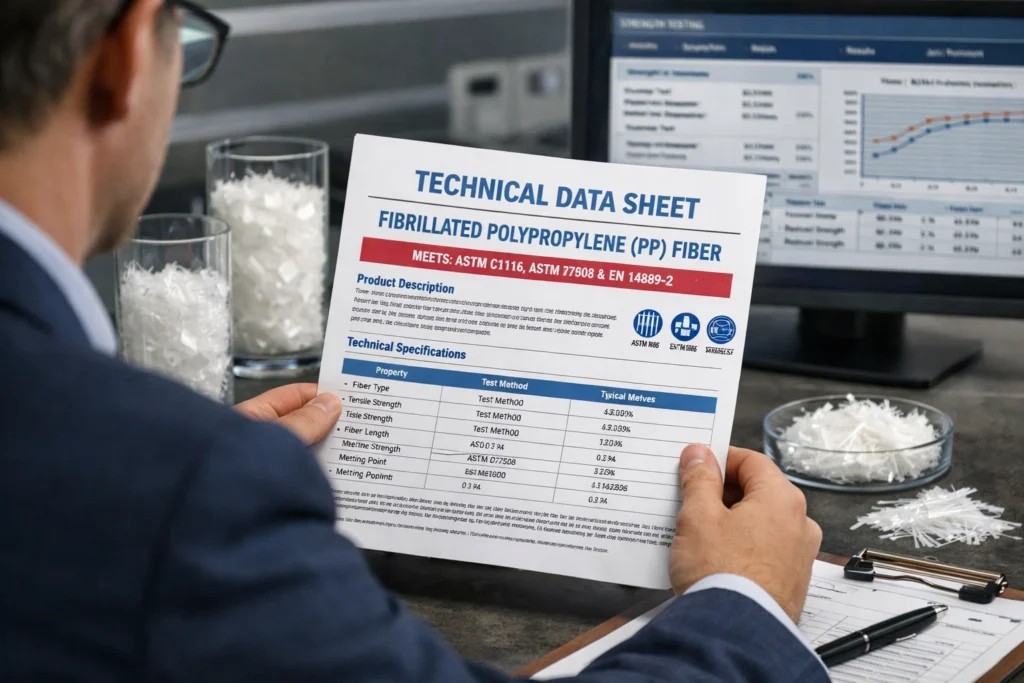
A serious buyer should not stop at the phrase “fibrillated polypropylene.” The buyer should check the standards behind the product. The first one is ASTM C1116/C1116M, which ASTM describes as the specification for fiber-reinforced concrete. ASTM’s own standard page says the materials are classified by fiber type and that Type III is synthetic fiber-reinforced concrete. It also says the concrete should be free of fiber balls at delivery.
The second standard is ASTM D7508, which covers polyolefin chopped strands for use in concrete. ASTM D7508 says the fibers are chopped strands mixed into concrete or mortar, defines the micro and macro split, and states that polyolefin chopped strands for use in concrete must comply with both C1116/C1116M and D7508. That matters because it ties the fiber product itself to a concrete-use specification, not only to a textile description.
The third standard is EN 14889-2 when the project follows EN practice. Sika’s handbook summary and Sika Australia’s product page both place fibrillated polypropylene in the Class 1b / Class Ib micro-fibre category. That gives buyers a clean way to identify the product class in export markets and international project files.
Typical dosage, handling, and site expectations
On site, fibrillated polypropylene is usually simple to use, but it still needs correct batching and mixing. NRMCA says synthetic fibers are added before or during mixing. It also says typical addition rates of 1 to 2 pounds per cubic yard do not usually require mix modification, while higher rates may reduce workability and may require water-reducing admixtures to retain slump.
Supplier data sheets line up with that practical guidance. Sika’s PPF-300 sheet gives a typical standard dosage of 1.5 lb/yd³ and says the product can be added during or after batching and mixed at high speed for four to five minutes. Sika Australia’s Confibre 51F page gives a recommended minimum dosage of 0.9 kg/m³ and says the optimum dosage depends on the concrete type, site conditions, mix proportions, and target properties. GCP’s Sinta F sheet also gives a standard range and says the load should be mixed long enough after addition to ensure uniform distribution.
A buyer should also keep expectations realistic. Fibrillated polypropylene can reduce cracking risk. It can improve cohesion and toughness. It can serve as a secondary reinforcement option in the right documented applications. But it is not a blanket substitute for all reinforcement required by building codes. GCP states this directly on the Sinta F sheet. It says the product is not recommended as a substitute for reinforcement required by model building codes and standards, even though it can eliminate welded wire fabric in some secondary reinforcement situations.
What fibrillated polypropylene is not
It is not the same as all polypropylene fibers. Some PP fibers are monofilament microfibers. Some are macro synthetic fibers. Some are graded or hybrid products. ASTM D7508 explicitly lists micro, macro, hybrid, multi-length, and graded categories for polyolefin chopped strands used in concrete. So the word “polypropylene” alone is too broad for a serious specification.
It is also not mainly a structural macrofiber product. Fibrillated polypropylene is usually specified to control plastic shrinkage cracking, plastic settlement cracking, and related early-age problems. Sika Australia says this directly on its product page. Sika PPF-300 and GCP Sinta F say the same in their data sheets.
It is not a magic fix for poor curing or poor placing practice either. NRMCA explains that synthetic fibers help by mechanical blocking and internal support, but the same document still frames them as part of a broader concrete practice approach. The fiber supports the mix. It does not erase bad weather exposure, bad timing, or bad finishing decisions.
Why this matters for Ecocretefiber™
For Ecocretefiber™, this topic matters because the search term sits between education and buying intent. A reader who asks “What is fibrillated polypropylene?” is often not looking for a chemistry lesson. The reader is often a contractor, buyer, or spec writer trying to decide whether a fibrillated PP fiber fits a slab, topping, pavement, or shotcrete job. That is why the best answer needs both plain language and standards language. The market sources and standards all point the same way: fibrillated polypropylene is a slit-film micro synthetic fiber form used mainly for early crack control and secondary reinforcement in concrete.
That also makes the topic a strong SEO bridge. It catches readers before they move into product-level searches like PP fibrillated fiber, secondary reinforcement fiber, or ASTM C1116 Type III microfiber. For a concrete fiber brand, that is useful traffic because it is already close to specification and procurement language.
Conclusion
Fibrillated polypropylene is a slit-film polypropylene fiber that opens into branching fibrils and forms a net-like micro synthetic reinforcement in concrete. In concrete practice, it is usually a micro PP fiber, not a macrofiber, and it is mainly used to reduce plastic shrinkage cracking, reduce plastic settlement cracking, improve cohesion, and support secondary reinforcement in the right applications. Standards and product literature place it clearly in this role, especially through ASTM C1116 Type III, ASTM D7508, and EN 14889-2 Class 1b / Ib references.
For a buyer, the practical takeaway is simple. If the job needs early-age crack control, better mix cohesion, and a proven micro synthetic fiber form, fibrillated polypropylene is one of the most established options in the concrete market. That is why it stays relevant for slabs, toppings, pavements, shotcrete, and precast work, and that is why it remains a strong fit for a concrete-focused brand like Ecocretefiber™ from Shandong Jianbang Chemical Fiber Co., Ltd.