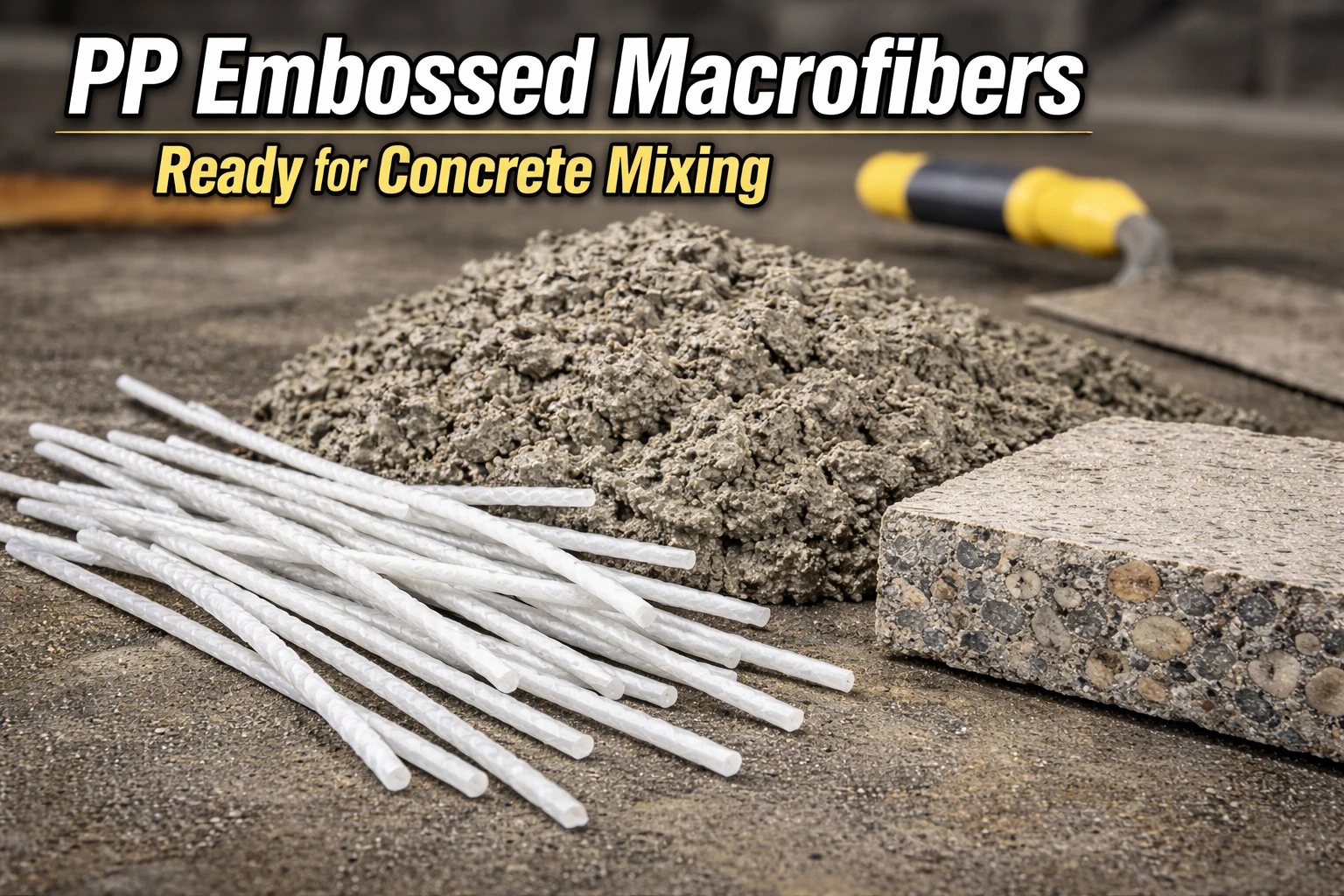
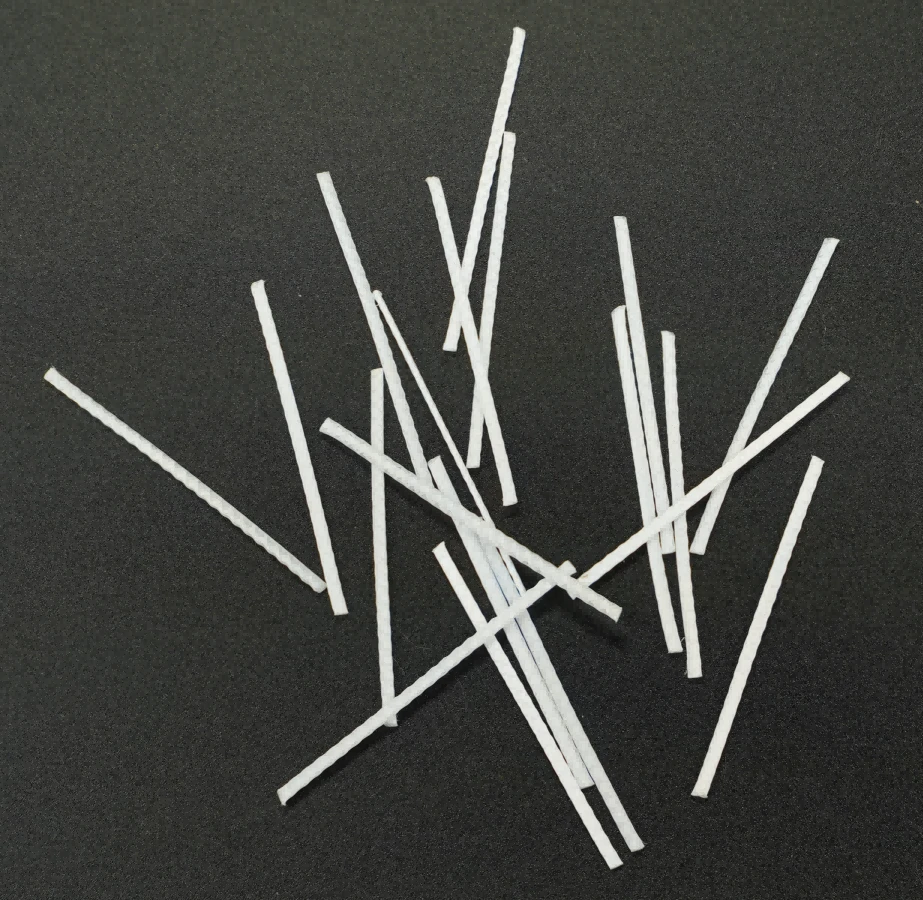
PP embossed macrofiber is a macro synthetic concrete fiber made from polypropylene, with a textured or embossed surface that helps the fiber grip the concrete better after cracks start to form. The term is common in product pages and sales materials, but the idea behind it is technical and standard-based. ACI defines macrosynthetic fibers as synthetic fibers with an equivalent diameter greater than 0.3 mm, and it notes that polypropylene fibers can be either micro or macro depending on size. Sika’s concrete fiber guidance also says synthetic macrofibers are larger than 0.3 mm and are used where post-cracking flexural strength is needed.
That means the phrase can be broken into three parts. PP means polypropylene. Macrofiber means a larger synthetic fiber for crack bridging after the concrete cracks. Embossed means the fiber surface is formed with a pattern, texture, or indentation to improve anchorage in the cement matrix. A Master Builders product page states this directly: its polypropylene macrofiber has an embossed surface to increase adhesion to concrete. A recent Scientific Reports paper also describes indented macro PP fibers as having surface indentations designed to improve mechanical anchorage.
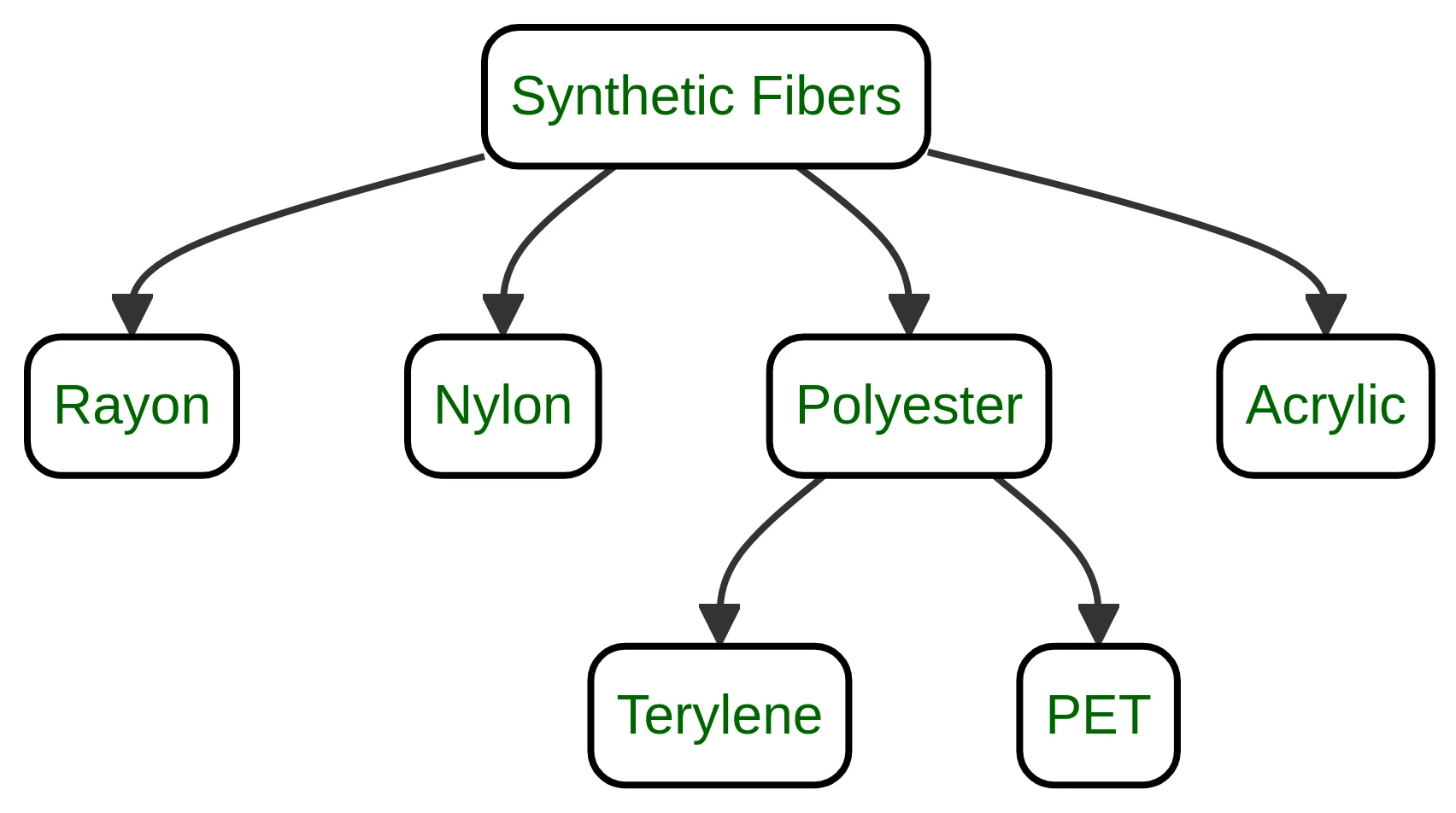
What “PP” means in this term
PP stands for polypropylene, which is one of the most widely used synthetic fiber materials in concrete. ACI 544.3R identifies polypropylene as a common synthetic fiber material and notes that polypropylene fibers can fall into either the micro or macro group. The same ACI guide lists polypropylene at a specific gravity of about 0.91, which is one reason it is easy to distribute in concrete at practical dosages.
Polypropylene matters in concrete because buyers usually want a fiber that is durable in the cement environment and easy to handle on site. ASTM C1116 is the core ASTM specification for fiber-reinforced concrete, and the ASTM standard family recognizes synthetic fibers as Type III. ASTM’s current standards listing shows C1116/C1116M-23 as the active specification for fiber-reinforced concrete. Sika and Master Builders product pages for polypropylene macrofibers also state compliance with ASTM C1116 or with ASTM C1116/C1116M.
For a buyer, this means PP is not just “plastic.” In concrete, PP is a mainstream reinforcement material with a defined place in standards and in real projects. It is used because it helps control cracking, improve toughness, and avoid corrosion issues that can matter with steel in some environments. Sika’s fiber guidance states that synthetic macrofibers can be used as replacement for temperature and shrinkage reinforcement or as structural reinforcement in concrete or shotcrete, and Sika also notes that they are used where residual post-cracking flexural strength is required.
What “macrofiber” means
A macrofiber is not the same as a microfiber. ACI sets a clear line between the two. Microsynthetic fibers are below 0.3 mm in equivalent diameter, and macrosynthetic fibers are above 0.3 mm. That difference matters because the function changes with the size. Microfibers mainly help control plastic shrinkage and settlement cracking in the first hours after placement. Macrofibers are chosen mainly for what happens after the concrete cracks. They help bridge cracks and keep the concrete carrying load.
The European classification makes this point in a direct way too. EN 14889-2 classifies polymer fibers for concrete, and the standard preview identifies Class II as macro fibres with diameter above 0.30 mm. The same preview notes that Class II fibers are generally used where an increase in residual flexural strength is required. The Concrete Society says the same thing in simpler language and explains that BS EN 14889 covers fibers for concrete and links declared polymer fiber performance to residual flexural strength values from standard beam testing.
So when a product is called a PP macrofiber, the supplier is telling you that the fiber is intended for structural or semi-structural crack bridging, not only for surface crack control in fresh concrete. That is why these products are commonly discussed for slabs, pavements, shotcrete, and industrial floors rather than only for basic shrinkage control. Sika and Master Builders both position their macro synthetic fibers for slab construction, pavements, shotcrete, and related structural or secondary reinforcement uses.
What “embossed” means on a macrofiber
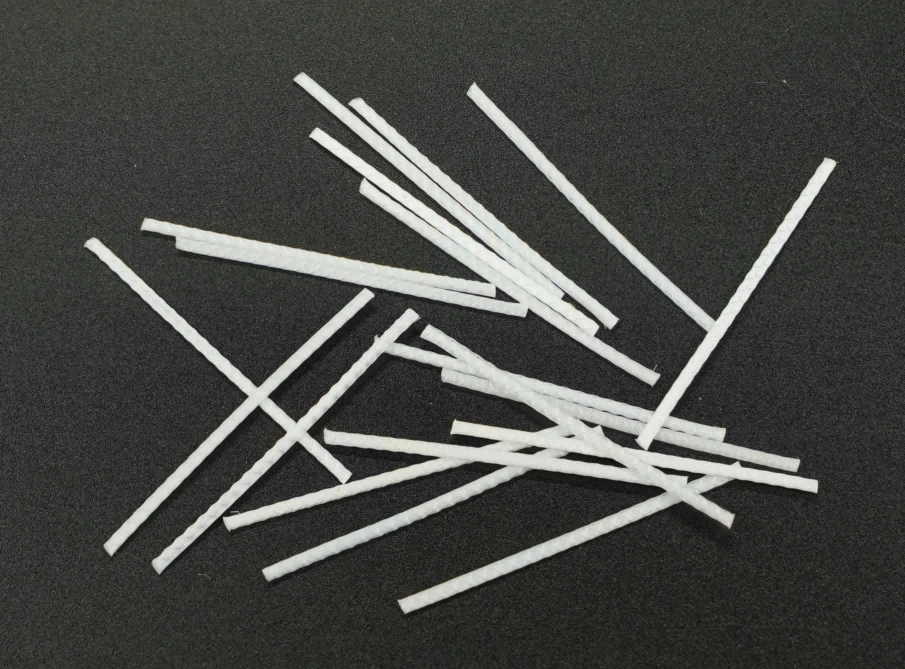
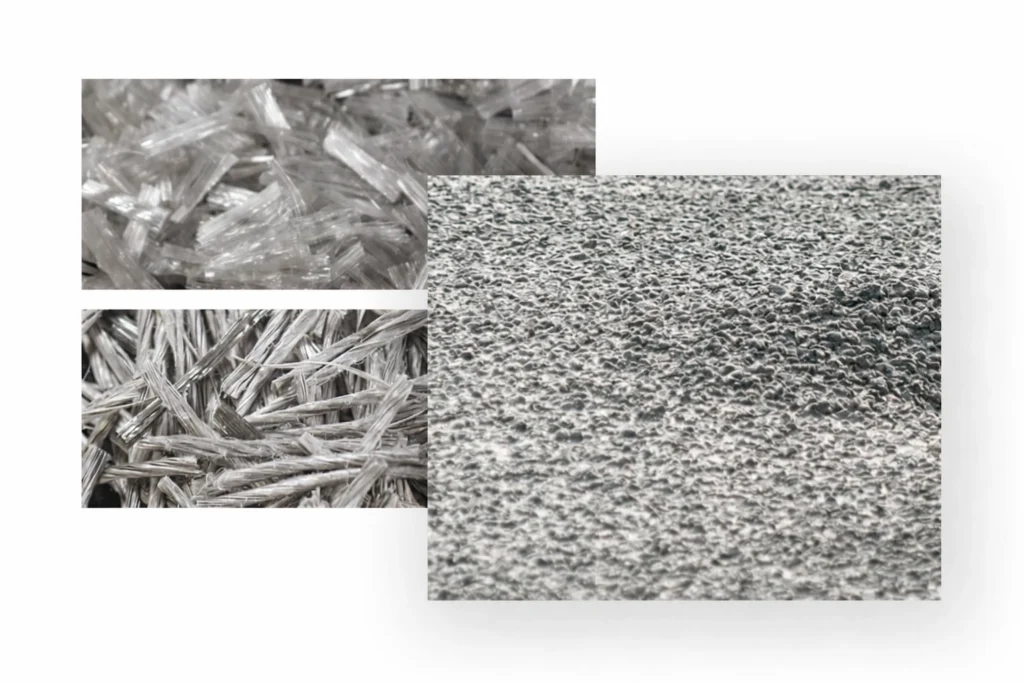
The word embossed is the part many buyers notice first. In simple terms, it means the fiber surface is not smooth. The surface is pressed, patterned, indented, or textured during manufacturing. That texture helps the fiber hold onto the surrounding cement matrix more effectively. A Master Builders product page describes this directly by saying the surface is embossed to increase adhesion to concrete.
This point is important because smooth polypropylene has limits in bond and pull-out behavior. The bond between a polymer fiber and concrete does not work the same way as deformed steel bar bond. A recent Scientific Reports paper on indented macro polypropylene fibers explains that surface indentations are added to enhance mechanical anchorage, and the paper reports major gains in splitting tensile strength, bond strength, and flexural strength in high-strength SCC when these macro PP fibers were used. The same paper says the undulated surface was intended to improve bonding with the surrounding matrix and reduce mixing problems seen with finer PP fibers.
Other research points in the same direction. A study summary on macro synthetic fiber length notes that macro synthetic fibers usually bond to concrete along their full length and often use an embossed surface, while steel fibers often depend more on hooked ends. A separate pull-out study on macro synthetic fibers also shows how fiber surface and damage from mixing affect pull-out behavior, which is another sign that surface form is not a cosmetic detail. It is part of the performance design.
So, in practice, embossed usually means the supplier is trying to improve crack bridging and pull-out resistance through surface shape. It does not mean the fiber is coated with a glue or decorative finish. It means the fiber has a working surface profile for better mechanical grip in concrete.
How PP embossed macrofiber works inside concrete
Concrete is weak in tension. Once a crack starts, the concrete section loses continuity fast. A macrofiber helps by crossing the crack and carrying part of the tensile force after the crack opens. This is why designers talk about post-crack behavior, residual strength, and toughness when they specify macro synthetic fibers. Sika’s fiber guidance says macrofibers are used where an increase in residual post-cracking flexural strength is required, and ASTM C1609 is one of the common test methods used for this purpose.
The embossed surface helps this process because the fiber does not slip out as easily. Instead, it develops more resistance as the crack opens. The Scientific Reports paper on indented macro PP fibers reported clear increases in splitting tensile strength, bond strength, and flexural strength, and it also reported a strong rise in flexural toughness with increasing fiber content. The authors described a shift from brittle behavior toward more ductile behavior as fiber content increased.
This is why an embossed PP macrofiber is usually discussed as a performance fiber, not only as a “crack reducer.” It can help with crack width control, toughness, energy absorption, and in some cases partial replacement of traditional crack-control reinforcement, depending on the design method and the required residual strength class. Sika, Master Builders, and the Concrete Society all frame macro synthetic fibers in this performance-based way.
What jobs use PP embossed macrofiber most often
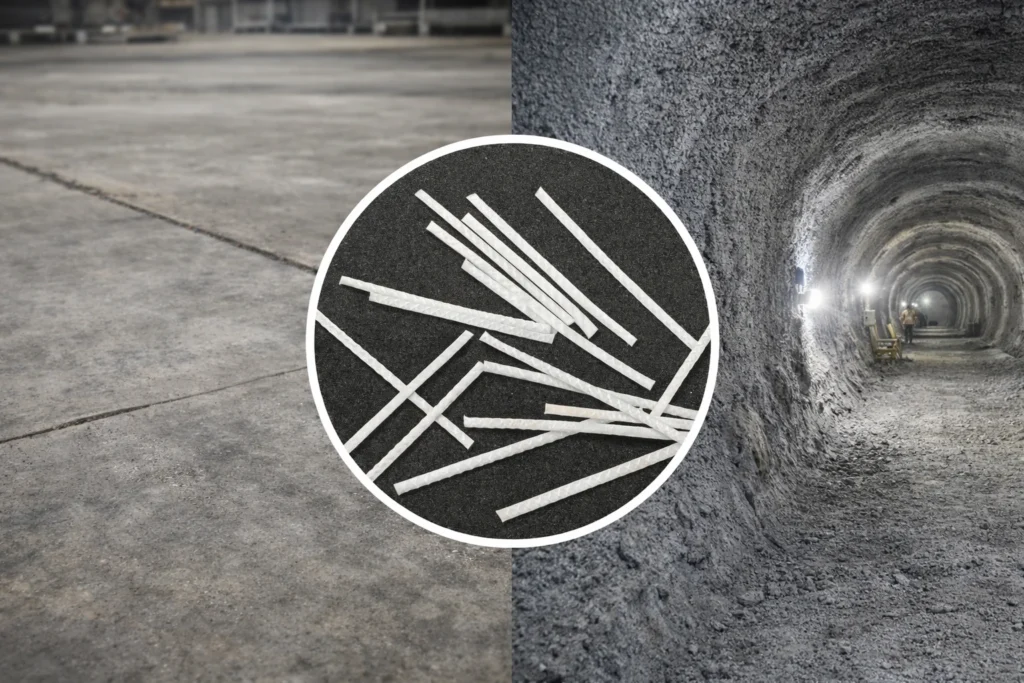
This type of fiber is commonly used in industrial and warehouse floors, commercial slabs-on-ground, concrete pavements, overlays, shotcrete, and some precast applications. Master Builders lists industrial floors, commercial slab construction, concrete pavement, overlays, thin-wall precast concrete, shotcrete, and composite metal decks as recommended uses for one of its macrofiber products. Sika also describes macro polypropylene fibers as suitable for structural concrete and shotcrete, including tunnel and mining support in some product lines.
The reason these applications keep appearing is simple. These are the jobs where post-crack behavior matters and where a distributed fiber system can save time or reduce dependence on mesh in the right design. Sika’s product and software materials say polypropylene macrofibers can partially or totally replace bulky steel bar or mesh reinforcement in concrete slabs in suitable applications. Master Builders says its macrofiber can eliminate the need for welded-wire reinforcement and small diameter bars used as secondary reinforcement, depending on the application.
That last phrase matters: depending on the application. A PP embossed macrofiber is not a magic one-to-one replacement for any steel layout. It works well when the design method, test data, and slab or shotcrete function match what the fiber is designed to do. For more demanding structural work, designers still need residual strength data and a design guide that supports the substitution. The Singapore BCA design guide for fiber-reinforced concrete structures is one example of a framework that uses residual strength and ductility classes for design decisions.
What standards and test data buyers should check
A buyer should not stop at the product name. The name tells you the concept, but the standards tell you whether the product is serious. The first standard many buyers look for is ASTM C1116/C1116M, because this is the main ASTM specification for fiber-reinforced concrete. ASTM’s standards listing shows the current version, and leading suppliers of polypropylene macrofibers cite compliance with it on their product pages.
The second major standard is EN 14889-2 for polymer fibers for concrete. The EN preview classifies macro fibers as Class II and notes they are generally used where residual flexural strength is required. The standard also requires the manufacturer to declare the unit volume of fibers that achieves specific residual flexural strength values in a reference concrete, and the Concrete Society explains this clearly in its guidance page.
The third thing buyers should check is the actual residual strength test basis. In ASTM systems, that often means ASTM C1609 beam data. In EN systems, that often means the strength declarations linked to EN 14845 testing. This matters because two products can both say “PP macrofiber” while giving very different post-crack performance. The embossed surface is a good sign, but the residual strength data is what turns that sign into a specification-grade claim.
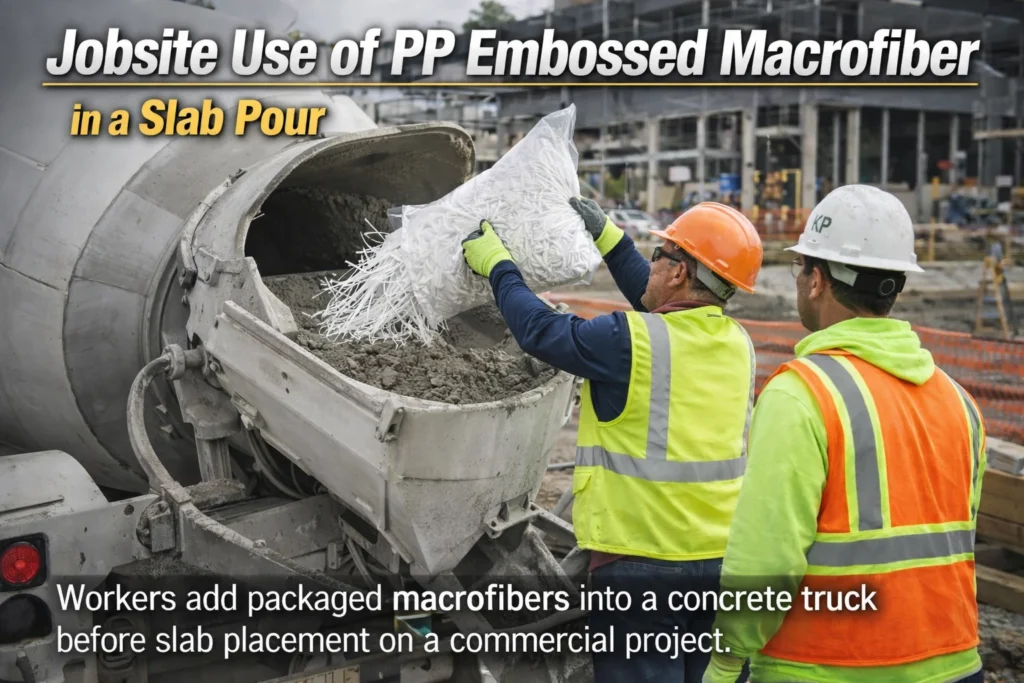
A good supplier should also give mixing instructions. EN 14889-2 requires the manufacturer to supply mixing sequence recommendations for central plants and dry-batch truck mixed concrete. That matters because macro synthetic fibers can affect workability and dispersion, and poor mixing can lower performance. A study on indented macro PP fibers in SCC reported lower slump flow and higher air content as fiber content increased, even while strength and toughness improved.
What PP embossed macrofiber is not
It is not the same as a micro polypropylene fiber. Micro PP fibers mainly reduce early-age plastic shrinkage and settlement cracking. Macro PP fibers are used mainly for post-crack flexural strength and toughness. ACI and Sika both make this distinction clearly.
It is not a formal ASTM material name by itself either. The phrase PP embossed macrofiber is mainly a market and product-description term. The standards classify the product by fiber family and size and required performance, not by the marketing word “embossed.” That means the embossed profile is important, but it still has to be backed by the right standard claims and test data.
It is also not a universal replacement for structural steel. In some slabs, pavements, and shotcrete applications, macro synthetic fibers can partially replace mesh or other secondary reinforcement. In other cases, they are used together with steel reinforcement. Sika and Master Builders both use careful wording around replacement and supplementation, which is the right way to present the product.
Why many buyers choose this type of fiber
The main reason is balance. PP embossed macrofiber gives buyers a combination of crack control, post-crack toughness, corrosion-free reinforcement, and easier site handling than traditional mesh in many use cases. Sika says polypropylene macrofibers offer a rust-free reinforcing solution and can be used for structural purposes in concrete and shotcrete. Master Builders highlights crack control, finishability, and labor savings in slab work.
Another reason is jobsite practicality. A distributed fiber system can reduce mesh placement work, cut labor time, and remove some handling problems tied to welded wire reinforcement. That is why these fibers keep showing up in industrial floors and fast-track slabs. Sika’s software page says polypropylene macrofibers can help replace bulky steel bar or mesh reinforcement in slabs, which saves time and money in the construction process.
A third reason is durability planning. PP does not rust, and the macrofiber is embedded through the concrete rather than sitting as a single plane of reinforcement. For buyers worried about corrosion stains, handling injuries from steel fibers, or mesh placement delays, embossed macro PP fiber has a practical market advantage. The product still needs design control, but it fits many commercial needs very well.
Why Ecocretefiber™ fits this topic well
Ecocretefiber™ is positioned in exactly the part of the market where this question comes up. Buyers do not only search for “macro synthetic fiber.” Many buyers search the more commercial term PP embossed macrofiber because they are already comparing concrete fiber products. That means this title sits close to real buying intent.
The best answer for that buyer is not vague. The best answer explains the material, the size class, the surface design, the test logic, and the applications in one place. That is also how serious suppliers present the category. ACI gives the micro-macro boundary. EN 14889-2 gives the macro polymer class and declaration logic. Leading suppliers explain embossed surfaces as a way to improve adhesion or anchorage. Recent research confirms that indented macro PP fibers can deliver strong gains in flexural and tensile behavior when the mix and dosage are suitable.
For Shandong Jianbang Chemical Fiber Co., Ltd., this topic is also a strong SEO bridge. It catches readers who start from a product phrase and then want technical confirmation before they contact a supplier. That is valuable traffic because it is already close to specification and procurement thinking.
Conclusion
PP embossed macrofiber is a polypropylene macro synthetic concrete fiber with a textured or indented surface designed to improve anchorage in concrete. PP means polypropylene. Macrofiber means a synthetic fiber larger than the micro class and mainly used for post-crack crack bridging and residual strength. Embossed means the fiber surface is shaped to improve grip in the cement matrix. ACI, EN 14889-2, supplier product pages, and recent research all support this basic definition.
In practice, PP embossed macrofiber is used in slabs, pavements, shotcrete, and other concrete applications where toughness, crack control, and reduced reliance on mesh are important. Buyers should still check ASTM C1116 or EN 14889-2 alignment, residual strength data, and mixing guidance before they specify a product. The embossed surface is valuable, but the real buying decision should still rest on proven test performance and fit for the job.