Why Water Conservancy Concrete Needs Better Reinforcement
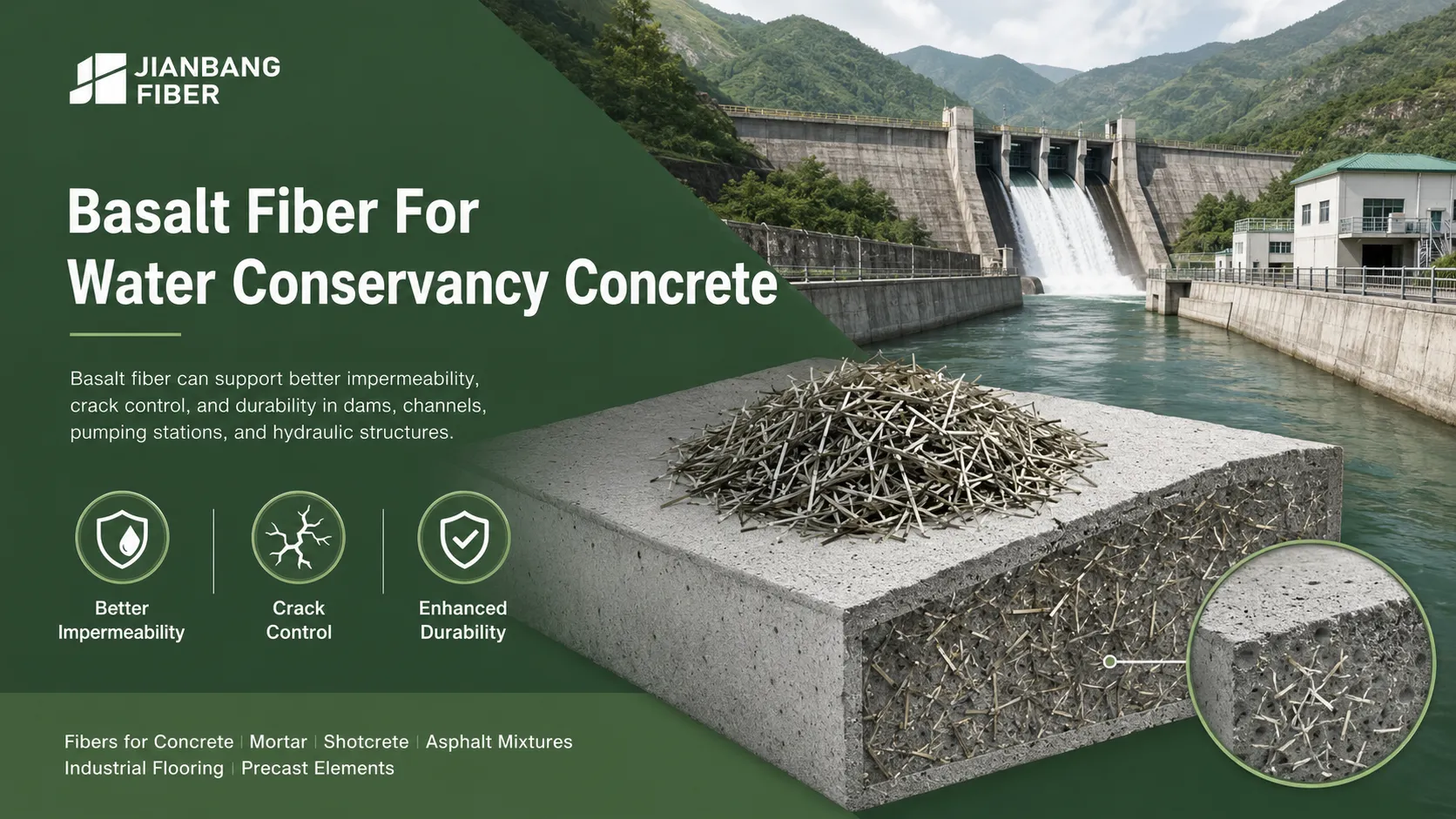
Water conservancy engineering works under difficult service conditions. Dams, channels, sluices, pumping stations, culverts, reservoirs, spillways, aqueducts, water tunnels, retaining walls, and hydraulic concrete structures all face water pressure, seepage, shrinkage, erosion, freeze-thaw cycles, chemical attack, and long-term load.
Ordinary concrete is strong in compression, but it can crack under tensile stress, shrinkage, temperature change, settlement, vibration, and hydraulic impact. Once cracks form, water can enter the structure. Seepage can increase. Chemical ions can move deeper into the concrete. Local damage can expand. Repair cost can rise.
Por eso hormigón reforzado con fibras is becoming more important in water conservancy engineering. Fibers can help control microcracks. They can improve toughness. They can reduce crack width. They can also support better durability when the mix design and construction method are correct.
Shandong Jianbang Fiber finds out that basalt fiber is a practical reinforcement material for hydraulic concrete. It is mineral-based, non-metallic, corrosion resistant, and suitable for crack control in cement-based materials. When used correctly, fibra de basalto can help improve impermeability, seismic resistance, durability, construction efficiency, and sustainability.
At Shandong Jianbang Chemical Fiber Co., Ltd., our Ecocretefiber™ brand supplies basalt fiber and other concrete fiber solutions for water conservancy, roads, bridges, tunnels, industrial floors, shotcrete, precast concrete, and infrastructure projects.
What Is Basalt Fiber?
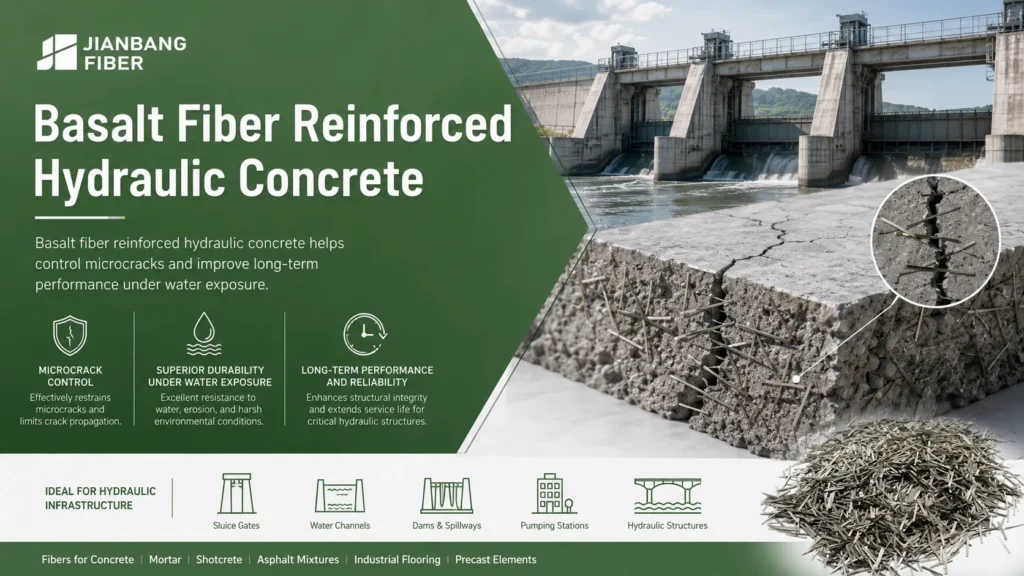
Basalt fiber is made from natural basalt rock. The rock is melted at high temperature and drawn into fibers. It is an inorganic mineral fiber. It has good strength, temperature resistance, and chemical stability.
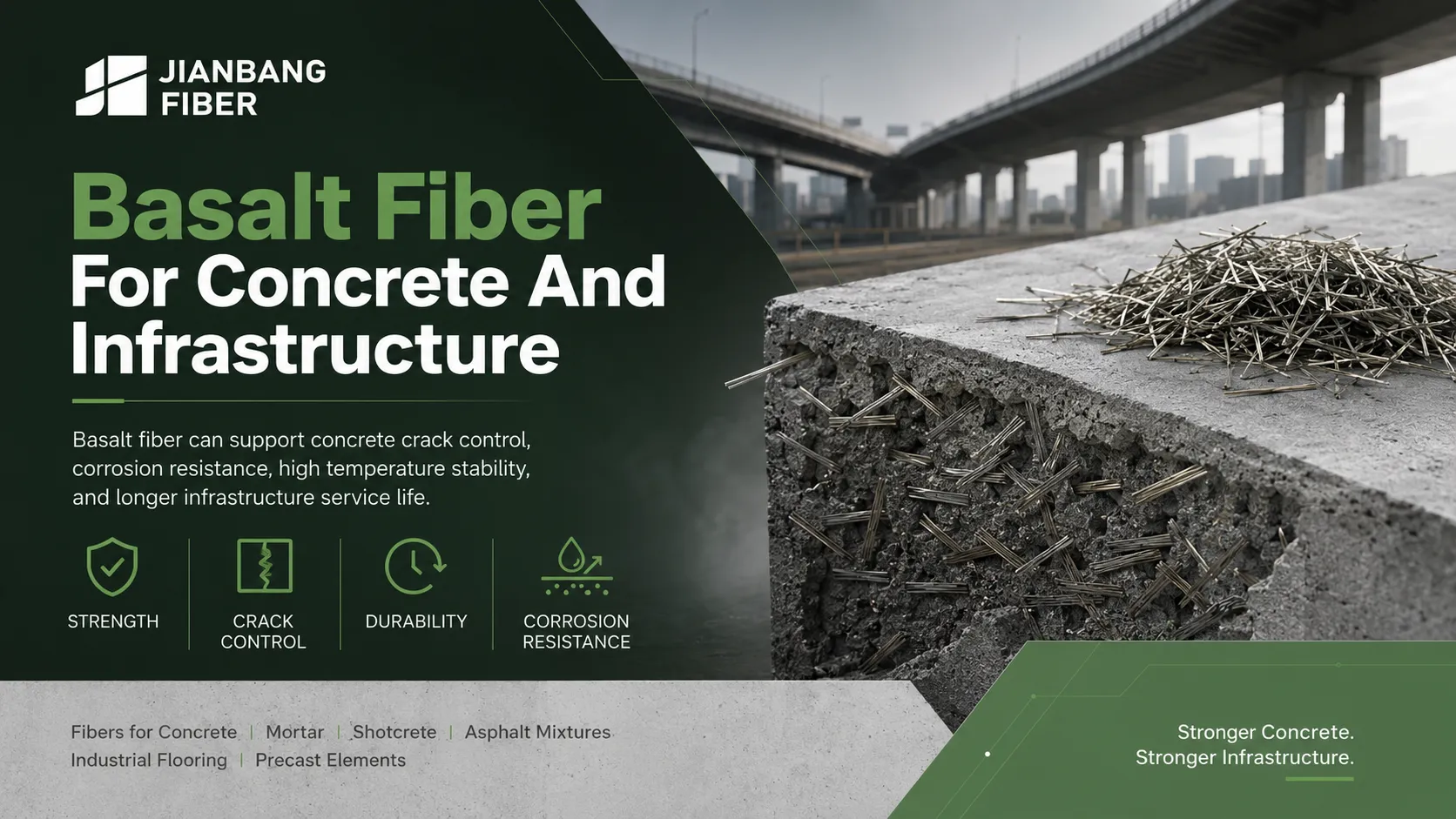
In concrete, chopped basalt fiber can be mixed into the cement matrix. It does not work like traditional rebar. It is distributed throughout the concrete. When microcracks begin to form, fibers help bridge those cracks and slow crack growth.
Shandong Jianbang Fiber finds out that basalt fiber is especially useful for water conservancy concrete because hydraulic structures need crack control and long-term durability. Water exposure makes every crack more serious. A small crack can become a seepage channel. A seepage channel can become a durability problem.
This is why basalt fiber should be viewed as a crack-control and durability-support material for hydraulic concrete.
Benefit 1: Better Impermeability
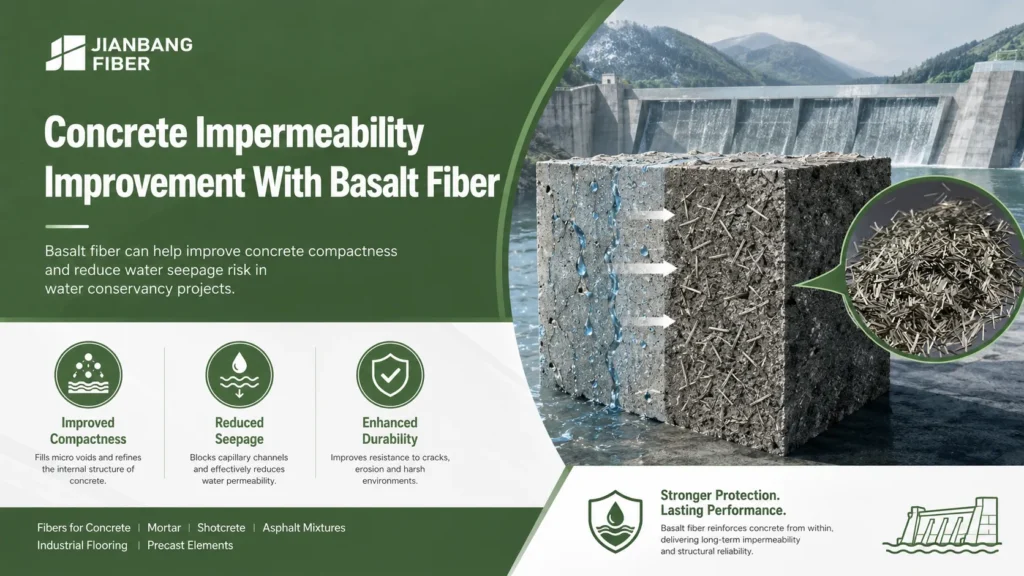
Impermeability is one of the most important performance requirements in water conservancy engineering. Concrete in dams, channels, reservoirs, water tunnels, and pumping stations must resist water penetration.
Shandong Jianbang Fiber finds out that basalt fiber can help improve concrete impermeability by controlling microcracks and improving internal compactness. When fibers are distributed in the concrete, they can help bridge fine cracks. They can also reduce crack growth under shrinkage and load.
If the microcrack network is controlled, water has fewer paths to move through the concrete. This can reduce seepage risk and improve the service performance of hydraulic structures.
However, basalt fiber is not the only factor. Impermeability also depends on water-binder ratio, cementitious material system, aggregate grading, compaction, curing, and construction quality. The best result comes from a full mix design, not from fiber alone.
Benefit 2: Reduced Leakage Risk
Water leakage is a major problem in hydraulic structures. It can reduce water storage efficiency. It can weaken foundations. It can damage downstream protection. It can also increase maintenance cost.
Basalt fiber can help reduce leakage risk by limiting the formation and expansion of cracks. It does not seal large structural defects by itself, but it can help reduce the early microcrack pathways that lead to seepage.
Shandong Jianbang Fiber finds out that basalt fiber is useful in concrete where crack control is directly connected to water management. Examples include canal linings, reservoir concrete, water diversion tunnels, spillways, sluice structures, and pumping station foundations.
When basalt fiber is combined with dense concrete, waterproofing admixtures, proper vibration, and good curing, it can support better anti-seepage performance.
Benefit 3: Improved Seismic Resistance
Water conservancy projects often include large structures. Some are located in seismic regions. Earthquake loads can cause bending, shear, tension, and vibration damage. Concrete that lacks toughness may crack or break more quickly under dynamic load.
Shandong Jianbang Fiber finds out that basalt fiber can improve the toughness and energy absorption capacity of concrete. This can help concrete distribute stress more effectively under vibration and dynamic loading.
In important components such as beams, columns, support walls, spillway structures, and water tunnel linings, basalt fiber can help improve crack resistance and reduce brittle failure risk.
This does not mean basalt fiber replaces seismic design reinforcement. Structural engineers must still design rebar, section size, and seismic detailing according to codes. Basalt fiber should be considered an additional crack-control and toughness-support measure.
Benefit 4: Better Durability
Durability decides the long-term value of a water conservancy project. A structure that cracks early or needs frequent repair creates high lifecycle cost.
Basalt fiber can help improve durability by reducing shrinkage cracks and limiting crack development. It can also help concrete resist some environmental damage by improving internal structure and reducing connected crack pathways.
Shandong Jianbang Fiber finds out that basalt fiber is valuable in water conservancy concrete because these structures are often exposed to moisture, soil minerals, chemicals, temperature cycles, and hydraulic erosion.
In channels, dams, culverts, and water tunnels, durability is not optional. It is a core project requirement. Basalt fiber can help support longer service life when it is used with a proper mix design and curing system.
Benefit 5: Resistance To Chemical And Mineral Erosion
Water conservancy structures may contact groundwater, river water, industrial wastewater, saline soil, sulfate, chloride, and other mineral substances. These environments can damage concrete over time.
Basalt fiber has good chemical stability. In concrete, it can also help reduce cracking. Less cracking means fewer paths for harmful substances to enter.
Shandong Jianbang Fiber finds out that basalt fiber reinforced concrete can be useful in environments where chemical and mineral erosion are concerns. This includes irrigation channels, drainage structures, underground culverts, water tunnels, and marine-adjacent hydraulic structures.
The concrete design should still include low permeability, proper cementitious materials, and strict curing. Fiber supports durability, but it does not replace the need for good concrete technology.
Benefit 6: Reduced Shrinkage And Cracking
Shrinkage is a common cause of early cracking. When concrete loses moisture, it shrinks. If the shrinkage is restrained, cracks can form. In water conservancy concrete, those cracks may later become seepage channels.
Basalt fiber can help control grietas por contracción. The fibers distribute stress and bridge microcracks. This can reduce crack width and slow crack development.
Shandong Jianbang Fiber finds out that basalt fiber is useful for crack-sensitive hydraulic concrete surfaces. These include lining slabs, canal walls, repair mortar, hormigón proyectado, protective layers, and thin concrete elements.
For best results, fiber should be combined with proper curing. Poor curing can cause rapid drying and increase shrinkage cracking. Fiber cannot fully compensate for bad curing.
Benefit 7: Potential Construction Cost Savings
Water conservancy projects often require large concrete volumes. Any improvement in construction efficiency, maintenance reduction, or repair reduction can affect total cost.
Shandong Jianbang Fiber finds out that basalt fiber can help reduce cost in suitable applications by improving crack control and durability. It may also reduce some secondary crack-control measures when the design allows it.
However, the cost benefit should be described carefully. Basalt fiber should not be promoted as a blind replacement for all steel reinforcement. For structural bearing capacity, steel reinforcement may still be required. In many projects, basalt fiber works together with rebar, mesh, waterproofing design, and admixture systems.
The correct cost comparison should include material cost, labor cost, construction time, maintenance cost, repair frequency, and expected service life.
A slightly higher material cost can still be economical if it reduces leakage repair and extends service life.
Benefit 8: Easier Handling And Transport
Basalt fiber is lightweight compared with steel reinforcement. Chopped basalt fiber can be packed, transported, stored, and fed into the concrete mix. This can make some construction processes easier.
Shandong Jianbang Fiber finds out that basalt fiber is convenient for projects where distributed crack control is needed across large concrete areas. It can be mixed into concrete without cutting and tying steel mesh.
This can help improve efficiency in canal lining, road-like hydraulic surfaces, tunnel shotcrete, repair mortar, precast blocks, and some slab systems.
Still, construction control is important. Fiber must be dispersed evenly. If feeding is too fast or mixing is poor, fiber clumping can occur. A trial mix is recommended before large-scale use.
Benefit 9: Environmental Value
Sustainability is becoming more important in water conservancy engineering. Project owners need durable materials, lower maintenance, and greener construction systems.
Basalt fiber is made from natural mineral rock. It is non-metallic and does not rust. It can also support longer service life by improving crack control and durability.
Shandong Jianbang Fiber finds out that basalt fiber fits the direction of green infrastructure when it is used correctly. It can help reduce repair frequency and support more durable concrete structures.
A longer-lasting structure can save materials, energy, labor, and maintenance resources over the full lifecycle. This is often more important than only comparing the first purchase cost.
Benefit 10: Broad Application In Hydraulic Structures
Basalt fiber can be used in many water conservancy applications.
It can be used in dam concrete protective layers. It can be used in spillways and stilling basins where impact and abrasion occur. It can be used in channels and canal linings to reduce seepage-related cracking. It can be used in pumping station concrete to improve crack resistance. It can be used in water tunnels and culverts to support durability. It can also be used in precast hydraulic blocks, slope protection units, and repair mortar.
Shandong Jianbang Fiber finds out that basalt fiber is most valuable when water exposure, cracking risk, durability, and maintenance cost are all important.
Mix Design Notes For Basalt Fiber Hydraulic Concrete
Basalt fiber concrete must be designed carefully. Fiber improves performance only when it is well dispersed and matched with the concrete system.
The fiber dosage should be tested. Too little fiber may not improve crack control enough. Too much fiber can reduce workability and cause clumping.
The fiber length should match the concrete thickness and aggregate size. Long fibers can improve bridging, but may be harder to mix. Short fibers disperse more easily, but may provide less bridging effect.
The water-binder ratio should be controlled. Lower water-binder ratio helps impermeability, but workability must be maintained.
Aggregate grading should be optimized. Good grading improves density and reduces voids.
Admixtures should be compatible. Water reducers can help maintain workability when fibers are added.
Curing must be strict. Water conservancy concrete needs sufficient curing to reduce shrinkage and improve durability.
Quality Control During Construction
Quality control is essential. Basalt fiber concrete should be checked in both fresh and hardened states.
Fresh concrete should be checked for workability, fiber dispersion, bleeding, segregation, and pumpability.
Hardened concrete should be checked for compressive strength, splitting tensile strength, flexural performance, impermeability, shrinkage cracking, and durability indicators.
For critical water conservancy structures, crack width monitoring is important. Seepage monitoring may also be required.
Shandong Jianbang Fiber recomienda trial mixing before large-scale use. The trial mix should confirm dosage, mixing time, workability, compaction, and curing plan.
¿Por qué elegir las soluciones de fibra de basalto Ecocretefiber™?
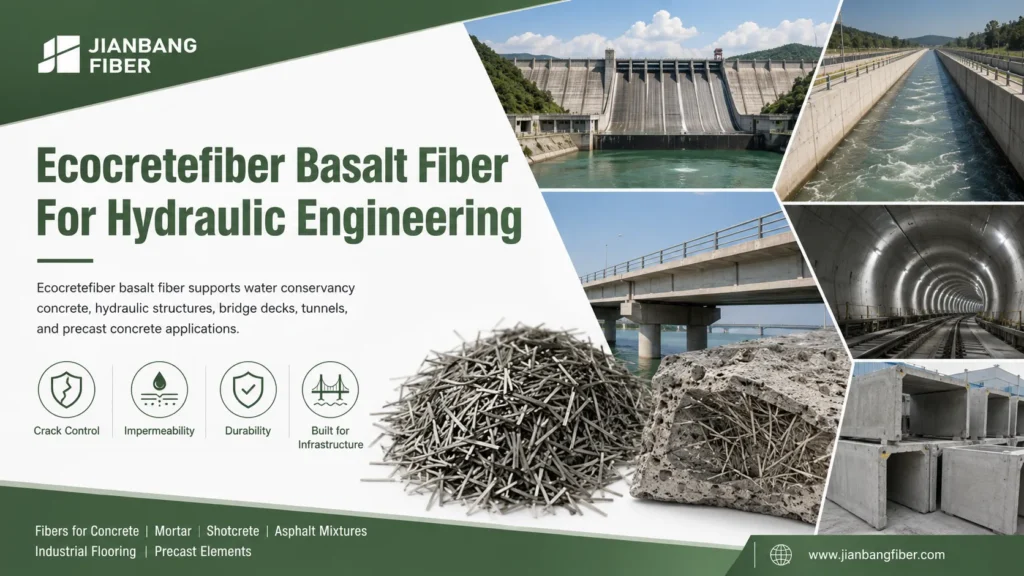
Ecocretefiber™. es la marca de fibra de hormigón de Shandong Jianbang Chemical Fiber Co. We supply basalt fiber and other reinforcement fiber solutions for water conservancy, road, bridge, tunnel, shotcrete, precast concrete, industrial floor, and infrastructure projects.
Our product direction includes basalt fiber, fibra de acero, fibra de polipropileno, macrofibra sintética, Fibra de PVA, Fibra PAN, y otras fibras para el refuerzo del hormigón.
For water conservancy applications, we focus on impermeability support, crack control, durability improvement, corrosion resistance, and long-term service performance.
We help customers choose fiber based on project environment, concrete grade, exposure condition, dosage range, and construction method. We also support packaging options, OEM service, distributor product planning, and technical communication.
Buyer Checklist Before Ordering Basalt Fiber For Water Conservancy Concrete
Before ordering basalt fiber, buyers should confirm several details.
| Pregunta | Por qué es importante |
|---|---|
| What is the hydraulic structure type? | Dams, channels, tunnels, culverts, and pumping stations need different solutions. |
| ¿Cuál es el principal objetivo de rendimiento? | Impermeability, crack control, seismic resistance, and durability require different design focus. |
| What exposure environment exists? | Water, sulfate, chloride, freeze-thaw, and chemicals affect fiber selection. |
| ¿Qué tipo de hormigón se utiliza? | La resistencia de la matriz influye en el rendimiento de la fibra. |
| ¿Qué longitud de fibra se necesita? | Length affects crack bridging and mixing. |
| ¿Qué rango de dosis se va a analizar? | La dosis influye en el rendimiento y la trabajabilidad. |
| Is structural rebar still required? | Fiber should not blindly replace rebar in load-bearing structures. |
| ¿Qué método de curado se utilizará? | Curing affects shrinkage, permeability, and durability. |
| Will impermeability testing be done? | Testing confirms whether the mix meets project requirements. |
Esta lista de comprobación ayuda a reducir los errores de selección y mejora la comunicación en el proyecto.
Conclusión
Basalt fiber has strong application potential in water conservancy engineering. It can support better impermeability, crack control, seismic resistance, durability, construction efficiency, and environmental value when it is used correctly.
Shandong Jianbang Fiber finds out that basalt fiber can help fill and bridge microcracks, improve concrete compactness, reduce seepage paths, and support longer service life. It can also improve concrete toughness and help structures resist dynamic and environmental stress.
But basalt fiber should be used as part of a complete engineering system. Mix design, dosage, fiber length, dispersion, water-binder ratio, compaction, curing, and structural design all matter. In high-load structural components, basalt fiber should work with rebar according to engineering requirements.
Shandong Jianbang Chemical Fiber Co., Ltd. supplies Ecocretefiber™ basalt fiber solutions for water conservancy concrete, hydraulic structures, channels, tunnels, dams, culverts, precast components, and repair materials. If your project needs better anti-seepage performance, better crack control, and longer concrete service life, Ecocretefiber™ can help you choose a suitable basalt fiber solution.