Why Fiber Classification Matters
纤维增强混凝土 is not one single material.
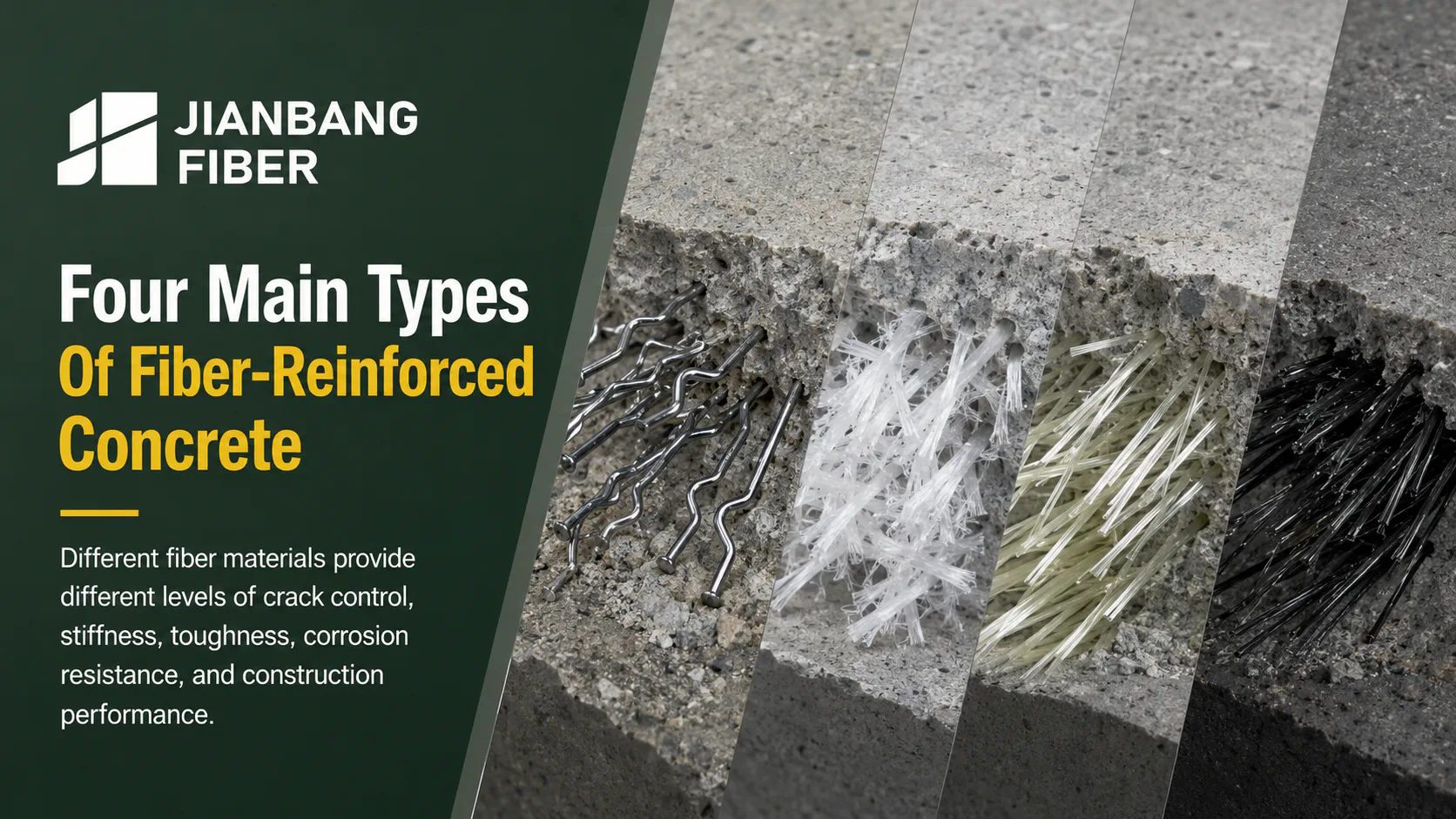
The term covers a large group of cement-based composites containing short or continuous fibers. Those fibers may be made from steel, polymers, glass, carbon, basalt, cellulose, PVA, or other materials.
Although the products are placed under the same general category, their behaviour can be completely different.
A steel fiber has a high elastic modulus and begins resisting crack opening relatively early. Polypropylene microfiber is much finer and more flexible. Its strongest value normally appears during the plastic stage, before concrete has developed enough tensile strength to resist rapid moisture loss.
AR glass fiber is frequently used in thin cement-based panels. Carbon fiber offers high tensile strength, low density, corrosion resistance, and potential electrical functionality, but its cost and dispersion requirements limit routine use.
Shandong Jianbang Fiber finds out that many purchasing errors begin with the phrase “We need fiber for concrete.” That description is too broad.
The buyer should first define the actual problem:
- Are cracks forming before the concrete hardens?
- Must the concrete carry load after cracking?
- 腐蚀是一个问题吗?
- Does the product need to remain thin and lightweight?
- Is impact or fatigue resistance important?
- Does the project require electrical conductivity or self-sensing behaviour?
Once the target is clear, the correct fiber category becomes easier to identify.
What Is Fiber-Reinforced Concrete?
Fiber-reinforced concrete, commonly abbreviated as FRC, contains discrete reinforcing fibers distributed through a cementitious matrix.
The matrix may be cement paste, mortar, conventional concrete, high-strength concrete, UHPC, shotcrete, or another specially proportioned cement-based material.
ACI identifies steel, glass, synthetic polymer, and natural fibers among the common reinforcement categories. The main improvements are normally related to cracking, residual strength, impact resistance, fatigue behaviour, or fire performance.
The fibers do not perform exactly like conventional reinforcing bars.
Rebar is positioned at designed locations and carries calculated structural forces. Short fibers are distributed throughout the mix. Their orientation is more random, although placement and flow can create preferred directions.
This distributed reinforcement is particularly useful for controlling local cracks that do not form only along one predetermined plane.
ASTM C1116 covers fiber-reinforced concrete delivered with the ingredients uniformly mixed. It does not, by itself, define the finished structural design or replace requirements for placing, curing, or protection.
How Fibers Change Concrete Behaviour
Ordinary concrete performs well under compression but has limited tensile capacity.
Small flaws already exist inside the cement matrix and around aggregate particles. Shrinkage, temperature change, bending, impact, settlement, and repeated loading can cause these flaws to grow.
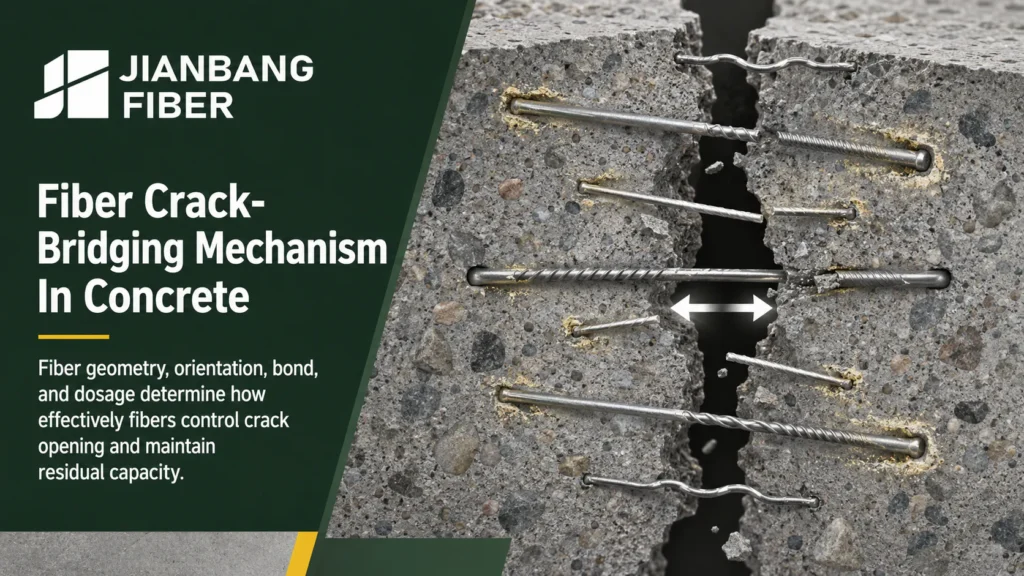
A fiber crossing a developing crack transfers stress between the two sides. The crack must then overcome the fiber–matrix bond, deform the fiber, pull it out, or break it.
Each process absorbs energy.
The result is not always a large increase in compressive strength. More often, the material develops:
- Narrower cracks
- 更分散的开裂
- Greater deformation before failure
- Higher residual strength
- Better impact resistance
- Greater energy absorption
- Improved integrity after cracking
Fiber effectiveness depends on several connected parameters.
Geometry determines how many fibers enter the concrete and how far each one can bridge a crack.
弹性模量 controls how quickly the fiber develops bridging stress.
拉伸强度 determines whether the fiber can survive crack opening.
Surface shape affects adhesion, friction, and mechanical anchorage.
Orientation decides how many fibers cross the critical crack plane.
Dosage influences network density, workability, and total cost.
The strongest individual fiber does not automatically produce the strongest fiber concrete. Poor dispersion or unfavourable orientation may prevent the fibers from reaching their potential.
1. Steel Fiber-Reinforced Concrete
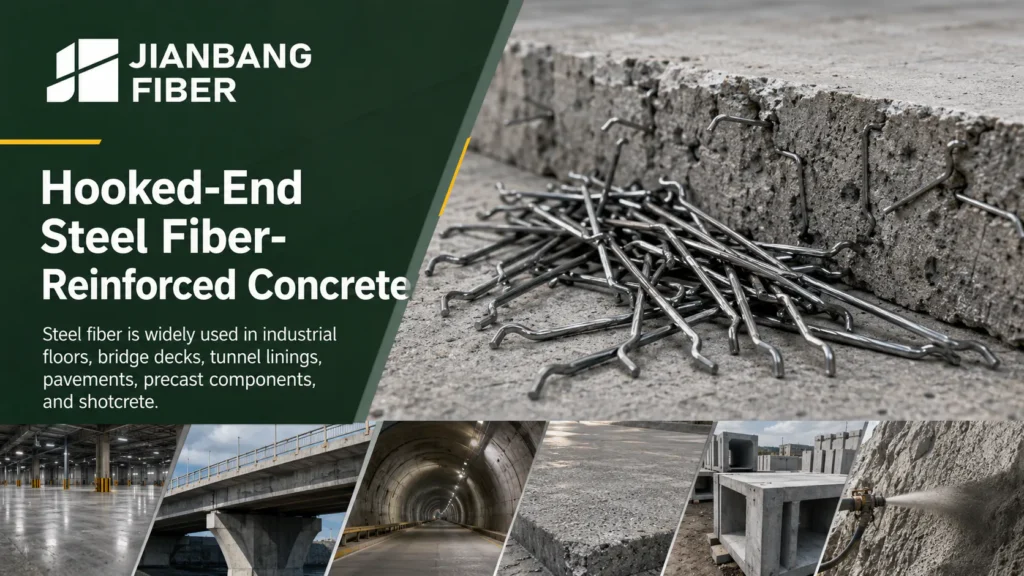
Steel fiber-reinforced concrete is produced by dispersing short steel fibers through mortar or concrete.
Steel has a high tensile strength and elastic modulus. These properties allow the fibers to resist crack opening with greater stiffness than most polymer fibers.
The early classification included straight cut wire fibers, sheet-cut fibers, melt-extracted fibers, and twisted or deformed forms. Modern products also include hooked-end fibers, glued fiber bundles, milled fibers, corrugated fibers, double-hooked fibers, and high-strength micro steel fibers.
How Steel Fiber Works
Before cracking, the concrete matrix carries most of the stress.
Once a crack begins to form, steel fibers crossing the crack plane transfer tensile force. A hooked end or deformed profile increases pull-out resistance. Instead of sliding freely from the matrix, the fiber must straighten, deform the surrounding paste, or overcome a stronger mechanical anchor.
This pull-out process creates toughness.
The concrete may retain useful capacity after the first crack instead of losing load suddenly. ASTM C1609 evaluates this behaviour through first-peak strength, residual strength at specified deflections, and specimen toughness.
Where Steel Fiber Is Used
Steel fiber is frequently selected for:
- Heavy-duty industrial floors
- Logistics and warehouse slabs
- Bridge decks
- Road and airport pavements
- Tunnel lining and shotcrete
- Precast tunnel segments
- Machine foundations
- Impact-resistant structures
- UHPC and RPC
- Structural repair materials
Different applications require different steel fiber geometries.
Long hooked fibers work well in conventional concrete with larger aggregate. Fine straight microfibers are more suitable for the dense, fine-grained matrix of UHPC. Calling one shape universally superior would ignore the role of the matrix and component geometry.
主要优势
Steel fiber provides strong crack-bridging stiffness and high residual strength. It also performs well under impact, repeated loading, and abrasion when the concrete system is properly designed.
For heavy floors and pavements, distributed steel fibers may simplify part of the conventional crack-control reinforcement. Any structural substitution must still follow engineering design and verified performance.
主要局限性
Steel fiber increases concrete density and may reduce workability.
Long fibers, high aspect ratios, or rapid feeding can produce fiber balls. Sharp ends may complicate handling and finishing. Exposed fibers can also develop rust staining in wet or chloride-rich environments.
The final selection should consider concrete thickness, aggregate size, mixer capacity, pumping, finishing, corrosion exposure, and required residual strength.
2. Carbon Fiber-Reinforced Concrete
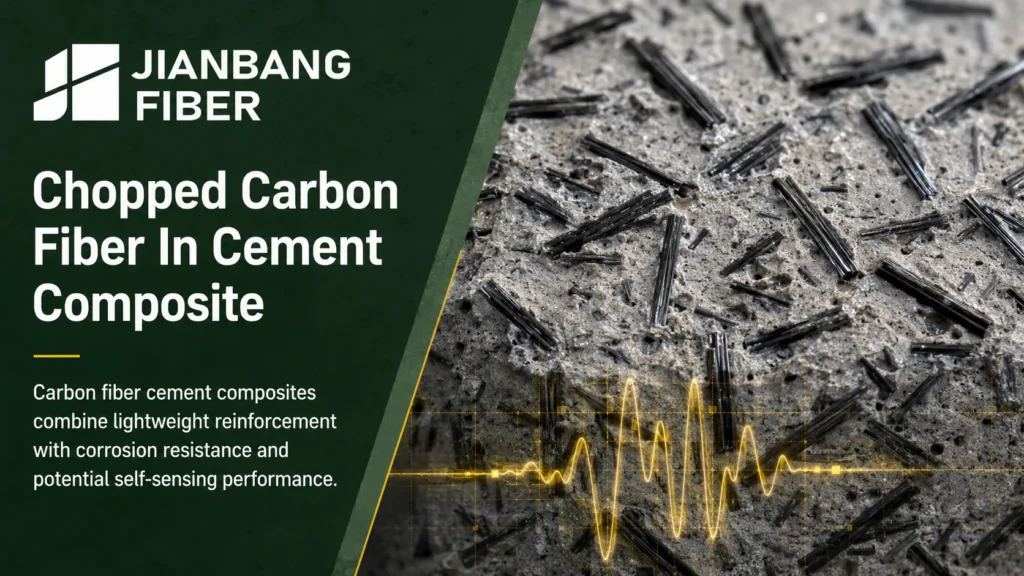
Carbon fiber-reinforced concrete may refer to several different systems.
This article focuses on short carbon fibers dispersed through cement paste or mortar. External CFRP sheets, carbon textile reinforcement, and carbon fiber bars belong to related but distinct reinforcement technologies.
Carbon fibers combine high tensile strength, low density, a low coefficient of thermal expansion, and resistance to ordinary steel corrosion.
Crack Control And Mechanical Performance
Short carbon fibers can restrain microcrack development and improve tensile or flexural behaviour. Their high stiffness helps them transfer stress across fine cracks.
However, the concrete response is highly sensitive to dispersion.
Carbon fibers attract one another and can form clusters. A clustered region contains more fiber than required, while the surrounding matrix receives little reinforcement. Workability also declines as the fiber content and total surface area increase.
Modern reviews consistently identify dispersion and fiber–matrix bonding as central challenges in carbon fiber cement composites.
Conductive And Smart Functions
Unlike most glass or polypropylene fibers, carbon fiber is electrically conductive.
When enough fibers form a connected network, changes in electrical resistance may reflect strain, cracking, moisture, or damage. This has led to research into self-sensing pavements, structural-health monitoring, electromagnetic shielding, and electrically heated cement composites.
These functions require a purpose-designed formulation and a defined test method. Adding carbon fiber does not automatically create a reliable sensor.
Where Carbon Fiber Concrete Is Used
Potential applications include:
- Smart cement-based sensors
- Self-monitoring structural components
- 电磁屏蔽
- Specialist repair mortars
- Lightweight precast components
- Conductive floors or heating elements
- High-value corrosion-sensitive systems
主要局限性
Cost remains much higher than common PP, glass, or many steel fibers.
Uniform dispersion may require surfactants, surface treatment, mineral additions, controlled mixing energy, or other process adjustments. Excessive fiber content can create agglomeration, reduce workability, introduce voids, and lower rather than improve mechanical performance.
Carbon fiber should not be presented as a simple universal replacement for steel reinforcement.
3. AR Glass Fiber-Reinforced Concrete
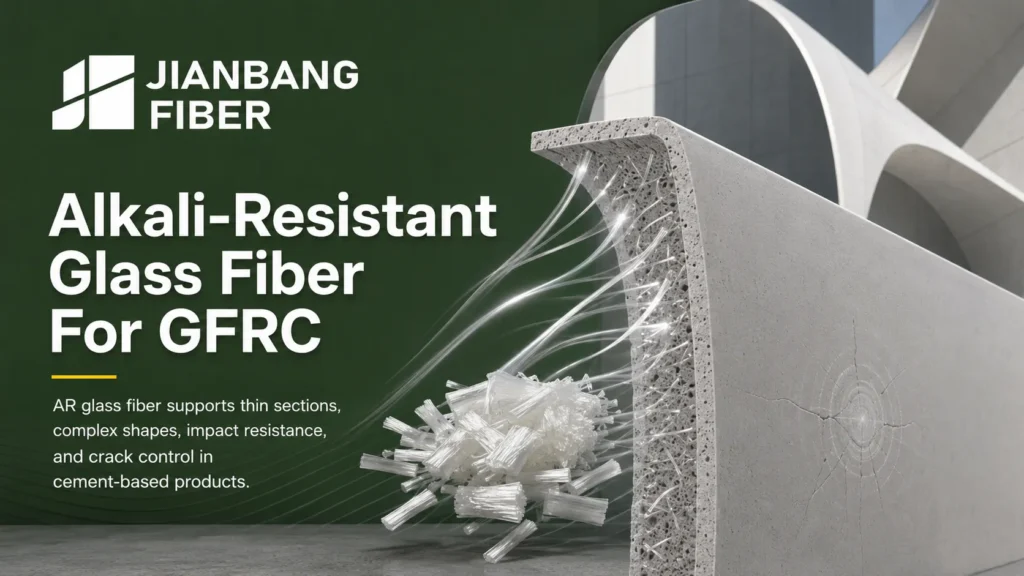
Glass fiber-reinforced concrete is usually associated with GFRC or GRC products.
These materials use fine cementitious matrices and alkali-resistant glass fibers to produce thin and relatively lightweight components.
Why Alkali Resistance Is Essential
Fresh and hardened cement paste has a highly alkaline internal environment.
Ordinary glass fiber may lose strength after long exposure to that environment. Construction products must therefore use glass designed for alkali resistance.
ASTM C1666/C1666M defines minimum requirements for AR 玻璃纤维 used in spray-up GFRC, premix GFRC, fiber-reinforced concrete, and other cementitious products.
The terms “glass fiber” and “AR glass fiber” should not be used interchangeably in cement applications.
How GFRC Is Made
Two main production directions are common.
Spray-up GFRC introduces chopped AR glass roving into a cementitious spray at the nozzle. The material is deposited in thin layers and consolidated into a mold.
Premix GFRC blends shorter AR glass fibers directly into the mortar before casting or spraying.
GFRC commonly uses cement, fine sand, water, polymer additives, admixtures, and AR glass fiber. Large coarse aggregate is generally absent, especially in thin architectural products.
主要优势
The fine fiber network supports thin sections and complex geometry.
Compared with conventional concrete panels, GFRC components can be lighter and easier to handle. Molded surfaces reproduce detailed textures, ribs, curves, and decorative patterns.
AR glass fibers help control fine cracks and increase flexural and impact performance. The material is widely used in:
- Architectural façade panels
- Decorative moldings
- Landscaping elements
- Lightweight cladding
- Thin cement boards
- 永久性模板
- Renovation components
- Complex precast shapes
主要局限性
Long-term performance depends on fiber quality, matrix chemistry, curing, polymer modification, water content, and environmental exposure.
Ordinary E-glass should not be substituted for AR glass simply because the initial appearance is similar.
Thick conventional structural members may also require another reinforcement system. GFRC is particularly valuable where thin sections, shape freedom, surface quality, and reduced weight are priorities.
4. Polypropylene Fiber-Reinforced Concrete
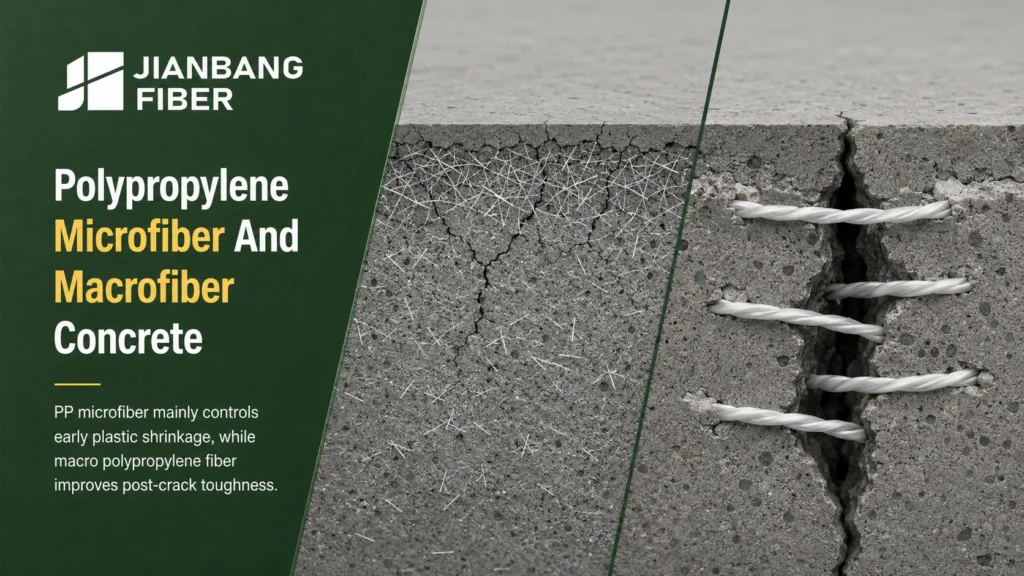
聚丙烯纤维 is among the most widely used synthetic fibers in cement-based materials.
PP has a low density, does not rust, and resists many acids and alkalis. Product forms include monofilament microfiber, fibrillated mesh fiber, twisted bundles, embossed macrofibers, and other engineered profiles.
The most important modern distinction is between 微纤维 和 macrofiber.
聚丙烯超细纤维
超细 PP 纤维 mainly works during the plastic and early-hardening stages.
Fresh concrete may lose surface water faster than bleeding can replace it. This creates capillary pressure and tensile stress before the concrete develops sufficient strength. Fine PP fibers form a dense network that restrains this movement and distributes early stress.
Research shows that PP fibers are effective in reducing plastic shrinkage cracking. Finer and longer fibers may provide better control within a tested system because they create more effective bridges across early cracks.
Micro PP fiber is commonly used in:
- Ground slabs
- Basement walls
- Precast panels
- Render and plaster
- Mortar
- Pavement
- Waterproof concrete
- Mass concrete
- Concrete exposed to rapid drying
Its main purpose is not high structural residual strength.
Macro Polypropylene Fiber
巨型 PP 纤维 is larger and has a stronger engineered profile.
It remains active after the matrix cracks and can provide measurable residual flexural capacity. Embossed, twisted, roughened, or fibrillated surfaces improve anchorage.
常见的应用包括
- 地面板
- Industrial floors
- 人行道
- Tunnel shotcrete
- 预制混凝土
- Bridge-related concrete
- Mining support
- Marine and wet structures
Macro synthetic fiber is lightweight and corrosion-free. Handling is easier than steel, and exposed ends do not produce rust stains.
Its elastic modulus is lower than steel. The fiber may permit more crack opening before developing an equivalent bridging force. Steel and macro PP therefore cannot be exchanged by equal mass.
Main Construction Considerations
PP fibers can reduce slump and increase internal friction.
Microfibers have a large surface area, while long macrofibers may wrap around one another if they are added too quickly. Controlled feeding, suitable paste volume, compatible water reducer, and adequate mixing time are essential.
Extra water should not be used as the automatic solution to lower workability.
Comparison Of The Four Fiber Types
| 纤维类型 | 主要优势 | Primary Performance Role | Typical Applications | Main Limitation |
|---|---|---|---|---|
| 钢纤维 | High modulus and strong anchorage | Residual strength, toughness, impact and fatigue resistance | Floors, pavements, tunnels, shotcrete, precast, UHPC | Weight, mixing difficulty, possible corrosion |
| Carbon fiber | High strength, low weight and conductivity | Fine crack control, specialist reinforcement and smart functions | Sensors, conductive composites, high-value repair materials | Cost and dispersion |
| AR 玻璃纤维 | Fine mineral reinforcement with alkali resistance | Thin-section flexural support and crack distribution | GFRC façades, decorative panels and cement boards | Requires verified alkali resistance |
| PP microfiber | Fine, lightweight network | Plastic shrinkage and early microcrack control | Slabs, walls, mortar, plaster and precast | Limited structural residual strength |
| 巨型 PP 纤维 | Corrosion-free macro reinforcement | Post-crack toughness and residual capacity | Floors, shotcrete, pavements and wet environments | Lower modulus than steel |
如何选择合适的纤维
1. Start With The Crack Stage
Plastic shrinkage occurs before hardening. PP microfiber is normally the most direct solution.
Load-related cracks develop after the matrix has hardened. 钢纤维或大型合成纤维 provides stronger post-crack reinforcement.
Fine cracks in thin architectural cement products may be better controlled with AR glass fiber.
2. Define The Required Residual Performance
A specification should state the required post-crack capacity or toughness rather than only naming a fiber and dosage.
ASTM C1609 provides a recognized method for measuring flexural response and residual strength in fiber-reinforced concrete.
3. Consider The Environment
Steel works well when high stiffness is required, but corrosion exposure and surface staining deserve attention.
Macro polypropylene does not rust and is useful in wet or chemically aggressive areas.
AR glass is designed for alkaline cement matrices.
Carbon fiber offers corrosion resistance but may not be economical for large-volume general concrete.
4. Match Fiber Size To The Concrete
Long fibers may not pass through narrow pumps, dense reinforcement, small precast sections, or thin repair layers.
Fine micro steel fibers suit UHPC. Longer hooked-end fibers suit thicker conventional concrete. AR glass fibers match fine GFRC matrices. PP fiber geometry should reflect whether the target is plastic shrinkage or post-crack capacity.
5. Complete A Trial Mix
Laboratory and production trials should check:
- Fiber dispersion
- Slump or flow
- 可泵送性
- Air content
- Finishing quality
- Early cracking
- Flexural response
- 残余强度
- Durability requirements
- Total installed cost
Common Fiber-Concrete Selection Mistakes
- Ordering only by fiber material
“Steel fiber” or “PP fiber” does not define geometry, strength, dosage, or application. - Assuming every fiber increases compressive strength
Many fibers provide their greatest value through crack control and post-crack behaviour. - Replacing fibers by equal kilograms
Different densities and elastic moduli make direct mass substitution unreliable. - Using ordinary glass fiber in cement
Cement-based applications require verified alkali-resistant glass fiber. - Selecting carbon fiber without a dispersion plan
Agglomeration can erase the expected mechanical and conductive benefits. - Adding water to recover lost workability
Uncontrolled water may reduce strength, durability, and bond. - Ignoring the fiber–matrix interface
Tensile strength alone cannot predict pull-out and crack-bridging performance. - Using supplier dosage as the final structural design
Dosage recommendations are starting points. Project performance must be tested. - Evaluating only uncracked strength
Residual strength and energy absorption reveal what happens after cracking. - Assuming fiber replaces every reinforcing bar
Primary structural reinforcement remains necessary where the design and code require it.
为什么选择 Ecocretefiber™
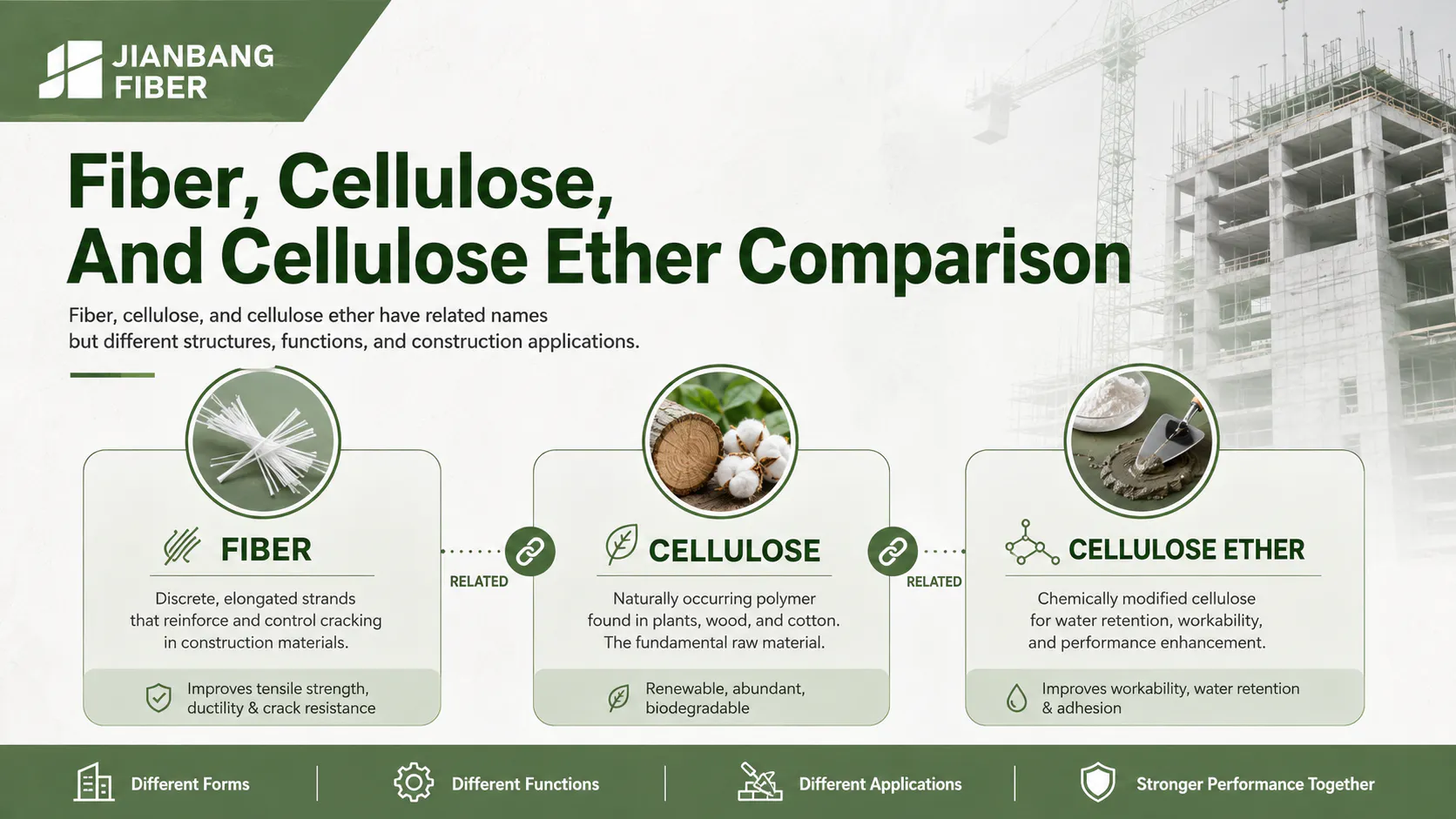
Ecocretefiber™ 生态岩浆纤维 is the concrete-fiber brand of 山东建邦化纤有限公司.
The current product range covers polypropylene fibers, macro synthetic fibers, steel fibers, AR glass fiber, basalt fiber, carbon fiber, PVA fiber, PAN fiber, cellulose fiber, and other specialist materials.
This broad portfolio allows the fiber to be matched to the project rather than forcing one product into every application.
A warehouse floor may require hooked-end steel fiber or macro synthetic fiber. GFRC façade production needs AR glass fiber. Plastic shrinkage in a thin slab calls for PP microfiber. UHPC requires high-strength micro steel fiber. Carbon fiber belongs in selected high-value or functional cement composites.
Shandong Jianbang Fiber finds out that the most useful supplier discussion begins with the project conditions:
- Application and component type
- Concrete or mortar grade
- Aggregate size
- Placement and mixing equipment
- Crack-control target
- Residual-strength requirement
- Exposure environment
- 表面处理
- Fiber dosage range
- Required testing standard
Ecocretefiber™ supports contractors, distributors, ready-mix plants, precast producers, tunnel companies, road builders, and infrastructure buyers with product selection, packaging, trial orders, OEM service, and technical communication.
买家检查清单
| 问题 | 为何重要 |
|---|---|
| Which crack stage must be controlled? | Early plastic cracks and post-hardening cracks need different fibers. |
| Is residual strength required? | This determines whether a macro reinforcement fiber is needed. |
| What is the component thickness? | Thin and thick sections require different fiber dimensions. |
| 使用的是哪种骨料粒径? | Large fibers must remain compatible with the matrix. |
| 腐蚀是一个问题吗? | Non-metallic fiber may offer an advantage. |
| Is the application GFRC? | Verified AR glass fiber is essential. |
| Is electrical functionality required? | Carbon fiber may be considered. |
| 有哪些混音设备可供选择? | Dispersion quality depends on feeding and mixing energy. |
| Which performance test will be used? | Concrete performance should be verified after cracking. |
| Is a trial batch planned? | Trials reduce material and construction risk. |
结论
Fiber-reinforced concrete is a family of materials rather than one standard product.
Steel fiber provides high stiffness, strong crack bridging, and reliable post-crack capacity for heavy-duty concrete.
Carbon fiber combines lightweight reinforcement, corrosion resistance, and electrical functionality, but requires careful dispersion and a clear economic reason.
AR glass fiber supports thin, lightweight, and complex GFRC components. Its resistance to the alkaline cement environment must be verified.
Polypropylene fibers serve two separate roles. Microfiber controls early plastic shrinkage, while macrofiber provides corrosion-free post-crack reinforcement.
The correct choice begins with the problem—not the fiber name.
Concrete type, crack stage, required residual capacity, exposure environment, placement method, workability, testing standard, and total cost must all be considered.
山东建邦化纤有限公司. 供应品 Ecocretefiber™ 生态岩浆纤维 fiber solutions for floors, roads, bridges, tunnels, shotcrete, precast concrete, GFRC, repair mortar, UHPC, and other cement-based materials.
A correctly selected fiber will not simply make concrete “stronger.” It will give the concrete the specific crack-control, toughness, durability, or functional performance required by the project.