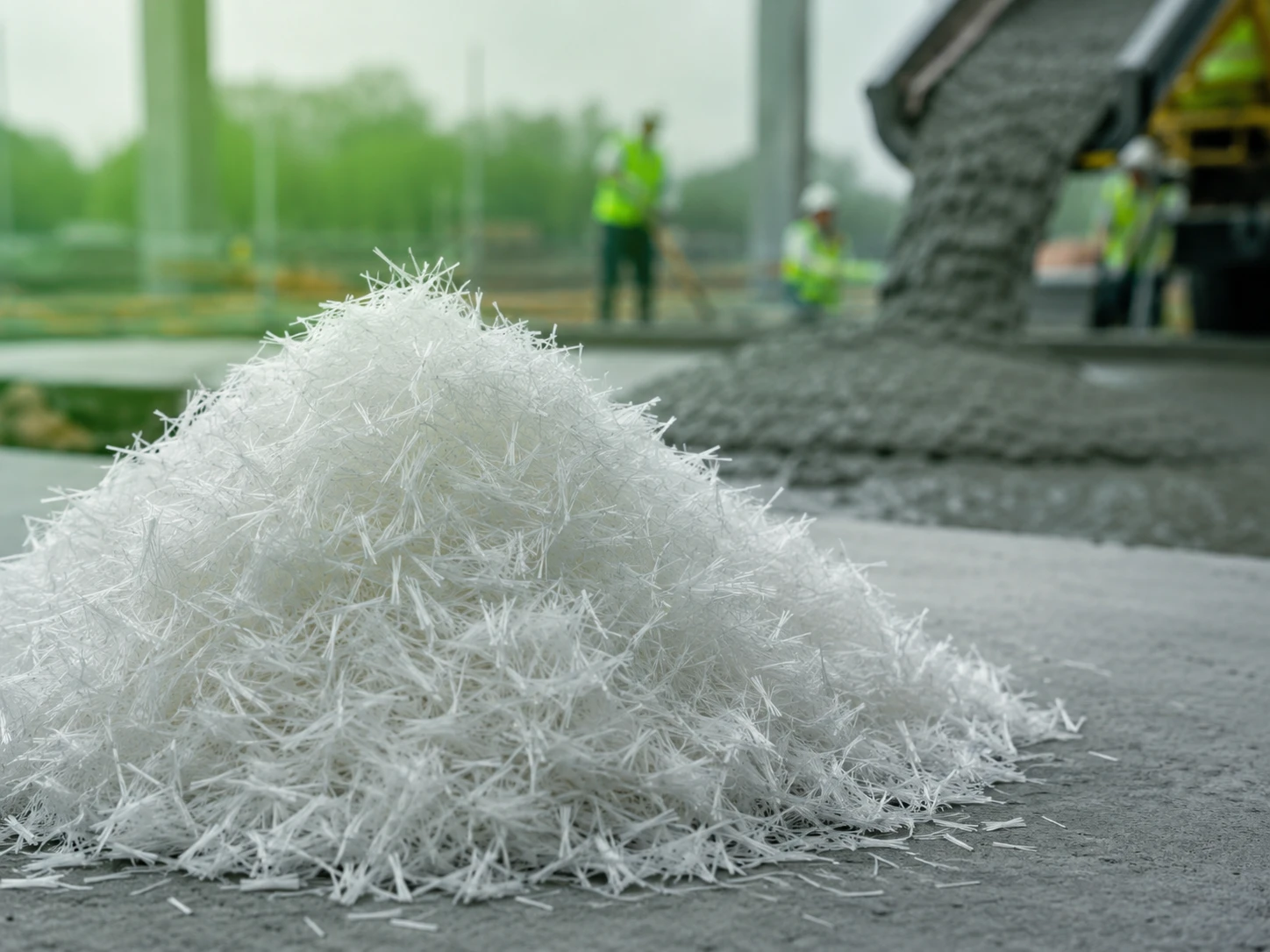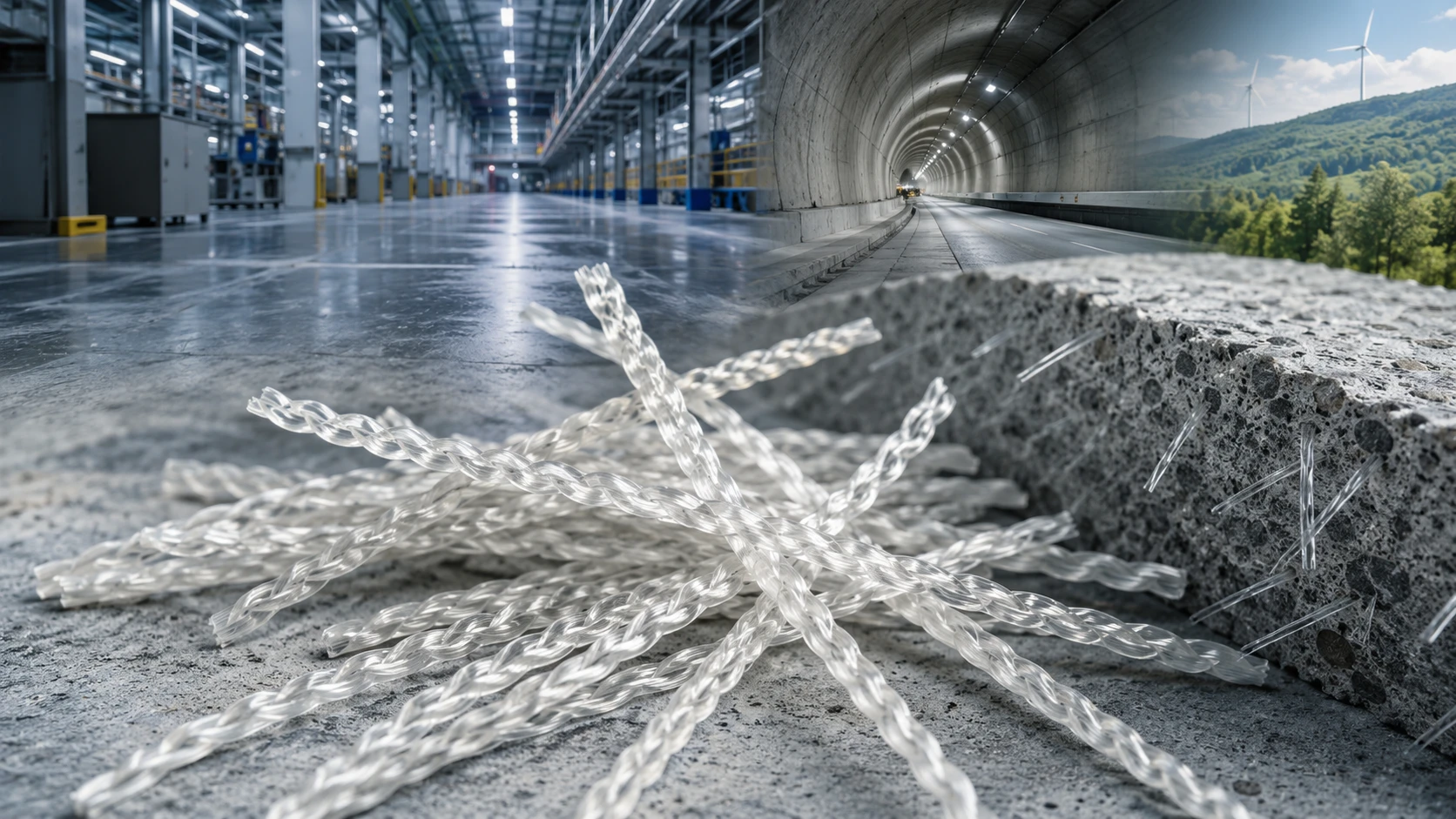
Mikro Kunstfaser is the most widely used fiber type in concrete worldwide. It appears in residential driveways, commercial sidewalks, shotcrete, stucco, and repair mortar. For distributors, this product offers a low-cost entry point into the concrete fiber market with a broad customer base and straightforward specifications.
This guide covers what distributors need to know about Mikro-Kunstfaser for concrete. You will learn how it works, which micro synthetic fiber applications drive demand, how to choose between monofilament and fibrillated types, what certifications your market requires, and how to position this product alongside macro fiber and other reinforcement products.
What micro synthetic fiber does inside concrete
Plastic shrinkage cracking: the problem
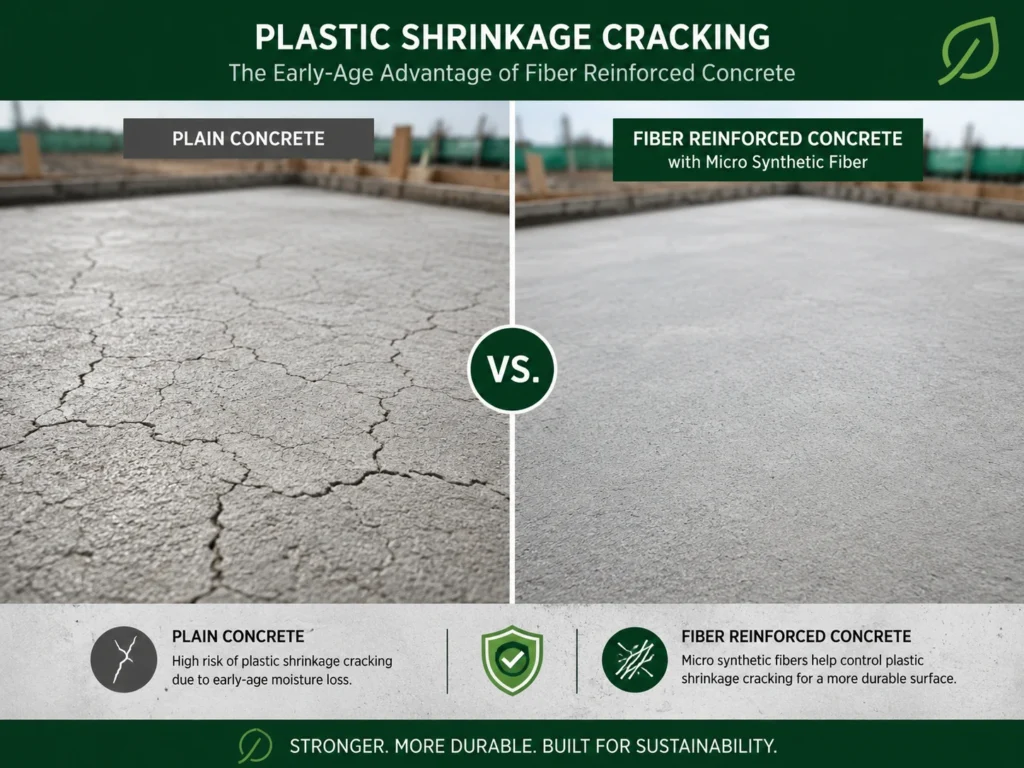
Concrete shrinks as it dries. In the first few hours after placement, before the cement has set, rapid moisture loss creates internal tensile stresses. When these stresses exceed the strength of the fresh concrete, cracks form. These are called Kunststoff-Schrumpfungsrisse.
Plastic shrinkage cracks typically appear within 2 to 6 hours after pouring. Hot weather, low humidity, and wind all increase the risk. The cracks may look minor at first, but they become pathways for water, de-icing salts, and other corrosive agents. Over time, these entry points accelerate steel reinforcement corrosion and reduce concrete durability.
Traditional methods to prevent plastic shrinkage cracking include wind breaks, fog spraying, and curing compounds. These methods help, but they do not address the root cause inside the concrete itself.
How the 3D fiber network works
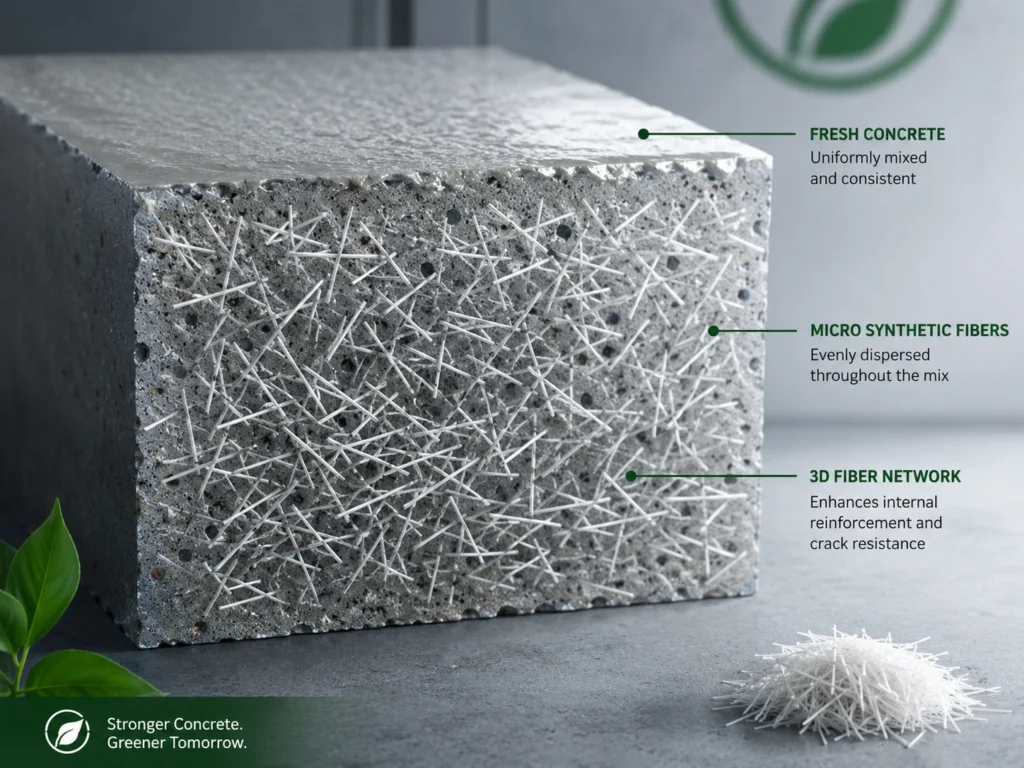
Micro synthetic fiber provides a different approach. When mixed into concrete, millions of individual fibers disperse throughout the matrix. Each fiber acts as a tiny reinforcement point that holds the cement paste together during the critical early hours.
The fibers create a three-dimensional network that distributes internal stresses. Instead of stress concentrating at a single point and causing a crack, the fiber network spreads the stress across a larger area. This prevents most plastic shrinkage cracks from forming in the first place.
Studies have shown that properly dosed micro synthetic fiber can reduce plastic shrinkage cracking area by up to 80% compared to plain concrete. For micro synthetic fiber, shrinkage cracking reduction is the primary performance metric. This is not a marginal improvement. Micro synthetic fiber shrinkage cracking control reduces crack area by up to 80% compared to plain concrete. It is a significant reduction that directly affects concrete durability.
What micro synthetic fiber does NOT do
Micro fiber controls plastic shrinkage cracking. That is its job, and it does it well. But it has clear limits:
- It does not provide Rissbewehrung. Once a crack has formed and the concrete has hardened, micro fiber cannot hold the crack faces together. That is what macro synthetic fiber does.
- It does not replace structural steel reinforcement. Rebar, mesh, and structural fibers serve different purposes.
- It does not increase load-bearing capacity. Micro fiber does not make concrete stronger in compression or flexure.
Distributors who understand these limits can advise customers correctly and avoid specification errors. For customers who need post-crack reinforcement, direct them to macro synthetic fiber products instead.
Monofilament vs fibrilliert: two types distributors must know
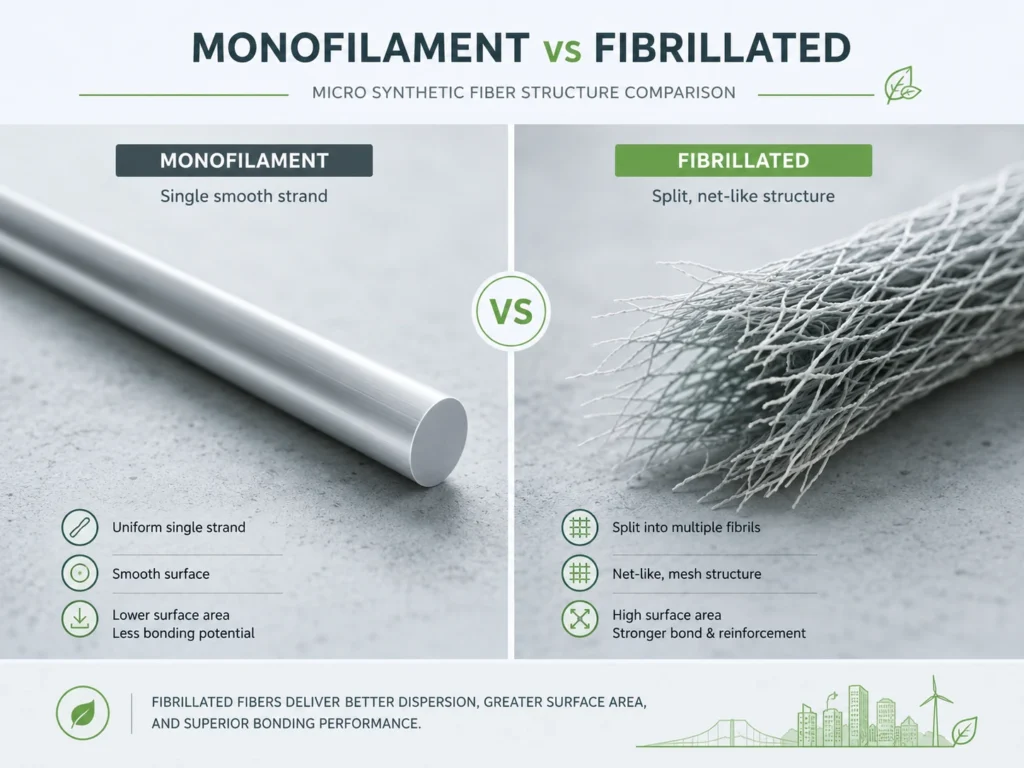
Micro synthetic fiber comes in two forms: monofilament and fibrillated. When evaluating micro synthetic fiber, monofilament and fibrillated are the two categories that matter. Understanding micro synthetic fiber monofilament fibrillated differences helps you recommend the right product. Each type performs differently in concrete and suits different applications. Distributors who understand the difference can recommend the right product to each customer.
Monofilament micro fiber
Monofilament fibers are individual single-strand filaments. Think of them as very thin fishing line cut into short lengths. Each fiber stands alone in the concrete mix.
Monofilament fibers disperse quickly and evenly. Because they are individual strands, they do not clump together during mixing. This makes them a good choice for applications where surface finish quality matters.
Common specifications:
- Length: 6–19 mm
- Diameter: 18–30 microns (very fine)
- Material: 100% virgin polypropylene
Monofilament micro fiber is preferred for architectural concrete, decorative flatwork, and shotcrete. In these applications, the fiber must not create visible strands on the finished surface. The fine individual filaments melt or become invisible under normal trowel finishing.
Fibrillated micro fiber
Fibrillated fibers start as a bundled group of fibers connected in a net-like structure. During mixing, the bundles open up into individual strands. The opening action creates a larger surface area in contact with the cement paste.
This greater surface area gives fibrillated fiber a stronger mechanical bond with the concrete matrix. The trade-off is that fibrillated fiber takes slightly longer to disperse fully compared to monofilament.
Common specifications:
- Length: 12–19 mm
- Form: Fibrillated mesh that opens during mixing
- Material: 100% virgin polypropylene
Fibrillated micro fiber is preferred for general-purpose slabs, pavements, precast elements, and any application where maximum crack control is the priority and surface appearance is less critical.
Which type to stock
Most distributors carry both types. But if you need to start with one, choose fibrillated. It covers a wider range of applications as a general-purpose product. The larger surface area contact with cement paste provides slightly better shrinkage crack control in most mix designs.
Stock monofilament when your customers include decorative concrete contractors, architectural precast producers, or pool builders. These customers need the invisible finish that monofilament provides.
Dosage differs slightly between the two types. Always follow the manufacturer’s recommended dosage, as fibrillated fiber may require a different rate than monofilament for the same application.
Applications that drive micro synthetic fiber demand
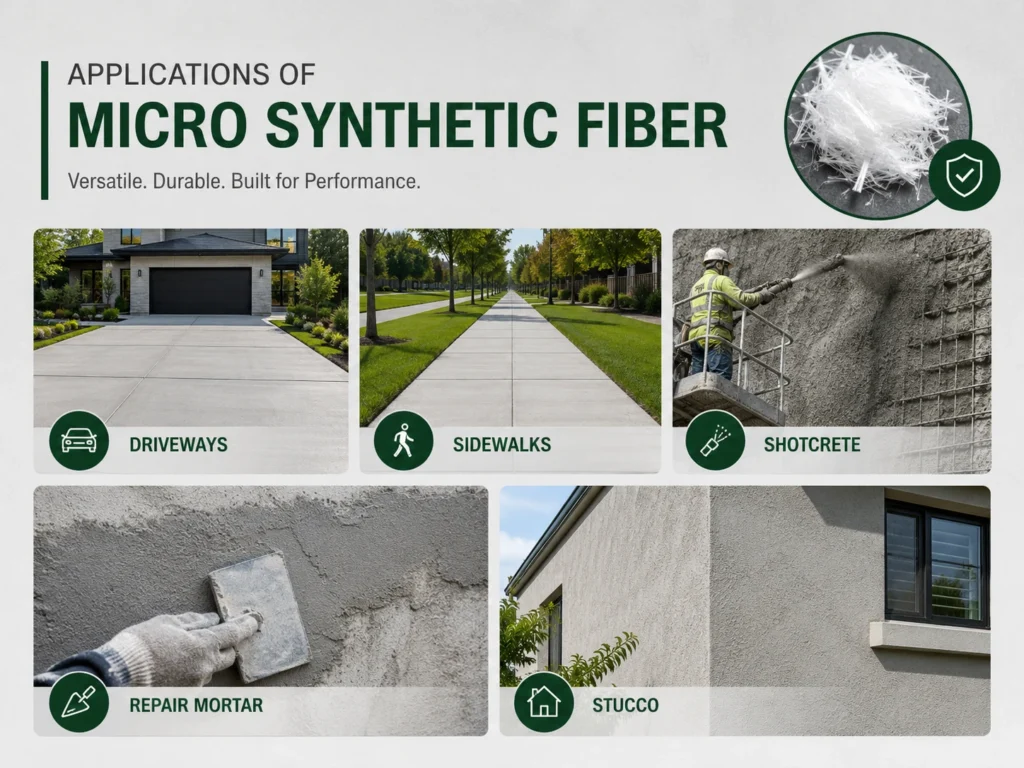
Understanding which applications use micro synthetic fiber helps distributors target the right customers and anticipate order patterns.
Residential slabs and driveways
Residential work is the largest volume segment for micro synthetic fiber. Home builders and residential contractors add it to garage floors, driveway slabs, patios, and basement floors. In many markets, micro fiber has replaced the old practice of placing wire mesh in residential slabs.
The concept is simple. Instead of paying laborers to place and tie wire mesh, the contractor adds a small bag of fiber to the concrete truck. The fiber mixes in within minutes. No wire handling. No mesh placement. No risk of mesh ending up at the bottom of the slab instead of the middle.
Dosage is typically 0.6–0.9 kg/m³, which keeps the cost per pour low. For distributors, residential contractors buy in small quantities but order frequently throughout the construction season.
Commercial flatwork
Commercial sidewalks, plazas, parking lots, and light-duty industrial floors use micro synthetic fiber as standard crack control. Many specifiers include micro fiber in their concrete specifications as a default, not as an optional extra.
Commercial flatwork typically requires a slightly higher dosage than residential work: 0.9–1.2 kg/m³. The volume per project is larger than residential, but the customer base is narrower. Commercial concrete contractors and ready-mix suppliers are the primary buyers.
Shotcrete and gunite
Micro synthetic fiber reduces rebound and controls shrinkage in sprayed concrete. In the shotcrete process, dry or wet mix is sprayed at high velocity onto a surface. Rebound (material that bounces off instead of sticking) wastes material and money. Micro fiber helps hold the fresh shotcrete together, reducing rebound.
Swimming pool contractors are a niche but reliable customer base for micro fiber in shotcrete. Pool construction uses gunite (dry-mix shotcrete) or shotcrete (wet-mix), and both processes benefit from fiber reinforcement.
Micro fiber in shotcrete typically dosed at 0.6–1.0 kg/m³. It is compatible with both wet-mix and dry-mix processes, though the mixing procedure differs between the two.
Overlay and repair mortar
Thin-bonded overlays and patching mortars use micro synthetic fiber for crack control in thin sections. When a concrete surface needs resurfacing, the overlay is typically 25–75 mm thick. In these thin sections, shrinkage cracking is a significant risk because the large surface-to-volume ratio accelerates moisture loss.
Micro fiber helps the overlay bond to the existing substrate without developing shrinkage cracks that would compromise the repair. Dosage is typically 0.5–0.9 kg/m³ for overlay applications.
For data on how polypropylene fiber performs in concrete under various conditions, see our article on the effect of polypropylene fiber in concrete.
Stucco and rendering
Exterior wall finishes use micro synthetic fiber to prevent hairline cracking. Stucco and rendering are applied in thin layers that are highly susceptible to plastic shrinkage cracking, especially in hot and dry climates.
The Middle East and North Africa are growing markets for fiber-reinforced stucco. Rapid moisture loss in desert climates makes plastic shrinkage cracking almost inevitable without fiber reinforcement. Micro fiber at very low dosages (0.3–0.6 kg/m³) significantly reduces this risk.
For distributors in these regions, stucco applicators represent a customer segment that buys consistently but at lower volumes per order.
Micro vs macro synthetic fiber: a distributor’s decision framework
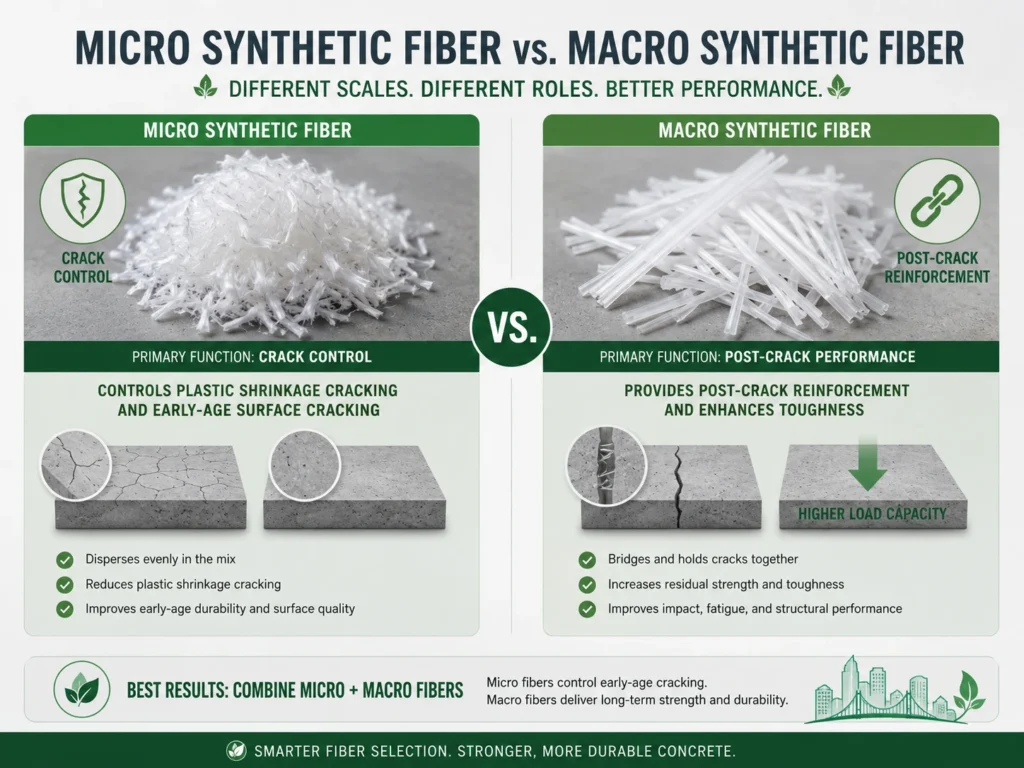
One of the most common questions distributors get from customers is: “Should I use micro fiber or macro fiber?” The micro synthetic fiber vs macro synthetic fiber comparison comes down to what the concrete needs to do. These two fiber types serve different purposes, and confusing them can lead to specification errors.
The 0.3mm line
The boundary between micro and macro synthetic fiber is diameter. Any synthetic fiber with a diameter below 0.3 mm is classified as micro. Anything at or above 0.3 mm is macro. This is not arbitrary. The diameter determines what the fiber can do inside concrete.
Mikro-Kunstfaser controls plastic shrinkage cracking in fresh concrete before it sets. It works in the first few hours after placement. Its job is prevention: stop cracks from forming in the first place.
Makro-Kunstfaser provides post-crack reinforcement in hardened concrete. It works after the concrete has set and cracks have formed. Its job is performance: hold cracked concrete together and maintain residual strength.
When customers need micro fiber only
- Residential slabs and driveways where crack control is the only requirement
- Stucco and rendering where only plastic shrinkage control is needed
- Overlay and repair mortar where post-crack performance is handled by the existing substrate
- Any application where the specification explicitly calls for plastic shrinkage crack control only
When customers need macro fiber only
- Industrial floor slabs where post-crack performance is required
- Composite metal deck slabs per SDI standards
- Shotcrete for tunnel linings and mining (structural applications)
- Any application where the specification includes a residual strength requirement
When both are specified together
Some projects use both micro and macro fiber in a hybrid approach. The micro fiber controls plastic shrinkage during the first few hours. The macro fiber provides post-crack reinforcement after the concrete hardens. This combination addresses both phases of concrete performance.
Hybrid fiber blends that combine micro and macro fiber in a single bag are a growing product category. Distributors who carry these blends can offer a one-product solution for specifiers who want both types of crack control.
Common specification mistakes
The most dangerous mistake is using micro fiber when the project requires post-crack reinforcement. Micro fiber cannot provide structural performance. If a specification calls for residual strength values (tested by ASTM C1609 or EN 14651), micro fiber alone will not meet those requirements.
This mistake creates liability. Distributors should always confirm whether the customer needs plastic shrinkage control (micro) or post-crack reinforcement (macro) before selling a product. For a deeper explanation of the structural alternative, see our article on what macro synthetic fiber is. And for guidance on sourcing macro fiber products, see our guide on choosing a macro PP fiber manufacturer.
Specification and certification essentials
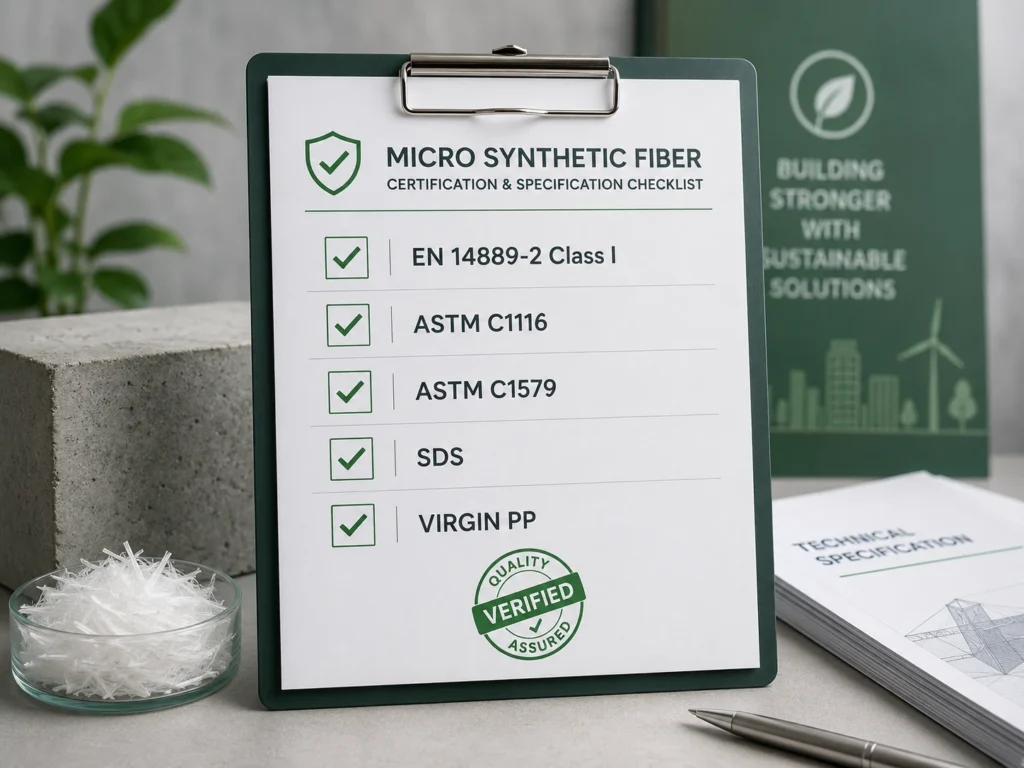
Certification requirements for micro synthetic fiber are less demanding than for macro fiber, but they still matter. Selling non-compliant product can result in project rejection and damaged customer relationships.
EN 14889-2 Class I: the standard for EU, UK, and Middle East markets
EN 14889-2 Class I covers non-structural polymer fibers. This is the classification for micro synthetic fiber. It certifies that the fiber is suitable for controlling plastic shrinkage cracking but does not provide structural reinforcement.
CE marking is required for micro synthetic fiber sold in the European Economic Area. The certification process uses System 3, which is less rigorous than the System 1 required for macro fiber (Class II). System 3 involves initial type testing by a notified body but does not require ongoing factory audits.
Distributors selling into EU, UK, or Middle East markets should request micro synthetic fiber EN 14889-2 Class I compliance documentation from their suppliers. Middle East projects increasingly reference EN 14889-2 as standard practice.
ASTM C1116: the standard for North American markets
ASTM C1116 covers fiber-reinforced concrete in general. Micro synthetic fiber complies with the Type III (synthetic fiber) classification under this standard.
For projects specifically focused on plastic shrinkage crack control, ASTM C1579 is the more targeted standard. It covers fiber-reinforced concrete for controlling plastic shrinkage and is sometimes referenced alongside ASTM C1116 in project specifications.
Distributors in North America should ensure that their suppliers provide compliance documentation for both ASTM C1116 and ASTM C1579, as specifiers may reference either standard.
What documentation distributors must verify
Before sourcing micro synthetic fiber from any manufacturer, request the following:
- Certificate of compliance with EN 14889-2 Class I or ASTM C1116 (or both, depending on your market)
- Material safety data sheet (MSDS/SDS) — required for all construction products
- Independent test data for shrinkage crack reduction performance. ASTM C1579 ring test results are the standard evidence.
- Raw material certification confirming 100% virgin polypropylene
For broader specification guidance on polypropylene fiber products, see our article on polypropylene fiber for concrete.
Dosage guidance distributors can share with customers
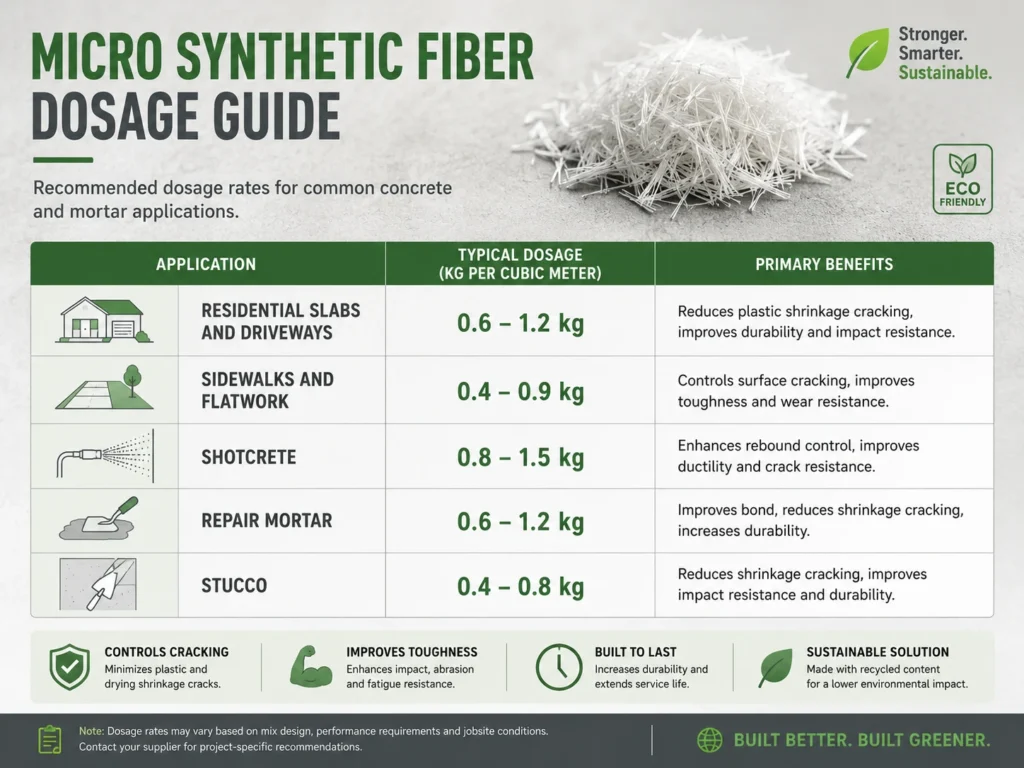
Correct micro synthetic fiber dosage is critical. Too little fiber provides minimal benefit. Too much can cause workability problems and surface blemishes. Distributors who can provide clear dosage guidance add value that differentiates them from suppliers who just sell product by the bag.
Typical dosage ranges by application
| Anmeldung | Dosage Range (kg/m³) | Anmerkungen |
|---|---|---|
| Residential slabs and driveways | 0.6–0.9 | Standard crack control for light-duty slabs |
| Commercial flatwork | 0.9–1.2 | Higher dosage for heavier traffic and larger areas |
| Spritzbeton | 0.6–1.0 | Adjust based on mix design and spray method |
| Stucco and rendering | 0.3–0.6 | Very low dosage due to thin sections |
| Overlay and repair mortar | 0.5–0.9 | Depends on overlay thickness and substrate condition |
How dosage affects cost per cubic meter
Micro synthetic fiber is the lowest-cost fiber reinforcement option available. At a typical dosage of 0.9 kg/m³, the fiber cost represents roughly 1–3% of the total concrete cost per cubic meter. This makes it an easy sell to cost-conscious customers.
A practical way to frame the value: for a small fraction of the total concrete cost, the customer gets up to 80% reduction in plastic shrinkage cracking. Most contractors see the return on the first project where they avoid a callback for crack repair.
Common mistakes in fiber dosing
Underdosing below 0.5 kg/m³ provides minimal crack reduction. Some contractors try to save money by using half the recommended dosage. The result is a concrete surface that looks no different from unreinforced concrete.
Overdosing above 1.5 kg/m³ can cause workability problems. The concrete becomes stiff and difficult to place. Surface blemishes (visible fiber strands) become more likely at high dosages.
Not adjusting for fiber type. Monofilament and fibrillated fiber have different optimal dosage ranges. Using the same dosage for both types can lead to either underperformance or workability issues.
Adding fiber too late in the mixing cycle. Fiber should go in with the aggregates or early in the batch. Adding it after the concrete is already mixed reduces dispersion quality and can create clumps.
Quality evaluation criteria for sourcing
Quality varies among micro synthetic fiber manufacturers. The differences are not always visible in the finished product, but they show up in concrete performance.
Material verification
The fiber must be 100% virgin polypropylene. Some manufacturers use recycled or reprocessed material to lower costs. Recycled polypropylene has inconsistent mechanical properties and may contain contaminants that affect concrete performance.
Ask the manufacturer for raw material certification. Reliable suppliers provide documentation that traces the polypropylene resin back to its source.
Dispersion testing
Good micro fiber disperses evenly within 3–5 minutes of mixing at normal speed. Poor dispersion creates fiber clumps (called “fiber balls”) in the concrete. These clumps are visible on the finished surface and create weak spots in the concrete matrix.
Request dispersion test results from the manufacturer. Better yet, order a sample quantity and run your own test. Mix the fiber into a standard concrete batch at the recommended dosage and observe how quickly and evenly it disperses.
Rote Fahnen bei der Bewertung eines Herstellers
Achten Sie auf diese Warnzeichen:
- No independent test reports for shrinkage crack reduction. If a manufacturer only provides in-house data, that is not sufficient.
- Cannot produce EN 14889-2 or ASTM C1116 compliance documentation. Without these, the product cannot be specified on regulated projects.
- Claims that micro fiber “replaces steel reinforcement.” This is false. Micro fiber controls plastic shrinkage cracking only. It does not provide structural reinforcement. Manufacturers who make this claim either do not understand their own product or are being dishonest. Either way, this is a liability risk.
- Price significantly below market average. Unusually low pricing often indicates recycled material, inconsistent production, or both.
- No SDS/MSDS available. Safety documentation is a basic requirement. If a manufacturer cannot provide it, look elsewhere.
Positioning micro synthetic fiber in your product line
Adding micro synthetic fiber to your product catalog is one of the simplest ways to enter the concrete fiber market. The product is inexpensive, the specifications are straightforward, and the customer base is broad.
The easy entry point for new distributors
Micro fiber has several advantages as a first fiber product:
- Lower unit cost than macro or steel fiber. A small inventory investment covers a significant number of projects.
- Simpler specifications. There is no need to discuss residual strength values or structural design. The product controls plastic shrinkage cracking. That is the entire story.
- Faster sales cycle. Customers do not need structural engineering approval to specify micro fiber. A contractor can decide to use it on the spot.
Cross-sell opportunities with macro fiber
Customers who buy micro fiber for one project often need macro fiber for another. Distributors who carry both products can serve a wider range of project specifications.
Hybrid fiber blends (micro + macro in one bag) are a growing product category. These blends address both plastic shrinkage and post-crack performance in a single product. Distributors who offer hybrid blends provide a convenient solution that saves customers from buying and dosing two separate fiber types.
Zielkundensegmente
Focus on these customer types:
- Ready-mix concrete producers. They add fiber at the batch plant and are the largest volume buyers. A single ready-mix plant can consume hundreds of kilograms per month during peak season.
- Residential contractors and builders. They buy smaller quantities per order but order frequently. Many residential contractors specify fiber in every slab they pour.
- Shotcrete and pool contractors. They need fiber that reduces rebound and controls shrinkage in sprayed concrete. Micro fiber is standard in most pool construction.
- Stucco and rendering applicators. In hot, dry climates, they need fiber to prevent hairline cracking in exterior finishes. This is a growing segment in the Middle East and North Africa.
For broader guidance on building a Polypropylenfaser distribution business, see our PP fiber distributor guide.
Schlussfolgerung
Micro synthetic fiber is the most accessible concrete fiber product for distributors. It controls plastic shrinkage cracking, costs less than any other fiber reinforcement option, and serves a broad customer base from residential contractors to ready-mix producers. Start with fibrillated fiber for general-purpose coverage, then add monofilament for customers who need superior surface finishes. Pair micro fiber with macro synthetic fiber to offer complete crack control coverage across all project types. Always verify certification compliance and raw material quality before sourcing from any manufacturer.
Ecocretefiber supplies both micro and macro synthetic fiber to distributors across North America, Europe, the Middle East, and Southeast Asia. Shandong Jianbang Chemical Fiber Co., Ltd. manufactures all products from 100% virgin polypropylene with EN 14889-2 and ASTM C1116 compliance documentation, dosage guidance, and distributor support.