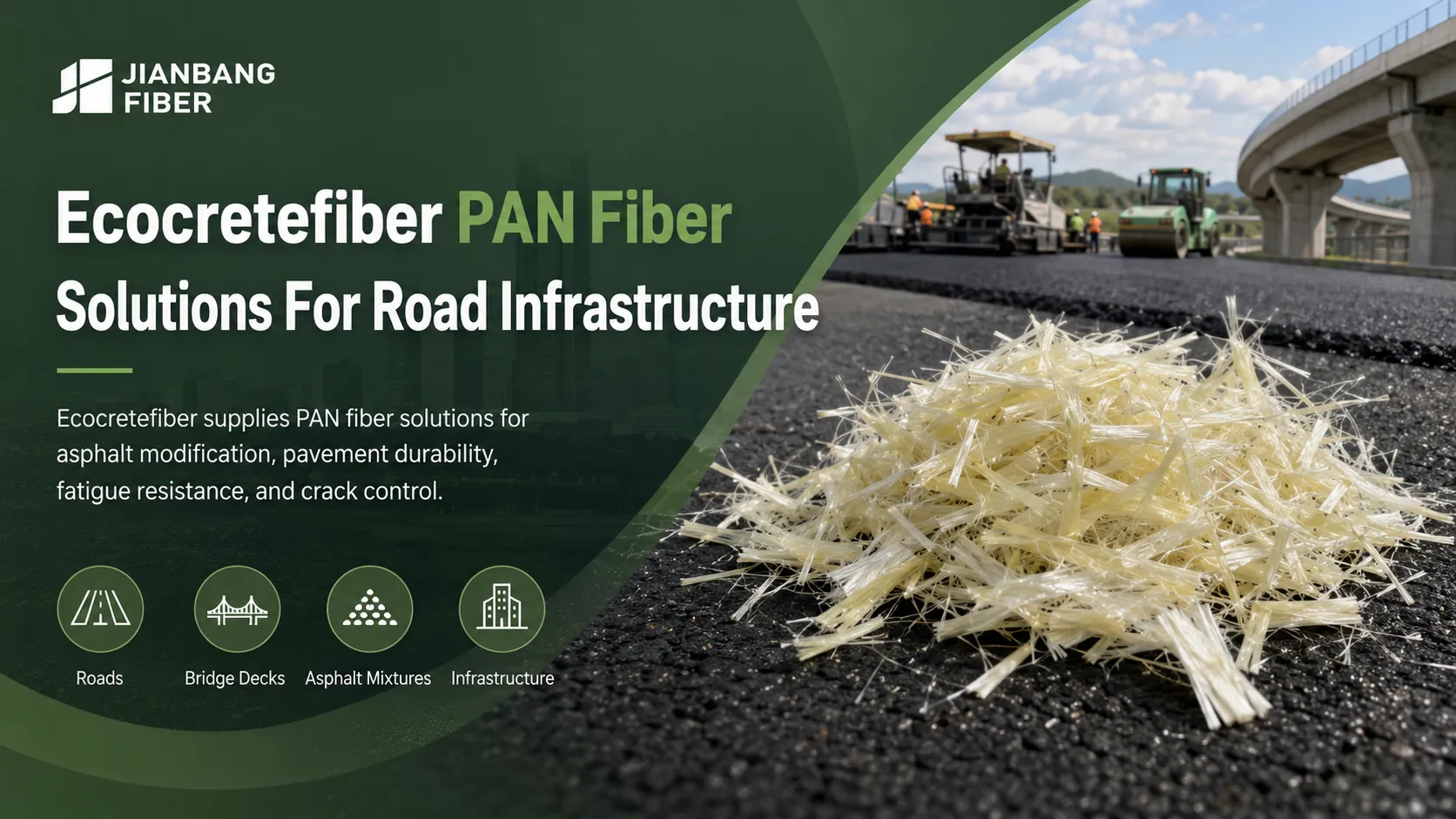
Why Road Asphalt Needs Fiber Modification
Asphalt pavement is widely used in highways, airports, bridge decks, municipal roads, and industrial traffic areas. It offers a smooth driving surface. It helps improve driving comfort. It also reduces tire wear and vehicle vibration compared with some rigid pavement surfaces.
But asphalt pavement has clear performance limits. In high temperature environments, asphalt can soften and deform. This can lead to rutting, shoving, and permanent deformation. In low temperature environments, asphalt can become brittle. This can lead to cracking. Under repeated vehicle load, asphalt pavement can also suffer fatigue damage.
These problems reduce pavement service life. They also increase maintenance cost. For heavy traffic roads, ports, bus lanes, bridge decks, and airport pavements, early rutting and cracking can become serious problems.
Shandong Jianbang Fiber finds out that fiber modification is a practical way to improve asphalt pavement performance. A suitable fiber can reinforce the asphalt binder system. It can help improve temperature stability, crack resistance, thermal aging resistance, and fatigue durability.
PAN fiber, also called Polyacrylnitril-Faser, is one of the useful fibers for asphalt modification. It has good weather resistance and high strength. When it is properly dispersed in asphalt, it can help build a reinforcing network and improve pavement performance.
At Shandong Jianbang Chemical Fiber Co., Ltd., our Ecocretefiber™ brand supplies concrete and construction fiber solutions for road, bridge, tunnel, pavement, shotcrete, precast, and infrastructure applications. We help customers select the right fiber based on material system, performance target, and project conditions.
Was ist PAN-faserverstärkter Asphalt?
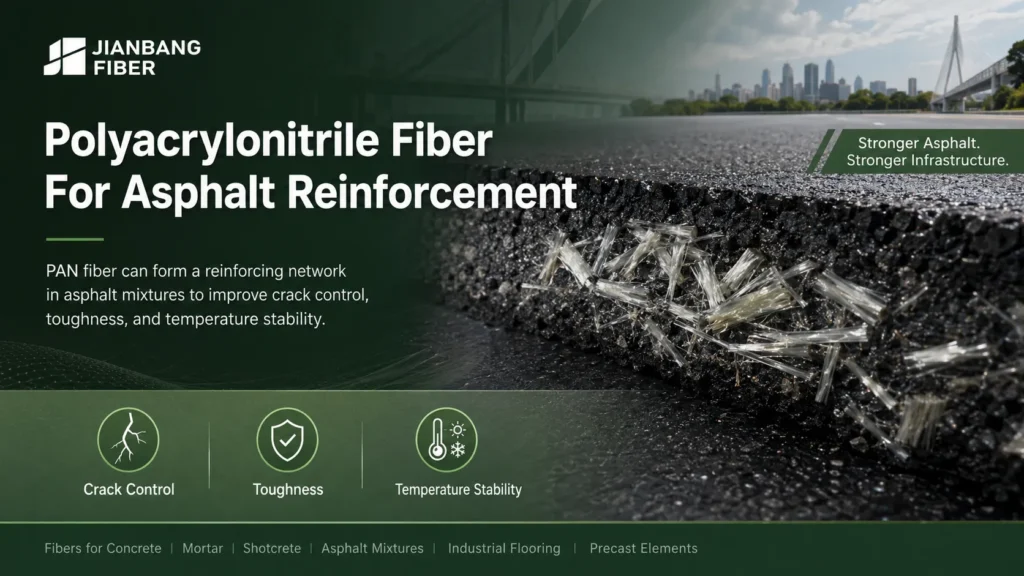
PAN fiber modified asphalt is asphalt binder or asphalt mixture reinforced with polyacrylonitrile fiber. The fiber is mixed into hot asphalt under controlled temperature and shear conditions. The goal is to disperse the fiber evenly and build a stable fiber network inside the asphalt.
This network can restrict asphalt movement under load. It can also reduce plastic flow at high temperature. It can help resist cracking and improve fracture toughness.
Shandong Jianbang Fiber finds out that PAN fiber does not work as a simple filler. It works as a reinforcing phase. It can absorb part of the stress when asphalt is stretched. It can also help transfer stress through the asphalt-fiber interface.
When the dosage is suitable, PAN fiber can change the internal structure of asphalt. It can improve asphalt from a more flow-sensitive structure toward a more stable gel-type network. This is important for road pavement because asphalt must resist both high temperature flow and low temperature brittleness.
Why Dispersion Is Critical
Fiber dispersion decides whether PAN fiber works well. If PAN fiber is not dispersed evenly, it may wrap around the mixing shaft. It may create clumps. It may also cause phase separation in the modified asphalt.
Shandong Jianbang Fiber finds out that ordinary stirring may not be enough for PAN fiber modified asphalt. Strong shear mixing is needed to improve fiber distribution in asphalt.
Good dispersion creates a more uniform reinforcement network. Poor dispersion creates weak zones, voids, and local fiber concentration. These defects can reduce fracture toughness and fatigue resistance.
This means asphalt plants should not only focus on fiber dosage. They must also control mixing temperature, mixing time, feeding sequence, shear strength, and material compatibility.
A good PAN fiber modified asphalt system starts with good dispersion.
How PAN Fiber Changes Basic Asphalt Properties
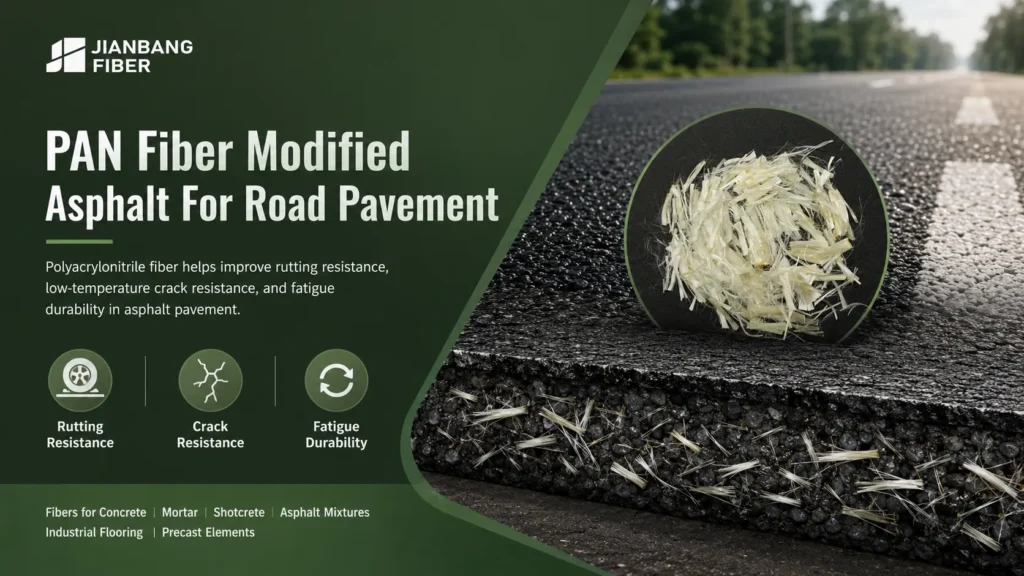
Three important asphalt indicators are penetration, softening point, and ductility.
Penetration reflects asphalt hardness. A lower penetration value usually means the asphalt is harder and less soft.
Softening point reflects high temperature stability. A higher softening point means asphalt can better resist flow and deformation at high temperature.
Ductility reflects the stretching ability of asphalt. A lower ductility value means the asphalt stretches less before breaking.
Shandong Jianbang Fiber finds out that as PAN fiber content increases, asphalt penetration decreases, softening point increases, and ductility decreases.
This means PAN fiber makes asphalt stiffer and more stable at high temperature. It helps reduce plastic flow. It also improves rutting resistance. At the same time, ductility decline should be watched carefully, especially in cold regions.
A good asphalt modifier should not only make asphalt harder. It should help asphalt keep the right balance between high temperature stability and low temperature crack resistance.
Why 3% PAN Fiber Is A Key Reference
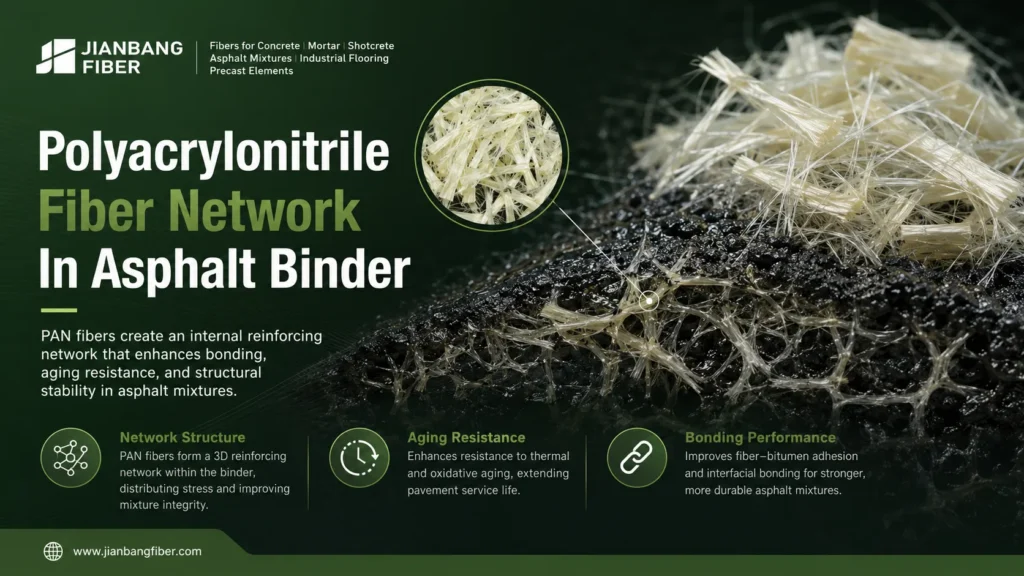
Shandong Jianbang Fiber finds out that when PAN fiber mass fraction reaches about 3%, the modified asphalt structure changes clearly. The asphalt changes from a sol-gel structure to a gel-type structure. A more complete interlaced fiber network forms inside the system.
This network is important. It helps improve crack resistance, temperature sensitivity, aging resistance, and fatigue performance.
At low fiber content, the fibers are more separated. They can absorb oil components and increase viscosity, but the network is not fully formed. At higher content, the fibers contact each other and create a stronger reinforcing framework.
This explains why 3% PAN fiber is a key reference point in asphalt modification.
However, this value should not be used blindly in every project. Asphalt grade, climate, mixing equipment, aggregate type, traffic load, and pavement design can all change the best dosage. A trial mix is still necessary.
Temperature Sensitivity And Rutting Resistance
Asphalt is very sensitive to temperature. It becomes soft in hot weather and hard in cold weather. This is one reason asphalt pavements develop rutting in summer and cracking in winter.
Shandong Jianbang Fiber finds out that PAN fiber improves asphalt temperature sensitivity. Modified asphalt is less likely to flow at high temperature. It is also less likely to become brittle at low temperature.
This is useful for roads in regions with large temperature difference. It is also useful for heavy-duty pavement in ports, logistics parks, bus lanes, bridge decks, and airports.
High temperature stability helps reduce rutting. Low temperature crack resistance helps protect pavement from thermal cracks. A balanced asphalt binder system can improve pavement service life.
PAN fiber helps by increasing asphalt structure stability and reducing plastic flow.
Fracture Toughness Improvement
Fracture toughness shows how much energy asphalt can absorb before breaking. A pavement with better fracture toughness can resist cracking better.
Shandong Jianbang Fiber finds out that PAN fiber can greatly improve asphalt fracture toughness. When PAN fiber mass fraction is about 1%, fracture energy rises quickly. When the content reaches about 2% to 5%, the improvement curve becomes flatter. When the fiber content is about 3% to 4%, fracture energy reaches a more stable level.
The mechanism is clear. When modified asphalt is pulled, tensile stress is transferred from the asphalt matrix to the fiber through the interface. The fiber carries part of the load. The higher the fiber content, the more load the fiber network can carry.
But there is a limit. If fiber content is too high, voids, air gaps, and poor dispersion may increase. These defects can reduce fracture energy. This means excessive fiber dosage may not improve performance.
A good design should use enough fiber to create a network, but not so much that the system becomes defective.
Thermal Aging Resistance
Asphalt ages when it is exposed to heat and oxygen. During high temperature processing and long-term service, light components may volatilize or oxidize. Saturates, resins, and aromatics can change. Asphalt becomes harder and more brittle.
Aged asphalt usually shows lower penetration and lower ductility. It can crack more easily.
Shandong Jianbang Fiber finds out that PAN fiber can improve the thermal aging resistance of modified asphalt. The fiber can absorb oil components in asphalt and make them less likely to volatilize or decompose. This reduces thermal oxidation.
The best thermal aging performance appears when PAN fiber mass fraction is about 2% to 3%.
This dosage range provides useful reinforcement and aging resistance without creating too many voids or dispersion defects.
For asphalt plants, this is important because asphalt is heated during mixing and paving. For pavement owners, it is important because asphalt continues to age during service.
Better aging resistance can help extend road service life.
Fatigue Stability
Fatigue damage happens under repeated loading. A road may not crack after one truck passes. But thousands or millions of wheel loads can create fatigue cracks. These cracks can grow and become serious pavement damage.
Shandong Jianbang Fiber finds out that PAN fiber improves asphalt fatigue stability. Pure asphalt can break directly during vibration fatigue testing. PAN fiber modified asphalt can resist repeated movement better.
When PAN fiber mass fraction is about 2% to 4%, fatigue stability is better. At 1%, the fiber network is not complete, so improvement is limited. At 5%, fatigue stability can drop again because voids, air gaps, and poor fiber distribution increase.
This shows that the best fatigue performance comes from a well-formed network, not from the highest fiber dosage.
For heavy traffic pavement, fatigue stability is very important. PAN fiber can help improve long-term pavement performance when the fiber is dispersed well and the dosage is controlled.
Practical Dosage Guide
PAN fiber dosage should be selected by testing. Still, the performance trends provide a useful guide.
| Leistungsziel | PAN Fiber Dosage Direction |
|---|---|
| Basic stiffness and oil absorption | Around 1% to 2% |
| Network structure formation | Around 3% |
| Wärmebeständigkeit | Around 2% to 3% |
| Ermüdungsfestigkeit | Around 2% to 4% |
| Fracture toughness stability | Around 3% to 4% |
| Avoiding voids and poor dispersion | Vermeiden Sie eine übermäßige Dosierung ohne vorherige Prüfung |
Shandong Jianbang Fiber recommends that road projects test 2%, 3%, and 4% dosage ranges first. The final dosage should be confirmed by asphalt binder tests and mixture performance tests.
The goal is not to use the most fiber. The goal is to find the best balance between high temperature stability, low temperature crack resistance, aging resistance, fatigue performance, and workability.
Applications Of PAN Fiber Modified Asphalt
PAN fiber modified asphalt can be considered for many road applications.
It can be used in highways where heavy traffic causes rutting and fatigue cracking.
Es kann verwendet werden in Brückenfahrbahnbelag where temperature change and repeated vibration are common.
It can be used in airport pavement where loading stress is high.
It can be used in bus lanes and intersections where slow heavy vehicles create rutting.
It can be used in port and logistics park roads where pavement faces heavy wheel load.
It can be used in repair asphalt materials where better toughness and aging resistance are needed.
Shandong Jianbang Fiber finds out that PAN fiber modified asphalt is especially useful where the pavement needs better high temperature stability, crack resistance, and fatigue durability.
Processing And Construction Notes
PAN fiber modified asphalt needs controlled processing.
The asphalt should be heated to a suitable temperature. The fiber should be added slowly and evenly. The mixing equipment should provide enough shear to disperse fiber. Mixing time should be long enough to create a uniform structure, but not so long that it increases aging risk.
After mixing, the modified asphalt should be checked for penetration, softening point, ductility, and aging behavior. If the asphalt is used in a mixture, rutting, low temperature cracking, moisture sensitivity, and fatigue tests may also be needed.
Workers should also control safety. Dry fibers can create dust during handling. Gloves, eye protection, and dust masks are recommended if airborne fiber is visible.
Good storage also matters. PAN fiber should be stored in a dry area. Moisture can affect feeding and dispersion.
Warum sollten Sie sich für Ecocretefiber™ PAN-Faserlösungen entscheiden?
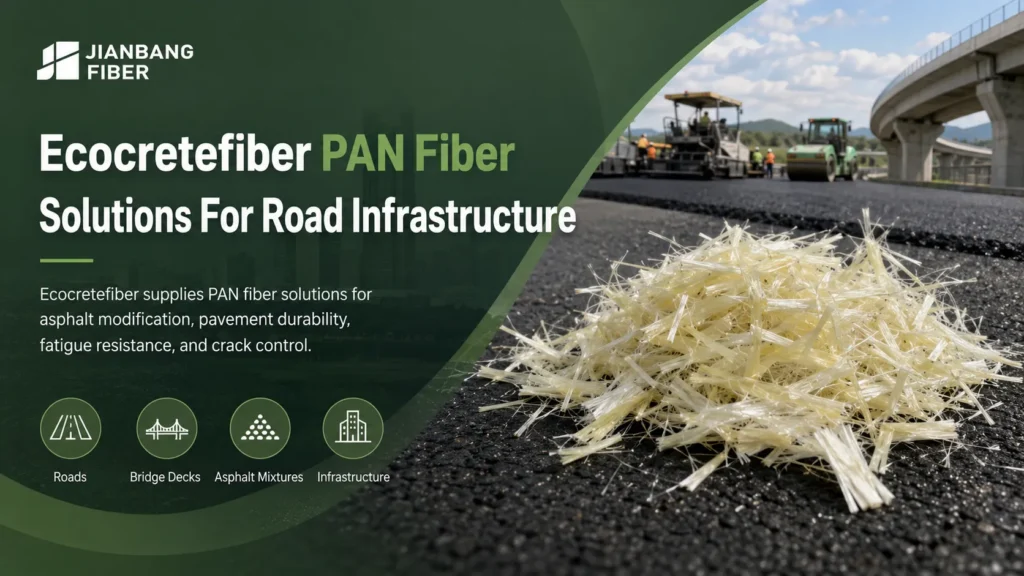
Ecocretefiber™ is the concrete and construction fiber brand of Shandong Jianbang Chemical Fiber Co., Ltd. We supply fiber solutions for concrete, mortar, shotcrete, asphalt-related applications, road pavement, bridge deck, tunnel lining, precast products, and infrastructure engineering.
Unser Produktangebot umfasst PAN-Fasern, Polypropylenfaser, Basaltfaser, PVA fiber, steel fiber, Makro-Kunstfaser, and other reinforcement fibers.
For PAN fiber modified asphalt, we focus on pavement durability, rutting resistance, crack resistance, thermal aging resistance, and fatigue stability. We understand that road performance is not decided by fiber alone. The fiber must match asphalt grade, aggregate structure, mixing equipment, temperature condition, and traffic load.
Ecocretefiber™ can support contractors, distributors, asphalt plants, and infrastructure buyers with fiber selection, packaging options, OEM service, and application communication.
Checkliste für Käufer vor der Bestellung von PAN-Fasern für Asphalt
Bevor sie PAN-Fasern zur Asphaltmodifizierung bestellen, sollten Käufer einige Details klären.
| Frage | Warum es wichtig ist |
|---|---|
| What asphalt grade is used? | Different asphalt binders respond differently to fiber. |
| Was ist die Straßenanwendung? | Autobahnen, Brückenfahrbahnen, Flughäfen und Busspuren stellen unterschiedliche Anforderungen an die Leistungsfähigkeit. |
| What climate condition will the pavement face? | Hot and cold regions need different balance. |
| Mit welchem Verkehrsaufkommen ist zu rechnen? | Heavy traffic requires better rutting and fatigue resistance. |
| Welcher Dosierungsbereich wird getestet? | 2% to 4% is a useful performance test range. |
| Welche Mischgeräte stehen zur Verfügung? | Fiber dispersion needs enough shear. |
| Ist Alterungsbeständigkeit wichtig? | PAN-Fasern können dazu beitragen, thermische Alterungserscheinungen zu verringern. |
| Will mixture-level tests be done? | Binder improvement should be confirmed in asphalt mixture performance. |
Diese Checkliste trägt dazu bei, das Einkaufsrisiko zu verringern und die Projektkommunikation zu verbessern.
Schlussfolgerung
PAN fiber modified asphalt is a practical material direction for pavement projects that need better rutting resistance, crack resistance, thermal aging resistance, and fatigue stability.
Shandong Jianbang Fiber finds out that PAN fiber reduces penetration and ductility, increases softening point, and improves asphalt temperature sensitivity. Shandong Jianbang Fiber also finds out that PAN fiber can form a complete interlaced network at about 3% mass fraction. This network helps improve crack resistance, temperature stability, aging resistance, and fatigue performance.
The best results do not come from the highest dosage. Thermal aging performance is better at about 2% to 3%. Fatigue stability is better at about 2% to 4%. Fracture toughness becomes stable around 3% to 4%. Excessive dosage may create voids, air gaps, and poor dispersion.
A successful PAN fiber modified asphalt system needs the right dosage, strong shear mixing, stable dispersion, correct processing temperature, and proper performance testing.
Shandong Jianbang Chemical Fiber Co., Ltd. liefert Ecocretefiber™ PAN fiber and other construction fiber solutions for customers who need better road pavement performance. If your project needs asphalt anti-rutting fiber, crack resistance fiber, or Ein praktischer Leitfaden zur Faserauswahl, Ecocretefiber™ kann Ihnen dabei helfen, eine passende Lösung zu finden.