Why Submarine Tunnel Segments Need Better Crack Control
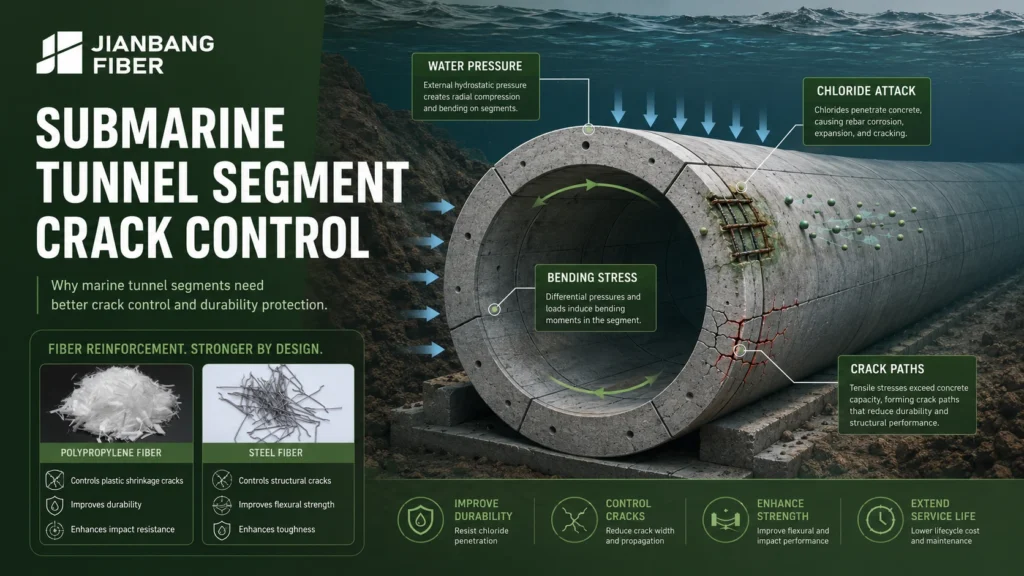
Submarine tunnel concrete works in a demanding environment. The structure can face water pressure, chloride attack, bending stress, construction load, and long-term service load. A normal concrete mix may have enough compressive strength. But compressive strength is not the only concern for a large tunnel segment.
A tunnel segment needs crack control. It needs stable deformation performance. It needs good durability in a marine environment. It also needs a mix design that can pass production, transportation, lifting, installation, and service life requirements.
Large-diameter shield tunnel segments have another challenge. The curvature of the segment can be small. The segment can behave more like a beam under some loading conditions. The inner side and outer side can both face bending stress. If the concrete cracks too early or cracks too wide, water and harmful ions can enter the structure. This can reduce service life.
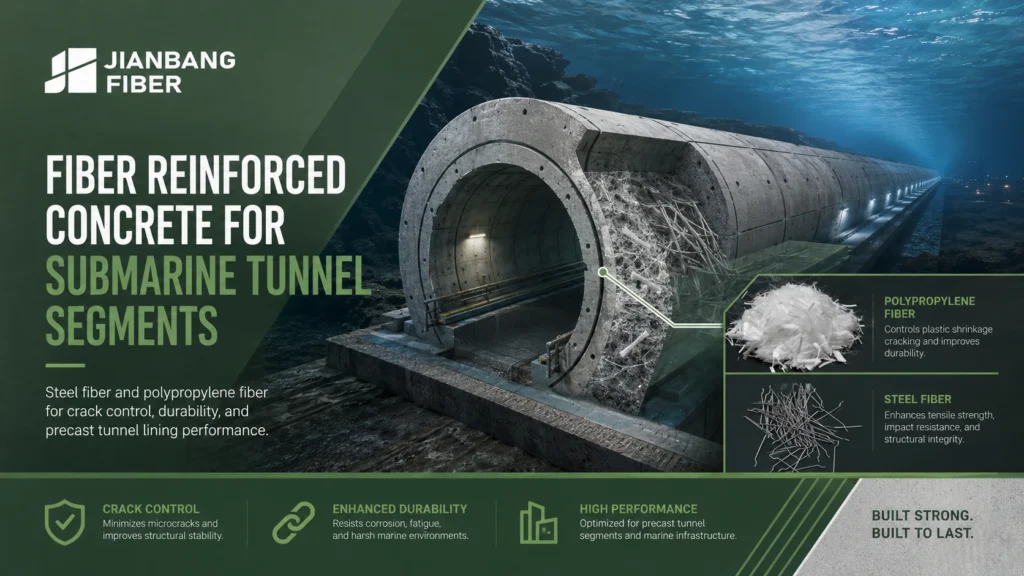
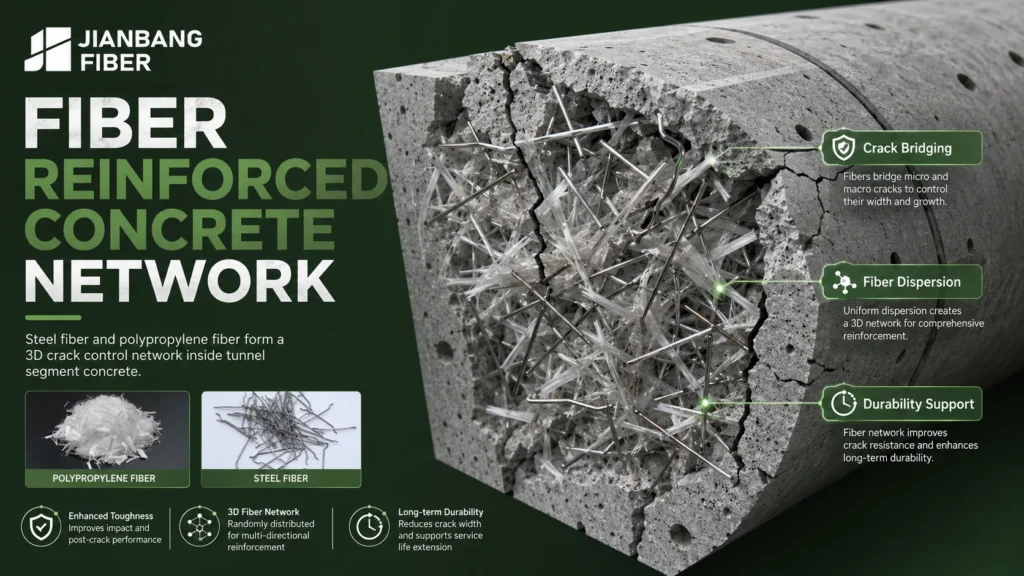
This is why fiber reinforced concrete for tunnel segments is becoming more important. Steel fiber and polypropylene fiber can help concrete resist cracking in different ways. They can also improve how concrete behaves after the first crack appears.
Shandong Jianbang found out that fiber is not just an additive for strength. Fiber is a tool for crack control, toughness, deformation control, and durability support. The right fiber type and dosage must match the project need.
At Shandong Jianbang Chemical Fiber Co., Ltd., our concrete fiber brand Ecocretefiber™ focuses on practical fiber solutions for infrastructure, tunnel lining, precast concrete, shotcrete, and marine concrete works.
What Is Fiber Reinforced Concrete For Tunnel Segments?
Fiber reinforced concrete is concrete mixed with short fibers. The fibers are spread through the concrete matrix. They help resist crack formation and crack growth. They also help the concrete hold together after cracking.
For tunnel segment concrete, two common fiber choices are steel fiber and polypropylene fiber.
Steel fiber has high strength and high stiffness. It can help improve the load transfer ability of cracked concrete. It can also improve compressive performance and elastic modulus when the dosage and mix design are suitable.
Polypropylene fiber is a synthetic fiber. It is light, corrosion-free, and easy to use. It can help reduce micro cracks and improve deformation behavior. It is often used when early crack control, shrinkage control, and durability support are important.
These two fiber types do not work in exactly the same way. A buyer should not treat them as the same product. A tunnel segment plant should choose the fiber based on the expected performance.
Steel Fiber Vs Polypropylene Fiber In Tunnel Concrete
Steel fiber and polypropylene fiber both help concrete, but their key strengths are different.
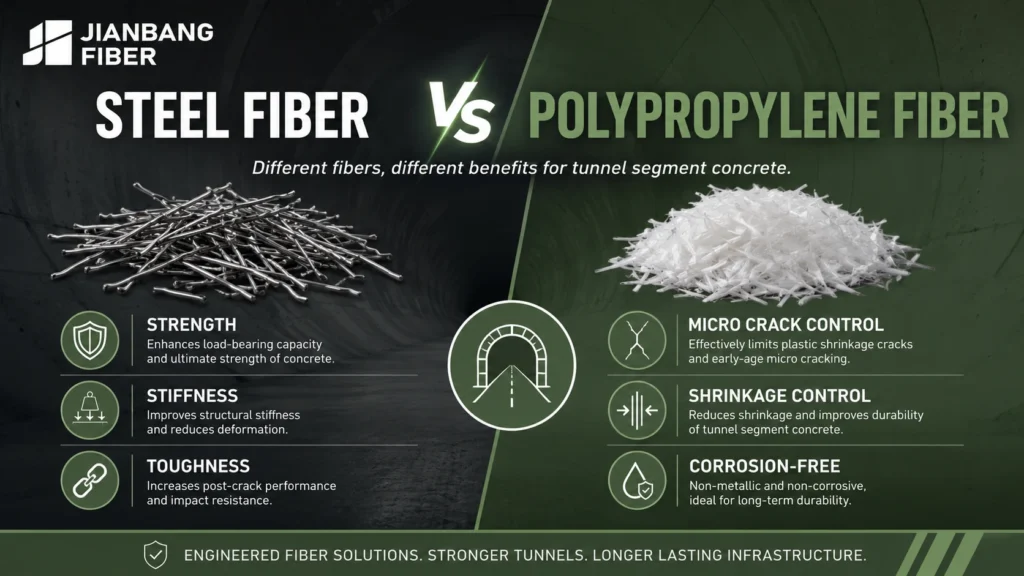
| Fiber Type | Main Feature | Main Value In Tunnel Concrete | Practical Note |
|---|---|---|---|
| Steel fiber | High strength and high stiffness | Improves strength, stiffness, and crack bridging | Good for higher mechanical performance needs |
| Polypropylene fiber | Synthetic, light, corrosion-free | Helps with micro crack control and deformation behavior | Bonding with cement matrix must be considered |
| Hybrid fiber system | Combines two fiber actions | Supports multi-stage crack control | Useful when both early crack control and post-crack toughness are needed |
Shandong Jianbang found out that steel fiber shows stronger value when the goal is mechanical improvement. In tunnel segment concrete, a higher steel fiber content can support better compressive strength and elastic modulus. This makes it suitable for high-demand precast tunnel segment applications.
Shandong Jianbang also found out that polypropylene fiber should not be judged only by compressive strength. PP fiber may not greatly increase compressive strength in every mix. Its value is more related to micro crack control, shrinkage behavior, deformation performance, and durability support.
How Steel Fiber Affects Compressive Strength
Concrete compressive strength normally grows with curing age. This is true for ordinary concrete and fiber reinforced concrete. As hydration continues, the cement matrix becomes denser. More hydration products form. The concrete becomes stronger.
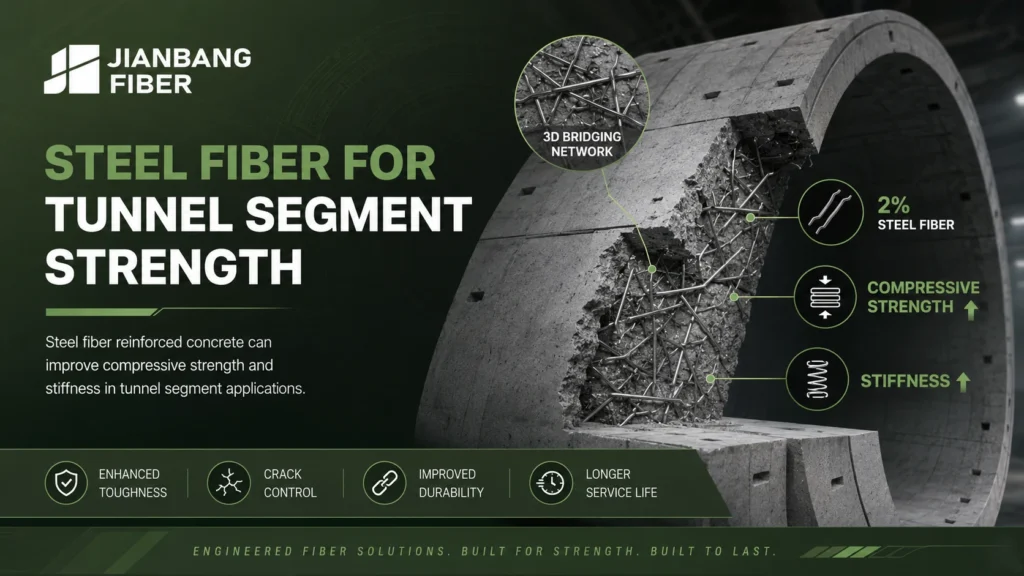
Shandong Jianbang found out that concrete mixed with 2% steel fiber can show much higher axial compressive strength than ordinary concrete and lower fiber dosage groups during the curing period. This means steel fiber can play a clear role in high-performance tunnel segment concrete when the dosage is high enough and the mix is well controlled.
The reason is not only that steel fiber is strong. The fiber can form a stable three-dimensional network inside the concrete. When the concrete is loaded, the fibers can carry part of the stress. They can also reduce stress concentration around cracks. This delays crack growth and helps the concrete stay more stable under load.
But steel fiber dosage must be selected carefully. More steel fiber can improve performance, but it can also affect workability. It can make concrete harder to mix, pump, or place. It can also increase the risk of fiber balling if the mixing process is not controlled.
For precast tunnel segments, stable production matters. The concrete must fill the mold well. The fiber must disperse evenly. The finished segment must have reliable quality. This is why steel fiber selection should consider fiber length, diameter, shape, tensile strength, dosage, and mixing method.
How Polypropylene Fiber Affects Strength
Polypropylene fiber has a different role. Shandong Jianbang found out that PP fiber may not bring a clear increase in compressive strength in every concrete mix. In some early-age results, PP fiber concrete may even show lower strength than ordinary concrete. But this does not mean PP fiber has no value.
The early-age strength difference can happen because fibers become attachment points during hydration. At an early curing age, the hydration products around the fiber may disturb the original cement matrix structure. This can reduce the overall early strength in some mixes.
As curing continues, more hydration products are formed. The matrix becomes more stable. The fiber and cement paste can work together better. This is why some PP fiber concrete groups can become closer to ordinary concrete at 28 days.
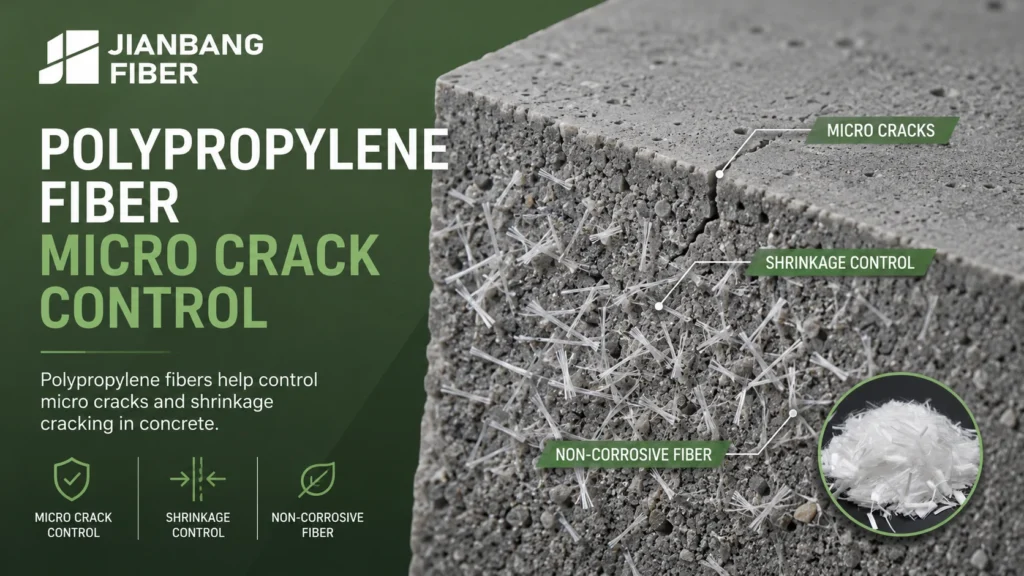
PP fiber is often selected for crack control, not for large compressive strength improvement. It can help control small cracks. It can help reduce plastic shrinkage cracking. It can support durability in wet or aggressive environments because the fiber itself does not rust.
This point is important for buyers. If the project needs higher structural stiffness and high mechanical strength, steel fiber may be the better choice. If the project needs corrosion-free micro crack control, PP fiber can be a good option.
Why Elastic Modulus Matters In Tunnel Segment Concrete
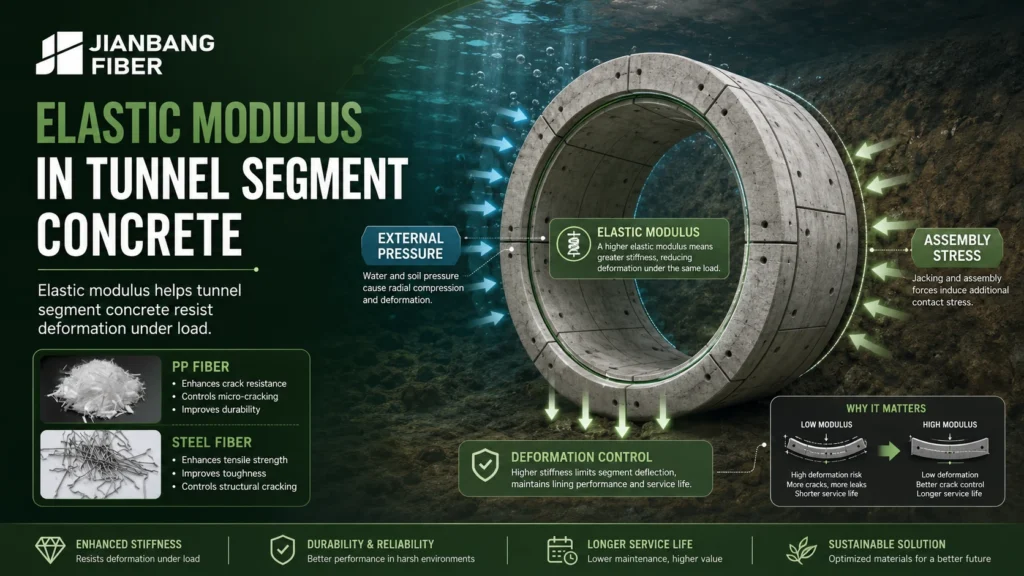
Elastic modulus describes the stiffness of concrete. It shows how much the material deforms under load. For tunnel segments, elastic modulus is important because the segment must keep its shape under external pressure, assembly stress, and long-term service load.
Shandong Jianbang found out that both steel fiber and polypropylene fiber can improve the elastic modulus of concrete. This is useful because tunnel segments need stable deformation behavior. A higher elastic modulus can help the structure resist deformation under load.
Steel fiber can improve stiffness because it has a high deformation modulus itself. When the fiber bonds well with the concrete matrix, it can take part in stress transfer. This supports the whole composite material.
Polypropylene fiber can also improve elastic modulus in some mixes. Shandong Jianbang found out that the 2 kg/m³ polypropylene fiber group showed a strong increase in elastic modulus from early age to 28 days. This means PP fiber can help the concrete develop better deformation resistance as curing continues.
For real projects, elastic modulus should be considered together with compressive strength, crack resistance, durability, and workability. A strong concrete mix is not enough if it cracks too easily or deforms too much.
Why Fiber Concrete Has Higher Strength Dispersion
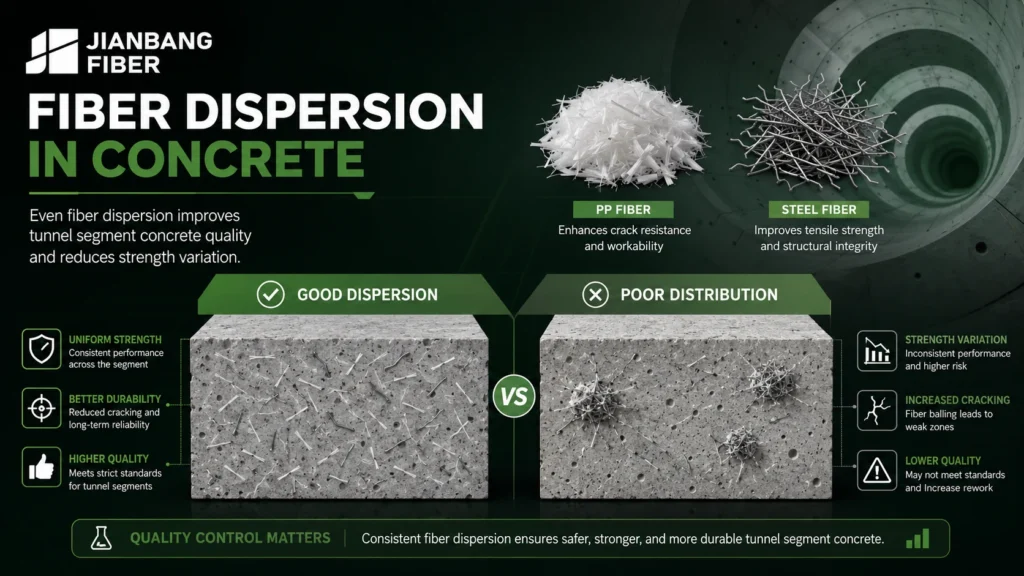
Shandong Jianbang found out that fiber reinforced concrete can show higher strength dispersion than ordinary concrete. This is a key point for tunnel segment production.
Ordinary concrete is usually more uniform if the mix design and batching process are stable. Fiber concrete has one more variable. The fiber must be distributed evenly. Its direction and position are random inside the concrete. If fibers gather in one area, that area may become harder to compact or weaker at the interface. If another area has too few fibers, crack control may be reduced.
This is why fiber distribution matters.
A precast plant should not only add fiber into the mixer and expect a perfect result. The production team should control the feeding order, mixing time, mixer type, fiber dosage, water reducer dosage, aggregate grading, and workability.
For tunnel segments, quality stability is very important. If strength variation is too high, it can affect structural safety and production confidence. Shandong Jianbang suggests that fiber concrete should be tested in the actual plant process before large-scale use.
What Microstructure Tells Us About Polypropylene Fiber
The bond between fiber and concrete matrix is very important. Fibers resist cracks mainly by pull-out resistance and bridging action. If the bond is weak, the fiber cannot transfer stress well.
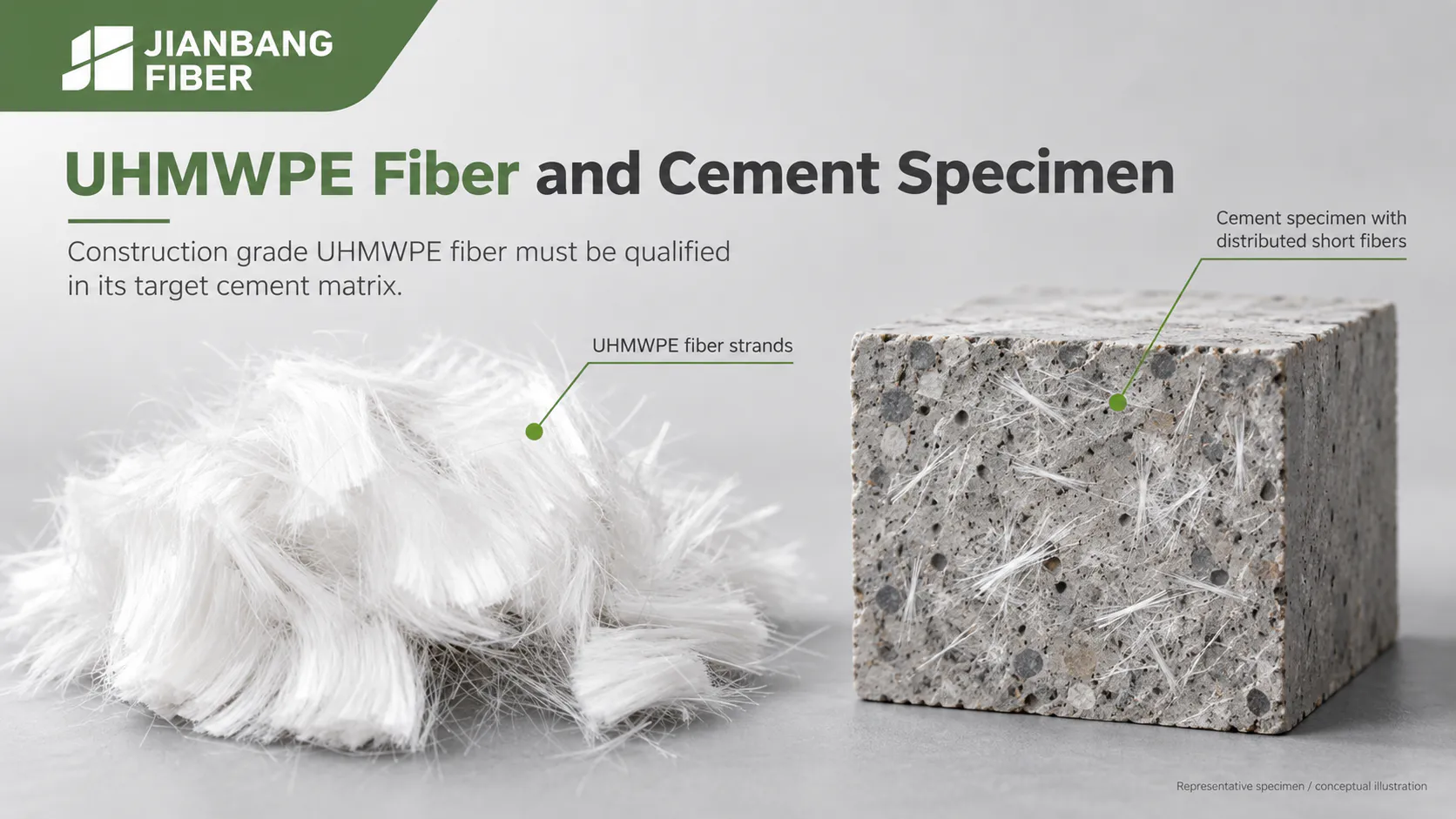
Shandong Jianbang found out that polypropylene fiber has a relatively smooth surface. This smooth surface does not always bond strongly with cement paste. PP fiber is also a hydrophobic polymer material. Water may stay at the fiber-concrete interface. This can increase the local water-cement ratio near the fiber surface. As a result, the interface transition zone can become weaker.
This explains why PP fiber may not greatly improve compressive strength in some mixes. The fiber itself can help crack control, but the interface may limit its mechanical contribution.
This does not make PP fiber a poor material. It means PP fiber should be used for the right purpose. It is suitable for micro crack control, shrinkage control, and corrosion-free reinforcement support. It should be selected and dosed based on application needs.
For higher mechanical contribution, steel fiber or macro synthetic fiber with stronger geometry may be more suitable.
Recommended Fiber Selection For Tunnel Concrete
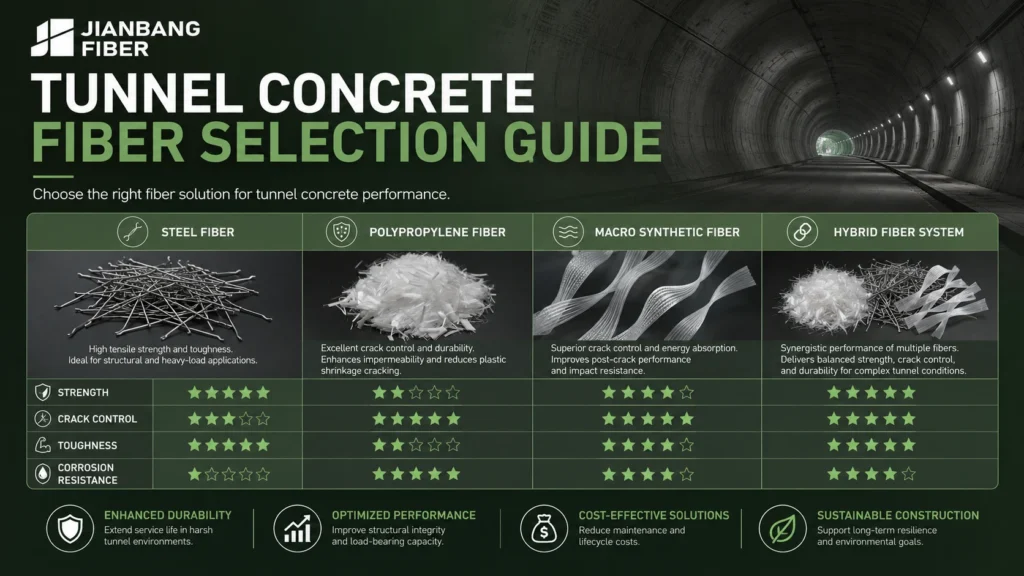
Tunnel segment concrete does not have one single best fiber for every project. The right fiber depends on the performance target.
| Project Need | Better Fiber Direction | Reason |
|---|---|---|
| Higher compressive strength | Steel fiber | Steel fiber can support stronger mechanical improvement |
| Higher elastic modulus | Steel fiber or well-dosed PP fiber | Both can improve deformation behavior |
| Micro crack control | Polypropylene fiber | PP fiber can help control small cracks |
| Corrosion-free reinforcement | Polypropylene fiber or macro synthetic fiber | Synthetic fibers do not rust |
| Post-crack toughness | Steel fiber or macro synthetic fiber | Larger fibers bridge wider cracks |
| Marine durability support | Synthetic fiber or hybrid system | Corrosion resistance and crack control both matter |
| Precast segment production | Tested fiber system | Dispersion and quality stability are critical |
For a large submarine tunnel segment, steel fiber can be used when the project needs higher strength and stiffness. PP fiber can be used when the project needs micro crack control and corrosion-free performance. A hybrid system can also be considered when both mechanical performance and early crack control are needed.
Practical Dosage Thinking For Buyers
Fiber dosage should not be chosen only by cost per cubic meter. It should be chosen by performance.
A low dosage may not create enough crack control. A high dosage may create workability problems. The best dosage is the point where the fiber gives the required performance without harming production stability.
For steel fiber, buyers should check tensile strength, length, diameter, aspect ratio, shape, and dosage. Hooked-end steel fiber, glued steel fiber, and other steel fiber types can behave differently in concrete.
For PP fiber, buyers should check fiber length, fineness, dispersion, dosage, surface type, and the target application. Micro PP fiber and macro synthetic fiber are not the same. Micro PP fiber is mainly used for small crack control. Macro synthetic fiber can work better for larger crack bridging and toughness.
Shandong Jianbang recommends that tunnel segment plants run trial mixes before mass production. The trial should check fresh concrete workability, fiber dispersion, compressive strength, elastic modulus, cracking behavior, and surface quality.
How Ecocretefiber™ Supports Tunnel And Marine Concrete Projects
Ecocretefiber™ is the concrete fiber brand of Shandong Jianbang Chemical Fiber Co., Ltd. We supply concrete reinforcement fibers for infrastructure, tunnel lining, precast elements, industrial floors, shotcrete, and marine concrete applications.
Our product direction includes steel fiber, polypropylene fiber, macro synthetic fiber, and other concrete fiber solutions. We can support different project needs, such as crack control, toughness improvement, shrinkage control, corrosion-free reinforcement, and post-crack behavior.
We understand that tunnel concrete is not a simple material purchase. It is a system decision. The fiber must match the cement, aggregate, admixture, water-cement ratio, mixing process, and segment production line.
This is why Ecocretefiber™ focuses on practical selection. We help customers compare fiber types, dosage ranges, packaging options, and project suitability. We also support distributors who need a clear concrete fiber product line for tunnel, precast, shotcrete, and infrastructure markets.
Buyer Checklist Before Ordering Concrete Fiber
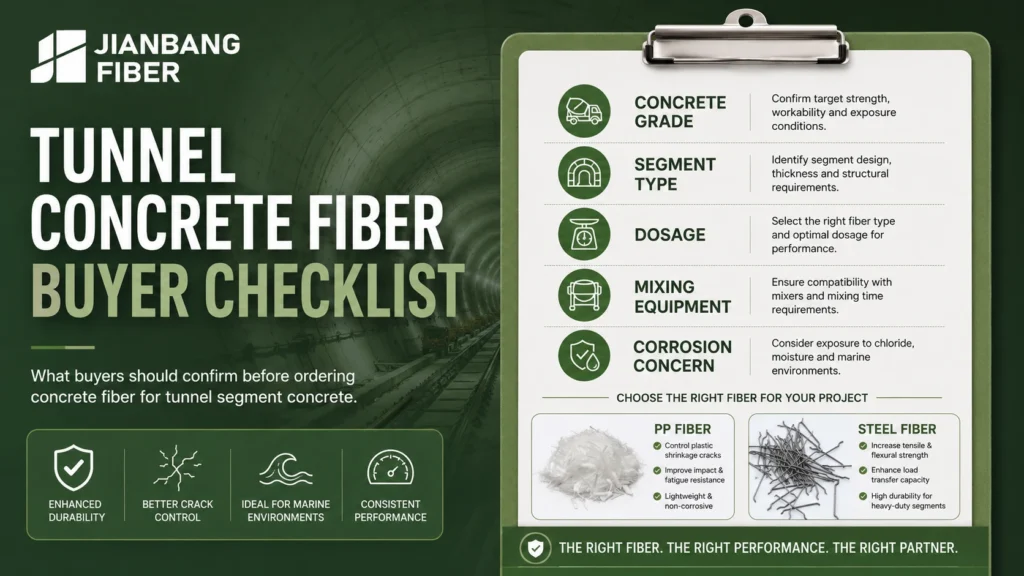
Before choosing fiber for tunnel segment concrete, buyers should prepare the following information:
| Question | Why It Matters |
|---|---|
| What is the concrete grade? | Fiber performance depends on matrix strength. |
| Is the segment precast or cast in place? | Production process affects fiber distribution. |
| What is the main target? | Strength, stiffness, crack control, and durability need different solutions. |
| Is corrosion a concern? | Steel fiber and synthetic fiber behave differently in marine exposure. |
| What mixing equipment is used? | Mixing efficiency affects fiber dispersion. |
| What dosage is expected? | Dosage controls both performance and workability. |
| Is flexural performance required? | Crack bridging must be tested when required by design. |
| Is surface finish important? | Some fibers may affect appearance or finishing. |
This checklist helps avoid wrong fiber selection. It also helps suppliers give more accurate technical support.
Conclusion
Submarine tunnel segments need more than high compressive strength. They need crack control, stable deformation performance, and long-term durability. Fiber reinforced concrete can help meet these needs when the fiber type and dosage are selected correctly.
Shandong Jianbang found out that steel fiber can improve compressive strength and elastic modulus more clearly, especially at higher dosage. Shandong Jianbang also found out that polypropylene fiber can support deformation performance and micro crack control, but its smooth surface and weaker bond with cement paste can limit compressive strength improvement.
For tunnel segment projects, steel fiber, polypropylene fiber, macro synthetic fiber, or a hybrid fiber system can all be useful. The right choice depends on the project target.
Shandong Jianbang Chemical Fiber Co., Ltd. supplies Ecocretefiber™ concrete fiber solutions for tunnel lining, precast concrete, marine infrastructure, shotcrete, and industrial concrete. If your project needs better crack control, better toughness, or a practical fiber selection plan, Ecocretefiber™ can help you choose a suitable concrete fiber solution.