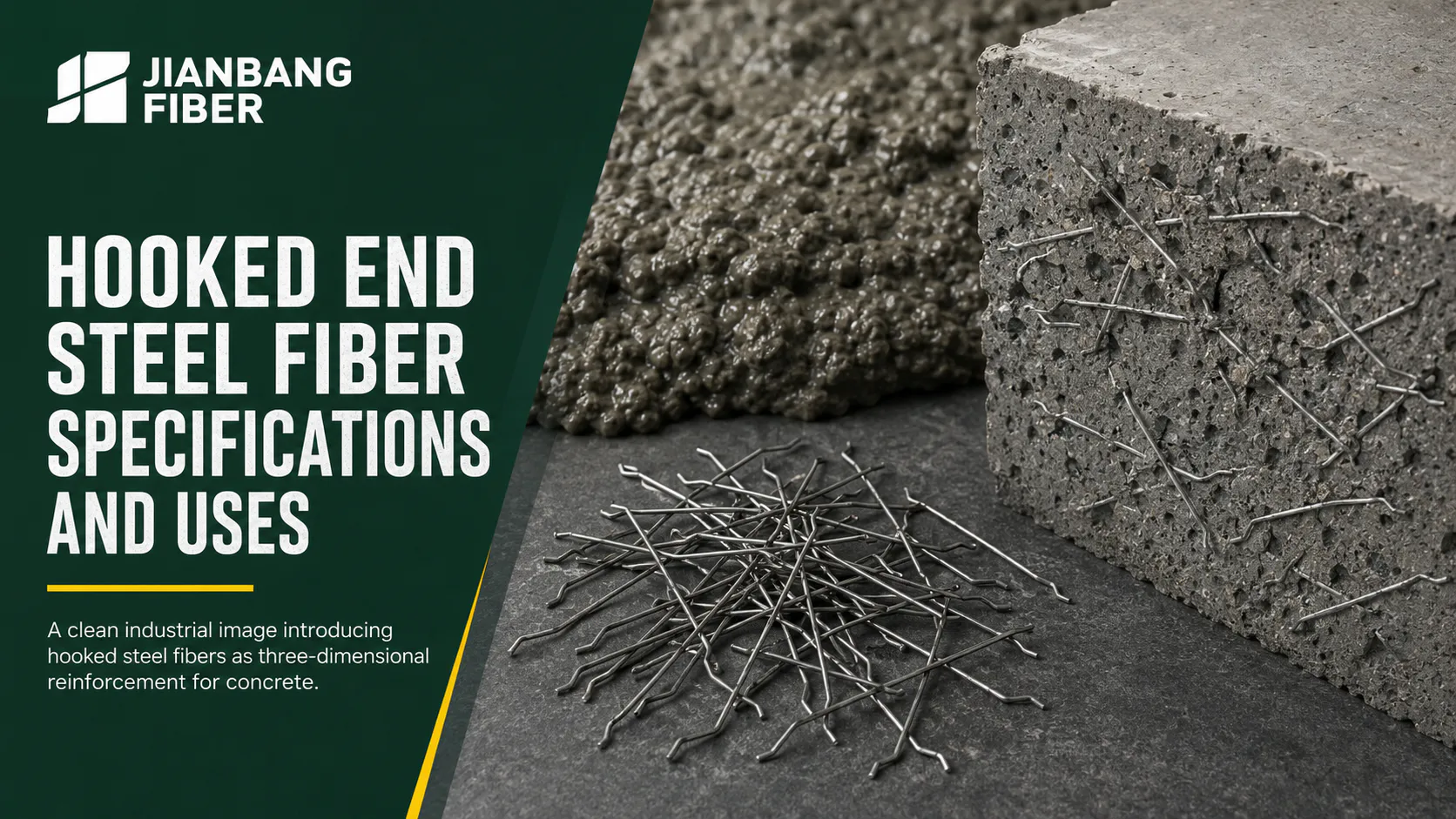
UHPC application requires control of the entire production process. A strong mix can still underperform if its fibers form clumps, its flow changes during delivery, or its surface dries before curing begins. Reliable results start with qualified materials and a procedure that works with the actual site equipment.
At Shandong Jianbang Chemical Fiber Co., Ltd., we supply concrete reinforcement fibers under the Ecocretefiber™ brand. For contractors, precast producers, and distributors, we recommend treating fiber selection as part of the UHPC system. The fiber, cementitious matrix, mixer, casting method, and curing conditions must work together.
This guide explains the main decisions from material selection to final inspection. It also shows how to assess micro steel fibers without confusing a supplier’s fiber specifications with the performance of finished concrete.

What Makes UHPC Different
Ultra-high-performance concrete combines a dense cementitious matrix with carefully selected reinforcement. Fine particles help reduce voids. A low water-to-binder ratio limits excess mixing water. A compatible high-range water reducer provides workability without relying on uncontrolled water addition.
Steel fibers bridge cracks after the matrix starts to crack. Their contribution depends on their dimensions, strength, bond, quantity, and orientation. A fiber that does not cross a developing crack cannot contribute in the same way as a well-anchored fiber crossing that crack.
UHPC is often associated with compressive strengths of 150 MPa or more. However, a compressive strength number alone does not establish structural suitability. Tensile behavior after cracking, durability, curing conditions, and the adopted specification also matter. Definitions and testing scopes differ, so buyers should identify the project requirements before comparing products.
A dense matrix can limit the movement of aggressive substances, but it does not make every structure permanently waterproof. Interfaces, cracks, exposure, and workmanship still influence service performance. A long design life requires a complete design and maintenance strategy.
Where UHPC Application Adds Value
UHPC is most useful where its properties solve a specific construction problem. Bridge connections can benefit from compact details and strong material performance. Thin precast components may benefit from reduced section size. Repair layers need reliable interaction with the existing substrate.
The FHWA guidance on field-cast UHPC connections describes their use between prefabricated bridge elements. These applications need coordinated connection design and field execution.
For a marine repair, the team should assess chloride exposure and the condition of the existing concrete. For an architectural panel, surface finish and fiber visibility may influence the fiber choice. For a structural connection, tensile behavior and reinforcement detailing become central requirements.
The commercial comparison should include installation time, testing, equipment, curing, and maintenance. Comparing only the cost of one cubic meter can miss the value of a smaller component or shorter closure. It can also hide the cost of difficult placement. UHPC should earn its place through a project-specific assessment.
Qualify The Materials Before Production
Cement And Mineral Components
Approve the cement, silica fume, other mineral additions, and fillers as a combined system. A cement strength class alone cannot confirm UHPC performance. Changes in the cement or powder supply can affect water demand, setting, and compatibility with the water reducer.
Record the supplier, product designation, batch number, and storage condition. Keep powders protected from moisture. Where a supplier or material changes, repeat the relevant compatibility and performance checks before using the new material in production.
Fine Aggregate And Moisture
Check aggregate grading, cleanliness, and moisture. Particle packing depends on the complete distribution of sizes, not just the maximum grain size. Many UHPC mixtures use fine aggregate, but a single grading rule should not be imposed on every system.
Moisture corrections deserve particular attention. Water carried by the aggregate can change the effective batch water. A production sheet should state the approved water calculation and the method for adjusting aggregate quantities. The operator should not make these corrections by visual judgment.
Water Reducer And Mixing Water
Evaluate the water reducer with the actual cementitious materials. Initial flow is only one part of the assessment. Flow retention over the planned mixing, transport, and placement period also matters.
Set an approved dosage range and adjustment procedure. Account for water contributed by liquid ingredients as required by the mix design. Adding water to rescue a stiff batch can change the material that was originally qualified.
Fiber Condition And Traceability
Check fiber dimensions, declared tensile strength, surface condition, packaging, and batch identification. Compare delivered fibers with the approved sample and technical data sheet. Investigate visible clumps, contamination, or abnormal deformation before batching.
Store fibers in dry conditions and weigh them accurately. Good incoming inspection makes later troubleshooting easier. Without traceability, a change in test performance may be difficult to connect to a particular material batch.
Select Steel Fibers For The Required Concrete Performance
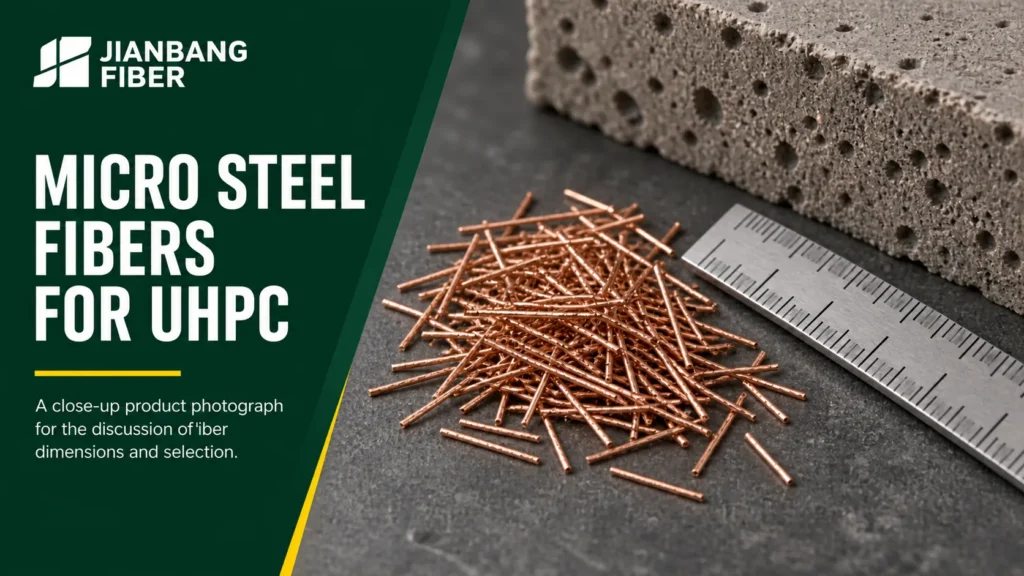
Micro steel fibers are relevant to dense UHPC matrices because their fine dimensions allow many individual fibers to be distributed through the material. Selection still requires a balance between workability and mechanical performance.
Our micro copper coated steel fiber page lists lengths of 10–20 mm, diameters of 0.10–0.30 mm, and tensile strength above 2,850 MPa. These are published product ranges. Confirm the exact grade, tolerances, and batch documentation for the order.
A high single-fiber tensile strength does not mean the concrete achieves the same strength. Concrete performance also depends on fiber pullout, matrix strength, dispersion, and casting direction. Copper coating should not be interpreted as a guarantee against corrosion in every exposure condition.
For purchasing, request a defined length and diameter combination rather than accepting a broad range. Then test that fiber in the intended matrix and component geometry. A change in length or shape can change both the mixing behavior and the results after cracking.
Convert Volume Dosage To Mass Correctly
Fiber volume percentage and kilograms per cubic meter are different quantities. Using an assumed steel density of 7,850 kg/m³ gives the following arithmetic conversions. These are calculation examples, not a universal dosage specification.
| Steel fiber volume fraction | Calculated steel fiber mass |
| 1.0% | 78.5 kg/m³ |
| 1.5% | 117.8 kg/m³ |
| 2.0% | 157.0 kg/m³ |
For example, a 0.20 m³ batch at 2.0% contains approximately 31.4 kg of steel fibers. Use the approved mixture yield and supplier density when preparing the actual batch sheet.
A dosage of 20–30 kg/m³ corresponds to only about 0.25–0.38% steel by volume under that density assumption. It should not be carried across from a general fiber concrete application without verifying UHPC performance. Published UHPC formulations vary substantially; the FHWA material review includes an example containing 156 kg/m³ of steel fibers.
Keep Steel And PP Fiber Functions Separate
Polypropylene microfibers are not a direct substitute for the structural contribution of micro steel fibers in a qualified UHPC mixture. A hybrid fiber system must be designed and tested for its intended purpose. Matching the same mass of two different fibers does not match their volume, stiffness, or crack-bridging behavior.
For buyers, the useful question is what the completed mixture must achieve. Choose the fiber package against those requirements, then confirm the result through testing.
Establish A Repeatable UHPC Mixing Procedure
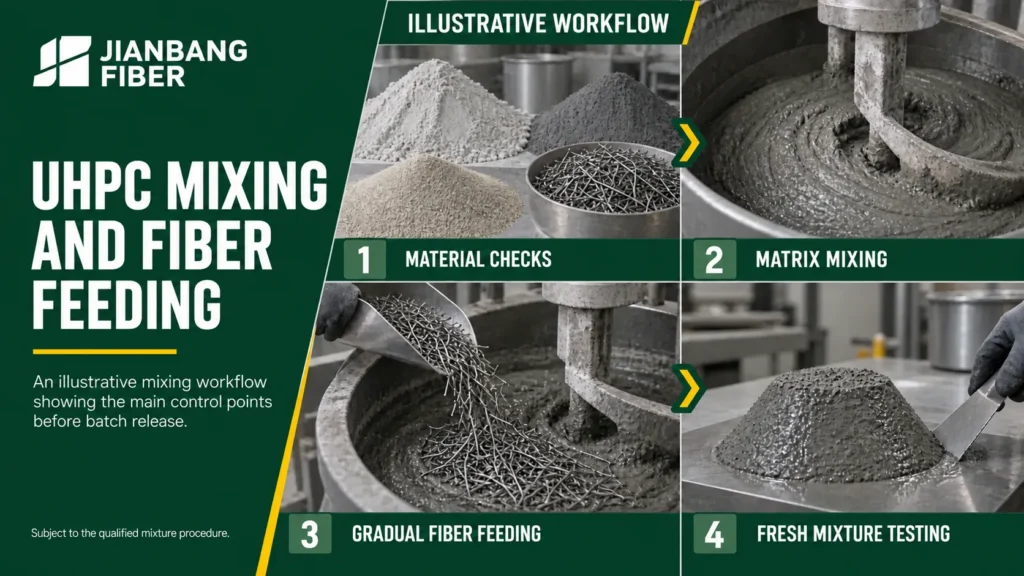
The approved mixing procedure should state the equipment, batch size, ingredient sequence, mixing stages, fiber feed rate, and release checks. Mixer revolutions per minute cannot be transferred directly between machines with different blade geometry and power.
We recommend using the following sequence as a planning framework. It must be adapted and qualified for the chosen UHPC system.
Prepare The Batch And Mixer
Verify the scales, planned batch quantities, and material identities. Inspect the mixer for hardened residue and confirm that the intended batch size suits its working capacity. Prepare the molds and testing equipment before mixing begins.
Record material and ambient temperatures. Confirm that the team can place and protect the entire batch within the qualified working time. Producing material before the receiving area is ready creates avoidable risk.
Develop A Uniform Matrix
Follow the approved dry blending and liquid addition stages. Many systems develop the matrix before fibers are introduced; other qualified procedures use an earlier fiber addition. The correct sequence is the one demonstrated for the actual materials and mixer.
Allow the mixture to reach the required uniformity. Do not assume that apparent stiffness early in mixing proves that more water is needed. Check the prescribed mixing stage, equipment performance, and ingredient quantities first.
Feed Fibers At A Controlled Rate
Introduce fibers progressively at the approved stage. Avoid releasing a large compact bundle into one part of the mixer. Check that the feed method distributes fibers rather than depositing them faster than the mixer can separate them.
If clumps appear, investigate the feed rate, sequence, batch size, and matrix condition. Continuing to mix indefinitely can create additional heat without solving the original cause. A batch with unresolved defects needs a documented disposition.
Test Before Release
Record mixing time, fresh temperature, and the specified flow result. Inspect the material for visible segregation or fiber clumps. Release it only when it meets the approved acceptance criteria.
Control Temperature And Working Time
Temperature changes can alter flow retention and strength development. The fresh mixture can also become warmer during mixing. Measuring ambient temperature alone will not show the full condition of the batch.
Prepare a hot-weather procedure using measures accepted for the mixture, such as shaded storage or controlled ingredient temperatures. Prepare a cold-weather procedure that addresses materials, molds, the substrate, and early curing. Confirm both procedures through trials where those conditions are expected.
A temperature limit should come from the approved material procedure and project specification. It should not be selected simply because another project used it. Record the fresh temperature at a consistent stage so that results can be compared between batches.
Plan delivery and placement around the verified working period. When production stops, record the delay and reassess the remaining material. A flow result taken immediately after mixing does not prove that the same batch remains suitable much later.
Place UHPC Without Losing Fiber Uniformity
Prepare Forms And Bonding Surfaces
Inspect form joints, seals, supports, and access points before placement. A fluid mixture can escape through gaps that would be less troublesome with stiffer concrete. Confirm that the forms can resist the anticipated casting pressure.
For repair work, remove unsound material and prepare the substrate to the specified condition. Agree the required surface profile, cleaning method, and moisture condition. UHPC strength cannot compensate for a weak or contaminated interface.
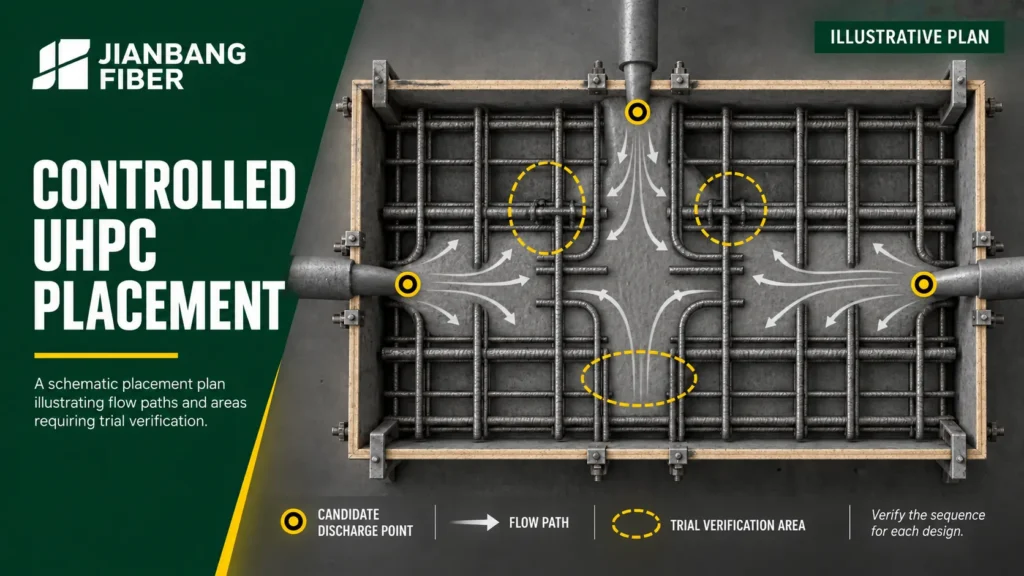
Plan The Flow Path
Choose the discharge positions and placement sequence before the pour. Avoid unnecessary changes in direction and uncontrolled long flow paths. Check areas around reinforcement, narrow spaces, and locations where two flow fronts meet.
Fiber orientation can change as material flows. This makes the casting procedure relevant to mechanical performance, especially in thin components. Representative trials should therefore reproduce the intended direction and geometry, rather than using only convenient laboratory molds.
Use The Qualified Consolidation Method
Do not automatically apply conventional internal vibration to a flowable UHPC mixture. FHWA’s UHPC technical note advises against internal vibration for the material described and discusses limited external form vibration for releasing entrapped air.
Some UHPC applications use different consistencies and placing methods. The contractor should follow the method qualified for that system. A fixed vibration frequency or duration is not a substitute for checking fill quality, segregation, and fiber distribution.
Start Curing Protection Promptly
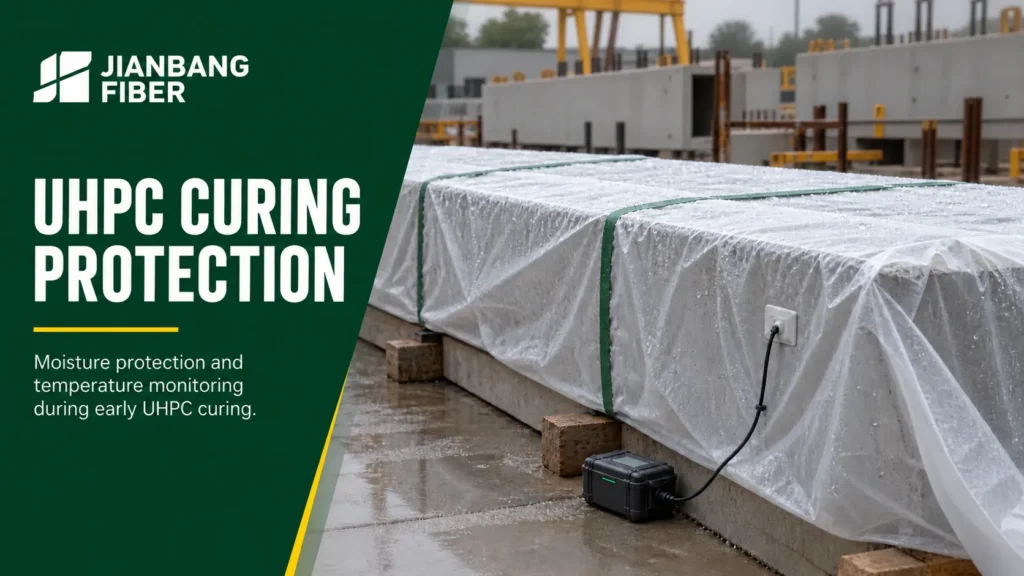
Fresh UHPC needs protection from moisture loss. Have covers and the approved curing materials ready before casting. Apply protection as soon as the surface and finishing process permit; do not leave the surface exposed for a fixed number of hours by default.
Ambient Curing
Ambient curing can be appropriate when the mixture reaches the required properties under the actual conditions. Keep moisture and temperature within the approved curing procedure. Monitor changes during cold nights, strong wind, or direct sunlight.
Do not assume that every ambient-cured UHPC reaches only a fixed percentage of its design strength at 28 days. Strength development depends on the formulation and curing history. Test results should establish the outcome.
Heat Curing
Heat treatment can accelerate property development in a qualified system. Specify the start condition, heating rate, peak temperature, duration, moisture protection, and cooling procedure. Monitor the component temperature where the specification requires it.
A steam cycle cannot guarantee a universal strength percentage after 24 hours. Starting heat too early or changing the cycle can also change performance. Autoclave treatment is a specialized factory process and should not be treated as a routine field-curing option.
Release For Handling Or Service
Set clear release criteria for stripping, lifting, prestressing operations where applicable, and service loading. Use the prescribed tests and representative curing records. A planned reopening time is a scheduling target until the required acceptance conditions have been met.
Verify Quality Before During And After Casting
Scale Up The Trial
Begin with laboratory qualification, then move to the intended production equipment and a representative trial element. Exact trial volumes depend on the project. The goal is to reproduce the conditions that could change the result.
Record batch size, mixing stages, discharge method, flow path, finishing, and curing. Inspect difficult details in the trial element. Resolve problems before the first production pour, when adjustments are easier to manage.
Name The Flow Test
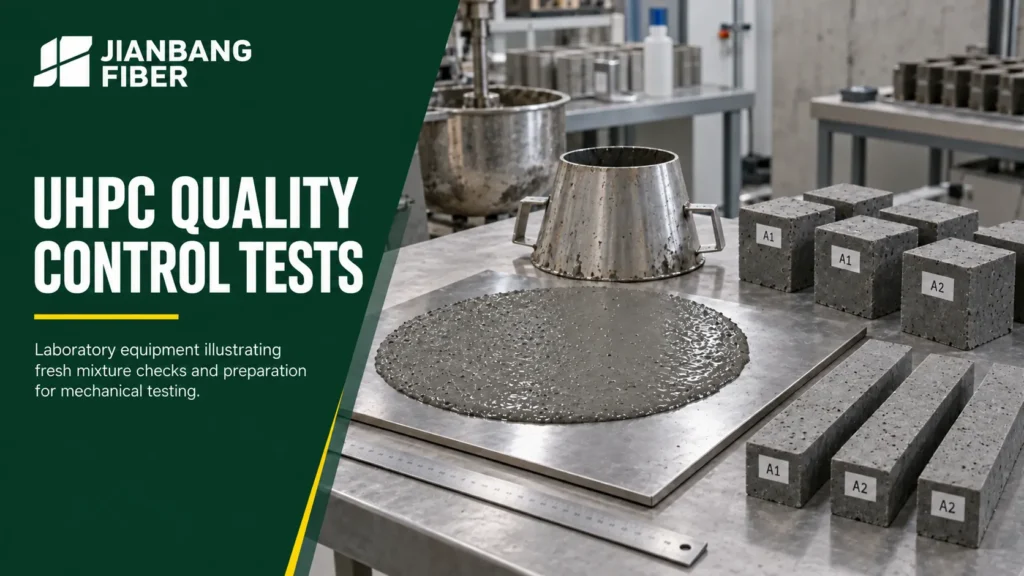
Flow and slump are not interchangeable measurements. A number in millimeters needs a named method, equipment, and acceptance range.
ASTM C1856/C1856M-24 covers specimen fabrication and testing for UHPC within its stated scope. That scope includes specified compressive strength of at least 120 MPa, nominal maximum aggregate size below 5 mm, and modified flow-table results between 200 and 250 mm. These conditions describe the practice’s applicability; they are not universal casting limits for every UHPC product.
Use the test procedure adopted by the project. Do not relabel a flow-table spread as a conventional slump value.
Check The Properties That Govern The Design
Compression testing is important, but it is not enough when the design relies on fiber reinforcement after cracking. Specify the required tensile or flexural performance tests and the relevant acceptance criteria. Record specimen geometry, casting direction, age, and curing condition.
Evaluate shrinkage and exposure-related durability where they affect the application. Non-destructive examination can help investigate defects, but it should not replace specified acceptance tests without an approved basis. Test selection should answer a defined engineering question.
| Stage | Record or inspection | Purpose |
| Incoming materials | Identity, condition, batch documents | Maintain the approved material system |
| Batching | Weights and moisture corrections | Control mixture proportions |
| Fresh mixture | Named flow test, temperature, visual condition | Confirm placement readiness |
| Placement | Timing, sequence, difficult details | Check consistency with the trial |
| Curing | Protection and temperature history | Track strength-development conditions |
| Acceptance | Required mechanical and durability results | Verify specified performance |
Solve Common Production Problems
When fibers form balls, check how fast they enter the mixer and whether the batch size is suitable. Compare the actual sequence with the trial record. An approved fiber grade can still perform poorly in an uncontrolled mixing process.
When flow falls too quickly, review temperatures, ingredient identities, moisture corrections, and elapsed time. Changes in admixture compatibility may also need investigation. Avoid using unrecorded additions to bring each batch back to a preferred appearance.
When surfaces crack early, examine exposure before curing, protection continuity, restraint, and the curing temperature history. Fiber addition does not remove the need for curing or shrinkage assessment.
When strength results are inconsistent, investigate sampling, specimen preparation, curing, and testing as well as production. Compare like-for-like results. Different specimen shapes or curing conditions can make a comparison misleading.
When a repair separates from its substrate, investigate the interface and structural movement. Increasing the compressive strength of the repair material alone may not address the cause.
Frequently Asked Questions
Does UHPC Always Need Steam Curing
No. Some mixtures achieve the required properties under ambient curing. The approved mixture, schedule, and acceptance requirements determine whether heat treatment is needed. Verify the intended curing method before production.
Can A Standard Concrete Mixer Produce UHPC
Some conventional mixers can produce UHPC, but suitability must be demonstrated. Check working capacity, power, mixing efficiency, temperature rise, and repeatability. A successful small batch does not automatically qualify a larger batch.
Can More Steel Fiber Fix A Poor Mix
No. More fiber can increase mixing and placement difficulty. The fiber content must suit the matrix and the required mechanical behavior. Correct the underlying mixture or process problem rather than changing dosage without testing.
Can Fibers Replace All Reinforcing Bars
No general replacement rule applies. The structural design determines the role of fibers, bars, and any prestressing. Follow the approved drawings and performance requirements.
What Should Buyers Send With A Fiber Inquiry
Provide the application, component thickness, fiber length and diameter, required documentation, target concrete performance, estimated volume, and destination. Include the intended dosage basis and mixing equipment. These details make product comparisons and trial planning more useful.
Conclusion
Successful UHPC application depends on a qualified mixture and controlled execution. Accurate batching, suitable fibers, consistent mixing, planned placement, and prompt curing all contribute to the final result. Acceptance testing must confirm the properties the structure actually needs.
At Shandong Jianbang, we encourage buyers to evaluate Ecocretefiber™ fibers in the complete concrete system. Contact our team with your UHPC application and fiber requirements to discuss product specifications and samples for qualification. Select the fiber with the project team, verify it in representative trials, and carry the approved procedure into production.