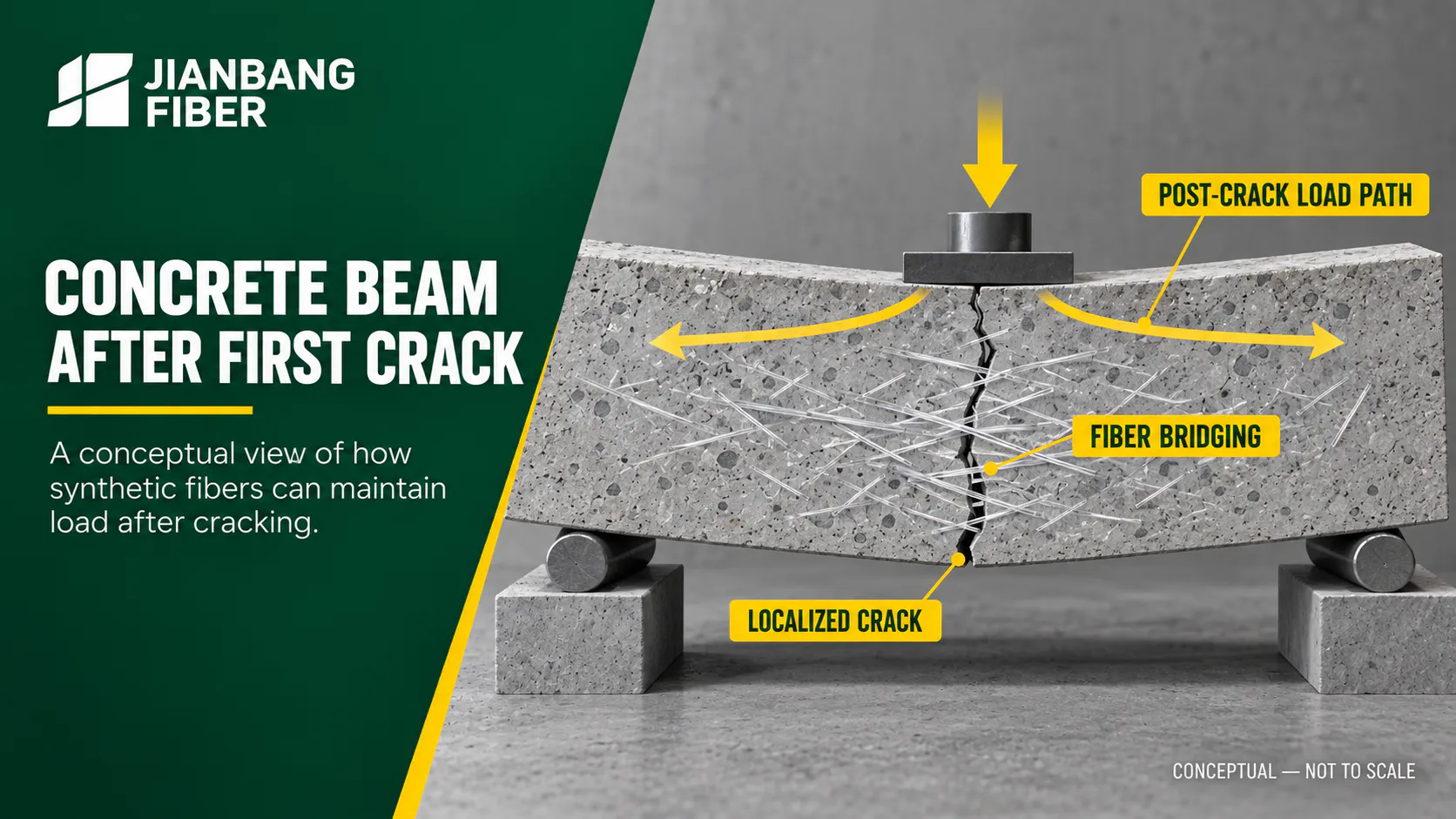
A concrete beam can carry a substantial load before its first major crack, then lose capacity quickly. For a floor, overlay, precast unit, or repair layer, the load after cracking can matter as much as the first peak. Flexural toughness describes how the material continues to resist bending and absorb energy as it deforms.
At Shandong Jianbang Chemical Fiber Co., Ltd., we help buyers connect fiber selection with the performance of the finished concrete. The central question is not whether a fiber is strong on its own. It is whether the chosen fiber, dosage, and mix keep the concrete carrying the required load after a crack begins to open.
Controlled tests on PAN and PVA fibers give a useful example. Both fibers changed a brittle beam response into a more gradual post-crack response. Their results also show why a higher dosage, a higher modulus, and a peak load should never be treated as interchangeable measures of toughness.
What Flexural Toughness Measures
Flexural strength usually reports a load-related value at a particular stage of bending. Toughness describes energy absorbed over a specified part of the load–deflection curve. That energy is represented by the area under the curve up to a stated deflection. A beam that retains some load over a larger displacement can absorb more energy than a beam that fails suddenly after its peak.
Residual flexural performance asks a related question: how much load or calculated strength remains at a defined deflection or crack opening? These metrics serve different purposes. A specification should name the test method, the target deformation, and the acceptance value instead of requesting “high toughness” alone.
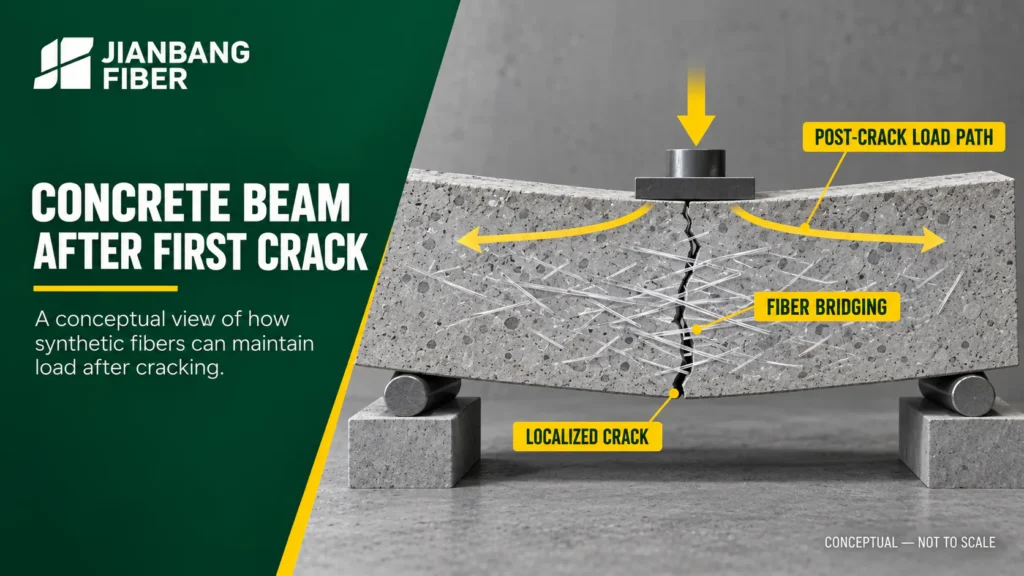
Fibers bridge cracks because they cross the fracture plane. As the two sides move apart, embedded fibers carry load through bond and pullout resistance. Their number, orientation, length, and embedment govern the result. Fiber tensile strength helps only if the matrix transfers force into the fibers and they remain effective at the crack widths that matter to the project.
Ordinary concrete often shows a sharp load decline once a dominant crack forms. A fiber-reinforced beam can show a declining but sustained load after the peak. This is still a meaningful gain even when the first peak does not increase much. It does not mean the member can replace designed reinforcement without an engineering check.
What The PAN And PVA Beam Tests Show
A published bending study compared plain concrete with two families of synthetic fiber concrete. The researchers used 12 mm polyacrylonitrile (PAN) and polyvinyl alcohol (PVA) fibers. Each family had four dosages: 0.9, 1.2, 1.5, and 1.8 kg/m³. The base mix had a stated water-to-binder ratio of 0.4, with cement, fly ash, sand, crushed stone, water, and a polycarboxylate admixture.
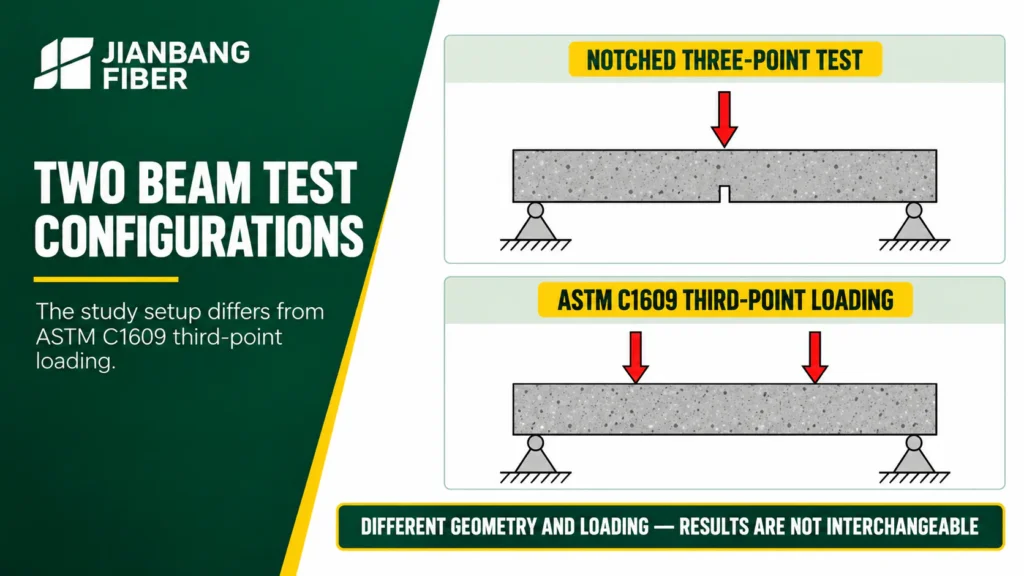
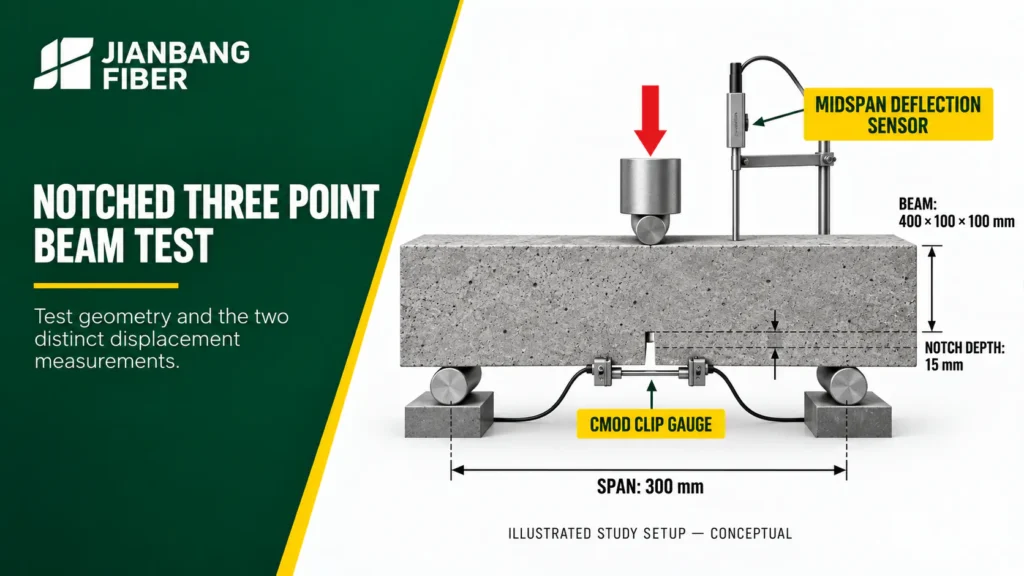
The beams measured 400 × 100 × 100 mm and were tested over a 300 mm span. A 15 mm deep notch was cut at the bottom of the beam. The test used a central load in three-point bending. A displacement sensor recorded midspan deflection, while a clip gauge at the notch recorded crack mouth opening displacement, or CMOD.
The plain control beam lost capacity rapidly after its peak. The PAN and PVA beams continued to carry load after cracking. The change is visible in the shape of the load–deflection curves, and it is quantified by energy and equivalent flexural strength at specified deformation intervals.
The finding has a clear limit. These are results for those fibers, that mix, those beam dimensions, and that loading setup. A supplier’s product with the same polymer name but different geometry, finish, or strength should not be assigned the same numerical performance automatically.
The Dosage Results In Context
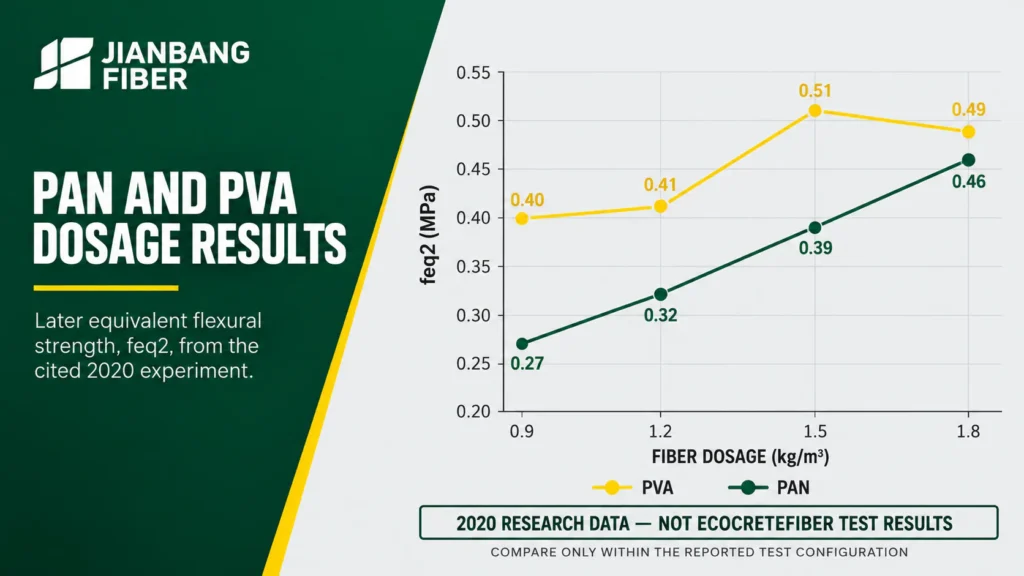
The tests measured fiber contributions to absorbed energy over two post-crack intervals, reported as D1f and D2f in N·mm. They also calculated equivalent flexural strengths, feq1 and feq2, in MPa. The later feq2 value is useful for seeing whether the beam retains capacity deeper into its deformation.
| Fiber | Dosage kg/m³ | Early energy D1f N·mm | Later energy D2f N·mm | Later equivalent strength feq2 MPa |
| PVA | 0.9 | 2,000.60 | 2,271.56 | 0.40 |
| PVA | 1.2 | 1,809.05 | 2,230.07 | 0.41 |
| PVA | 1.5 | 2,169.46 | 2,828.77 | 0.51 |
| PVA | 1.8 | 2,178.34 | 2,747.70 | 0.49 |
| PAN | 0.9 | 1,384.95 | 1,518.90 | 0.27 |
| PAN | 1.2 | 1,453.10 | 1,740.58 | 0.32 |
| PAN | 1.5 | 1,867.18 | 2,170.55 | 0.39 |
| PAN | 1.8 | 2,150.93 | 2,562.25 | 0.46 |
These values are study results, not Ecocretefiber™ product guarantees. They should be compared only within the reported test configuration. The exact meaning of each energy and equivalent strength index follows that test’s defined displacement intervals; it is not a universal residual-strength value.
PAN performance rose through the tested 1.8 kg/m³ level. The study reports fiber clumping above that level in its mixing conditions. PVA’s later equivalent strength reached 0.51 MPa at 1.5 kg/m³ and slipped to 0.49 MPa at 1.8 kg/m³. Its later energy value also declined slightly. A higher amount therefore did not deliver a higher late-stage result for every fiber.
For that particular mix, the main text and conclusion suggested roughly 1.5–1.8 kg/m³ PAN and 1.2–1.5 kg/m³ PVA for flexural toughness. The abstract gives a slightly different lower end for PVA. We use the main test discussion here. Neither interval is a default dosage for another project. Start with the project mix and define the target result before setting a trial range.
Why More Fiber Can Stop Helping
Adding fibers increases the potential number of bridges across a crack. It also changes the fresh mixture. At higher content, fibers can form clumps, restrict aggregate movement, and make compaction harder. Trapped air or a weak local zone may offset the benefit of the extra reinforcement.
The practical limit depends on fiber dimensions, bundle structure, surface treatment, aggregate grading, paste content, admixture compatibility, mixer energy, and the placement method. A dosage that disperses well in a laboratory pan mixer may behave differently in a truck mixer or a precast plant.
Watch both the early and later part of the curve. A mix could improve its early equivalent strength while failing to improve load retention at a larger deflection. The PVA series illustrates that distinction. A single “improvement percentage” can hide which part of the behavior changed.
The best dosage is thus an engineering decision, not the largest number a mixer can accept. Measure fresh workability, air, distribution, finish, and hardened flexural response at each trial level. Reject fiber balls before interpreting a favorable result from a small number of beams.
PAN Versus PVA What The Comparison Can And Cannot Prove
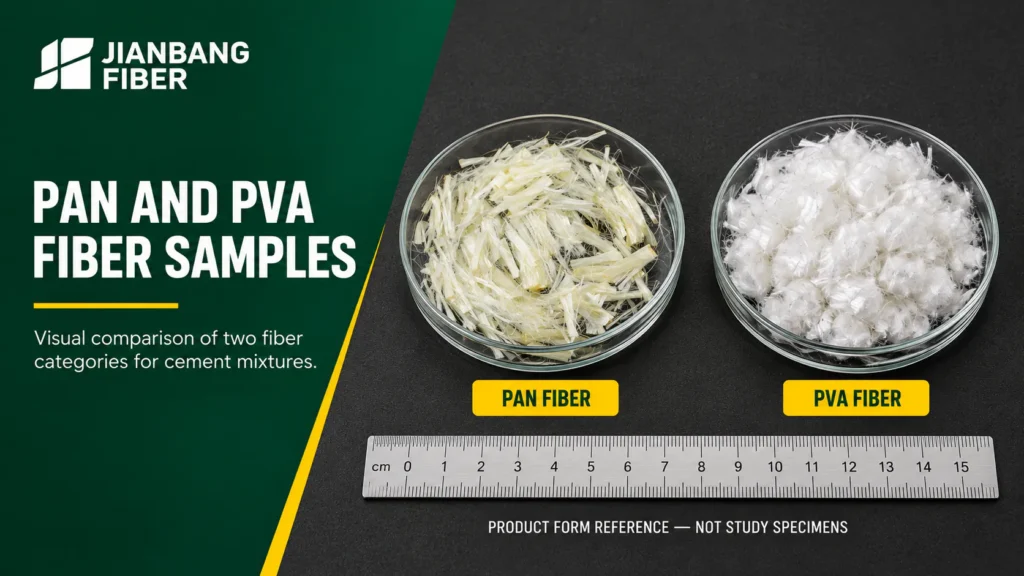
In the controlled comparison, PVA concrete absorbed more energy and showed higher equivalent flexural strength than PAN concrete at the same mass dosage. The PVA fiber used in that work had an elastic modulus of about 12.45 GPa, while the PAN fiber was about 11.48 GPa. The two had the same nominal 12 mm length.
Modulus was not the only difference. Their filament diameters, measured tensile forces, densities, and interaction with the cement matrix differed. The researchers did not hold every property constant and change modulus alone. It is more accurate to say that the tested PVA product outperformed the tested PAN product than to claim that modulus by itself caused the entire gap.
PVA fibers often have strong affinity with cement paste. Bond can help transfer load at a fine crack, while excessive bond in a specific engineered composite may cause fiber rupture rather than useful pullout. PAN fibers can also bridge microcracks, but their actual response depends on grade and interface. Ask for concrete beam data when the purchase decision depends on post-crack behavior.
Mass dosage also masks a density difference. The study listed PVA at 1.26 g/cm³ and PAN at 1.18 g/cm³. Equal kilograms per cubic meter do not provide exactly equal fiber volumes. Diameter affects the number of filaments and total potential intersections with a crack. A fair comparison needs more than a matched mass label.
Ecocretefiber™ offers PVA fiber for cementitious materials and PAN fiber for concrete and asphalt. Our current product pages describe multiple lengths and different grade specifications. Do not substitute their published single-fiber values for the exact fibers in the study. Request the current data sheet and test a selected grade in your own mixture.
Deflection And CMOD Answer Related Questions
Midspan deflection is the movement of the beam at its center during bending. CMOD measures the opening at the mouth of the saw-cut notch. The two readings often track each other after a dominant crack develops, but they are not the same displacement.
In the PAN tests, the relationship over the selected post-peak interval was close to linear. The study proposed an empirical expression linking deflection, CMOD, and PAN dosage for its beams. That equation was fitted after excluding an early nonlinear region and simplifying the individual regression intercepts. It should not be copied into a design spreadsheet for different beam sizes, fiber types, or loading methods without new validation.
CMOD can be convenient to measure when the clip gauge is firmly mounted at a controlled notch. Midspan deflection needs careful sensor setup and reference measurement. Neither method excuses an unstable loading frame, poor notch geometry, or inconsistent specimen curing.
A buyer should ask which signal produced the reported performance: load–deflection or load–CMOD. If two laboratories report different metrics, their numerical toughness values may not be directly comparable. Include specimen dimensions, span, notch details, control mode, measurement location, and the exact calculation rules with every report.
Choose The Right Test For The Contract
The study used notched, centrally loaded three-point beams and its stated Chinese test and evaluation methods. ASTM C1609/C1609M-24 instead evaluates beams under third-point loading using a load–deflection curve. The ASTM method reports first-peak and peak behavior, residual loads and strengths at specified deflections, and toughness to prescribed deflection.
These are different specimen and loading systems. A value calculated from the notched three-point test should not be relabeled as an ASTM C1609 result. Even when two methods both discuss toughness, their beam geometry, crack location, and endpoints influence the number.
For a project, write the specified method and edition into the purchase and trial plan. Request the complete curve and individual beam results, not only an average. Where a contractor must meet a residual performance target, the test report needs to show that exact endpoint under the required method.
The test method also needs to match the design decision. Plastic shrinkage crack control, impact behavior, post-crack bending capacity, and chemical durability are separate questions. One bending test is valuable, but it cannot prove all of these claims by itself.
A Trial Plan For Concrete Producers
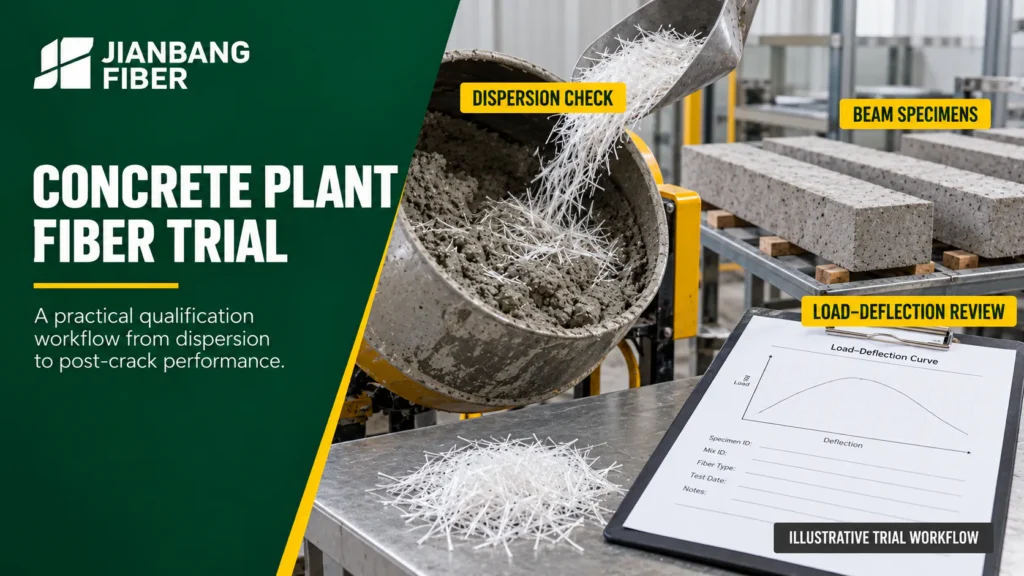
Begin with the concrete that will actually be supplied. Keep a plain reference mix and record cementitious materials, aggregate grading, water, admixtures, air, and target workability. Identify the structural or service goal: early cracking, later residual load, finish, impact, or a combination.
Select PAN or PVA fiber grades with a documented length, diameter, modulus, tensile specification, surface treatment, and batch identity. Set a practical dosage ladder around the proposed starting point. The laboratory range above can inform a starting discussion, but it must not predetermine the answer for another mix.
Add the fiber according to the selected product’s instructions and the plant’s validated sequence. Increase mixing enough to obtain uniform distribution without damaging the intended fiber form. Keep water adjustments measured and controlled. Trial the planned pumping, spraying, casting, or finishing operation as part of the qualification.
Make enough specimens for a useful comparison under the contract method. Cure and test them consistently. Record the full load response, first peak, specified residual points, and toughness endpoint. Note visible clumps, surface defects, and air differences. A beam with unusual fiber concentration at one crack plane should not be treated as representative of production.
Finally, compare delivered performance and total installed cost. Fiber price per kilogram is only one line in the decision. A stable, well-dispersed mix can reduce rejected units and help the plant meet its acceptance requirement. Ask the supplier to support a sample trial before an order is scaled up.
Where Flexural Toughness Matters
Pavement overlays and industrial floors need controlled crack behavior under service loads and repeated traffic. Precast sections need predictable handling and bending behavior. Repair mortars and thin cementitious elements can benefit from fibers that bridge fine cracks, provided the formulation and finish remain practical.
PAN and PVA should be compared with other reinforcement choices on the project target, not by polymer name alone. A PP microfiber may be selected primarily for early plastic shrinkage control. A macro synthetic or steel fiber may be considered when the required residual capacity and relevant design provisions support it. Our concrete fiber portfolio includes these options for different application needs.
Fiber reinforced concrete still needs good curing, joint planning, placement, and engineering. Fibers cannot repair a poor subbase, prevent every crack, or automatically replace specified steel bars. The strongest commercial claim is one that an agreed test can verify.
Frequently Asked Questions
Does A Higher Peak Flexural Strength Mean Higher Toughness
No. Toughness includes the load sustained over deformation. Two beams can reach a similar peak yet carry very different loads after cracking. Request the complete load–deflection curve and the agreed toughness endpoint.
Is PVA Always Better Than PAN For Bending
No. One controlled mix showed better results for its tested PVA fiber at matched mass dosages. Other fiber grades and concrete recipes can behave differently. Qualify the product and target performance in the project mix.
Can We Use 1.5 Kg Per Cubic Meter As A Universal Dosage
No. That number is a useful trial reference for one experimental system, not a standard prescription. Fiber geometry, grading, paste, workability, mixing, and the required residual endpoint can all change the appropriate dosage.
What Does CMOD Tell Us
CMOD is the opening measured at a notch mouth. It helps track crack development during a notched-beam test. It does not equal beam deflection, and an empirical conversion from one test should not be transferred to another geometry without validation.
Why Does A Fiber Rich Mix Sometimes Perform Worse
Clumping and entrapped air can reduce uniformity. A high dosage may also hinder placement or produce an unfavorable fiber orientation. Check fresh concrete and the spread of individual beam results before increasing the dosage again.
Conclusion
Flexural toughness is a property of the fiber, concrete, and test system working together. The PAN and PVA comparison shows meaningful post-crack gains, a dosage response that differs between fibers, and the need to read later residual behavior alongside early results. A reproducible trial provides stronger buying evidence than a single fiber specification.
Shandong Jianbang Chemical Fiber Co., Ltd. supplies Ecocretefiber™ PAN and PVA fibers for concrete applications. Tell us your mix design, placement method, test standard, and required residual performance. Contact our team to select sample grades and plan a practical beam trial before bulk purchasing.