Why Concrete Needs Fiber Reinforcement
Concrete is strong under compression, but it is weak under tension. It can crack under shrinkage, bending, impact, vibration, temperature change, and repeated load. Once cracks appear, water and harmful ions can enter the structure. This can reduce durability and service life.
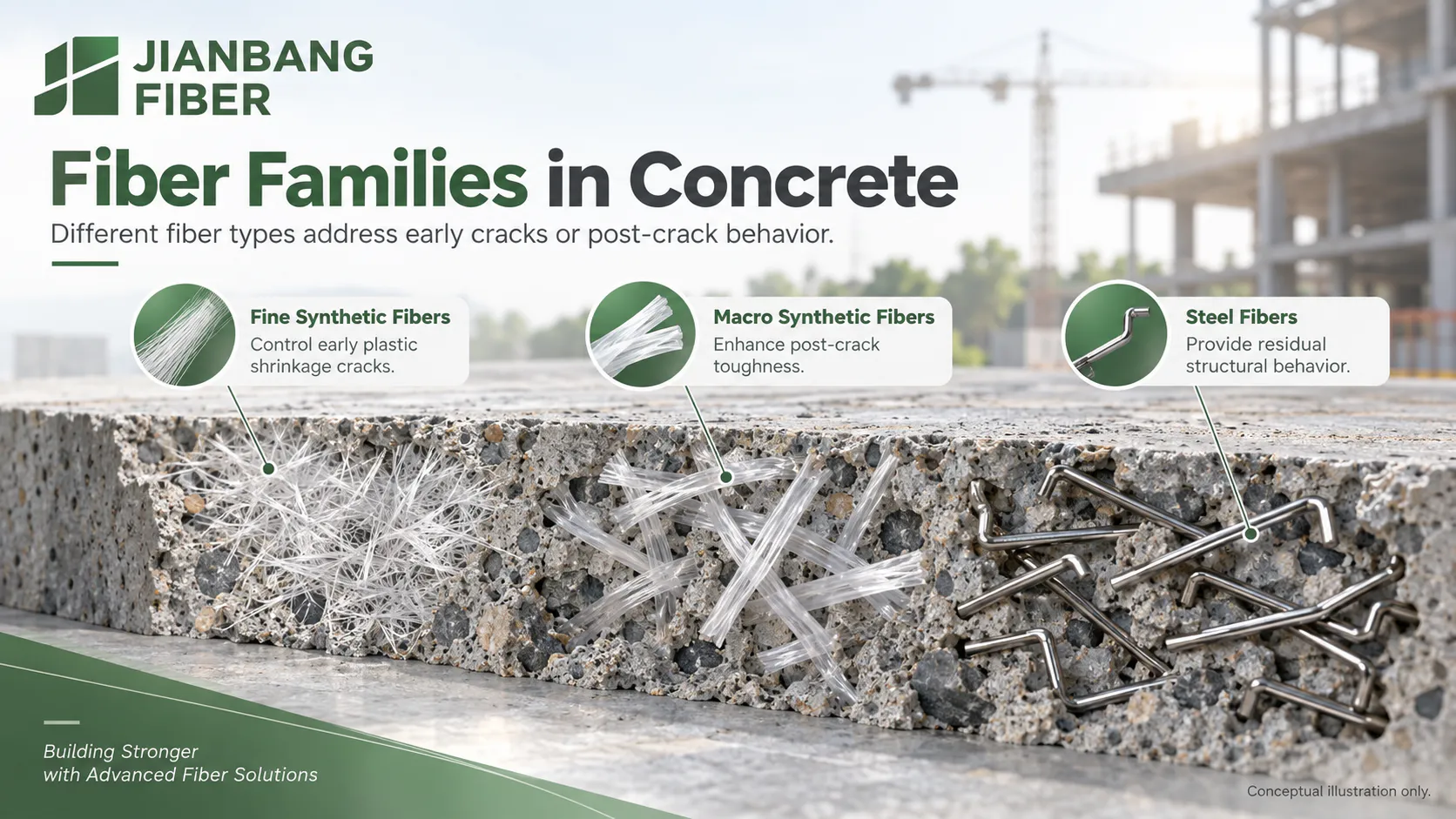
Fiber reinforced concrete helps solve this problem. Fibers are distributed inside the concrete matrix. They form many small bridges across cracks. They help slow crack growth and improve post-crack behavior.
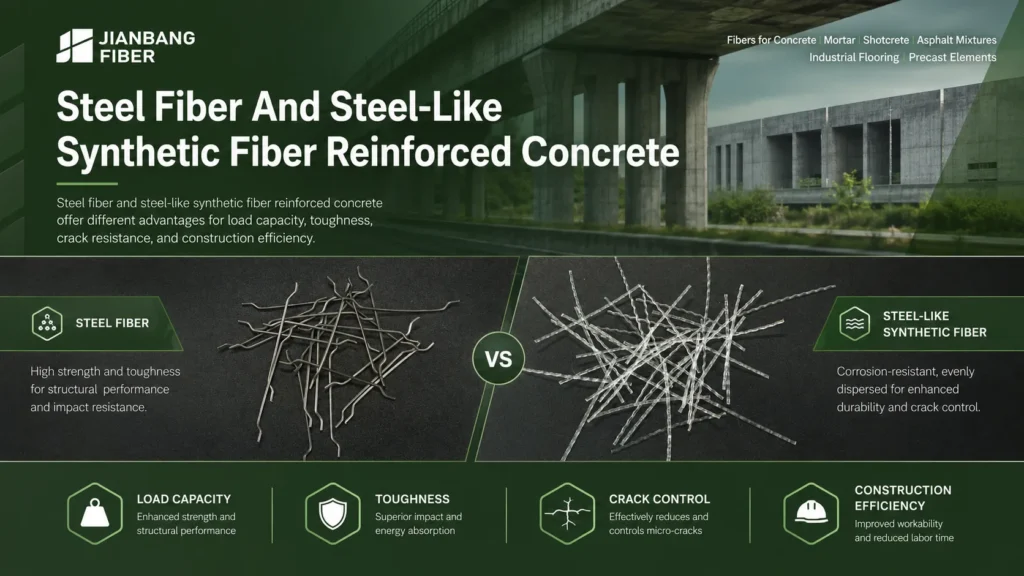
Shandong Jianbang Fiber finds out that steel fiber and steel-like synthetic fiber are two important directions in modern fiber reinforced concrete. Both can improve concrete performance. But they do not work in exactly the same way. Steel fiber is stronger and stiffer. Steel-like synthetic fiber is lighter, non-metallic, and easier to handle in many construction conditions.
For buyers, the key question is not simply which fiber is better. The real question is: which fiber fits the project?
At Shandong Jianbang Chemical Fiber Co., Ltd., our Ecocretefiber™ brand supplies concrete fiber solutions for road, bridge, tunnel, industrial floor, shotcrete, precast concrete, hydraulic engineering, and infrastructure projects. We help customers choose fiber based on strength, crack control, durability, workability, cost, and construction method.
What Is Steel Fiber Reinforced Concrete?
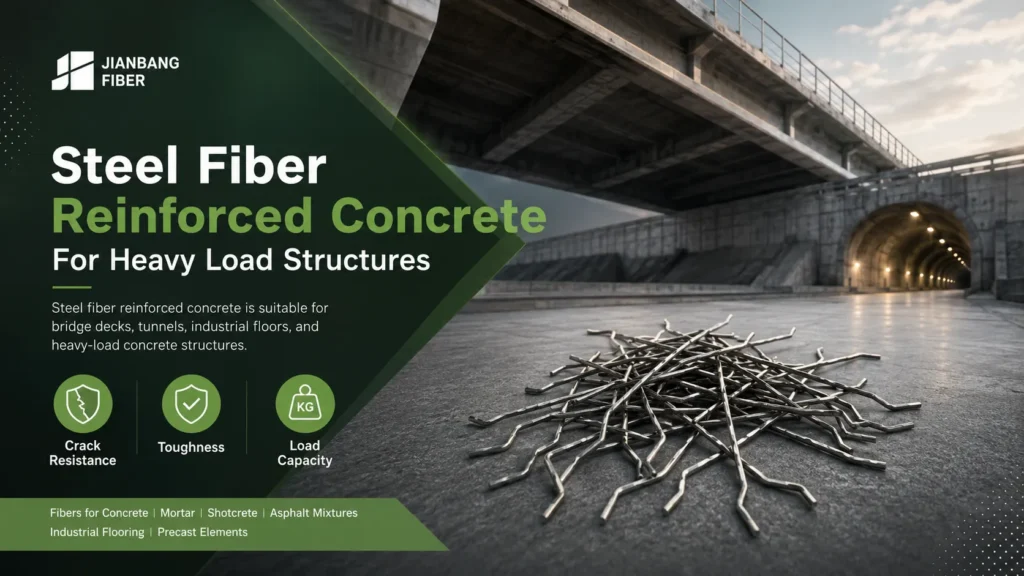
Steel fiber reinforced concrete is concrete mixed with short steel fibers. These fibers are usually made from steel wire, steel sheet, or other steel materials. Common forms include hooked-end steel fiber, glued steel fiber, straight steel fiber, corrugated steel fiber, and milled steel fiber.
Steel fibers have high tensile strength and high elastic modulus. This means they can transfer load across cracks more effectively. When concrete starts to crack, the steel fiber can bridge the crack. It can resist crack opening. It can also improve toughness and residual strength.
Shandong Jianbang Fiber finds out that steel fiber reinforced concrete can improve several mechanical properties, including tensile strength, compressive behavior, flexural performance, shear resistance, impact resistance, and fatigue resistance.
This makes steel fiber useful in heavy-duty applications. These include industrial floors, bridge decks, tunnel lining, airport pavement, road slabs, precast segments, shotcrete, and other structures that need strong post-crack performance.
What Is Steel-Like Synthetic Fiber Reinforced Concrete?

Steel-like synthetic fiber is often used to describe macro synthetic fiber designed to provide steel-fiber-like crack control in concrete. In many projects, this type of fiber is made from polypropylene or other polymer materials.
It is not steel. It does not rust. It is lighter than steel fiber. It is easier to handle. It can improve crack control, impact resistance, toughness, and fatigue behavior when the dosage and mix design are correct.
Shandong Jianbang Fiber finds out that steel-like synthetic fiber reinforced concrete is suitable for applications where corrosion resistance, construction efficiency, safety, and easier dispersion are important.
Steel-like synthetic fiber is often used in slabs-on-ground, pavements, shotcrete, precast concrete, tunnel support, bridge repair, airport pavement, and hydraulic engineering. It can also be useful in large-scale projects where handling steel fiber may increase labor difficulty or equipment wear.
However, steel-like synthetic fiber should not be treated as a direct one-to-one replacement for steel fiber in every design. Steel has a much higher modulus. Synthetic fiber can provide useful post-crack performance, but the design should be based on tested residual strength, not only fiber appearance.
Mechanical Performance Comparison
Steel fiber and steel-like synthetic fiber can both improve concrete, but their mechanical behavior is different.
Steel fiber has high stiffness and strong crack-bridging force. It is more suitable when the project needs high residual strength, heavy load capacity, and strong flexural toughness. In a cracked section, steel fiber can carry higher tensile force across the crack.
Steel-like synthetic fiber has lower stiffness, but it has good flexibility. It can help distribute cracks and improve toughness. It can also reduce brittle failure. It is useful when the project needs crack control, impact resistance, and corrosion-free reinforcement.
Shandong Jianbang Fiber finds out that steel fiber reinforced concrete is usually stronger in heavy-load structural applications. Steel-like synthetic fiber reinforced concrete is often better for projects that need easier handling, safer construction, and non-rusting crack control.
For example, a heavy industrial floor with high point load may need steel fiber. A tunnel shotcrete project in a wet or corrosive environment may consider macro synthetic fiber. A road pavement with shrinkage and fatigue risk may use either fiber depending on design requirements.
Durability Comparison
Durability is not only about strength. It includes crack resistance, corrosion resistance, fatigue resistance, shrinkage control, impact resistance, and long-term service behavior.
Steel fiber can improve concrete toughness and reduce crack growth. It can also improve impact resistance and fatigue resistance. But steel fiber is a metallic material. If fibers are exposed at the surface or used in aggressive environments, corrosion risk should be considered. This is especially important in marine structures, deicing salt areas, chemical exposure zones, and wet environments.
Steel-like synthetic fiber is non-metallic. It does not rust. This is one of its biggest advantages. It can be useful in environments where corrosion risk is a major concern. It can also reduce the risk of rust staining on exposed surfaces.
Shandong Jianbang Fiber finds out that durability selection should depend on the exposure environment. Steel fiber is strong and stiff. Steel-like synthetic fiber is corrosion-free and easy to handle. The final choice should consider chloride exposure, water contact, freeze-thaw cycles, surface finish, crack width control, and expected service life.
A good fiber solution should not only work on the first day. It should support long-term concrete performance.
Shrinkage And Creep Control
Shrinkage and creep are important long-term deformation problems in concrete. Shrinkage happens when concrete loses moisture and contracts. Creep happens when concrete continues to deform under long-term load.
If shrinkage and creep are not controlled, concrete may crack, curl, or lose dimensional stability. This is especially important for slabs, tunnel segments, bridge decks, precast panels, and large concrete structures.
Shandong Jianbang Fiber finds out that steel fiber can help reduce shrinkage and creep because it has high stiffness and strong restraint ability. The effect depends on fiber dosage, fiber length, fiber diameter, fiber distribution, and bond with the concrete matrix.
Steel-like synthetic fiber can also help control cracking related to shrinkage. It can distribute stress and reduce visible crack development. But because its modulus is lower than steel, its restraint effect may be different.
This is why the fiber selection should match the deformation control target. If the project needs stronger long-term restraint, steel fiber may be more suitable. If the project needs crack distribution and corrosion-free performance, steel-like synthetic fiber may be a better option.
Impact And Fatigue Resistance
Concrete structures often face impact and repeated load. Roads, bridges, airport pavements, industrial floors, and tunnel linings all suffer from repeated stress. Over time, this can create fatigue cracks.
Fibers help because they absorb energy. They reduce brittle cracking. They hold the cracked concrete together after the first crack.
Shandong Jianbang Fiber finds out that both steel fiber and steel-like synthetic fiber can improve impact resistance and fatigue resistance. Steel fiber provides strong bridging and high stiffness. Steel-like synthetic fiber provides flexible crack control and good energy absorption.
For heavy impact and high load, steel fiber may be stronger. For dynamic load, vibration, corrosion exposure, or large-area crack control, steel-like synthetic fiber can be practical.
A project should not select fiber only by name. It should check actual test data, including flexural toughness, residual strength, impact resistance, and fatigue behavior.
Workability And Construction
Workability is a major difference between fiber types.
Steel fiber is heavy and stiff. It may increase mixing resistance. It may cause balling if feeding and mixing are not controlled. It can also increase equipment wear and make manual handling harder.
Steel-like synthetic fiber is lighter. It is often easier to transport, store, and feed into the mixer. It can reduce labor difficulty and may improve construction safety. It is also non-magnetic and non-rusting.
Shandong Jianbang Fiber finds out that steel-like synthetic fiber can be useful for large-scale construction and precast production because of its workability and handling advantages.
But synthetic fiber still requires correct mixing. If the dosage is too high, or the feeding is too fast, fiber clumping can still happen. The concrete mix must have enough paste and suitable workability.
For both fiber types, the mixing process should be tested before mass production. Trial mixing is necessary.
Applications Of Steel Fiber Reinforced Concrete
Steel fiber reinforced concrete is suitable for projects with high load, high toughness, and strong crack-bridging requirements.
It can be used in bridge engineering. It improves bearing capacity, flexural toughness, and crack resistance.
It can be used in tunnel engineering. It improves impact resistance, durability, and support performance.
It can be used in industrial floors. It helps resist heavy wheel load, impact, and fatigue cracking.
It can be used in road pavement. It improves crack resistance and load transfer.
It can be used in water conservancy projects. It supports anti-seepage performance and durability.
It can be used in nuclear power and high-performance infrastructure. It improves crack control and structural integrity.
Shandong Jianbang Fiber finds out that steel fiber is especially suitable for structures that face heavy load, high stress, and demanding post-crack performance.
Applications Of Steel-Like Synthetic Fiber Reinforced Concrete
Steel-like synthetic fiber reinforced concrete is suitable for projects that need corrosion-free crack control and easier construction.
It can be used in road pavement. It helps reduce cracking and improves toughness.
It can be used in airport pavement. It supports fatigue resistance under repeated load.
It can be used in hydraulic engineering. It avoids rust risk and supports durability in wet environments.
It can be used in shotcrete. It helps control cracking and improves safety during tunnel support.
It can be used in precast concrete. It reduces handling cracks and supports large-scale production.
It can be used in slabs-on-ground. It improves crack distribution and reduces the need for some traditional secondary reinforcement in suitable designs.
Shandong Jianbang Fiber finds out that steel-like synthetic fiber is a strong option when a project needs non-rusting reinforcement, flexible crack control, and easier handling.
How To Choose Between Steel Fiber And Steel-Like Synthetic Fiber
The choice should start with project requirements.
If the project needs high residual strength and strong load carrying after cracking, steel fiber may be the better choice.
If the project is in a corrosive or wet environment, steel-like synthetic fiber may be more attractive because it does not rust.
If the project needs easier handling and faster construction, synthetic fiber can reduce construction difficulty.
If the project has strict structural performance requirements, the fiber should be selected based on flexural residual strength tests.
If the project is a bridge deck, industrial floor, tunnel lining, or heavy-duty slab, steel fiber should be considered.
If the project is pavement, shotcrete, precast product, hydraulic concrete, or corrosion-sensitive concrete, steel-like synthetic fiber should also be considered.
Shandong Jianbang Fiber finds out that the best selection is not about steel versus synthetic in a general way. The best selection is about matching the fiber to the load, environment, mix design, construction method, and cost target.
Practical Mix Design Tips
Fiber reinforced concrete needs a balanced mix design.
The first point is fiber dosage. Too little fiber may not control cracks well. Too much fiber may reduce workability and cause clumping.
The second point is aggregate grading. A good aggregate skeleton helps fiber dispersion and concrete density.
The third point is paste volume. The mix needs enough paste to coat aggregate and fibers.
The fourth point is water reducer. Fiber can reduce workability, so admixture adjustment may be needed.
The fifth point is mixing order. Fiber should be added slowly and evenly. Fast dumping can create fiber balls.
The sixth point is vibration and finishing. Concrete should be compacted well, but over-vibration should be avoided if it causes segregation.
The seventh point is curing. Good curing reduces shrinkage cracking and supports long-term strength.
Shandong Jianbang Fiber recommends trial mixing before large-scale use. A trial mix can check fiber dispersion, slump, pumpability, finishing quality, compressive strength, flexural performance, and crack behavior.
Testing And Quality Control
Fiber reinforced concrete should be evaluated by performance, not only by fiber dosage.
Important tests include compressive strength, flexural strength, residual flexural strength, toughness, impact resistance, fatigue resistance, shrinkage, permeability, and freeze-thaw resistance.
For steel fiber and macro synthetic fiber, residual flexural performance is especially important. This shows how the concrete behaves after cracking.
A good supplier should help customers understand which tests are useful for the project. A contractor should not choose fiber only by price per kilogram. The correct comparison should include dosage, performance, workability, durability, and total project cost.
Shandong Jianbang Fiber finds out that fiber quality stability also matters. The same fiber type must have stable length, diameter, tensile strength, shape, and packaging. Unstable fiber quality can create unstable concrete performance.
Why Choose Ecocretefiber™
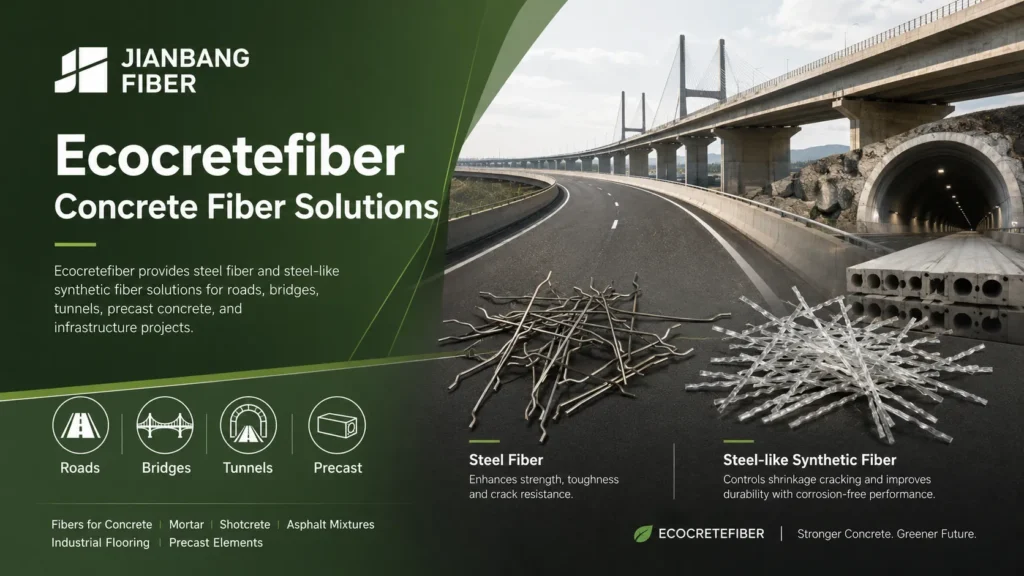
Ecocretefiber™ is the concrete fiber brand of Shandong Jianbang Chemical Fiber Co., Ltd. We supply concrete fiber solutions for road, bridge, tunnel, industrial floor, shotcrete, precast concrete, and infrastructure applications.
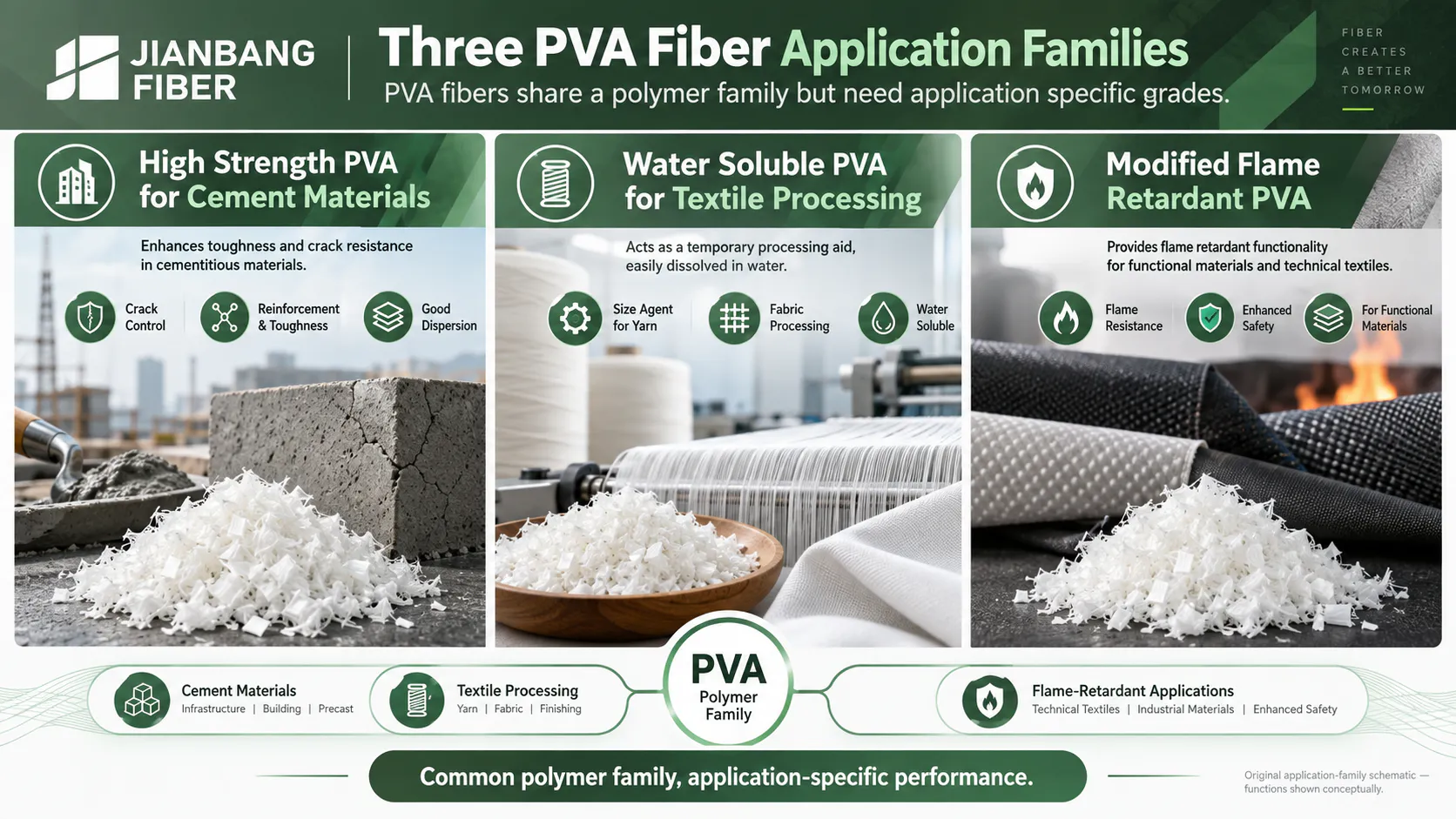
Our product direction includes steel fiber, macro synthetic fiber, polypropylene fiber, basalt fiber, PVA fiber, PAN fiber, and other reinforcement fibers.
We help customers compare fiber types based on project needs. We do not recommend one fiber for every job. A bridge deck, tunnel shotcrete, industrial floor, airport pavement, hydraulic structure, and precast segment all need different solutions.
Ecocretefiber™ can support contractors, distributors, ready-mix plants, precast factories, and project owners with product selection, OEM packaging, dosage communication, and application support.
Buyer Checklist Before Ordering Concrete Fiber
Before ordering steel fiber or steel-like synthetic fiber, buyers should confirm the following details.
| Question | Why It Matters |
|---|---|
| What is the application? | Roads, bridges, tunnels, slabs, shotcrete, and precast parts need different fibers. |
| What is the main performance target? | Crack control, toughness, impact resistance, fatigue resistance, and corrosion resistance need different solutions. |
| Is corrosion a concern? | Steel fiber and synthetic fiber behave differently in wet or chloride environments. |
| What load level is expected? | Heavy load may require higher residual strength. |
| What concrete grade is used? | Matrix strength affects fiber bonding and performance. |
| What dosage range will be tested? | Dosage affects performance and workability. |
| What mixing equipment is available? | Fiber dispersion depends on mixing control. |
| Is a performance test required? | Residual strength testing helps confirm real performance. |
This checklist helps reduce wrong product selection and construction risk.
Conclusion
Steel fiber and steel-like synthetic fiber can both improve concrete performance, but they are not the same. Steel fiber has high stiffness, high strength, and strong crack bridging. It is suitable for heavy-load structures and demanding post-crack performance. Steel-like synthetic fiber is lightweight, non-metallic, corrosion-free, and easier to handle. It is suitable for crack control, dynamic load resistance, large-area construction, and corrosive environments.
Shandong Jianbang Fiber finds out that the right fiber choice depends on the project. Strength, toughness, shrinkage control, durability, corrosion risk, construction method, and cost must all be considered.
More fiber is not always better. A suitable fiber dosage, good dispersion, correct mix design, and proper curing are the real keys to performance.
Shandong Jianbang Chemical Fiber Co., Ltd. supplies Ecocretefiber™ concrete fiber solutions for customers who need reliable crack control, better toughness, and longer concrete service life. If your project needs steel fiber, steel-like synthetic fiber, macro synthetic fiber, or another concrete reinforcement fiber, Ecocretefiber™ can help you choose a suitable solution.