Glass fibre reinforced concrete, often called GFRC, can solve many problems that normal concrete cannot. It can reduce panel weight, support thin sections, and create decorative shapes that are hard to make with ordinary reinforced concrete. At the same time, it is not a perfect material. Its disadvantages become very clear when it is used in the wrong place, made with weak process control, or judged only by its best marketing claims. ACI notes that the largest use of GFRC in the U.S. is exterior architectural cladding panels, while PCI’s current GFRC panel standard puts its main focus on thin-walled alkali-resistant GFRC architectural cladding panels made in controlled factory conditions. That already tells us something important: GFRC is valuable, but it is specialized.
So, what are the disadvantages of glass fibre reinforced concrete? The honest answer is that GFRC has six main weak points. It can face long-term durability concerns in alkaline and wet conditions. It often loses workability as fibre content rises. It does not always gain strength when more glass is added. It is highly sensitive to manufacturing quality. It is usually not a direct substitute for conventional structural reinforced concrete. It can also bring higher upfront cost and more production complexity on some projects. None of these points mean GFRC is a bad material. They mean it needs the right job, the right mix, and the right factory.
GFRC Still Has A Durability Problem To Manage
The first disadvantage is the one that has followed GFRC from the beginning: glass does not naturally like the alkaline cement environment. ACI explains that ordinary glass fibers, such as E-glass, were found to be attacked and eventually destroyed by the alkali in cement paste. That is why alkali-resistant glass with zirconia was developed in the first place. Even today, ACI’s durability report still discusses degradation and embrittlement of glass-fiber systems due to alkali attack and bundle effect.
This point matters because some buyers hear “alkali-resistant” and assume the problem is fully solved. It is not that simple. A 2022 review in Applied Sciences states plainly that GRC uses alkali-resistant glass fibers, but fiber durability is still limited because of the aggressive alkaline medium created during Portland cement hydration. A 2018 durability study reached a similar conclusion. It reported that even alkali-resistant fibers treated with zirconium oxide still show degradation in the cement matrix, and it added that humid conditions remain risky even after improvements such as silica fume.
This is one of the biggest reasons why GFRC should not be sold as a carefree material. It performs well when the matrix is designed correctly and the application matches the material. But if long-term moisture exposure, poor matrix design, or poor curing are ignored, the fibre system can age in ways that reduce toughness and reliability over time. For a material that is often selected for thin sections, that long-term behaviour matters a lot.
Workability Often Gets Worse As Glass Fibre Content Goes Up
The second disadvantage is practical and immediate: fresh concrete usually becomes harder to handle when glass fibres are added. A 2022 review in Materials found that glass fibers improved strength and durability in many cases, but they also decreased concrete flowability. The same review noted that higher glass fibre doses can slightly reduce mechanical performance because the mix loses workability, and it recommended more plasticizer when glass dosage goes beyond the normal optimum.
A 2022 experimental study on chopped glass fiber concrete reported the same trend in a more direct way. It found that slump decreased as glass fibre content increased. It also found that at low dosage the mix could improve, but after that point the results got worse. In that study, fiber contents above 0.15% performed worse than the control concrete.
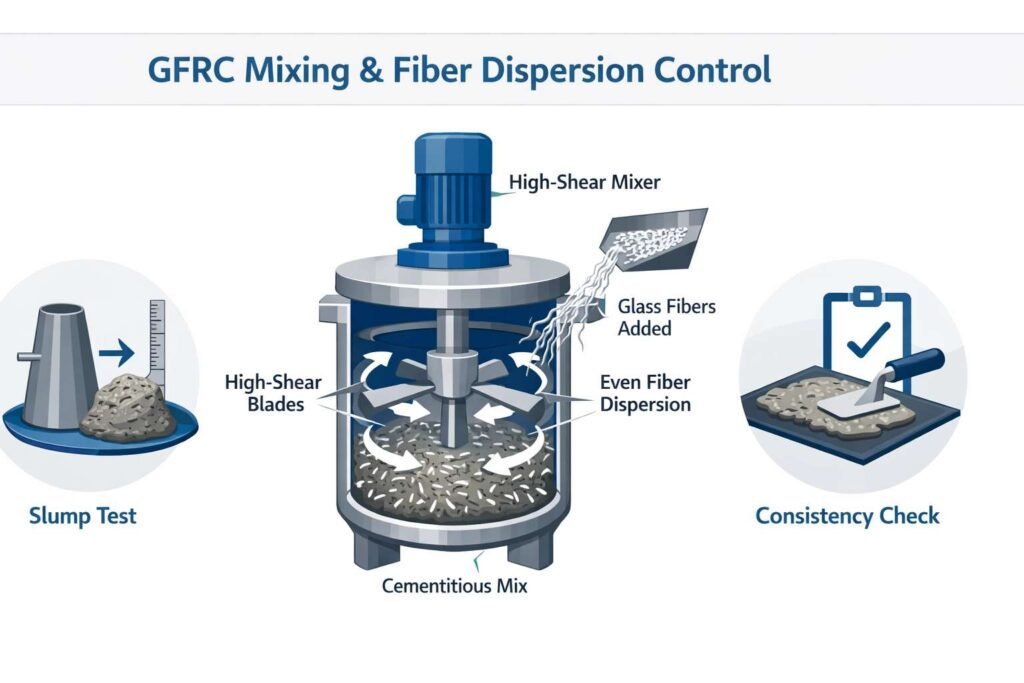
This disadvantage creates real site and factory problems. Low workability means harder placing, harder compaction, harder finishing, and greater risk of non-uniform fibre distribution. It can also force the producer to change water, admixture, or batching sequence. In other words, GFRC is not only a “stronger” concrete. It is a more sensitive concrete. If the mix design is not adjusted properly, the fibers that were supposed to help may instead make production harder.
More Glass Does Not Always Mean Better Performance
A common buying mistake is to think that adding more glass fibre will always make the concrete stronger. The research does not support that simple idea. The review in Materials says the typical optimum dose is around 2.0%, and it warns that higher doses may start to hurt performance because the mix becomes too hard to work with.
The experimental data above points in the same direction. The chopped-glass study found its best result at 0.10% fibre, then saw performance fall at higher contents. Another aging study on alkali-resistant glass fibre concrete found that 3% was the optimum level for compressive and flexural strength in its wet-medium exposure program, while 5% negatively affected the mechanical characteristics.
This is a real disadvantage because it makes GFRC less forgiving than some buyers expect. There is usually a narrow range where the fibers improve cracking behaviour and flexural response without causing fresh-mix problems or long-term penalties. Outside that range, the material can become harder to place and not clearly better in performance. So GFRC often needs testing and optimization instead of rough rule-of-thumb dosing.
GFRC Is Very Sensitive To Manufacturing Quality
The fourth disadvantage is that GFRC depends heavily on process quality. PCI’s GFRC guide specification requires a qualified manufacturer, PCI certification, engineering analysis based on production test values, source quality-control programs, source test reports, shop drawings, mockups, and controlled curing. PCI 128-24 also says its main focus is GFRC panels made in controlled factory conditions. That is a clear sign that this material is not intended for casual production without tight process control.
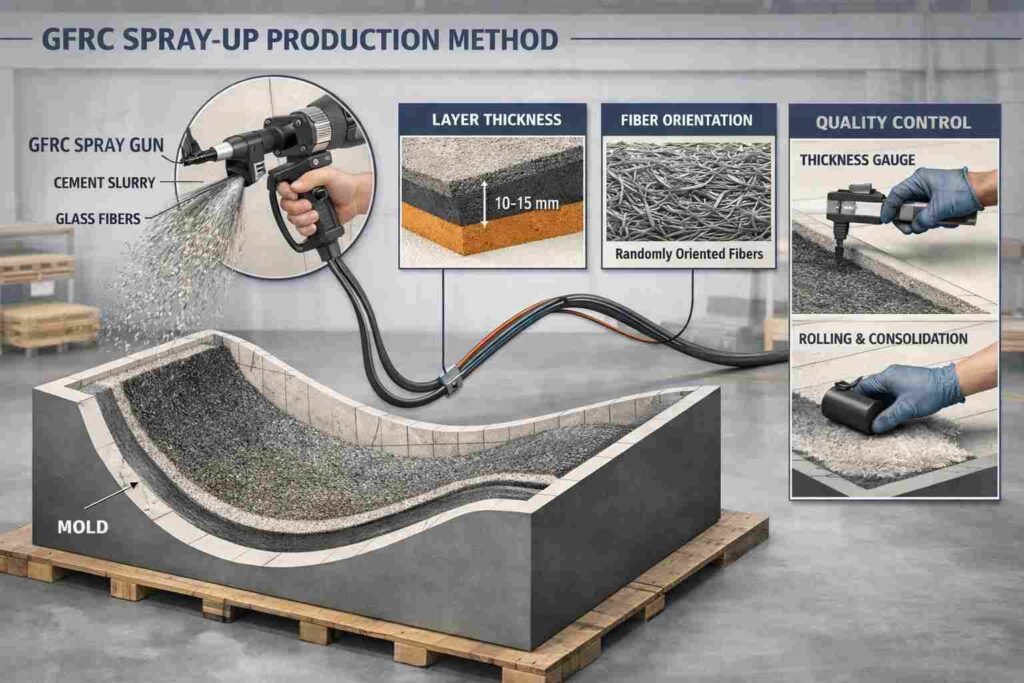
This process sensitivity is not only a paperwork issue. A TU Delft review of thin-walled GFRC production says current production methods have limits in material properties and surface quality, and it adds that the sprayed method depends on skilled workmanship because the GFRC is applied by hand. The same paper says premixed methods can improve quality through automation, but they are still limited in important ways, especially for complex shapes.
This means one of GFRC’s disadvantages is inconsistency risk. A good GFRC panel and a poor GFRC panel may look similar at first, but they may not have the same fibre orientation, density, curing quality, or surface finish. For buyers, this is important. GFRC is not only a material purchase. It is also a manufacturing-capability purchase. The supplier matters more than it does for many ordinary concrete items.
GFRC Is Usually Not A Direct Replacement For Conventional Structural Concrete
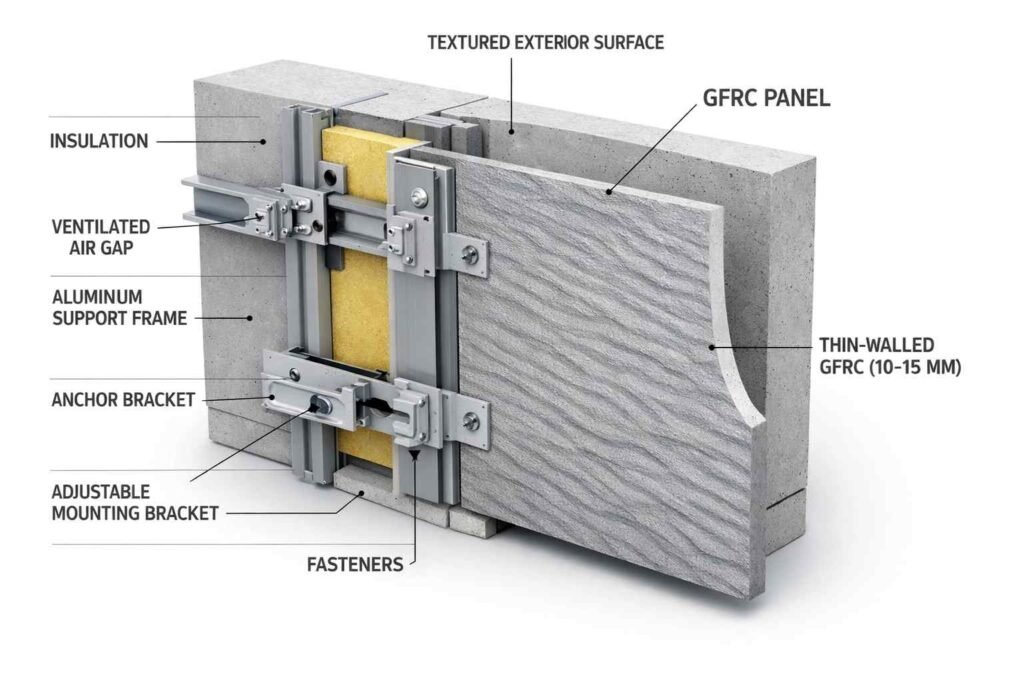
Another disadvantage is that GFRC is often misunderstood as a universal structural substitute. The standards and guidance do not support that idea. ACI says the largest use of GFRC in the U.S. is exterior architectural cladding panels. PCI’s current ANSI/PCI 128 standard puts primary emphasis on thin-walled architectural cladding panels. PCI’s guide specification is also written around GFRC panels, panel frames, anchors, and connection hardware.
That does not mean GFRC has no structural role at all. It means that in mainstream building practice it is mostly treated as a thin-walled panel material rather than as a direct substitute for thick, primary load-bearing reinforced concrete. The TU Delft review makes this easier to picture. It describes sprayed thin-walled panels as typically 8 to 20 mm thick and premixed panels as typically 40 to 60 mm thick, then notes that thicker plates would normally be considered conventional reinforced concrete.
So one disadvantage of GFRC is application range. It is excellent for facades, cornices, column covers, soffits, and lightweight architectural skins. It is less natural as a drop-in answer for beams, heavy slabs, and other conventional structural members where steel reinforcement, thicker sections, and familiar reinforced-concrete design rules remain the norm. Buyers who ignore this can end up forcing GFRC into jobs it was not meant to do.
Surface Quality And Complex Shapes Can Be Harder Than They Look
GFRC is often marketed through beautiful facades and freeform panels. That is fair, because the material really can create shapes that are hard for ordinary precast concrete. But this strength also hides another disadvantage: the more demanding the geometry and the appearance standard, the harder the production becomes. The TU Delft paper says current methods are limited when trying to produce more complex shapes, and it points to visible pores, voids, blemishes, and inconsistent side-surface quality as real challenges in thin-walled GFRC production.
The same paper gives a very practical example. It notes that a major complex-geometry building was originally designed with thin-walled GFRC elements, but the project was completed with GFRP elements instead because the GFRC production method and material performance had not developed enough to compete in cost and structural performance. That does not mean GFRC cannot do complex architecture. It means the difficulty curve rises fast when the design gets more ambitious.
This is a disadvantage that architects and buyers often feel late in the process. A panel that looks easy in a rendering may be much harder to make repeatedly with clean edges, stable thickness, low blemish rate, and reliable connections. For simple shapes, GFRC is very attractive. For very complex geometry, the project team must expect more sampling, more mockups, more trial work, and sometimes more compromise than the early concept suggests.
Upfront Cost And Process Complexity Can Be Higher
The last disadvantage is commercial rather than purely mechanical. GFRC is often more expensive up front than plain concrete. A 2022 review in Materials says GFRC is a more costly material than ordinary concrete, even though the overall structure can still become cheaper in some cases because of lower weight and lower maintenance.
This cost issue is easy to understand once the production route is clear. PCI standards point to controlled factory production, qualified manufacturers, engineering analysis, certification, source QC, mockups, and detailed fabrication requirements. Those things improve reliability, but they also add cost and reduce the appeal of GFRC for very simple, low-value work.
So the cost disadvantage is real, but it needs to be read correctly. GFRC is not always more expensive in total project value. It is often more expensive as a material-and-process package at the start. On projects where lighter cladding, design freedom, or lower dead load matters, that premium can make sense. On basic projects where normal concrete already works well, it may not.
Conclusion
The disadvantages of glass fibre reinforced concrete are not hard to list once the material is judged honestly. GFRC can suffer long-term aging and embrittlement in the alkaline cement environment, even when alkali-resistant glass is used. It often loses workability as fibre content rises. More glass does not always mean more strength. It needs tighter factory control and more skilled production than ordinary concrete. It is usually a thin-walled panel material rather than a direct replacement for conventional structural reinforced concrete. It can also bring higher upfront cost and more production complexity.
That said, these disadvantages do not make GFRC a poor material. They simply define its proper use. When the project needs thin architectural panels, reduced dead load, good shape freedom, and controlled factory production, GFRC can be an excellent choice. When the project needs a simple, forgiving, heavy structural concrete system, GFRC is often not the first answer. At Ecocretefiber™, we believe that good material selection starts with this kind of clear view. Shandong Jianbang Chemical Fiber Co., Ltd. supports that approach because the best concrete solution is not the one with the best brochure. It is the one whose strengths and limits both match the real job.