A piece of basalt rock cannot be placed into a concrete mix and expected to behave like a controlled fiber product. The rock must be suitable for melting and drawing. The melt must remain stable as it passes through tiny openings. The filaments must then be protected, cut, packed, and tested for the job they will do. Each step affects what a contractor receives.
At Shandong Jianbang Chemical Fiber Co., Ltd., we focus on that last connection: how a basalt fiber grade performs in a real cement or asphalt mixture. The Ecocretefiber™ basalt fiber range includes chopped fibers for those two applications. The same raw material can also become roving, fabric, or a fiber-reinforced polymer (FRP) bar through further processing, but those are different products with different design rules.
This guide follows basalt from quarry to finished strand. It explains why rock chemistry, melt behavior, bushing design, sizing, and consistent cutting matter. It then shows how a buyer can turn a product description into a practical quality plan for concrete or asphalt.
Start With the Right Basalt Rock
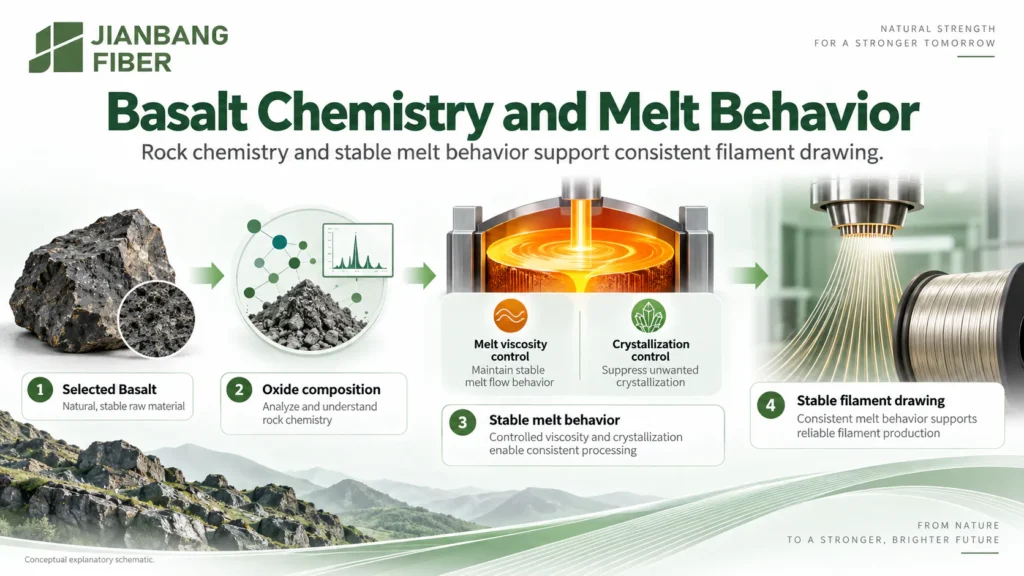
Basalt is an igneous rock formed from cooled lava. It contains several oxides, mainly silica and alumina with varying amounts of iron, calcium, magnesium, and alkalis. A potential fiber source needs chemical analysis and melting trials. Not every quarry produces rock that can be drawn into consistent filaments under the same process conditions.
Basalt deposits vary across regions, so a broad oxide range is useful for screening rock but cannot serve as a universal purchasing specification. A producer checks a defined range for the chosen ore and watches for unwanted mineral phases, moisture, and batch changes. More silica does not automatically mean a stronger filament, and a darker rock does not prove better corrosion resistance.
Rock selection connects chemistry to process behavior. Once melted, basalt has to flow at a viscosity suitable for drawing. If it becomes too viscous, flow through the bushing is difficult. If crystals appear as the melt cools, filaments may break or vary in diameter. Research on basalt melt behavior during fiber spinning describes why mineral composition, viscosity, and crystallization must be controlled together. A stable source and careful blending can therefore be as important as a furnace temperature printed in a brochure.
A buyer rarely needs the full quarry recipe. The buyer does need evidence that the supplied grade has consistent diameter, length, strength, and handling behavior between lots. Traceability from fiber batch to test record is much more useful than a broad claim that all basalt fibers share the same properties.
What Happens in a Basalt Fiber Plant?
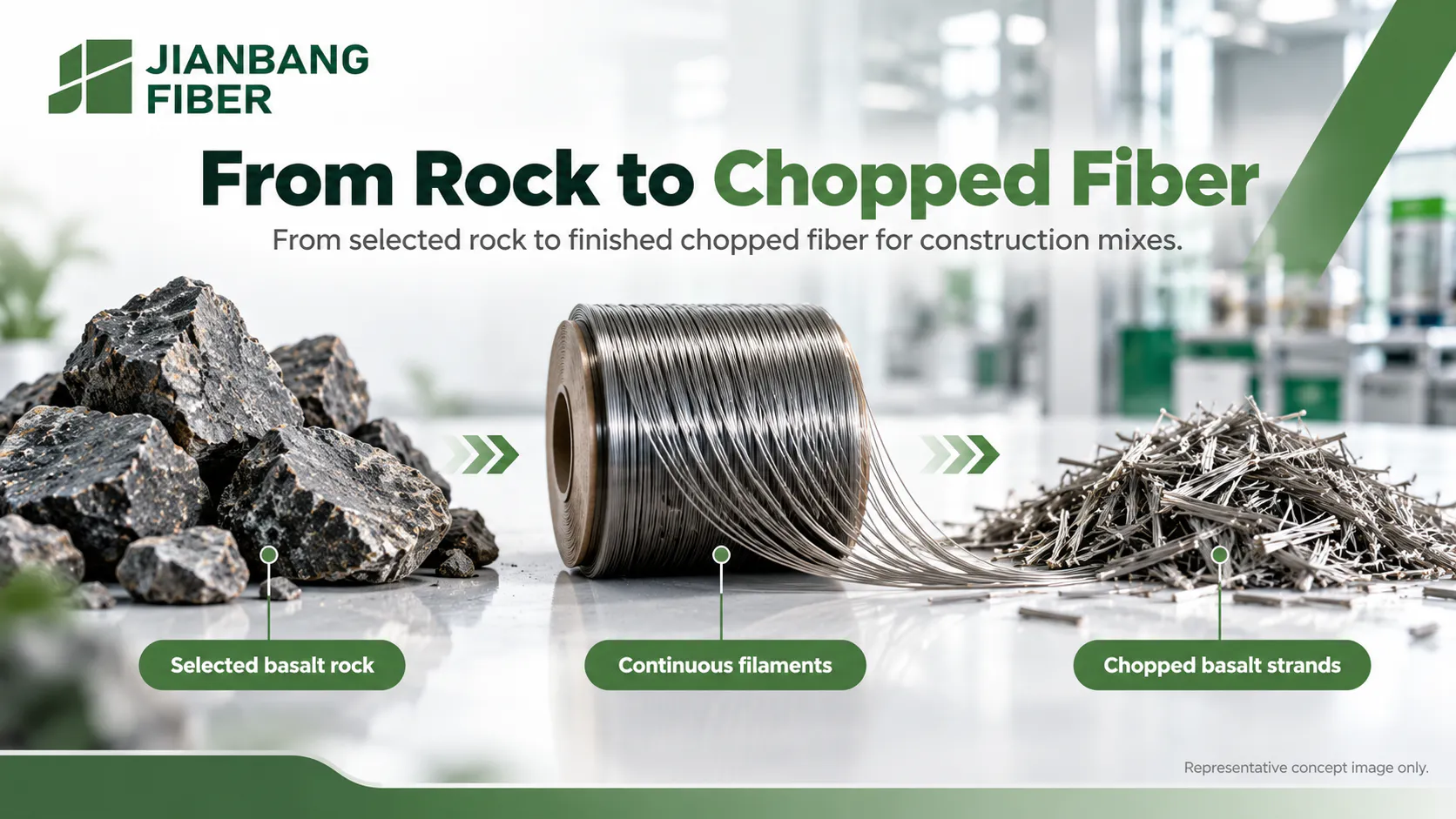
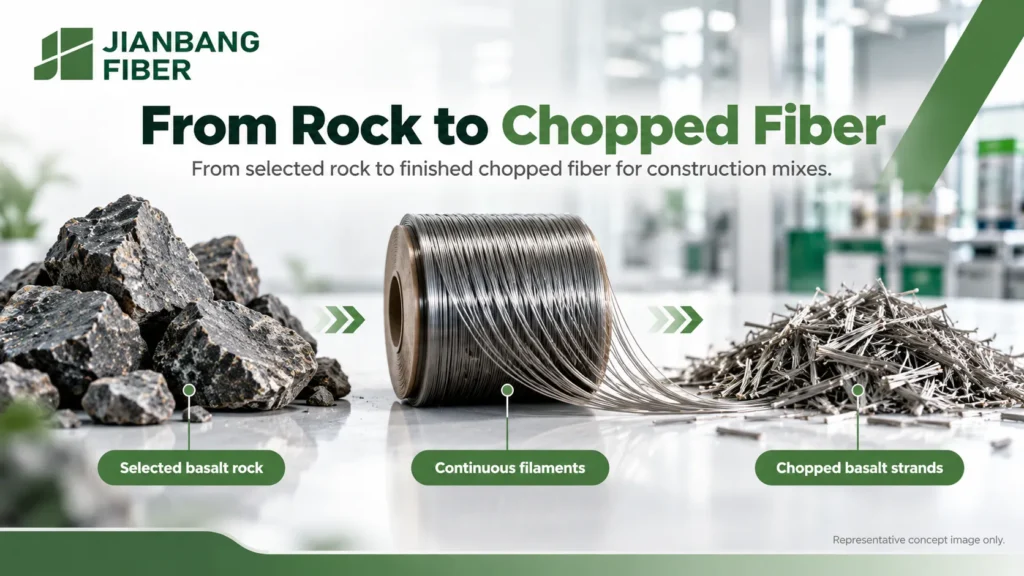
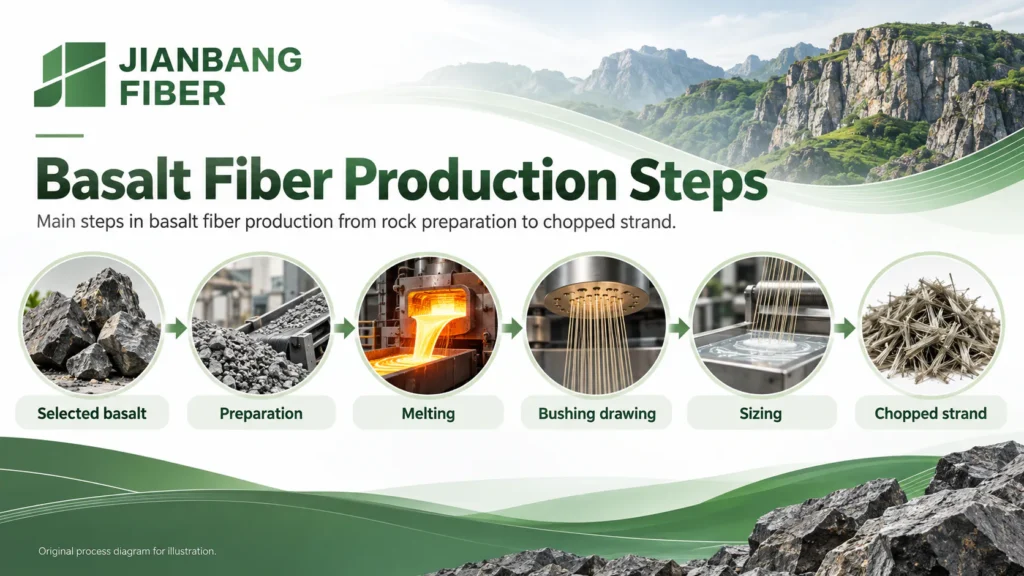
The basic route is easy to picture: selected rock is prepared, melted, and drawn into continuous filaments. In practice, each operation needs control. Rock size and moisture affect feeding and heat transfer. The furnace must produce a homogeneous melt. A bushing with many small openings forms the filaments, and a drawing system sets their diameter. A finish or sizing is commonly applied as they cool, followed by winding and, for chopped products, cutting and packaging.
ASTM D8448/D8448M-22 describes basalt fiber strands, including rovings and chopped strands. Its scope notes the melt-drawing route and the typical application of sizing. This is why a statement that basalt fiber is produced with “no additional materials” needs care. The rock may be the main melt feed, while surface treatment, packaging, or later resin impregnation still belongs to the finished product process.
Melt stability is more than a temperature number
A furnace operating around the temperatures commonly discussed for basalt fiber does not guarantee a stable filament. The useful drawing window depends on the ore. Operators need a melt that is uniform and sufficiently fluid at the bushing, without premature crystallization. Recent experimental work has examined the upper crystallization limit and drawing temperature. This is a better way to think about process control than claiming every basalt must be melted at one exact setting.
Moving from small furnaces and bushings to larger production lines brings an engineering challenge. Adding more openings can raise output, but it also makes temperature uniformity, flow distribution, filament breaks, and maintenance more demanding. A high hole count alone is not proof of lower energy use or higher quality. Ask for stable output, consistent product tests, and lot-to-lot records rather than a single machine-size claim.
Filament diameter and sizing shape the next product
The continuous filament can be wound as a roving, formed into a textile, or chopped into short strands. Diameter influences surface area and the number of filaments in a kilogram. It can also affect handling and the strength measured on an individual filament. Sizing helps protect fibers during processing and can be chosen for compatibility with a binder or resin. It should be identified when interface performance is important.
For concrete, the next challenge is dispersion and alkaline exposure. For asphalt, it is blending with hot aggregate and binder. For FRP, the resin and fiber volume fraction become central. A certificate for raw roving does not, by itself, prove the performance of any one of those finished products.
A Fiber Product Is Defined by More Than Tensile Strength
Tensile strength and modulus are useful screening properties, yet they are measured on a specified specimen under a specified method. An individual filament, a strand, and a concrete beam do not give interchangeable numbers. The strength measured in a strand may differ from a single-filament result. Damage, twists, alignment, and test geometry matter.
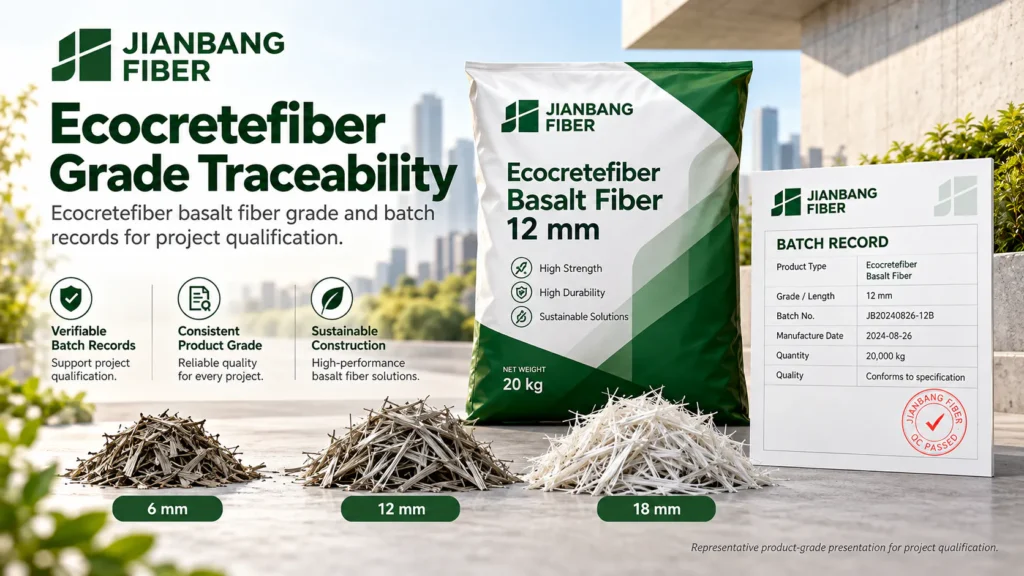
Ecocretefiber™ currently lists at least 1,200 MPa tensile strength, at least 75 GPa elastic modulus, 2.6–2.8 g/cm³ density, and standard cut lengths of 3, 6, 9, and 12 mm for its listed basalt fiber product. These are product-page figures for a defined offering, not properties of every basalt fiber in the market. Buyers should request the current data sheet and batch certificate, including the exact test methods and tolerance for the selected grade.
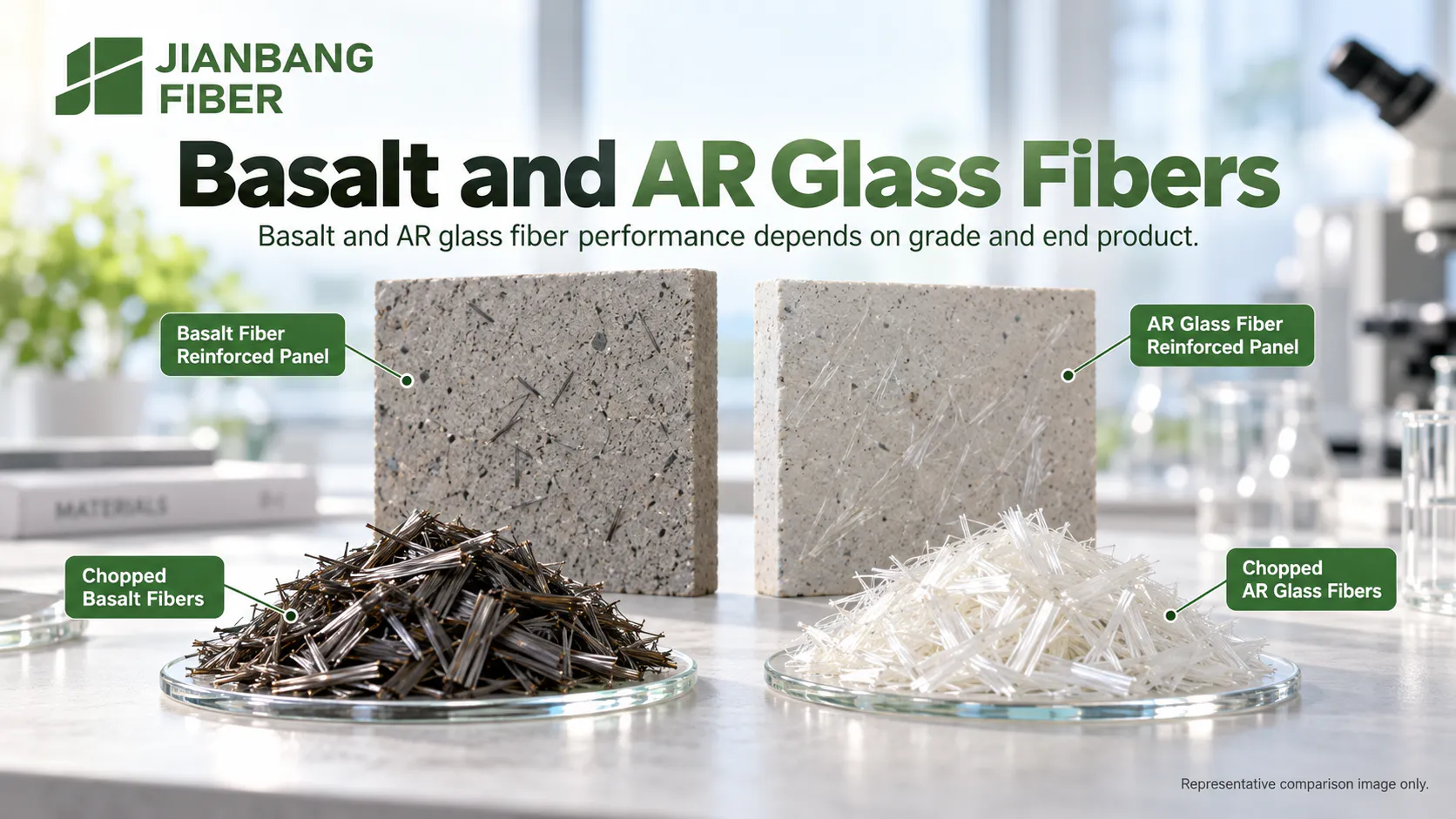
The other major property is durability in the actual matrix. Basalt is inorganic and will not rust like steel, but cement’s highly alkaline pore solution can still alter a silicate fiber. Fiber chemistry, sizing, temperature, moisture, and exposure time change the result. Experimental work on short fibers in an alkaline binder found substantial loss for basalt in the tested system. That result does not settle every Portland cement application. It shows why a blanket claim of permanent alkali resistance is insufficient. Where long-term performance matters, specify a relevant retained-property or composite durability test.
For asphalt, the fiber encounters mixing heat and a different binder. Its useful property is the behavior of the asphalt mixture at the target fiber content, gradation, binder content, and compaction level. Avoid transferring a concrete alkali test or a single-filament strength number to a pavement performance claim.
| Stage | Supplier control to request | Buyer verification |
| Rock and melt | Selected feed and consistent melt process | Grade identity and lot traceability |
| Filament and strand | Diameter, tensile test, finish or sizing | Data sheet and certificate for the delivered grade |
| Chopped product | Cut length, moisture, packaging, cleanliness | Sampling and dispersion in the target mix |
| Finished composite | Suitable formulation and production method | Fresh and hardened concrete or asphalt tests |
Match Chopped Fiber to Concrete, Mortar, or Asphalt
Concrete and mortar
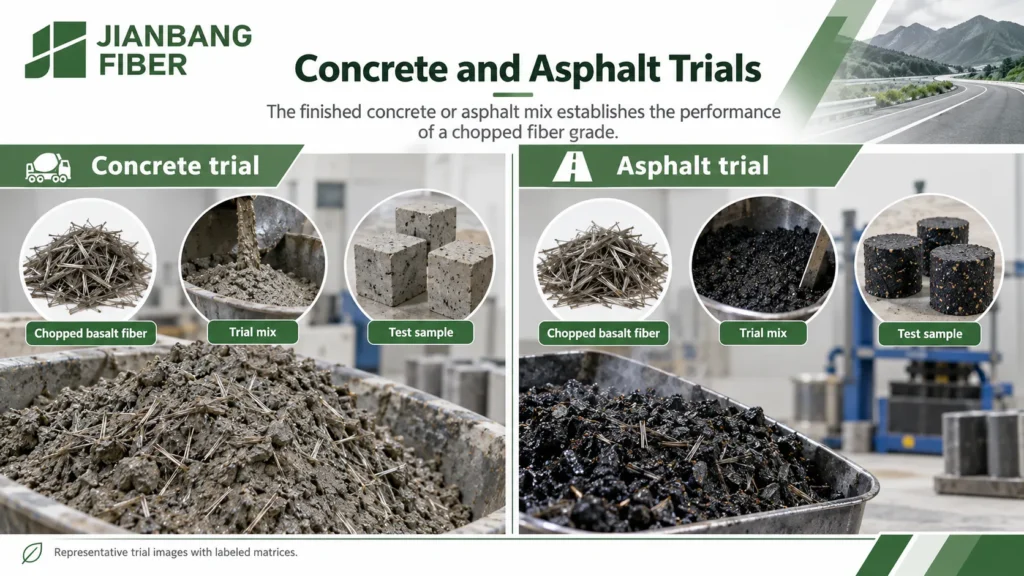
Chopped basalt can be evaluated as distributed secondary reinforcement in slabs, precast components, repair mortar, and other cementitious mixes. Short fibers may help control cracking or improve a specified toughness response when the mix is properly designed. The required outcome must be written as a testable criterion, because the same fiber can behave differently with a new aggregate, binder, admixture, or mixing sequence.
China’s current GB/T 23265-2023, *Chopped Basalt Fiber for Cement Concrete and Mortar*, replaced the 2009 edition cited in older industry writing. Use the current edition when it applies to the project. It addresses the fiber material; the concrete producer and engineer still need to qualify the complete mix under the relevant project codes. For a specified post-crack flexural result, ASTM C1609/C1609M-24 offers a recognized beam test method in jurisdictions that adopt it.
Ecocretefiber™ gives an indicative 1.0–3.0 kg/m³ range for general concrete and mortar trials on its basalt product page. That range is a starting point. The final content must meet the project’s fresh workability, dispersion, strength, crack, durability, and placement requirements. It does not authorize the removal of mesh or rebar without an engineer’s design and suitable performance evidence.
Road asphalt mixtures
In asphalt, chopped basalt is mixed with aggregate and binder to produce a uniform mix. A fiber may help stabilize binder and change rutting, moisture, or crack behavior, but each result depends on the asphalt formulation. Ecocretefiber™ lists an indicative 0.2%–0.4% by total mix mass for asphalt trials, with adjustment to the actual mixture. This is not a universal pavement recipe.
China also has a separate current standard, GB/T 42280-2022, *Chopped Basalt Fibers for Road Asphalt Mixture*. Distinguishing the asphalt and cement standards prevents a buyer from asking for the wrong qualification document. Trial production should verify dosing, dry blending or other approved feed sequence, mix temperature, binder distribution, compaction, and the performance tests named by the pavement specification.
Roving, fabrics, and FRP products
A continuous basalt roving can be woven or impregnated with resin to make another type of reinforcement. That creates options for composites, but the finished product’s properties depend on resin, fiber alignment, cure, and test conditions. A chopped strand for concrete cannot be substituted for a structural FRP bar, and a roving tensile result cannot qualify a finished bar. If the design uses a bar, obtain its separate standard, product certification, and engineering approval.
Scale, Cost, and Environmental Claims
Basalt manufacturing has genuine scale-up challenges. Furnace size, platinum-alloy bushings, process energy, output, and development of finished products all affect supplier economics. Capacity, electricity use per ton, ore price, and savings from a proposed furnace design need current, plant-specific evidence. They cannot be inferred from a general industry figure.
A larger furnace can spread fixed heat loss over more output, but actual energy use depends on yield, fuel, electricity mix, furnace design, shutdowns, and the proportion of fiber that meets specification. More bushing holes can increase nominal output while also creating control and maintenance demands. When a purchase depends on production capacity, ask the supplier for current lead time, stable monthly output, quality yield, and an achievable shipment plan.
The environmental comparison also needs a defined basis. A natural rock feed does not make melting emissions disappear. Heating and drawing consume energy, and the finish, packaging, freight, waste treatment, and later composite processing all count. If a project needs a quantified carbon claim, request a product-specific environmental declaration or a life-cycle assessment with a clear functional unit. “No waste” and “zero emissions” are not suitable conclusions from rock origin alone.
Compare price at the qualified finished-product level. A cheaper fiber per kilogram may need a higher dose, different binder content, or extra processing. A more expensive grade may save cost if its verified performance allows a better product design. Both cases need measured results, not a generic basalt-versus-carbon or basalt-versus-glass price ratio.
What to Ask a Basalt Fiber Supplier
A useful inquiry describes the finished material before it asks for a price. Tell the supplier if the fiber goes into Portland cement mortar, ready-mix concrete, hot-mix asphalt, a textile, or an FRP product. State the application, exposure, mixing or fabrication equipment, performance target, and governing standard.
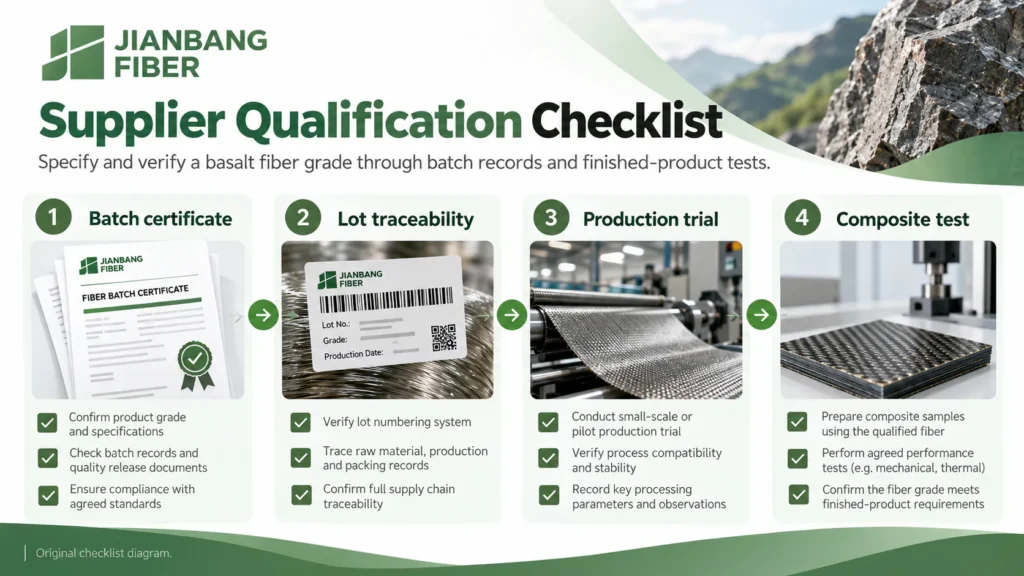
1. Define the grade. Request the exact cut length or roving form, diameter information, sizing, density, and packaging.
2. Check lot consistency. Match the certificate of analysis to the delivered batch and agree on tolerances before the trial.
3. Confirm exposure evidence. For cement, ask about alkaline durability in a relevant matrix; for asphalt, check mixing-temperature handling and mixture performance.
4. Run the plant trial. Record fiber feed point, dose, mixing time, dispersion, workability, and any pumping or compaction issues.
5. Test the product. Use the specified concrete, mortar, asphalt, or FRP method, with an acceptance threshold set before production.
For repeat purchases, keep the trial record linked to the fiber grade and batch. If rock source, process, sizing, or cut length changes materially, decide whether the change calls for another qualification trial. This approach turns a promising mineral fiber into a reproducible construction material.
Frequently Asked Questions
Does every basalt rock make fiber? No. Ore chemistry, melt viscosity, and crystallization behavior must support stable drawing. A producer selects and controls the feed source.
Is basalt fiber made with no additives? The melt may be based mainly on selected basalt rock, but a surface sizing is commonly applied to drawn strands. Later products can also contain resin or other materials.
Is chopped basalt the same as basalt FRP rebar? No. Chopped strands distribute through a mix. FRP bars are engineered fiber-resin composites with separate testing and design rules.
What dosage should I specify for concrete? Use the supplier’s indication to plan a trial, then set the final dosage from the target mix’s workability and hardened performance tests. An engineer must assess any proposed reinforcement substitution.
Is basalt fiber a zero-carbon material? No quantified environmental conclusion follows from its natural feedstock alone. A credible comparison accounts for production energy, yield, sizing, transport, and the finished product’s service life.
Turn Rock Into Measured Performance
The journey from basalt rock to a reliable fiber is a chain of material and process decisions. Ore selection controls the melt. Stable drawing controls filament quality. Sizing, cutting, and packaging affect the form that reaches the plant. The final test is the finished concrete, asphalt, or composite under the conditions it will face.
Shandong Jianbang can help you evaluate an Ecocretefiber™ basalt grade for the intended mix. Contact our team with the application, fiber form, target performance, and trial quantity, and we can provide the current grade information for your qualification plan.