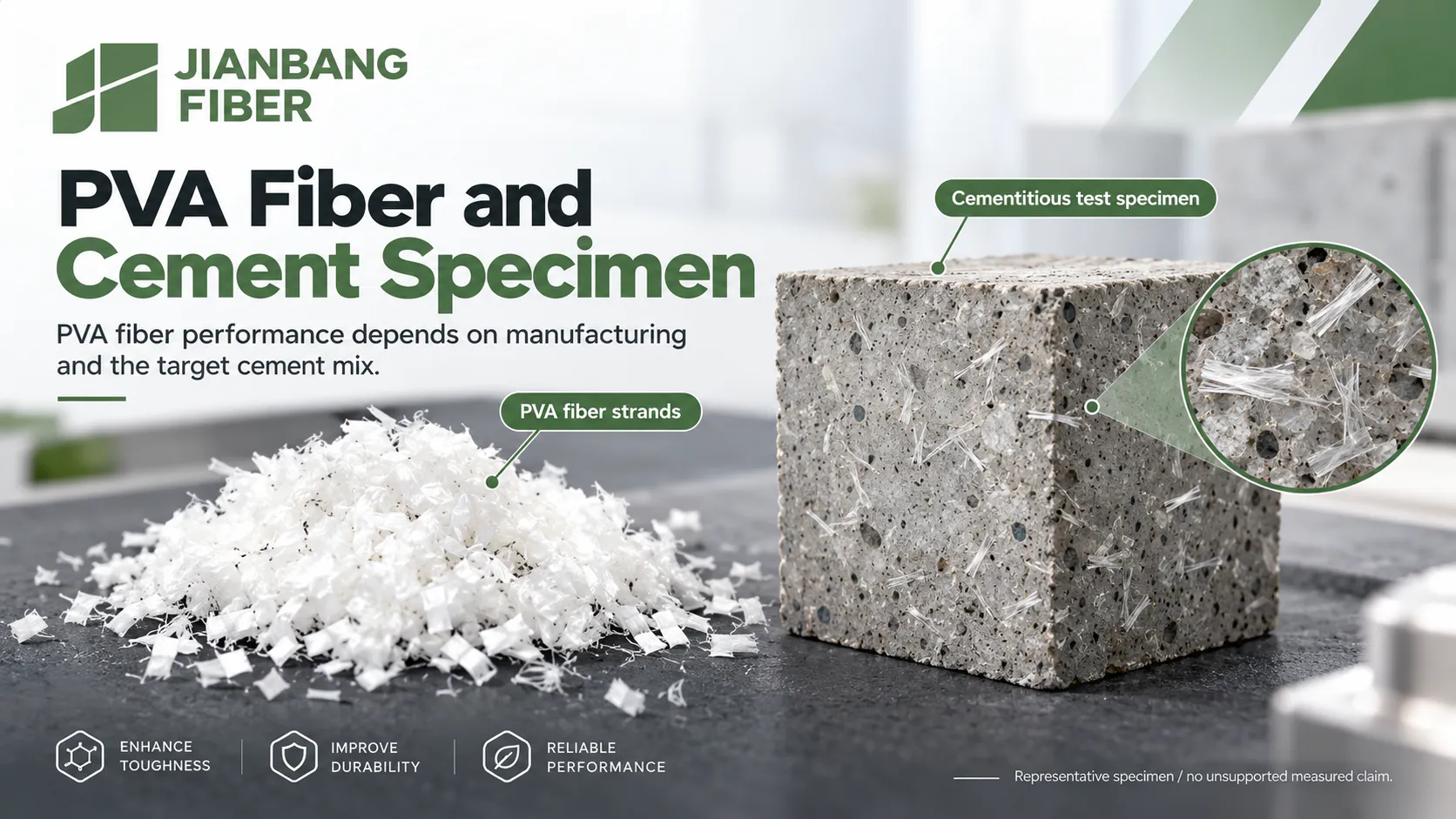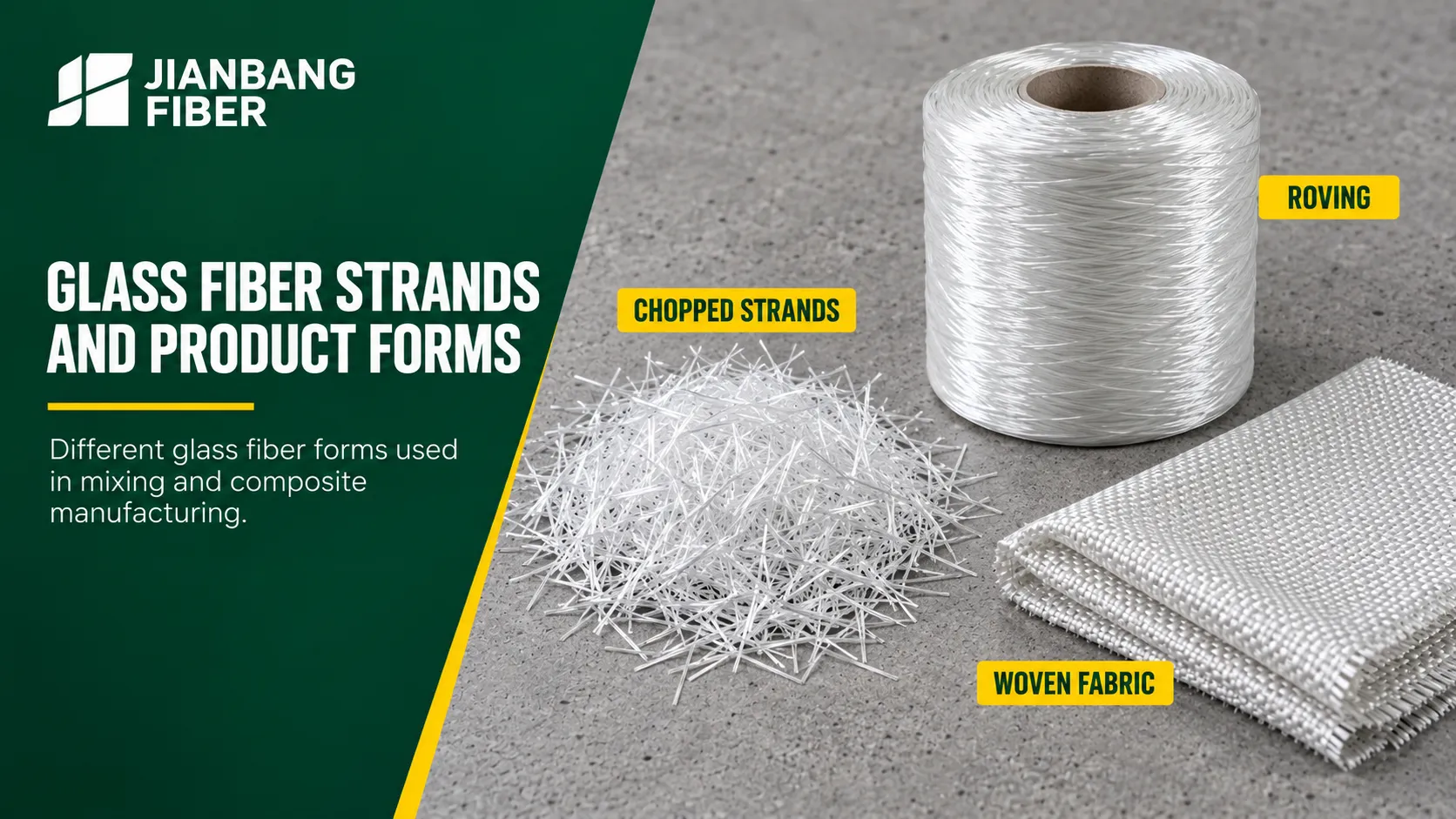
A PVA fiber does not become suitable for concrete simply because its polymer has a high tensile strength. Its behavior depends on the resin, the spinning route, the way the filament is drawn and heated, its surface, and the mix into which it is placed. Those choices determine whether a fiber dissolves in warm water, holds its shape in a cement matrix, or bonds so strongly that it breaks before it can pull out of a crack.
At Shandong Jianbang Chemical Fiber Co., Ltd., we use that manufacturing perspective when discussing Ecocretefiber™ PVA fiber with concrete and mortar producers. The useful question is not only “What is PVA fiber?” It is “Which PVA fiber was made for this application, and how will the finished mix prove its performance?”
This guide follows the material from vinyl acetate to a finished filament. It then connects each production step to the properties a buyer needs to check. Historical process conditions in fiber literature help explain the chemistry, but they are not a specification for every modern product line.
The Chemistry Begins With Vinyl Acetate
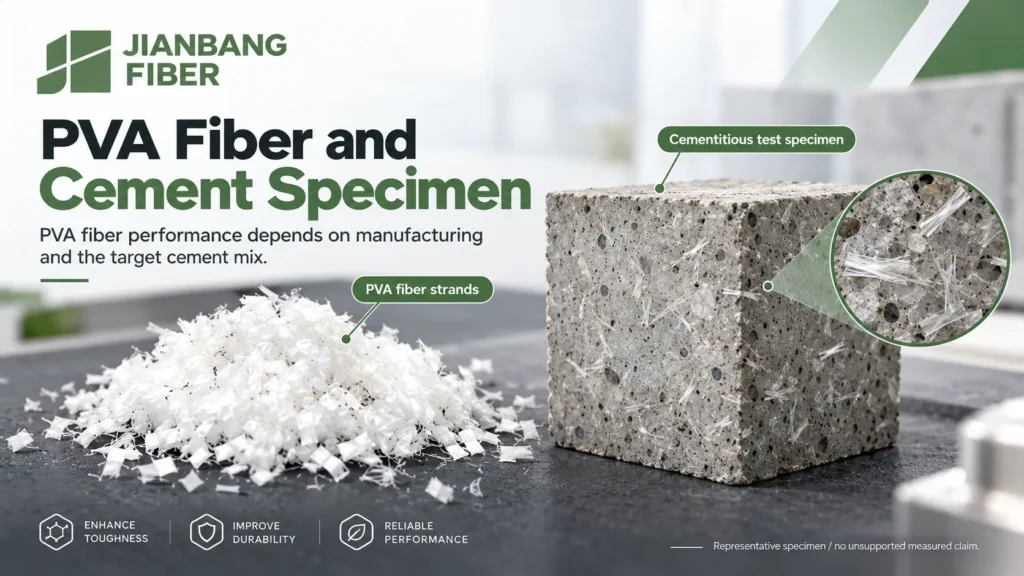
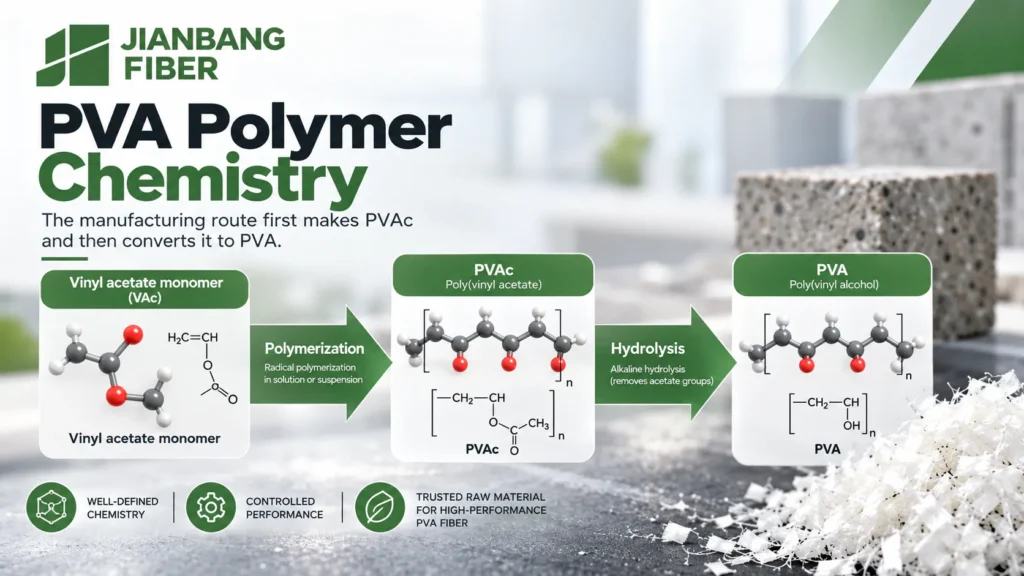
Free vinyl alcohol is too unstable to serve as a practical monomer for making PVA directly. Producers first polymerize vinyl acetate monomer (VAM) to polyvinyl acetate (PVAc). They then convert the acetate groups by alcoholysis or hydrolysis to produce polyvinyl alcohol (PVA). Kuraray describes the same two-step chemistry in its current PVOH technical guide.
Vinyl acetate can be produced through different industrial routes. An older route reacts acetylene with acetic acid. Another reacts ethylene, acetic acid, and oxygen over a catalyst. The source of VAM and a plant’s economics may differ, while the polymer design question remains: what molecular chain is needed for the fiber grade?
Two resin variables matter especially. Degree of polymerization describes chain length. It affects solution viscosity and the potential to draw a strong filament. Degree of hydrolysis describes how much of the original acetate functionality has been converted to hydroxyl groups. It influences hydrogen bonding, crystallization, water response, and processing. A lower degree of hydrolysis can make some grades easier to dissolve, but the resulting fiber also has to remain spinnable and meet its end-use requirements. Neither parameter can be judged in isolation.
The PVAc-to-PVA conversion needs controlled reaction conditions and washing. Residual salts, alkali, and low molecular weight material can affect the solution and later heat treatment. A fiber manufacturer therefore treats the resin as an engineered feedstock, not as a bag of interchangeable PVA powder. The resin’s viscosity, residual acetate groups, and impurity profile all influence the next step.
From Resin to a Spinning Solution
Many PVA fibers are made by solution spinning. The resin is dissolved, the liquid is mixed and filtered, and trapped air is removed before it reaches the spinneret. Water is a common solvent for conventional processes. Other solvent systems are used for selected high-performance or water-soluble grades.
A stable spinning solution must flow through fine holes without gel particles or bubbles. In the manufacturing account examined here, washing and dewatering precede dissolution. Mixing, filtration, and deaeration follow. The sequence explains why a small upstream variation can later appear as broken filaments, uneven diameter, or poor tensile consistency. Solution concentration and viscosity are controlled for the chosen route and resin; values from one spinning line should not be transferred to another as purchasing specifications.
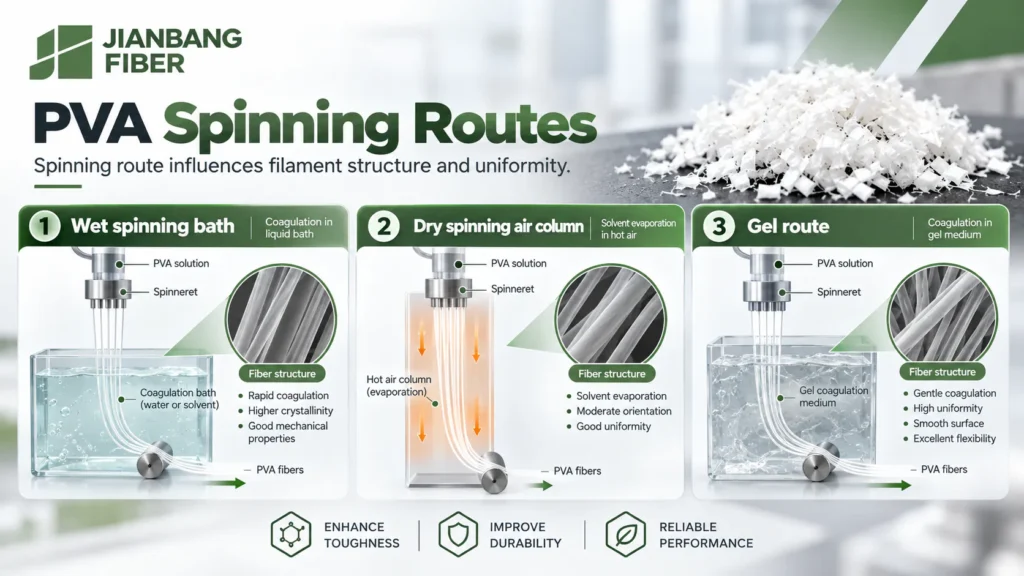
Wet spinning and its cross section
In wet spinning, a PVA solution exits the spinneret into a coagulation bath. Water leaves the filament while bath components move inward. A sodium sulfate bath is one conventional example. The outer region can set before the center, producing a dense skin and a more open core. This skin-core pattern may also lead to a flattened or irregular cross section.
That structure matters to a composite producer. The fiber’s equivalent diameter, surface area, and cross section can affect how it disperses and grips a cement matrix. A different coagulation or gel process can produce another shape. Do not assume that two fibers with the same nominal length and mass have the same count per kilogram or crack-bridging behavior.
Dry spinning and specialized gel routes
In dry spinning, the solution leaves the spinneret into heated air and the solvent evaporates. The process can suit certain filaments, but removal of water takes energy and a more concentrated solution adds preparation challenges. Dry-wet spinning introduces an air gap before the coagulation bath. Gel spinning or cooled solvent coagulation can hold chains in a form that permits high drawing and a more uniform filament. These are process families, not a ranking that makes every gel-spun fiber superior in every concrete mix.
A buyer does not need the producer’s proprietary setpoints. The buyer does need consistent delivered properties and a trial that reflects the application. Ask for diameter, length, tensile strength, modulus, elongation, heat and alkali behavior, and the basis on which each figure was measured.
Drawing, Heat Treatment, and Surface Chemistry
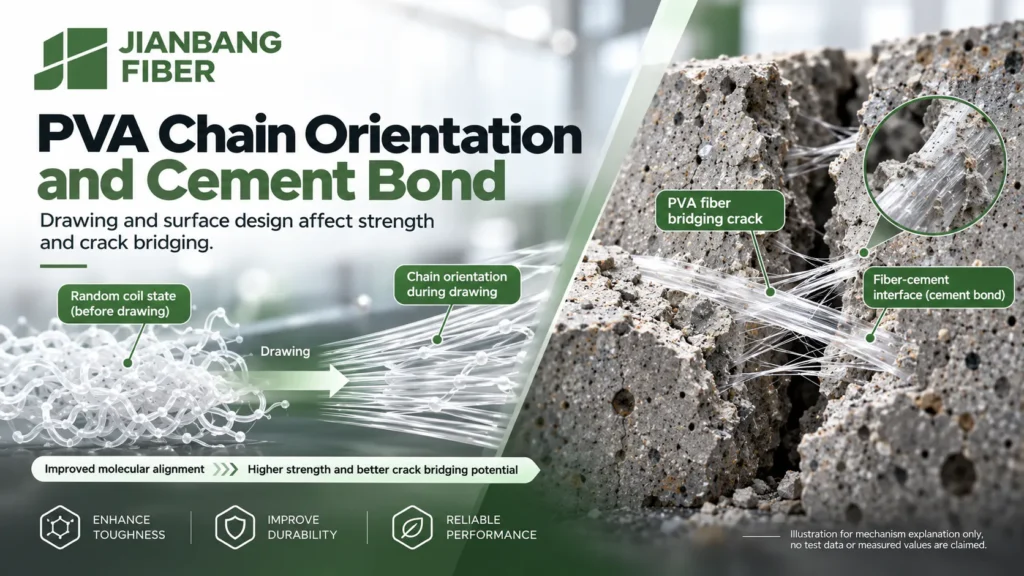
A newly formed filament has not yet reached its final mechanical performance. Drawing stretches the filament and aligns polymer chains along its axis. Controlled heat treatment helps stabilize that orientation and increase crystallinity. In the source material, staged drawing and heat treatment are central to strength, dimensional stability, and resistance to hot water. The exact draw ratio and temperature depend on the feedstock and line, so they should be treated as process history rather than universal PVA fiber values.
PVA chains contain many hydroxyl groups. They create hydrogen bonds between chains and help the fiber interact with cement paste. They also explain why water resistance and interfacial behavior need careful control. More orientation and crystallinity can limit water access. Some conventional vinylon products undergo acetalization, often with formaldehyde, after heat treatment. The reaction ties up some available hydroxyl groups and improves hot-water resistance. Yet a product designed to dissolve in water may deliberately follow a different route and omit that step.
There is another subtle point for concrete: maximum adhesion is not always the best composite design. In an engineered cementitious composite, a PVA fiber that bonds too strongly can rupture instead of pulling out gradually. Published ACI research on PVA-ECC interface design shows how surface treatment can tune the bond and enable multiple fine cracks in a designed matrix. This does not mean all PVA concrete fibers need an oil coating. It means fiber, surface, and cement matrix must be selected together for the target behavior.
| Production choice | Property it can change | Concrete question to test |
| Resin chain length and hydrolysis | Solution behavior, crystallization, water response | Does the grade remain stable in the intended environment? |
| Spinning and coagulation | Diameter, cross section, uniformity | Does it disperse evenly and bridge the relevant cracks? |
| Drawing and heat treatment | Strength, modulus, dimensional stability | Does it meet the required fresh and hardened performance? |
| Surface treatment | Bond and pullout behavior | Does the complete composite meet its tensile or flexural target? |
Water-Soluble PVA and Cement Reinforcement Grades Are Different Products
PVA can be intentionally formulated into a water-soluble fiber. Its dissolution temperature depends on polymerization, hydrolysis, crystallinity, and processing. Such fibers are useful in textile processing and removable support materials. Kuraray currently lists water-soluble PVA fiber separately from construction reinforcement grades.
A cement reinforcement fiber has a different job. It must remain effective in the mix and through the specified service conditions. A buyer should not conclude from “PVA is water soluble” that every finished PVA fiber dissolves in concrete. The reverse is also unsafe: a high-strength label alone does not demonstrate adequate stability in water, alkaline pore solution, or the project’s exposure. Request grade-specific data and verify the performance of the finished concrete or fiber-cement product.
The source material also describes very high strengths achieved in research using high polymerization grades, gel spinning, and intensive drawing. Those figures show what controlled molecular orientation can make possible. They are not the specification of a commodity fiber or of Ecocretefiber™. Presenting a laboratory record as a product guarantee would mislead a buyer.
Why PVA Fibers Work in Cementitious Materials
A suitably selected PVA fiber can cross a fine crack and transfer stress between its faces. Its polar surface often bonds well to cement hydration products. Fiber length, diameter, dosage, matrix composition, and orientation determine how many effective bridges form. The result can include narrower cracking, improved toughness, or resistance to chipping and impact when the system has been designed and tested for those outcomes. Kuraray’s construction-grade information likewise shows that different PVA grades have markedly different dimensions and properties.
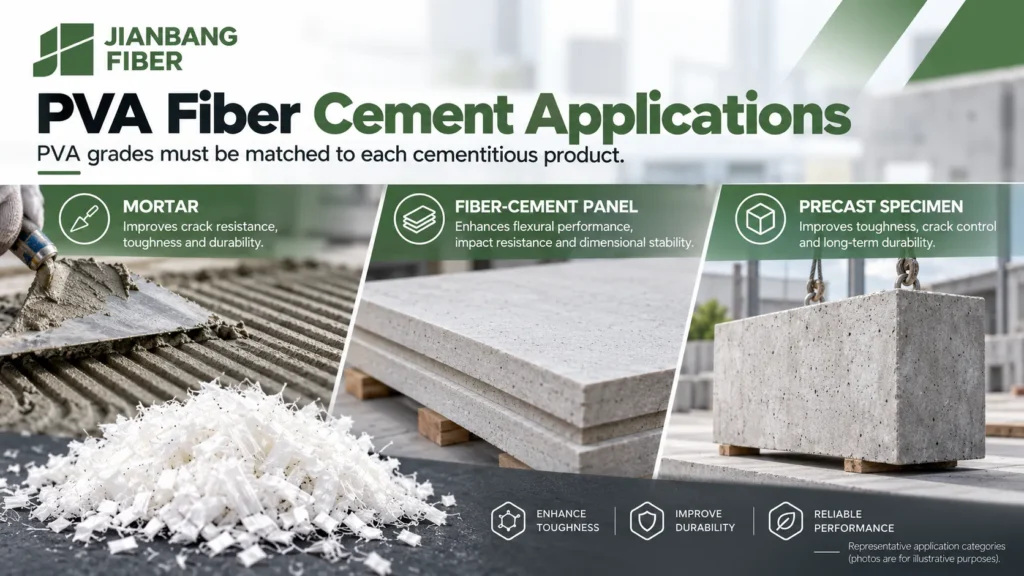
Applications include crack-control mortar, repair materials, fiber-cement panels, precast elements, and specialized strain-hardening composites. In a conventional concrete slab, a fine PVA fiber can be considered for distributed crack control, subject to trial placement and the project specification. In ECC or UHPC, a different volume fraction, surface treatment, and matrix design may be required. A low-dose mortar trial cannot establish ECC tensile strain hardening, and the word “PVA” cannot replace that evidence.
Ecocretefiber™ currently lists PVA fiber lengths of 4, 6, and 12 mm, an equivalent diameter of 13 ± 3 μm, tensile strength of at least 1,200 MPa, and modulus of at least 30 GPa on its PVA product page. These are published product-page parameters. Confirm the selected grade and batch certificate before specifying them. The page’s typical concrete and mortar dosage guidance is a trial starting point, not a design value for every concrete, board, or strain-hardening composite.
Qualify the Fiber in the Actual Mix
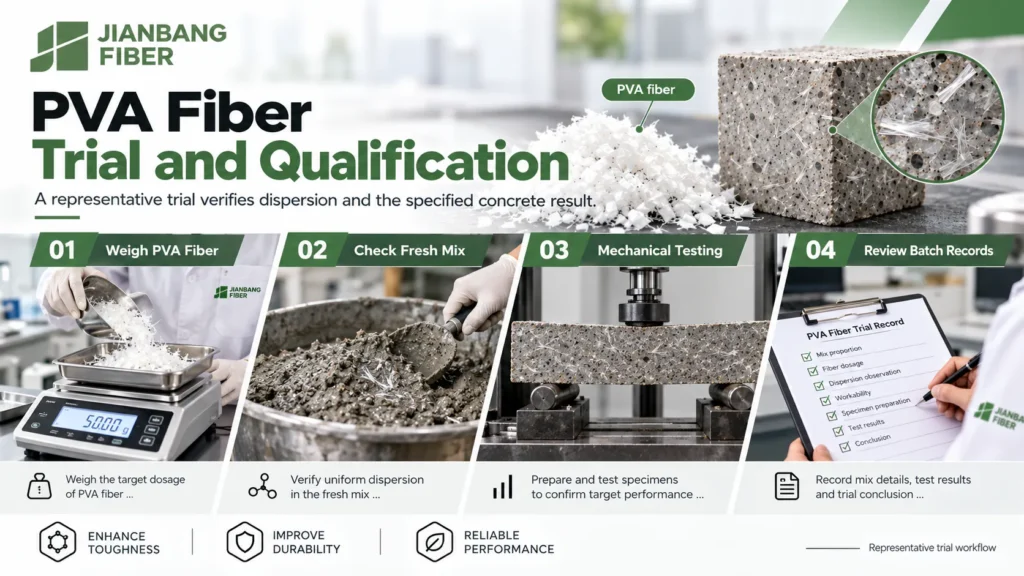
PVA fiber can change workability because many fine filaments expose substantial surface area to the paste. Adding more fiber may increase cohesion but can also make mixing, pumping, or finishing harder. At an unsuitable feed rate, bundles may not open evenly. A higher-strength fiber cannot make up for poor dispersion.
Set up a trial with the actual binder, sand and aggregate grading, admixtures, water content, mixer, and intended placement method. Record the fiber model, length, dosage by mass and by volume, and the mixing sequence. Compare a control mix with candidate fiber contents. Inspect uniformity and fresh consistency at discharge, and cast enough specimens to test the performance stated in the specification.
For concrete supplied as uniformly mixed fiber reinforced concrete, ASTM C1116/C1116M-23 provides a specification framework. Where flexural response after cracking is the target, ASTM C1609/C1609M-24 is a recognized beam method. A strain-hardening claim needs an appropriate direct tensile test and explicit criteria. Specify specimen preparation, curing, age, deflection or strain point, sampling, and acceptance threshold before production. Compressive strength alone does not prove the fiber’s post-crack contribution.
A useful purchasing checklist includes the grade-specific technical data sheet, batch certificate, fiber length and diameter distribution, tensile and modulus methods, alkali and heat exposure data where relevant, packaging and handling instructions, and results from a representative mix trial. If the project proposes to reduce mesh or other reinforcement, an engineer must approve the structural design and relevant verification tests.
Choosing a PVA Fiber Partner
Shandong Jianbang offers Ecocretefiber™ PVA fiber for buyers who need a defined synthetic reinforcement candidate. Our role is to match the available grade and documentation to the intended application, then support a practical trial with the concrete producer and engineer. Tell us whether the material is a mortar, board, ordinary concrete, precast component, or engineered composite. Include the binder system, service exposure, target crack or flexural behavior, mixing equipment, and test standard.
Frequently Asked Questions
Is PVA fiber the same as PVA powder or PVAc adhesive? No. PVA fiber is a spun and treated solid filament. PVA resin is its polymer feedstock, while PVAc is the acetate polymer converted into PVA. Product form and processing change the end use.
Does every PVA fiber dissolve in water? No. Water-soluble grades are intentionally designed for dissolution. Construction reinforcement grades need grade-specific evidence of stability in their intended mix and exposure.
Does stronger bonding always improve ECC? No. A bond that is too strong can cause fiber rupture. ECC design balances fiber strength, interface, and matrix so cracks can multiply and the composite reaches its specified tensile response.
What does heat treatment do? It helps align and stabilize the filament’s structure, raising crystallinity and dimensional stability under the controlled conditions of a given process. The result still needs testing in the finished product.
What dosage should a concrete producer use? Start with the supplier’s grade guidance and the project performance requirement. Confirm the final amount in the actual mix through fresh and hardened tests. Do not transfer a dosage from a thin mortar or an ECC study to a different concrete slab.
From Fiber Chemistry to Reliable Concrete
The route from vinyl acetate to PVA fiber explains why two products with the same polymer name can behave differently. Polymer chain design, spinning, drawing, heat treatment, and surface control all leave a mark on the finished filament. Concrete performance then adds another set of variables: dispersion, matrix, curing, and testing.
If you are selecting PVA fiber for a new cementitious product, contact Shandong Jianbang with your mix and performance target. We can help identify an Ecocretefiber™ candidate and the product information needed for a meaningful trial.