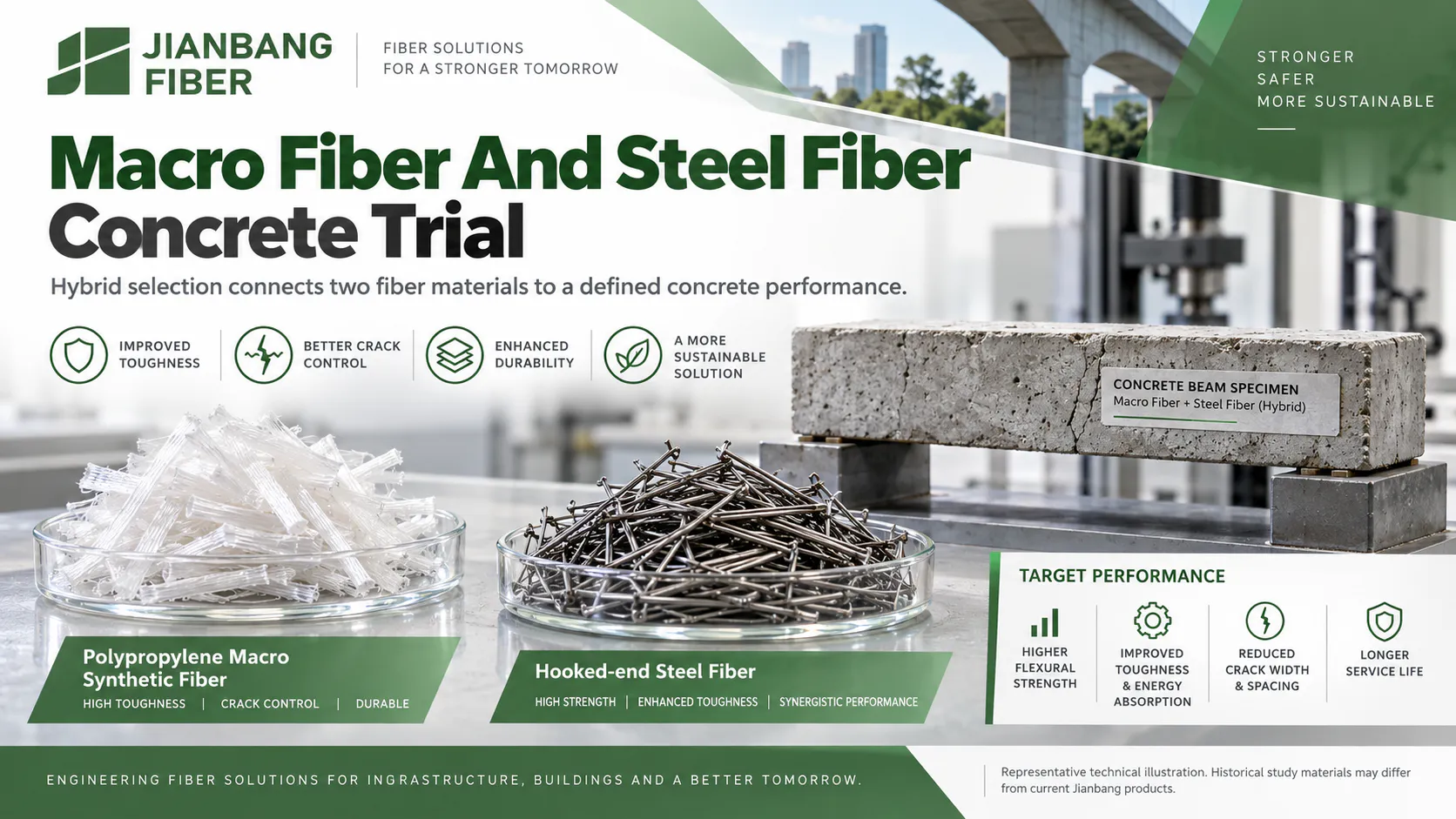
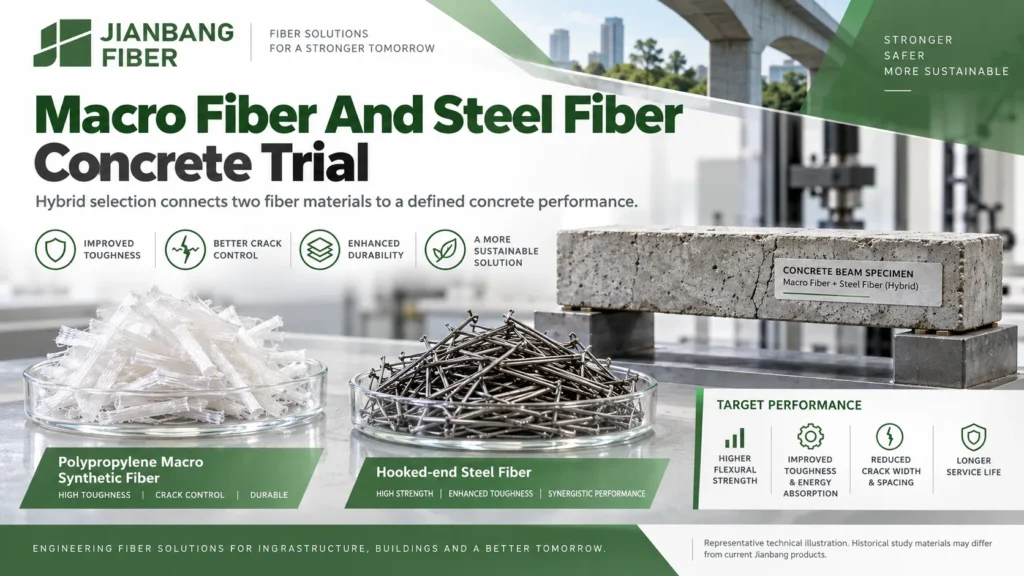
Combining Macro Fiber with steel fiber can change the way concrete carries load after cracking. The useful result may be a more gradual loss of load or greater energy absorption over a selected deformation range. The optimum blend depends on which part of the response the design needs, together with workability, compressive strength, and cost.
At Shandong Jianbang Chemical Fiber Co., Ltd., we supply Ecocretefiber™ reinforcement fibers and help buyers compare candidate systems for trials. This guide examines a seven-mixture experimental series and turns its findings into practical questions for hybrid concrete selection. The results show a promising route for partial steel-fiber replacement, with measurable tradeoffs that should be checked in every project.
Why combine Macro Fiber with steel fiber?
Steel fiber and polypropylene Macro Fiber differ in stiffness, density, geometry, and deformation. A well-anchored steel fiber can resist crack opening at relatively small deformation. A longer polymer fiber can remain engaged as a crack opens further, depending on its bond, extension, and pullout behavior. Combining the materials may produce a useful response over a wider deformation range.
That is a design hypothesis to test. Two fibers in one batch do not automatically create synergy. Their proportions can reduce flow, increase air, or make distribution less consistent. The complete load-deflection curve and the specified acceptance properties show whether the hybrid is useful.
In the 2006 study by Cao Jifeng and Ding Yining, the researchers compared plain concrete, steel-fiber concrete, Macro Fiber concrete, and two hybrid mixtures. The work examined fresh behavior, cube strength, energy absorption, and equivalent flexural strength. These are laboratory findings for identified materials, rather than certified results for current Ecocretefiber™ grades.
Understand the materials and test conditions
Two fibers with different properties
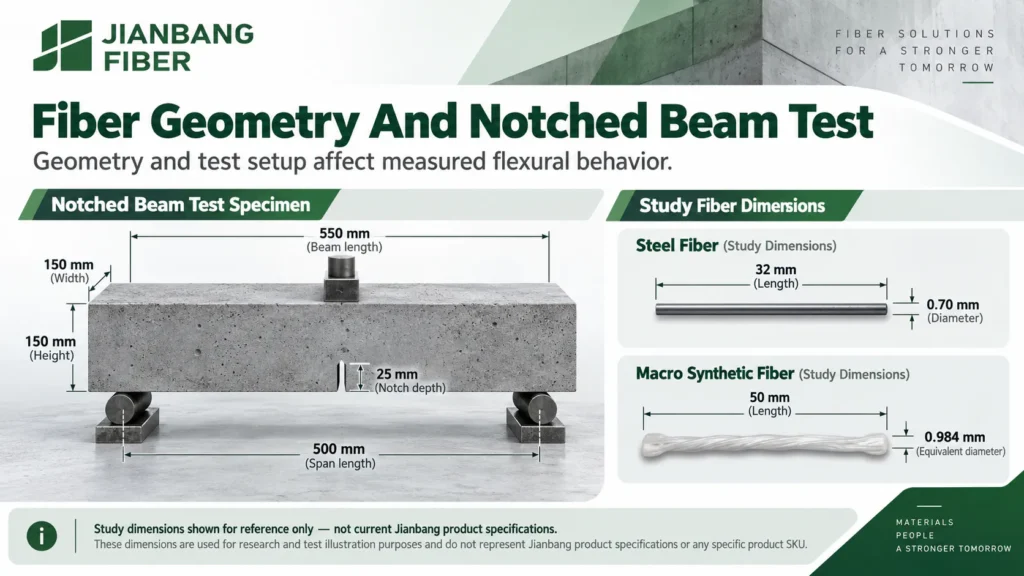
The study used an indented steel fiber measuring 32 mm long and 0.70 mm in diameter. Its reported density was 7.85 g/cm³, tensile strength above 600 MPa, and elastic modulus 200 GPa.
The polypropylene Macro Fiber was 50 mm long, with an equivalent diameter of 0.984 mm. Its reported density was 0.91 g/cm³, tensile strength 490 MPa, and elastic modulus 8 GPa. The authors also reported 10.7% elongation at break. These values describe the study materials; they should not be copied into a purchase order for a different product.
The stiffness difference was substantial: the reported steel-fiber modulus was 25 times that of the Macro Fiber. However, stiffness alone does not establish composite performance. The different lengths, surfaces, amounts, and numbers of fibers also affect crack interception and load transfer.
One base concrete and seven mixtures
The base mixture targeted Chinese C50 concrete. Per cubic meter, it contained 420 kg cement, 180 kg fly ash, 669 kg sand, 818 kg coarse aggregate, 210 kg water, and 4.2 kg water reducer. The reported water-to-binder ratio was 0.35, and the coarse aggregate size was 5–10 mm. This is an experimental formulation, not a general production recipe.
Steel fiber was used at 30 or 50 kg/m³. Macro Fiber was used at 4 or 6 kg/m³. The hybrid combinations were 30 kg/m³ steel plus 4 kg/m³ Macro Fiber, and 50 kg/m³ steel plus 6 kg/m³ Macro Fiber. The labels below keep those quantities visible when comparing results.
For bending, the researchers used notched beams measuring 150 × 150 × 550 mm, with a 500 mm span and a 25 mm notch. They recorded deflection and crack-mouth opening during controlled loading and evaluated toughness using a RILEM-based procedure. Specimen and method details matter because a result from this setup cannot be directly assigned to another beam method or structural member.
What happened to workability and air content?
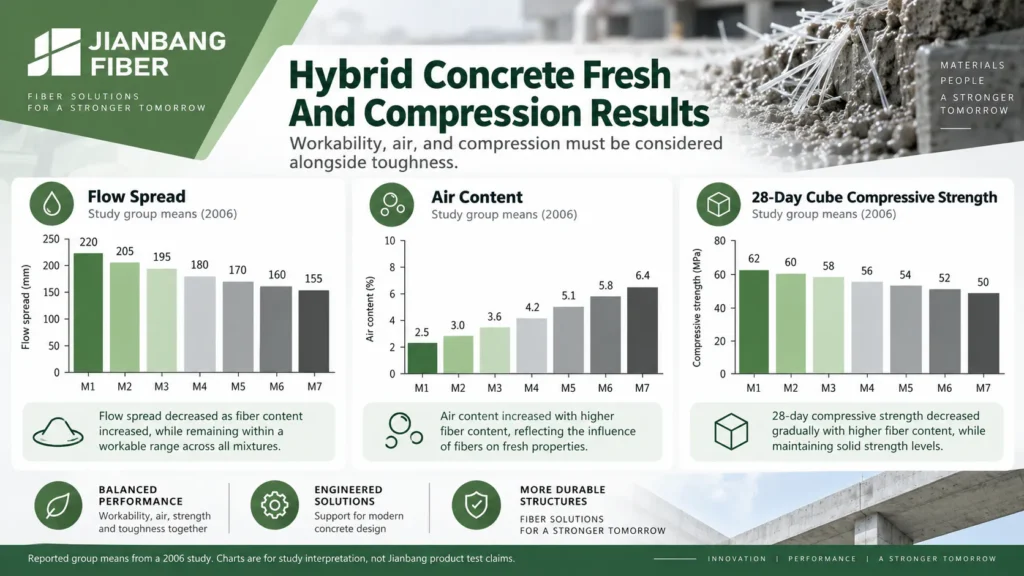
Adding fibers reduced the reported flow spread and increased measured air content. The base concrete spread was 670 mm. The highest-dose hybrid measured 350 mm. Air content rose from 2.00% in plain concrete to 3.15% in that hybrid.
| Mixture | Steel / Macro Fiber dose, kg/m³ | Reported flow spread, mm | Air content, % |
| NC | 0 / 0 | 670 | 2.00 |
| SF30 | 30 / 0 | 475 | 2.36 |
| SF50 | 50 / 0 | 355 | 2.60 |
| PP4 | 0 / 4 | 575 | 2.50 |
| PP6 | 0 / 6 | 445 | 2.65 |
| SF30PP4 | 30 / 4 | 405 | 2.95 |
| SF50PP6 | 50 / 6 | 350 | 3.15 |
The researchers described the mixtures as stable and observed no segregation or bleeding under their test conditions. The spread values should be kept with their original procedure. They are not ordinary slump heights and do not establish a modern self-consolidating-concrete classification by themselves.
For production, the practical task is to retain sufficient flow while keeping the approved water balance. Select compatible admixtures, paste volume, and aggregate grading through trials. Check pumpability, form filling, finishing, and air at the contract sampling point. The higher air readings also mean that fibers should not be described as automatically making every mixture denser.
Compressive strength did not follow the same trend as toughness
Steel-only mixtures had higher 28-day cube strengths than the plain control in this series. Macro Fiber-only mixtures were slightly below the control. The hybrids also showed different compression results from their steel-only counterparts.
| Mixture | 1-day cube strength, MPa | 28-day cube strength, MPa |
| NC | 18.19 | 64.26 |
| SF30 | 17.03 | 71.76 |
| SF50 | 15.98 | 73.29 |
| PP4 | 16.00 | 60.75 |
| PP6 | 16.78 | 60.66 |
| SF30PP4 | 14.80 | 58.98 |
| SF50PP6 | 13.92 | 64.83 |
These are reported group averages. The means alone do not establish statistical equivalence or a production characteristic strength. In particular, SF30PP4 measured 58.98 MPa compared with 73.29 MPa for SF50, about 19.5% lower. Its favorable later-stage bending result should therefore be considered alongside the compression requirement.
The practical conclusion is to qualify compression separately. A hybrid selected for energy absorption must still satisfy the project’s strength grade, sampling rules, curing conditions, and acceptance criteria. Do not infer guaranteed compression gains from the fiber tensile-strength data.
Read flexural performance over the required deformation range
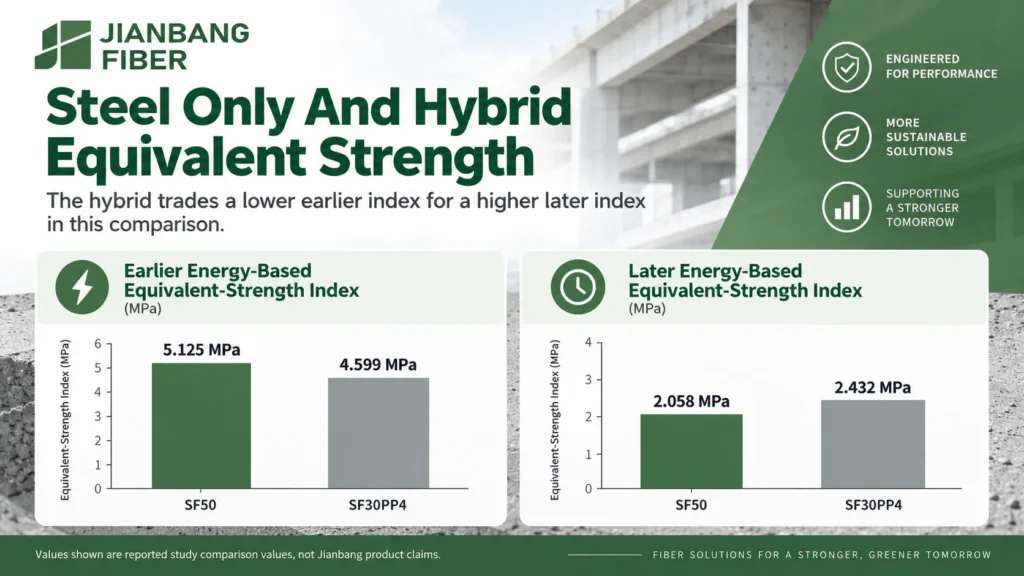
The study calculated equivalent flexural strength from energy absorption over defined parts of the bending response. Its two reported equivalent-strength indices used endpoint deflections at the reference deflection plus 0.65 mm and plus 2.65 mm. The reference was associated with the initial flexural load criterion.
For clarity, the table calls these the earlier and later indices. They are energy-based values over the defined intervals. They are not simply the stress at one point on the curve, and they are not interchangeable with residual strengths from a different standard.
| Mixture | Earlier equivalent strength, MPa | Later equivalent strength, MPa |
| SF30 | 2.959 | 1.119 |
| SF50 | 5.125 | 2.058 |
| PP4 | 1.289 | 1.624 |
| PP6 | 1.340 | 1.639 |
| SF30PP4 | 4.599 | 2.432 |
| SF50PP6 | 6.291 | 3.580 |
Adding Macro Fiber to a fixed steel dose
Compared with SF30, SF30PP4 increased the earlier equivalent strength from 2.959 to 4.599 MPa, about 55%. The later value increased from 1.119 to 2.432 MPa, about 117%. This suggests a stronger benefit over the later deformation interval for that combination.
At the higher steel dose, SF50PP6 exceeded SF50 by about 23% in the earlier index and about 74% in the later index, calculated from the tabulated means. These are additions of Macro Fiber to the existing steel amounts. They do not, by themselves, demonstrate steel replacement or isolate a pure interaction effect: total fiber content also increased.
Reducing steel while adding Macro Fiber
The useful replacement comparison is SF30PP4 against SF50. Steel content fell from 50 to 30 kg/m³, a 40% reduction in steel mass, while 4 kg/m³ Macro Fiber was added. The earlier equivalent strength was about 10% lower, and the later equivalent strength was about 18% higher.
This is a conditional tradeoff. It supports investigating partial replacement when the later deformation range is relevant. It does not establish equal performance at every crack opening, equal compressive strength, or permission to reduce steel by 40% on another project. The acceptable design response must determine which blend passes.
Why mass substitution can be misleading
Steel and polypropylene have very different densities. Using the study values, 50 kg/m³ steel represents about 0.64% of concrete volume. The combination of 30 kg/m³ steel and 4 kg/m³ Macro Fiber represents about 0.38% steel plus 0.44% Macro Fiber, or 0.82% total fiber volume.
The hybrid therefore used less steel mass but more total fiber volume than SF50. Its behavior reflects changes in material, geometry, count, and total content. A kilogram-for-kilogram substitution would obscure those differences.
For a purchase comparison, record both mass dosage and calculated volume fraction using actual grade densities. Include cost per cubic meter and any changes in mixing, admixture, testing, and finishing. Reducing steel mass by 40% is not the same as reducing total concrete cost by 40%.
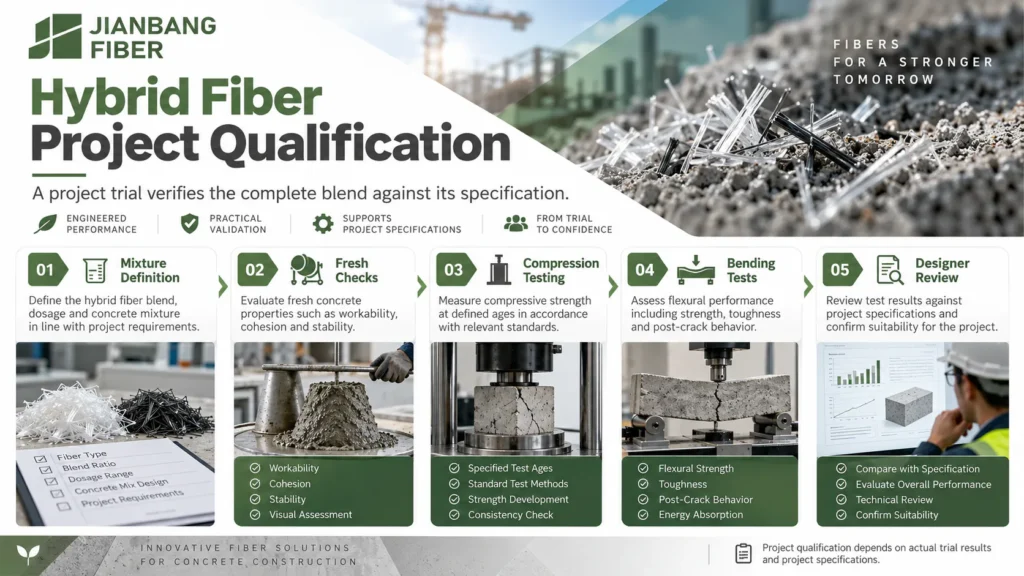
Turn the research into a project qualification plan
Define the required response first
Specify the compressive strength, exposure, workability, and response after cracking that the element needs. If limited crack opening governs serviceability, the earlier response may be critical. If the application needs energy absorption at larger deformation, a later interval may matter. The structural designer selects the relevant criterion.
ASTM C1609/C1609M-24 distinguishes first-peak flexural strength from residual strength at specified deflections. A project using that method should qualify its proposed mixtures under that method. Do not convert the historical equivalent-strength values directly into C1609 acceptance numbers without a justified correlation.
Compare a practical trial matrix
Include a control, the current steel-only mixture, and candidate blends. Where the aim is to study synergy, consider comparisons that control total fiber volume as well as the production alternatives. Keep materials and curing consistent and report specimen variability alongside means. This helps separate a useful blend from normal scatter or an increase in total reinforcement.
Check dispersion at production scale. Feed both fiber types at a controlled rate into the moving mix using the sequence approved in trials. A successful laboratory bowl does not qualify a truck mixer, pump line, or sprayed-concrete system. Record air, flow retention, batch yield, fiber quantities, and placing behavior.
Check design conditions beyond the beam test
Sustained load and creep, fatigue, impact, fire, corrosion exposure, joints, and member detailing may require separate evidence. A polypropylene component does not make the steel remaining in a hybrid corrosion-free. Similarly, a static beam result cannot establish every impact or seismic property.
ACI SPEC-544.12-23 provides a performance-based specification for fiber-reinforced slabs on ground and overlays. Its defined scope and required residual performance must be respected. Replacing discrete steel fibers in a mixture is also a different decision from removing bars or welded-wire reinforcement from a structure.
Select current Ecocretefiber™ grades for the trial
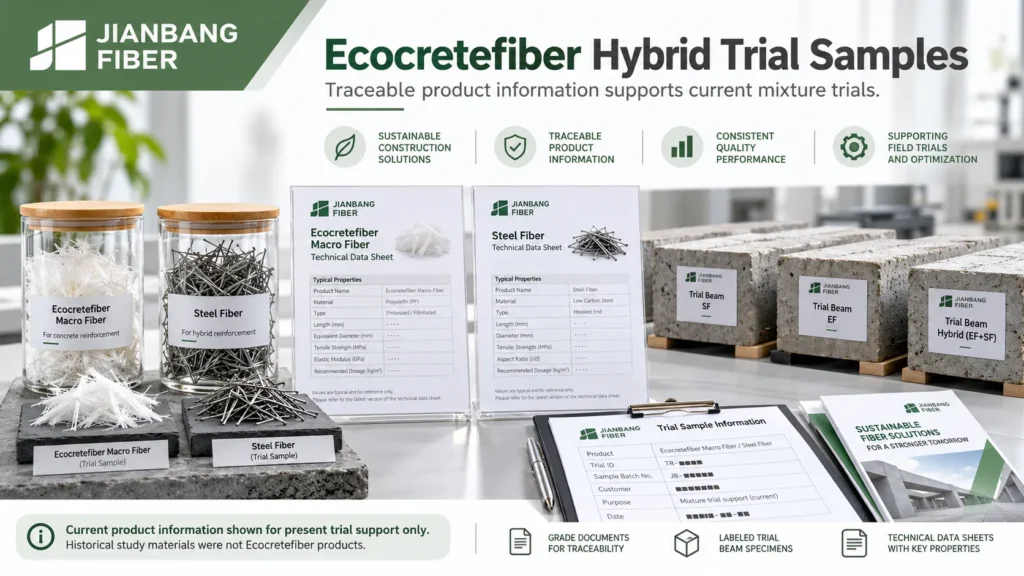
Our Ecocretefiber™ Macro Fiber and steel fiber range provide options for a current project evaluation. Confirm the exact grade, dimensions, shape, tensile properties, density, and supporting test reports. A hooked-end steel product is not the same as the indented steel fiber in the historical experiment.
Shandong Jianbang can discuss candidate lengths, packaging, and supply details for trial production. Share the existing steel dosage, base mix, placement method, design criteria, and cost target. The trial should show whether a proposed hybrid meets the complete specification before a replacement is priced or approved.
Frequently asked questions
Does Macro Fiber always increase compressive strength?
No. In the seven-mixture series, the compression results and toughness results followed different trends. Qualify the required strength grade separately for each proposed blend.
Can 4 kg/m³ Macro Fiber replace 20 kg/m³ steel fiber?
That combination produced a promising later-stage bending result in one identified laboratory system. The earlier equivalent-strength index and compressive strength were lower than the 50 kg/m³ steel-only mixture. A new project needs its own mix tests and design approval.
Is equivalent flexural strength the same as residual strength?
They may both describe aspects of behavior after cracking, but the calculation and test method matter. The historical indices here are energy-based. A residual value at a specified C1609 deflection is a different reported quantity.
Why can a hybrid improve later-stage behavior?
Fibers with different stiffness, length, bond, and extension can engage differently as a crack opens. The study’s curves and equivalent-strength results support investigating that mechanism. They do not guarantee it for every fiber pairing.
Is a steel-reduced hybrid automatically cheaper?
No. Compare the complete cost per cubic meter, including both fibers, mixture adjustments, production, testing, and any change to construction. Approve performance before claiming savings.
Discuss a Macro Fiber and steel fiber trial with Jianbang
A hybrid system is valuable when its measured response fits the element’s actual requirements. Shandong Jianbang Chemical Fiber Co., Ltd. supplies Ecocretefiber™ reinforcement options and helps customers prepare product information for controlled trials. Contact our team with your steel-fiber baseline, target deformation range, and acceptance criteria to discuss a candidate Macro Fiber blend.