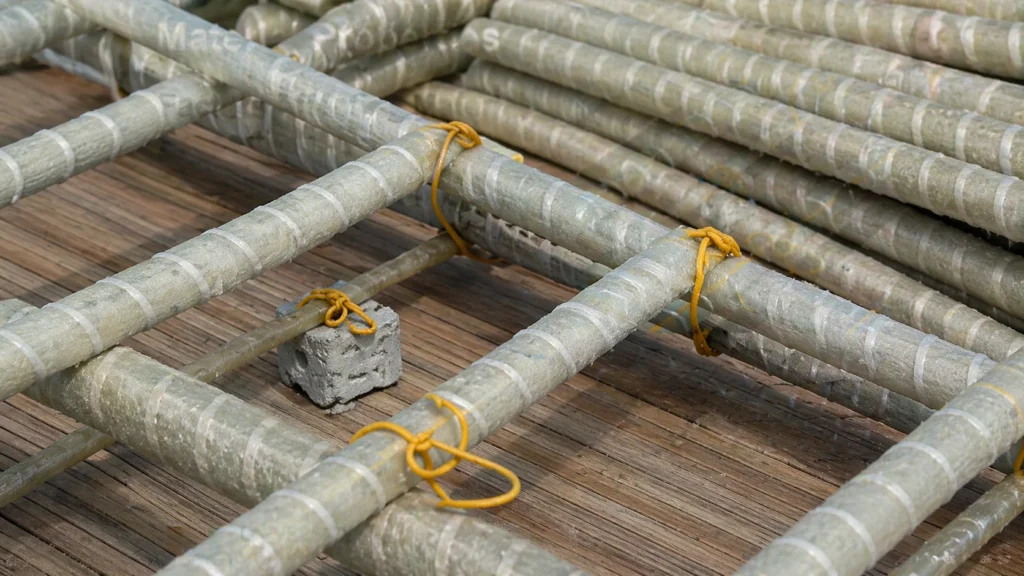
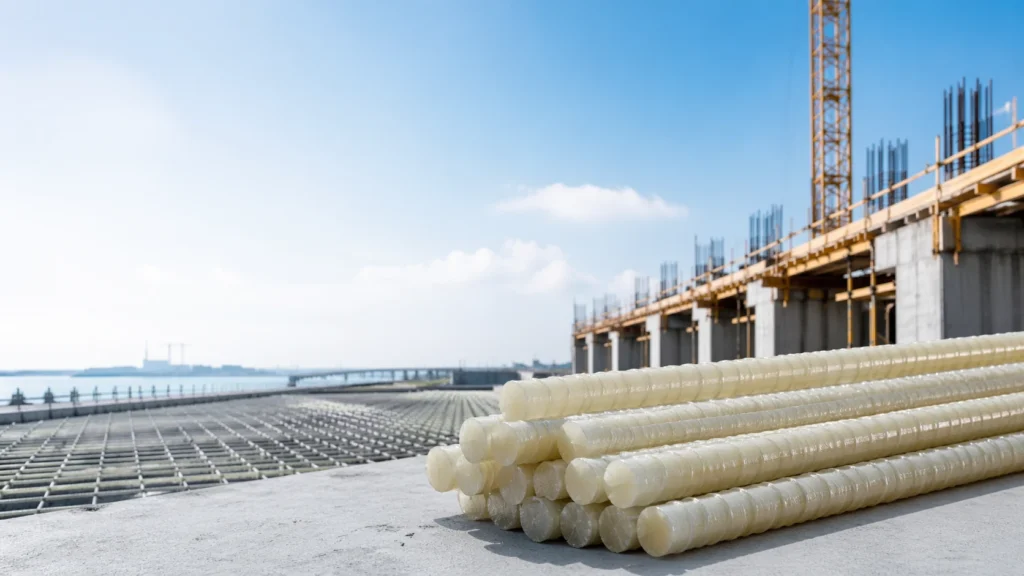
FRP stands for fiber-reinforced polymer. In construction, it usually means composite materials made of strong fibers embedded in a resin matrix. ACI explains that the fibers provide strength and stiffness while the matrix bonds and protects the fibers and transfers stress between them. In concrete work, FRP is commonly used as reinforcing bars, prestressing tendons, or strengthening systems for repair and retrofit. FHWA and FDOT also show that the most common civil-engineering FRP types include glass FRP (GFRP), basalt FRP (BFRP), and carbon FRP (CFRP).
So, what are the advantages of FRP? The short answer is that FRP offers corrosion resistance, high strength-to-weight ratio, low weight, nonmagnetic behavior, low electrical and thermal conductivity in some types, and easier handling and installation. In many concrete structures, these benefits solve problems that steel cannot solve as efficiently, especially in chloride exposure, marine environments, bridge decks, MRI buildings, and rehabilitation work. ACI, FHWA, and FDOT all point to these same core benefits when explaining why FRP has become more important in modern construction.
At Ecocretefiber™, we think the best way to explain FRP is not with abstract material science alone. The real value of FRP becomes clear when we ask a practical question: What job can FRP do better than steel or traditional retrofit materials? In many cases, the answer is not just one thing. FRP can make a structure lighter, more durable in corrosive environments, faster to install, and easier to maintain over its service life.
FRP Resists Corrosion Much Better Than Steel
The biggest advantage of FRP is usually corrosion resistance. FDOT states that FRP reinforcing is highly resistant to chloride ion and chemical attack. FHWA also highlights corrosion resistance as one of the main advantages of FRP composite bridge decks, GFRP rebars, and other FRP structural products. ACI’s recent GFRP handbook and code-related news pages make the same point by describing GFRP reinforcement as non-corrosive and identifying that property as one of the main reasons for its use.
This matters because corrosion is one of the biggest long-term problems in reinforced concrete. Once steel starts to corrode, it expands, cracks the cover concrete, reduces bond, and creates expensive repair cycles. FRP avoids that electrochemical deterioration problem. That is why FRP is especially attractive in marine structures, bridge decks exposed to deicing salts, coastal infrastructure, chemical plants, wastewater facilities, and other aggressive environments. ACI 440 guidance specifically points to highly corrosive environments such as seawalls, marine structures, bridge decks, and pavements treated with deicing salts as places where the corrosion resistance of FRP is a significant benefit.
For owners, this is not just a material advantage. It is a service-life advantage. If the reinforcement does not corrode, the structure may need less repair and less disruption over time. That is one reason FRP is often discussed not only as a technical material, but also as a durability strategy for concrete infrastructure.
FRP Has a Very High Strength-to-Weight Ratio
Another major advantage of FRP is its high strength-to-weight ratio. FDOT states that FRP reinforcing has tensile strength greater than steel while weighing only about one quarter as much. FHWA also describes FRP bridge products as lightweight and high-strength. In practical terms, this means FRP can deliver serious tensile performance without the mass of steel.
This combination changes a lot in the field. A lighter material is easier to transport, easier to lift, easier to place, and often safer for workers to handle. It can reduce crane demand, reduce labor strain, and speed up assembly on site. ACI’s GFRP design handbook preview explicitly notes that FRP reinforcement is lightweight and easy to handle, allowing increases in productivity and improvements in worker health and safety.
For contractors, this is one of the most visible benefits of FRP. Corrosion resistance is a long-term owner benefit, but light weight is an immediate jobsite benefit. Bars, grids, and composite members that are much lighter than steel are easier to move and position, especially in projects with repetitive handling or difficult access.
FRP Is Nonmagnetic and Transparent to Electromagnetic Signals
FRP also has a special advantage that steel cannot match: it can be nonmagnetic and transparent to magnetic fields and radar frequencies. FDOT lists transparency to magnetic fields and radar frequencies as a direct beneficial characteristic of FRP reinforcing. ACI also identifies the nonmagnetic properties of FRP as especially important in structures supporting MRI units or equipment sensitive to electromagnetic fields.
This makes FRP very useful in places where steel reinforcement can interfere with equipment or signals. Hospitals, laboratories, research facilities, military installations, tolling systems, and certain transportation or communication facilities can all benefit from nonmagnetic reinforcement. In these applications, FRP is not just an alternative to steel. It may be the better engineering choice because steel’s magnetic behavior becomes a design problem.
This is one reason FRP provides benefits that are not available with traditional reinforcement. Some materials can match steel in strength, and some can beat it in corrosion resistance, but very few can also offer electromagnetic neutrality at the same time.
Some FRP Types Have Low Electrical and Thermal Conductivity
FDOT also notes that GFRP and BFRP have low electrical and thermal conductivity. This can be a real advantage in projects where electrical isolation is valuable or where lower thermal conductivity is preferred.
This property matters in infrastructure exposed to stray current, in specialized industrial facilities, and in structures where conductive reinforcement would create unwanted pathways. It also supports the idea that FRP can solve a broader set of engineering problems than steel alone. The benefit is not universal for every FRP type in the same way, but for GFRP and BFRP reinforcement it is one of the standard reasons agencies like FDOT highlight the technology.
FRP Is Easier to Install in Strengthening and Repair Work
One of the strongest advantages of FRP in repair and retrofit work is installation efficiency. ACI’s guide for externally bonded FRP systems states that FRP strengthening systems offer advantages over traditional strengthening techniques because they are lightweight, relatively easy to install, and noncorroding. This statement appears consistently across ACI’s preview and product pages for the guide.
This is important because repair work is often constrained by existing conditions. A strengthening system that is thin, light, and easier to apply can reduce downtime and limit disruption to the structure. Compared with steel plate bonding, section enlargement, or external post-tensioning, FRP systems often require less added dead load and less intrusive construction work. ACI specifically frames FRP strengthening as an alternative to those traditional methods for exactly this reason.
For owners of existing structures, this may be one of the most valuable FRP advantages of all. In new construction, durability is often the main reason to choose FRP. In repair and rehabilitation, speed, low added weight, and relative ease of installation can be just as important as corrosion resistance.
FRP Supports Faster Construction and Prefabrication
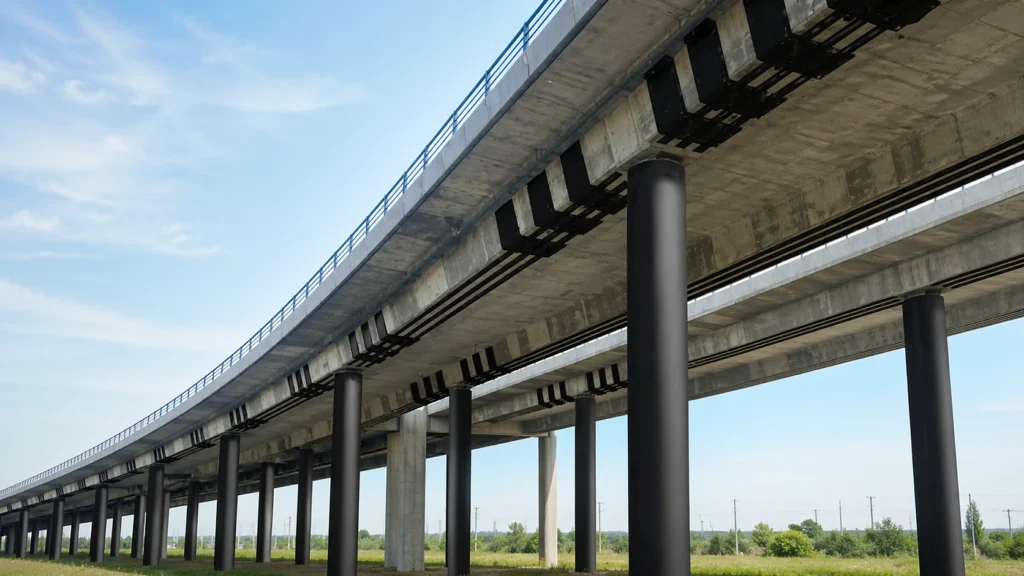
FHWA notes that FRP composite bridge deck systems can be preengineered and prefabricated offsite and then rapidly deployed and installed at the jobsite. It also highlights easy construction and handling as advantages of these systems.
This is a very practical advantage in infrastructure work. When components are lighter and easier to handle, offsite fabrication becomes more attractive, and field installation can move faster. That can shorten closures, reduce traffic disruption, and improve construction logistics. In bridge replacement and rehabilitation work, those schedule benefits can matter just as much as the structural benefits.
The same logic also explains why FRP is often discussed as a modern material rather than just a niche product. It fits well with industrialized construction, prefabrication, and rapid-installation strategies, especially in transportation structures where time on site is expensive.
FRP Can Improve Long-Term Value in Aggressive Environments
Because FRP resists corrosion and chemical attack, its advantages are not limited to first-day performance. They also extend to maintenance planning and lifecycle cost, especially in harsh environments. FHWA’s emphasis on FRP for bridge decks and bridge components is closely tied to these durability benefits. FDOT’s long-term support for FRP reinforcement also reflects the same logic: if chloride resistance is critical, a noncorroding reinforcement option can reduce future deterioration risk.
ACI’s 2023 externally bonded FRP guide preview also notes that FRP retrofit can be regarded as a viable method for sustainable design for strengthening and rehabilitation of existing structures, linking the technology to longer service life and safer retrofitted structures.
This does not mean FRP is always cheaper at the start. It means FRP often becomes more attractive when the project is judged across its whole life rather than only by first material cost. In severe exposure conditions, durability can be the deciding advantage.
FRP Gives Designers More Options Than Traditional Materials
ACI has repeatedly described FRP as providing options and benefits not available using traditional materials. One of the reasons is that FRP is not a single product. Designers can choose different fibers and different systems depending on the job. FDOT notes that FRP reinforcing may be made from glass, basalt, or carbon fibers, while FHWA describes bridge composites using glass, aramid, and carbon fibers in resin matrices.
This gives designers flexibility. GFRP may be chosen for corrosion-resistant internal reinforcement. CFRP may be selected where higher stiffness or higher-performance strengthening is needed. Externally bonded sheets, near-surface-mounted systems, bars, tendons, pultruded members, and composite decks all fit under the FRP family, but each solves a slightly different problem.
That design flexibility is itself an advantage. FRP is not only a substitute for steel. In many cases, it is a new way to solve an old structural or durability problem.
The Advantages Are Real, but They Come With Design Differences
A strong article on FRP should also be honest about one important point: advantages do not mean FRP can be treated exactly like steel. ACI’s GFRP design handbook preview says FRP reinforcement behaves differently than steel, and it highlights two major design differences: the lack of ductility of FRP reinforcement and the lower modulus of elasticity of some FRP products. The same preview notes that these differences mean FRP structures often require different design treatment. FDOT’s training material similarly notes relatively low modulus, creep-rupture behavior under sustained load, and fatigue rupture under cyclic loading as material characteristics engineers must consider.
This does not weaken the advantages of FRP. It clarifies them. FRP is strongest when it is selected for the right reason: durability, weight reduction, signal transparency, retrofit efficiency, or aggressive-environment performance. It should not be sold as “steel, but better in every way.” It is a different material system with different strengths.
At Ecocretefiber™, this is how we prefer to explain FRP to buyers and project teams. The value of FRP is not that it replaces steel everywhere. The value is that it gives engineers a stronger answer where corrosion, weight, installation speed, or nonmagnetic performance are the real design drivers.
Conclusion
The main advantages of FRP are clear. It is highly resistant to corrosion and chemical attack, has a very high strength-to-weight ratio, is much lighter than steel, can be nonmagnetic and transparent to electromagnetic signals, and in some types offers low electrical and thermal conductivity. In strengthening work, FRP systems are also valued because they are lightweight, relatively easy to install, and add little extra dead load. In bridge and prefabricated applications, FRP can support faster handling and rapid deployment.
The most important practical advantage is usually durability. In corrosive concrete environments, FRP can solve the steel-corrosion problem at its source. The next biggest advantage is efficiency: lighter materials are easier to transport, handle, and install. For hospitals, labs, and other special facilities, nonmagnetic behavior can be the deciding factor. So, while FRP is not a universal replacement for traditional materials, it offers a set of advantages that make it one of the most useful modern reinforcement and strengthening options in concrete construction. That is why Ecocretefiber™ and Shandong Jianbang Chemical Fiber Co., Ltd. view FRP as a performance-driven material choice rather than just a trend.