Why Asphalt Pavement Needs Fiber Modification
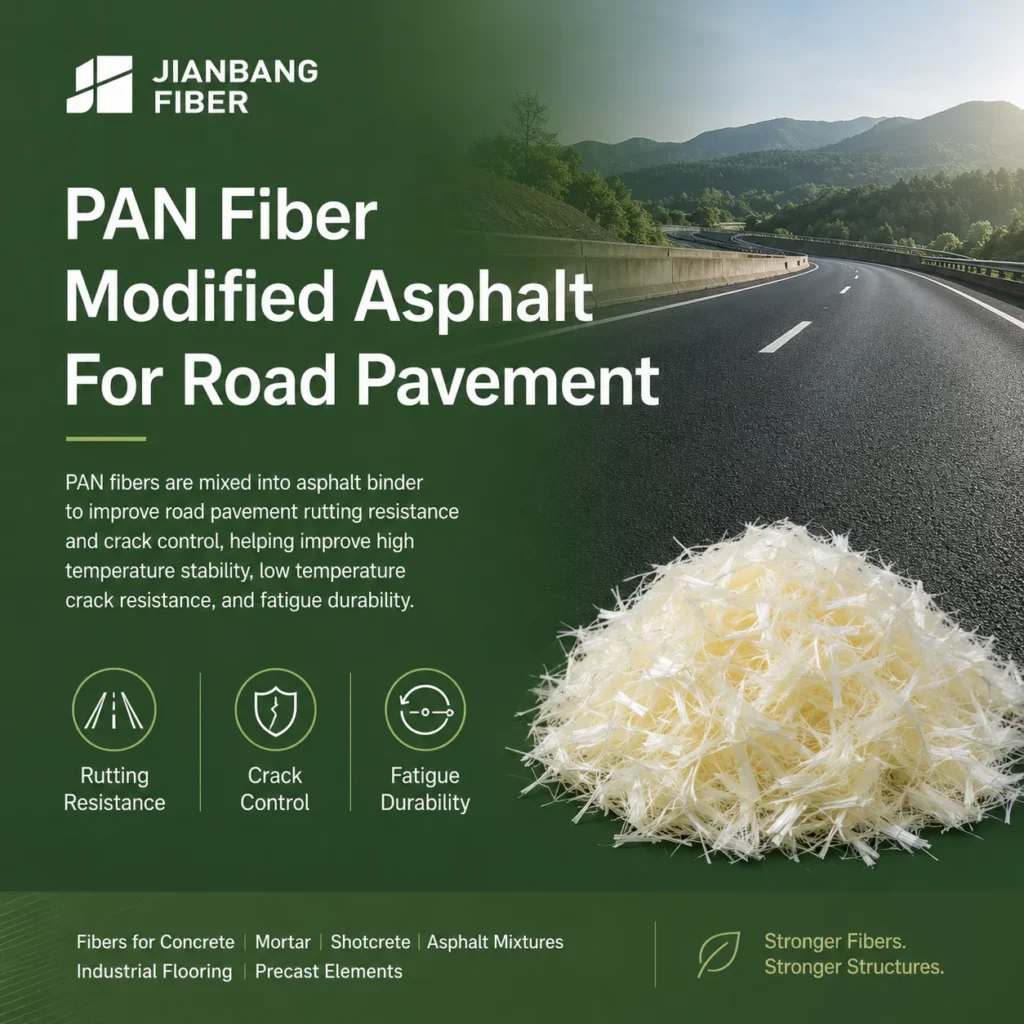
Asphalt pavement is widely used in road construction because it gives a smooth driving surface. It can reduce driving noise. It can improve riding comfort. It can also reduce tire wear compared with some rigid pavement surfaces.
But asphalt pavement also has clear problems. Under high temperature and heavy traffic, asphalt can become soft and deform. This can create rutting, shoving, and permanent deformation. Under low temperature, asphalt can become brittle. This can cause cracking. Under repeated traffic load, asphalt pavement can also develop fatigue damage.
These problems reduce road service life. They also increase maintenance cost. For highways, airports, bridge decks, urban roads, and industrial roads, pavement failure can create traffic interruption and safety risk.
This is why fiber modified asphalt has become important. Fibers can reinforce the asphalt binder and asphalt mixture. They can help improve temperature stability, crack resistance, aging resistance, and fatigue performance.
Shandong Jianbang Fiber finds out that PAN fiber modified asphalt is a practical direction for road pavement improvement. PAN fiber, also called poli̇akri̇loni̇tri̇l elyaf, has good weather resistance and high strength. When it is dispersed correctly in asphalt, it can form a reinforcing network and help improve pavement performance.
At Shandong Jianbang Kimyasal Elyaf Co, Ltd., our concrete and construction fiber brand Ecocretefiber™ supplies fiber solutions for road, bridge, tunnel, concrete, mortar, shotcrete, and pavement applications. PAN fiber can be used as a road asphalt reinforcement fiber when the project needs better rutting resistance, crack control, thermal aging resistance, and fatigue durability.
What Is PAN Fiber Modified Asphalt?
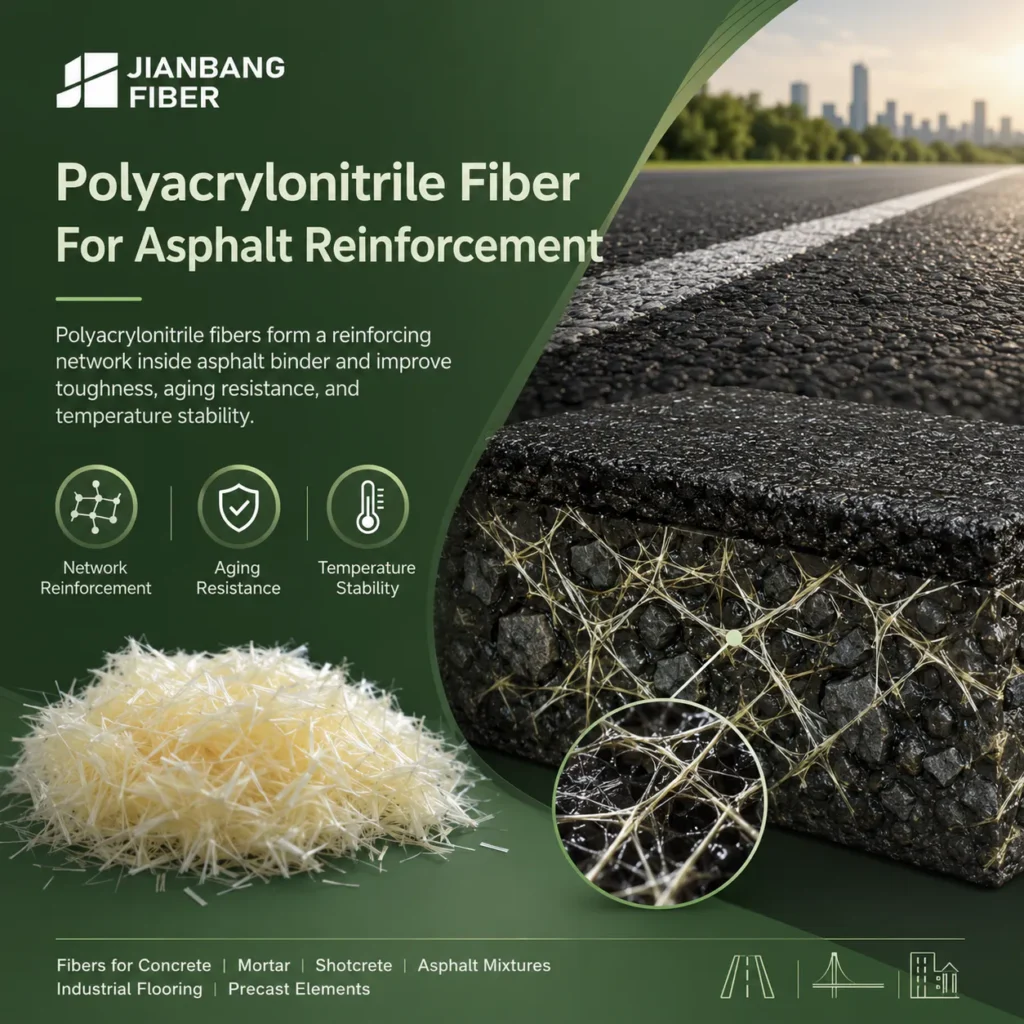
PAN fiber modified asphalt is asphalt binder or asphalt mixture reinforced with polyacrylonitrile fiber. The fiber is mixed into hot asphalt under controlled conditions. If the fiber disperses well, it can create a network inside the asphalt system.
This network helps the asphalt resist deformation and cracking. It can also help reduce the movement and loss of light oil components in asphalt during heating and aging.
PAN fiber does not work like mineral filler. It does not only fill space. It works as a reinforcing phase. It can absorb part of the stress when the asphalt is pulled or bent. It can improve toughness. It can also reduce temperature sensitivity.
Shandong Jianbang Fiber finds out that the value of PAN fiber modified asphalt depends on dispersion, dosage, mixing method, and asphalt type. If fiber is not dispersed well, the mixture can separate. If fiber dosage is too high, voids and uneven fiber zones may appear. These defects can reduce performance.
This means PAN fiber should be used with a controlled asphalt modification process, not added casually.
Why PAN Fiber Is Useful For Road Asphalt
PAN fiber has several properties that make it useful for road asphalt modification.
It has good weather resistance. Road pavement is exposed to sunlight, oxygen, rain, temperature change, and traffic load. A fiber used in asphalt should not degrade too quickly.
It has relatively high strength. A stronger fiber can carry part of the tensile stress inside the asphalt system.
It can form a reinforcing network. When PAN fiber content reaches a suitable level, the fibers can connect with each other inside the asphalt. This changes the asphalt structure from a weaker sol-gel type state into a stronger gel-type structure.
It can improve temperature stability. This is important because asphalt must resist both high temperature deformation and low temperature cracking.
It can improve fatigue behavior. Roads are loaded again and again by vehicles. A pavement material with better fatigue stability can last longer under repeated load.
Shandong Jianbang Fiber finds out that PAN fiber is especially useful when the road faces high traffic load, high temperature rutting risk, or repeated fatigue stress.
How PAN Fiber Changes Penetration, Ductility, And Softening Point
Three common asphalt indicators are penetration, ductility, and softening point.
Penetration reflects asphalt hardness. A lower penetration value usually means the asphalt is harder.
Ductility reflects the asphalt’s ability to stretch before breaking. A lower ductility value means the asphalt has less stretchability.
Softening point reflects the high temperature resistance of asphalt. A higher softening point usually means the asphalt can resist softening and flow better at high temperature.
Shandong Jianbang Fiber finds out that as PAN fiber dosage increases, asphalt penetration decreases, ductility decreases, and softening point increases.
This tells us several things. First, PAN fiber makes asphalt harder. Second, it reduces plastic flow. Third, it improves high temperature stability. This can help reduce rutting and shoving in hot weather.
But ductility reduction must be watched carefully. If the asphalt becomes too stiff, low temperature cracking risk may increase. This is why dosage control is important. The goal is not to make asphalt as hard as possible. The goal is to reach a balance between high temperature stability and low temperature crack resistance.
Why 3% PAN Fiber Is Important
Shandong Jianbang Fiber finds out that when PAN fiber mass fraction reaches about 3%, the modified asphalt system can change from a sol-gel structure to a gel-type structure.
This means the asphalt structure becomes more stable. The fiber network is no longer only local. The fibers begin to form a more complete interlaced network through the whole system.
This network can improve crack resistance, temperature sensitivity, thermal aging performance, and fatigue resistance.
This does not mean 3% is always the best dosage for every project. It means 3% is an important reference point in this research system. The best dosage in a real project still depends on asphalt grade, aggregate type, mixing temperature, road climate, traffic load, and performance target.
For road engineers and contractors, this gives a clear direction. PAN fiber dosage should be tested around the effective network-forming range. A trial mix should compare 2%, 3%, and 4% dosage ranges before final selection.
PAN Fiber And Temperature Sensitivity
Asphalt is temperature sensitive. It becomes softer at high temperature and harder at low temperature. This is one of the main reasons asphalt pavement can rut in summer and crack in winter.
A good asphalt modifier should reduce temperature sensitivity. It should help asphalt stay stable over a wider temperature range.
Shandong Jianbang Fiber finds out that PAN fiber can improve asphalt temperature sensitivity. Modified asphalt becomes less likely to flow at high temperature and less likely to become brittle at low temperature.
This is useful for road pavement in regions with large temperature differences. It is also useful for bridge decks, airport pavement, and high-speed road sections where both thermal stress and traffic stress are high.
In hot weather, better high temperature stability can reduce rutting. In cold weather, better low temperature behavior can reduce cracking. For roads with heavy trucks, this balance is very important.
PAN Fiber And Rutting Resistance
Rutting is one of the most common asphalt pavement failures. It appears as permanent wheel-path deformation. It is caused by repeated traffic load, high pavement temperature, weak mixture structure, and poor binder stability.
PAN fiber helps reduce rutting risk in two ways.
First, it increases the softening point of asphalt. This means the asphalt is less likely to soften and flow at high temperature.
Second, it forms a fiber network. This network helps restrict asphalt movement under load. It can reduce plastic deformation.
Shandong Jianbang Fiber finds out that PAN fiber modified asphalt has better high temperature resistance than ordinary asphalt. This makes it useful for hot climates, heavy-load roads, bus lanes, bridge decks, ports, and industrial traffic areas.
But rutting resistance also depends on aggregate skeleton, asphalt content, air voids, compaction, and pavement structure. PAN fiber improves the binder system, but the whole asphalt mixture must be designed correctly.
PAN Fiber And Low Temperature Crack Resistance
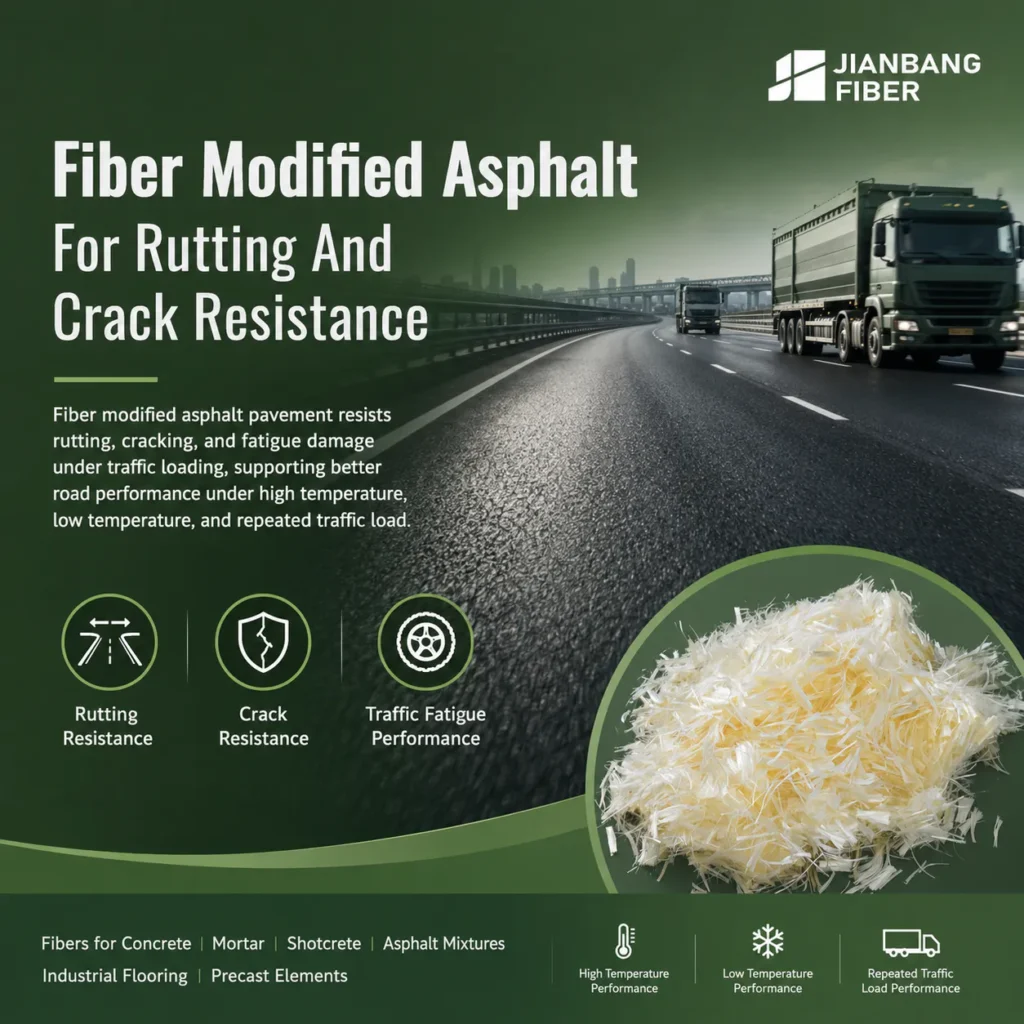
Low temperature cracking is another major asphalt pavement problem. When temperature drops, asphalt becomes stiff. If the pavement cannot release thermal stress, cracks can form.
Shandong Jianbang Fiber finds out that PAN fiber can help improve low temperature crack resistance by improving the toughness and structure of asphalt. A good fiber network can help distribute stress and delay crack growth.
However, too much PAN fiber can reduce ductility too much. If the asphalt becomes overly stiff, cracking risk can increase. This is why fiber dosage must be balanced.
The best PAN fiber modified asphalt should not only have a high softening point. It should also keep enough crack resistance at low temperature. For cold regions, low temperature testing is necessary before project use.
PAN Fiber And Fracture Toughness
Fracture toughness describes how much energy the material can absorb before cracking or breaking. For road asphalt, higher fracture toughness means better crack resistance and better resistance to sudden damage.
Shandong Jianbang Fiber finds out that PAN fiber can significantly improve asphalt fracture toughness. When PAN fiber content is about 1%, fracture energy increases quickly. When the fiber content reaches about 3% to 4%, fracture toughness tends to become stable.
This happens because fibers can carry part of the tensile load. When the asphalt is pulled, stress is transferred from the asphalt matrix to the fiber. The fiber helps resist crack opening.
But when fiber content is too high, the benefit can stop increasing. Voids, air gaps, and uneven fiber distribution can appear. These defects reduce fracture toughness.
This is a key lesson for asphalt buyers. Do not choose a very high dosage only because more fiber sounds stronger. Proper dispersion and correct dosage matter more.
PAN Fiber And Thermal Aging Resistance
Asphalt ages during production, paving, and service. Heat and oxygen can change asphalt chemistry. Light components may evaporate or oxidize. Resin and aromatic components can form larger molecular structures. Asphalt becomes harder and more brittle.
Aged asphalt has lower ductility and lower penetration. It is more likely to crack.
Shandong Jianbang Fiber finds out that PAN fiber can improve the thermal aging resistance of asphalt. The fiber can absorb oil components in asphalt and reduce their evaporation and decomposition. This can reduce thermal oxidation.
When PAN fiber mass fraction is around 2% to 3%, the thermal aging performance is better. This range gives useful reinforcement without creating too many dispersion defects.
For asphalt plants, this matters because asphalt is heated during mixing. For pavement owners, this matters because aging continues during service. Better aging resistance can support longer pavement life.
PAN Fiber And Fatigue Resistance
Fatigue damage happens when pavement is loaded many times. One truck pass may not cause visible damage. But millions of passes can create cracks. These cracks grow over time and become fatigue cracking.
Shandong Jianbang Fiber finds out that PAN fiber can improve asphalt fatigue stability. Pure asphalt can break directly under oscillation fatigue. With PAN fiber, the material can better resist repeated movement.
When PAN fiber mass fraction is around 2% to 4%, the fatigue stability is better. At about 1%, the fiber network may not be complete, so fatigue improvement is limited. At about 5%, voids, air gaps, and poor dispersion can increase, so fatigue stability can drop again.
This means the best fatigue result comes from a well-formed fiber network, not from the highest fiber content.
For roads with heavy traffic, fatigue resistance is one of the most important design goals. PAN fiber can help asphalt pavement resist repeated load when used in the right range.
Why Fiber Dispersion Is Critical
Fiber dispersion decides whether PAN fiber works or fails. If fibers are mixed with ordinary low-shear stirring, they may wrap around the mixing shaft. The asphalt mixture may separate. The fiber may not be evenly distributed.
Shandong Jianbang Fiber finds out that strong shear mixing can improve PAN fiber dispersion in asphalt. Better dispersion helps the fiber form a stable network. It also reduces weak points.
Poor dispersion creates several problems. It can create fiber clumps. It can create air gaps. It can create non-uniform stiffness. It can also reduce fracture toughness and fatigue resistance.
For asphalt plants, this means the mixing process must be designed carefully. Fiber should be added evenly. Mixing temperature should be controlled. Mixing time should be enough for dispersion, but not so long that it harms asphalt quality.
A trial mix is necessary before large-scale road construction.
Suggested PAN Fiber Dosage Direction
Based on the performance trends, Shandong Jianbang Fiber finds out the following dosage directions for PAN fiber modified asphalt.
| Performance Target | Recommended PAN Fiber Direction |
|---|---|
| Network formation | Around 3% is an important reference point |
| Thermal aging resistance | Around 2% to 3% performs well |
| Fatigue stability | Around 2% to 4% performs well |
| Fracture toughness | Around 3% to 4% becomes stable |
| Avoiding dispersion defects | Avoid excessive dosage without testing |
These ranges are not fixed rules for every road. They are practical reference points. The final dosage should be confirmed by asphalt binder tests and asphalt mixture performance tests.
The project should consider climate, traffic load, asphalt grade, aggregate type, mixing equipment, and construction temperature.
PAN Fiber Modified Asphalt Compared With Other Fiber Systems
PAN fiber is one option for asphalt reinforcement. Other common fibers include polyester fiber, lignin fiber, basalt fiber, glass fiber, cellulose fiber, and mineral fiber. Each fiber has its own function.
PAN fiber is useful for improving asphalt structure, temperature sensitivity, aging resistance, and fatigue stability.
Bazalt elyaf can provide high strength and high temperature resistance.
Polyester elyaf can improve crack resistance and flexibility in some asphalt systems.
Selüloz elyaf is often used to stabilize asphalt binder in stone mastic asphalt and reduce binder drain-down.
Cam elyaf can improve tensile reinforcement, but compatibility and durability must be checked.
The best fiber depends on pavement type and design target. Shandong Jianbang Fiber recommends choosing fiber based on performance testing, not only material name.
Practical Applications Of PAN Fiber Modified Asphalt
PAN fiber modified asphalt can be considered in many pavement applications.
It can be used for highways with heavy traffic. It can help reduce rutting and fatigue cracking.
It can be used for bridge deck pavement. Bridge decks face vibration, temperature change, and heavy wheel load.
It can be used for airport pavement. Airport pavement needs good resistance to repeated loading and high stress.
It can be used for urban bus lanes. Bus lanes often face slow heavy traffic and high rutting risk.
It can be used for industrial roads and port areas. These roads carry heavy vehicles and need better deformation resistance.
It can also be used in asphalt repair materials where better crack resistance and aging resistance are needed.
Construction And Mixing Notes
PAN fiber modified asphalt needs controlled processing. The fiber should be dry, clean, and evenly fed. The asphalt should be heated to a suitable temperature. The mixing equipment should provide enough shear to disperse fiber.
The mixing time should be controlled. Too short mixing can cause poor dispersion. Too long mixing can increase aging risk.
The final modified asphalt should be checked for penetration, ductility, softening point, aging resistance, and fatigue behavior. For pavement mixtures, rutting, low temperature cracking, moisture sensitivity, and fatigue tests may also be needed.
Workers should use basic protection when handling dry fiber. Gloves, eye protection, and a dust mask are recommended if airborne fiber is visible. The fiber should be stored in a dry place and protected from moisture.
Why Choose Ecocretefiber™ PAN Fiber Solutions
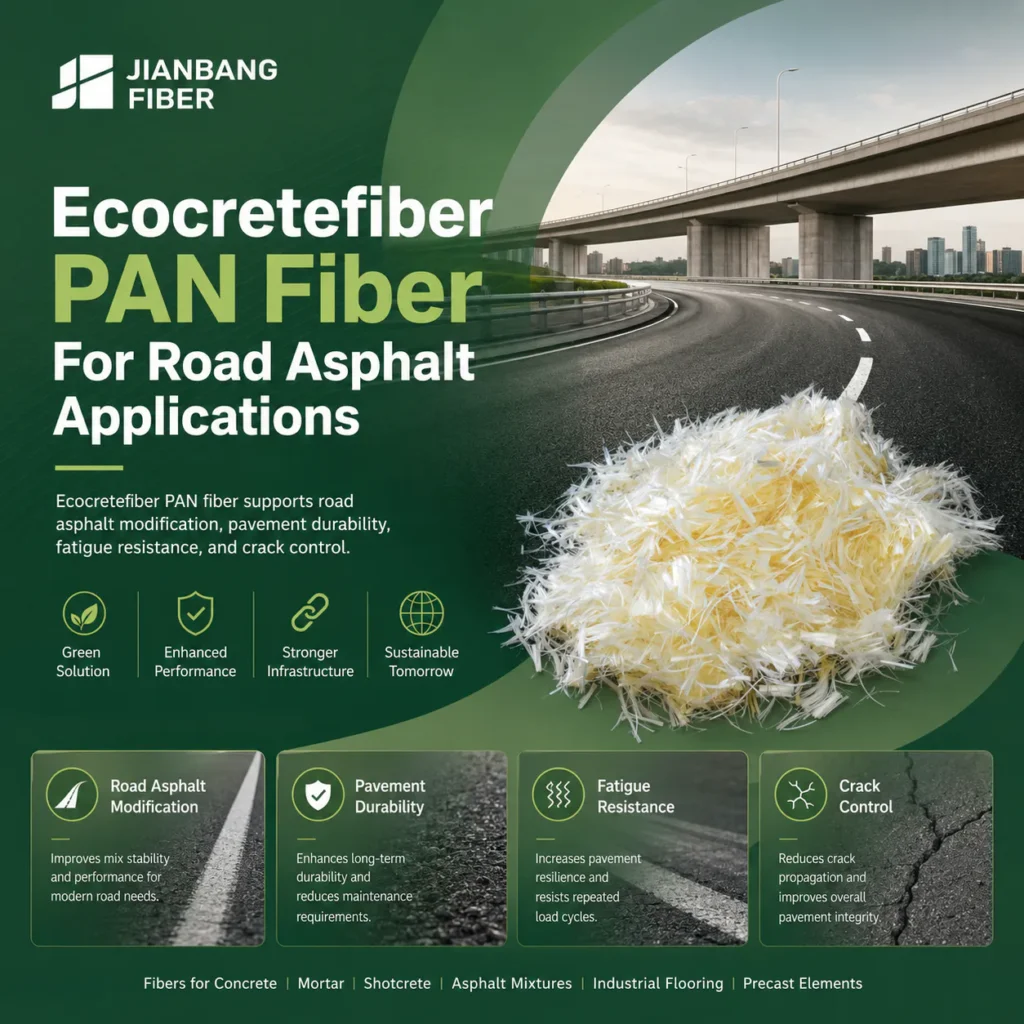
Ecocretefiber™ is the concrete and construction fiber brand of Shandong Jianbang Kimyasal Elyaf Co, Ltd. We supply fiber solutions for concrete, mortar, shotcrete, road pavement, bridge deck, tunnel lining, precast products, and asphalt-related applications.
Our product direction includes PAN fiber, poli̇propi̇len elyaf, basalt fiber, steel fiber, PVA fiber, macro synthetic fiber, and other reinforcement fibers.
For PAN fiber asphalt applications, we focus on pavement durability, anti-rutting performance, crack control, thermal aging resistance, and fatigue stability. We understand that road performance is not decided by fiber alone. The fiber must match asphalt binder, aggregate, plant mixing process, climate, and traffic load.
Ecocretefiber™ can support contractors, distributors, asphalt plants, and infrastructure buyers with fiber selection, packaging options, OEM service, and technical communication.
Buyer Checklist Before Ordering PAN Fiber For Asphalt
Before ordering PAN fiber for asphalt modification, buyers should prepare several details.
| Soru | Neden Önemli? |
|---|---|
| What asphalt binder grade is used? | Binder grade affects modification response. |
| What is the road application? | Highway, bridge deck, airport, and bus lane need different performance. |
| What is the climate condition? | Hot and cold regions need different balance of rutting and cracking resistance. |
| What traffic load is expected? | Heavy traffic requires better fatigue and rutting resistance. |
| What dosage range will be tested? | 2% to 4% is a useful test direction, but final dosage needs confirmation. |
| What mixing equipment is available? | Fiber dispersion depends on shear and mixing control. |
| Is aging resistance important? | PAN fiber can help reduce thermal aging effects. |
| Will mixture performance tests be done? | Binder improvement must be confirmed at mixture level. |
This checklist helps reduce purchase risk and improves project communication.
Sonuç
PAN fiber modified asphalt is a practical material direction for roads that need better rutting resistance, crack control, thermal aging resistance, and fatigue performance. PAN fiber can reduce asphalt penetration and ductility, increase softening point, and improve temperature stability. It can also improve fracture toughness, aging resistance, and fatigue stability when the dosage and dispersion are controlled.
Shandong Jianbang Fiber finds out that the most important point is network formation. Around 3% PAN fiber can help asphalt change from a sol-gel structure to a gel-type structure and form a more complete fiber network. This network supports better road performance.
But Shandong Jianbang Fiber also finds out that more fiber is not always better. Excessive dosage can create air gaps, voids, and uneven fiber distribution. These defects can reduce fracture toughness and fatigue resistance.
The right solution is to use PAN fiber as part of a complete pavement system. Fiber type, dosage, asphalt grade, mixing process, aggregate structure, climate, traffic load, and testing method should all be considered.
Shandong Jianbang Kimyasal Elyaf Co, Ltd. malzemeler Ecocretefiber™ PAN fiber and other construction fiber solutions for customers who need better road pavement performance. If your project needs asphalt anti-rutting fiber, asphalt crack resistance fiber, or a practical fiber selection plan, Ecocretefiber™ can help you choose a suitable solution.