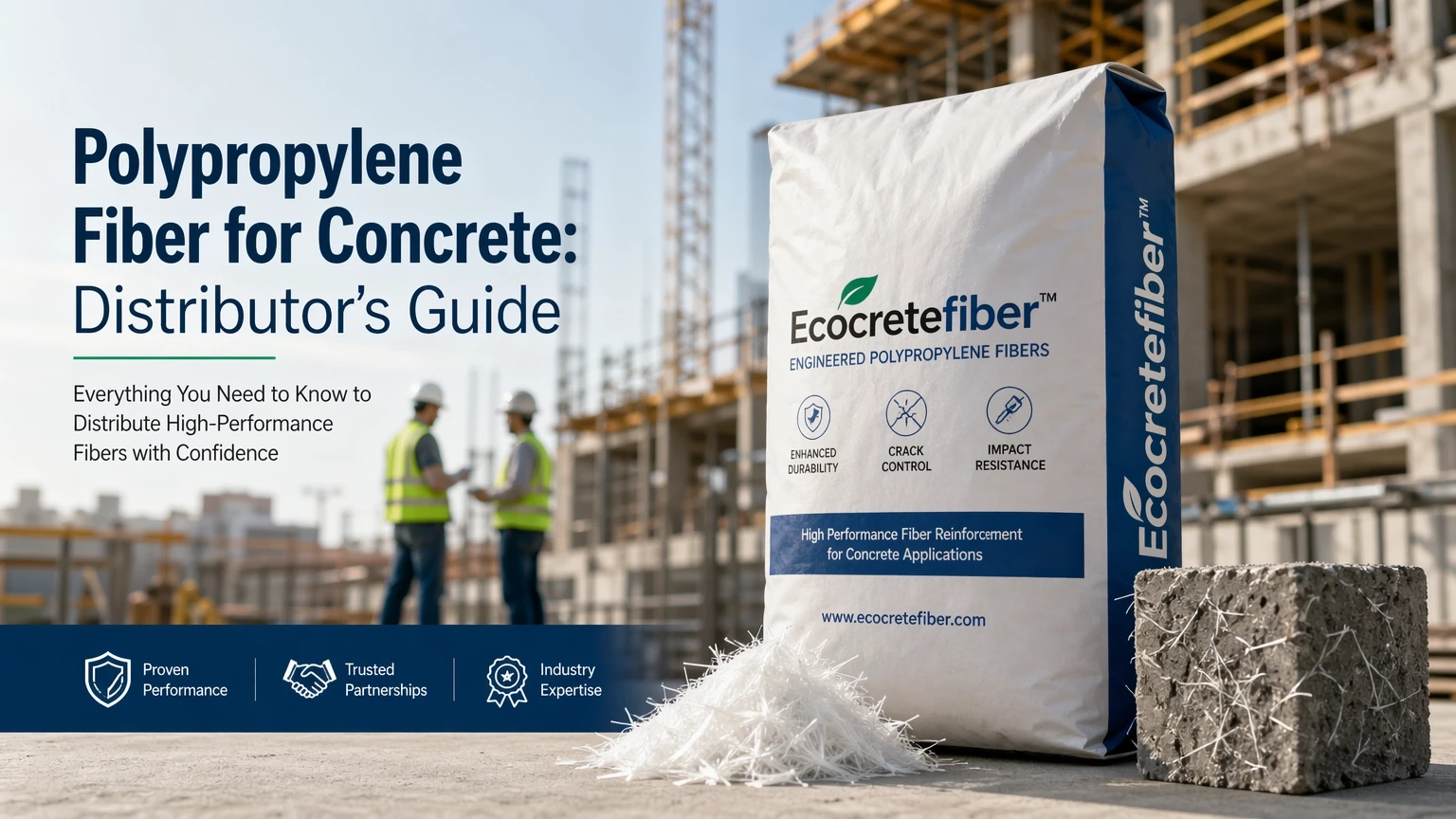
Most articles about beton i̇çi̇n poli̇propi̇len elyaf are written for contractors. They cover how to mix it, how much to add per cubic yard, and why your slab will crack less. Good information if you are the one pouring concrete.
You are not a contractor. You are a distributor. You do not pour slabs. You sell the material that goes into them.
This guide covers what poli̇propi̇len elyaf does in concrete, yes. It also covers what matters to you: which SKUs move fastest, how certifications affect your margins, which regions are buying right now, and what questions your clients will ask before they order. Every section ties back to something that affects your bottom line.
What Polypropylene Fiber Actually Does in Concrete
You cannot sell poli̇propi̇len elyaf well if you cannot explain what it does. Skip the academic version. Your customers want plain language.
Polipropilen elyaf (usually shortened to PP elyaf) is a synthetic reinforcement made from polymer resin. Manufacturers extrude resin into thin filaments, cut them to specific lengths, and pack them into bags or bales. Once mixed into concrete, millions of these filaments spread through the entire mix.
They do one thing: interrupt crack formation.
Concrete cracks when it dries, when temperatures drop, and under load. PP elyaf does not stop cracking completely; no material can make that claim honestly. It reduces crack size ve number, especially during early curing when concrete is at its weakest. Smaller cracks mean less water getting in, less rebar corrosion, and a longer-lasting structure.
Sell that one fact. Everything else (dosage numbers, certification codes, pricing) builds on top of it.
Micro vs. Macro Polypropylene Fibers — Two Different Products, Two Different Markets
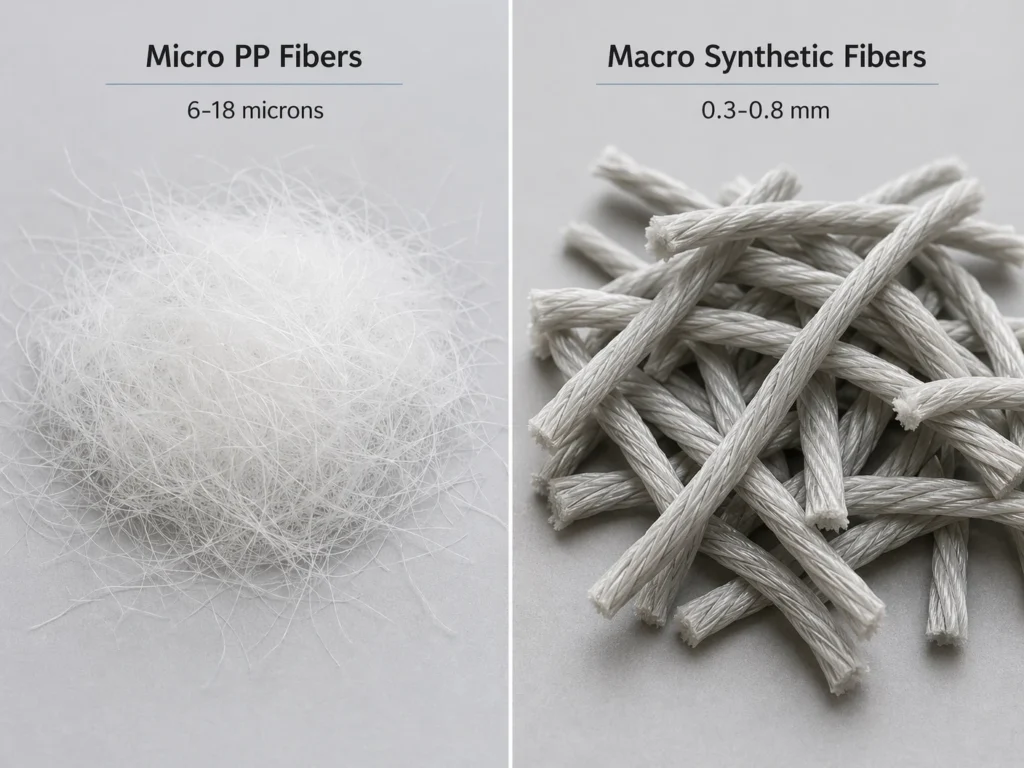
Not all PP elyaf is the same. Distributors who treat it as a single product confuse their customers and leave money on the table. There are two distinct categories, each serving different applications at different prices.
Mikro polipropilen lifler are fine filaments, typically 6–18 microns in diameter and 4–19 mm long. Think tiny hairs. Their main job is plastic shrinkage crack control, which means preventing those hairline cracks that show up on fresh slabs before the concrete cures fully. Micro fibers cost less per kilogram, get used at low dosages (usually 0.9–1.5 kg/m³), and work best in flatwork: industrial floors, driveways, parking decks, residential foundations.
Macro synthetic fibers (or macro synthetic fiber for concrete) are thicker and heavier, usually 0.3–0.8 mm in diameter and 30–54 mm long. They look like small twisted cords. Macro fibers go beyond shrinkage control. They give concrete post-crack structural capacity; the slab holds together even after a crack appears. That makes macro fibers a partial replacement for welded wire mesh or light steel rebar in certain applications. Dosages run higher (2.0–6.0 kg/m³), and so does the per-kilogram price.
For distributors, the difference comes down to this: micro fiber moves fast at low margin (commodity). Macro fiber moves slower but earns better margin (value-added). Stock both if you can afford to. If you must pick one to start with, begin with micro for volume, then add macro later to grow your margins.
The Crack-Control Mechanism in Plain Language
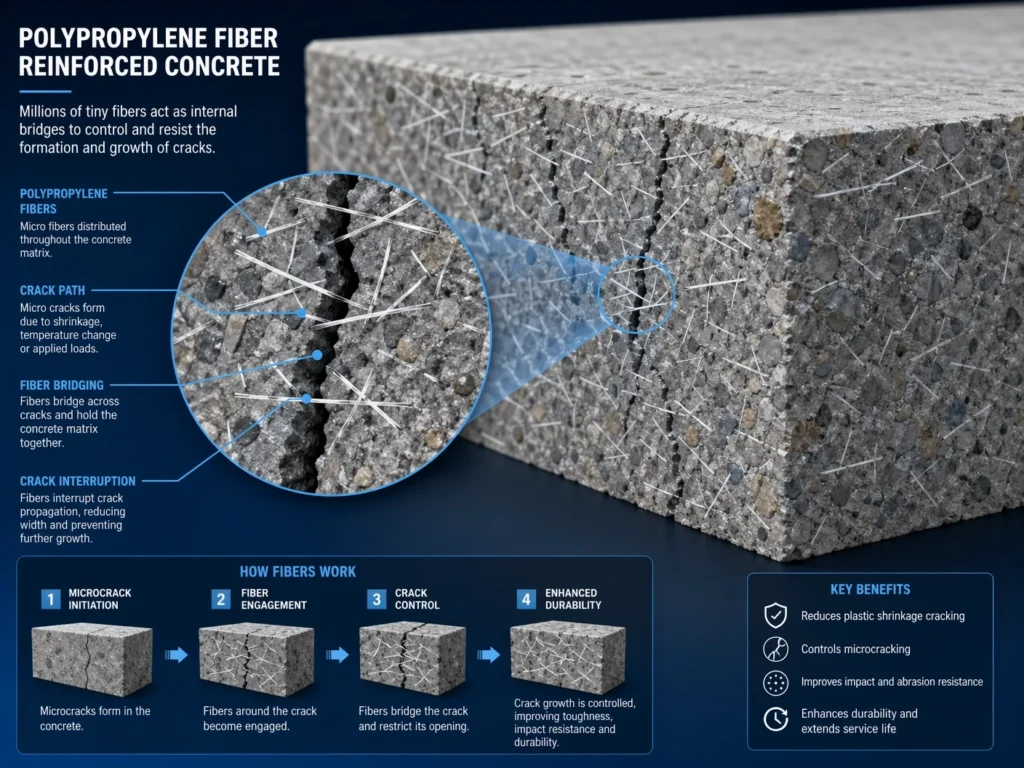
Your clients will ask: “How does little pieces of plastic actually stop concrete from cracking?” Have an answer ready that sounds confident without sounding like a materials science lecture.
Here is a simple version:
Wet concrete loses water from its surface as it cures. As water leaves, the concrete shrinks. When shrinkage force beats the concrete’s tensile strength, a crack opens. This often happens within the first 24 hours.
PP elyaf filaments scattered throughout the mix act like millions of internal bridges. Each filament crosses potential crack paths. When shrinkage stress builds, the fibers absorb some of that tension. A crack might still form. But instead of one wide crack, you end up with many microscopic ones too small to cause real problems. Engineers call this “crack width limitation.” You can just say: “It keeps cracks too small to matter.”
That explanation takes thirty seconds. Your customer nods, feels smart, and you move on to price and delivery. That is how you sell.
Polypropylene Fiber vs. Steel Fiber vs. Glass Fiber — What Your Clients Will Ask
Comparison questions show up in almost every sales conversation. Your client has options. They want to know why they should choose poli̇propi̇len elyaf over çelik elyaf, cam elyafı, or traditional steel mesh. Give honest answers backed by data.
Performance Comparison Table
Copy this into an email, print it as a PDF, or keep it on your phone for reference calls:
| Faktör | Polipropilen Elyaf | Çelik Elyaf | Cam Elyaf |
|---|---|---|---|
| Primary Function | Plastic shrinkage crack control; post-crack capacity (macro) | Structural load-bearing reinforcement | Alkali-resistant shrinkage control |
| Crack Control Effectiveness | Excellent (early-age); Good (structural, macro only) | Excellent (structural) | Good (shrinkage) |
| Corrosion Resistance | No corrosion (chemically inert) | Rusts over time; causes staining and spalling | No corrosion |
| Fire Performance | Melts at ~160°C; reduces explosive spalling in tunnels | Retains strength in fire; no melting | Loses strength above ~250°C |
| Weight per m³ of Concrete | Negligible (~0.1% of concrete mass) | Significant (40–100 kg/m³ common) | Very light |
| Impact on Workability | Minimal at standard dosages | Reduces slump noticeably | Can reduce workability if overdosed |
| Cost per kg | Low (1.50–1.50–3.00/kg depending on type) | Higher (3.00–3.00–8.00/kg) | Moderate (2.00–2.00–4.50/kg) |
| Cost per m³ of Concrete | Lowest total installed cost | Highest material + handling cost | Moderate |
| Certification Availability | EN 14889-2, ASTM C1116/C1579, widely available | EN 14889-1, ASTM A820 | EN 14889-2, ISO standards |
| Safety During Handling | Safe; no sharp edges; PPE still recommended | Sharp; requires gloves and careful handling | Irritating dust; requires respiratory protection |
Where PP Fiber Wins — And Where It Does Not
Polipropilen elyaf has three real advantages that matter to most of your clients:
Cost. The total installed cost of PP fiber-reinforced concrete runs lower than steel or glass fiber alternatives almost every time. The material costs less per kilogram, dosages are lower, handling is easier (no cuts from sharp steel), and there is zero rust risk that could trigger warranty claims later.
Corrosion immunity. In marine environments, parking structures, wastewater plants, or anywhere chlorides are present, steel corrodes. Polipropilen does not. That single fact drives specification decisions for coastal infrastructure projects around the world.
Ease of use. Workers toss bags of PP elyaf into the mixer or onto the aggregate pile. No special equipment needed. Steel fiber sometimes needs special mixing protocols to avoid clumping together. Easier adoption means faster contractor acceptance and fewer complaints about installation.
Where PP elyaf falls short: heavy structural load applications. If an engineer specifies structural reinforcement for high-load conditions (bridge decks under heavy traffic, seismic zones, blast-resistant structures), makro senteti̇k elyaf can help, but it does not fully replace structural steel rebar in most code-governed designs. Be upfront about that limit. Your credibility depends on honesty here.
Can PP Fiber Replace Steel Mesh? (The #1 Client Question)
This question comes up more than any other. Here is the accurate answer:
Yes, in many cases, with conditions.
For plastic shrinkage crack control in ground-supported slabs (industrial floors, residential foundations, sidewalks, driveways), mikro polipropilen elyaf at 0.9–1.5 kg/m³ is widely accepted as a replacement for light welded wire fabric (WWF). ACI 116R and various national guidelines back this substitution.
For structural replacement (replacing steel mesh or rebar in suspended slabs, loaded pavements, seismic elements), makro senteti̇k elyaf at higher dosages (3.0–6.0 kg/m³) can partially replace light steel reinforcement sometimes. But the decision belongs to the project’s structural engineer, not the material supplier. Building codes vary by country and application.
Give your clients this line: “Polipropilen elyaf replaces light steel mesh for shrinkage control in most flatwork. Anything beyond that? Check with the engineer.” It protects you, protects your client, and it is technically correct.
Dosage & Mix Design — The Numbers Distributors Need to Know
Nothing kills a sale faster than a distributor who cannot answer “How much do I need?” Have these numbers ready. Your competitors probably already do.
Standard Dosage Ranges by Application
Different applications need different fiber types, different lengths, and different dosages. Here is a quick-reference table your clients will use:
| Uygulama | Recommended Fiber Type | Typical Dosage | Typical Fiber Length | Common Standard Referenced |
|---|---|---|---|---|
| Industrial floor slabs (ground-supported) | Mikro PP elyaf | 0.9 – 1.5 kg/m³ | 12 – 19 mm | ACI 360R, EN 14488 |
| Residential foundations & driveways | Mikro PP elyaf | 0.7 – 1.2 kg/m³ | 6 – 12 mm | Local building codes |
| Shotcrete / sprayed concrete | Micro or Macro PP fiber | 2.0 – 6.0 kg/m³ | 12 – 38 mm | EFNARC, ACI 506 |
| Precast concrete elements | Mikro PP elyaf | 0.6 – 1.0 kg/m³ | 6 – 12 mm | PCI handbook guidelines |
| Tunnel linings (fire-spalling resistance) | Macro PP fiber | 2.0 – 4.0 kg/m³ | 30 – 48 mm | EN 1992-1-2, ETAG 028 |
| Pavements / airport runways | Makro sentetik elyaf | 3.0 – 5.5 kg/m³ | 38 – 54 mm | FAA, local DOT specs |
| Composite cement board / render | Mikro PP elyaf | 0.5 – 1.0 kg/m³ | 3 – 6 mm | Manufacturer specifications |
A few practical notes:
- Kg/m³ converts roughly to 1.5 – 2.5 lbs/yd³ for US-market clients. Keep both units handy.
- These ranges reflect typical industry practice. Project specifications sometimes call for dosages outside these ranges.
- Follow the project engineer’s spec sheet when one exists. Your job as distributor is to supply what gets specified, not redesign the mix.
What Happens When You Overdose or Underdose
Two scenarios your clients will run into. Know the consequences so you can advise them.
Underdosing. If a client adds 0.3 kg/m³ when the spec says 1.0 kg/m³, the poli̇propi̇len elyaf concentration drops below the threshold for effective three-dimensional crack bridging. Result? Almost no measurable benefit. The client spent money on fiber and got unreinforced concrete performance. Then you hear complaints like “your fiber does not work” when the real problem was not enough dosage.
Overdosing. Going far above recommended dosage (say, 5.0 kg/m³ of micro fiber when the target was 1.0 kg/m³) creates two problems. Workability suffers first; the mix turns stiff and hard to finish. Second, surface defects called “fiber balling” or “hairy concrete” appear, where clumped fibers create visible imperfections in the finished slab. Overdosing wastes money and produces worse results than using the right amount.
Tell your clients this: Follow the specified dosage. More is not better.
Certifications & Compliance — Your Ticket to Cross-Border Sales
If you plan to sell into regulated markets (Europe, North America, the Middle East), certifications are not optional paperwork. They are gatekeepers. Projects with uncertified materials get rejected at inspection. Distributors who supply non-compliant products lose contracts and reputation. Understand the certification landscape, and you understand where the real sales opportunities sit.
EN 14889-2 (Europe) — The Gateway to EU and Middle East Markets
EN 14889-2 is the European standard for fiber for concrete, part 2: polymer fibers. It sets test methods, classification criteria, and performance requirements that poli̇propi̇len elyaf products must meet to carry CE marking.
Why should you care?
Public tenders in the EU, major infrastructure projects in Gulf Cooperation Council countries (Saudi Arabia, UAE, Qatar, Kuwait), and increasingly in Southeast Asian government projects all require EN 14889-2 compliance. A PP fiber product without this certification cannot legally be supplied to these jobs.
When sourcing poli̇propi̇len elyaf, ask suppliers for:
- Valid CE certificate issued by a notified body (TÜV, SGS, Bureau Veritas, or equivalent)
- Test reports confirming compliance with EN 14889-2 performance classes
- Batch-level traceability documentation
Shandong Jianbang Chemical Fiber Co., Ltd., the manufacturer behind Ecocretefiber™, holds EN 14889-2 certification for its polypropylene fiber products. Certificates are available on request for each shipment batch.
ASTM C1116 / ASTM C1579 (North America) — What US Buyers Demand
The US market runs on ASTM International standards instead of European ones. Two key standards apply to synthetic fiber reinforced concrete:
- ASTM C1116 / C1116M: Standard Specification for Fiber-Reinforced Concrete. This classifies fiber types and sets minimum performance requirements.
- ASTM C1579 / C1579M: Standard Test Method for Evaluating Plastic Shrinkage Cracking of Restrained Fiber-Reinforced Concrete. It measures exactly what your clients care about most; how well the fiber stops early cracking.
US-specifying engineers write “ASTM C1116 compliant” into project documents regularly. Some go further and list specific manufacturers on approved product lists (APL). Getting onto an APL involves independent lab testing and project-by-project approval; it is a separate process.
If you target the US market, confirm your poli̇propi̇len elyaf supplier has relevant ASTM-compliant test data. Having that documentation on hand shortens sales cycles noticeably.
Why Certification Consistency Matters for Distributor Margins
Here is a problem that catches distributors off guard: batch inconsistency.
Many suppliers claim certifications. Some even show valid certificates. The problem shows up when shipment #5 arrives and the fiber geometry, tensile strength, or dispersion looks different from shipment #1. The certificate said “EN 14889-2 compliant,” but this batch performs differently.
Then what? Your customer complains. The inspector flags non-conformance. You hold inventory that does not match its paperwork. Margin disappears. Relationship damage follows.
Certification consistency means every batch meets the same documented specification. That takes disciplined quality management at the factory level: incoming raw material checks, in-process quality controls, finished-product sampling, and full batch traceability records.
When evaluating suppliers, ask specifically about their batch-to-batch consistency track record. Request test reports from several recent shipments, not just one certificate from two years ago. A supplier who hands over consistent, batch-specific data without hesitation is worth a long-term relationship.
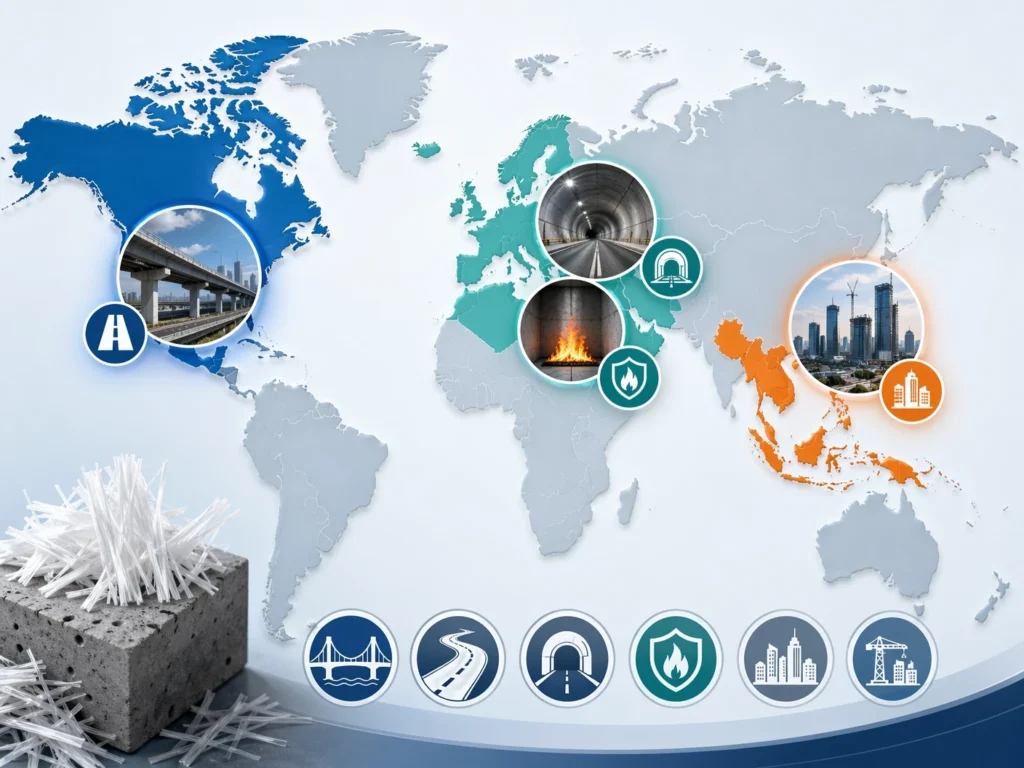
Market Demand by Region — Where the Growth Is
Polypropylene fiber for concrete sells differently depending on where you look. Construction activity levels, regulations, climate, and cost sensitivity all shape where demand is strongest right now. Understanding these patterns helps you prioritize markets and allocate resources smarter.
North America: Infrastructure Spending Driving Fiber Demand
The United States passed major federal infrastructure investment legislation in recent years. Bill names and funding amounts shift with politics, but the trend is clear: billions are flowing into road repairs, bridge work, airport upgrades, and public building construction.
Infrastructure spending boosts concrete fiber demand for two reasons. More concrete gets poured overall. And newer specs increasingly favor fiber-reinforced solutions over traditional wire mesh because they save labor and perform better. Federal and state Departments of Transportation have been expanding their acceptance of synthetic fiber in pavement and transportation projects.
For distributors, the US market offers large individual orders and relatively standard specification frameworks. The catch: you need ASTM-compliant products and patience for longer procurement cycles on government-funded projects.
Europe & Middle East: Fire Safety Regulations Pushing PP Fiber Adoption
Europe tightened tunnel fire safety rules after catastrophic fires in the late 1990s and early 2000s. Eurocode 2 (EN 1992-1-2) now prescribes measures to prevent explosive spalling in tunnel linings exposed to fire. Makro sentetik elyaf, including macro polypropylene fiber, is one of the main engineered solutions tunnel designers specify to meet those fire-resistance requirements.
The Middle East, especially the Gulf states, took similar approaches. Major metro rail projects in Riyadh, Doha, Dubai, and other regional hubs specify poli̇propi̇len elyaf both for fire-spalling resistance underground and for durability in hot, arid climates where thermal cycling stresses concrete surfaces.
These markets support premium pricing. Certified makro senteti̇k elyaf for tunnel applications sells at 2 to 3 times the price of commodity micro fiber for general flatwork. If your operation can handle certification requirements and project approval processes, Europe and the Middle East offer the best-margin opportunities in PP elyaf right now.
Southeast Asia: Rapid Urbanization and the Cost Advantage of PP Fiber
Southeast Asia (Vietnam, Thailand, Indonesia, the Philippines, Malaysia) is building fast. New residential developments, industrial parks, and infrastructure projects are going up at a pace most other regions cannot match.
In this market, poli̇propi̇len elyaf wins mainly on cost versus traditional reinforcement methods. Labor costs for installing steel mesh keep climbing. PP elyaf eliminates that labor step entirely because workers add it during batching. For developers counting every dollar per square meter of construction cost, that saving matters.
Southeast Asia is less driven by certifications than Europe or the Gulf. Price sensitivity runs higher. Order quantities per transaction tend to be smaller. The competitive field includes plenty of regional and Chinese suppliers. Success here means competitive pricing, reliable logistics, and strong relationships with local contractors and ready-mix plants. It is a volume game, but volumes are growing quickly.
How to Evaluate a PP Fiber Supplier — A Distributor’s Checklist
Pick the wrong poli̇propi̇len elyaf supplier and the damage goes beyond one lost shipment. Quality failures delay projects. Certification gaps cause rejected deliveries. Inconsistent batches generate ongoing complaints that eat your time and hurt your reputation with end users. Get supplier selection right from day one.
7 Things to Verify Before Signing a Supply Agreement
Run through this checklist when vetting new poli̇propi̇len elyaf suppliers. Each item addresses a real failure mode distributors have actually encountered.
1. Valid, current certifications with batch traceability.
Ask for copies of EN 14889-2 certificates (for EU/ME markets), ASTM-related test reports (for US markets), or whatever regional standard fits your target market. Check expiry dates. Confirm the manufacturer name on the certificate matches who you are contracting with. Then ask: “Can you send me batch-specific test reports for your last three shipments?” A supplier with nothing to hide answers immediately.
2. Third-party laboratory test reports.
Manufacturer self-testing has value, but independent third-party verification carries more weight. Look for reports from recognized labs: SGS, TÜV, Bureau Veritas, Intertek, or national labs in the manufacturing country. Third-party results on tensile strength, elastic modulus, melt point, and dispersion give you objective quality assurance.
3. Demonstrated production capacity and realistic lead times.
Can the supplier handle your peak-season volume? Ask about monthly production tonnage, current capacity utilization, and lead time from order confirmation to port. A supplier running at 95% year-round cannot scale when your orders grow. One promising 3-day lead times for custom specs is probably overcommitting.
4. Consistent fiber geometry across batches.
Request samples from three different production batches. Compare length distribution, denier (thickness), and appearance visually, under magnification if possible. Variation between batches should be minimal. Visible differences in color, thickness, length uniformity, or texture point to process instability.
5. Export-ready packaging and proper labeling.
International shipments need proper packaging (moisture-proof, palletized, stable in containers) and labeling (product name, net weight, batch number, manufacture date, destination country, certification marks). Suppliers experienced in export have this handled. New-to-export suppliers generate customs headaches, damaged-goods claims, and documentation disputes.
6. Technical support in your language(s).
When your client asks a technical question about dosage adjustment, mix design interaction, or admixture compatibility, can your supplier respond? Technical support capability separates commodity resellers from actual manufacturing partners. Even basic support (datasheets, FAQ answers, sample calculations) adds real value to what you offer.
7. Clear sample policy.
Every serious PP elyaf manufacturer offers samples. The real questions: how easily can you get them, do they cost anything, and how fast do they arrive? A manufacturer confident in product quality wants you to see and test it firsthand. Sample policies that require excessive paperwork, long wait times, or refuse small-quantity requests are warning signs.
Red Flags That Signal an Unreliable Supplier
Watch for these during your evaluation:
- Certificates that do not check out independently. If a certificate lists a notification body that does not appear on official EU NANDO lists or equivalent registries, be very careful.
- Reluctance to share recent batch test reports. “We will send those later” that never arrives usually means the reports do not exist or contain problems.
- Prices far below established market range. Everyone else quotes 2.00–3.00/kg and someone offers $0.80/kg? That is either recycled/regrind material (lower quality), mislabeled product, or a scam. 2.00–
- No verifiable factory address on Google Maps/Earth. Trading companies posing as manufacturers are common in this industry. Nothing wrong with traders, but know who you are dealing with and whether they control quality.
- Inconsistent communication patterns. Fast responses during negotiation, then silence after payment or when a problem surfaces. That signals someone interested in closing deals, not serving partners.
Building a Profitable PP Fiber Product Line — Positioning & Pricing Strategy
Selling poli̇propi̇len elyaf is straightforward. Selling it profitably, consistently, with room to grow? That takes some thought about product selection and pricing.
Which PP Fiber SKUs Should You Stock First?
If you are new to poli̇propi̇len elyaf distribution or expanding your current range, you face a familiar constraint: limited warehouse space and working capital. You cannot stock every SKU. Prioritize based on velocity (what sells fastest in highest volume) and margin (what earns the most profit per unit).
Recommended starting lineup:
SKU 1: 12mm monofilament micro PP fiber, 0.9–1.5 kg/m³ dosage grade.
Your bread-and-butter product. Covers industrial floors, foundations, driveways, precast; the highest-volume applications worldwide. Stock this first. Sell it in 20kg or 25kg bags depending on what your region prefers.
SKU 2: 19mm fibrillated micro PP fiber.
Some markets (parts of Asia and Latin America especially) prefer fibrillated (mesh-structured) fibers over smooth monofilaments for certain uses. Fibrillated fibers anchor slightly better within the concrete matrix mechanically. Add this once SKU 1 is selling steadily.
SKU 3: 38–48mm macro synthetic fiber.
Your premium item. Lower volume, higher margin. Targets tunnel linings, shotcrete, heavy-duty pavements. Stock smaller quantities until you build project-based demand. Consider consignment arrangements with your supplier for slow-moving premium SKUs.
SKU 4: 6mm short-cut micro fiber (for render/plaster/cement board).
Niche product, but useful where cementitious board manufacturing or exterior insulation finishing systems (EIFS) are active. Low stocking cost because it packs tight. Good add-on alongside your core SKUs.
Four SKUs cover roughly 85% of distributor inquiries. Expand from there based on what your specific market asks for.
Margin Structure: From Factory Gate to Distributor Shelf
Knowing the cost stack helps you price competitively while protecting your margin. Here is how a kilogram of poli̇propi̇len elyaf accumulates cost from factory to end user:
Factory ex-works price: 1.00–1.00–2.00 per kg (varies by fiber type, quantity, supplier quality tier)
Export packaging, documentation, inland freight to port: 0.05–0.05–0.15 per kg
Ocean freight (China to major ports): 0.10–0.10–0.25 per kg depending on distance and current rates
Import duties and customs clearance: varies widely by destination country; 0% to 8+%
Distributor landed cost (before your margin): approximately 1.30–1.30–2.80 per kg
Typical distributor margin: 15% – 35% depending on competition, value-added services (technical support, warehousing, credit terms), and relationship depth with buyers
End-user price (contractor/project): approximately 1.80–1.80–4.00 per kg
These are illustrative ranges based on current industry observation. Real numbers fluctuate with polypropylene resin prices (which follow crude oil), shipping costs, exchange rates, and competitive dynamics in your region. Use this as a pricing framework, not as fixed quotes.
Bottom line: poli̇propi̇len elyaf offers decent margins at reasonable volume. It is not razor-thin like bulk cement, nor is it astronomical-markup specialty chemical territory. It sits in the middle; accessible entry point, solid returns at scale, room to grow as you build presence.
FAQ — Answers Your Clients Will Google Before They Call You
These six questions show up repeatedly in search results and in sales conversations. Keep them handy for your team, and consider putting an FAQ page on your website for SEO.
What is the typical dosage of polypropylene fiber in concrete?
Standard dosage for polypropylene fiber runs from 0.9 kg/m³ to 1.5 kg/m³ for micro fiber applications (industrial floors, foundations, flatwork). Makro sentetik elyaf dosages run higher, usually 2.0 kg/m³ to 6.0 kg/m³ depending on structural requirements. Always follow the project spec or the manufacturer’s technical datasheet for the product you use. For context, one cubic meter of concrete weighs about 2,400 kg, so even 1.5 kg/m³ represents less than 0.1% of total mix weight.
Can polypropylene fiber replace steel reinforcement?
Partially, in specific cases. Mikro polipropilen elyaf effectively replaces light welded wire fabric for plastic shrinkage crack control in ground-supported slabs; accepted practice under ACI 360R and similar guidelines internationally. Makro sentetik elyaf at higher dosages provides post-crack structural capacity and partially replaces light steel reinforcement in some cases, such as composite metal deck slabs or tunnel shotcrete linings. But PP fiber does not replace structural steel rebar in code-governed load-bearing applications. The final call always goes to the licensed structural engineer on the project.
Does PP fiber affect concrete workability?
At correct dosages, properly manufactured poli̇propi̇len elyaf barely affects workability. Most modern PP fibers include dispersing agents that help filaments spread evenly during mixing. You might see slight slump reduction (typically 10–25 mm), easily fixed with minor admixture adjustments if needed. Workability problems almost always come from overdosing, low-quality fiber with poor dispersion, or not mixing long enough. If your mix turns unworkable after adding fiber, check the dosage first. Then check the fiber quality.
Is polypropylene fiber resistant to alkali in concrete?
Yes. One of polypropylene’s real advantages as concrete reinforcement is complete chemical inertness to the alkaline environment inside hardened concrete (pH typically 12.5–13.5). Glass fiber historically suffered alkali-silica reaction degradation (which led to alkali-resistant AR-glass development). PP elyaf shows no alkaline degradation over time. That stability helps poli̇propi̇len elyaf takvi̇yeli̇ beton last longer in all service environments.
How should PP fiber be stored and transported?
Store poli̇propi̇len elyaf in original sealed packaging, in a dry covered area, away from direct sunlight and heat above 60°C (140°F). PP softens at high temperatures, and prolonged UV exposure can degrade the polymer surface over time (rarely an issue since fibers end up embedded inside concrete). Shelf life is typically 24 months from manufacture date when stored properly. During transport, prevent punctures and water exposure. Damaged bags should be used promptly rather than stored long-term; moisture ingress can grow mold on packaging (not harmful to the fiber itself, but looks bad).
What certifications should I look for when sourcing PP fiber?
It depends on your target market:
- European Union and Middle East: EN 14889-2 (Fiber for Concrete, Polymer Fibers) with valid CE marking is essential. Many projects also request ETA (European Technical Assessment) or national technical approvals.
- North America: Compliance with ASTM C1116 (Specification for Fiber-Reinforced Concrete) plus test data per ASTM C1579 (Plastic Shrinkage Cracking Test). Some projects maintain Approved Product Lists requiring specific brand or fiber-type approval.
- Other markets: Check local building codes and project specs. Many countries reference EN or ASTM standards even outside their home regions.
Always confirm certificates are current, issued to the actual manufacturer (not some other entity), and backed by recent batch-level test reports.
Why Ecocretefiber™ — Certified PP Fiber from a Source You Can Verify
This guide covered what beton i̇çi̇n poli̇propi̇len elyaf does, how it compares to alternatives, what dosages different applications need, which certifications matter where, and how to pick a reliable supplier. All of this applies no matter which brand you distribute.
If you are evaluating manufacturing partners for your PP elyaf product line, here is what Ecocretefiber™ offers:
Ecocretefiber™ is the registered brand of Shandong Jianbang Kimyasal Elyaf Co, Ltd., a China-based manufacturer focused on poli̇propi̇len elyaf for concrete reinforcement. Key details for distributors:
- Production capacity: Dedicated PP elyaf production lines capable of fulfilling large-scale orders across multiple simultaneous markets
- Certification coverage: Products carry EN 14889-2 certification (CE marked) for European and Middle East market access; ASTM-relevant test data available for North American inquiries
- Product range: Both mikro polipropilen elyaf (monofilament and fibrillated forms, 6–19mm lengths) and makro senteti̇k elyaf (30–54mm lengths for structural and fire-performance applications)
- Batch traceability: Full batch-level test documentation ships with every order, letting downstream users verify compliance for project requirements
- Export experience: Active export operations serving distributors in North America, Europe, the Middle East, and Southeast Asia
- Sample policy: Samples available for qualified distributor inquiries; contact the sales team with your target market, expected volume range, and certification requirements
If you are building or growing a poli̇propi̇len elyaf distribution business and want a manufacturing partner with documented certifications, consistent quality systems, and global market experience, Ecocretefiber™ is worth a conversation.
Reach the Ecocretefiber™ team via ecocretefiber.com contact channels, or request a sample quotation with your target product type, monthly volume estimate, and destination port.