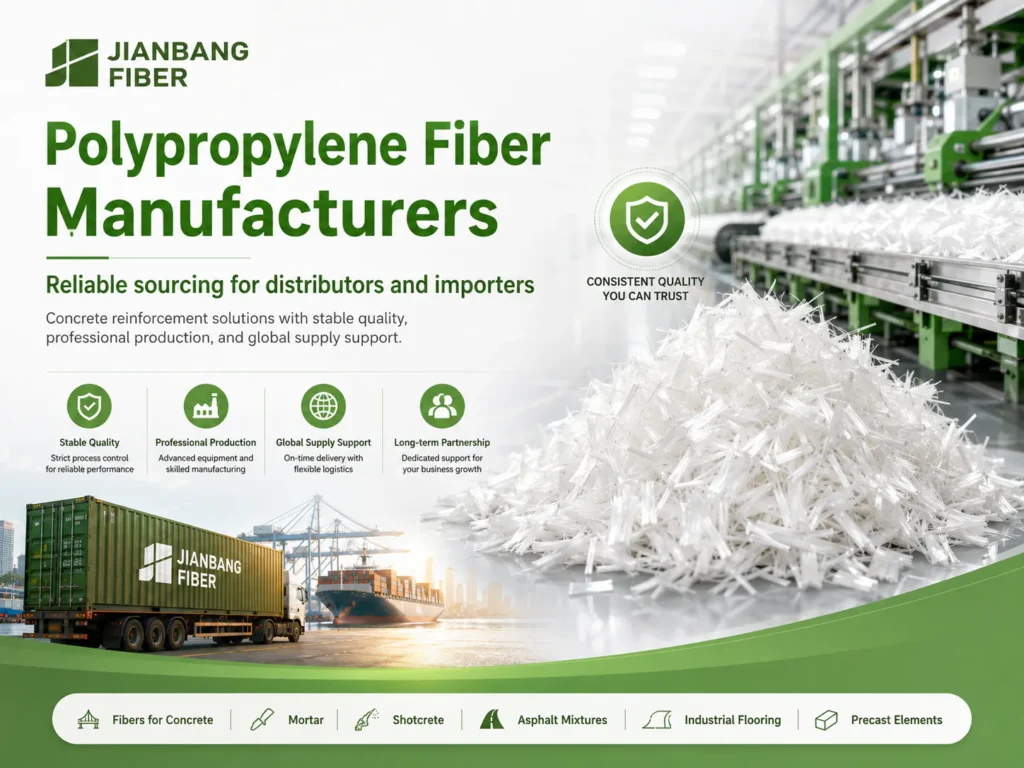
You are a distributor or an importer. You need a reliable polypropylene fiber manufacturer. A real manufacturing partner who delivers consistent quality and holds the right certifications. Someone who can scale with your business, not just answer emails. This guide breaks down what matters when evaluating polypropylene fiber manufacturers, so you can make sourcing decisions with confidence.
The polypropylene fiber market is crowded. A search for suppliers returns thousands of results across B2B platforms like Alibaba and Made-in-China. Most of those listings look the same. Similar product photos. Similar claims. Similar pricing. The difference between a profitable long-term partnership and a costly sourcing mistake comes down to what you know to ask, and what most distributors skip.
This article gives you that framework. Whether you are sourcing polypropylene fiber for concrete for the first time or switching from an underperforming supplier, here is how to evaluate manufacturers on the criteria that actually matter.
What Distributors Should Look for in Polypropylene Fiber Manufacturers
Why manufacturer selection goes beyond price
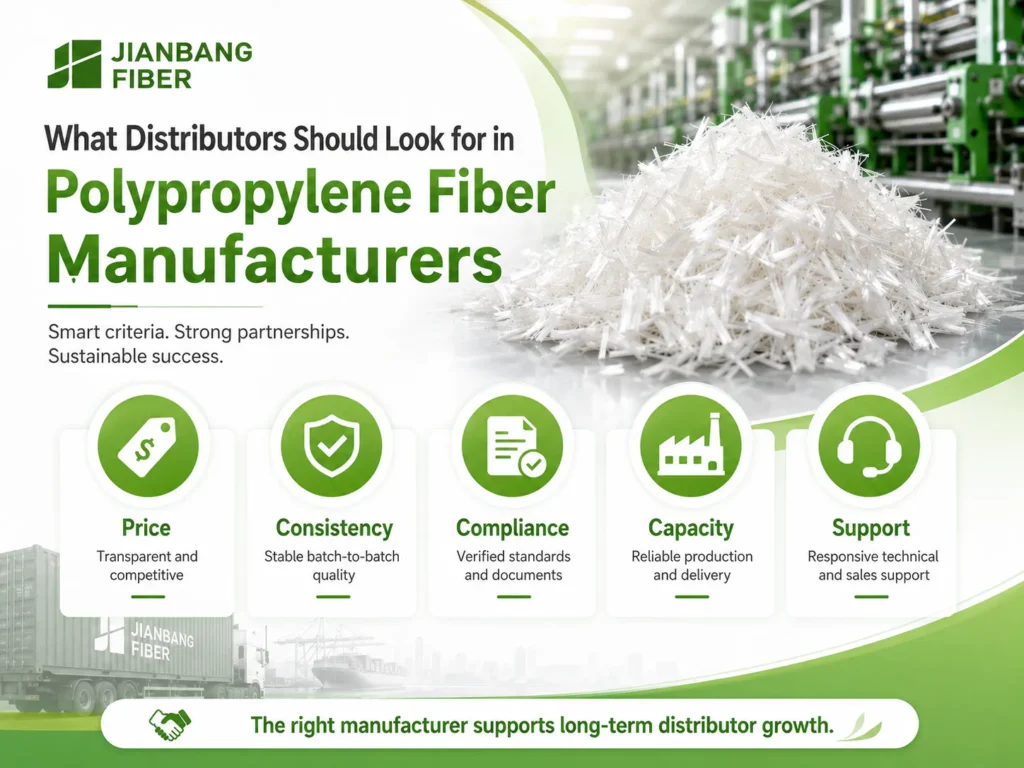
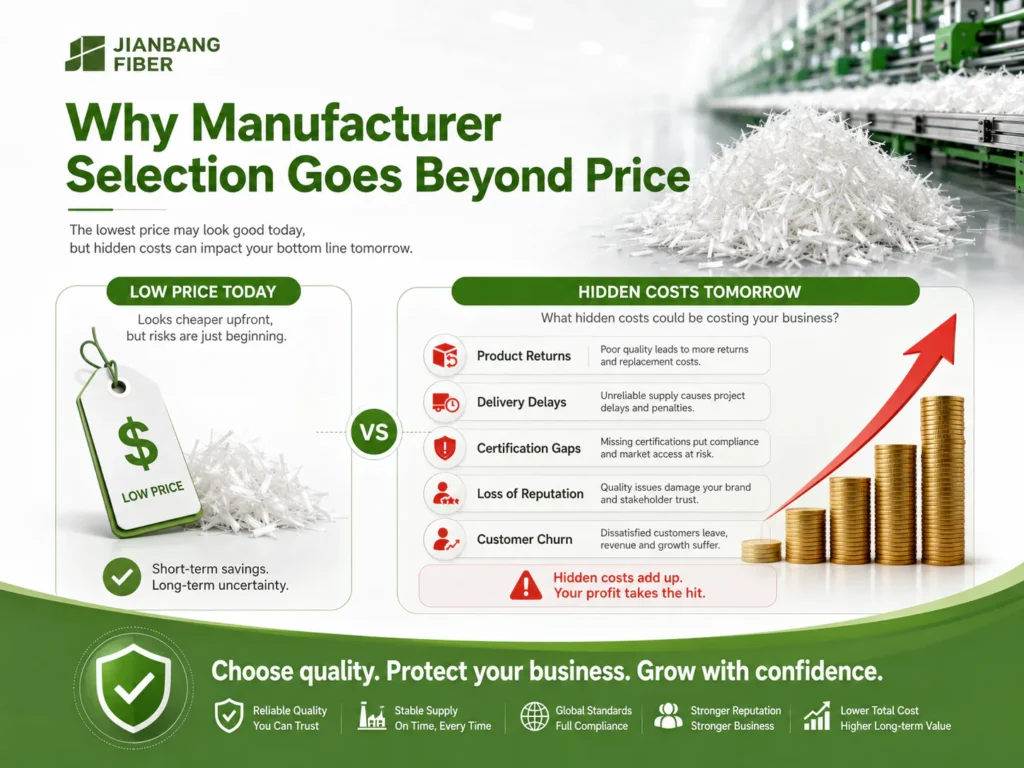
Price is the first question every distributor asks. It should not be the last. A low per-kilogram quote from a manufacturer who ships late, fails quality tests, or cannot provide certification documents will cost you far more than the savings on the invoice. When you evaluate polypropylene fiber manufacturers, what matters is consistency, compliance, and whether they have the capability to back you up.
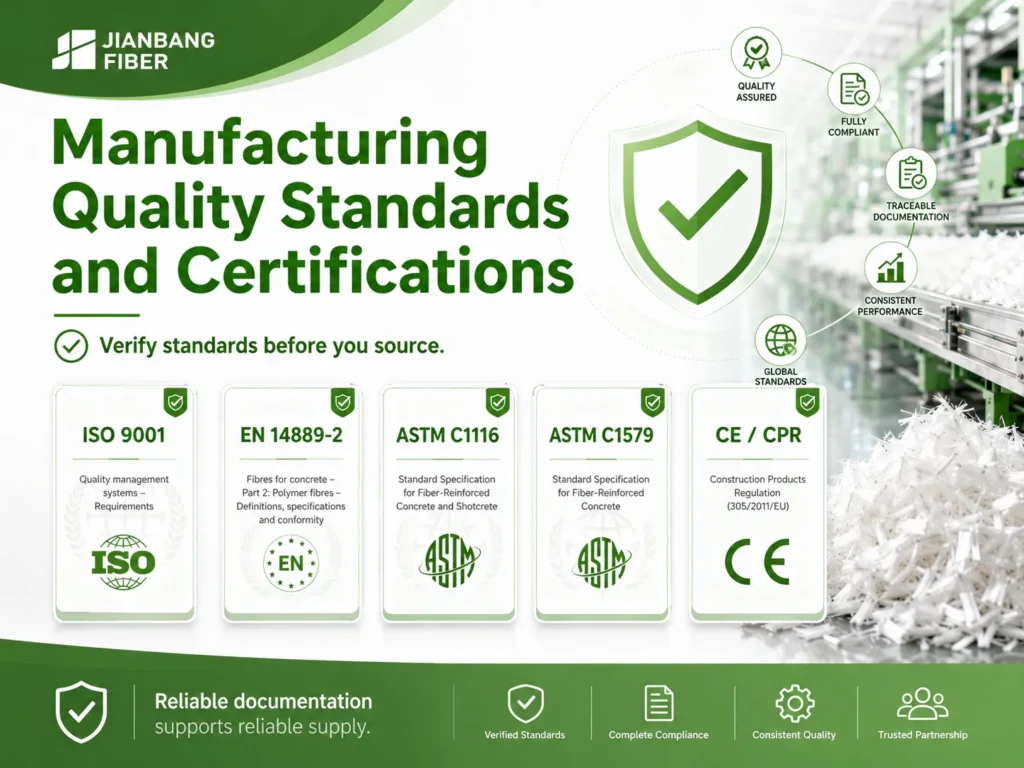
Consistency means every batch meets the same tensile strength, elongation, and dimensional specifications. Compliance means the manufacturer holds the certifications your target markets require. ISO 9001 is the baseline. Beyond that, you need market-specific standards like EN 14889-2 for Europe and the Middle East, or ASTM C1116 for the United States. Capability means the manufacturer can produce the fiber types your customers demand, at the volumes you need, within the timelines you promise.
The real cost of choosing the wrong supplier
Wrong-supplier costs show up in places most distributors do not calculate. Customer returns due to inconsistent fiber performance. Project delays caused by out-of-spec material that fails jobsite testing. Lost bids because your product lacks the certification stamps specifiers require. Relationship damage when you cannot fulfill orders on time because your manufacturer ran out of stock.
One bad batch of polypropylene fiber can erase a year of margin on that product line. The evaluation process you invest in upfront pays for itself the first time it prevents a quality failure in the field.
Product Range and Specialization
Micro synthetic fiber vs macro synthetic fiber capabilities
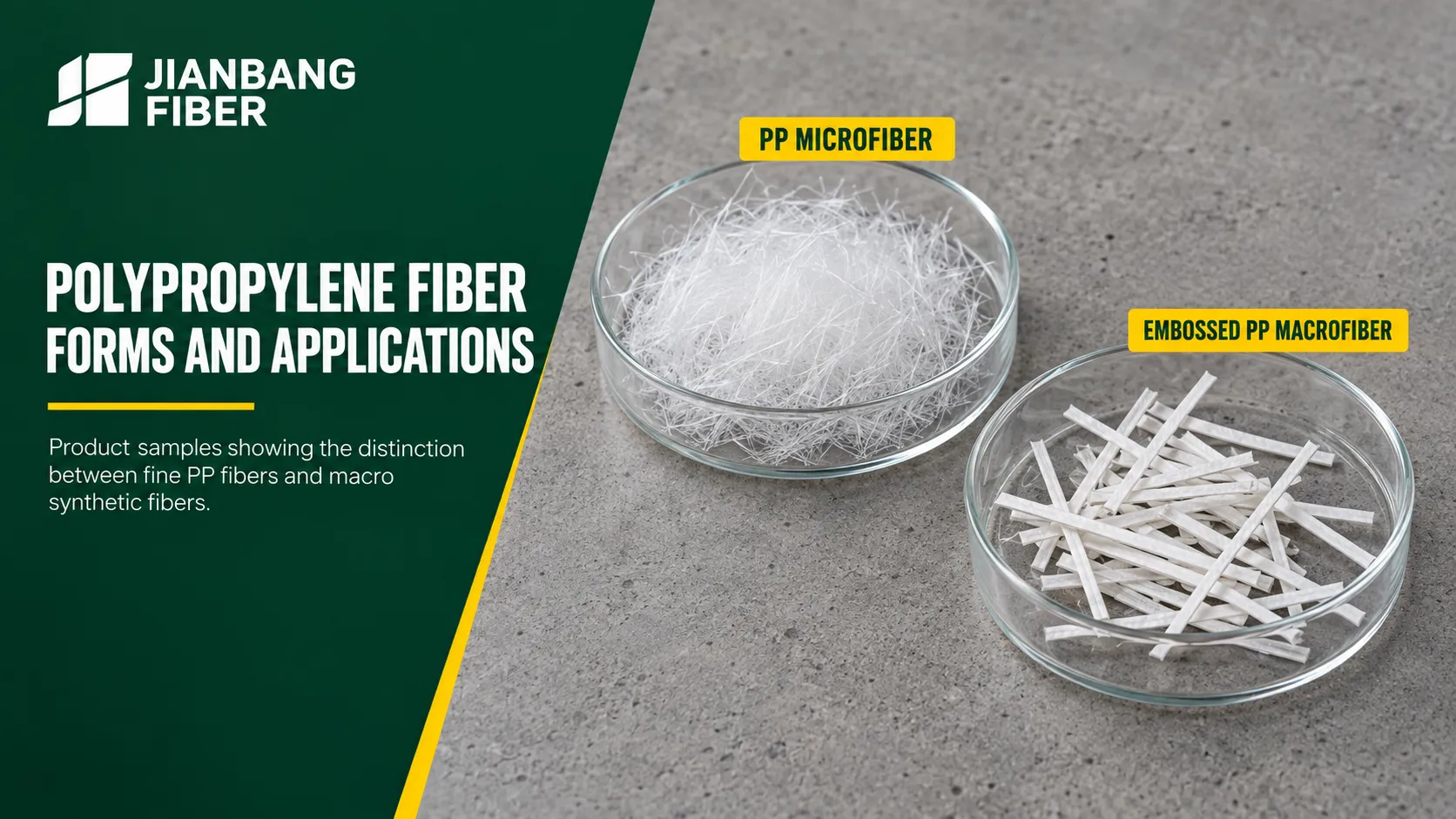
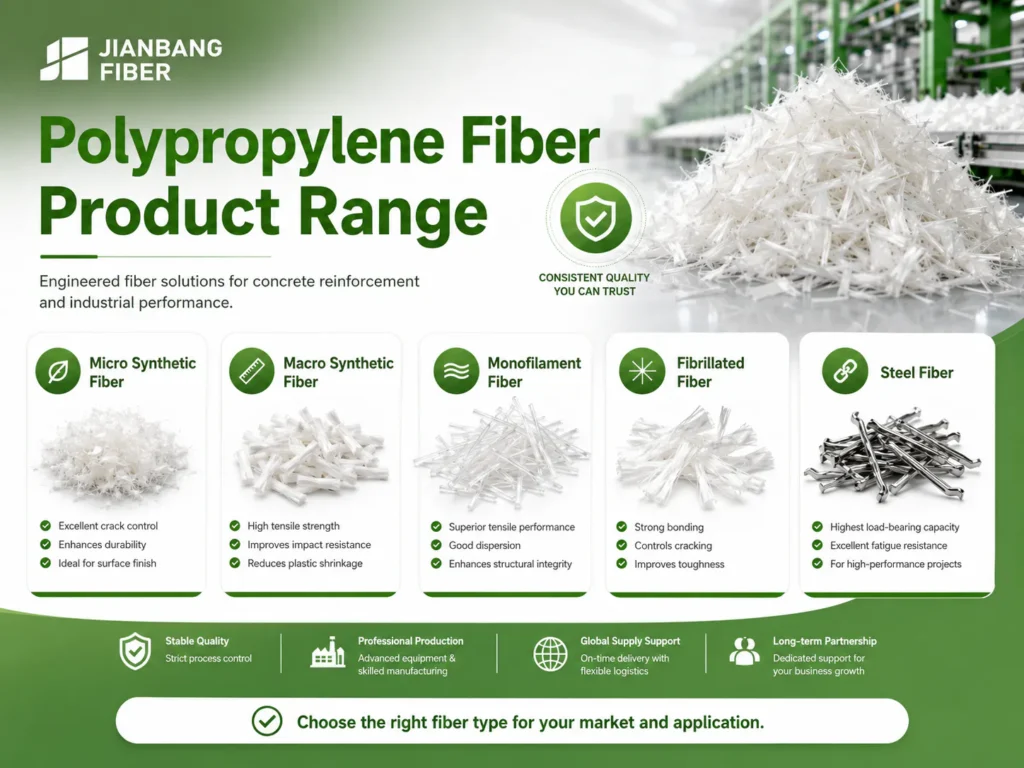
Not every manufacturer produces both micro and macro synthetic fiber. Many specialize in one category. If you serve customers who use both types (and most distributors do), working with a manufacturer who covers the full range simplifies your supply chain and lets you consolidate orders for better pricing and shipping rates.
Micro synthetic fiber controls plastic shrinkage cracking in residential slabs, overlays, and shotcrete. Macro synthetic fiber replaces steel mesh or rebar in structural applications like industrial floors, pavements, and precast elements. These are different products with different manufacturing processes and market requirements. A manufacturer who produces both has deeper process control than one who only makes one type.
Monofilament vs fibrillated fiber production
Within the micro fiber category, polypropylene fiber comes in two forms: monofilament and fibrillated. Monofilament fibers are individual smooth strands. Fibrillated fibers are bundled strands that open into a net-like structure during mixing. Each type performs differently in concrete, and each requires different extrusion and cutting equipment.
When evaluating PP fiber manufacturers, ask whether they produce both monofilament and fibrillated forms. A manufacturer who only offers one form is either limited by equipment or by technical expertise. As a distributor, you want the flexibility to offer your customers the right fiber form for their specific application, not the only form your manufacturer happens to make.
Beyond polypropylene: steel fiber and specialty fiber offerings
Some polypropylene fiber manufacturers also produce steel fiber and specialty fibers like glass fiber or basalt fiber. Among concrete fiber manufacturers, those who offer multiple fiber types provide a real advantage. This matters for your business because it opens cross-selling opportunities. A contractor who buys macro PP fiber for a warehouse floor project might also need steel fiber for a heavy-duty industrial slab. If your manufacturer produces both, you can quote the full package. Products like macro synthetic fiber for structural reinforcement are increasingly specified alongside PP fiber in the same projects.
Even if you currently only distribute polypropylene fiber, working with a manufacturer who has broader capabilities gives you room to grow your product line without changing suppliers. Check whether the manufacturer also offers choosing a macro PP fiber manufacturer level guidance and technical support for their full product range.
Manufacturing Quality Standards and Certifications
ISO 9001 quality management systems
ISO 9001 is the baseline certification every credible manufacturer should hold. It certifies that the manufacturer has a documented quality management system covering raw material procurement, production processes, inspection protocols, and traceability. Without ISO 9001, there is no independent verification that the manufacturer follows any standardized process at all.
When you ask a manufacturer about ISO 9001, do not just check whether they have the certificate. Ask to see the certificate, verify the issuing body, and check the scope. Some manufacturers hold ISO 9001 for their trading company but not for the production facility. Others have certificates with scopes that do not cover the specific fiber products you are sourcing. The certificate should list the manufacturing address and the product categories covered.
EN 14889-2 compliance for European and Middle East markets
EN 14889-2 is the European standard that specifies requirements for synthetic fibers used in concrete. It covers fiber identification, geometry, tensile strength, modulus of elasticity, and alkali resistance. If you sell into European Union markets or Middle East markets where European standards are referenced in project specifications, EN 14889-2 compliance is not optional. It is a deal-breaker.
The polypropylene fiber manufacturer EN 14889-2 compliance question separates serious manufacturers from the rest. Compliance means the manufacturer has had their fiber tested by an accredited laboratory against the EN 14889-2 standard and can provide test reports and a Declaration of Performance. Ask for the DoP document and the supporting test reports. If the manufacturer cannot produce them, move on.
Understanding the effect of polypropylene fiber in concrete helps you evaluate whether a manufacturer’s EN 14889-2 test results align with the performance claims they make in their marketing materials.
ASTM C1116 and ASTM C1579 for American markets
ASTM C1116 is the American standard for fiber-reinforced concrete. ASTM C1579 covers the standard test method for measuring the resistance of fiber-reinforced concrete to restrained drying shrinkage cracking. These standards are referenced in American construction projects and in many international projects where ASTM standards are the default specification.
For distributors selling into the US market or into markets that reference ASTM standards, confirming polypropylene fiber manufacturer certification for ASTM compliance is essential. Ask the manufacturer for ASTM test reports from accredited US laboratories. Generic “compliance statements” without supporting test data are not sufficient.
CE marking and CPR compliance
The Construction Products Regulation (CPR) requires that construction products sold in the EU carry a CE mark. For polypropylene fiber used in concrete, CE marking under EN 14889-2 is mandatory. The CE mark confirms that the product meets the essential requirements of the CPR and that the manufacturer has issued a Declaration of Performance.
CE marking is more than a label. It means the manufacturer has established a Factory Production Control system, has their product regularly tested by a Notified Body, and maintains full traceability from raw material to finished product. For distributors, CE-marked product is shelf-ready for the European market. Non-CE-marked product cannot legally be sold for structural concrete applications in the EU.
Production Capacity and Supply Reliability
Monthly and annual production volumes
A manufacturer’s production capacity determines whether they can meet your demand during peak ordering periods without delays. Ask for specific numbers. How many tons of polypropylene fiber do they produce per month? What is their annual capacity? How much of that capacity is currently utilized?
Polypropylene fiber manufacturer production capacity is not just a number on a spec sheet. A manufacturer running at 95% capacity has no room to absorb your growth. A manufacturer running at 60% capacity has headroom but may have demand problems of their own. Look for a manufacturer operating at 70-85% capacity. That is enough volume to be efficient, with headroom to scale with you.
Raw material sourcing: virgin vs recycled polypropylene
The quality of polypropylene fiber starts with the raw material. Virgin polypropylene resin produces fiber with consistent tensile strength, melting point, and chemical resistance. Recycled polypropylene introduces variability. Each batch of recycled resin has a different composition depending on the source material, and that variability transfers directly to the finished fiber.
For construction applications, virgin polypropylene is the industry standard. Ask your manufacturer what grade of resin they use and whether they use 100% virgin material. Some manufacturers blend virgin and recycled resin to reduce costs. This is acceptable for non-critical applications but creates risk for structural concrete where fiber performance is specified.
Lead times, MOQs, and seasonal considerations
Lead times vary significantly between manufacturers. A small producer with limited extrusion lines may need 4-6 weeks to fulfill a large order. A larger manufacturer with multiple production lines can often ship within 2-3 weeks. Ask about standard lead times, rush order capabilities, and how they handle peak season demand (typically March through June in Northern Hemisphere markets).
Minimum order quantities (MOQs) matter for distributors testing a new supplier. Some manufacturers require a full container load (18-20 tons) as a minimum. Others accept trial orders of 1-5 tons. Starting with a smaller trial order lets you verify quality before committing to large volumes.
Quality Control and Testing Protocols
Tensile strength and elongation testing
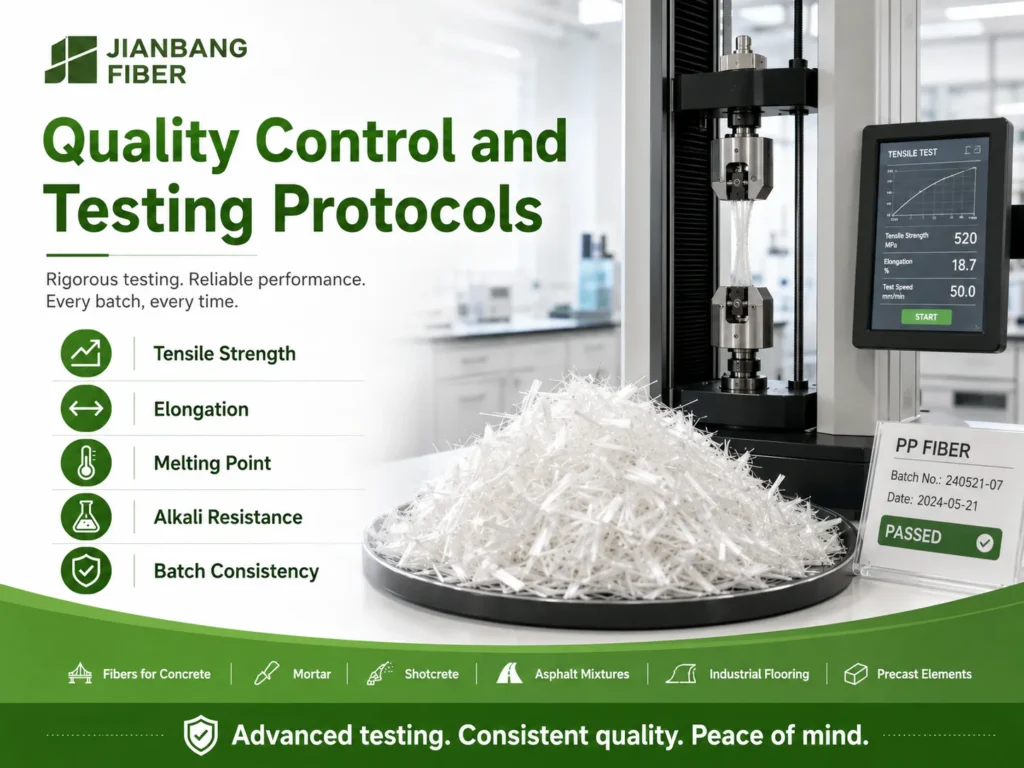
Tensile strength is the most critical property of polypropylene fiber in concrete. It determines whether the fiber can bridge cracks and hold the concrete matrix together under stress. EN 14889-2 and ASTM C1116 both specify minimum tensile strength requirements, and these values are what engineers and specifiers use to approve or reject products.
When evaluating best polypropylene fiber manufacturers, ask about their testing frequency. Do they test every batch? Every production run? Do they test individual fibers or averaged samples? A manufacturer who tests every batch and can provide lot-specific test reports gives you and your customers confidence that the product in the bag matches the product on the data sheet.
Melting point and alkali resistance verification
Polypropylene fiber must maintain its properties in the highly alkaline environment of concrete (pH 12-13). Alkali resistance testing confirms that the fiber does not degrade over time when embedded in concrete. Melting point testing confirms that the fiber has been manufactured from polypropylene with the correct molecular weight and crystallinity.
These tests are part of the EN 14889-2 and ASTM compliance requirements. A manufacturer who claims compliance but cannot produce alkali resistance test results should raise a red flag. Ask for test reports from independent, accredited laboratories, not from the manufacturer’s own lab.
Batch-to-batch consistency
Consistency is what separates a reliable manufacturer from a problematic one. Inconsistent fiber diameter, length, or tensile strength between batches creates problems at the jobsite. Concrete mix designs are calibrated for specific fiber properties. When those properties shift between deliveries, the mix performance changes, and contractors notice.
Ask the manufacturer about their polypropylene fiber manufacturer quality standards for batch consistency. What is their tolerance range for tensile strength variation? For fiber length? For denier? A manufacturer with tight tolerance ranges and documented control charts demonstrates the kind of process discipline that distributors need.
Geographic and Logistics Considerations
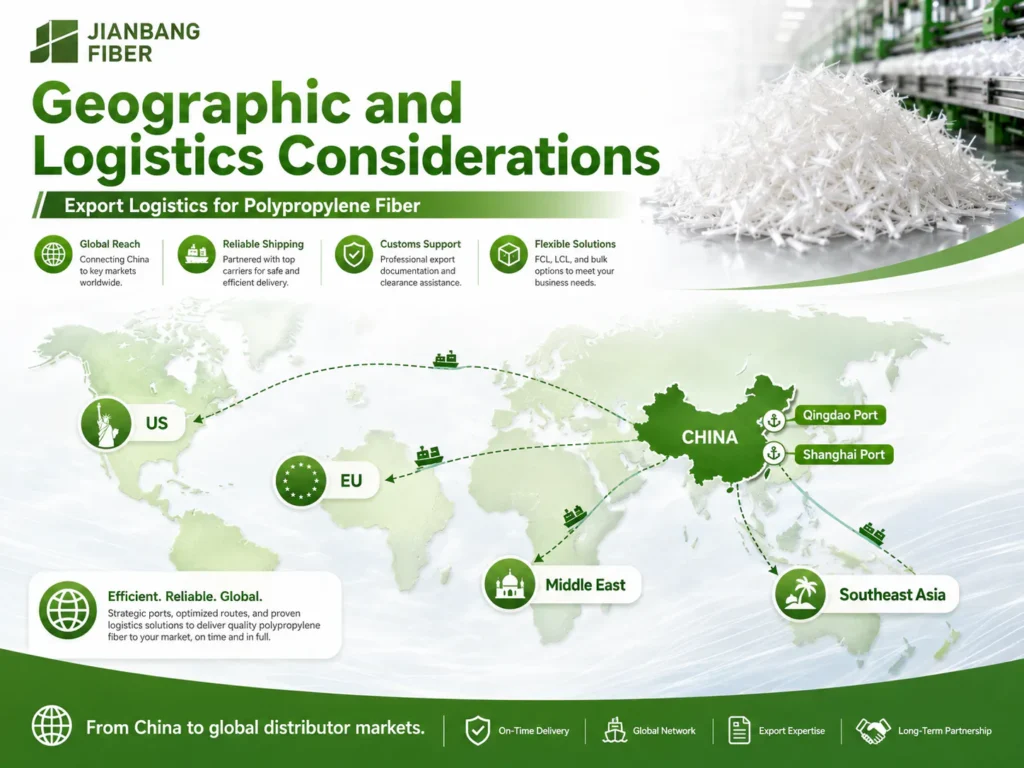
China-based manufacturers: advantages and challenges
China produces the majority of the world’s polypropylene fiber for concrete. Polypropylene fiber manufacturers in China offer real cost advantages: lower raw material costs and established manufacturing infrastructure that creates economies of scale. Many of the most experienced manufacturers are located in Shandong Province, which has a strong chemical fiber industry cluster.
The challenges of sourcing from China are well-documented but manageable. Communication barriers, time zone differences, quality verification from a distance, and longer shipping times all require proactive management. The key is working with manufacturers who have experience exporting to your target markets and who understand the documentation and compliance requirements those markets demand.
Shipping routes, ports, and delivery timelines
Most polypropylene fiber from China ships from Qingdao Port or Shanghai Port. Qingdao is the primary export hub for Shandong-based manufacturers and offers direct shipping routes to major destinations including Los Angeles/Long Beach (US), Rotterdam (EU), Jebel Ali (UAE), and Singapore/Southeast Asian ports.
Typical ocean freight timelines are 14-18 days to the US West Coast, 25-35 days to Europe, 12-15 days to the Middle East, and 7-12 days to Southeast Asia. Add 5-7 days for production and inland transport to port, plus customs clearance time at destination. Total door-to-door lead times range from 3-6 weeks depending on destination and shipping conditions.
Regional market requirements by geography
Different markets have different compliance requirements, and your manufacturer needs to support all the markets you serve. The EU requires CE marking under CPR with EN 14889-2 compliance. The US market references ASTM C1116 and ASTM C1579. The Middle East often references both EN and ASTM standards depending on the project and the specifying engineer. Southeast Asian markets vary by country but increasingly reference EN standards.
Before committing to a manufacturer, confirm that they can provide the documentation package your target markets require. This includes test reports, certificates of analysis, Declarations of Performance, and any country-specific documentation. A manufacturer who only serves the domestic Chinese market will not have the export documentation experience you need.
Pricing Structure and Commercial Terms
Factors that affect polypropylene fiber pricing
Polypropylene fiber pricing is driven by several factors. Raw material cost (polypropylene resin) is the largest component and tracks global petrochemical markets. Production costs include energy, labor, and equipment depreciation. Certification and testing costs add to the per-unit price, especially for EN 14889-2 and CE-marked product. Packaging, labeling, and palletizing for export add another layer.
Understanding these cost drivers helps you evaluate whether a manufacturer’s pricing is realistic. A price significantly below market rates usually means something has been cut. Raw material quality, testing rigor, or certification compliance. As covered in the polypropylene fiber for concrete distributor guide, the cheapest fiber is rarely the most profitable for distributors.
MOQ, payment terms, and sample policies
Commercial terms vary widely between manufacturers. Common payment structures include 30% advance with 70% against bill of lading, 100% letter of credit, or net 30 terms for established customers. Sample policies range from free samples (you pay shipping only) to paid sample orders at a premium price.
For wholesale polypropylene fiber suppliers, the payment and order structure affects your cash flow and inventory risk. Manufacturers who offer flexible MOQs and reasonable payment terms make it easier for you to start small, verify quality, and scale up with confidence. Avoid manufacturers who require full prepayment on your first order before you have verified their product.
Technical Support and After-Sales Service
Dosage recommendation and mix design support
Contractors and specifiers frequently ask distributors for dosage recommendations. “How much fiber do I need per cubic meter for a 150mm residential slab?” “What dosage replaces WWR in a 200mm industrial floor?” If your manufacturer can provide these answers backed by test data and project experience, you can respond with confidence instead of guessing.
The best polypropylene fiber suppliers provide dosage charts, mix design guidelines, and application-specific recommendations as part of their technical support package. This support extends to custom dosage calculations for non-standard applications, which can be the difference between winning and losing a project bid.
Specification writing and project consultation
When architects and engineers specify fiber-reinforced concrete, they need performance data, test reports, and specification language they can insert into their project documents. A manufacturer who provides ready-to-use specification sections (including fiber type, dosage, performance criteria, and applicable standards) makes it easy for specifiers to write your product into their projects.
Project consultation goes further. It means the manufacturer can review project requirements, recommend the right fiber type and dosage, provide supporting documentation, and even participate in pre-bid meetings or conference calls with the specifying engineer. This level of support is rare among manufacturers, and it gives distributors a real edge.
Red Flags When Evaluating Manufacturers
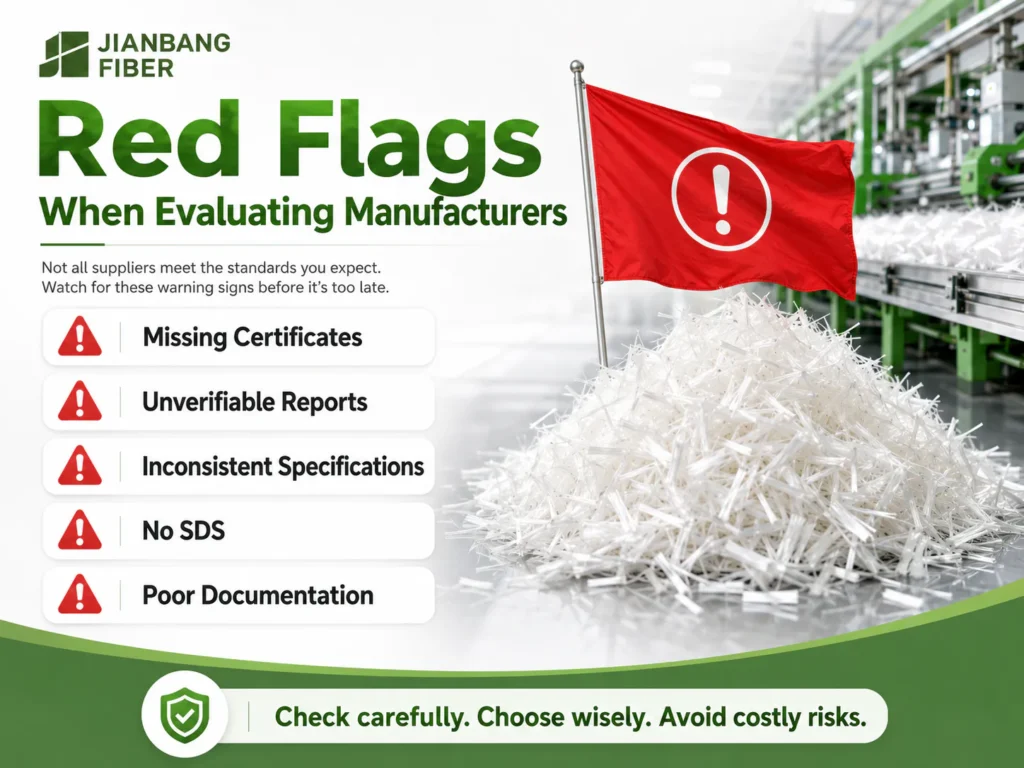
Missing or unverifiable certifications
If a manufacturer claims EN 14889-2 compliance but cannot produce a Declaration of Performance, that is a red flag. If they claim ISO 9001 certification but the certificate is expired, issued by an unrecognized body, or does not cover the manufacturing facility, walk away. How to choose polypropylene fiber manufacturer partners starts with verifying every certification claim independently.
Contact the certification body directly. Check the certificate number against the issuing body’s database. Request the full scope of the certification, not just the certificate cover page. Legitimate manufacturers expect and welcome this level of scrutiny. Manufacturers who resist it are hiding something.
Inconsistent product specifications between batches
Request test reports from three different production batches. Compare the tensile strength, elongation, melting point, and dimensional data across all three. If the values swing widely, the manufacturer lacks process control. A 20% variation in tensile strength between batches is unacceptable for construction fiber.
Batch inconsistency is the single most common complaint distributors raise about manufacturers they have left. It usually appears after the first few container loads, once the manufacturer has secured your business and begins substituting lower-grade raw materials or skipping quality checks to save costs.
Lack of technical documentation and test reports
A manufacturer who cannot provide comprehensive technical data sheets, safety data sheets, test reports, and certification documents is not ready for the export market. These documents are not optional extras. They are required for customs clearance, specifier approval, and jobsite acceptance in most markets.
If the manufacturer sends you a one-page product specification with no supporting test data, that tells you everything you need to know about their commitment to quality. Professional manufacturers maintain detailed technical libraries and can provide documentation packages tailored to your market requirements.
Building a Long-Term Manufacturer Partnership
From first sample order to exclusive distribution
The best distributor-manufacturer relationships develop over time. Start with a sample order. Test the product in your market. Verify the documentation. Place a trial order of one to five tons. Evaluate delivery time, packaging quality, and communication responsiveness. If everything checks out, increase order volumes gradually.
Many manufacturers offer exclusive distribution agreements for specific regions or countries after the distributor has proven market demand and consistent order volume. These agreements protect your territory from competing distributors and give you pricing stability. They also signal to the manufacturer that you are committed, which typically results in better service and support.
Ecocretefiber™ — positioned for global distributor partnerships
Ecocretefiber™, manufactured by Shandong Jianbang Chemical Fiber Co., Ltd., is built for distributor partnerships. The product line covers the full range of polypropylene fiber types for polypropylene fiber reinforced concrete applications, from micro crack control to macro structural reinforcement, including monofilament and fibrillated forms. All products are manufactured from 100% virgin polypropylene resin.
Certifications include ISO 9001, EN 14889-2 compliance, and ASTM standards support for US market entry. The manufacturing facility in Shandong Province has the production capacity to support growing distributors, and the technical team provides dosage recommendations, specification writing support, and project consultation.
Ecocretefiber™ is not the only manufacturer in this space. But for distributors who value consistency and compliance alongside competitive pricing, it is the type of manufacturing partner this guide recommends you seek. One who treats your business success as their business success.
Conclusion
Selecting the right polypropylene fiber manufacturer is one of the most consequential decisions a distributor makes. It determines your product quality, your compliance position, your delivery reliability, and ultimately your reputation in the market. Evaluate manufacturers on certifications, production capacity, quality control, geographic logistics, and technical support. Not just price. The framework in this guide gives you the questions to ask and the red flags to watch for. Use it, and you will find a manufacturing partner who grows with your business.