Why Steel-Like Synthetic Fiber Concrete Needs Correct Construction
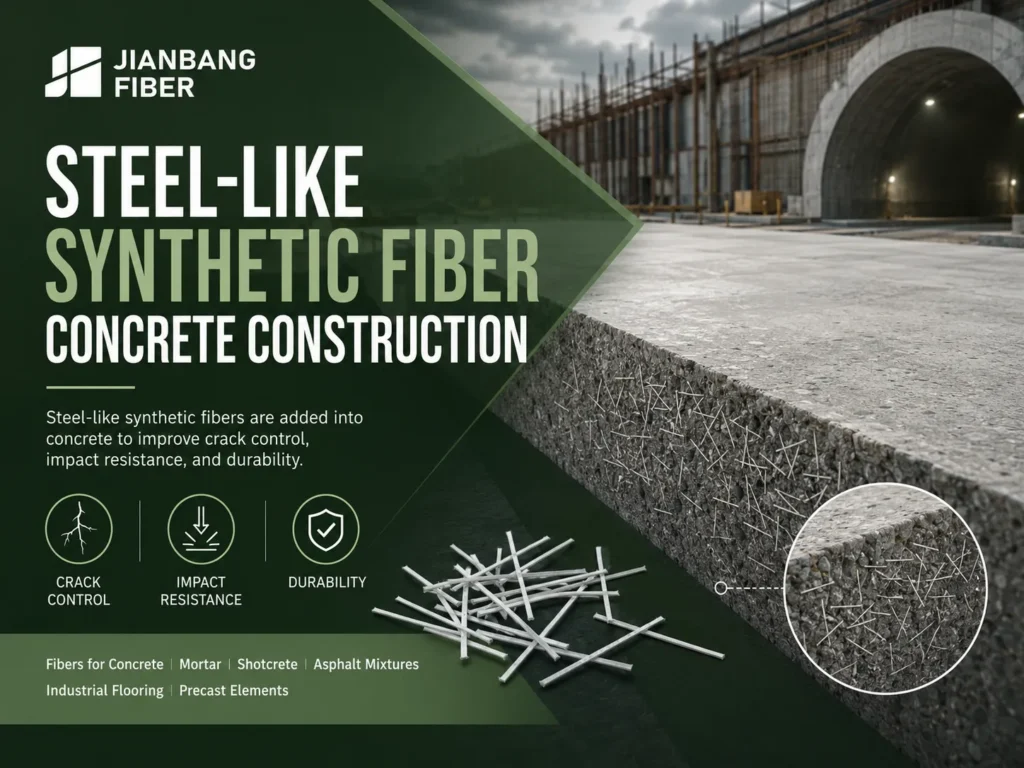
Steel-like synthetic fiber concrete is becoming more common in slabs, pavements, tunnels, underground garages, bridge decks, industrial floors, hydraulic structures, and precast concrete. The reason is simple. Concrete needs better crack control, better impact resistance, and better durability.
Ordinary concrete is strong in compression, but it is weak in tension. It can crack because of shrinkage, temperature change, traffic load, vibration, impact, and long-term service stress. Traditional steel mesh can help, but it needs cutting, placing, tying, positioning, and inspection. In many projects, this increases labor time and construction complexity.
Steel-like synthetic fiber offers another solution. It is mixed into concrete and distributed through the matrix. It helps control cracks in many directions. It can also reduce part of the work related to traditional secondary reinforcement in suitable designs.
Shandong Jianbang Fiber finds out that the performance of steel-like synthetic fiber concrete depends not only on fiber quality. It also depends on dosage, mixing order, placing method, vibration time, finishing, curing, and quality control. A good fiber can still perform poorly if construction is not controlled.
At Shandong Jianbang Chemical Fiber Co., Ltd., our Ecocretefiber™ brand supplies concrete fiber solutions for roads, bridges, tunnels, slabs, shotcrete, precast concrete, and infrastructure projects. We believe that fiber selection and construction method should work together.
What Is Steel-Like Synthetic Fiber?
Steel-like synthetic fiber is a macro synthetic fiber designed to provide crack control and toughness in concrete. It is usually made from polypropylene or other polymer materials. It is called “steel-like” because its shape and reinforcing function are designed to imitate some benefits of steel fiber.
But it is not steel. It is lighter. It does not rust. It is easier to handle. It can be used where corrosion risk, worker safety, speed, and easier installation matter.
Shandong Jianbang Fiber finds out that steel-like synthetic fiber is mainly used to improve concrete crack resistance, impact resistance, fatigue behavior, and durability. It can be used in concrete floors, pavements, tunnel linings, bridge decks, underground structures, marine concrete, water conservancy projects, and large-area slabs.
A typical steel-like synthetic fiber may have a length of 30 mm to 60 mm and a diameter of about 0.5 mm to 1.2 mm. Tensile strength should usually be higher than 400 MPa. The melting point should be higher than 160°C. The fiber should also resist alkali corrosion in the high-pH environment of concrete.
These values are practical references. The final product selection should still be based on the project requirement, supplier data sheet, and performance testing.
Why Alkali Resistance Matters
Concrete is highly alkaline. Its pH value can reach around 12 to 14. Any fiber used in concrete must remain stable in this environment. If the fiber loses strength or degrades too fast, crack control performance can decline.
Steel-like synthetic fiber should have good alkali resistance. It should remain stable inside the concrete matrix. This is especially important for long-service projects such as tunnels, bridge decks, pavements, underground garages, ports, and industrial floors.
Shandong Jianbang Fiber finds out that buyers should not only check fiber appearance. They should check the test report, tensile strength, alkali resistance, length, diameter, melting point, and suitable application. A low-cost fiber without reliable data may create risk in construction and service.
For international projects, buyers should also check which standard or specification is required. Fiber reinforced concrete is often evaluated by fiber type, dosage, distribution, residual strength, toughness, and crack control performance.
Recommended Dosage Direction
Steel-like synthetic fiber dosage should be selected by design, not by guesswork. A common dosage range is about 6 kg/m³ to 9 kg/m³. For special areas, the dosage may be increased to about 12 kg/m³.
Shandong Jianbang Fiber finds out that dosage should depend on slab thickness, concrete grade, crack control requirement, traffic load, impact load, exposure environment, and structural design.
For normal slabs and pavements, a moderate dosage can support crack control and toughness. For heavy-duty areas, higher dosage may be needed. For structural components with very high bearing requirements, steel reinforcement may still be required together with fiber.
This is an important point. Steel-like synthetic fiber can reduce or replace some traditional secondary reinforcement in suitable applications, but it should not be promoted as a universal replacement for all steel reinforcement. A structural engineer should confirm the final design.
Construction Preparation
Steel-like synthetic fiber concrete construction should start before mixing. The construction team should review drawings, fiber dosage, concrete grade, slab thickness, joint layout, and construction sequence.
The site should prepare a forced mixer or a mixing system suitable for fiber concrete. Compared with ordinary concrete, mixing time should usually be extended slightly. A practical reference is to extend mixing by about 30 seconds, but the actual time should depend on mixer type, batch size, fiber dosage, and workability.
Templates and formwork should be tight. Corners should be handled carefully. Rounded corner forms can reduce stress concentration in some applications.
Workers should receive specific training before construction. They should understand fiber feeding, mixing order, placing, vibration, finishing, curing, and safety protection. Most fiber concrete problems are not caused by the fiber itself. They are caused by poor mixing, incorrect vibration, wrong finishing time, or insufficient curing.
Mixing Procedure For Steel-Like Synthetic Fiber Concrete
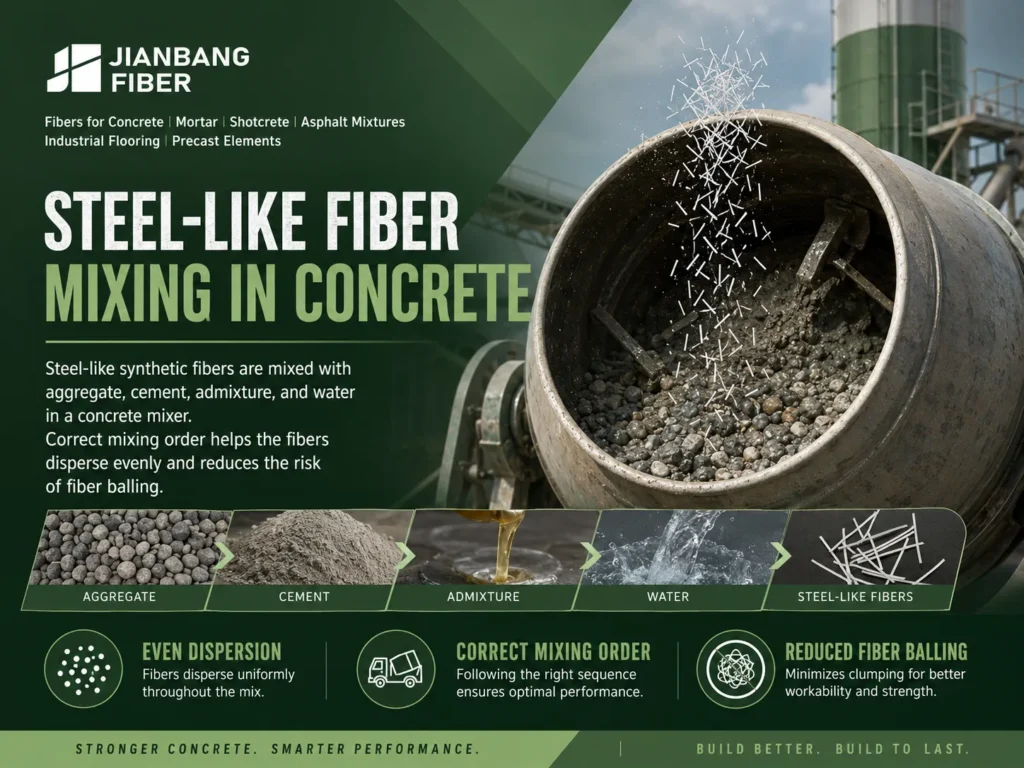
Mixing is the key step. If the fiber does not disperse well, the concrete will not perform well. Fiber balling can create weak areas and construction defects.
Shandong Jianbang Fiber finds out that a three-step mixing method can improve fiber dispersion.
First, add about 50% of the aggregate and the steel-like synthetic fiber into the mixer. Dry mix for about 30 seconds. This allows the aggregate to help separate the fibers.
Second, add the remaining aggregate, cement, admixture, and other materials. Then wet mix for about 60 seconds. The goal is to let the fiber spread evenly in the full concrete system.
Third, check the concrete condition before discharge. The concrete should have stable workability. There should be no obvious fiber clumps. The mixture should not segregate or bleed heavily.
In one practical case, layered feeding helped achieve high fiber distribution uniformity. This shows that feeding order is very important.
After mixing, the concrete should be placed as soon as possible. A practical reference is to complete placing within about 45 minutes after mixing. Long waiting time can reduce workability and affect final quality.
How To Avoid Fiber Balling
Fiber balling is one of the most common problems in fiber concrete. It usually happens when too much fiber is added too fast, the mixer is not suitable, the mixture is too dry, or the aggregate grading is poor.
Shandong Jianbang Fiber recommends several control measures.
Add fiber gradually. Do not dump all bags into one point at one time.
Use aggregate to help disperse the fiber. Adding fiber with part of the aggregate can reduce clumping.
Keep the mix workable. If the concrete is too dry, fibers may not spread well.
Check admixture compatibility. Water reducer can help maintain workability, but too much admixture may cause bleeding or segregation.
Do a trial mix before mass production. Trial mixing can reveal problems before the concrete reaches the site.
If fiber balling appears during construction, stop placing immediately. Remove the clumped material. Do not place fiber balls into the structure.
Placing Method
Steel-like synthetic fiber concrete should be placed in sections and layers. This helps control thickness, compaction, and finishing quality.
A practical layer thickness should not exceed about 400 mm. If the layer is too thick, vibration may not compact the concrete properly. Fiber distribution may also become uneven.
During placing, workers should avoid dropping concrete from excessive height. Excessive drop can cause segregation. Concrete should be placed close to the final position.
Shandong Jianbang Fiber finds out that placing should be continuous and organized. Cold joints should be avoided. If construction joints are required, they should be located according to the design.
In slabs and floors, the team should also control screeding, leveling, and joint cutting. Fiber can improve crack control, but it cannot correct poor joint design.
Vibration Control
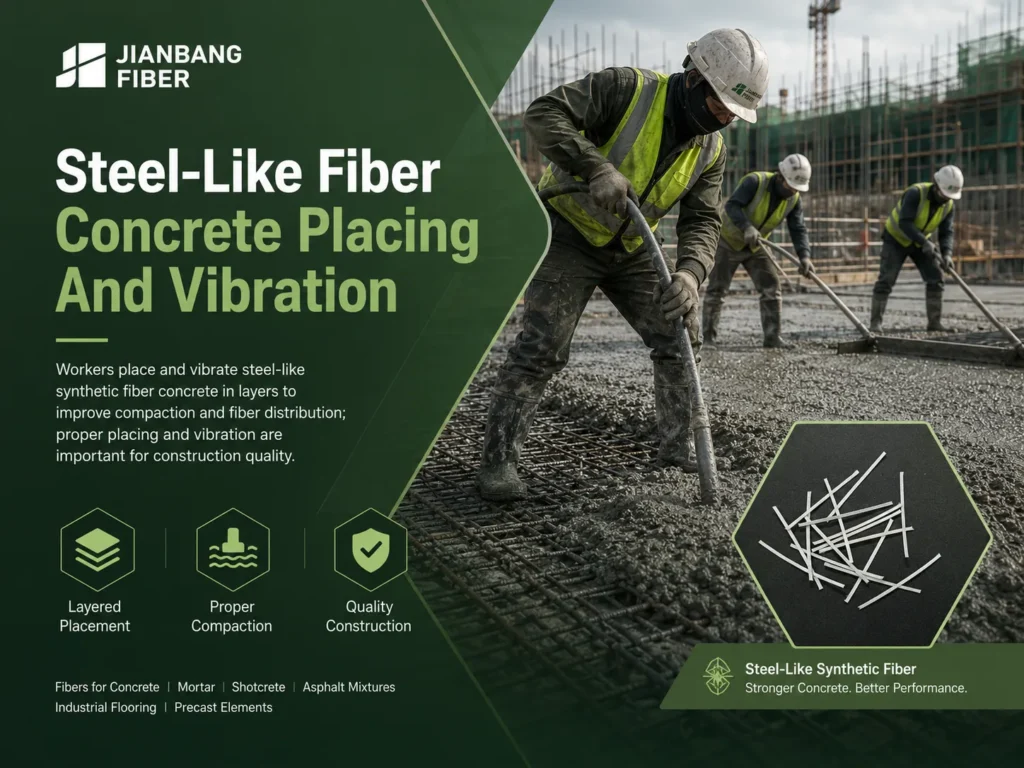
Vibration is important for density and surface quality. But fiber concrete needs balanced vibration.
If vibration time is too short, concrete may not be compacted. Voids and honeycombs may remain. Fiber may not be evenly distributed.
If vibration time is too long, fibers may float or move. Segregation may also increase.
Shandong Jianbang Fiber finds out that high-frequency vibrators can be used. Vibration spacing should be controlled within about 30 cm. A practical vibration time may be around 25 seconds per point in some engineering cases, but the final time should be adjusted based on concrete workability, thickness, vibration equipment, and site conditions.
The goal is simple. The concrete should be dense, but not segregated. The fiber should remain evenly distributed, but not exposed or floating.
Finishing Method
Finishing affects both appearance and durability. Steel-like synthetic fiber concrete may have fiber exposure if finishing is not controlled.
A heavy-duty power trowel can be used for large-area surfaces. The first troweling should be done around initial setting. The second finishing should be completed before final setting.
Corners and edges need special attention. Manual finishing should be used where machines cannot reach. This helps prevent fiber exposure at edge areas.
Shandong Jianbang Fiber finds out that finishing time is critical. If finishing is too early, bleeding water and paste can be disturbed. If finishing is too late, the surface may become hard and difficult to close. Poor timing can cause fiber protrusion.
If local fiber exposure occurs, epoxy mortar can be used for repair. If protruding fibers affect surface quality, mechanical grinding may be required. But the better solution is to control finishing correctly from the beginning.
Curing Method
Curing is one of the most important steps in concrete construction. Poor curing can cause shrinkage cracking, low surface strength, dusting, curling, and durability problems.
Shandong Jianbang Fiber finds out that a combined curing method is useful. After placing, cover the concrete with plastic film. After about 12 hours, start water curing. Keep the surface wet for about 7 days.
In hot or dry weather, curing should start early to prevent rapid water loss. In windy conditions, evaporation can be very fast. Plastic film, curing compound, or wet covering may be needed.
In winter construction, insulation is important. Cotton felt or other insulation materials can be used. The cooling rate should be controlled. A practical reference is to keep cooling below about 3°C per day.
In freeze-thaw regions, strict curing can improve durability. Good curing helps the cement matrix develop strength and supports fiber-concrete bonding.
Quality Control Requirements
Steel-like synthetic fiber concrete needs quality control during and after construction.
Shandong Jianbang Fiber recommends checking splitting tensile strength, fiber distribution, crack width, surface quality, and curing records.
A practical control method is to take test specimens regularly. For example, every 100 m³ of concrete can be sampled for splitting tensile strength testing. The expected improvement should meet the project requirement.
Core drilling can be used to check fiber distribution density. A practical allowable deviation can be around ±10%, depending on project specification.
Crack width should be controlled. For many crack-sensitive applications, a target such as ≤0.2 mm may be used. The final requirement should follow the project design.
The site should also record fiber dosage, mixing time, ambient temperature, humidity, placing time, vibration method, and curing method. Photos and videos should be kept for inspection.
For important projects, digital monitoring or IoT systems can be used to record construction data in real time.
Common Problems And Solutions
Fiber balling is a common problem. If it appears, stop placing immediately. Remove the clumped material. Check mixing order, fiber feeding speed, moisture condition, and mixer performance.
Local fiber exposure can happen during finishing. It can be repaired with epoxy mortar if the area is small. If there are many exposed fibers, the finishing process should be reviewed.
Large-area bleeding can happen when water content is too high or admixture dosage is not suitable. The solution is to adjust admixture dosage, water-binder ratio, and aggregate grading.
Poor fiber dispersion can happen when mixing time is too short or feeding is too fast. The solution is to use staged feeding and extend mixing time properly.
Surface cracking can happen when curing is late or insufficient. The solution is to cover early, maintain moisture, and protect the surface from sun and wind.
Shandong Jianbang Fiber finds out that most construction defects can be reduced by trial mixing, worker training, and strict process control.
Safety Protection
Steel-like synthetic fiber is lighter than steel fiber, but workers still need protection. When bags are opened, light dust or flying fiber may appear.
Workers should wear dust masks and safety glasses. Gloves are also recommended. The mixing area should have dust control. In some sites, mist cannon or water mist systems can be used to reduce airborne dust.
Waste packaging should be stored by category according to solid waste management rules. Open burning should be prohibited.
Good safety control protects workers and keeps the site clean. It also reflects professional construction management.
Economic Value
Steel-like synthetic fiber can improve construction efficiency in suitable applications. Compared with traditional steel mesh, it can reduce material handling, cutting, tying, placement, and inspection work.
Shandong Jianbang Fiber finds out that steel-like synthetic fiber can reduce material cost and shorten construction time in some floor and pavement projects. A practical reference shows possible material cost savings and shorter construction periods when it replaces part of traditional mesh in suitable designs.
However, the economic result depends on project type. If the structure has very high load-bearing requirements, steel reinforcement may still be necessary. In that case, steel-like synthetic fiber can work together with rebar or mesh instead of fully replacing it.
The correct economic comparison should include material cost, labor cost, construction time, equipment cost, repair cost, and long-term maintenance.
Application Areas
Steel-like synthetic fiber concrete can be used in many engineering fields.
It can be used in underground garages. It helps control shrinkage cracks and improves floor durability.
It can be used in logistics parks and industrial floors. It supports impact resistance and reduces cracking under vehicle traffic.
It can be used in bridge decks and pavements. It helps improve crack control and long-term surface performance.
It can be used in tunnels and shotcrete. It supports crack control and can reduce corrosion risk compared with metal fibers in wet environments.
It can be used in marine structures. In splash zones, non-metallic fiber can avoid rust staining and support durability.
It can be used in highways, toll station floors, and heavy-traffic concrete surfaces.
It can also be used in decorative concrete when special fiber shapes or colors are developed.
When Steel-Like Synthetic Fiber Should Work With Steel Reinforcement
Steel-like synthetic fiber is useful, but it is not a universal replacement for steel reinforcement.
For structural beams, columns, suspended slabs, heavily loaded foundations, and high-bearing structures, rebar may still be required. Fiber can improve crack control and toughness, but primary structural reinforcement should follow engineering design.
Shandong Jianbang Fiber recommends a clear position. Use steel-like synthetic fiber where distributed crack control, corrosion resistance, construction efficiency, and toughness are needed. Use steel reinforcement where structural bearing capacity and code design require it. Use both when the project needs combined performance.
This honest selection approach helps avoid wrong application and improves customer trust.
Why Choose Ecocretefiber™ Steel-Like Synthetic Fiber
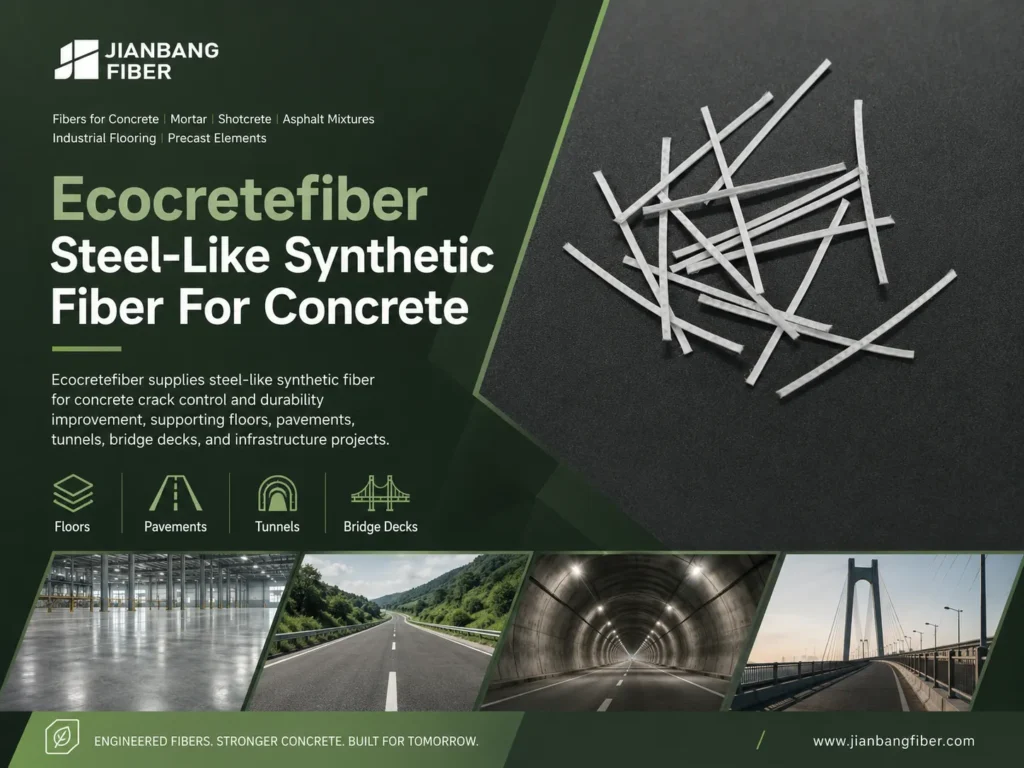
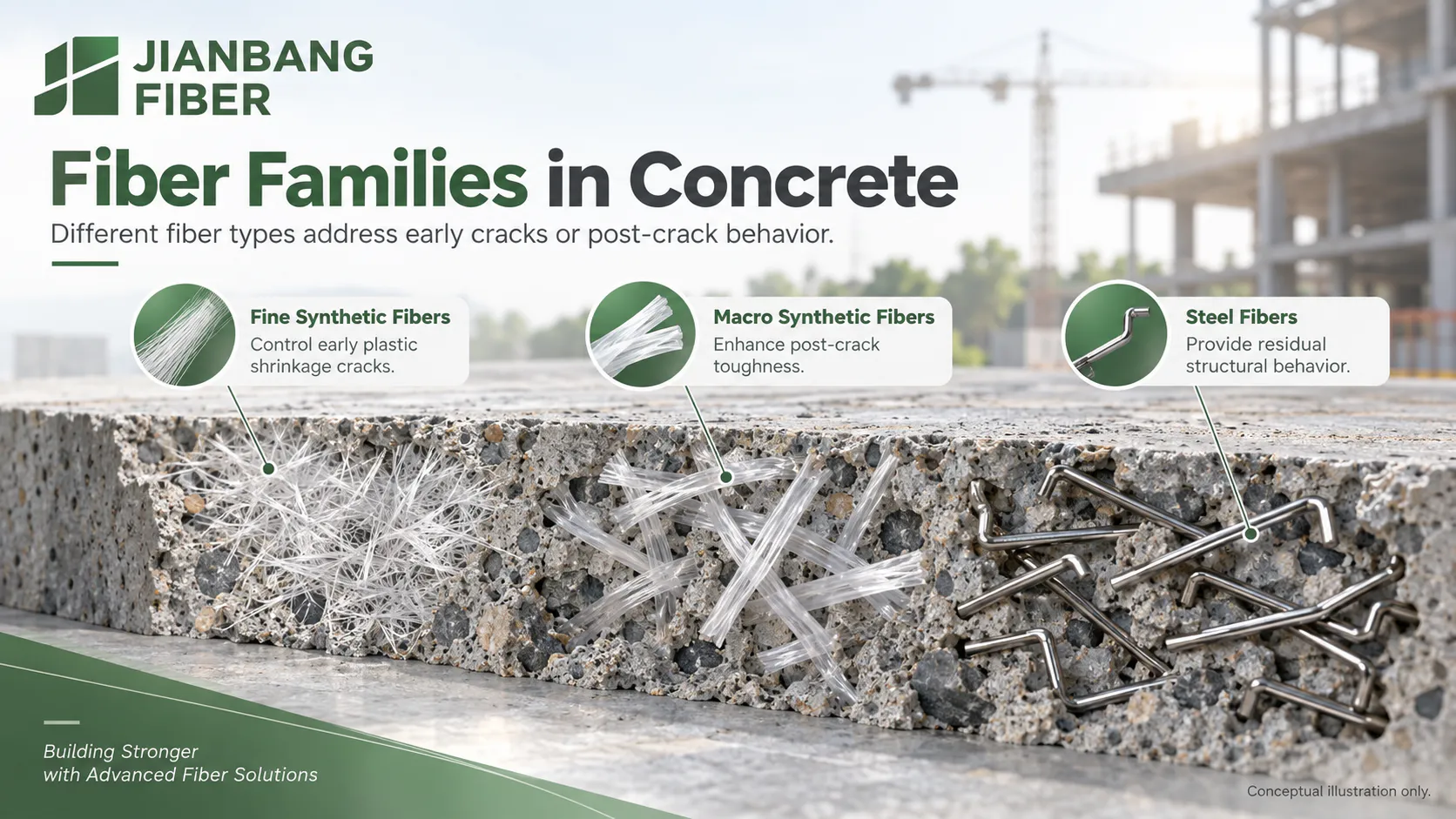
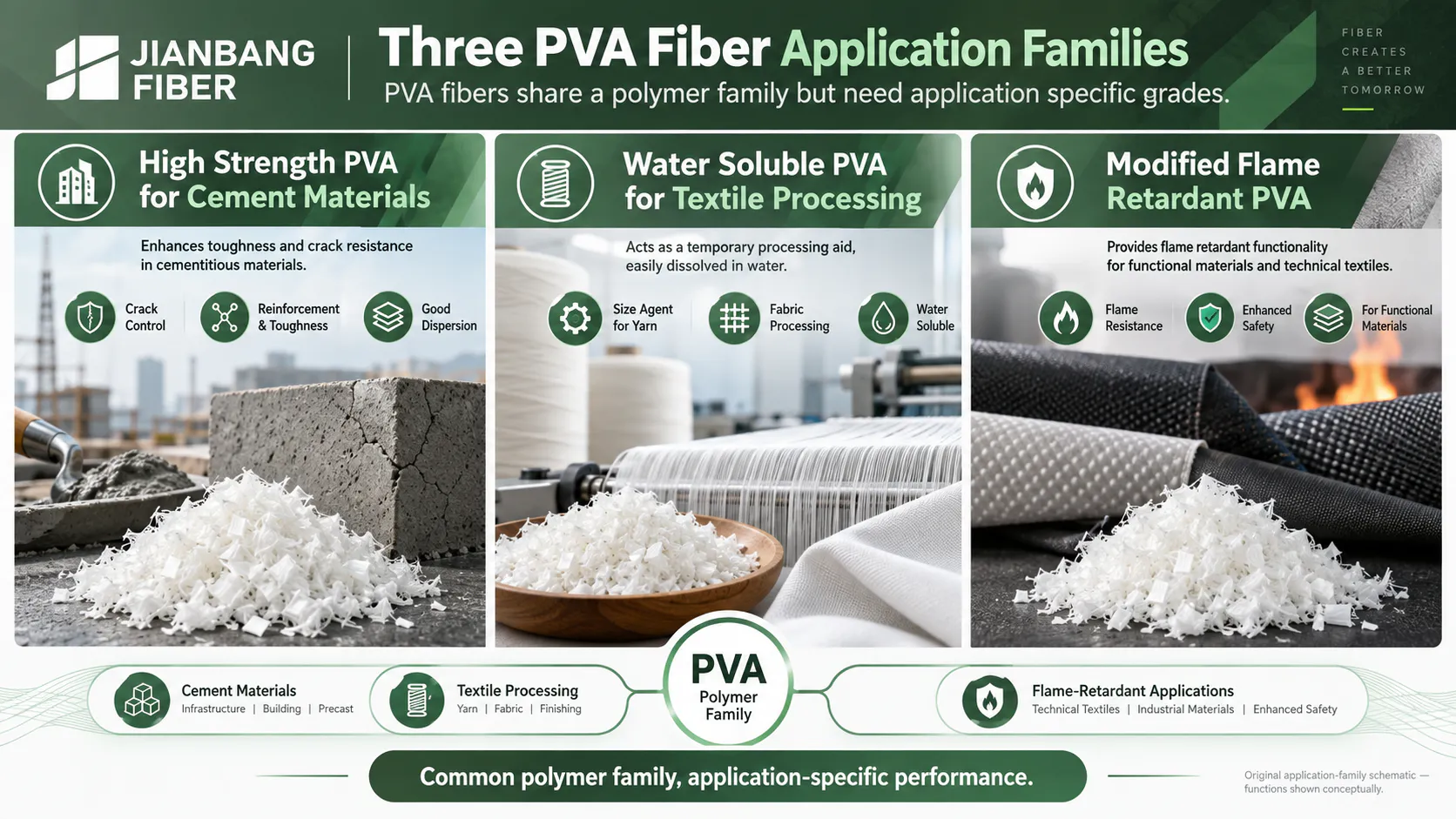
Ecocretefiber™ is the concrete fiber brand of Shandong Jianbang Chemical Fiber Co., Ltd. We supply steel-like synthetic fiber, macro synthetic fiber, polypropylene fiber, steel fiber, basalt fiber, PVA fiber, PAN fiber, and other concrete reinforcement fibers.
We support contractors, distributors, ready-mix plants, precast factories, tunnel contractors, road builders, and infrastructure project teams.
Our goal is to help customers choose the right fiber for the right application. A floor, bridge deck, tunnel lining, marine structure, road pavement, and precast element all need different solutions.
For steel-like synthetic fiber concrete, we can support product selection, dosage communication, packaging options, OEM service, and application guidance.
Buyer Checklist Before Ordering Steel-Like Synthetic Fiber
Before ordering steel-like synthetic fiber, buyers should confirm the following details.
| Question | Why It Matters |
|---|---|
| What is the project application? | Floors, pavements, tunnels, bridge decks, and marine structures need different dosage and design. |
| What is the concrete grade? | Concrete strength affects fiber bonding and crack control. |
| What is the target dosage? | Common dosage may be 6–9 kg/m³, but design may require adjustment. |
| Is the structure load-bearing? | Very high bearing structures may still need rebar. |
| What mixing equipment is used? | Mixer type affects fiber dispersion. |
| What is the placing thickness? | Thick layers need controlled vibration and compaction. |
| Is surface finish important? | Finishing time affects fiber exposure. |
| What curing method will be used? | Curing affects shrinkage, strength, and durability. |
| Is quality inspection planned? | Fiber distribution and crack width should be checked. |
This checklist helps reduce construction risk and improves project communication.
Conclusion
Steel-like synthetic fiber concrete can improve crack resistance, impact resistance, durability, and construction efficiency when it is designed and placed correctly. It is useful for floors, pavements, tunnels, bridge decks, marine structures, underground garages, industrial floors, and precast concrete.
Shandong Jianbang Fiber finds out that the key to success is not only fiber quality. Dosage, mixing order, placing time, vibration, finishing, curing, and quality control are equally important.
A practical dosage range is often 6–9 kg/m³, while special areas may require higher dosage. Mixing should be staged. Placing should be completed in time. Vibration should be balanced. Finishing should prevent fiber exposure. Curing should keep the concrete wet and stable.
Steel-like synthetic fiber can reduce construction labor and improve crack control in many applications, but it should not be blindly used to replace all steel reinforcement. For high-load structural elements, it should work with steel reinforcement according to design requirements.
Shandong Jianbang Chemical Fiber Co., Ltd. supplies Ecocretefiber™ steel-like synthetic fiber and other concrete fiber solutions for customers who need reliable crack control, better toughness, and longer concrete service life. If your project needs steel-like synthetic fiber, macro synthetic fiber, steel fiber, or another concrete reinforcement fiber, Ecocretefiber™ can help you choose a suitable solution.