Hooked End Steel Fiber: Specifications, Anchorage, Concrete Performance, And Selection Guide
Concrete carries compression well, but cracks can still form under shrinkage, bending, impact, fatigue, temperature change, or restraint. Once a crack opens, plain concrete loses tensile capacity quickly. A suitable steel fiber system changes this response.
Hooked end steel fiber bridges cracks and transfers stress after the cement matrix has cracked.
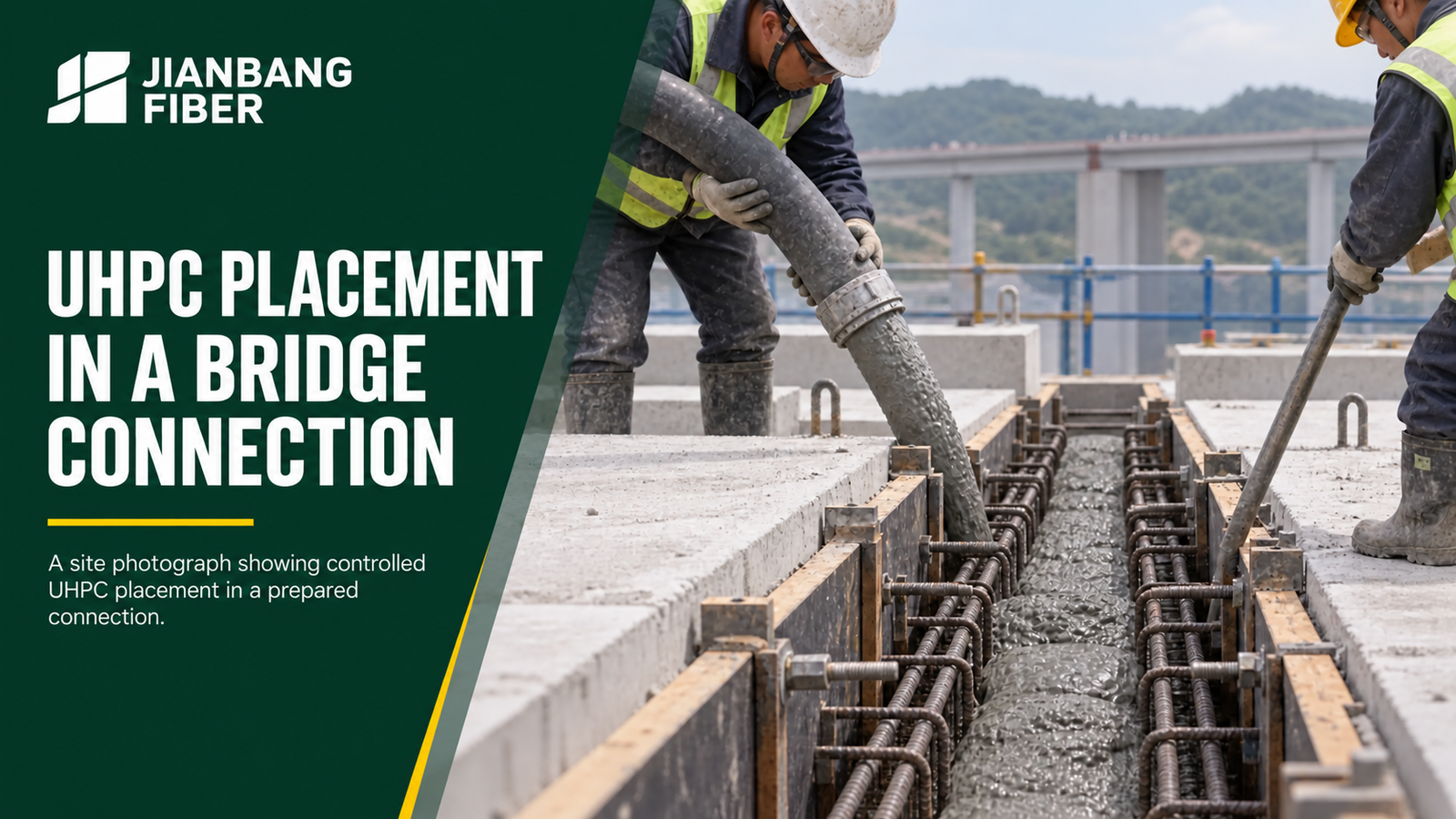
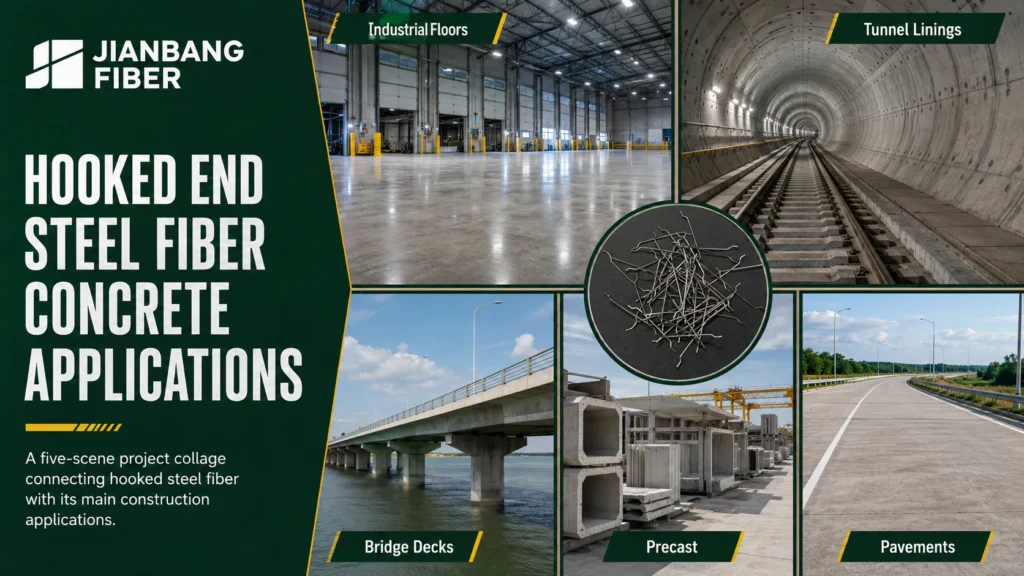
Its bent ends create mechanical anchorage inside the concrete. This anchorage raises pull-out resistance, helps control crack opening, and supports post-crack load capacity. These qualities make the fiber useful in industrial floors, pavements, bridge decks, tunnel linings, shotcrete, precast products, and repair concrete.
However, the hook is only one part of the system. Length, diameter, aspect ratio, tensile strength, dosage, concrete workability, fiber orientation, and mixing quality all affect the result. The longest or strongest fiber is not automatically the best choice.
Shandong Jianbang Chemical Fiber Co., Ltd. supplies Ecocretefiber hooked end steel fiber in several geometries. This guide explains how to read those specifications, how each parameter affects concrete, and what buyers should confirm before placing an order.
What Is Hooked End Steel Fiber?
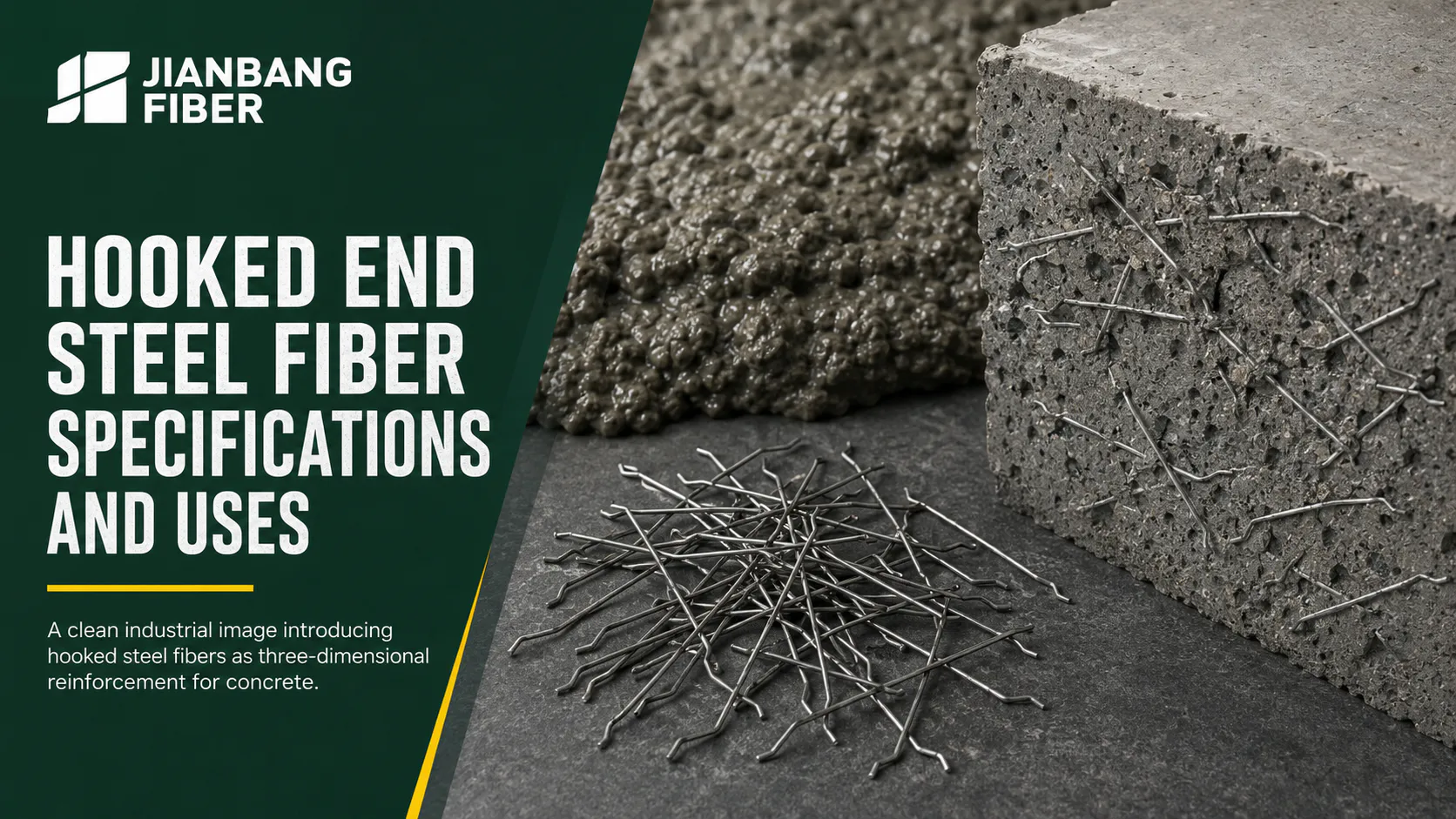
Hooked end steel fiber is a short length of steel wire with a straight middle section and a bent anchor at each end. The fibers are mixed into concrete instead of being fixed in one reinforcement plane. A well-produced batch disperses through the concrete volume and crosses potential cracks in many directions.
Conventional reinforcing bars still carry force at designed locations. Welded wire mesh works near a planned level in a slab or panel. Steel fibers have a different role. They form distributed reinforcement throughout the matrix. This distribution can improve crack control between bars, support impact resistance, and give the cracked concrete useful residual capacity.
Hooked end steel fibers are commonly produced from cold-drawn steel wire. In the ASTM system, cold-drawn wire fibers fall within Type I, while modified cold-drawn wire fibers fall within Type V. ASTM A820/A820M-22 covers five steel fiber types and requires checks on finished-fiber dimensions plus physical properties. A product name alone is therefore not enough. The purchaser should also confirm the production type, declared geometry, tolerances, strength, bend performance, and concrete test data.
A hooked steel fiber may be supplied loose or in glued bundles. Loose fibers are ready to separate as the mixer turns, but fast dumping can create clumps. Glued bundles improve feeding efficiency for some high-aspect-ratio products. The water-soluble adhesive must break down during mixing so the individual fibers can disperse.
How Hooked Ends Improve Anchorage
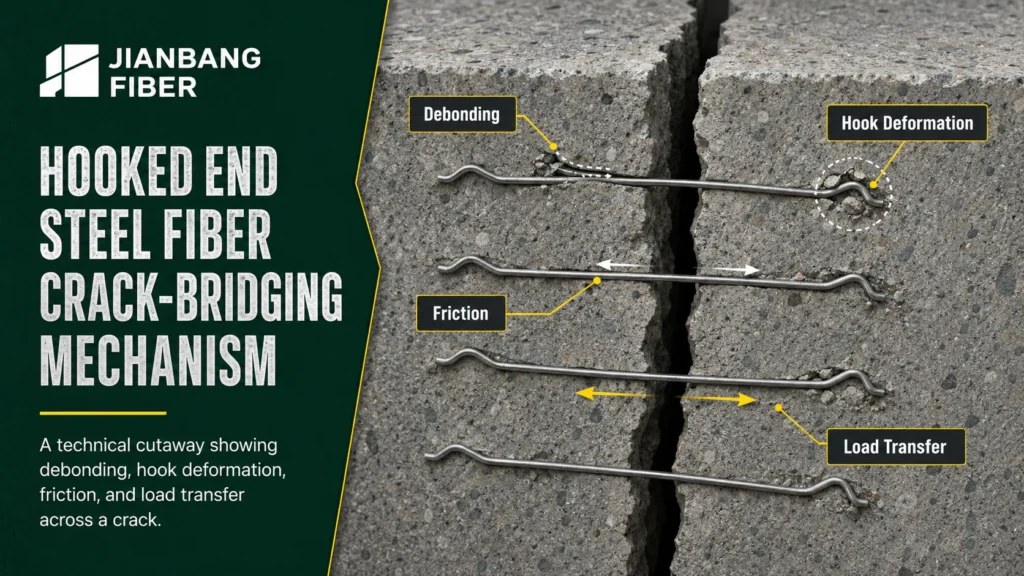
A steel fiber does not improve concrete only because steel is strong. The concrete must transfer stress into the fiber. The fiber must then resist pull-out or rupture while the crack opens.
The process normally includes several stages:
The cement matrix carries most of the load before cracking.
A crack reaches a fiber and begins to separate the surrounding interface.
The fiber starts to debond from the matrix.
Friction along the embedded length resists sliding.
The hook bears against the concrete and begins to straighten or rotate.
The fiber continues to carry load until it pulls out, ruptures, or loses anchorage.
A smooth straight fiber relies mainly on adhesion and friction. A hooked end adds mechanical resistance. The hook must deform or damage the surrounding matrix before the fiber can leave the crack plane. This usually creates a higher pull-out load and more energy absorption than a smooth fiber of similar size.
The FHWA review of high-performance concrete reported that hooked-end geometry gave stronger results than several straight or corrugated fibers in the concrete systems examined. That finding explains the commercial success of hooked fibers, but it is not a universal performance guarantee. Matrix strength, hook shape, embedment angle, dosage, and fiber orientation can change the outcome.
Pull-Out Is Not Always A Defect
Buyers sometimes assume that fiber rupture is the best result because the fiber used its full tensile strength. That view is too simple.
Controlled pull-out can absorb a large amount of energy. The fiber slides, the hook deforms, and friction continues to act while the crack opens. If every fiber snaps suddenly, the composite may lose load capacity with less warning. If every fiber slips too easily, residual strength may be too low. A useful system balances bond, anchorage, steel strength, and matrix strength.
This balance also explains why stronger concrete does not always produce a better fiber response. A dense matrix can increase bond. It can also create a condition where a fiber ruptures before enough pull-out energy develops. The correct geometry must match the concrete.
Hooked End Steel Fiber Specifications Explained
The main specifications describe geometry, material behavior, and dimensional consistency. Each value answers a different question.
| Parameter | Common Reference Range | What It Affects | Buyer Check |
|---|---|---|---|
| Length | About 20-60 mm across common hooked-fiber applications | Crack interception, embedment, section compatibility, pumpability | Match length with element thickness, aggregate size, reinforcement spacing, and delivery system. |
| Equivalent diameter | About 0.2-1.0 mm as a broad market range; Ecocretefiber common models use 0.40-1.00 mm | Fiber count per kilogram, surface area, stiffness, balling risk | Confirm the measurement method and tolerance on the current TDS. |
| Aspect ratio | Often about 30-100 in the wider market; Ecocretefiber models are nominally 45-80 | Anchorage potential, crack bridging, workability | Do not select L/D without checking dosage and mix rheology. |
| End geometry | Hooks at both ends; bend angle, hook leg, and radius vary by design | Mechanical anchorage and pull-out curve | Check shape consistency, not only whether a hook is visible. |
| Tensile strength | Ecocretefiber declares at least 1000 MPa for its common hooked-end range | Resistance to fiber rupture under load | Ask for the test method, sampling plan, and batch certificate. |
| Elastic modulus | Steel is typically about 200 GPa | Fiber stiffness and response at small crack openings | Treat this as a steel-material property, not proof of concrete residual strength. |
| Elongation or bend capacity | Purchase specifications may include elongation or bend requirements | Manufacturing quality and ability to form hooks without brittle failure | Confirm the specified test method and acceptance value. |
These ranges help screen products. They do not replace a project specification. For example, a 60 mm fiber may suit a thick industrial slab but create problems in a thin topping. A 0.40 mm fiber gives many fibers per kilogram, yet it may need tighter feeding control. A high aspect ratio can improve crack bridging, but only when the mixer can separate the fibers.
Generic steel descriptions sometimes include base-wire chemistry. Typical figures may show carbon at 0.05-0.20%, silicon at 0.10-0.50%, manganese at 0.30-1.00%, with sulfur and phosphorus kept at low levels. These figures explain how chemistry can influence strength, hardness, ductility, and wire quality. They should not be copied into a purchase order unless the selected steel grade and mill certificate support them. Finished-fiber performance, dimensional consistency, and concrete behavior matter more to most projects than a generic chemistry range.
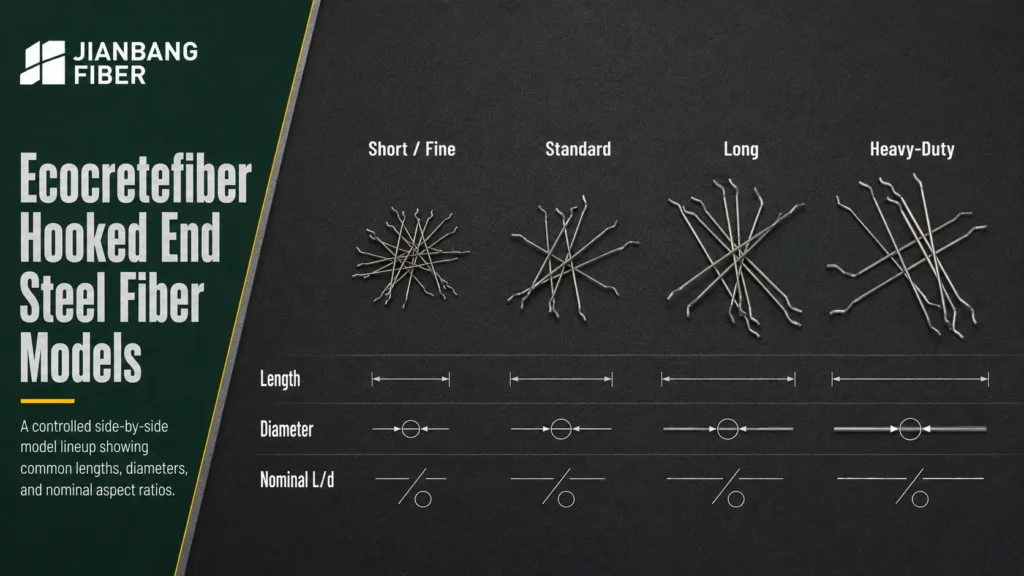
Common Ecocretefiber Hooked End Steel Fiber Models
Ecocretefiber supplies several common length and diameter combinations. The model name gives a nominal aspect-ratio and length reference, while the published dimensions identify the actual geometry.
| Model | Diameter | Length | Nominal L/D Class | Practical Screening Direction |
|---|---|---|---|---|
| J-50/25 | 0.50 mm | 25 mm | 50 | Thin toppings, repairs, and compact precast sections |
| J-60/25 | 0.40 mm | 25 mm | 60 | Fine, high-count reinforcement where dispersion is well controlled |
| J-55/30 | 0.54 mm | 30 mm | 55 | Repair, shotcrete, and medium-thickness concrete |
| J-60/30 | 0.50 mm | 30 mm | 60 | Higher fiber count with a moderate working length |
| J-45/35 | 0.77 mm | 35 mm | 45 | Easier handling where a stiffer, lower-L/D fiber is suitable |
| J-65/50 | 0.77 mm | 50 mm | 65 | Floors, pavements, and structural precast trials |
| J-55/50 | 0.90 mm | 50 mm | 55 | Robust handling for heavy-duty concrete |
| J-50/50 | 1.00 mm | 50 mm | 50 | Thick sections that favor a stiff, larger-diameter fiber |
| J-65/60 | 0.92 mm | 60 mm | 65 | Large slabs and infrastructure elements |
| J-80/60 | 0.75 mm | 60 mm | 80 | High anchorage potential where workability is engineered carefully |
This table is a selection map, not a structural design table. The correct model depends on the required residual strength, slab or member geometry, concrete grade, aggregate, dosage, casting method, and local code. Buyers should request the current TDS because model availability and tolerances may change.
How Length Changes Concrete Behavior
Fiber length affects how far a fiber can bridge across a crack and how much embedment remains on each side. A longer fiber can develop stronger anchorage in a suitable matrix. It may also cross wider crack zones or larger aggregate gaps.
However, length creates practical limits. A long fiber can interact with coarse aggregate, reinforcing bars, pump bends, hoses, and narrow molds. It can align with concrete flow. It can also become caught with neighboring fibers if the feed rate is too high.
Shorter hooked fibers, often 25-35 mm, are easier to use in thin repairs, toppings, small precast units, or mixes with restricted flow paths. Longer fibers, often 50-60 mm, are common candidates for industrial floors, thick pavements, bridge decks, tunnel segments, and other elements that need strong post-crack performance.
These are starting directions. A project should not use element thickness alone to select length. Maximum aggregate size, clear spacing, pump-line diameter, nozzle size, finishing method, and specimen dimensions also matter.
How Diameter Changes Fiber Count And Workability
At the same steel mass and length, a smaller diameter produces more individual fibers. More fibers can create more potential crack crossings. The smaller diameter also increases total steel surface area, which can improve stress transfer when the matrix and dispersion are suitable.
The trade-off is fresh-concrete behavior. Fine fibers add internal friction. They may reduce slump or flow. They can also interlock during feeding. A larger-diameter fiber is stiffer and may be easier to separate, but each kilogram contains fewer pieces.
Diameter therefore changes both the hardened result and the batching process. Buyers should avoid a simple rule such as “smaller is always better.” A fine 60 mm fiber has a very different mixing demand from a thick 25 mm fiber.
Equivalent diameter also needs careful reading. Round wire has a direct measured diameter. Irregular, cut-sheet, or non-circular fibers may use an equivalent diameter calculated from cross-sectional area. The test report should state which definition applies.
What Aspect Ratio Really Tells You
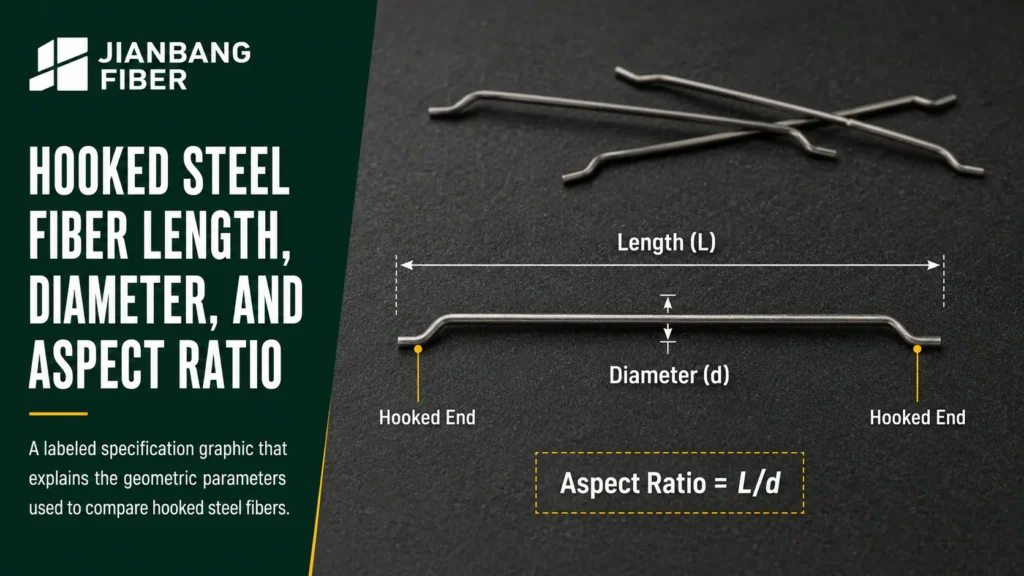
Aspect ratio is fiber length divided by diameter. A 60 mm fiber with a 0.75 mm diameter has an aspect ratio of 80. This number is useful because it combines slenderness and working length.
A higher aspect ratio can improve crack bridging, increase embedment efficiency, and give more fibers for a given steel mass. It can also reduce workability and raise the risk of fiber balls. A lower aspect ratio usually handles more easily, but the concrete may need a different dosage or hook design to reach the same residual target.
Aspect ratio does not measure hook quality. Two fibers can have the same L/D but different bend angles, hook legs, wire strength, surface condition, and pull-out curves. It also does not describe distribution. A high-L/D product trapped in clumps gives poor reinforcement outside those clumps.
Shandong Jianbang recommends reviewing L/D with five other inputs:
Fiber dosage by kg/m3 or volume fraction
Paste volume and mortar quality
Aggregate grading and maximum size
Water-reducer response and target workability
Mixer, pump, placement flow, and vibration method
The best aspect ratio is the highest value that safely meets the required concrete performance in the actual production system. In some projects, a more workable geometry gives more consistent results than a more aggressive geometry.
Tensile Strength, Elastic Modulus, And Elongation
The tensile strength of the finished fiber shows how much stress the steel can resist before rupture. Ecocretefiber common hooked-end models declare a tensile strength of at least 1000 MPa. High-strength versions may be available for projects that need a different balance of bond and rupture resistance.
Tensile strength must be high enough for the hook and embedded length to mobilize without premature breakage. Yet the highest available value is not always necessary. If the matrix bond is low, the fiber may pull out before its tensile capacity becomes important. If the bond is very high, a low-strength fiber may rupture early. Concrete testing reveals whether the combination works.
Steel has an elastic modulus of about 200 GPa. This high stiffness allows a steel fiber to resist crack opening at relatively small deformation. It is one reason steel fiber behaves differently from a lower-modulus synthetic macrofiber.
Elongation and bend capacity relate to ductility and manufacturing quality. Some specifications use an elongation threshold, while ASTM A820 includes finished-fiber tensile and bend testing. The test method, gauge length, and fiber type affect how results should be interpreted. Buyers should request the actual acceptance document instead of relying on an unqualified statement such as “elongation is above 3%.”
How Hook Geometry Affects Pull-Out
Hook length, hook width, bend angle, bend radius, and the number of bends can all change anchorage. Generic descriptions may mention hook lengths around 2-5 mm or bend radii around 1-3 mm, but these are not universal acceptance limits.
A larger or sharper hook may raise mechanical resistance. It can also damage the surrounding matrix or place high stress at the bend. A poorly formed hook may straighten too easily. An over-hardened wire may crack during forming. Consistent geometry is therefore more important than a dramatic-looking hook.
Single-hooked, double-hooked, and multi-hooked fibers can produce different pull-out responses. More deformation may increase anchorage in one concrete grade, yet another matrix may cause fiber rupture or local crushing. A project should compare residual beam data at the proposed dosage rather than assume that more hooks always mean better concrete.
What Performance Can Hooked End Steel Fiber Improve?
Hooked end steel fiber mainly changes behavior after cracking. It can help concrete retain load, limit crack opening, absorb energy, and resist repeated or impact loading. The improvement depends on dosage and distribution.
Residual Flexural Strength
Residual flexural strength describes what a cracked beam can still carry at defined deflections. This value is more useful than fiber tensile strength when a designer needs post-crack capacity. A strong fiber with poor anchorage or poor orientation can still give a weak residual result.
ASTM C1609/C1609M-24 evaluates first-peak, peak, residual load, residual strength, and toughness from a third-point-loaded beam. ASTM also notes that specimen size and preferred fiber orientation can affect the result. The test report should therefore state specimen size, dosage, casting method, and concrete mix.
Toughness And Energy Absorption
Toughness describes the energy absorbed while the specimen deflects. Hook straightening, friction, pull-out, and steel deformation all contribute. This behavior is valuable in tunnel linings, mining support, impact-prone floors, precast handling, and dynamic loading.
Crack Width Control
Fibers crossing a crack share stress and slow crack opening. Tighter service cracks can support durability because water and aggressive ions have a smaller path. Steel fiber does not make concrete waterproof, and exposed fibers can corrode. Concrete cover, exposure class, crack-width design, curing, and surface treatment still matter.
Fatigue And Impact Resistance
Repeated wheel loads, vibration, dropped tools, machinery, and traffic can extend small cracks over time. Hooked fibers can reduce the rate of crack growth and help the concrete retain integrity under repeated loading. The project should still use a test method and acceptance value that match the real load case.
Compressive Strength
Hooked end steel fiber is not selected mainly to raise compressive strength. A good mix may show a moderate increase, little change, or a reduction if workability and consolidation become poor. Compressive strength alone cannot prove that the fiber system is successful.
Where Hooked End Steel Fiber Is Used
Industrial Floors And Warehouses
Forklifts, rack loads, joints, impact, and repeated wheel paths make residual strength important. Hooked fibers are used in cut-joint, reduced-joint, jointless, pile-supported, and heavy-duty floors. A floor designer must still check slab thickness, subgrade support, joints, curling, load transfer, and any required conventional reinforcement.
Roads, Pavements, And Bridge Decks
Steel fibers can improve flexural toughness, crack control, fatigue behavior, and edge resistance. Ecocretefiber’s guide to steel fiber reinforced concrete for roads and bridges explains how fiber selection must match traffic, climate, mix design, and construction.
Tunnels, Mines, And Shotcrete
Distributed steel fibers reinforce the sprayed layer through its thickness. They can improve energy absorption and help the lining remain intact after cracking. Wet-mix or dry-mix shotcrete requires checks on pumpability, hose size, rebound, nozzle flow, and trial-panel performance.
Precast Products And Pipes
Hooked fibers can support demoulding, handling, impact resistance, edge integrity, and post-crack performance in precast segments, sleepers, piles, pipes, covers, and utility products. Thin sections may need a shorter model to avoid surface exposure or flow restrictions.
Hydraulic And Abrasion-Exposed Concrete
Spillways, sluices, dam surfaces, channels, and industrial areas can face impact plus abrasion. Fibers can support toughness and crack control, while the matrix still needs suitable strength, aggregate, finishing, and durability design.
How To Choose A Model For The Project
The project team should start with a performance requirement, not a product code.
Define the structural or service problem. State whether the project needs residual flexural strength, crack-width control, impact resistance, energy absorption, fatigue support, or easier placement.
Confirm the element geometry. Record thickness, clear spacing, cover, aggregate size, pump or hose dimensions, and any congested zones.
Select a practical length range. Shorter models often suit thin or restricted sections. Longer models may suit thick, heavy-duty elements.
Compare diameter and aspect ratio. Check both performance potential and mixing risk.
Set a trial dosage. Use supplier guidance only as a starting point.
Run a plant or full-scale trial. Measure workability, dispersion, pump pressure, finish quality, and visible fibers.
Test the concrete. Use the specified residual-strength or toughness method.
Adjust the full system. Fiber geometry, dosage, mix design, and placement method may all need changes.
This process is more reliable than choosing the cheapest price per kilogram. A lower-priced fiber may require a higher dosage. A high-performance fiber may save material but need better dosing equipment. The useful comparison is cost per cubic meter at the required verified performance.
How Much Hooked End Steel Fiber Should Be Added?
There is no universal dosage. Ecocretefiber uses the following starting windows for project discussion:
General slabs and industrial floors: about 20-40 kg/m3
Heavy-duty pavements, bridge decks, and precast: about 30-60 kg/m3
Shotcrete and repairs: about 25-45 kg/m3
Selected UHPC or high-performance systems: about 1.0-2.0% by volume, with engineering design
These ranges are not automatic design values. A light floor and a heavily loaded logistics slab should not receive the same dosage simply because both are floors. The selected model also changes the number of fibers per kilogram and the resulting crack-bridging network.
The article on steel fiber dosage in concrete explains why dosage affects flow, orientation, distribution, and post-crack results. For a structural application, the engineer should set a residual performance target. Trial batches should then confirm the dosage that reaches it.
How To Prevent Fiber Balling During Mixing
Fiber balling occurs when fibers interlock before the mixer separates them. A ball creates a local cluster plus a fiber-poor zone elsewhere. It may also block a pump or leave a void.
The most common causes are fast dumping, a dry or harsh mix, high aspect ratio, poor aggregate grading, excessive dosage, low mixer energy, and inadequate mixing time.
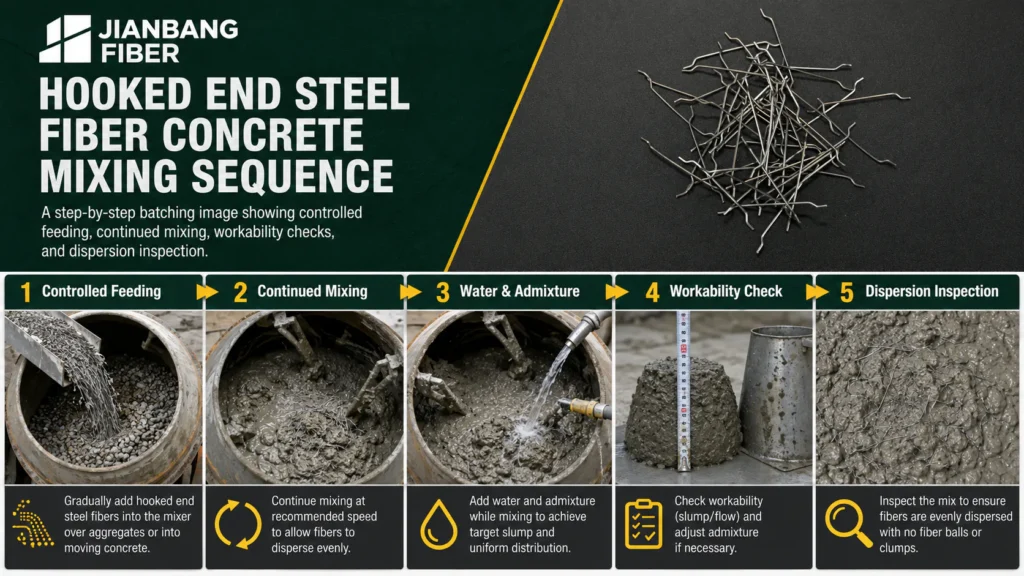
A practical cementitious batching sequence is:
Charge the correctly graded aggregates.
Add hooked end steel fiber gradually while the mixer is moving.
Add cementitious materials.
Add water and compatible admixtures.
Continue mixing until the fibers are separated and uniformly distributed.
Check workability, visible clumps, fiber distribution, and discharge consistency.
Some plants make the base concrete first, then add fibers through a controlled feeder. Either sequence can work when it has been validated. The key rule is controlled feeding into a moving, workable mix.
Do not add uncontrolled water to recover slump. Extra water can weaken the matrix and increase shrinkage. Use a compatible water reducer or superplasticizer, then adjust paste volume and aggregate grading during the trial if needed.
The American Concrete Institute’s reinforcement resource also advises adding steel fibers to the batch mixer at a uniform rate to reduce segregation or balling.
Quality Tests And Standards Buyers Should Check
A strong procurement specification links the fiber certificate with concrete performance.
ASTM A820/A820M
ASTM A820/A820M-22 covers minimum requirements for steel fibers used in fiber reinforced concrete. It classifies fibers by manufacturing route and covers finished-fiber dimensions, permissible variations, tensile testing, bend testing, inspection, certification, and packaging.
For hooked cold-drawn wire fiber, a buyer should confirm the declared ASTM type, nominal length, diameter, aspect ratio, dimensional tolerances, tensile result, and bend result. The purchase order can apply stricter requirements when the project needs them.
ASTM C1609/C1609M
ASTM C1609/C1609M-24 tests the flexural response of fiber reinforced concrete beams. It produces first-peak, peak, residual, and toughness values. This method helps compare actual fiber-mix combinations and verify specification compliance.
The same fiber can give different results in two concretes. The report should therefore identify the fiber model, dosage, concrete strength, specimen size, casting direction, curing, and age.
BS EN 14889-1
BS EN 14889-1:2006 covers steel fibers for concrete and addresses definitions, specifications, and conformity. Buyers serving EN-related markets should ask which intended use, declaration, and conformity documents apply to the product.
Project-Specific Quality Control
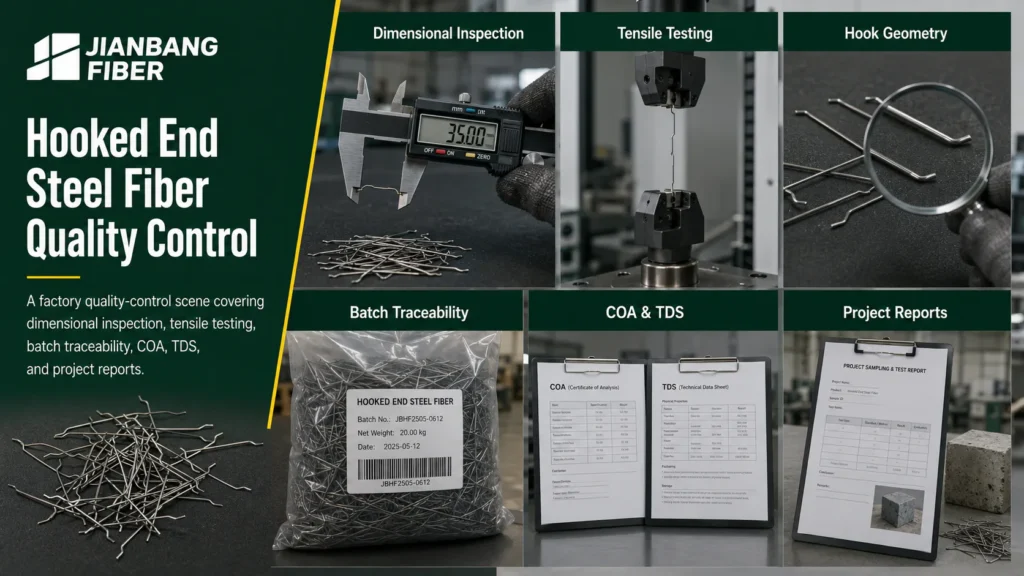
Incoming and production checks may include:
Length, diameter, mass, and aspect-ratio verification
Hook-shape consistency and visible damage inspection
Tensile and bend results
Fiber count or mass-dosage calibration
Moisture condition and packaging integrity
Trial mixing plus dispersion inspection
Fresh-concrete workability before and after fiber addition
Residual flexural or toughness testing at the proposed dosage
Batch traceability through COA, TDS, SDS, and project reports
No certificate can compensate for a poorly designed mix or uncontrolled site addition. Quality control must continue from the wire and fiber batch to the finished concrete.
Loose Or Glued Hooked End Steel Fiber?
Loose fiber gives direct, individual pieces. It can work well with a suitable geometry, controlled feeder, and experienced batching team. It also avoids waiting for a bundle adhesive to dissolve.
Glued fiber arrives in aligned bundles. The bundle format can reduce interlocking during storage and feeding, especially for slender fibers. The adhesive separates in the wet mix. The plant must provide enough water contact and mixing energy for complete dispersion.
Neither format is always better. Loose fiber may be simpler for lower aspect ratios or smaller batches. Glued fiber may improve dosing for high-volume production or demanding geometries. A trial batch should confirm the choice.
Common Selection Mistakes
Selecting Only By Tensile Strength
Tensile strength is a finished-fiber property. Concrete residual strength also depends on anchorage, dosage, distribution, orientation, and matrix quality. A 1500 MPa fiber does not automatically outperform a 1000 MPa fiber in every concrete.
Assuming A Higher Aspect Ratio Is Always Better
Higher L/D can improve crack bridging, but it also increases internal friction and balling risk. If site dispersion is poor, the theoretical advantage disappears.
Using A Generic Dosage For Every Project
Dosage must follow the load case and acceptance test. A warehouse floor, shotcrete lining, bridge deck, and pipe have different performance needs.
Treating Steel Fiber As A Universal Rebar Replacement
Hooked end steel fiber may reduce or replace secondary mesh in some tested, engineered applications. It does not automatically replace primary load-bearing reinforcement, punching reinforcement, edge bars, dowels, or other code-required steel.
Skipping The Full-Scale Trial
Small laboratory mixes do not reproduce every pump bend, truck mixer, laser screed, mold, or finishing operation. A plant trial or trial panel reveals workability and handling problems before mass placement.
A Practical Procurement Checklist
Before issuing a purchase order, confirm:
Product form: loose, glued, single-hooked, double-hooked, or another geometry
Manufacturing type and applicable ASTM or EN classification
Nominal length, diameter, aspect ratio, and tolerances
Tensile strength plus the test method and sampling basis
Bend or ductility requirement
Recommended dosage range for the exact model
Packaging size, pallet mass, storage, and feeder compatibility
Trial-mix plan and fresh-concrete acceptance checks
Required ASTM C1609, EN 14651, panel, or project-specific performance
COA, TDS, SDS, ISO 9001, and third-party reports
Batch traceability and replacement procedure for non-conforming goods
Delivery schedule, container plan, and site handling method
This checklist helps contractors, ready-mix plants, distributors, and engineers compare suppliers on real project value. It also reduces the risk of buying a generic “hooked fiber” that does not match the approved design.
Why Work With Shandong Jianbang?
Shandong Jianbang Chemical Fiber Co., Ltd. supplies concrete reinforcement fibers under our brand, Ecocretefiber™. Our role goes beyond quoting one steel price.
We help buyers compare length, diameter, aspect ratio, tensile strength, dosage, and packaging against the actual concrete application. The Ecocretefiber hooked-end range includes common 25-60 mm models with nominal L/D classes from 45 to 80 and declared tensile strength of at least 1000 MPa.
Our support can include:
Factory-direct supply and predictable production planning
Model selection for floors, pavements, bridges, tunnels, precast, and repairs
Trial-mix discussion before large-volume placement
Dimensional, tensile, and batch quality control
COA, TDS, SDS, ISO 9001, and project-specific inspection documents
Loose or bundled supply options based on the confirmed order
Pallet, container, and international shipping planning
OEM packaging plus support for distributors and local agents
Frequently Asked Questions
Is Hooked End Steel Fiber Better Than Straight Steel Fiber?
It usually gives stronger mechanical anchorage and pull-out resistance than a smooth straight fiber of similar size. The final concrete result still depends on dosage, mix design, orientation, and testing.
What Length Should I Choose?
Models around 25-35 mm are practical candidates for thin toppings, repairs, shotcrete, and restricted sections. Models around 50-60 mm are common candidates for thick floors, pavements, bridge decks, and large precast elements. A trial and engineering review should confirm the choice.
Does More Steel Fiber Always Improve Concrete?
No. A higher dosage may improve residual capacity, but it can also reduce workability, increase balling risk, and make finishing harder. The best dosage meets the test target with stable production.
Can Hooked End Steel Fiber Replace Steel Mesh?
It can reduce or replace secondary mesh in some engineered crack-control or slab designs. It does not automatically replace primary reinforcement or code-required detailing. The structural engineer must approve the design.
What Is The Most Important Acceptance Test?
The answer depends on the specification. Fiber dimensions, tensile strength, and bend quality confirm the product. A residual flexural test such as ASTM C1609 confirms how the fiber and concrete work together. Structural projects usually need both levels of evidence.
Conclusion
Hooked end steel fiber is effective because it combines high steel stiffness with mechanical end anchorage. It can help cracked concrete retain load, control crack opening, absorb energy, and resist impact or fatigue. These benefits are valuable in heavy-duty floors, pavements, bridge decks, tunnels, shotcrete, precast products, and repairs.
The product should never be selected by one number. Length must match the section and aggregate. Diameter affects fiber count and workability. Aspect ratio balances crack bridging with dispersion. Tensile strength must match the bond and matrix. Dosage must be verified in the proposed concrete.
Under the Ecocretefiber™ name, we provide multiple hooked-end geometries so contractors, distributors, and project teams can select a practical system instead of forcing one model into every application. Share the element type, concrete grade, aggregate size, target dosage, placing method, and required residual performance with Shandong Jianbang. We can then recommend a model, documents, packaging plan, and trial direction for the project.