
A concrete batching plant stores, measures, and combines concrete ingredients through a controlled production process. The plant must deliver the specified mixture at a rate that matches construction. When fibers are included, accurate dosing and uniform dispersion become part of that process.
At Shandong Jianbang Chemical Fiber Co., Ltd., we supply Ecocretefiber™ reinforcement fibers for concrete applications. For plant operators and technical buyers, fiber selection starts with the required concrete performance and continues through feeding, mixing, delivery, and placement trials.
A suitable plant can support repeatable production for bridges, tunnels, highways, water infrastructure, industrial facilities, and municipal projects. Its results still depend on the mixture, equipment condition, operating procedure, and site work. This guide explains the main plant arrangements and the production checks that matter when adding fibers.
What A Concrete Batching Plant Includes
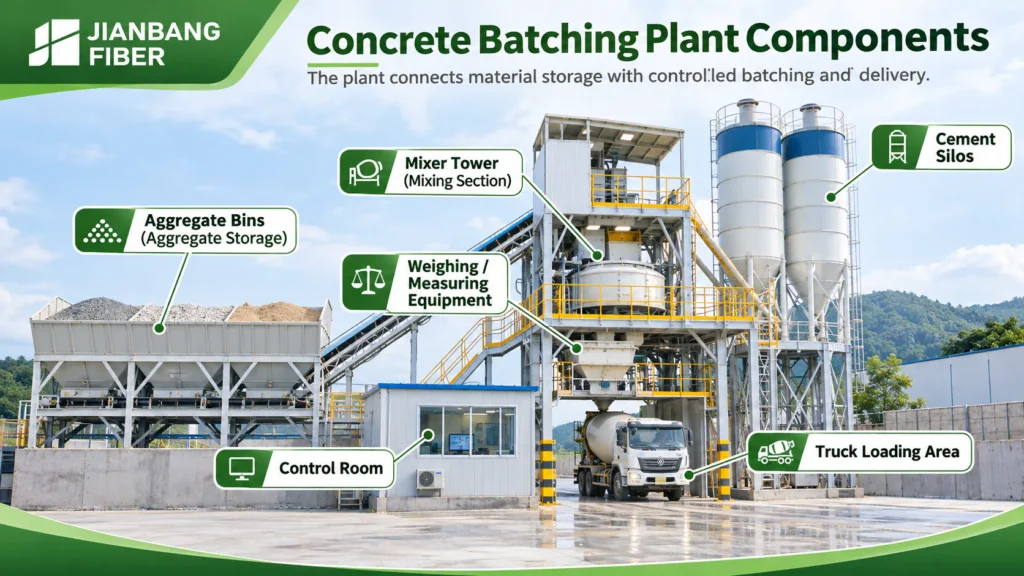
A plant is a connected system of storage, measuring, conveying, and control equipment. A central mixing installation also has a stationary mixer. In a truck mixing installation, the truck performs the concrete mixing after ingredients have been batched.
Cementitious materials need separate, clearly identified storage. Aggregate bins or stockpiles hold sand and different coarse aggregate sizes. Water and liquid admixtures have their own supply and measuring systems. Conveyors, screws, gates, and chutes move the ingredients to the point of mixing.
The control system selects a mixture and operates the batching sequence. Scales and meters report the quantities delivered. Operators review alarms and confirm that the materials and settings match the order. Fiber concrete production adds a measured fiber supply and a suitable feeding location to this arrangement.
| Plant element | Main function | Check for fiber concrete production |
| Aggregate storage and conveying | Separate and transfer sand and stone | Provide a controlled addition point where the selected fiber procedure requires it |
| Cementitious material storage | Keep binder types identified and available | Confirm the binder and mixture version used in the qualification trial |
| Water and admixture systems | Deliver measured liquids | Account for moisture and approved workability adjustments |
| Mixer or truck mixer | Combine materials into uniform concrete | Confirm usable batch size, condition, and fiber distribution |
| Fiber weighing and feeding | Deliver the approved fiber quantity | Verify grade, actual mass, feed rate, and packaging procedure |
| Controls and batch records | Run the sequence and record production | Link fiber additions and operator changes to each batch |
How Concrete Moves Through The Plant
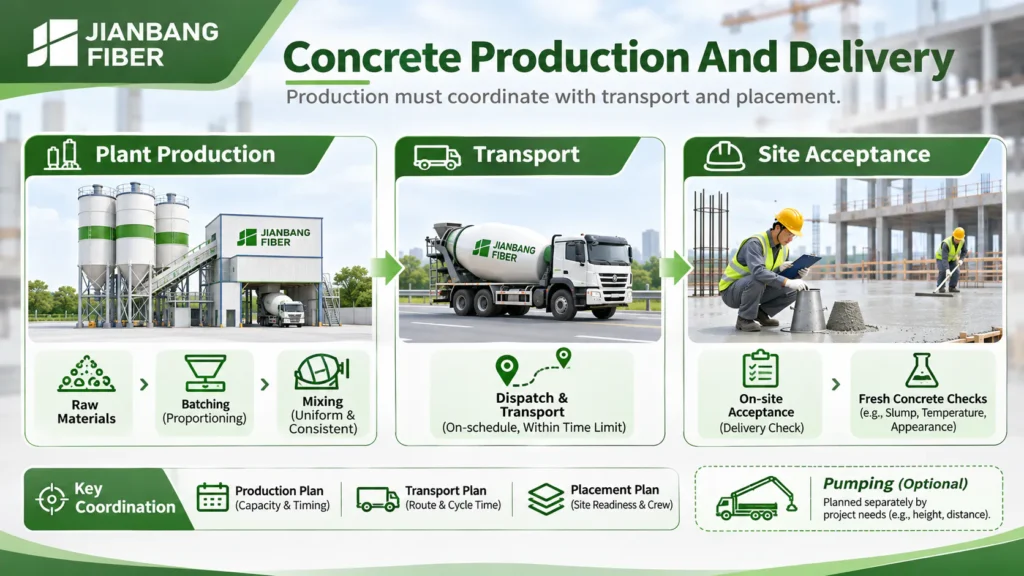
Production begins before the mixer starts. The operator confirms the order, mixture identification, intended volume, and delivery plan. Materials are checked against the approved supply. The producer then batches the ingredients using the selected moisture corrections and equipment settings.
The charging order depends on the mixer and mixture. A central mixer combines the ingredients before discharge into a transport vehicle. A truck mixer can receive the batched ingredients and complete mixing in its drum. Fibers enter at the qualified stage, with enough mixing action to distribute them throughout the concrete.
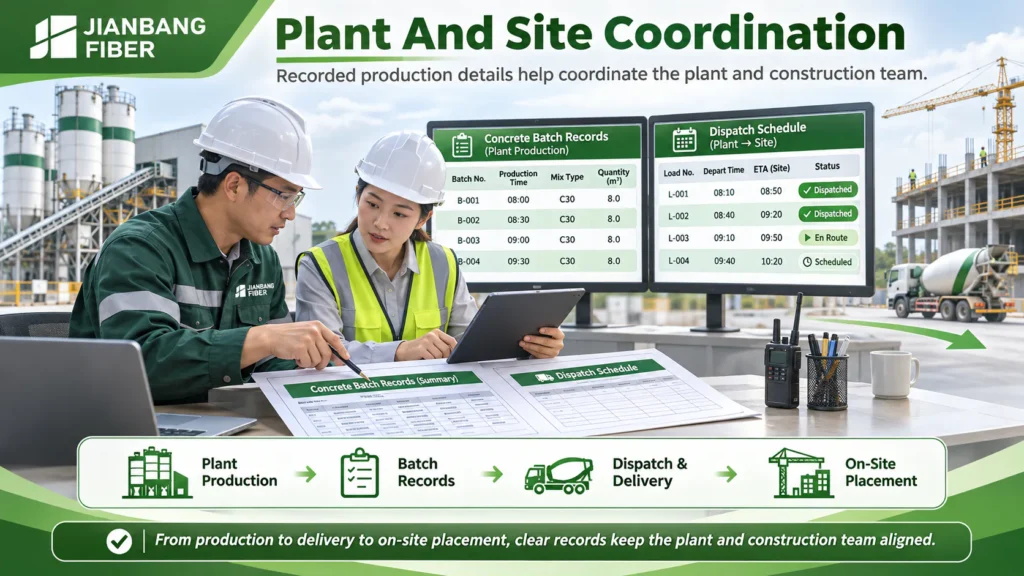
The next step is a controlled handoff to delivery. The batch record should identify the mixture and its production details. The dispatch team coordinates the vehicle with the placement crew. At the site, the receiving team checks the concrete against the project requirements before placing it.
Pumping and placement need separate planning. A batching plant does not automatically include a pump, placing boom, or site finishing crew. Transport distance, vehicle access, pump availability, and the placing rate all affect whether concrete can move continuously from production into the structure.
Mobile Stationary And Semi Stationary Plants
Mobility describes how a plant is installed and relocated. It does not define its concrete quality, mixing method, or complete output capacity. Buyers should compare actual equipment configurations and site requirements.
Mobile Concrete Batching Plants
A mobile plant is designed for relocation between projects. This arrangement can suit temporary construction sites or work where transporting concrete from a distant supplier is difficult. It can reduce the amount of permanent installation work, depending on the model.
Mobile plants still need a planned source of water and energy. That source may be a utility connection, a generator, a tank, or another approved arrangement. The site must also support the equipment, loaded vehicles, material storage, drainage, and safe access.
Some designs avoid permanent concrete foundations, but their ground requirements remain specific. For example, Liebherr’s Mobilmix information describes a steel foundation arrangement on level, compacted ground. That is a model specific installation condition. A mobile label does not establish suitability for unprepared terrain.
Stationary Concrete Batching Plants
A stationary plant is intended to remain at one location for extended production. It can serve a regional ready mixed concrete market or a long construction program. Storage, material handling, and dispatch areas can be arranged around that continuing demand.
The required footprint depends on the layout and storage capacity. A stationary plant is not defined simply by occupying more land. Truck movements, aggregate deliveries, cleaning areas, maintenance access, and future expansion can be as important as the mixer footprint.
Semi Stationary Concrete Batching Plants
A semi stationary or modular plant combines an installation intended for sustained use with components that can later be relocated. The term varies between equipment suppliers, so the buyer should request the actual dismantling and installation requirements.
The comparison should include transport loads, lifting arrangements, foundations, utility reconnection, and commissioning. Relocation also creates a reason to verify weighing performance again before routine production resumes.
Central Mixing And Truck Mixing
The place where mixing happens is a separate choice from mobility. The American Cement Association description of ready mixed concrete distinguishes three production arrangements.
| Production arrangement | Where mixing happens | Fiber planning question |
| Central mixed concrete | Mixing is completed in a stationary plant mixer | Can the fiber feeder and mixing cycle produce uniform distribution at the proposed batch size |
| Truck mixed concrete | Ingredients are batched at the plant and mixed in the truck | Is the fiber addition and drum mixing procedure qualified for the actual load |
| Shrink mixed concrete | Mixing starts in a plant mixer and finishes in the truck | Which stage receives the fibers and how is final uniformity confirmed |
A dry batching or transit mixing plant does not mean concrete is placed without water. The description refers to the production arrangement. The approved ingredients, including mixing water, must still be combined under the selected procedure.
For fiber concrete, document the complete mixing route. A successful result in a small laboratory mixer does not establish that a truck or production mixer will distribute the same fiber equally well. Equipment, load size, and charging sequence need to be represented in the trial.

What Automation Can Improve
Automation can repeat a charging sequence, control target quantities, and create production records. It can reduce routine manual input and help operators find deviations. These benefits depend on correctly maintained equipment and accurate settings.
The producer still needs trained people to confirm material identity, approve mixture changes, investigate alarms, and maintain the plant. A controller can repeat an incorrect recipe or use an inaccurate measurement just as consistently as a correct one.
NRMCA’s plant inspection framework addresses material handling, measuring devices, moisture accounting, mixer condition, delivery tickets, and vehicles. This gives a useful picture of the controls behind repeatable production. Automated batching alone does not guarantee concrete strength or uniformity.
Plants can also change between approved mixtures for different orders. That flexibility requires recipe control and clear material identification. The operator should know when a fiber grade, dosage, or sequence has changed and which production procedure applies.
Control Water And Aggregate Moisture
Water control matters because wet aggregates carry water into the batch. Changes after rain or between stockpile locations can alter the water contribution. The aggregate mass and added water must be corrected on a consistent moisture and absorption basis.
Consider an illustrative calculation. If 800 kg of oven dry sand carries free surface water equal to 4% of its dry mass, that contribution is 32 kg of water. This example isolates free water above absorption. It is not a complete moisture correction for every aggregate or mixture.
The practical implication is straightforward. A fixed water meter setting cannot keep total mixing water constant when aggregate moisture changes. The producer needs representative moisture information and a correction procedure that matches the mixture design basis.
The NRMCA plant certification guidance calls for documented accuracy checks of measuring devices. It also identifies relocation and maintenance affecting weighing systems as reasons to verify scale accuracy. Plants should follow the applicable project requirements and equipment instructions when setting their own verification program.
Fiber additions do not remove this responsibility. If workability changes after adding fibers, investigate the mixture and feeding procedure. Any admixture or water adjustment must remain within the approved limits and be recorded.
Add Fibers Through A Qualified Procedure
Fiber type affects what the plant needs to achieve. ACI guidance on fiber selection identifies synthetic microfibers mainly with early plastic shrinkage control. Steel and synthetic macrofibers are used where behavior after cracking is required. Dosage should follow the specified performance and relevant concrete tests.
Our Ecocretefiber™ PP monofilament fibers are candidates for early crack control evaluation. Our Macro Fiber range provides options for mixtures requiring assessment of toughness after cracking. Confirm the grade and concrete performance required for the application before selecting the production dose.
Calculate Fiber Mass From The Actual Batch Volume
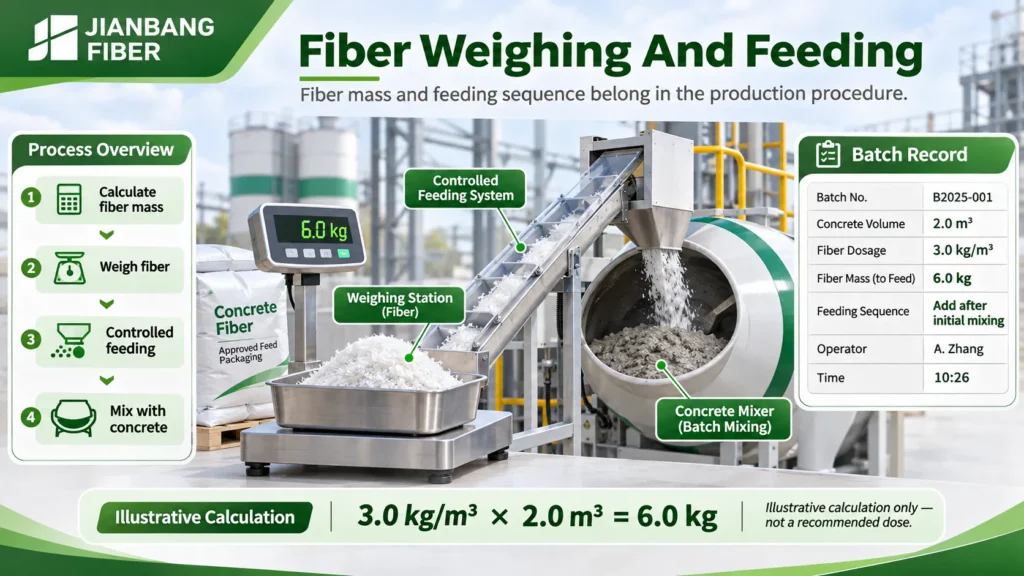
Fiber mass equals the approved dosage multiplied by the actual concrete batch volume. As a calculation example, a dose of 3.0 kg/m³ in a 2.0 m³ batch requires 6.0 kg of fiber. The example demonstrates arithmetic and does not recommend a dose for a particular structure.
Use the actual batch volume rather than the truck’s maximum capacity. Check how partial packages are weighed and identified. The batch record should connect the supplied grade, production lot, and fiber quantity with the concrete order.
Confirm Feeding Sequence And Packaging
The Fiber Reinforced Concrete Association batching guidance makes the addition procedure dependent on fiber type, dose, and mixing equipment. It generally places synthetic macrofibers with aggregates and other materials. It also advises continuous, controlled steel fiber addition and excludes steel fibers as the first ingredient.
Confirm the actual procedure with the fiber supplier and plant team. A feeder must deliver the intended mass without bridging or suddenly releasing a large accumulated quantity. The transfer route must also avoid losing fibers between weighing and mixing.
Only add packaging directly when the supplier confirms it is designed for that use. An ordinary plastic bag is not automatically a dispersible dosing package. Storage and package handling should preserve the material identification and the measured quantity.
Demonstrate Uniform Distribution
Set mixing duration through the approved product instructions and representative trials. The required cycle can change with mixer design, load size, fiber geometry, and dose. A single mixing time cannot be assumed to work for every plant and fiber.
Check discharge samples for visible fiber balls and uneven distribution. Include the proposed pumping route and surface finish in the trial where these affect the job. A uniform looking discharge is useful evidence of production consistency, but the specified concrete performance still requires its own testing.
Match Plant Capacity To The Delivery Plan
Rated plant output is only one part of the supply calculation. Actual production includes charging, mixing, discharge, and waiting. Extra time for the qualified fiber procedure must be included when estimating the rate for that mixture.
The delivery fleet can become the limiting factor even when the plant has spare capacity. Travel time, traffic, site unloading, and the return journey determine vehicle availability. The placement crew and pump also have a working rate that the dispatch plan must respect.
Compare the required peak demand with a demonstrated production and delivery plan. A temporary mobile plant may suit a remote project, while a continuing regional operation may favor a stationary arrangement. The choice should reflect haul distance, duration, space, and the mixtures that will actually be supplied.
Checks Before Releasing A Fiber Concrete Order
| Production stage | Evidence to review | Responsible team |
| Order preparation | Mixture identification and required fiber performance | Technical and sales teams |
| Trial approval | Grade, dose, batch size, feeding sequence, and mixing results | Producer laboratory and plant team |
| Batch production | Actual quantities and recorded approved adjustments | Plant operator |
| Dispatch | Vehicle identification and delivery information | Dispatch team |
| Site acceptance | Specified fresh properties and sampling records | Receiving and testing teams |
| Performance review | Required strength and fiber performance results | Project technical team |
Agree these responsibilities before the first delivery. A fiber supplier, concrete producer, and contractor each control different parts of the outcome. Clear records help the teams investigate a problem and keep approved changes consistent across later batches.
Maintenance also affects continuity. Mixer buildup, worn components, leaking gates, or unreliable feeders can change production behavior. Include inspection and cleaning access in the plant layout, along with a planned route for collecting wash water and returned material.
Frequently Asked Questions
Does A Mobile Plant Need Foundations
Some mobile designs use steel supports on prepared ground and avoid permanent concrete foundations. The equipment supplier must define the required bearing conditions, level, support arrangement, and installation method. Mobility does not remove those checks.
Can An Automated Plant Run Without Operators
Automation can run repetitive batching operations. People still verify materials, maintain measuring systems, manage exceptions, and authorize changes. Operator training and quality control remain part of concrete production.
Can Fibers Be Added To A Truck Mixer
Some fibers can be added through an approved truck mixing procedure. Confirm the addition point, load size, mixing action, and required mixing duration with the supplier and producer. Validate the procedure using the actual production equipment.
Does Macro Fiber Replace Every Type Of Reinforcement
The use of Macro Fiber depends on the required concrete performance and the engineer’s design. A plant cannot approve reinforcement replacement by changing a recipe. Any proposed replacement needs the design approval and test evidence required for that element.
What Information Does Jianbang Need For A Trial
Send the application, required performance, concrete proportions, mixer type, batch volume, and proposed fiber addition method. Include the delivery route, pump details, surface finish, and test requirements where relevant. This helps us discuss suitable grades and sample quantities.
Conclusion
A concrete batching plant supports consistent production when storage, measuring, mixing, and delivery operate under an approved procedure. Mobile, stationary, and modular arrangements serve different project needs. Fiber concrete adds specific requirements for material selection, accurate dosing, and verified dispersion.
At Shandong Jianbang, we help buyers discuss Ecocretefiber™ grades for their concrete trials. Share your plant arrangement and project requirements through our product inquiry page. We can review candidate fiber products with your team so the production trial evaluates the proposed material in the equipment that will supply the job.