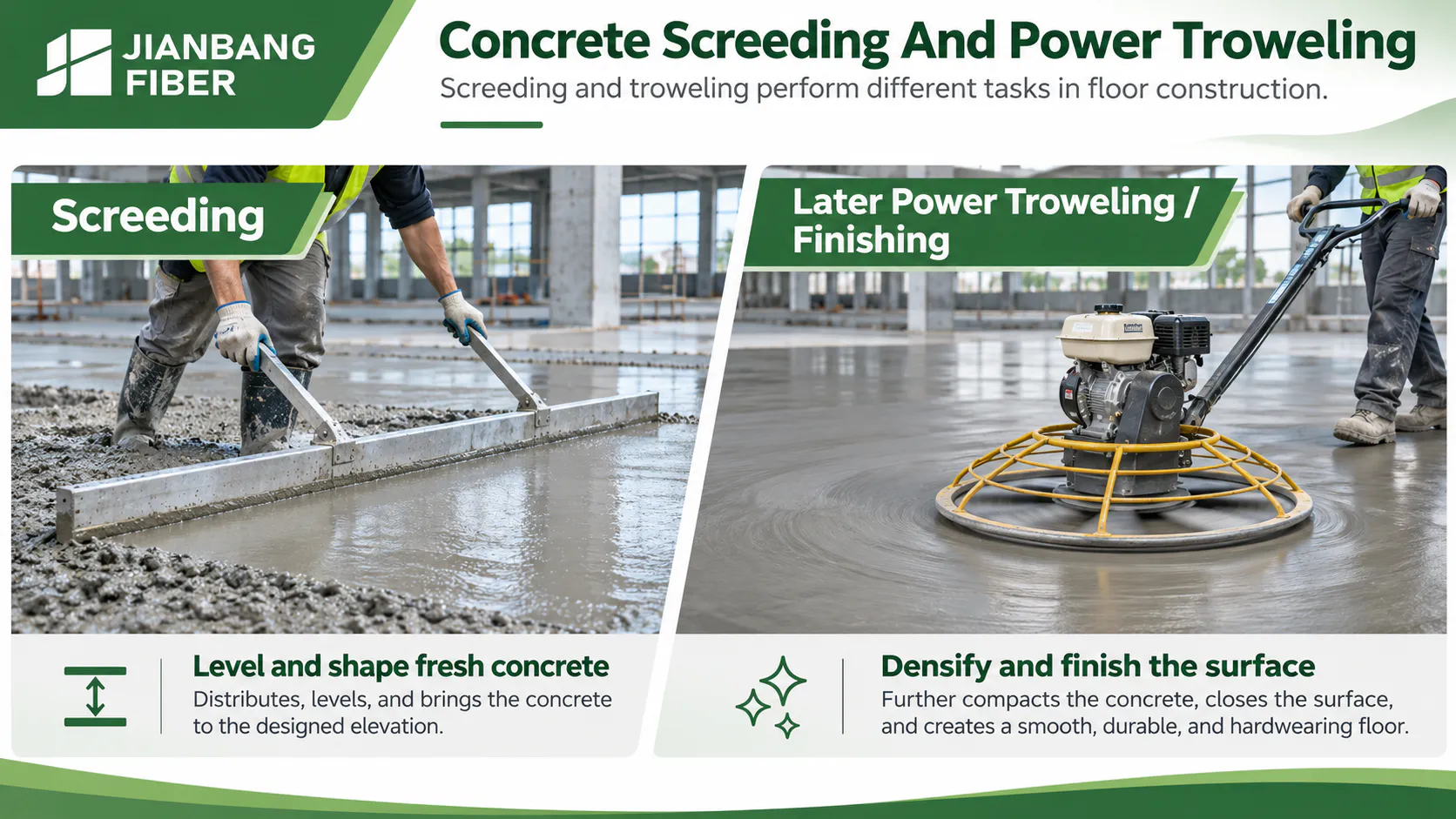
A concrete leveling machine is usually called a concrete screed when it levels freshly placed concrete. A laser screed controls the screeding elevation with a reference system. A power trowel performs later floating or finishing operations. These names describe different jobs, so buyers should state the required operation when discussing equipment.
At Shandong Jianbang Chemical Fiber Co., Ltd., we supply Ecocretefiber™ reinforcement fibers for concrete. For a fiber reinforced floor, the equipment and the concrete mixture must work together. The contractor needs to achieve the specified profile and surface texture while placing a mixture with the approved fiber grade and dosage.
This guide covers equipment used while concrete is fresh. Lifting a sunken hardened slab by injection is a different service, often called slab lifting or concrete leveling. Grinding a hardened floor is another separate operation.

What The Common Equipment Names Mean
Screeding, also called strike off, establishes the surface elevation by removing excess concrete and filling low areas. Floating and troweling follow according to the concrete condition and specified finish. The American Cement Association guide to working with concrete describes these as separate operations.
The five groups below are useful for comparing equipment. They are not a formal classification standard. Some groups overlap: a compact machine may use laser control, and an automated screed may also be laser guided.
| Equipment group | Main operation | What to confirm |
| Laser screed | Controls screeding elevation using a reference system | Reference setup, access, concrete compatibility, and trial results |
| Robotic or automated screed | Automates specified screeding or movement functions | Exactly which functions are automatic and which require an operator |
| Roller or truss paving screed | Strikes off pavement or slab strips using its particular mechanism | Support arrangement, working width, vibration, and profile control |
| Power trowel | Floats or finishes concrete at the appropriate stage | Pans or blades, operating space, timing, and required texture |
| Compact or specialty screed | Works in restricted areas or follows a particular surface profile | Equipment weight, reach, power source, and profile capability |
Laser Screeds For Controlled Surface Elevation
A typical laser screed uses a transmitter to establish a reference plane. Receivers on the equipment detect that reference, and the control system adjusts the screed head elevation. The head arrangement may combine strike off with material spreading and vibration, depending on the model.
The equipment is relevant to large floor placements where consistent elevation and production rate matter. Warehouses, industrial buildings, and commercial slabs are common settings. The contractor still needs a suitable placing method, a consistent concrete supply, and a crew that can complete the remaining operations.
Automation of the screed head is a specific capability. For example, the Somero S 940 product information describes an automated self leveling head and operator controls. That feature does not mean the entire construction process runs without people.
Check The Whole Working Area
Before selecting a machine, map the pour boundaries, columns, door openings, and embedded items. Confirm where the machine travels and which areas its head can reach. Plan how the crew will handle edges and places hidden from the reference signal.
For an elevated slab, the project team should confirm equipment loading and access against the structural and temporary works plan. A machine that fits through a doorway may still impose an unsuitable load on the supporting construction.
Laser control can help the crew maintain a chosen elevation, but it does not guarantee a finished floor tolerance. Setup, concrete behavior, screeding passes, later finishing, and slab movement all affect the measured result. Ask for a representative demonstration and an agreed test method.

Robotic And Automated Concrete Screeds
The term concrete leveling robot can refer to equipment with automated positioning, movement, or screeding functions. The exact capability depends on the product. Buyers should request a function list and an operating demonstration rather than infer autonomy from the word robot.
Separate automatic elevation control from automatic travel. Then ask whether the system plans a route, requires a prepared route, or follows continuous operator commands. Confirm who handles obstacles, interrupted signals, stopping, restarting, and boundary work.
A useful demonstration should represent the proposed site. Include columns, a restricted corner, and the intended material supply method where these are part of the job. Observe how much work the crew performs around the machine and how the system recovers after a planned interruption.
The commercial comparison should include setup time, training, supervision, and support. A faster machine pass may not shorten the full pour if concrete delivery or the finishing crew controls the rate. Request a production plan for the complete operation.
Roller And Truss Screeds For Paving Work
For roads, yards, and slab strips, buyers may encounter roller screeds, vibrating beams, and modular truss screeds. These terms should be kept distinct because the equipment mechanisms and support arrangements differ.
A roller screed uses a rotating tube or roller to move excess concrete and establish the surface. A vibrating truss screed uses a supported beam or truss assembly with vibration. Some paving machines use multiple rollers and other components, so the exact model must be identified before its consolidation capability is assumed.
Husqvarna’s concrete screed range includes both walk behind and modular truss arrangements. It also shows that petrol, electrical, and battery options exist across the range. Equipment selection therefore requires more detail than a general preference for hydraulic or electric drive.
Confirm the working width and how the machine follows forms, rails, or another reference. Inspect those supports as part of the setup. The concrete delivery and crew must maintain enough material ahead of the screed to avoid leaving unfilled areas.
Do not assume a roller provides the same vibration or depth of consolidation as another machine. The project method should identify any separate consolidation required around reinforcement, embedded items, or slab edges.

Power Trowels For Floating And Finishing
A power trowel works on concrete after screeding, when the slab is ready for the intended floating or finishing operation. It can be operated by a person walking behind it or riding on it. Pan and blade configurations support different stages of the work.
A pan provides a broad working surface for floating. Finishing blades can produce a denser and smoother surface as the concrete develops sufficient support. Some machines use different attachments at different stages. They should not be treated as permanently separate disc machines and blade machines.
The Husqvarna CRT 36 information illustrates this arrangement by describing early passes with pans and later passes with finishing blades. The correct timing and settings still depend on the actual concrete and operating instructions.
Choose The Finish For Its Use
A smooth troweled finish may suit an indoor industrial floor. Outdoor paving may need a texture that supports traction when wet. A floor receiving a coating or covering can have a different surface requirement again.
NRMCA’s CIP 14 guidance on finishing flatwork separates early surface leveling from later finishing. Later operations should wait until bleeding has stopped and surface water has disappeared. Finishing too early can cause surface defects. The guidance also calls for caution when troweling air entrained concrete.
Every slab does not require a polished looking power trowel finish. Agree the required texture before selecting equipment. A glossy appearance alone does not establish slip resistance, wear performance, or compliance with the specified floor profile.

Compact Screeds And Equipment For Slopes
Small powered screeds can serve areas where a larger machine cannot work efficiently. Compare blade width, handling space, and the proposed reference method. A compact tool may be useful around restricted access, but its size alone does not define the achievable tolerance.
Some compact machines also have laser control. Other systems follow forms or guides. The contractor should select the arrangement that fits the pour rather than assume every small tool is manual or suited only to loose tolerances.
Sloped and contoured surfaces require their own control plan. A loading dock, drainage area, or pavement transition may have several elevations and slopes. Setting every part of such a surface to one horizontal plane would defeat the design.
For example, Somero’s 3 D Profiler system uses a robotic total station with compatible screeds for contoured paving. This demonstrates a profile control option; it does not establish that every laser screed follows arbitrary three dimensional surfaces.
Compare service access, parts availability, training, and the complete drive system when reviewing durability. Hydraulic drive does not provide a universal reliability ranking over electrical drive. The specific design, operating conditions, and maintenance program determine the practical comparison.
Set The Acceptance Method Before The Pour
Flatness, levelness, and surface smoothness describe different properties. A floor can have a smooth finish and still contain waves. A slab can also follow its intended drainage slope without being horizontal.
Write the required measurement method into the project documents. A gap under a specified straightedge needs a stated straightedge length, locations, and acceptance rule. A bare statement such as a few millimeters of error is incomplete without that context.
ASTM E1155 E1155M 23 provides a method for evaluating floor profiles using FF flatness and FL levelness numbers. Its stated applications include randomly trafficked floors. It specifically excludes using its results to enforce tolerances for fixed path vehicle installations, such as narrow aisle warehouse floors.
For that reason, a warehouse project needs its traffic arrangement identified before the testing plan is chosen. The designer and testing team should define the relevant method, locations, timing, and acceptance criteria.
Do not treat a straightedge gap and an F number as interchangeable specifications. They evaluate the floor through different procedures. Machine positioning accuracy is another separate quantity and cannot be used by itself as the acceptance result for a completed slab.
Generic claims of fixed strength gains or a fixed multiple of labor productivity also need a defined comparison. Concrete strength depends on the mixture and construction. Job productivity depends on pour size, obstacles, supply, crew, and finish. Ask for evidence that represents those conditions.
Coordinate The Floor Construction Stages
Prepare the substrate, forms, reinforcement, and embedded details before concrete arrives. Confirm the intended elevations and slopes. The equipment route and the placing sequence should allow the crew to reach each area without disrupting completed work.
Place concrete near its final position and provide the consolidation required by the approved method. Screed to the specified profile. Use the planned checking and local correction procedure at edges and other areas that need attention.
Initial floating, later floating, and final finishing are timed to the concrete condition. They are not governed by one fixed number of minutes or a universal instruction to start after initial set. The operator needs to judge whether the slab is ready for the particular operation.
Keep the surface protected during drying conditions. NRMCA CIP 14 advises against sprinkling water or cement onto the surface to help finishing. It also identifies curing after finishing as necessary for surface strength and durability. Include joints and curing in the work plan alongside the equipment sequence.
Plan Fiber Concrete Around The Required Performance
Fiber reinforcement and surface geometry need separate checks. ACI guidance on selecting fibers identifies synthetic microfibers mainly with early plastic shrinkage control. Steel and synthetic macrofibers are used for specified behavior after cracking. Dosage follows the required performance and relevant concrete tests.
Our Ecocretefiber™ PP monofilament fibers are candidates for early crack control trials. Our Macro Fiber products provide options where the project requires evaluation of toughness after cracking. The engineer should approve any proposed change to conventional reinforcement.
Test The Exact Fiber Mixture And Finish
The Fiber Reinforced Concrete Association placing and finishing guidance explains that fiber material, dimensions, shape, and dosage affect placement and surface appearance. It recommends trials with the specified fiber and dose. A lower apparent slump also does not justify exceeding the approved water to cementitious materials ratio.
Use a representative trial area with the intended screed and finishing equipment. Check the proposed pump route if concrete will be pumped. Include the same surface texture and any specified surface treatment so the owner can assess the result under the intended conditions.
Evaluate visible fibers as well as the floor profile. A broomed texture can reveal fibers differently from a troweled surface. Agree the acceptable appearance before the main pour. Changing the approved fiber dose to hide fibers would also change the mixture being evaluated.
| Trial item | What to record | Why it matters |
| Concrete and fiber | Mixture identity, fiber grade, dosage, and batch details | Establishes what was actually placed |
| Equipment | Screed type, attachments, reference setup, and trowel configuration | Makes the demonstrated method identifiable |
| Placement conditions | Delivery intervals, pump route, weather, and crew arrangement | Shows the operating conditions represented |
| Finished surface | Texture, visible fibers, edge condition, and measured profile | Allows appearance and geometry to be reviewed separately |
| Performance | Required concrete tests and acceptance records | Checks the specified material performance |

Frequently Asked Questions
Is A Concrete Screed The Same As A Power Trowel
A screed establishes the fresh concrete profile. A power trowel performs later floating or finishing. Both may be used on one floor, depending on its specified finish and construction method.
Does A Laser Screed Replace The Finishing Crew
Laser control automates part of elevation control. The crew still manages placement, reference checks, edges, finishing, joints, and curing. Confirm the actual functions of the proposed machine.
Can Fiber Concrete Be Laser Screeded
Laser screeding can be part of a fiber concrete floor method. Qualify the intended fiber, dose, mixture, and equipment together. Review profile measurements and surface appearance in the trial.
Does Every Industrial Floor Need The Same Tolerance
The required profile depends on the floor use, traffic, and project specification. A random traffic floor and a defined vehicle path can require different evaluation methods. The test method must accompany the acceptance value.
What Should Buyers Send To Shandong Jianbang
Send the slab application, reinforcement objective, concrete mixture, fiber test requirements, and planned finish. Include screed type, pump details, and trial volume where relevant. This information helps us discuss candidate Ecocretefiber grades and sample quantities.
Conclusion
Choose a concrete leveling machine by its construction task. Laser and automated screeds support profile control. Roller, truss, and compact arrangements serve particular placing conditions. Power trowels perform a later surface operation where the specified finish calls for it.
For fiber reinforced floors, approve the material performance, equipment method, surface appearance, and measurement plan before production. Contact Shandong Jianbang to discuss Ecocretefiber™ PP monofilament or Macro Fiber options for a representative trial with your concrete producer and flooring contractor.