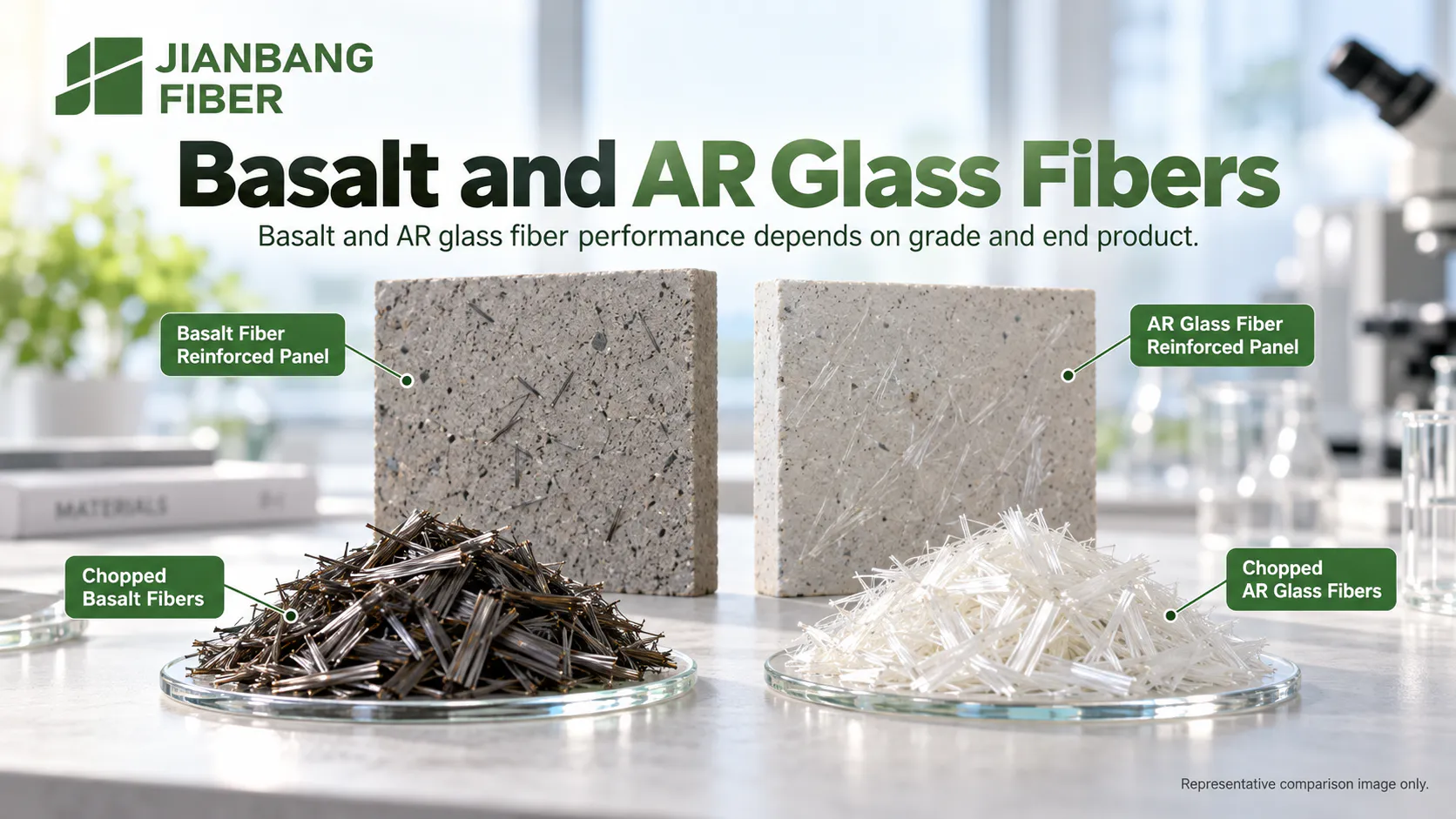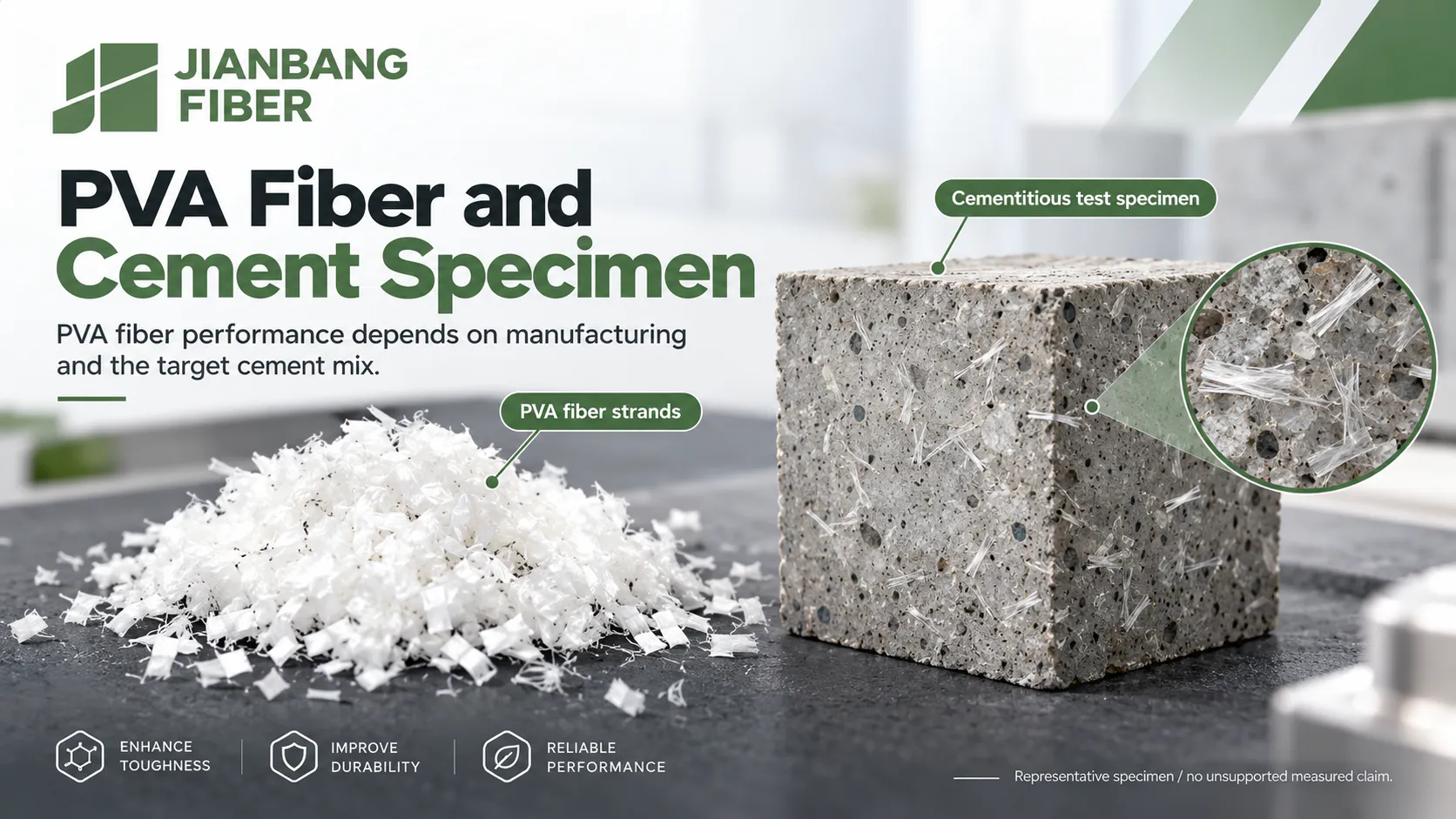
Basalt fiber and glass fiber can look similar in a specification sheet. Both are inorganic filaments that can be chopped, woven, or combined with a resin. Both can help a finished material resist cracks. Yet the name alone tells a buyer little about performance in cement, asphalt, or a polymer composite.
At Shandong Jianbang Chemical Fiber Co., Ltd., we often receive a version of the same question: “Is basalt fiber better than glass fiber?” The useful answer starts with the grade and the end product. A chopped fiber dispersed in concrete does a different job from a woven mesh in a thin façade panel. A glass fiber designed for electrical insulation is different from an alkali-resistant glass fiber made for cement.
This guide compares the materials at the points that matter in purchasing and design: raw materials, manufacturing, tensile properties, alkaline exposure, temperature, product form, cost, and testing. It also explains how to evaluate Ecocretefiber™ basalt fiber and Ecocretefiber™ alkali-resistant glass fiber in a real project.
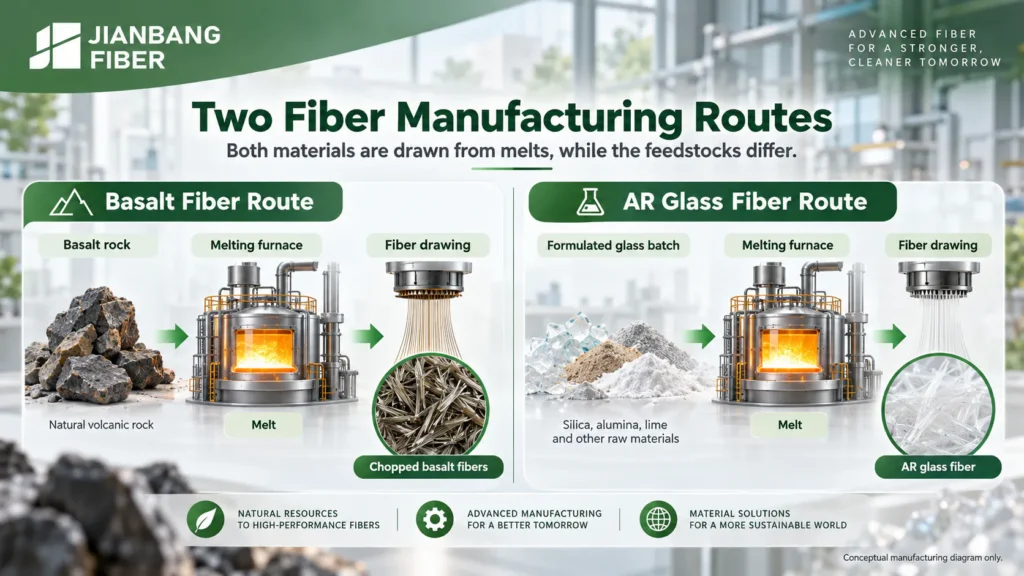
What Are the Fibers Made From?
Continuous basalt fiber is drawn from molten basalt rock. The rock contains silica, alumina, iron oxides, calcium, magnesium, and other oxides. The feed rock and melting conditions can change the final filament. A manufacturer therefore selects suitable deposits and controls the melt and drawing process. “Made from rock” does not mean that every basalt fiber has one fixed chemical composition or strength.
Glass fiber is produced from a designed batch of mineral raw materials. Silica sand is a major input, while other components are selected for the desired glass chemistry. That ability to formulate different glasses is important. E-glass is widely used in polymer composites and electrical applications. AR glass has a different composition developed for cementitious systems. Its zirconia content is a key part of its alkaline durability. There are also other glass families, each with a different purpose.
Both fiber families are made by melting feed material and drawing the liquid through small openings into filaments. Manufacturing conditions, filament diameter, sizing, and cutting or weaving steps affect the delivered product. A comparison that treats basalt as a single natural grade and glass as a single generic grade misses the main engineering decision.
Fiber Form Changes the Application
A chopped strand is mixed through concrete, mortar, or asphalt. A roving or textile can be placed in a designed layer. A fiber-reinforced polymer (FRP) bar is a separate composite product in which fibers are held by resin. Data for one form cannot be transferred to another. The tensile strength of a single dry filament does not prove the residual flexural capacity of fiber concrete, the capacity of a mesh, or the strength of a finished FRP bar.
Compare Strength and Stiffness by Grade
Fiber tensile strength and elastic modulus affect how a filament responds to strain. Still, a quoted range for all “basalt” or all “glass” products is rarely useful. Individual filament tests, strands, woven fabric, and finished concrete specimens have different test methods and failure modes. Fiber diameter, damage during handling, moisture, sizing, and gauge length can also change measured results.
Our current Ecocretefiber™ product pages list at least 1,200 MPa tensile strength and at least 75 GPa modulus for the listed chopped basalt grade. The AR glass page lists 1,000–1,700 MPa tensile strength and more than 72 GPa modulus for its listed product. These are page-level product specifications, not a universal ranking of basalt against glass. Confirm the selected SKU, batch certificate, test method, and test conditions before a design uses the figures. Other glass grades may have different tensile properties.
In a concrete mix, the fiber has to reach a crack and transfer load across it. Its effective contribution depends on fiber count, aspect ratio, bond, orientation, dosage, and matrix strength. A lower tensile number on a product sheet can still accompany a useful composite result, while a higher one cannot rescue poor dispersion. When post-crack behavior is required, set a performance target for the finished mix and test it.
| Comparison point | Basalt fiber | AR glass fiber for cement |
| Feed material | Selected basalt rock, melted and drawn | Formulated mineral batch with zirconia, melted and drawn |
| Common cement product forms | Chopped strands, selected textiles and composite reinforcement | Chopped strands, rovings, meshes and GFRC systems |
| Alkali qualification | Check the exact grade and cement exposure test | Check AR composition, applicable specification and cement exposure test |
| Selection question | Does the grade meet the target mix and durability test? | Does the AR product meet the panel or concrete system specification? |
This table describes material choices, not a pass/fail judgment. A supplier’s certificate and a representative composite test make the comparison meaningful.
Alkali Resistance Is the Critical Cement Question
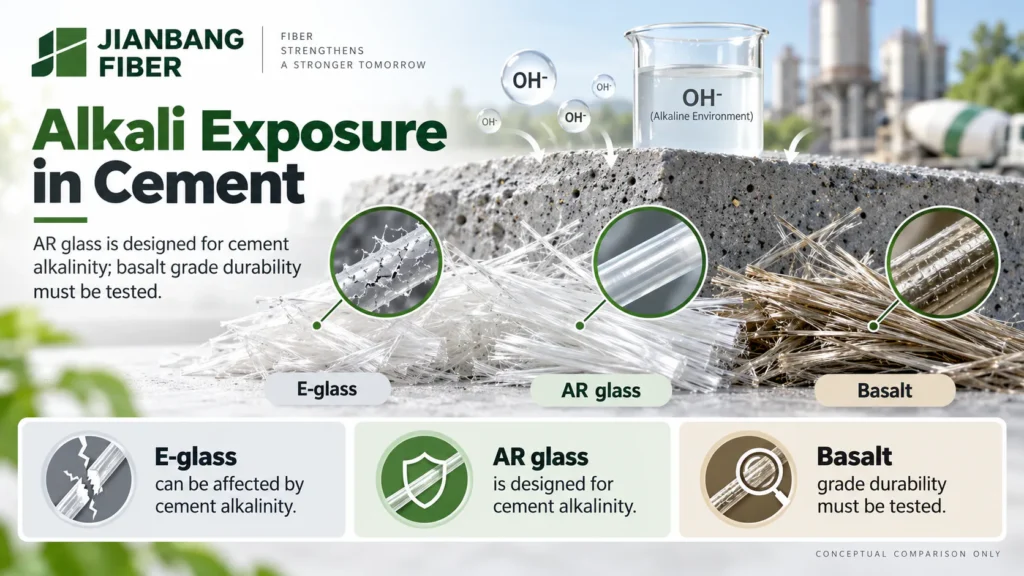
Fresh Portland cement paste has a highly alkaline pore solution. That environment is hard on many silicate fibers. A common error is to describe E-glass as alkali-resistant because its name is sometimes translated as “alkali-free glass.” The name describes a glass family; it does not certify long-term resistance inside cement. The American Concrete Institute’s GFRC report describes strength loss of earlier E-glass and A-glass cement composites and specifies AR glass for the GFRC systems covered by its report.
AR glass is intentionally formulated for that environment. ASTM C1666/C1666M-08(2023) covers minimum requirements for AR glass fiber intended for GFRC and other cementitious products, including physical properties and minimum zirconia content. Ecocretefiber™ lists 16.7% ZrO₂ for its AR glass product. Buyers should check the certificate for the specific batch and any more demanding project requirement.
Basalt fiber also needs scrutiny. Its chemistry and surface treatment vary. Research on an alkaline binder found that basalt and E-glass can lose more strength than AR glass under particular alkaline exposure conditions. That result does not mean every basalt grade fails in every Portland cement mix. It does show why an unqualified claim that basalt is naturally immune to cement alkalinity would be a poor basis for a long-life design. Ask for residual strength or composite durability data under relevant pH, temperature, time, and moisture conditions. A short acid immersion test cannot answer a cement alkalinity question.
The exposure medium matters as much as the label. Seawater around a resin composite, alkaline pore solution inside concrete, and hot acidic process water are different environments. Resin selection, coating, matrix design, and crack exposure can change the behavior of the finished system. Specify the exposure first, then compare candidate systems under the same test protocol.
Heat and Fire Performance Need System Tests
Both basalt and glass are inorganic and do not burn like an organic polymer. But “noncombustible fiber” does not mean a resin composite, coating, mesh finish, or assembled component will retain its design strength in a fire. At elevated temperatures, a fiber can lose strength before it softens, and a polymer matrix or sizing may deteriorate earlier still. Test duration and load also matter.
Basalt is considered for hot-mix asphalt because it can be mixed at asphalt processing temperatures when the selected grade is suitable. AR glass is considered for cement panels and other specified products. Neither application supports a universal claim that one fiber retains a precise percentage of its strength at 600°C or that ordinary glass fails at a fixed temperature. Those claims require a stated grade, test method, exposure time, and retained-property measurement.
If a project has a fire-resistance or high-temperature requirement, request testing of the actual assembly. A fiber data sheet may help screen choices, while a certified component test addresses performance under the project conditions. This is especially important for façade panels, insulation systems, brake components, and structural composites.
Where Each Fiber Makes Practical Sense
AR glass for thin cement products
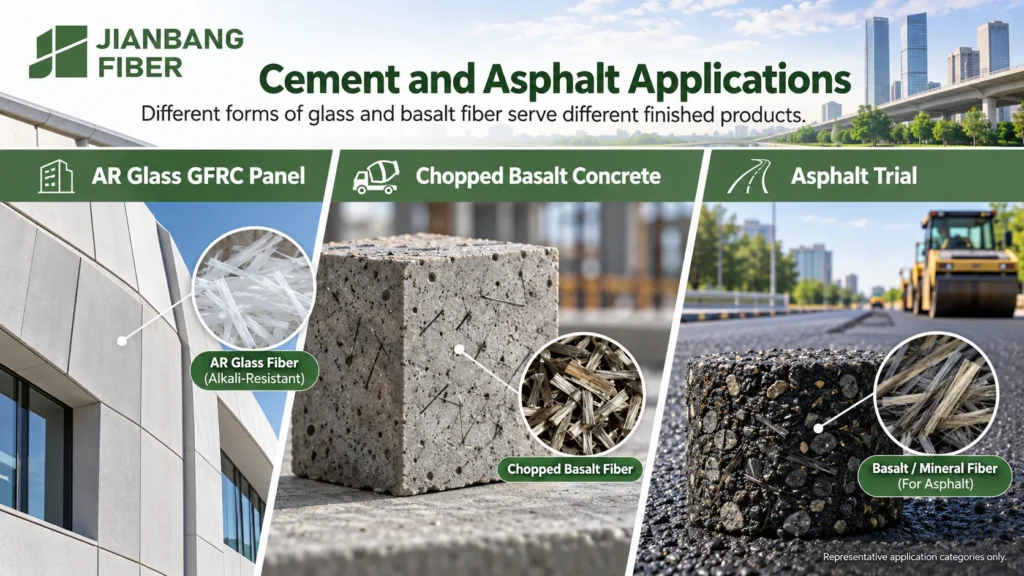
GFRC façades, decorative shapes, thin precast skins, and many cement boards need a fiber system that can be distributed or placed in a thin section. AR glass has a long record in this type of work. The material can be supplied as chopped strands for premix, continuous strands for spray-up, or a textile for a designed reinforcement layer. The ACI report describes these as distinct manufacturing processes. Choose the form and fiber content for the panel design, not by copying a concrete dosage from a product page.
A glass mesh used in a wall render also needs a compatible coating, mesh geometry, and installation system. “Fiberglass mesh” alone does not identify whether it is suitable for a cement or lime matrix. Ask for the relevant mesh and system test reports.
Basalt for selected concrete and asphalt mixes
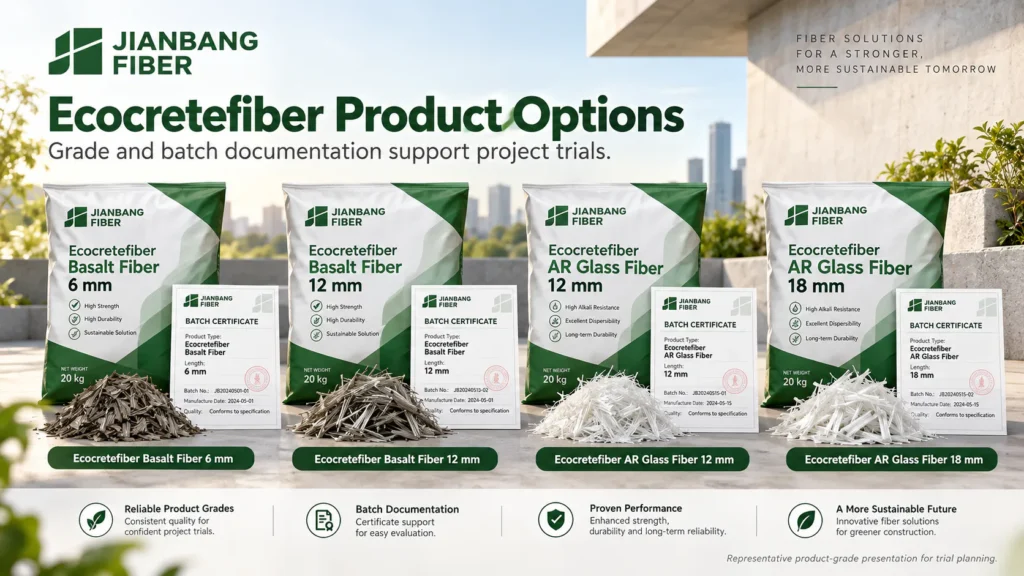
Short basalt fibers can be evaluated in mortar, concrete, and asphalt mixes for crack control and toughness. In asphalt, the fiber’s effect depends on binder content, aggregate grading, mixing, and compaction. In cement, the alkaline environment and long-term retained properties need checking. Ecocretefiber™ lists 3, 6, 9, and 12 mm standard cut lengths for its basalt product, with indicative use guidance for asphalt and concrete. The final length and dosage should come from a trial with the actual plant and performance targets.
Basalt textiles and basalt FRP bars belong to different design categories. They can be considered for an engineered reinforcement scheme, but their product qualification is separate from short chopped fibers. ASTM D8448/D8448M-22 addresses basalt strands, including rovings and chopped strands. ASTM D8505/D8505M addresses basalt and glass FRP bars. The standard for a bar cannot be used as proof of a chopped fiber’s concrete performance.
Polymer composites and electrical uses
Glass fibers are established in many polymer composites, insulation systems, and electrical laminates, but the glass formulation, sizing, resin, and laminate design decide performance. Basalt can also be considered for a resin composite where a producer values a particular balance of stiffness, temperature response, and processability. Compare a finished laminate at equal thickness, fiber volume fraction, resin system, and test conditions. Do not infer a weight saving or an electrical advantage from the fiber name alone.
Price and Environmental Claims Need a Defined Basis
Glass production has a large mature supply chain. Basalt and AR glass can have different prices by grade, region, form, order size, and certification package. A historical price per ton does not establish today’s delivered cost. Cost per ton also misses the effect of required dosage, fabrication, waste, labor, transport, inspection, and service life.
Compare cost per compliant finished unit. For a GFRC panel, that unit might be one square meter at the specified thickness and strength. For concrete, it may be one cubic meter that meets the required fresh and hardened properties. For asphalt, it may be a ton placed at the target mix design. If one grade needs more fiber or a different process to meet the same requirement, the initial fiber price may be a small part of the difference.
Basalt’s rock feedstock and glass’s formulated minerals do not, by themselves, prove a lower carbon footprint or near-perfect recyclability. Melting takes energy in both processes. Mining, fuel or electricity source, sizing, waste treatment, transport, and the finished product’s service life all matter. Ask for a product-specific environmental product declaration or a transparent life-cycle assessment with the same functional unit before making a quantified sustainability claim.
A Buyer Checklist That Prevents a False Comparison
Send both suppliers the same application brief. State whether the fiber will be chopped into concrete, incorporated into asphalt, woven into a mesh, or manufactured into an FRP product. Include the binder or resin, exposure, placement method, target service life, and governing test method.
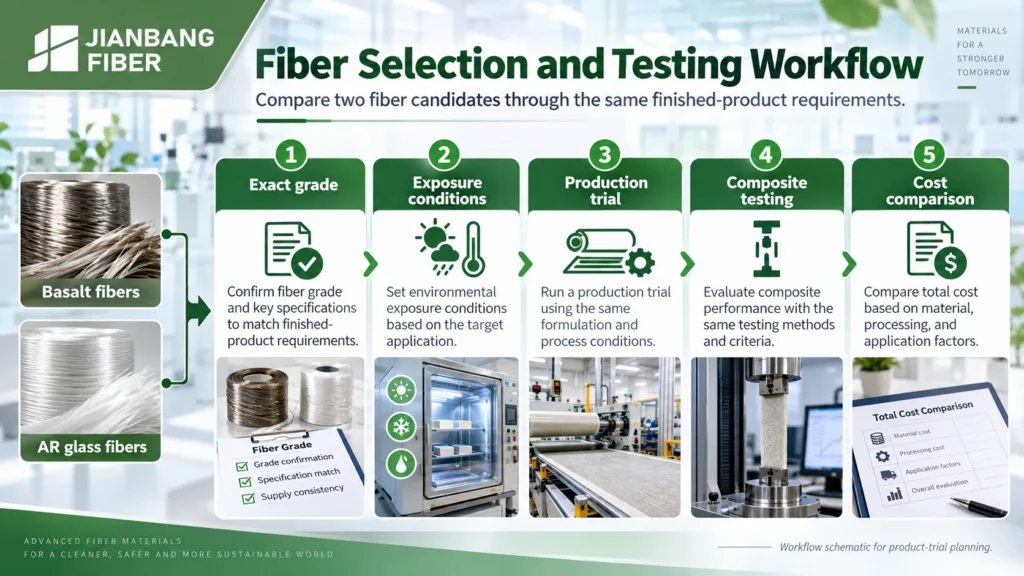
1. Identify the exact grade and form. Record composition, length or textile geometry, diameter, sizing, and batch traceability.
2. Check the right durability test. For cement, ask about alkaline exposure and retained properties. For resin composites, test the selected resin-fiber system in its actual exposure.
3. Run a representative production trial. Measure dispersion, flow, pumping or spray behavior, and finish quality with the planned equipment.
4. Test the finished material. Define flexural, tensile, impact, or other criteria in the same method for both alternatives. ASTM C1609/C1609M-24 is one recognized flexural method for fiber-reinforced concrete beams.
5. Compare whole-project cost. Include the quantity needed to pass, production losses, inspection, and maintenance assumptions supported by evidence.
When a fiber is proposed to replace a structural mesh, rebar, or another reinforcement system, the project engineer must approve the design and its verification plan. A material tensile number alone cannot establish equivalence.
Work With Ecocretefiber™ on the Right Candidate
Shandong Jianbang supplies both basalt fiber and AR glass fiber under the Ecocretefiber™ range. That lets us discuss the function before selecting a material. A thin cement façade, a chopped-fiber pavement mix, and a corrosion-exposed composite each require a different technical brief.
Share the end product, matrix chemistry, fiber form, dimensions, dosage target, process equipment, exposure, and test standard. We can provide current grade information and a candidate for trial. The final selection should be based on a testable product specification and results from the actual mix or component.
Frequently Asked Questions
Is basalt always stronger than glass fiber? No. Strength varies by grade and test. AR glass, E-glass, and specialty glass cannot be combined into one number. Compare certified products using the same method and evaluate the finished composite.
Can ordinary E-glass be mixed into Portland cement? Its alkaline durability requires careful qualification. AR glass is the established glass choice for GFRC, and its composition and tests should be verified for the project.
Is basalt automatically alkali-resistant because it comes from rock? No. Source chemistry, surface treatment, and the cement environment affect durability. Ask for relevant retained-property and composite test data.
Can I use an FRP bar data sheet to specify chopped fibers? No. A bar is a fiber-and-resin composite with different geometry and tests. Specify chopped strands and their concrete performance separately.
Which material is cheaper? It depends on the exact grade, form, order, location, and amount needed to meet the finished-product specification. Ask for comparable delivered quotations and trial results.
Choose the Tested System
Basalt and glass begin with different feed materials and can serve overlapping applications. The most useful distinction for cement is between an identified basalt grade and AR glass designed for alkaline cement, while ordinary E-glass belongs to another set of applications. Form, coating, matrix, and test method decide whether either option works in the finished product.
Contact Shandong Jianbang with the end use and performance target. Ecocretefiber™ can help narrow the options and support a trial that gives your team a defensible material choice.