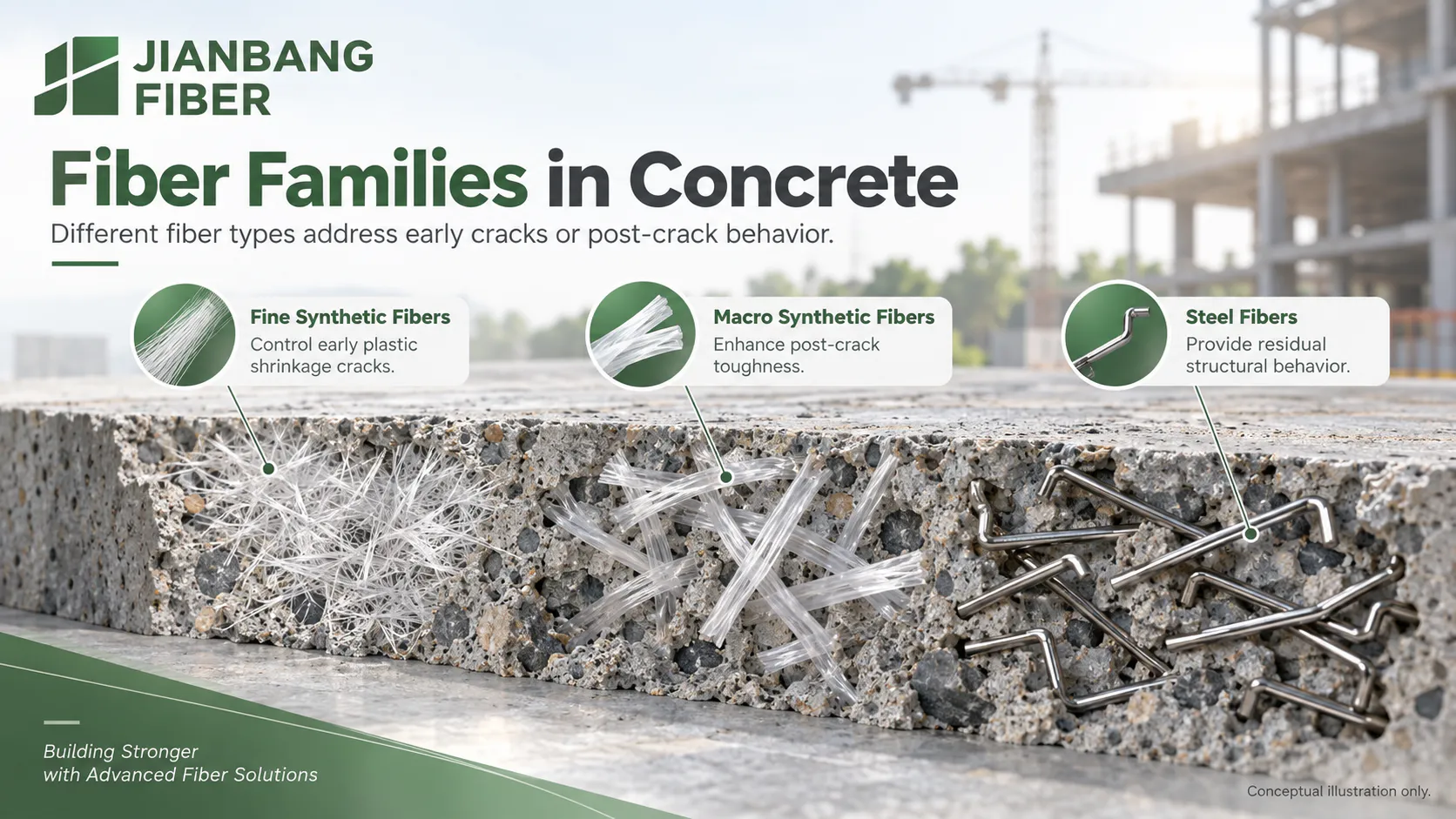
Concrete performs well in compression, yet cracks can form before it reaches full strength and grow under service loads. Fibers can help address different parts of that problem. A fine synthetic fiber may control early plastic shrinkage cracking. A larger synthetic or steel fiber can bridge cracks after the matrix has hardened. The benefit depends on the fiber, the concrete mix, and what the project actually measures.
At Shandong Jianbang, we treat fiber selection as part of an entire concrete production system. China’s JGJ/T 221-2010, Technical Specification for Application of Fiber Reinforced Concrete, offers a useful framework: choose qualified raw materials, design and trial the mix, maintain fiber distribution during production and placement, then inspect both fresh and hardened concrete. The standard covers short steel and synthetic fibers. Its provisions should be read alongside the current project specifications and applicable local standards.
This guide turns that framework into decisions a contractor, ready-mix producer, or buyer can use. It also explains where Ecocretefiber™ products fit into the conversation without treating a catalog description as a structural test result.
Start With the Performance You Need
“Fiber reinforced concrete” describes a material family, not a single recipe. The first question is whether the project needs better control of cracks at very early age, a stronger response after a crack forms, impact resistance, or a combination of these outcomes.
| Project objective | Fiber option to evaluate | Evidence to request |
| Control plastic shrinkage cracks in slabs, toppings, or mortar | Fine synthetic fibers, often polypropylene | Trial placement, finishability, and early-age crack observations |
| Improve post-crack flexural response in floors, pavements, or shotcrete | Steel fibers or qualified macro synthetic fibers | Beam or panel tests at the proposed dosage and mix |
| Combine early crack control with post-crack toughness | A designed blend of fine and larger fibers | Fresh-mix checks and performance tests for the combined system |
These are starting points, not interchangeable specifications. Fine polypropylene fibers do not automatically provide the residual capacity expected from steel or macro synthetic fibers. Likewise, a steel fiber selected for post-crack performance does not replace good curing or early-age protection. A designer must approve any change to conventional reinforcement, including mesh or rebar.
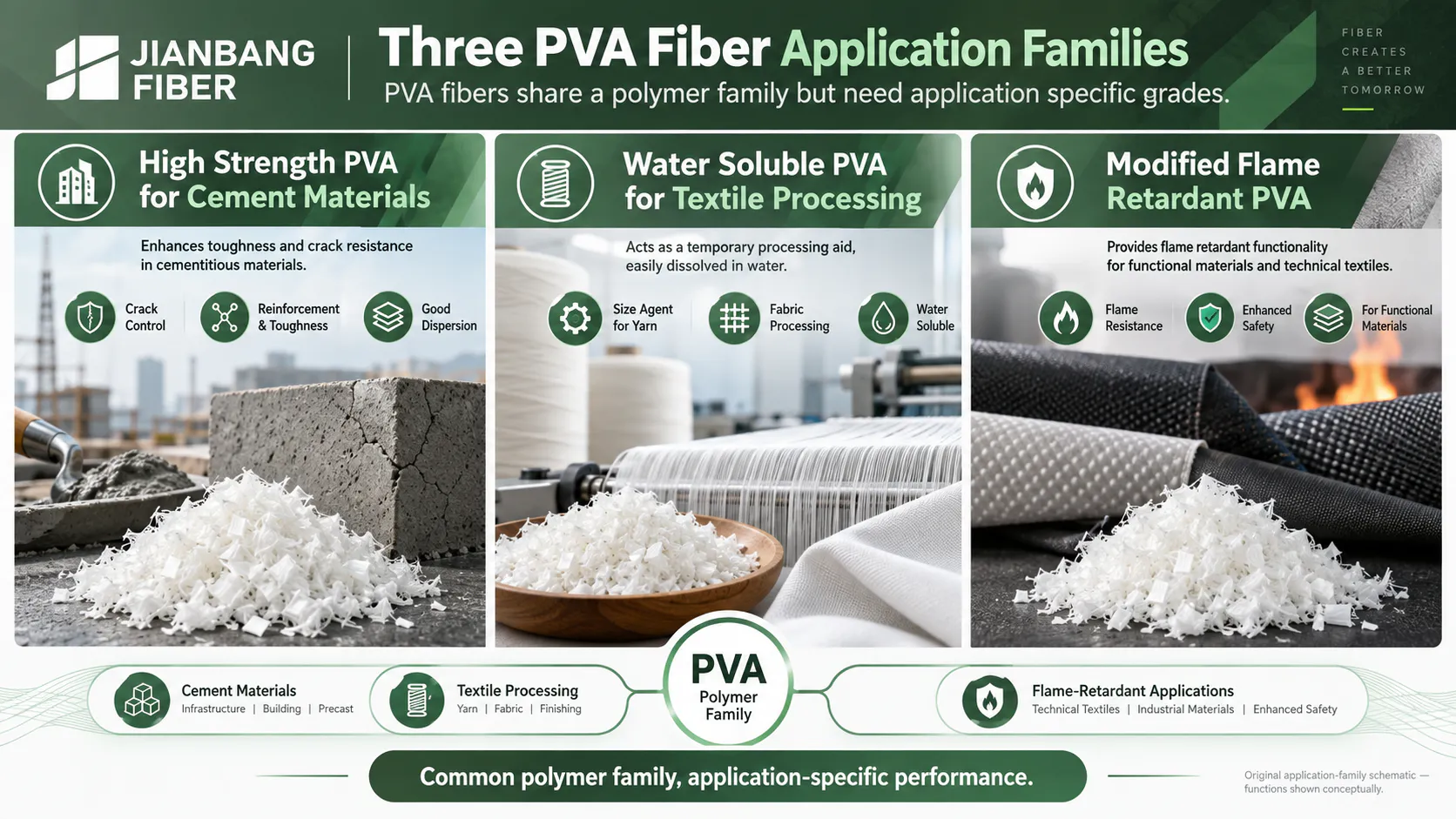
JGJ/T 221-2010 distinguishes steel and synthetic fiber concrete. Within synthetic fibers, it discusses monofilament, bundled, fibrillated film, and coarse fibers. It also recognizes polypropylene, polyacrylonitrile, polyamide, and polyvinyl alcohol among possible materials. The choice therefore begins with an intended function and verified properties, rather than the generic word “fiber.”
Check the Fiber Before It Reaches the Mixer
Steel fiber: geometry, strength, and condition
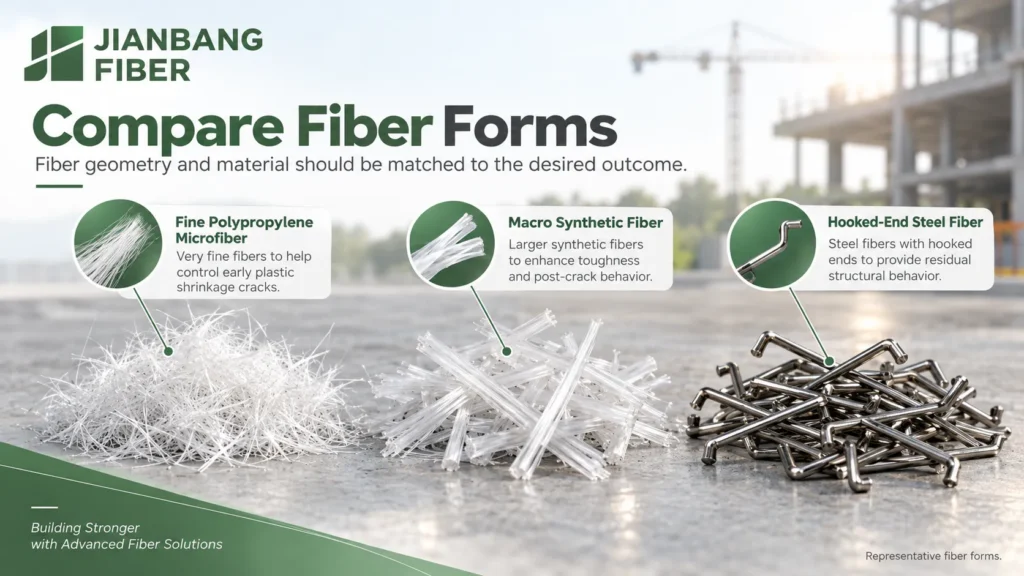
A steel fiber can be straight or deformed. Hooks, indentations, and other shapes affect anchorage and pullout behavior. Length, equivalent diameter, and aspect ratio influence dispersion, workability, and the number of fibers crossing a crack. Tensile strength matters, but it cannot alone predict a concrete beam’s residual strength. A fiber may be strong in isolation and still disperse poorly or bond inadequately in a particular mix.
Ask for the specific grade’s length and diameter tolerances, tensile test report, shape consistency, bend performance, and impurity limits. Inspect packages for damage, moisture, or contamination. For a proposed Ecocretefiber™ hooked-end steel fiber, match the product data sheet and batch certificate to the trial mix. Do not assume all listed models have the same dimensions or that a general range guarantees performance in every floor or tunnel lining.
Synthetic fiber: function and dispersion
For synthetic fibers, the standard calls attention to tensile properties, initial modulus, elongation, alkali resistance, and dispersion. It distinguishes fibers intended mainly for crack control from those intended to improve toughness. This distinction remains useful when comparing polypropylene microfibers with macro synthetic options.
A lightweight synthetic fiber can look easy to dose by the bag, yet poor feed timing can create floating fibers or balls. Ask the supplier for a grade-specific dosing method and inspect the first production batches for uniform distribution. Where fire performance, chemical exposure, or a structural role is claimed, request tests for the actual concrete system and the relevant design basis.
The standard’s material tables describe ranges and test criteria for its defined fiber categories. They are not a substitute for current product certification or a project’s performance schedule. For products outside the standard’s defined steel or synthetic scope, another applicable standard and separate qualification may be needed.
Design the Mix Around a Testable Outcome
The base concrete still has to satisfy strength, durability, and placement requirements. Fiber does not repair a poor aggregate grading, an unsuitable water-to-binder ratio, or a lack of curing. JGJ/T 221-2010 builds the fiber mix from normal concrete proportioning, then calls for trial batches, adjustments, and production verification.
The standard expresses fiber dosage in two useful ways. Mass per cubic meter is practical for purchasing and batching. Volume fraction is useful for design and comparison. Convert between them using the actual fiber density: mass in kg/m³ equals volume fraction as a decimal multiplied by fiber density in kg/m³. For example, 0.1% by volume of a 900 kg/m³ polymer is 0.9 kg/m³. That arithmetic is not a recommended dosage or a guarantee of performance.
The 2010 standard gives indicative steel volume ranges for particular applications and a typical 0.06%–0.20% synthetic fiber range for early shrinkage control in certain building components. It allows different ranges for coarse toughness fibers. Its governing principle is more important than a copied number: verify the final fiber content by tests against the intended performance and the actual mix. A floor’s design load, joint layout, thickness, subgrade, and exposure all affect what a suitable trial should demonstrate.
Build a trial matrix around a realistic base mix and two or three candidate fiber dosages. Record the exact fiber model, batch, length, mass, mixing sequence, admixture, slump or flow, air content where relevant, and temperature. Cast specimens from representative batches. Compare compressive strength and any specified flexural or residual performance after the specified curing period. Select the lowest practical dosage that meets the full performance target with workable production, rather than the highest dosage that can be added to a mixer.
Do not trade durability for apparent flow
Fibers often change the way a fresh mix moves. More water may make the first batch look easier to place, but it can alter strength, permeability, shrinkage, and the designed water-to-binder ratio. Adjust aggregate grading, paste volume, and a compatible water reducer through a controlled trial. The standard explicitly prohibits adding water during placement and permits a suitable water reducer, with mixing, to manage slump loss before discharge under its stated conditions.
The project team should define exposure limits for chloride and other durability requirements. These depend on whether the concrete contains steel fibers, reinforcing steel, or prestressing steel and on the environment. It is unsafe to lift one chloride value from an old table and apply it to every modern project; check the adopted project code and the current material specifications.

Measure the Properties That Matter After Cracking
Compressive strength identifies a concrete strength class, but it says little about the ability to carry load after a flexural crack. A useful fiber concrete acceptance plan separates three questions:
1. Is the base concrete strong and durable enough for the project?
2. Does the fresh mix disperse and place the specified fiber consistently?
3. Does the hardened material provide the flexural toughness, residual load, impact response, or other behavior the design requires?
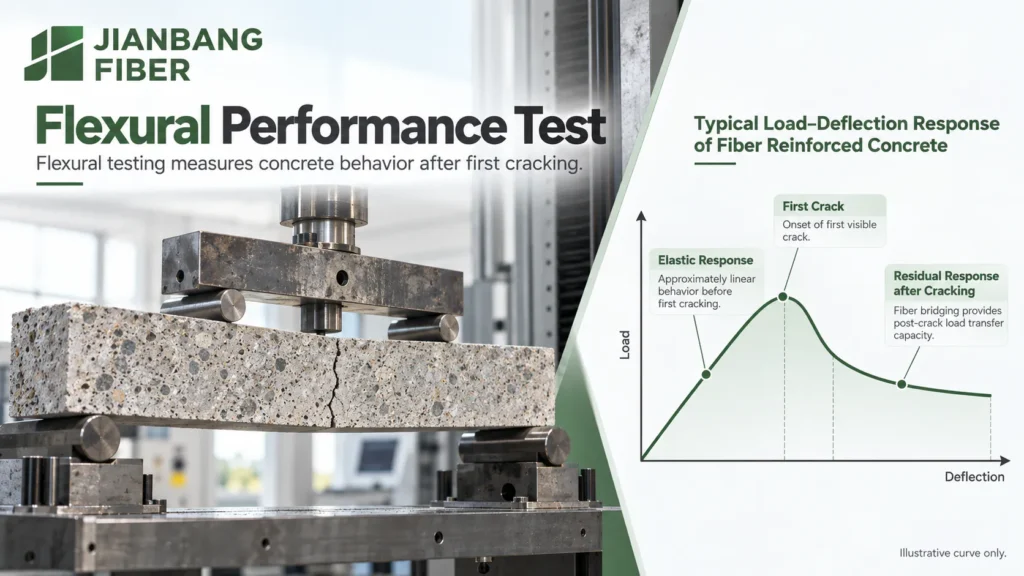
JGJ/T 221-2010 includes procedures for flexural toughness and first-crack behavior in its appendices, alongside provisions for other mechanical and durability tests. It cautions that two flexural toughness methods differ; a project should select and state the method rather than mix their numerical outputs. For an international project, ASTM C1609/C1609M-24 is one current beam test method for flexural performance. Specify the test method, specimen geometry, age, target at a defined deflection, sampling frequency, and acceptance rule together. A result obtained by one method should not be presented as directly equivalent to a different method’s result.
A fiber’s own tensile strength is a material qualification result. The concrete’s post-crack response is a system result. Matrix strength, fiber orientation, bond, placement direction, and curing can all change the outcome. When a supplier says a product can replace mesh in a particular slab, ask for an engineered design and relevant concrete tests. For ready-mixed FRC delivered with uniformly mixed ingredients, ASTM C1116/C1116M-23 provides a separate specification framework; its scope does not by itself cover placement and curing after delivery.
Keep Fibers Distributed Through Production
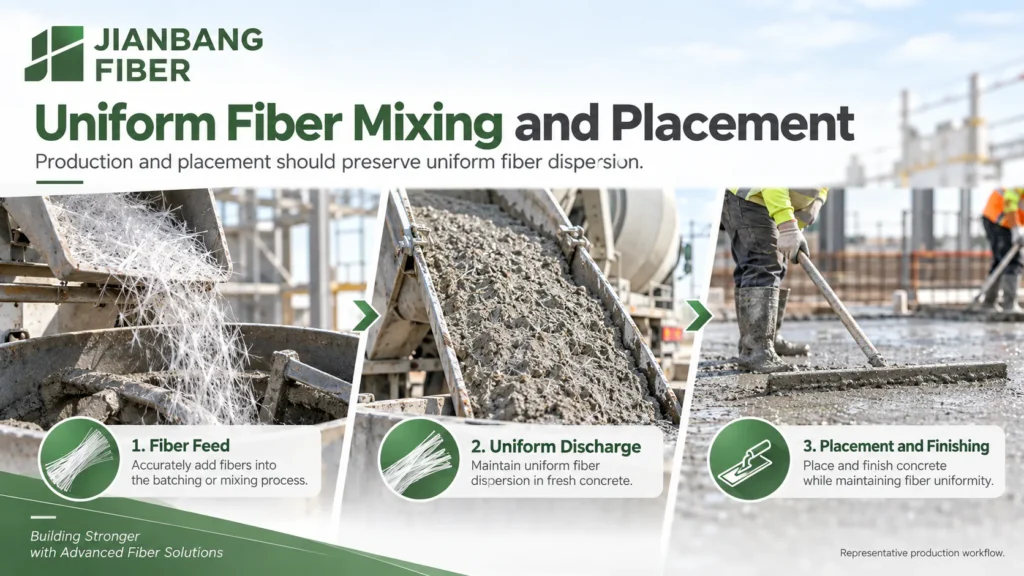
The standard recommends controlled batching with calibrated equipment and mechanical mixing. In its described production sequence, fibers are introduced with coarse and fine aggregate for dry mixing before binder, water, and admixture are added. The stated dry and wet mixing intervals are a useful reference for a plant trial, but actual equipment, fiber packaging, volume fraction, and mix design must be checked in production. The goal is a uniform batch without fiber balls, segregation, or excessive loss of workability.
A practical start-up procedure is straightforward:
1. Confirm the mix ticket, fiber grade, target mass per cubic meter, and calibration of the fiber feed device.
2. Introduce fiber at a rate and point that allow dispersion; follow the validated sequence for the specific plant and product.
3. Observe at least the first batches during discharge. Look for clumps, dry pockets, floating fibers, and changes in consistency.
4. Record mixer time and measure fresh properties at the prescribed locations and frequency.
5. Repeat the trial if aggregate moisture, admixture, fiber grade, or production equipment changes materially.
For pumpable or spray-applied concrete, verify the line, pump, nozzle, and crew procedure with the proposed fiber length and dosage. A laboratory batch that looks uniform can behave differently at the hose or discharge point. Trial placement should also confirm compaction and finishing. If the mix must remain pumpable, a lower apparent slump is not automatically a defect, while a high slump cannot excuse segregation.
JGJ/T 221-2010 also addresses transportation without separation, controlled discharge height, vibration without overworking the mix, and surface finishing that prevents exposed steel fibers. Cure the placed concrete according to its exposure and project specification. Fibers do not remove the need to protect a fresh slab from rapid evaporation or a member from poor temperature control.
Make Acceptance a Chain of Evidence
A reliable acceptance file starts before delivery. The 2010 standard asks suppliers for quality documents such as type-test reports, factory inspection reports, certificates, and use instructions for fibers and admixtures. It calls for incoming inspection and checks during construction. For steel fibers, it lists tensile strength, bending, dimension deviations, and impurities among sampled items. For synthetic fibers, it lists tensile behavior, initial modulus, elongation, alkali resistance, dispersion, and relevant concrete performance measures.
On site, inspect the fresh mix for consistency, segregation, bleeding, viscosity, water retention, and loss of workability over time as applicable. The standard gives sampling locations and frequencies, including checks at mixing and placing points. For steel fiber concrete it includes a method to determine fiber volume fraction in the fresh mix. Hardened specimens then show whether specified strength, toughness, and durability criteria were met. The construction work itself remains subject to the appropriate structure, floor, roof, waterproofing, or pavement acceptance rules.
Keep a traceable record linking every field result to the fiber shipment and concrete batch. The following request is concise enough for a purchase order and detailed enough to make a failed test diagnosable:
| Record | Minimum useful detail | Why it matters |
| Fiber supply | Grade, geometry, batch, density, test certificate, instructions | Confirms what actually entered the mixer |
| Concrete production | Mix ID, fiber kg/m³, other constituents, mixer sequence, time | Reproduces the qualified trial |
| Fresh concrete | Sampling point, slump or flow, uniformity, temperature, defects | Detects distribution and placement problems |
| Hardened concrete | Specimen age, curing, test method, strength, residual or toughness result | Links field performance to the design requirement |
This record also helps when a project changes suppliers or plants. A fiber with the same nominal material and length is not automatically equivalent. Compare the entire performance package and repeat the necessary trials.

How Shandong Jianbang Supports a Project Trial
Ecocretefiber™ supplies several fiber families, including steel fibers and polypropylene fibers. We can help shortlist grades against a project’s crack-control or toughness objective and provide the product information needed for batching discussions. The engineer and concrete producer then qualify the selected grade in their own mix, equipment, exposure conditions, and acceptance program.
A useful inquiry tells us the application, member dimensions, concrete strength class, anticipated exposure, mixer and pump configuration, required fresh properties, governing test method, target post-crack result if any, and proposed trial quantity. With those facts, selection becomes a defined experiment instead of a guess based on a fiber’s advertised tensile strength.
Frequently Asked Questions
Can one fiber control both plastic shrinkage and structural cracking? Some systems aim at more than one stage, but each claimed benefit needs suitable testing. Fine synthetic fiber and macro or steel fiber often address different mechanisms. A combined system can be considered when both functions matter.
Is there a standard dosage for every concrete floor? No. The standard offers application ranges, while final content is confirmed by tests. Floor design, base mix, fiber geometry, distribution, finishing, and the required residual performance determine the project dosage.
Can fiber replace rebar or welded wire mesh? Only where the engineer’s design and applicable rules permit that substitution, supported by relevant concrete performance data. A product data sheet or a compression result cannot establish structural equivalence by itself.
Which test should a buyer ask for? Begin with the design’s required behavior. Specify fresh-mix uniformity and strength, then a recognized flexural method with explicit residual or toughness criteria where post-crack performance matters. Agree on sampling, curing, and acceptance rules before placing the first production batch.
Build Performance Into Every Stage
Good fiber concrete is made through a sequence: define the required behavior, qualify the fiber, trial the complete mix, maintain uniform production, place and cure it properly, and verify the specified results. JGJ/T 221-2010 organizes those decisions for steel and synthetic fiber concrete. The strongest procurement choice is the one that can be reproduced at the plant and demonstrated in the finished concrete.
Share your mix design and performance target with Shandong Jianbang / Ecocretefiber™. We will help identify a practical fiber candidate and the information your trial team needs to evaluate it.