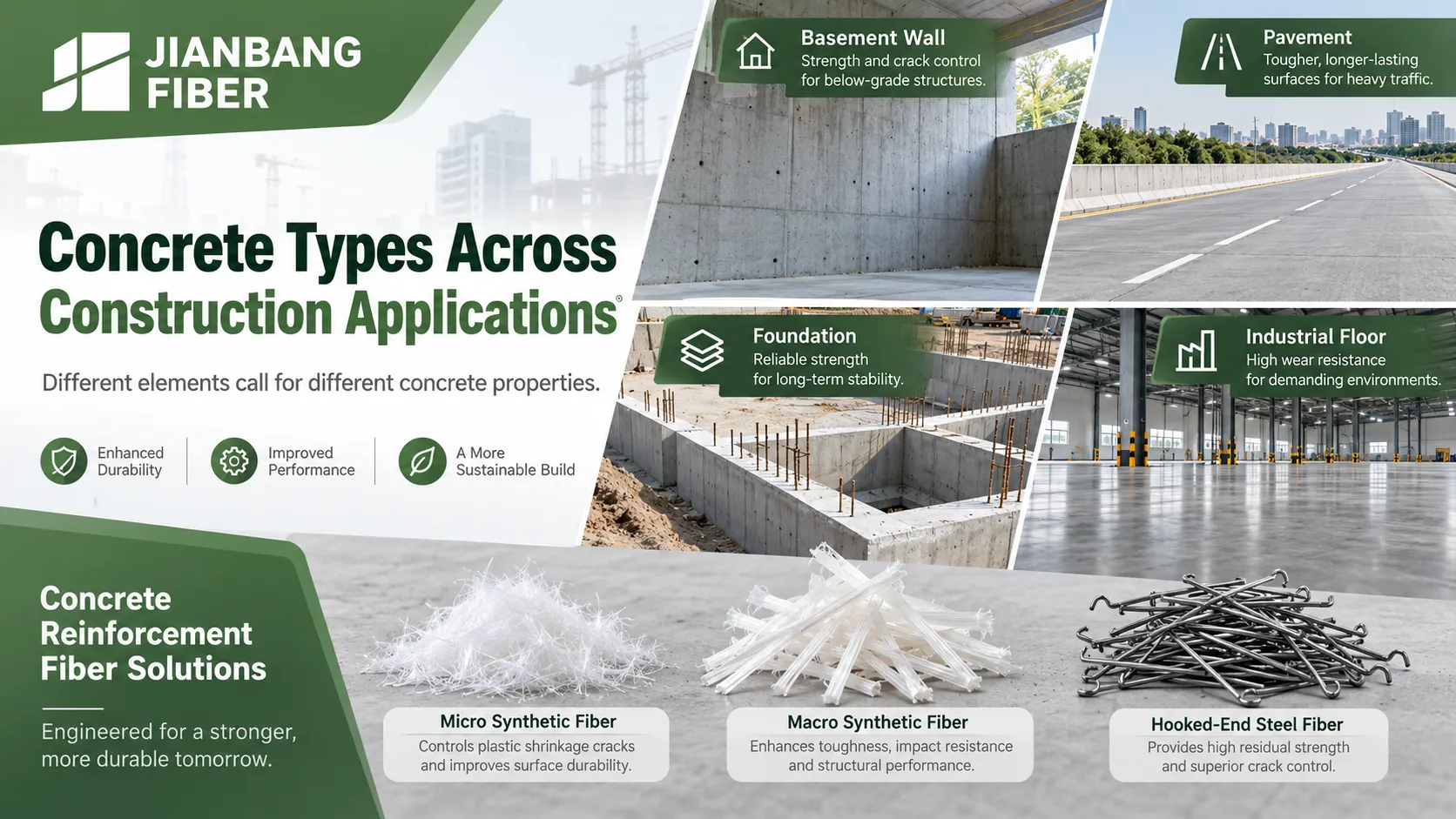
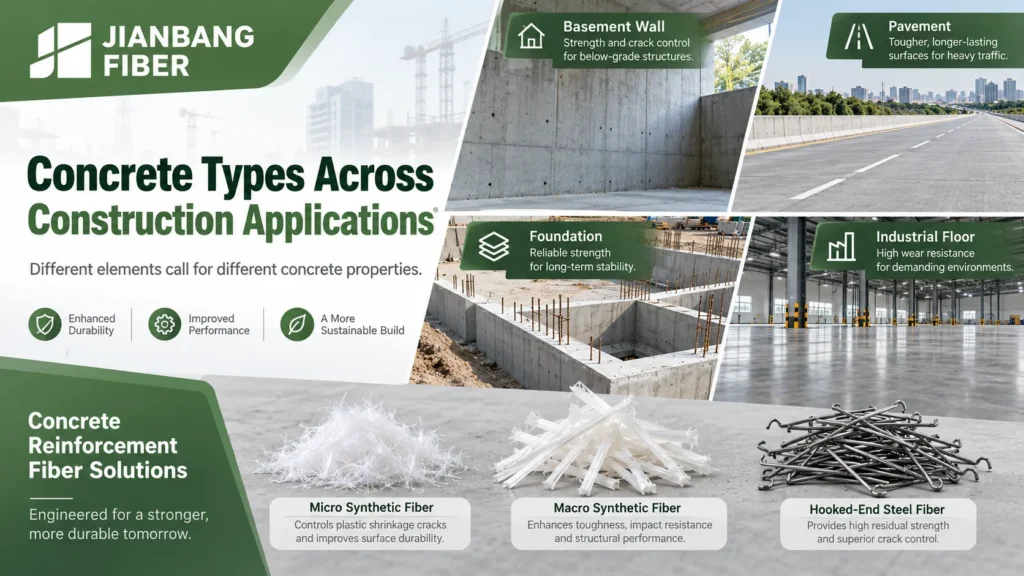
Choosing concrete starts with the job it must do. A basement wall needs a reliable barrier against water. An exposed pavement needs to withstand its climate and traffic. A thick foundation needs a plan for heat and restraint. A floor may need fibers to control early cracks or provide specified capacity after cracking. Each requirement changes the mix, construction process, or acceptance plan.
At Shandong Jianbang Chemical Fiber Co., Ltd., we supply Ecocretefiber™ concrete reinforcement fibers and help customers compare fiber options for their application. Good fiber selection begins with the concrete system. This guide explains nine common types of concrete, how their names overlap, and where reinforcement fibers can contribute to a tested solution.
Understand what each concrete name describes
These categories answer different questions. High-strength concrete describes a mechanical property. Low-permeability concrete describes resistance to fluid movement through the material. Pumpable concrete describes behavior during transport through a line. Ready-mixed concrete describes manufacture and delivery. Fiber-reinforced concrete describes a reinforcement system. A project can need all five at once.
For example, a ready-mix plant might supply a pumpable, fiber-reinforced mixture for a basement slab with specified strength and water-resistance requirements. Each property needs its own verification. The delivery ticket alone cannot establish pumpability, and a compressive-strength result cannot establish water tightness or residual flexural strength.
| Concrete category | Main selection question | Main control |
| Low-permeability concrete | How will the structure resist water ingress? | Matrix quality, crack control, joints, and curing |
| Freeze-thaw-resistant concrete | Will saturated concrete face repeated freezing? | Exposure design, air system, aggregate, and testing |
| High-strength concrete | What compressive strength does the design require? | Mixture consistency and specified strength tests |
| Pumpable concrete | Can the mix pass through the planned pipeline? | Cohesion, grading, flow retention, and pump trial |
| Mass concrete | Can hydration heat cause damaging temperatures or stresses? | Thermal analysis, monitoring, and curing plan |
| Fiber-reinforced concrete | What crack behavior or residual capacity is required? | Fiber selection, distribution, and performance tests |
| High-performance concrete | Which combination of properties must be achieved? | Explicit performance criteria and quality control |
| Lightweight aggregate concrete | What density and structural properties are needed? | Aggregate moisture, density, strength, and stiffness |
| Ready-mixed concrete | How will concrete be produced and delivered? | Order requirements, batching records, and site coordination |
Low-permeability concrete for water-exposed structures
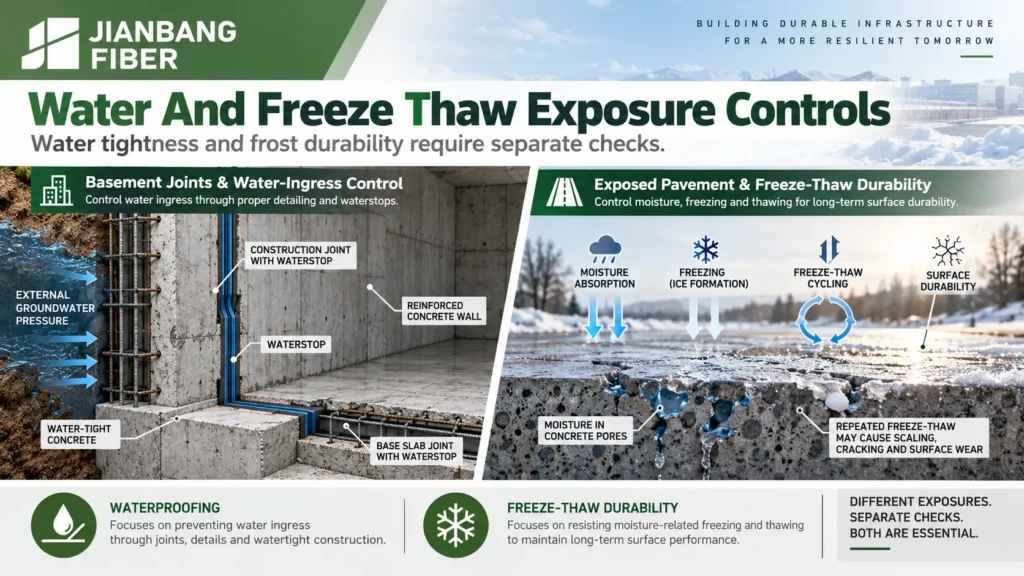
Low-permeability concrete is used in basements, tanks, retaining structures, and other elements exposed to water. It limits connected paths through the cement paste and defects through which water can move. Its performance depends on the water-to-cementitious-material ratio, suitable binder and aggregate, consolidation, curing, and crack behavior. An admixture alone cannot establish the water tightness of a structure.
ACI guidance on permeability identifies mixture proportions and construction conditions as interacting factors. Well-graded aggregate, clean materials, compatible admixtures, and a stable mixture help create dense concrete. Poor consolidation can leave a leakage path even when laboratory specimens meet the required test value.
Define the water-pressure or permeability test, acceptance age, and applicable local grade in the specification. A Chinese P grade should be interpreted through its governing test method; it should not be presented as interchangeable with another country’s chloride, absorption, or water-penetration test. The structure also needs designed joints, waterstops where required, controlled crack widths, and any specified waterproofing system.
Fibers may support a crack-control strategy. They do not replace joint detailing or a waterproofing design. For a customer requesting fibers for a basement slab, we first need to know whether the concern is plastic shrinkage, hardened crack opening, or a structural residual-strength requirement.
Freeze-thaw-resistant concrete for cold exposure
Concrete that repeatedly freezes while sufficiently wet can suffer internal damage and surface distress. Freeze-thaw durability therefore depends on exposure and saturation, the aggregate, a suitable air-void system where required, and maturity developed through curing. Deicing chemicals can introduce additional deterioration mechanisms that require an exposure-specific design.
A laboratory freeze-thaw grade or cycle count is meaningful only with its named method, conditioning, and acceptance criteria. Slow-freezing and rapid-freezing procedures do not produce interchangeable classifications. Do not turn a laboratory cycle count into a promised number of winters in service. The specification should identify the adopted test and limits rather than reproduce a historical grade table.
Check fresh air content at the point required by the contract, and account for any changes caused by pumping or handling. Plan curing, drainage, and protection from premature freezing. Cold-weather concreting concerns the conditions during construction; freeze-thaw resistance concerns repeated exposure in service. A project may need both plans.
Fibers can help selected crack-control or toughness objectives, but they do not create the air system required for frost durability. Choose the fiber and the durability mixture together, then verify their compatibility.
High-strength concrete for demanding structural designs
High-strength concrete, or HSC, is selected when the structural design calls for elevated compressive strength. It can be useful in columns, heavily loaded elements, and other applications where the engineer needs a defined material strength. The numerical boundary for the name varies with the classification system. A cube-strength class and a specified cylinder strength should not be treated as the same number.
HSC commonly relies on a low water-to-binder ratio, effective water reduction, suitable aggregate, and controlled production. Trial mixes must establish placing behavior and strength development with the actual materials. Extra cement is not a complete mix-design method. High binder content can raise heat generation, and low water content can make workability and curing more demanding.
Higher compressive strength also does not establish ductility or adequate behavior after a crack forms. The engineer must address tensile response, reinforcement, restraint, and other design properties separately. A steel fiber or macro synthetic fiber may be useful for a particular residual-performance target, but its contribution needs composite test data.
Pumpable concrete for reliable placement through pipelines
Pumpable concrete must stay cohesive while moving through the planned line. Aggregate grading, mortar volume, workability retention, bends, line diameter, delivery rate, and equipment all affect the result. A high slump by itself does not prove pumpability; a fluid but segregating mix may still block a pipe or produce inconsistent concrete at discharge.
Coordinate the batching plant, truck schedule, pump operator, and placing crew. The trial should represent the line length, bends, elevation, fiber grade, and discharge method. Check the properties at the sampling location required by the specification. Avoid unapproved water additions that change the qualified mixture.
Fibers add another variable. Long fibers, rapid feeding, or inadequate mixing can produce balls, while a change in fiber content can change fresh behavior. Our synthetic PP macrofiber and hooked-end steel fiber should be assessed in the intended mix and pump arrangement. Successful pumping of an unreinforced control does not qualify a revised fiber mix.
Mass concrete for placements governed by heat
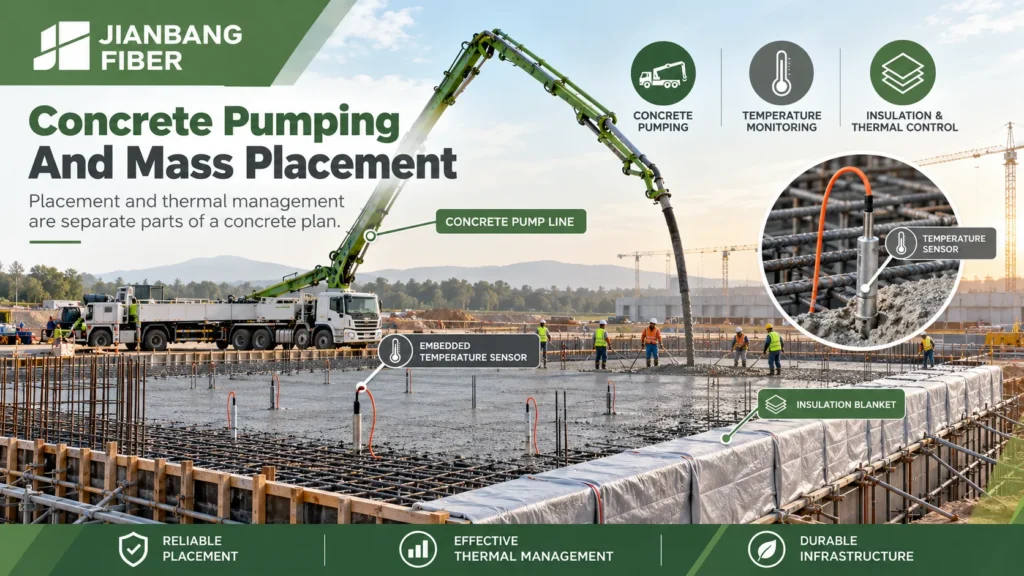
Mass concrete requires special attention when heat generated during hydration can cause damaging temperatures, thermal stresses, or cracking. Large dimensions often make heat dissipation difficult, but size is not the only factor. Mixture heat generation, boundary conditions, restraint, placement temperature, and weather also matter.
ACI’s explanation of mass concrete uses thermal behavior rather than one fixed dimensional threshold. A one-meter rule from a local specification may be relevant to a particular contract, but it should not be used as a universal definition. Smaller members with a high heat-generating mixture can also need a thermal assessment.
The thermal plan may involve binder selection, supplementary cementitious materials, controlled placement temperature, staged construction, insulation, cooling where designed, and temperature monitoring. Specify the applicable temperature limits and procedures for removing protection. Cooling the outside too quickly can increase thermal gradients.
Fibers may be part of a designed crack-control system, but they do not remove hydration heat or eliminate restraint. Keep thermal analysis and reinforcement design in the project plan even when a fiber is included.
Fiber-reinforced concrete for specific crack-control goals
Fiber-reinforced concrete contains fibers distributed through a cement-based mixture. Different materials, sizes, shapes, and amounts serve different purposes. The useful purchasing question is what the finished concrete must demonstrate.
Microfibers for early crack control
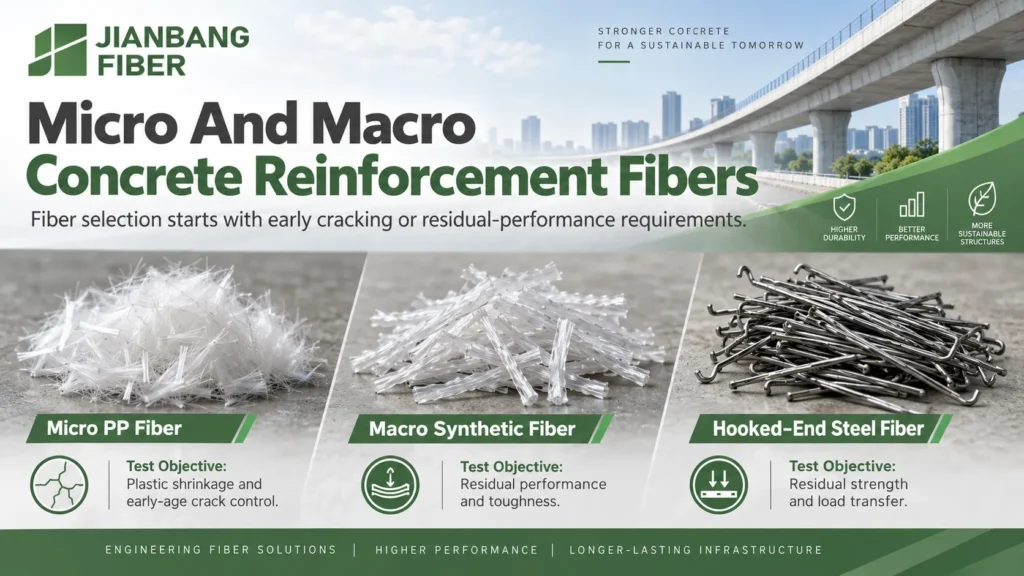
Polypropylene monofilament fibers are often considered for reducing plastic shrinkage and settlement cracking. They form a distributed support system while the concrete is young. They still require prompt curing and protection against rapid moisture loss.
NRMCA CIP 24 explains the distinction between synthetic fiber roles in fresh and hardened concrete. Microfibers used at an early-crack-control dosage should not be assumed to provide the residual strength required for a structural or reinforcement-substitution application.
Macrofibers and steel fibers for behavior after cracking
Macro synthetic and steel fibers can provide toughness and residual load capacity when properly selected and distributed. Geometry, anchorage, bond, amount, and the base concrete affect performance. Compare the load carried at specified crack openings or deflections using the method required by the designer. Individual fiber tensile strength does not establish that result.
Any reduction of conventional reinforcement must follow an approved design and the applicable code. A floor on ground, suspended slab, column, and tunnel lining have different design requirements. The word “fiber” does not provide general permission to remove bars or mesh.
Specialty fibers for cement-based products
AR glass, basalt, PVA, carbon, and other fibers may suit specialty mortar, thin sections, repair materials, or functional composites. Their surfaces and long-term compatibility with alkaline cement require evaluation. Ordinary glass fiber should not be treated as interchangeable with an alkali-resistant grade. Our fiber-reinforced concrete guide provides a starting point for comparing material families.
High-performance concrete for a defined set of requirements
High-performance concrete, or HPC, addresses a specified combination of properties. Depending on the project, these may include durability, strength, workability, volume stability, early strength, or consistency in difficult placement conditions. ACI’s definition of HPC emphasizes the combination of performance and uniformity requirements.
An HPC order should name those requirements. A marine element may need resistance to chloride ingress and controlled cracking. A precast product may need a defined release strength and dimensional stability. A heavily reinforced element may need verified filling ability. One high compressive-strength result does not prove all of these properties.
HSC and HPC can overlap. Their names do not make them interchangeable. HPC is also not automatically ultra-high-performance concrete, which has its own material behavior and project qualification requirements. Keep the specification tied to tests, limits, and the element’s service conditions.
Lightweight aggregate concrete for reducing structural weight
Lightweight aggregate concrete uses suitable low-density aggregate to reduce the weight of the hardened material. Expanded shale, clay, and slate are examples of structural lightweight aggregates. This category should be distinguished from foamed or aerated concrete, which achieves low density through a different material structure and may have a different use.
For structural work, specify both density and strength. State whether the density is fresh, oven-dry, air-dry, or equilibrium density. These values describe different conditions and should not be exchanged during purchasing. NRMCA CIP 36 explains structural lightweight concrete and the importance of aggregate preparation.
Porous aggregate can absorb water and affect workability. Manage its moisture and any required prewetting so that batching and pumping remain consistent. Confirm stiffness, deflection, creep, shrinkage, and the relevant structural design factors. Reduced weight alone does not prove improved seismic or fire performance for the complete building.
Adding fibers creates another trial condition. Verify distribution, fresh density, consolidation, and the required hardened properties. Do not transfer a normalweight-concrete dosage directly into a lightweight formulation without checking the result.
Ready-mixed concrete for controlled production and delivery
Ready-mixed concrete is manufactured and delivered fresh for use at the project. The supply category does not guarantee one strength, exposure class, or placing method. Ready-mix can be high strength, lightweight, fiber reinforced, or designed for low permeability. It may be placed by pump, bucket, chute, or another approved method.
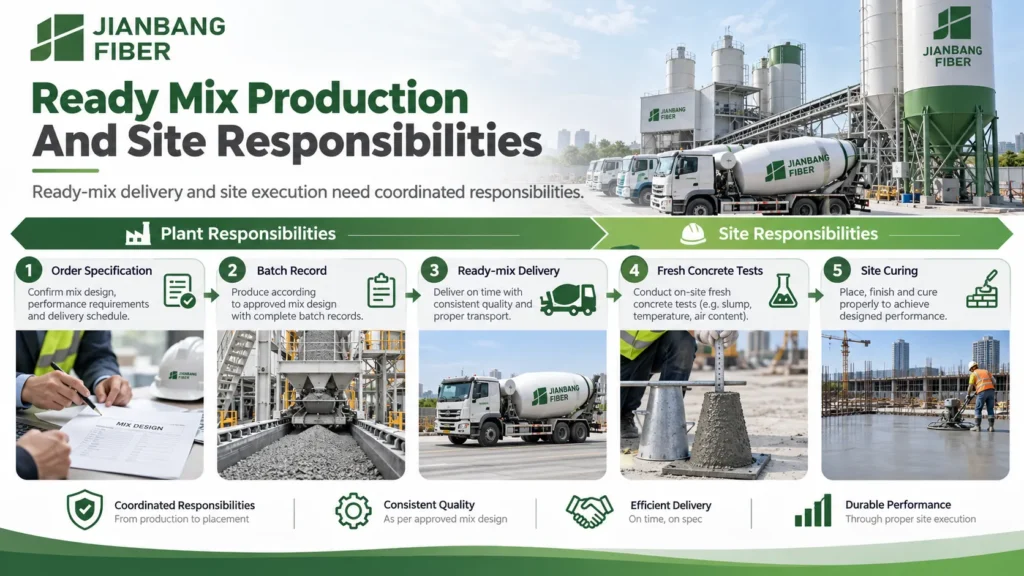
ASTM C94/C94M covers ready-mixed concrete manufacture and delivery and makes the purchaser’s specified requirements important to the order. Its scope does not cover placement, consolidation, curing, or protection after delivery. Those site activities need their own responsibilities and inspection plan.
State the strength and age, exposure requirements, workability, maximum aggregate size, air requirements, delivery arrangement, and fiber details in the order. Confirm who adds the fibers, how addition is recorded, and who checks distribution. Coordinate sampling, site adjustments, discharge, curing, and handling of nonconforming loads before the first truck arrives.
Turn concrete selection into a project specification
Start with the element and its exposure. Then list the required structural properties, placement conditions, thermal issues, density, and crack-control target. Some requirements may compete: a fiber amount that improves a beam test may make pumping harder, and a mixture chosen for rapid strength may complicate temperature control.
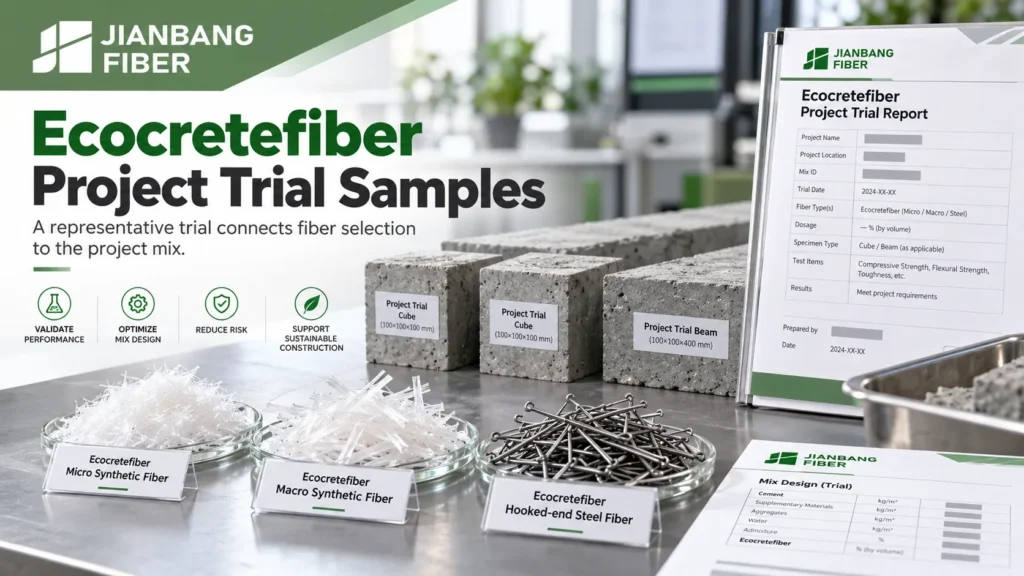
Run a representative trial that combines the proposed materials and construction method. Record the fresh tests, mixing sequence, delivery time, specimen preparation, curing, and hardened results. Agree on acceptance rules and corrective actions before production. Evaluate changes to aggregate, binder, admixture, fiber, or equipment against the approved mixture.
For Ecocretefiber™ inquiries, send us the application, base mixture, strength requirement, aggregate size, section thickness, equipment, placement method, and desired fiber function. We can help narrow the fiber choice and prepare the grade information needed for a project trial.
Frequently asked questions
Can one mix belong to several concrete categories?
Yes. A ready-mixed concrete can also be pumpable, high strength, low permeability, and fiber reinforced. The specification must define and verify each required property.
Does high-strength concrete always have high durability?
No single strength result establishes durability for every exposure. The project must address water movement, freezing, chemicals, cracking, curing, and detailing as applicable.
Do fibers make concrete waterproof or frost resistant?
Fibers can contribute to selected crack-control goals. Water tightness and freeze-thaw resistance require the appropriate matrix, joints, air system where needed, exposure design, and tests.
Is ready-mixed concrete always suitable for pumping?
No. The supplied mixture must be designed and verified for the proposed pump and pipeline. Fiber addition or a change in aggregate can require a further trial.
Which fiber should I choose for my project?
Define the required function first. Micro PP is commonly considered for early cracking, while macro synthetic and steel fibers may be selected for specified behavior after cracking. Confirm the exact grade and amount with tests in the project mixture.
Discuss your concrete requirements with Jianbang
Concrete selection works best when performance, delivery, and construction are specified together. Shandong Jianbang Chemical Fiber Co., Ltd. supplies Ecocretefiber™ reinforcement fibers for customers evaluating crack control and toughness in concrete and mortar. Contact our team with your application and test requirements to discuss fiber options and arrange a suitable trial sample.