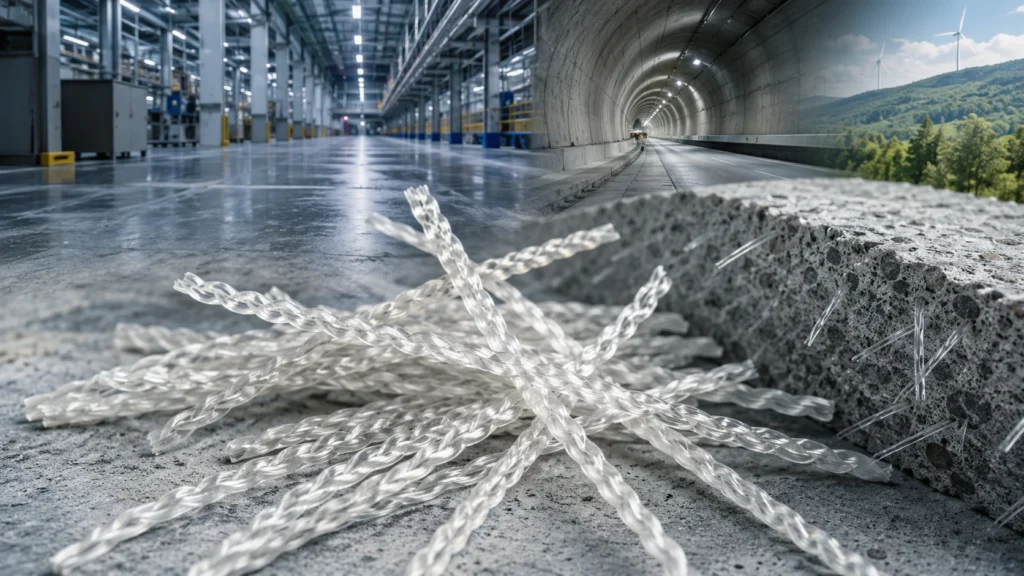
The construction industry is moving away from traditional steel mesh reinforcement toward fiber-based solutions. Among the options available, macro synthetic fiber has become one of the fastest-growing product categories in concrete reinforcement. For distributors and dealers, this shift creates a real business opportunity. Projects that once relied on welded wire mesh or steel fiber are now specifying this fiber for slabs, shotcrete, and precast elements.
This guide covers what distributors need to know to evaluate, source, and sell macro synthetic fiber for concrete. It focuses on the practical side. You will learn which applications drive demand, what certifications your market requires, how to compare products from different manufacturers, and how to position this product alongside your existing concrete reinforcement line.
What makes macro synthetic fiber a distinct category
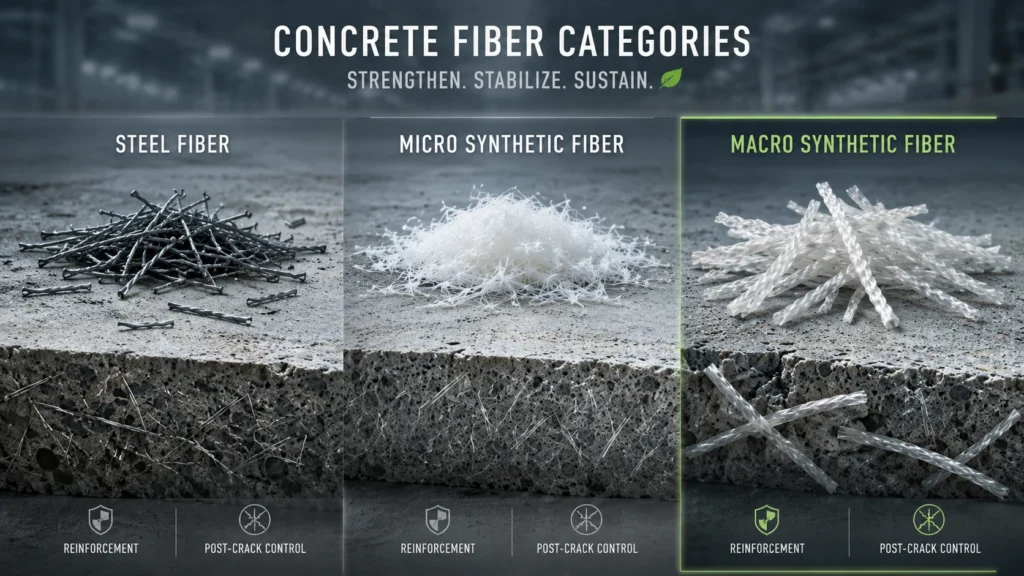
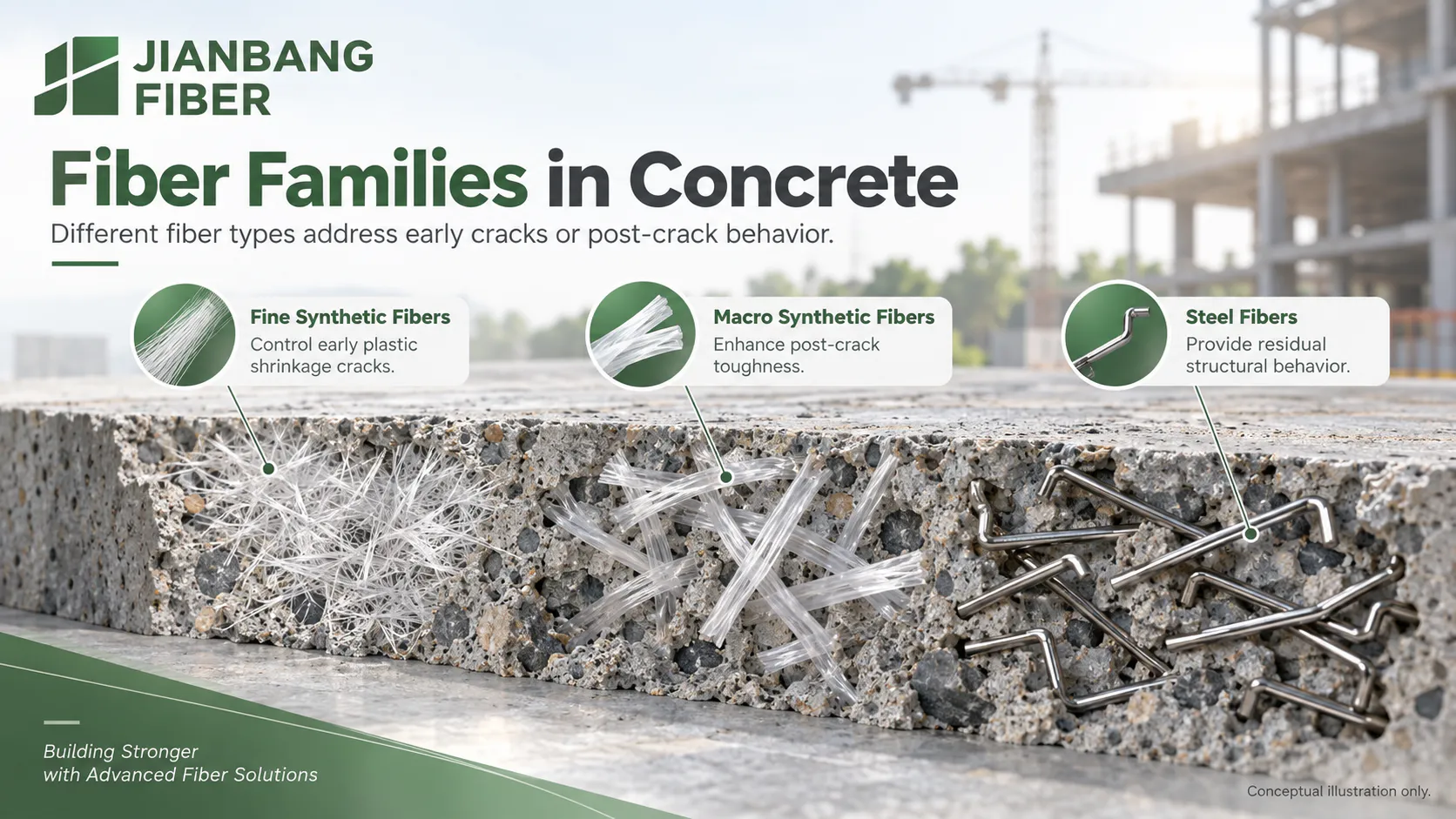
Concrete fiber reinforcement falls into three main groups: steel fiber, micro synthetic fiber, and macro synthetic fiber. Each works differently inside concrete, and each serves a different purpose.
Macro synthetic fiber is defined by diameter. Any synthetic fiber with a diameter of 0.3 mm or larger qualifies as “macro” under both EN 14889-2 and ASTM D7508. Fibers below that threshold are classified as micro synthetic fiber.
Most macro fiber on the market is made from polypropylene, though some products use polyolefin or polyethylene blends. The material choice matters less than the geometry and the mechanical properties. What matters for concrete performance is that the fiber is thick enough and long enough to bridge cracks after they form.
Micro synthetic fiber controls plastic shrinkage cracking in fresh concrete. It prevents surface cracks during the first few hours after placement. Macro fiber does something different. It provides post-crack reinforcement, meaning it holds concrete together after cracks have already formed. This is why engineers specify it as a structural component, not just a plastic shrinkage control additive.
Steel fiber also provides post-crack reinforcement, but through a different mechanism. Steel has higher tensile strength and stiffness. Macro synthetic fiber compensates with a much higher fiber count per kilogram, which distributes reinforcement more evenly through the concrete matrix. For a more detailed explanation of how this fiber works inside concrete, see our article on what macro synthetic fiber is and how it functions.
Applications that drive macro synthetic fiber sales
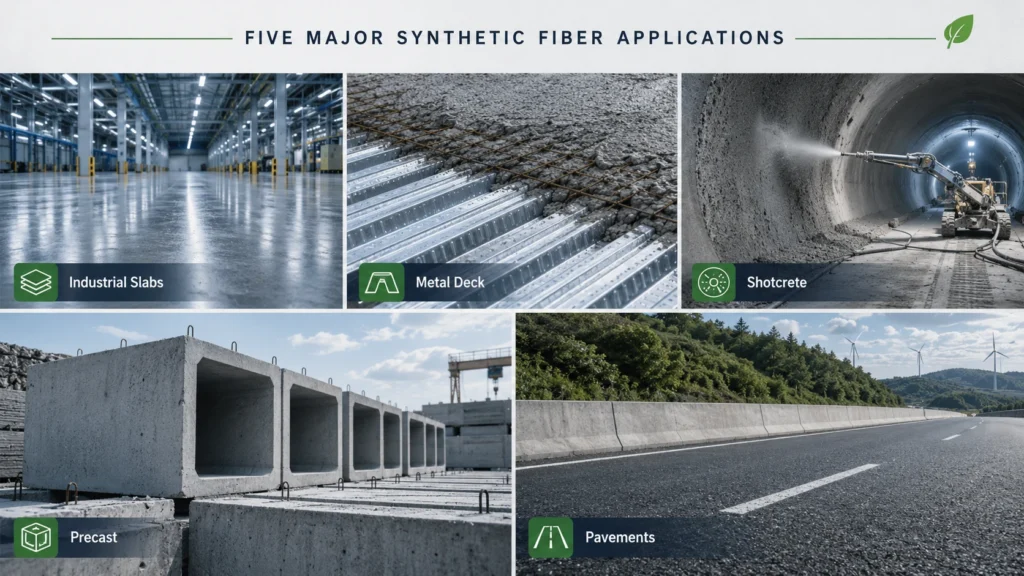
Understanding which applications use this fiber helps distributors target the right customers and stock the right products. The five macro synthetic fiber applications below account for the majority of global demand.
Industrial and warehouse floor slabs
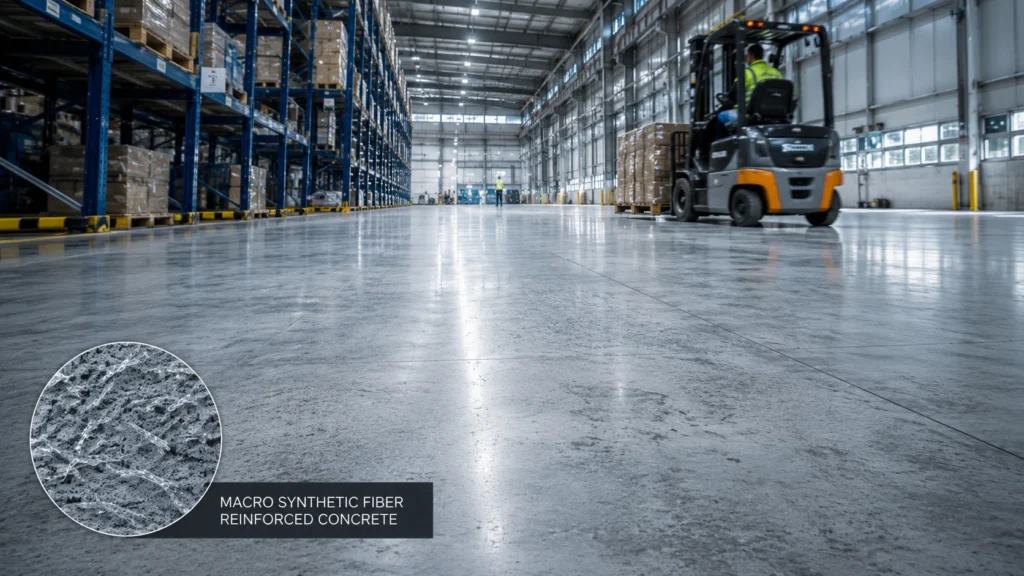
Industrial flooring is the largest application segment for this fiber worldwide. Warehouse floors, distribution centers, and manufacturing facilities need slabs that can withstand heavy forklift traffic, point loads from racking systems, and repeated stress cycles.
Macro synthetic fiber replaces welded wire mesh in slab-on-grade construction. Contractors prefer it because there is no mesh to place, tie, and lift. The fiber goes directly into the concrete mix, which saves labor time and reduces the risk of mesh placement errors.
For distributors, industrial flooring contractors are the most accessible customer segment. They buy in consistent volumes, and the specification process is well established. Most projects reference ASTM C1116 or EN 14889-2 with a target residual strength value.
Composite metal deck slabs
Composite metal deck construction is common in North America and parts of Europe. The concrete is poured onto corrugated steel decking, and the deck acts as both formwork and tensile reinforcement.
The Steel Deck Institute (SDI) ANSI standard specifies that fiber-reinforced concrete used in composite deck slabs must contain a minimum of 2.4 kg/m³ of macro synthetic fiber. This gives distributors a clear specification to quote against. When a project uses composite metal deck, the fiber dosage is already determined by the standard.
Distributors serving commercial construction markets should stock products specifically rated for composite deck applications. The product data sheet must reference ASTM C1116 Type III compliance and state the recommended macro synthetic fiber dosage for SDI-compliant decks.
Shotcrete and tunnel linings
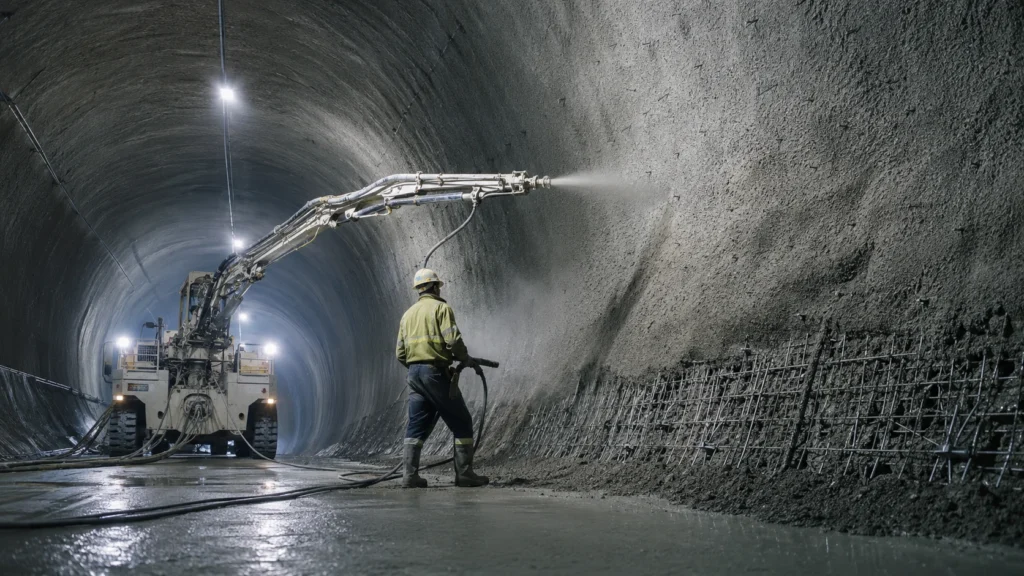
Shotcrete applications represent a high-value segment for this fiber. In mining and tunneling, shotcrete is sprayed onto rock surfaces to provide immediate support. Macro synthetic fiber is preferred over steel fiber in many of these applications for a practical reason: steel fibers can protrude from the shotcrete surface and create safety hazards for workers.
The Middle East has significant tunneling and infrastructure projects underway, and many of these projects specify this fiber for shotcrete. Distributors in that region should focus on products with EN 14889-2 Class II certification, which covers structural use.
Shotcrete contractors typically buy in bulk and need reliable supply chains. This makes them strong repeat customers for distributors who can guarantee stock availability and fast delivery.
Precast concrete elements
Precast concrete is a smaller segment for this fiber, but it offers higher margins. Precast manufacturers produce elements like panels, beams, and pipes in factory conditions. Fiber reinforcement helps reduce handling damage during transport and installation.
Precast manufacturers also value fiber reinforcement because it eliminates the need to place and tie reinforcement mesh inside tight molds. This speeds up production and reduces labor costs.
For distributors, precast customers often need technical support. They want to see test data, mixing procedures, and finishing recommendations specific to their production setup. Distributors who can provide this support win repeat business. For specific guidance on how polypropylene fiber works in precast applications, see our article on PP fiber reinforced concrete.
Pavements and hardstandings
Airport hardstandings, container yards, parking areas, and industrial pavements use this fiber as an alternative to steel fiber. In these applications, the fiber provides crack control and improves load-bearing capacity over subgrade soils.
Macro synthetic fiber competes directly with steel fiber in this segment. The choice often comes down to project specifications and contractor preference. Distributors who carry both products can offer customers a side-by-side comparison based on the specific project requirements.
Pavement projects tend to use higher fiber dosages (4–9 kg/m³), which means larger order volumes per project. For data on how polypropylene fiber performs in concrete under load, see our article on the effect of polypropylene fiber in concrete.
Specification and certification you need to understand
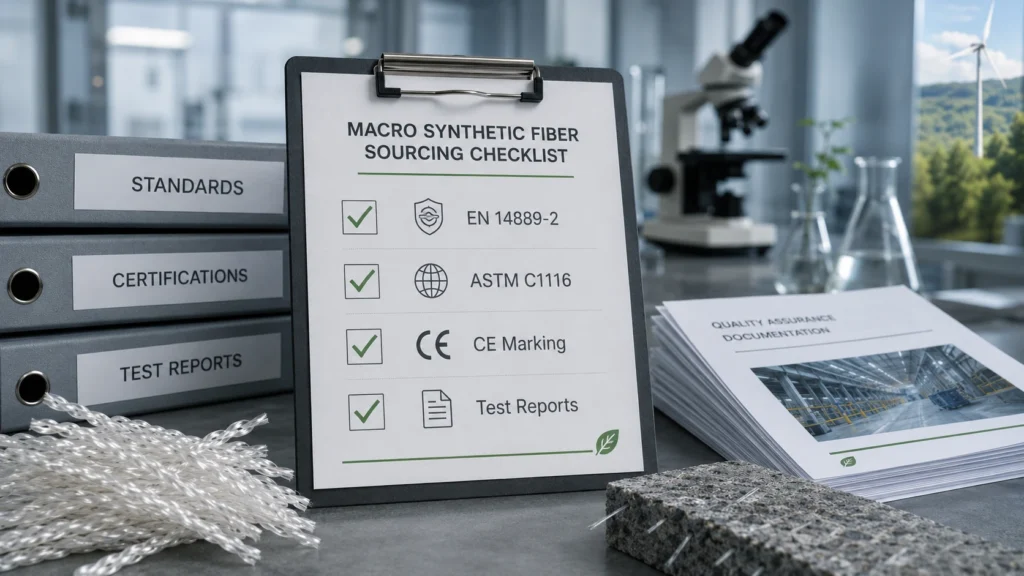
Certification requirements vary by region. Selling non-compliant product into a regulated market can result in project rejection, liability claims, and damaged relationships with customers. Distributors must understand which standards apply to their target markets and verify compliance before they buy from any macro synthetic fiber manufacturer.
EN 14889-2: the standard for EU, UK, and Middle East markets
EN 14889-2 is the European standard that covers polymer fibers for concrete. It divides synthetic fibers into two classes:
- Class I: Non-structural use. These fibers control plastic shrinkage cracking only. They do not provide post-crack reinforcement.
- Class II: Structural use. These fibers provide post-crack reinforcement and can be used as part of the structural design.
Macro synthetic fiber for concrete reinforcement must carry Class II certification. Class I products are micro synthetic fibers and cannot replace steel reinforcement in structural applications.
Under the Construction Products Regulation (CPR), this fiber sold in the European Economic Area must carry a CE mark. The CE marking process involves two certification systems:
- System 1: The most rigorous. A notified body conducts factory production control audits and issues the certificate of conformity. Required for structural applications.
- System 3: Less rigorous. A notified body performs initial type testing, but ongoing factory audits are not required.
Distributors selling into EU, UK, or Middle East markets should request System 1 certification from their suppliers. Many Middle East projects reference EN 14889-2 because Gulf state construction standards align with European norms.
ASTM C1116 Type III: the standard for North American markets
ASTM C1116 is the American standard for fiber-reinforced concrete. It defines three fiber types:
- Type I: Steel fiber
- Type II: Glass fiber
- Type III: Synthetic fiber
Macro synthetic fiber products must comply with ASTM C1116 Type III. Specifiers in North America reference this macro synthetic fiber specification in project documents, along with a target residual strength value tested according to ASTM C1609.
ASTM C1609 measures the flexural performance of fiber-reinforced concrete. It reports residual strength at specific deflection points, which engineers use to design slab thicknesses and fiber dosages. Distributors should ensure that their suppliers provide test data from ASTM C1609 or an equivalent test method.
What distributors must verify on product documentation
Before sourcing from any manufacturer, distributors should verify the following:
- Independent test reports. Manufacturer-generated test data is not sufficient. Look for reports from accredited third-party laboratories.
- Tensile strength and modulus of elasticity values. These properties determine how the fiber performs under load. Compare them against the minimum values stated in EN 14889-2 or ASTM D7508.
- Fiber geometry data. Length, diameter, and aspect ratio must match what the manufacturer claims. Fibers that are shorter or thinner than specified will not deliver the expected performance.
- Batch consistency documentation. Reliable manufacturers track their production consistency and can provide data showing that mechanical properties are stable from batch to batch.
- Third-party certification logos. Look for CE marking, ISO 9001 certification, and any relevant national certification marks.
Macro synthetic fiber vs steel fiber: what distributors need to know
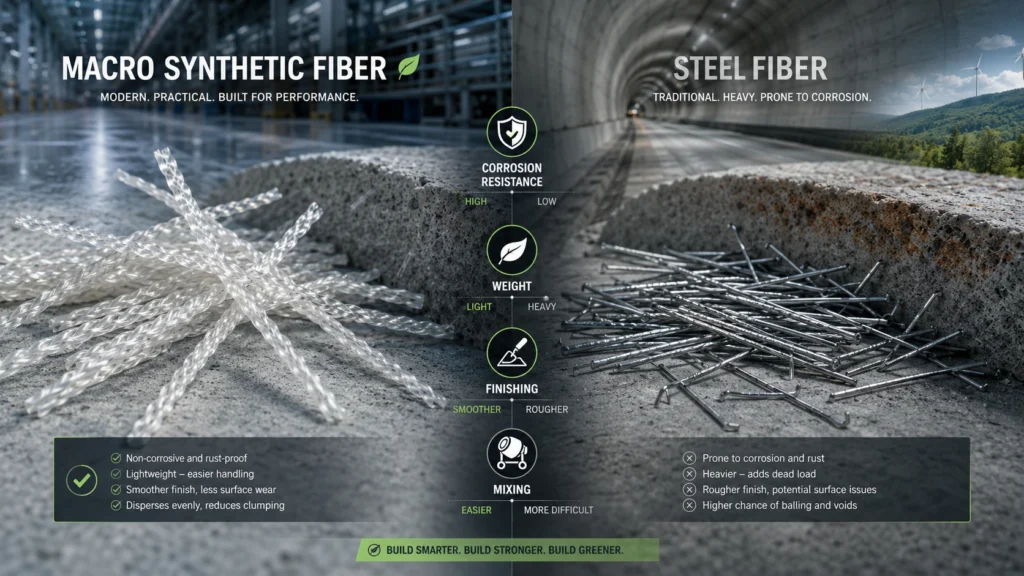
Distributors who carry concrete reinforcement products will get questions from customers about how macro synthetic fiber compares to steel fiber. Understanding the practical differences helps you advise customers and close sales.
Where this fiber has an advantage
Corrosion resistance is the most cited advantage. Steel fiber can corrode inside concrete, especially in aggressive environments like marine structures, chemical plants, or roadways exposed to de-icing salts. Macro synthetic fiber does not corrode. This makes it a better choice for projects where long-term durability in corrosive environments is a priority.
Lower weight simplifies logistics. This fiber weighs roughly one-ninth as much as steel fiber per cubic meter of concrete at equivalent dosages. This means lower shipping costs, easier warehouse storage, and less physical strain on workers who handle the product on site.
No finish interference. Steel fibers can protrude from the concrete surface, creating a rough finish that requires grinding or overlay. Macro synthetic fiber does not cause this problem. The fiber ends melt under trowel pressure and become invisible in the finished surface. This matters for projects where floor flatness specifications are strict.
Easier mixing and pumping. This fiber disperses faster than steel fiber in the mixer and does not cause the balling problems that steel fiber sometimes creates. It also has less impact on pump pressure, which matters for shotcrete and high-rise concrete pumping.
Where steel fiber still has a role
High-temperature resistance. Polypropylene melts at approximately 160°C. Steel does not. In applications where concrete may be exposed to sustained high temperatures (furnace foundations, refractory linings, fire-rated structures), steel fiber is the safer choice.
Heavy impact and blast loading. Steel fiber has higher tensile strength and modulus of elasticity. For applications involving extreme dynamic loads (military structures, blast-resistant walls, heavy industrial impact zones), steel fiber often outperforms synthetic alternatives.
Established track record. Steel fiber has been used in concrete for over 50 years. Some specifiers and engineers still prefer it because they have more confidence in the long-term performance data. This is changing as more projects accumulate service records, but the perception persists in some markets.
The switching trend
Projects that used steel fiber for decades are now specifying the synthetic alternative. The reasons are practical, not theoretical. Contractors report faster placement times. Project owners report lower maintenance costs in corrosive environments. Ready-mix producers report fewer mixing and pumping problems.
For distributors, this trend means that customers who currently buy steel fiber are potential converts. The key is to position macro synthetic fiber vs steel fiber as a project-specific decision, not a blanket replacement in every application.
For detailed information on steel fiber types and applications, see our article on the different types of steel fiber.
How to evaluate macro synthetic fiber quality before you buy

Quality varies significantly among manufacturers. Some produce consistent, well-documented products that meet international standards. Others cut corners on raw materials, skip independent testing, or make performance claims they cannot support. Distributors who source poor-quality fiber risk project failures, customer complaints, and legal liability.
Material properties that matter
Three properties determine how macro synthetic fiber performs in concrete:
- Tensile strength. This is the maximum stress the fiber can withstand before breaking. EN 14889-2 and ASTM D7508 specify minimum tensile strength requirements. If a manufacturer cannot provide test data showing their product meets these minimums, do not buy from them.
- Modulus of elasticity. This measures fiber stiffness. A higher modulus means the fiber resists stretching under load, which translates to better crack-bridging performance. Polypropylene macro fiber typically has a modulus of 3–8 GPa. Compare this across manufacturers when evaluating products.
- Fiber geometry. Length, diameter, and surface texture all affect performance. Embossed or twisted fibers grip the concrete matrix better than smooth fibers. Longer fibers bridge wider cracks but may be harder to disperse evenly. The manufacturer should specify exact dimensions and surface treatment.
Red flags when evaluating a manufacturer
Watch for these warning signs:
- No independent test reports available. If a manufacturer only provides their own in-house data, that is a red flag.
- Cannot produce EN 14889-2 or ASTM C1116 compliance documentation. Without these, the product cannot be specified on regulated projects.
- Vague marketing claims without supporting data. Statements like “equivalent to steel fiber” or “outperforms all alternatives” mean nothing without test results.
- No batch-to-batch consistency records. Variable quality between production runs causes unpredictable concrete performance.
- Unwillingness to provide sample quantities for testing. Reliable manufacturers want you to test their product before you commit to a purchase.
What a reliable supplier provides
A manufacturer worth working with will give you:
- Full technical data sheets with references to specific test methods (ASTM C1609, EN 14651, or equivalent)
- Independent laboratory test reports from accredited facilities
- Project references and case studies showing real-world application
- Responsive technical support for dosage calculations and mix design questions
- Consistent product availability and reasonable lead times
For a detailed framework on evaluating macro PP fiber manufacturers, see our guide on how to choose a macro PP fiber manufacturer.
Regional market overview: where the demand is
Demand for this fiber varies by region. The standards, customer expectations, and competitive dynamics differ enough that distributors need to adjust their approach for each market.
North America
The North American market is ASTM-driven. Specifiers reference ASTM C1116 and ASTM C1609 in project documents. The market is growing, driven by commercial flooring and composite metal deck construction.
Sika and Euclid Chemical dominate the premium segment. They have strong brand recognition and established relationships with specifiers. Chinese manufacturers, including Ecocretefiber, compete on price and are gaining market share, particularly among distributors who serve the mid-market.
Distributors entering the North American market should focus on products with full ASTM compliance documentation and competitive pricing relative to Sika and Euclid Chemical products. Technical support in English is essential.
Europe and UK
EN 14889-2 governs the European market. CE marking is mandatory for structural applications (Class II). The UK follows the same standard post-Brexit, though some specifiers reference both EN and BS standards.
Environmental regulations in Europe favor synthetic fiber over steel fiber. The carbon footprint of polypropylene fiber production is lower than steel fiber production, and some project specifications now include embodied carbon requirements.
BarChip, Sika, and several European brands lead the market. Chinese imports compete primarily on price. Distributors should ensure that any product they source carries CE marking with System 1 certification, as this is what most specifiers require.
Middle East
The Middle East is one of the fastest-growing markets for this product. Massive infrastructure investment in the Gulf states has created strong demand for concrete reinforcement products. Tunneling, shotcrete, and industrial flooring projects all specify macro synthetic fiber.
EN 14889-2 is the dominant standard, reflecting the influence of European engineering consultants who design many of the region’s major projects. CE marking is widely expected, and projects often require System 1 certification.
Certification sensitivity is high in this market. Distributors who cannot provide complete certification documentation will struggle to win project approvals. At the same time, the volume opportunity is significant for distributors who get it right.
Southeast Asia
Southeast Asia presents a mixed standards environment. Some projects reference ASTM standards, others reference EN standards, and some use local national standards. This creates complexity for distributors, but also opportunity.
The market is price-sensitive. Construction budgets are tight, and customers compare products primarily on cost per kilogram. However, quality awareness is rising, especially among international contractors working on large infrastructure projects.
Distributors in Southeast Asia should carry products that can meet both ASTM and EN requirements. This maximizes the number of projects you can quote on. Stocking a single product that satisfies both standards simplifies inventory management.
Positioning macro synthetic fiber in your product line
Adding this product to an existing concrete reinforcement line takes more than just listing it in your catalog. Distributors who add it without a strategy will struggle to generate sales.
Target customer segments
Focus on three customer types:
- Ready-mix concrete suppliers. They add fiber at the batch plant and deliver fiber-reinforced concrete to project sites. They buy in bulk and value consistent supply and clear mixing instructions.
- Slab contractors and flooring specialists. These contractors place concrete on the ground and are the most common end users of this fiber. They need dosage guidance and finishing recommendations.
- Shotcrete and mining contractors. They use the fiber in sprayed concrete applications. They need products with proven performance in high-velocity spray equipment.
Handling common customer objections
Customers who have never used this fiber will raise objections. Here are the most common ones and how to address them:
“Is macro synthetic fiber as strong as steel fiber?” Not in absolute tensile strength, but the higher fiber count per kilogram means more reinforcement points per cubic meter. For most slab and shotcrete applications, it provides equivalent or better performance at a comparable or lower cost per cubic meter of concrete.
“Will it work in my mix design?” This fiber is compatible with standard concrete mix designs. Macro synthetic fiber dosage typically ranges from 1.8 to 9.0 kg/m³ depending on the application. The manufacturer should provide mix design guidance.
“What about finishing?” The fiber does not cause surface protrusion like steel fiber. Under normal trowel finishing, the fiber ends blend into the surface. This is one of the main reasons contractors switch from steel fiber.
Complementary products to cross-sell
Distributors who carry this product should also consider stocking these related products:
- Micro synthetic fiber for plastic shrinkage control. Many projects use both macro and micro fiber together.
- Steel fiber for applications where high modulus or high-temperature resistance is required. Carrying both products lets you serve a wider range of project specifications.
- Hybrid fiber blends that combine macro and micro synthetic fiber in a single bag. These are growing in popularity because they simplify dosing and mixing on site.
For broader guidance on building a polypropylene fiber distribution business, see our PP fiber distributor guide.
Conclusion
Macro synthetic fiber is one of the fastest-growing segments in concrete reinforcement. Demand is driven by the shift from welded wire mesh to fiber reinforcement, infrastructure investment in developing markets, and contractor preference for products that simplify the construction process. Distributors who understand the key applications, certification requirements, and quality evaluation criteria are positioned to capture market share. Start with your strongest regional market, source from manufacturers with proper certification and independent test data, and build technical support capabilities that differentiate you from competitors who simply sell on price.
Ecocretefiber supplies this fiber to distributors across North America, Europe, the Middle East, and Southeast Asia. Shandong Jianbang Chemical Fiber Co., Ltd. manufactures all products with EN 14889-2 and ASTM C1116 compliance documentation and provides dosage guidance, technical data sheets, and project support to distributor partners.