A shotcrete layer succeeds only when the material that sticks to the wall meets the project requirements. A promising batch at the mixer can still produce excessive rebound, blocked hoses, poor bond, or weak spots behind reinforcement. The mixture, equipment, nozzle operator, substrate, and curing all affect the placed layer.
At Shandong Jianbang Chemical Fiber Co., Ltd., we supply Ecocretefiber™ reinforcement fibers for concrete applications. We work with buyers who need to select a fiber grade and test it in the actual sprayed mix. This guide explains the dry-mix and wet-mix processes, the main mixture controls, the role of fibers, and a practical route from trial panel to site quality control.
What Is Shotcrete and Where Is It Used?
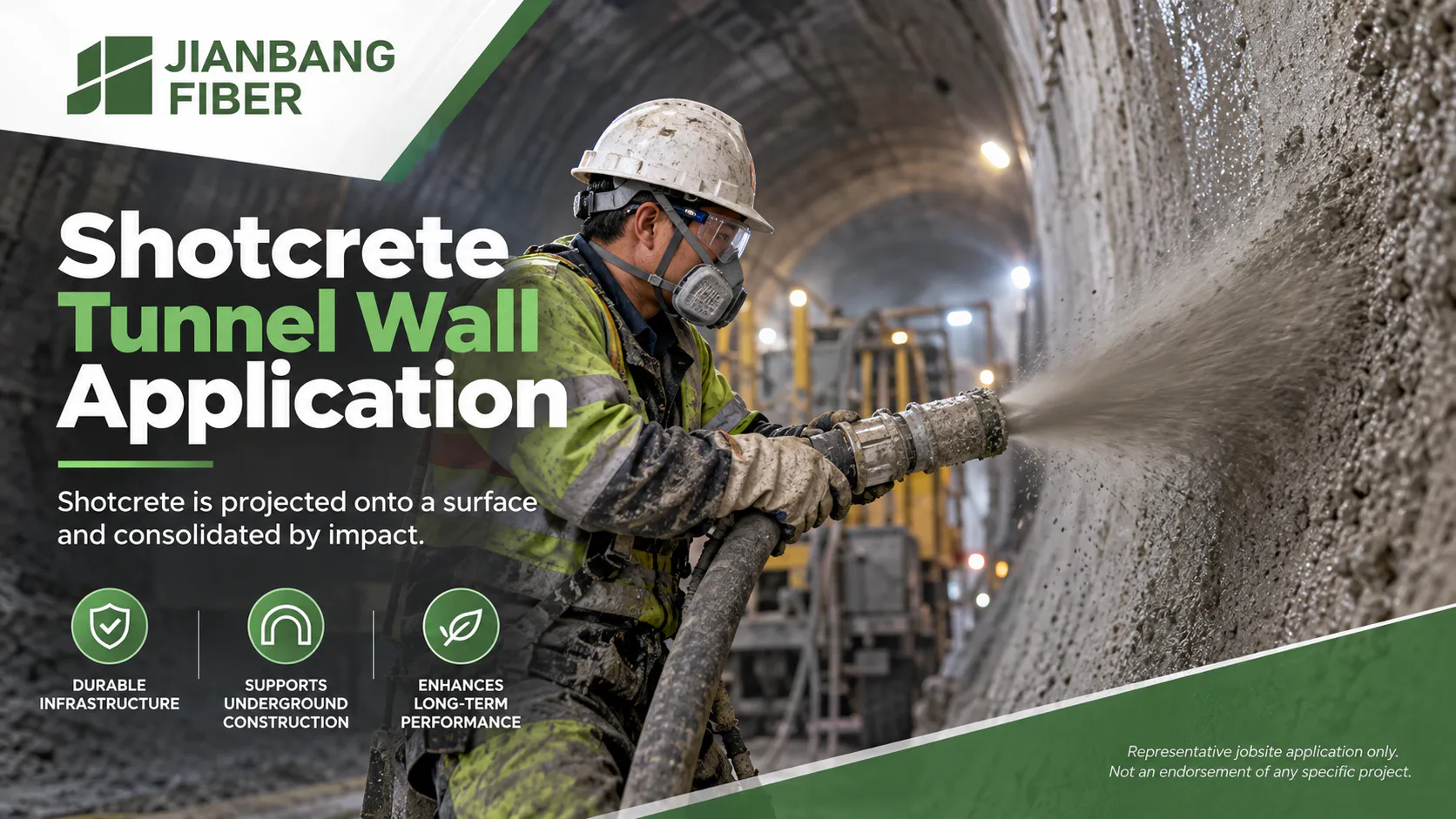
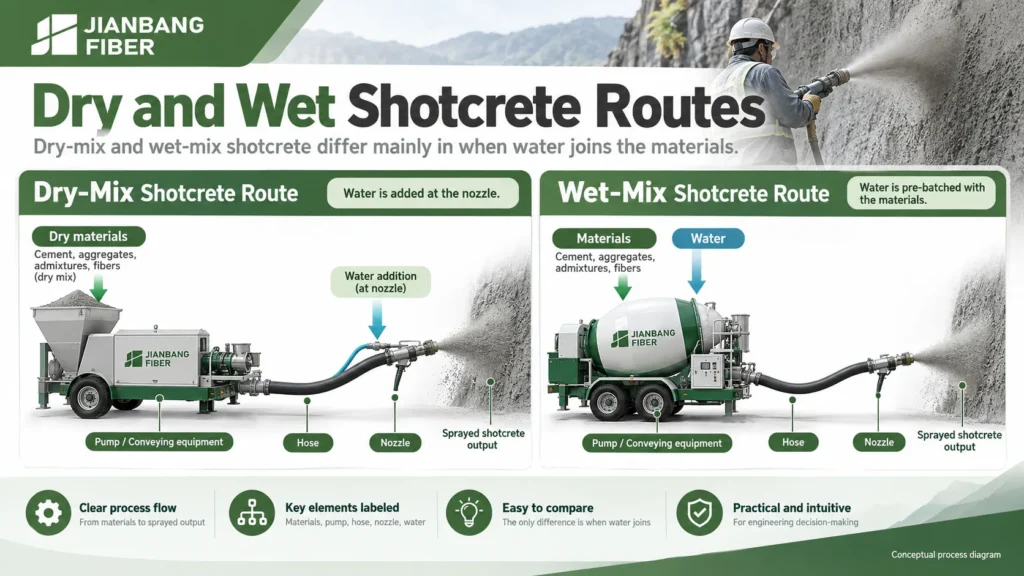
Shotcrete is concrete or mortar projected at high velocity onto a surface. Impact helps consolidate it in place. It is commonly used for tunnel and mine support, slope stabilization, excavation support, rock protection, structural repair, and surfaces with shapes that are difficult to form and cast. It can reduce the amount of formwork, especially on a vertical or overhead face. The American Concrete Institute’s explanation of shotcrete distinguishes the wet and dry processes by when water enters the mix.
The sprayed layer is not automatically stronger, watertight, or cheaper than cast concrete. Those outcomes depend on surface preparation, mixture design, placement skill, thickness, and curing. A clean, sound substrate and proper nozzle access matter as much as a high cement content. If the specification requires early ground support, bond, strength, low permeability, or post-crack capacity, each requirement needs its own acceptance method.
Dry-Mix and Wet-Mix Shotcrete
Dry-mix shotcrete conveys dry or pre-dampened cement and aggregate through a hose. Water is added at the nozzle. The nozzle operator controls the water addition and the spray. This process can be useful for intermittent work and sites where a smaller amount is placed at a time. Water control at the nozzle, dust, and rebound need close attention.
Wet-mix shotcrete combines the cement, aggregate, water, and most admixtures before pumping. Compressed air at the nozzle accelerates the stream; a set accelerator may be injected near the nozzle. The water content can be measured at batching, and the process suits continuous, higher-volume work. Pumpability, slump or flow, delivery time, and accelerator compatibility become central controls. Wet spraying often has less dust than dry spraying, but the actual result depends on equipment, ventilation, and technique.
| Decision point | Dry-mix route | Wet-mix route |
| Water addition | Primarily at the nozzle | Measured before pumping |
| Main field control | Stable feed and nozzle water adjustment | Fresh mix stability and pumpability |
| Typical operational concern | Dust and rebound | Hose blockage, slump change, and dosing at the nozzle |
| Qualification | Spray a panel with the intended equipment and crew | Spray a panel with the intended mix, pump, accelerator, and crew |
The choice should follow the job’s access, output, equipment, crew experience, and performance specification. ACI PRC-506-22, *Shotcrete – Guide* covers both processes, preconstruction testing, placement, curing, and acceptance. A method that looks efficient on a mix sheet still needs a successful spray trial.
Design the Mix for the Sprayed Layer
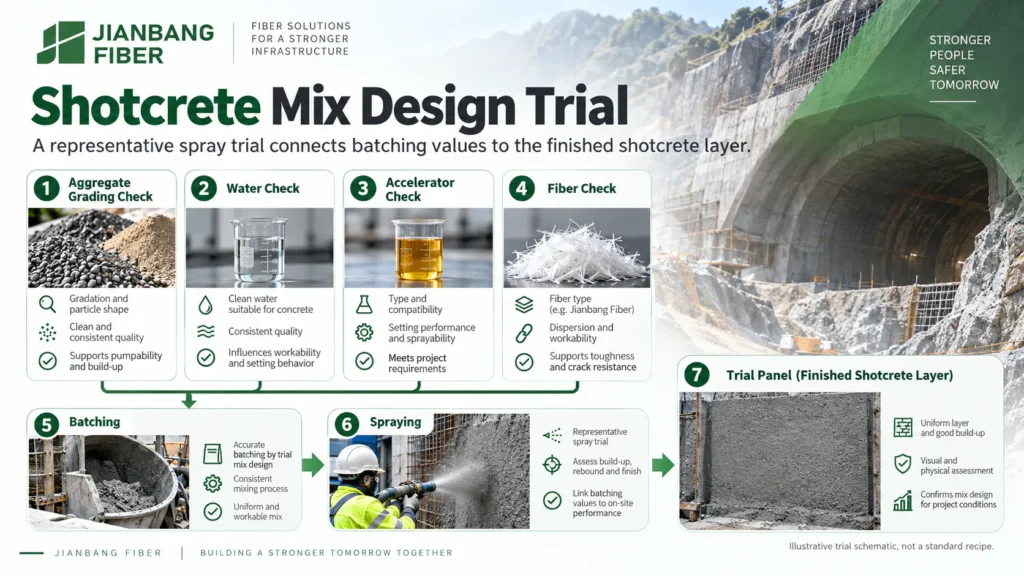
Shotcrete mixture design starts with the required in-place performance, not with a fixed cement-to-aggregate ratio. The project may specify 28-day compressive strength, an early strength milestone, bond, thickness, durability, and toughness. The designer then chooses aggregate grading, binder, water, admixtures, and any fibers so the mix can travel through the equipment and stick to the surface.
Cement, aggregate, water, and accelerator
The aggregate has to pass through the pump, hose, and nozzle and still pack into a dense layer. Its top size and grading must suit the equipment, layer thickness, reinforcement spacing, and the specification. Too much coarse aggregate can raise rebound and make tight areas difficult to fill. Too little useful coarse fraction or poor grading can increase paste and shrinkage demand. A reported mixture’s sand fraction should never be copied without checking local materials.
The water-to-cementitious-materials ratio influences strength and durability, but a mix with too little water may not pump or consolidate well. A mix with too much water may sag, rebound differently, or lose strength. Wet-mix work also needs the right slump or flow at the pump. Do not repair poor pumpability simply by adding water on site. Recheck aggregate moisture, mixing sequence, and a compatible water reducer.
An accelerator can help a fresh layer stay on a wall and develop early strength. It also changes set time and may affect later strength and durability. Select it with the cement and other admixtures, then establish the dose during a spray trial. Early set is not a substitute for the required hardened properties. The water must be clean and suitable for concrete, and curing must start under the approved procedure after placement.
A worked calculation is only a starting point
Consider an illustrative wet-mix screen with 200 kg/m³ of batch water and a proposed water-to-cement ratio of 0.45. The arithmetic gives about 444 kg/m³ of cement before changes for supplementary cementitious materials, aggregate moisture, or admixture liquids. If a trial accelerator dose is 4% of cement mass, the initial calculation is about 17.8 kg/m³. That number describes the chosen product’s mass at a defined dosing basis; it does not predict set time.
A screening program can hold the water content and sand fraction steady while it tests several ratios around the proposed value. It should record workability before the pump, nozzle pressure, accelerator delivery, rebound, build-up, early set, and later strength. Then the team adjusts one variable at a time. The accepted mix is the one that meets the specification after spraying, not the one with the neatest arithmetic.
Understand Rebound, Bond, and Layer Quality
Rebound is the material that bounces away from the surface instead of becoming part of the layer. It wastes material and can change the composition of what remains. Rebound can be affected by substrate orientation, nozzle distance and angle, air pressure, aggregate grading, water content, reinforcement congestion, and operator skill. The rebound rate from one surface or spray method cannot be promised for another. Record it in the project trial, and keep rebound debris out of the finished layer.
Bond starts with the substrate. Remove loose rock, weak concrete, dust, and contamination as the project method requires. Prepare the surface and manage moisture to the approved procedure. A dense mix will not repair an unsound interface. Where bond is a design criterion, use the specified pull-off or other relevant test and define the acceptable failure mode before work starts.
Layer quality includes adequate thickness, coverage behind reinforcement, absence of laminations or voids, and curing. Spray sequence and nozzle angle can make a major difference at bars, mesh, corners, and overhead areas. A high cube or cylinder strength from conventionally cast concrete cannot establish that the sprayed layer is sound. The crew should qualify with the same access and reinforcement conditions expected on the job.
Where Fibers Add Value in Shotcrete
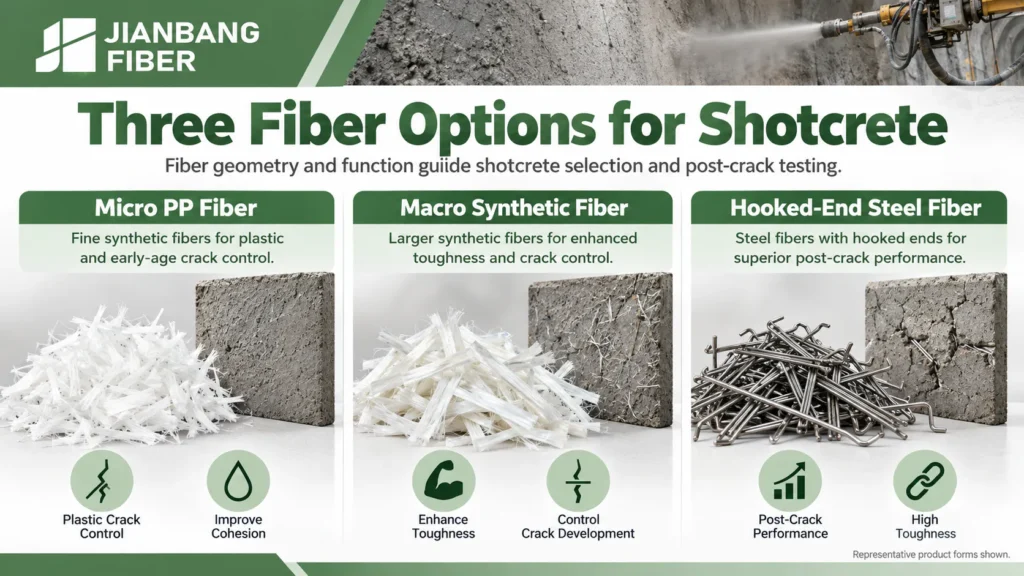
Fibers can help control cracking or provide post-crack resistance, but their function depends on fiber type, geometry, dose, dispersion, and how much remains in the sprayed layer. ACI PRC-506.1-21, *Fiber-Reinforced Shotcrete – Guide* focuses on steel and synthetic macrofibers and discusses mixture changes, placement, toughness, testing, and quality control.
Micro polypropylene fiber for early crack control
Fine polypropylene microfibers are distributed in large numbers through a mix. They can be considered for plastic shrinkage and early crack control. They are not a direct substitute for structural reinforcement or a specified post-crack toughness level. Ecocretefiber™ offers a polypropylene monofilament microfiber that buyers can assess in their cementitious mix. Confirm fiber length, dispersion, and the fresh spray behavior for the chosen grade.
Macro synthetic fiber for post-crack response
Macro synthetic fibers bridge wider cracks and can be specified for energy absorption or residual capacity when the shotcrete is tested as a composite. Our Ecocretefiber™ Synthetic PP Macrofiber page lists 30, 40, 50, and 60 mm length options and an indicative 3-6 kg/m³ range for shotcrete or higher-toughness trials. These are grade and product-page indications, not a universal dose or an as-placed performance guarantee.
The fiber must feed evenly, pass through the pump and nozzle, and remain distributed in the layer. A longer fiber or higher dose can affect workability and blockage risk. Ask the nozzle crew to inspect dispersion and measure the finished panel’s response. Polypropylene does not rust, which can be useful in exposed environments, but corrosion resistance alone does not establish structural equivalence to mesh or steel fiber.
Hooked-end steel fiber for mechanical anchorage
Steel fibers with hooked ends can provide strong crack bridging through their pull-out resistance. Our Ecocretefiber™ Hooked End Steel Fiber page gives an indicative 25-45 kg/m³ window for shotcrete and repair trials. Its length, diameter, and aspect ratio vary by model. The trial must show adequate dispersion, pumpability, rebound behavior, cover, and the required post-crack result. Exposure conditions and surface appearance also affect grade choice.
Neither macro synthetic nor steel fiber automatically replaces primary reinforcement. Any proposed change to mesh, bars, or ground-support design belongs to the engineer and the project specification. The purchasing comparison should use the tested sprayed layer and the installed system cost, including rebound and placement, rather than kilograms of fiber alone.
Qualify the Crew, Equipment, and Finished Material
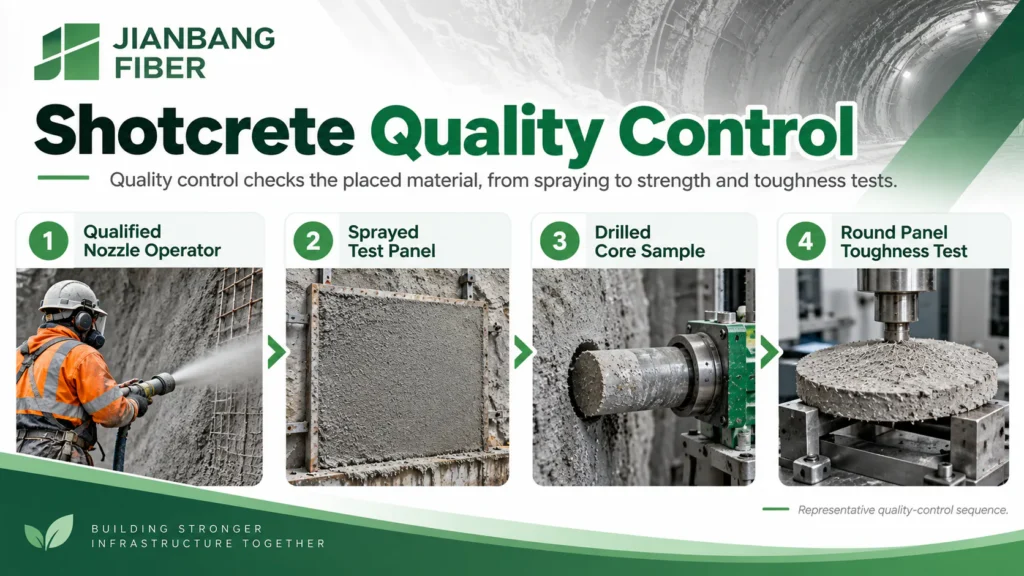
A practical qualification plan begins before the production spray. Agree on the specification, approved mix variants, fiber grade and dose, accelerator product, pump and nozzle setup, panel orientation, reinforcement detail, and acceptance tests. Keep the nozzle operator and equipment representative of the job. A panel made in an easy horizontal position cannot automatically qualify a congested overhead tunnel section.
ASTM C1140/C1140M-11(2019) describes the preparation of wet- or dry-mix shotcrete test panels and specimens cut or cored from them. For in-place core testing, ASTM C1604/C1604M-05(2019) addresses obtaining and testing drilled shotcrete cores. The acceptance plan should state sample location, age, conditioning, and frequency under the governing project documents. A number from an unrepresentative cast specimen is not a replacement for placed-material evidence.
When the design depends on fiber toughness, specify a relevant post-crack test. ASTM C1550-26 measures energy absorption in a centrally loaded round panel of fiber-reinforced concrete. The result belongs to that specimen and loading configuration. Record the specified deflection and acceptance threshold before testing, and prepare the shotcrete panels with the correct process. A fiber tensile-strength certificate cannot replace the panel result.
| Stage | Record on the job | What it helps verify |
| Before spraying | Materials, mix, fiber lot, accelerator, moisture, fresh properties | Repeatability of the approved setup |
| During spraying | Pump/nozzle settings, operator, surface condition, thickness, rebound | Quality of placement and actual yield |
| After spraying | Curing, panel IDs, core locations, strength and toughness results | In-place performance and traceability |
If a panel fails, diagnose the reason before raising the fiber dose. A low toughness result might come from poor dispersion, fiber loss in rebound, a weak matrix, improper panel orientation, or test preparation. More fiber can also make the mixture harder to pump. Correct the cause, repeat the trial, and document the new configuration.
Buy Fibers for a Defined Shotcrete Trial
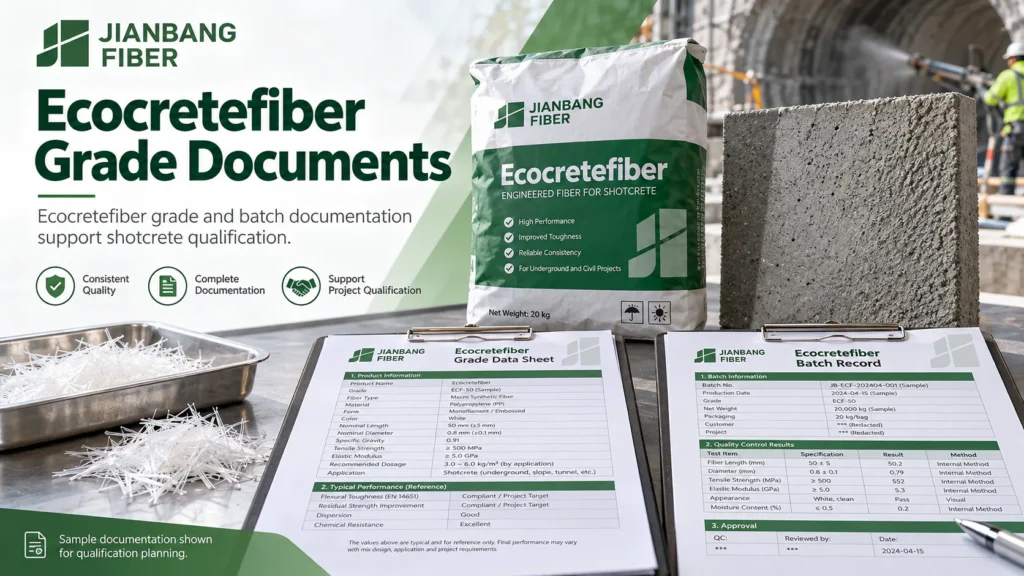
A useful inquiry to Shandong Jianbang states the wet or dry process, application, layer thickness, pump and nozzle type, aggregate top size, cement and accelerator, exposure, and any reinforcement congestion. Add the required strength, age, toughness, and test method. We can then discuss an Ecocretefiber™ micro PP, macro synthetic, or hooked-end steel grade for the first trial and supply the current grade documents.
Ask for the exact fiber geometry, packaging, batch identification, certificate, and any applicable safety or handling sheet. Coordinate the fiber addition with the concrete producer. Dose the fiber so it disperses before pumping, following the chosen product and equipment instructions. Keep the first production batch within the qualified range. If a fiber grade, accelerator, aggregate, or pump arrangement changes, decide with the engineer whether a new trial is needed.
Frequently Asked Questions
Is wet-mix shotcrete always better than dry-mix? No. Wet mix offers measured batching water and often suits continuous output. Dry mix may suit intermittent work. The site, equipment, crew, and accepted sprayed performance decide the choice.
Does a higher cement content automatically reduce rebound? No. Grading, water, nozzle technique, orientation, and surface conditions also matter. A trial should measure rebound and the properties of the layer that remains.
Can micro PP fiber meet a structural toughness requirement? A micro PP fiber should be specified for its tested role. A post-crack toughness requirement generally calls for a suitable macrofiber system and composite test, with engineering approval.
Can fiber replace welded mesh in tunnel support? Only when the engineer approves a tested design under the relevant project rules. Fiber type, dose, shotcrete thickness, ground conditions, and post-crack result all matter.
What should the first trial test? It should check feed and dispersion, pump and nozzle performance, rebound, build-up, early set, thickness, strength, and any required bond or toughness result.
Specify the Sprayed Layer, Then Select the Fiber
A shotcrete design should connect material batching to field placement and final testing. Choose the dry or wet process for the job, tune the mixture with a representative spray trial, and measure what stays on the surface. If fibers are required, identify the crack-control or post-crack target before choosing the grade and dose.
Shandong Jianbang can help you compare Ecocretefiber™ concrete fiber options for that trial. Contact our team with the project specification, proposed mix, equipment, and test plan. We will help you identify a relevant product grade and the documents needed for qualification.