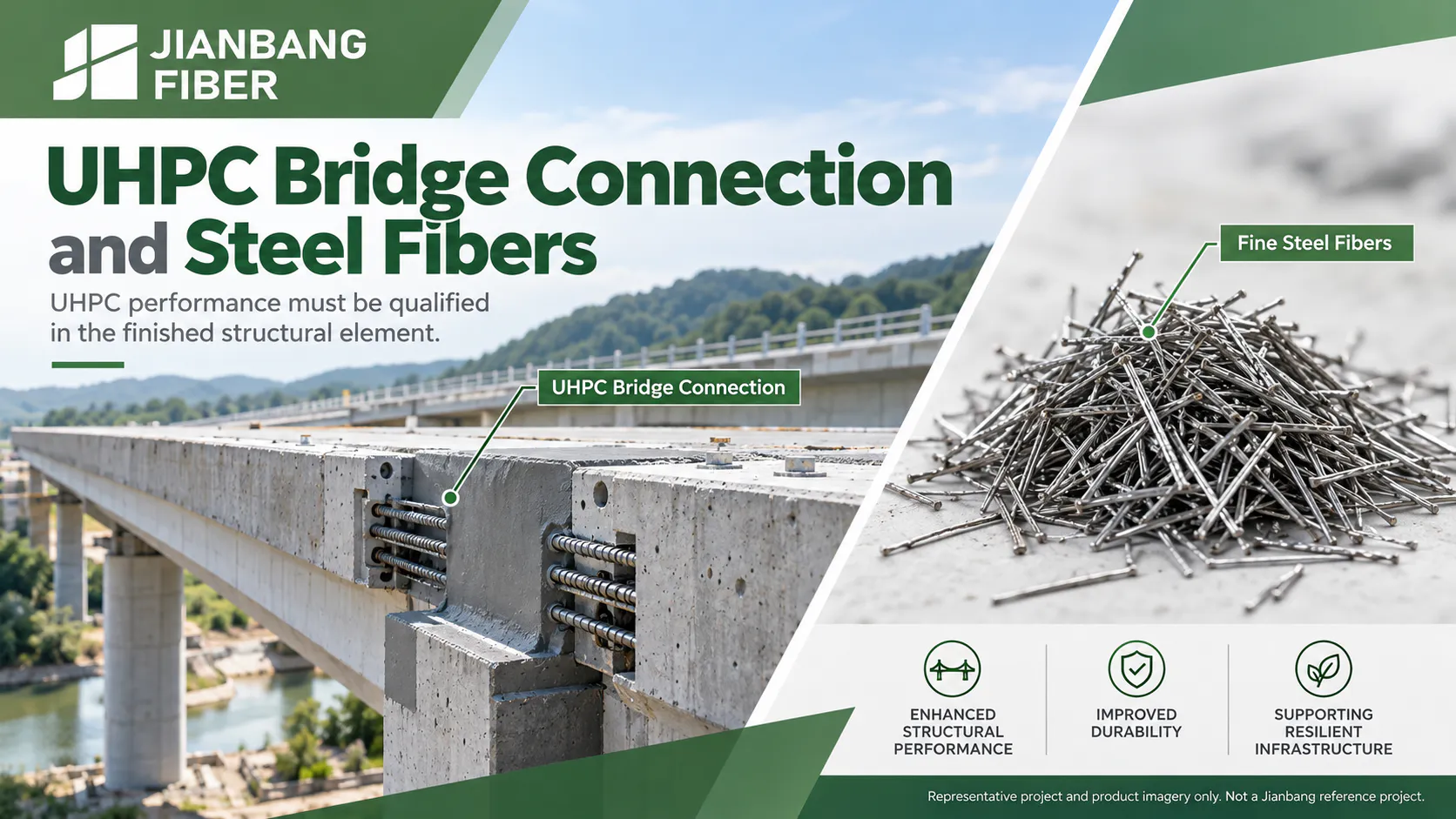
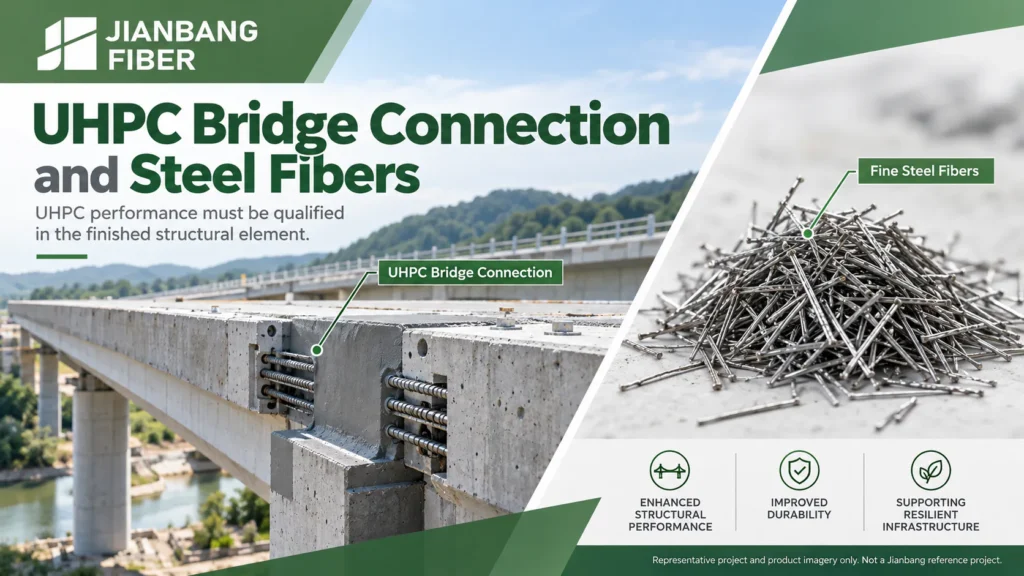
A UHPC mix should be approved for the performance of the finished element, not for a label on a bag. High compressive strength is valuable, but it does not tell an engineer how a joint carries tension after cracking, whether a thin panel can be filled without voids, or whether the specified properties will develop under site curing. Those questions have to be answered before a bridge connection, repair, or architectural component goes into production.
At Shandong Jianbang Chemical Fiber Co., Ltd., we supply Ecocretefiber™ steel fibers for concrete systems, including fine copper-coated options for UHPC trials. We see fiber selection as one part of a complete qualification plan. This guide turns material, mixing, placement, curing, and testing requirements into practical questions that a buyer, producer, and engineer can resolve together.
Start With a Performance Specification
Ultra-high-performance concrete is a family of dense cementitious composites, not one fixed recipe. ACI describes the class through mechanical and durability performance that exceeds conventional concrete, including high compressive strength, low permeability, and sustained tensile resistance after cracking. Fiber reinforcement is commonly central to that tensile response. The ACI PRC-239.1-24 UHPC TechNote is a useful starting point for understanding the material class.
A specification should name the intended use and the required test at the required age. A field-cast bridge joint, a precast façade panel, and a repair layer may need different early strengths, tensile behavior, flow, exposure resistance, surface quality, and curing. A single number such as “UHPC above 100 MPa” cannot cover all these decisions. In many bridge applications, the tensile response after first cracking is the reason for choosing UHPC. It deserves a measured acceptance criterion.
Standards must be identified by their actual scope and edition. China’s active GB/T 31387-2015 is titled Reactive Powder Concrete. It should not be cited as “GB/T 31387-2025” or assumed to govern every UHPC product. ASTM C1856/C1856M-24 covers fabricating and testing representative UHPC specimens within its stated scope. The engineer should state the applicable design code, material standard, test procedures, and project-specific acceptance values in the contract documents.
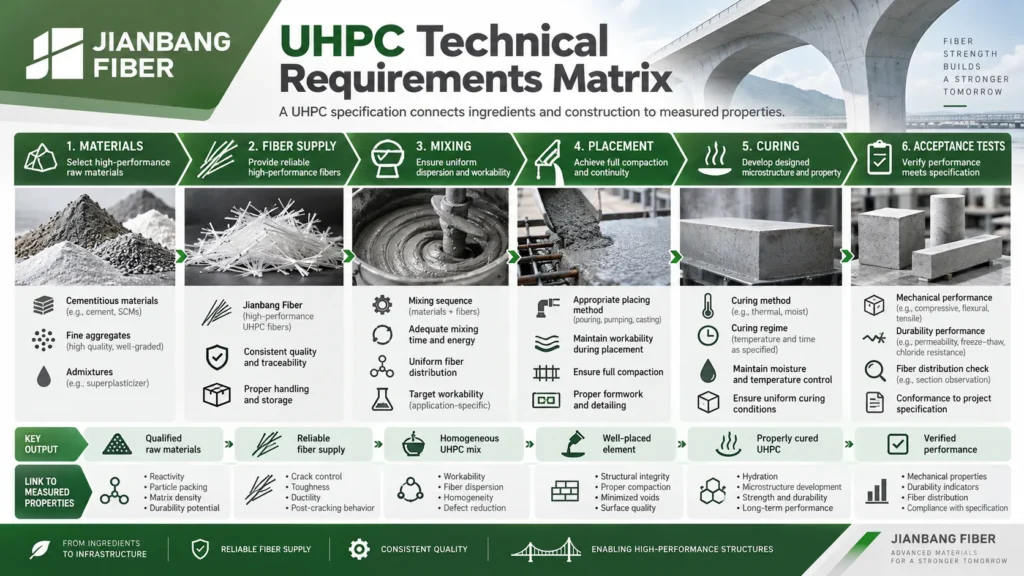
Select Materials as a Compatible System
UHPC gains much of its performance from a carefully graded matrix with low free-water content. Cement, fine aggregate, supplementary cementitious materials, fillers, water reducer, and fibers must work together. The aim is a dense, workable material that can be mixed consistently and placed in the real element. A list of impressive ingredient specifications does not prove that the whole system will meet the project’s performance targets.
Binder and particle packing
Cement and supplementary materials provide the binder. Silica fume and other fine powders can fill space between larger particles and change hydration and workability. The best proportion depends on the cement, particle-size distribution, admixture, curing, and test target. Some systems use finely graded quartz sand and little or no conventional coarse aggregate. Others use different local materials. The FHWA bridge-community review reports a range of UHPC formulations and research with alternative binders and aggregates.
Do not turn one laboratory composition into a rule that every batch must contain a fixed silica-fume percentage or one sand fraction. Ask the producer for the actual material grades, moisture corrections, source controls, and approved tolerances. A change in cement, silica fume, sand, or filler can alter fluidity and fiber dispersion even when the nominal weights remain the same.
Water reducer and water balance
Low water-to-cementitious-materials ratios are common in UHPC. FHWA describes field-cast systems with ratios below about 0.25, but a target value is not a universal recipe. The water balance must account for aggregate moisture and liquid admixtures. A high-range water reducer helps develop usable flow at low water content. Its chemistry and dose must be compatible with the chosen binder and placement window.
More water reducer is not automatically better. An incompatible or excessive dose can change setting, segregation resistance, and the time available for casting. The producer should verify flow when mixing ends and again at the time of placement. Document ambient conditions and elapsed time. If flow falls outside the approved window, adjust through a qualified procedure rather than adding unrecorded water on site.
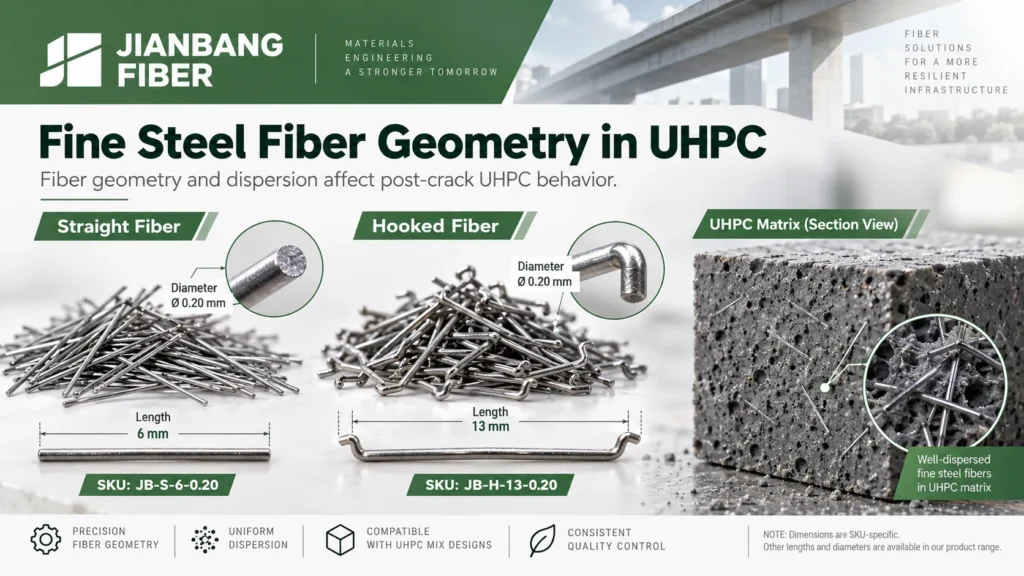
Steel fiber geometry and quality
The fine steel fibers in many UHPC systems bridge cracks and help the composite continue to resist tension after first cracking. Their diameter, length, shape, strength, surface condition, and dose affect mixing, orientation, pull-out, and the final tensile response. The right fiber is the one that meets the element’s tested composite requirement with reliable handling in production.
Our Ecocretefiber™ Micro Copper Coated Steel Fiber page lists 10-20 mm lengths, 0.10-0.30 mm diameters, and a product tensile strength above 2,850 MPa for its listed options. It gives 1.0-2.0% by volume as an indicative UHPC or high-performance element trial range, subject to engineering design. Confirm the exact SKU and certificate before using those figures. The page’s product range is not a rule for all UHPC, and a single-fiber tensile result is not the tensile capacity of the cast element.
Where a steel-fiber material specification is needed, ASTM A820/A820M-22 can help define the supplied fiber class and properties. The design team must separately qualify the UHPC composite. Copper coating may be a product feature, but the whole element’s durability still depends on cover, matrix, exposure, and detailing.
Control Mixing and Fiber Dispersion
UHPC often needs more mixing energy and time than conventional concrete. Dry powders must be blended consistently, water and admixture must reach the full batch, and the mixture must pass through its characteristic transition into a workable paste. Fibers are then incorporated by a proven feed sequence so they separate rather than form balls. Mixer capacity, blade geometry, batch size, and raw-material condition affect how long each stage takes.
A fixed “five-minute” mixing rule or one three-speed sequence cannot qualify all equipment. Trial the actual mixer at a representative batch size, record the sequence and power or visual change where relevant, and confirm that the mixture is uniform. A damp bag of powder or a sudden addition of fiber can cause local clumps. A longer fiber or a larger fiber volume can lower flow, yet a higher dose is useful only if the mix can place and the tested tensile response improves.
Fiber dispersion and orientation also depend on how the UHPC enters the form. Flow from one end of a long joint may align fibers differently from multiple-point filling. A lab specimen cast in a different direction can give a misleading picture of the finished element. FHWA research describes substantial orientation effects on flexural response in some geometries. The qualification mockup should reflect the actual form, flow path, dimensions, reinforcement, and casting method.
A useful batch record includes the material lot numbers, water corrections, admixture dose, mixing sequence, fiber addition rate, batch size, mixing time, fresh flow, temperature, and time of placement. These records let the producer investigate a failed test without guessing which variable changed.
Measure Fresh Flow With the Named Method
Fresh UHPC must flow through narrow details while keeping its fibers suspended. The project should set a flow window and a method for measuring it. Some project teams use a slump-flow-style measurement; others specify the modified flow table method. Their reported diameters are not interchangeable.
For example, ASTM C1856/C1856M-24 states an applicability scope for UHPC with specified compressive strength of at least 120 MPa, nominal maximum aggregate size below 5 mm, and a 200-250 mm flow measured by its modified flow table procedure. That is the scope of this specimen practice, not a universal fresh-flow target for every UHPC product. A separate “600-800 mm slump spread” should not be compared to that number without checking the apparatus and method. Write the test name and acceptable range together on the trial sheet.
Visual checks still matter. The inspector should look for fiber balls, paste leakage, segregation, entrapped air, and a change in flow during the planned placement interval. A fresh-flow number alone cannot confirm that the fibers remain distributed or that a joint will fill behind bars.
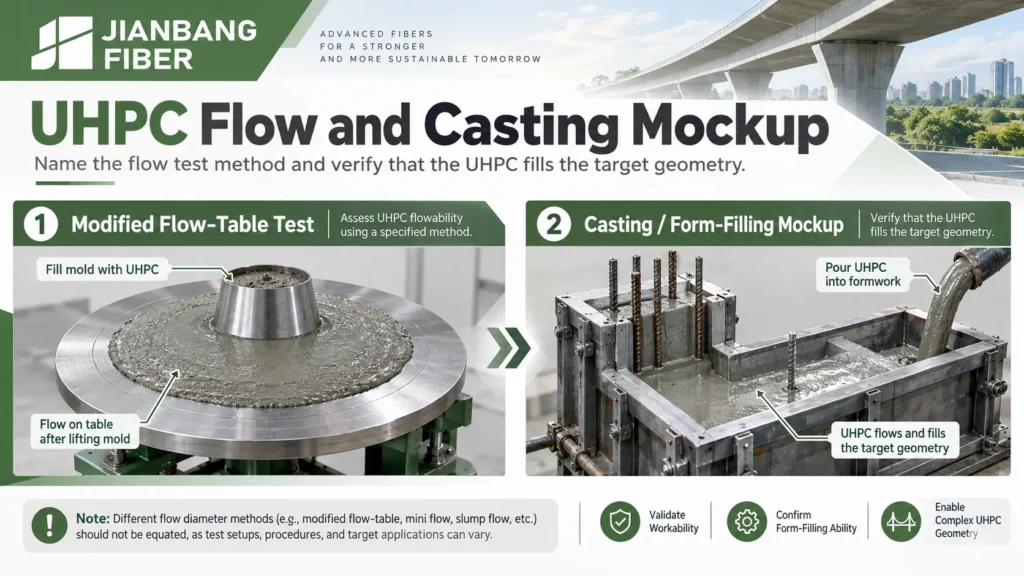
Plan Placement, Joints, and Curing
UHPC can be self-consolidating in an approved mix, but it still needs a tight form, a clear vent path, and a sequence that fills the element. The form must resist the fresh material’s pressure and limit paste leakage. The surface of a field-cast connection must be prepared to the engineer’s detail so the new material can bond with the existing concrete. Keep movement out of a fresh connection until it reaches the required release strength.
Placement affects fiber orientation, so changing pour direction or using untested internal vibration can change the product. FHWA’s review notes that internal vibration is generally not recommended for fiber-reinforced UHPC; limited external form vibration may be considered to release entrapped air when it is part of the qualified method. Neither a universal layer thickness nor a universal vibration time belongs in every UHPC specification. The mockup should demonstrate the intended route into corners, openings, and thin sections.
Curing has two related jobs: protect the low-water matrix from moisture loss and maintain a temperature history that develops the required properties. The first period before and just after set is particularly sensitive to drying. Some precast operations use heat or steam treatment after an initial hold; many field-cast applications use approved ambient curing. Heat treatment can accelerate property development, but its temperature, ramp, and duration must be qualified for the actual product and element geometry. The FHWA review of UHPC curing describes several curing paths, including ambient options.
Record the curing start, moisture protection, temperature profile, and time of form removal or loading. A laboratory specimen that receives a different heat treatment from the installed joint should not be used to claim the field element has reached the same strength.
Verify the Properties That Control the Design
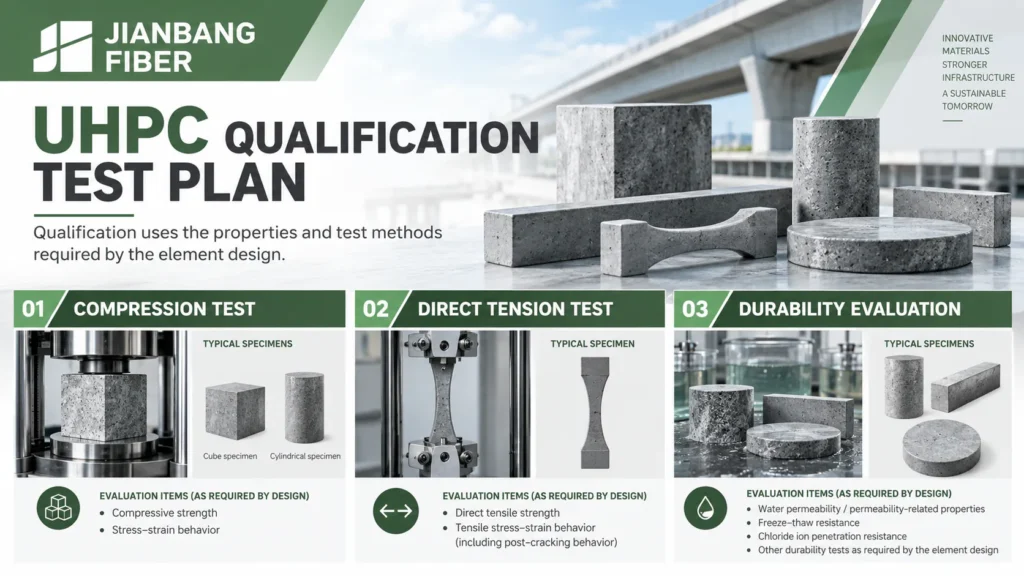
A complete acceptance plan separates fresh properties, mechanical properties, and durability. It defines sampling, specimen geometry, casting orientation, curing, age, number of tests, and rejection or retest rules. The required values belong to the engineer’s design and exposure class. A table of generic “UHPC minimums” is not a substitute for that plan.
| Requirement | Project question | Evidence to request |
| Fresh workability | Can the mix fill this element during the placement window? | Named flow method, time, temperature, segregation and fiber-dispersion checks |
| Compressive strength | When can the element be released, connected, or loaded? | Representative specimens, curing history, specified age and acceptance threshold |
| Tensile response | Does the material retain resistance after cracking? | Direct-tension method and response criteria linked to the design |
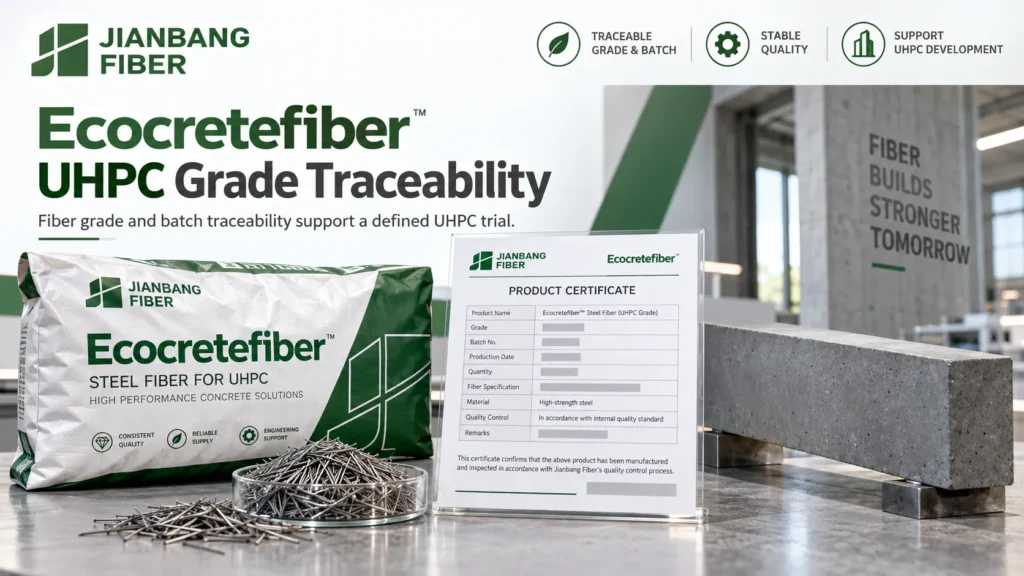
| Fiber supply | Is the delivered grade the qualified one? | Dimensions, type, dose, lot traceability and material certificate |
| Durability | Will the matrix and detail suit the exposure? | Project-specific transport, freeze-thaw, or other exposure tests |
| Finished element | Does the as-built geometry match the design? | Joint preparation, fill, cover, tolerances, surface condition and curing records |
ASTM C1856/C1856M-24 adapts specimen fabrication and testing for UHPC. If structural design uses direct tensile properties, AASHTO T 397 covers uniaxial tension testing of UHPC. A flexural beam method such as ASTM C1609/C1609M-24 can characterize fiber-reinforced composite behavior when the project calls for it, but a flexural value should not be substituted for a direct-tension design property without an accepted relationship.
Low permeability is a common UHPC advantage, yet it is not a promise of zero chloride ingress, zero carbonation, or a fixed 100- or 200-year service life. The exposure, crack state, joints, curing, and test method all matter. State the durability criterion and the method used to demonstrate it. For metallic-fiber mixtures, also check whether an electrical transport test is suitable for the particular fiber arrangement before interpreting its result.
A Buyer Checklist for UHPC Steel Fiber
Before asking for price, send the supplier the application and performance target. State whether the fiber goes into a field-cast bridge connection, precast element, overlay, thin architectural panel, or repair. Share the binder system, mixer type, expected flow method, casting route, curing plan, and required tensile or flexural test.
1. Identify the exact fiber. Agree on material type, straight or hooked form, length, diameter, aspect ratio, surface, and packaging.
2. Set the dose by volume and mass. Record the density and conversion. A percentage by volume cannot be copied as a percentage by mass.
3. Check compatibility. Trial the fiber with the actual binder, water reducer, mixer, and form. Observe dispersion and flow over the placement window.
4. Test the composite. Use representative UHPC specimens and the project method for compression, tension, and durability.
5. Control changes. Link the approved fiber grade, mix, casting method, and cure to the production batch record. Requalify a material or process change when it can affect the accepted response.
Ecocretefiber™ can provide current information for the selected micro steel fiber grade and discuss trial quantities and packaging. Our role is to help the production team start with a defined, traceable fiber. The engineer and producer establish the mix and acceptance values for the actual element. For more on the practical sequence, see our UHPC mixing, placement, curing, and steel fiber guide.
Frequently Asked Questions
Is every concrete mix above 100 MPa UHPC? No. UHPC is evaluated as a material system. Tensile response, durability, and the project’s definition matter as well as compressive strength.
Does UHPC always require 90 °C steam curing? No. Some products and precast schedules use heat treatment, while field-cast UHPC can be qualified for ambient curing. Use the approved regimen and test specimens cured to represent it.
Is 2% steel fiber by volume a standard dosage? No. It can be a trial level in some formulations. Fiber geometry, flow, tensile target, and production method determine the qualified dose.
Can a fiber certificate replace UHPC tensile testing? No. The certificate identifies the supplied fiber. The structural tensile response belongs to the mixed, cast, and cured composite.
Can I compare two suppliers by slump-flow diameter alone? Only if the same specified test method and conditions were used. Flow, fiber distribution, placement window, and mechanical performance must be considered together.
Qualify the Element, Then Scale Production
UHPC technical requirements work best as a connected chain. Material selection controls particle packing and workability. Mixing and casting control fiber dispersion and orientation. Curing controls property development. Tests must represent the finished element and answer the engineer’s design questions.
Shandong Jianbang can support that chain with an Ecocretefiber™ fine steel fiber grade for a defined trial. Contact our team with the element drawing, target response, proposed mix, and test plan. We can help you select the appropriate fiber option and prepare the grade documents for qualification.