Why Road And Bridge Concrete Needs Fiber Reinforcement
Road and bridge structures work under repeated traffic load every day. They face vehicle vibration, wheel impact, temperature change, freeze-thaw cycles, rainwater, surface wear, and long-term fatigue. Ordinary concrete can provide compressive strength, but it can still crack under tensile stress and bending stress.
Once cracks appear, the problem can develop fast. Water can enter the structure. Steel reinforcement can corrode. The surface can peel. Bridge deck pavement can break. Expansion joints can fail. Vehicle comfort can drop. Maintenance cost can rise.
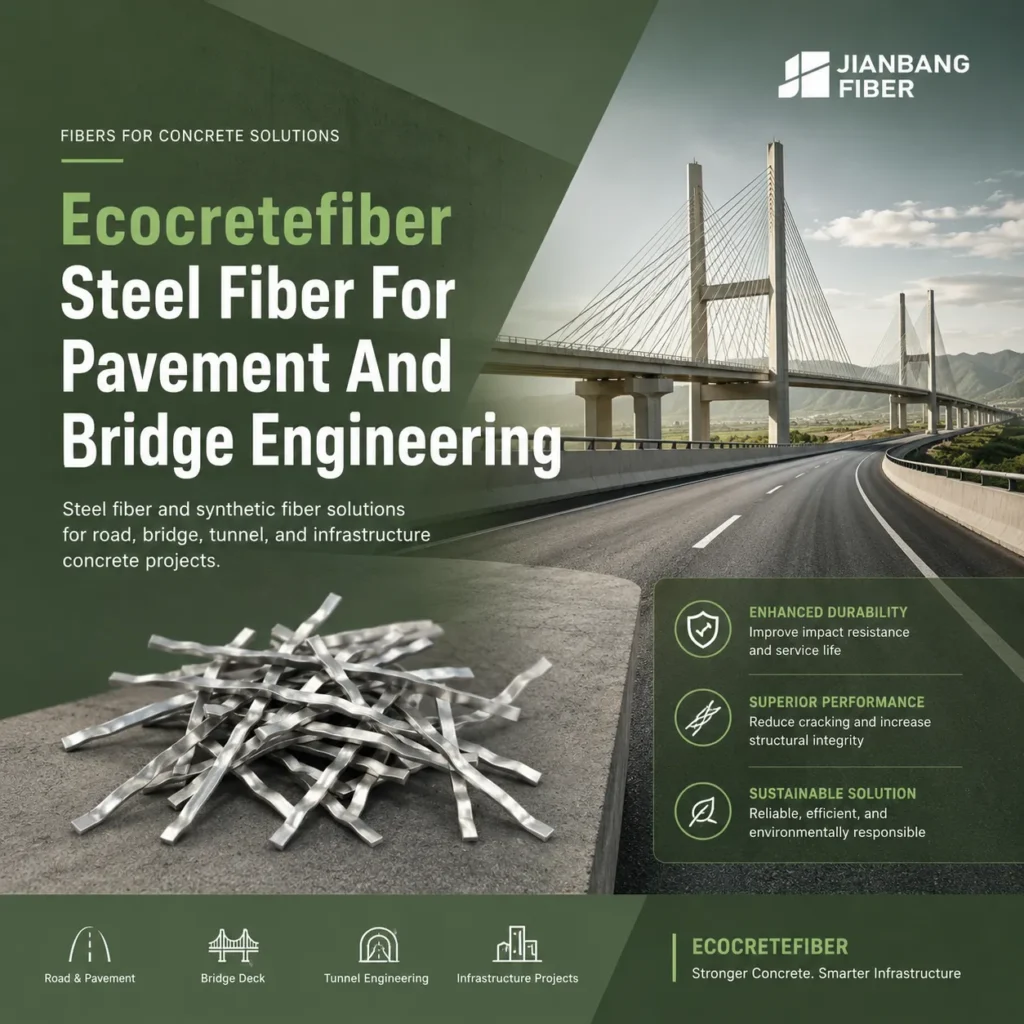
This is why steel fiber reinforced concrete for road and bridge engineering has become a practical solution. Steel fibers form a three-dimensional reinforcement system inside the concrete. They help control crack growth. They improve toughness. They improve impact resistance. They also help concrete keep integrity after the first crack appears.
Shandong Jianbang found out that fiber concrete is not only a material upgrade. It is a construction strategy. It helps roads and bridges resist cracking, vibration, freeze-thaw damage, and surface wear. This makes it useful for pavement, bridge deck repair, overlays, pile top reinforcement, tunnel lining, and other infrastructure concrete works.
At Shandong Jianbang Chemical Fiber Co., Ltd., our concrete fiber brand Ecocretefiber™ supplies steel fiber, polypropylene fiber, macro synthetic fiber, and other concrete reinforcement fibers for infrastructure projects. We help contractors, distributors, ready-mix plants, and project owners choose a fiber system that matches the real construction condition.
What Is Steel Fiber Reinforced Concrete?
Steel fiber reinforced concrete is concrete mixed with short steel fibers. These fibers are spread through the concrete matrix during mixing. After hardening, the fibers work as small bridges across micro cracks and larger cracks.
The main function is crack control. When concrete starts to crack, the steel fibers resist crack opening. They transfer stress across the crack. They delay crack growth. They also improve energy absorption.
This is different from normal rebar. Rebar is placed in a designed position. Steel fiber is distributed throughout the whole concrete body. Rebar controls structural stress in planned directions. Steel fiber helps control cracks in many directions.
In road and bridge projects, this is very useful. Pavement and bridge deck concrete often suffer from random cracks. These cracks may come from shrinkage, traffic vibration, temperature difference, or impact. A distributed fiber system can help control these cracks before they become larger damage.
Main Benefits Of Steel Fiber Concrete In Road And Bridge Engineering
Steel fiber reinforced concrete can support several important performance needs in road and bridge construction.
It can improve tensile behavior. Ordinary concrete is weak in tension. Steel fiber helps resist tensile stress after cracks begin to form.
It can improve crack resistance. Fibers bridge cracks and reduce crack expansion. This helps the structure keep better integrity under repeated load.
It can improve impact resistance. Roads and bridge decks face wheel impact and vibration. Steel fiber helps concrete absorb energy and reduce sudden brittle failure.
It can improve wear resistance. Road surfaces face tire friction and heavy traffic. Fiber concrete can help increase surface durability when the mix design is correct.
It can improve freeze-thaw resistance. In cold regions, water inside cracks can freeze and expand. This can widen cracks. Fiber concrete can help reduce crack growth and support longer service life.
It can reduce maintenance pressure. Better crack control means fewer early repairs. This is important for roads and bridges with heavy traffic, because traffic closure can create large economic losses.
Shandong Jianbang found out that the practical value of steel fiber concrete is not only higher strength. Its bigger value is longer service life, better crack control, and better resistance to harsh service conditions.
Common Steel Fiber Types Used In Concrete
Steel fibers can be produced by different methods. Common types include cut steel fiber, milled steel fiber, sheared steel fiber, and melt-extracted steel fiber. Each type has its own shape and performance feature.
Cut steel fiber usually has high tensile strength. It can be used when a project needs strong crack bridging.
Milled steel fiber is produced from steel plate processing. It can have a rough surface, so it may bond better with the concrete matrix.
Sheared steel fiber is made by cutting thin steel sheets. Its thickness and width must be controlled, because fiber geometry affects workability and bonding.
Melt-extracted steel fiber is made by a different production process. It can be selected for special performance needs.
For buyers, the key point is simple. Do not choose steel fiber only by name. The buyer should check tensile strength, length, diameter, aspect ratio, shape, surface condition, dosage, and application.
A strong steel fiber can still perform poorly if it does not disperse well. A low-cost fiber can become expensive if it causes balling, poor workability, or weak crack control. A suitable fiber must match the concrete mix and construction method.
Steel Fiber Concrete For Full-Width Road Pavement
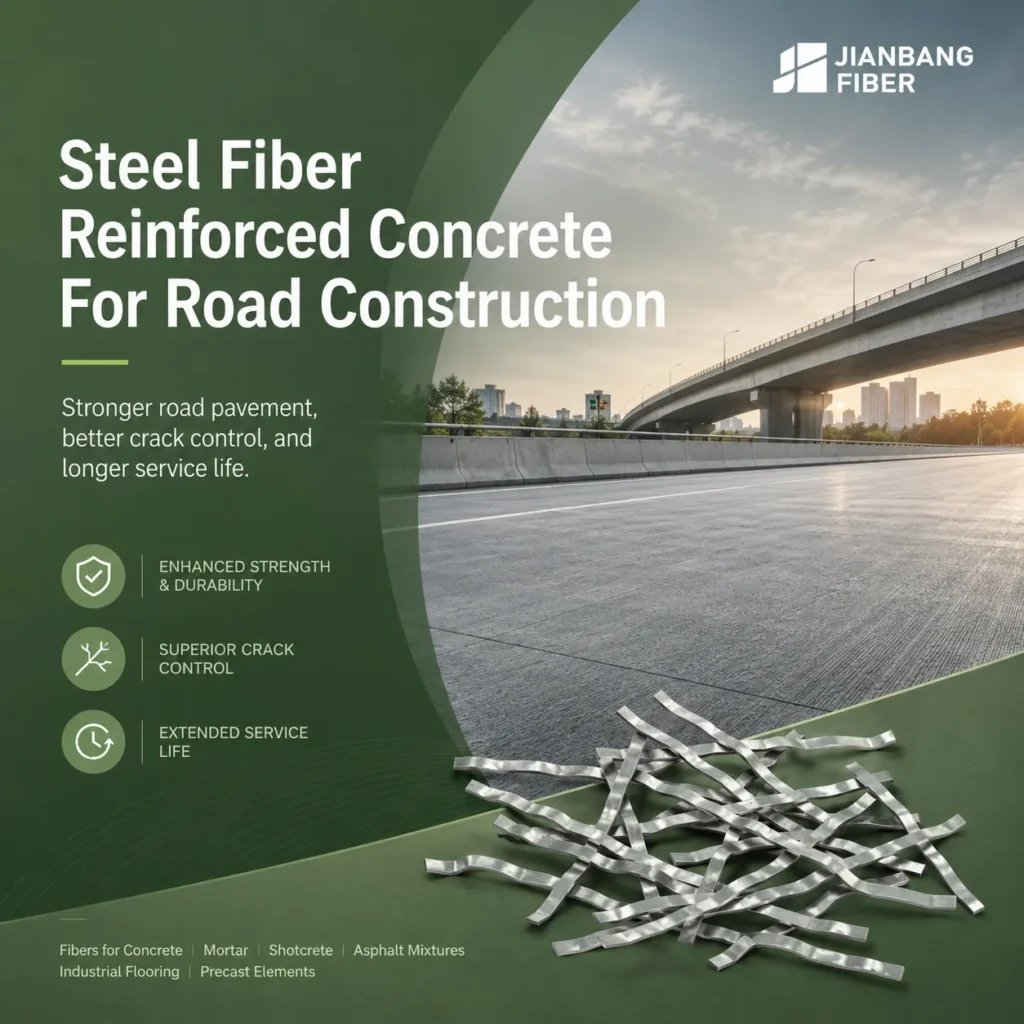
Full-width pavement is one of the useful applications for steel fiber reinforced concrete. In this type of work, fiber concrete can reduce cracking, improve pavement toughness, and support longer service life under traffic load.
Shandong Jianbang found out that when fiber concrete reaches the required strength, the pavement thickness may be reduced in some project designs compared with ordinary concrete. This can reduce dead load on bridge structures. It can also reduce material use when the design allows it.
For a bridge with multiple traffic lanes, fiber concrete can reduce the need for longitudinal construction joints. This helps improve pavement integrity. Fewer joints can also reduce weak points where water and traffic stress may start damage.
In some road and bridge pavement work, transverse joints may still be needed. The joint spacing should follow the project design. Construction teams should avoid random joint placement. Poor joint planning can increase cracking risk.
Steel fiber content must also be controlled. In many pavement projects, a dosage around 1% by total material mass may be used as a practical reference, but the final dosage should depend on the design, concrete grade, traffic load, fiber type, and testing result.
Steel Fiber Concrete For Composite Pavement
Composite pavement can use different concrete layers. A common structure may use fiber concrete in the top and bottom layers, with ordinary concrete in the middle layer. Another structure may use fiber concrete in the upper layer and ordinary concrete in the lower layer.
This method can control cost while still improving the main stress zones. The top layer faces wheel load, surface wear, impact, and temperature stress. Fiber concrete can give better crack resistance in this layer.
For a two-layer structure, the fiber concrete layer can be designed as about half of the total pavement thickness in some project conditions. The upper layer uses fiber concrete. The lower layer uses ordinary concrete.
For a three-layer structure, the top and bottom layers may use fiber concrete. The middle layer may use ordinary concrete. This can improve service life, but it also increases construction difficulty.
Shandong Jianbang found out that composite pavement needs careful timing. Each layer must bond well. The construction team must control layer thickness, placing time, surface condition, and compaction. If layer construction is not well controlled, the benefit of fiber concrete may be reduced.
Steel Fiber Concrete For Roller-Compacted Pavement
Steel fiber can also be used in roller-compacted pavement. In this application, fiber concrete is compacted by rolling equipment. The goal is to improve pavement strength, toughness, and crack resistance.
This method can be useful for road repair and pavement strengthening. Steel fiber and concrete work together under rolling compaction. The fiber helps improve the mechanical performance of the hardened layer.
Shandong Jianbang found out that roller-compacted fiber concrete must have good material consistency. The mixture should not be too wet. It should not be too dry. The fiber should be evenly distributed. If the fibers clump, the pavement can develop weak areas.
The construction team should check mixing order, moisture content, fiber feeding method, compaction equipment, and final surface quality. Good compaction is very important. Poor compaction can create voids and reduce durability.
Steel Fiber Concrete Overlay For Road Repair
Road overlay is a common repair method. Steel fiber reinforced concrete can be used as an overlay material when the old pavement has cracks, surface damage, or reduced bearing capacity.
There are three common overlay methods.
Direct overlay means fiber concrete is placed directly on the damaged pavement. This can be used when the damage is light and the old pavement can still provide a stable base.
Separated overlay means an isolation layer is placed between old concrete and new fiber concrete. This can reduce direct interaction between the two layers. It can be used when movement or cracking from the old layer should not directly affect the new layer.
Bonded overlay means the old pavement and new fiber concrete are designed to work together. This can create a stronger composite pavement. The old surface must be cleaned and treated well before placement.
Shandong Jianbang found out that overlay selection should depend on damage level. A lightly damaged road may only need direct overlay. A road with stronger old cracks may need separated overlay. A road that needs higher load capacity may need bonded overlay.
Steel Fiber Concrete For Freeze-Thaw And Cold Region Roads
Cold regions create special problems for concrete roads. Water can enter pores and cracks. When temperature drops, water freezes and expands. This creates internal pressure. Repeated freeze-thaw cycles can cause scaling, cracking, and surface damage.
Steel fiber reinforced concrete can help reduce this risk. Fibers bridge cracks and slow crack development. Better crack control reduces water entry. This supports durability.
In some cold region road applications, fiber dosage may be selected in a wider range, such as 0.8% to 2%, depending on design target and material type. A higher dosage does not always mean better performance. The mix must still remain workable and compactable.
Shandong Jianbang found out that freeze-thaw resistance depends on the whole concrete system. Fiber helps, but it cannot replace good air-entrainment, low water-cement ratio, correct curing, and proper drainage design.
For cold region road projects, Ecocretefiber™ can help customers compare steel fiber and synthetic fiber options. Synthetic fibers do not corrode, so they may also be useful in some freeze-thaw or wet environments.
Steel Fiber Concrete For Bridge Deck Paving
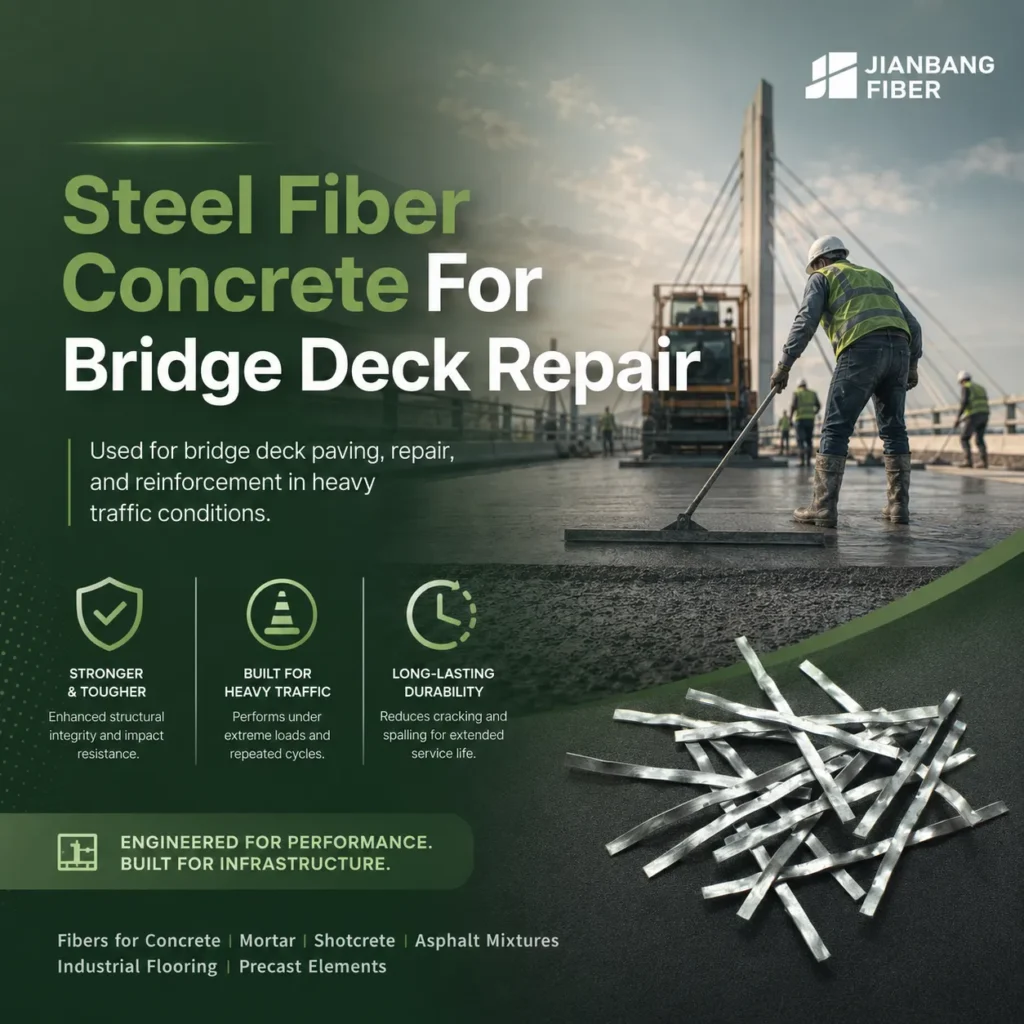
Bridge deck concrete works under heavy stress. It faces vibration, wheel load, water, deicing chemicals, temperature change, and fatigue. Ordinary concrete bridge decks can develop cracks, exposed reinforcement, surface peeling, and joint damage.
Steel fiber concrete can improve bridge deck paving. It can increase toughness, improve load transfer, reduce crack growth, and help the pavement resist repeated traffic vibration.
For bridge repair work, fiber concrete can be used to restore the deck surface and improve driving comfort. It can also reduce the chance that small cracks expand quickly.
Shandong Jianbang found out that bridge deck fiber concrete must balance strength and comfort. The surface must be strong, but it must also be flat and stable for vehicles. The fiber dosage should be controlled. Too much fiber may affect finishing. Too little fiber may not give enough crack control.
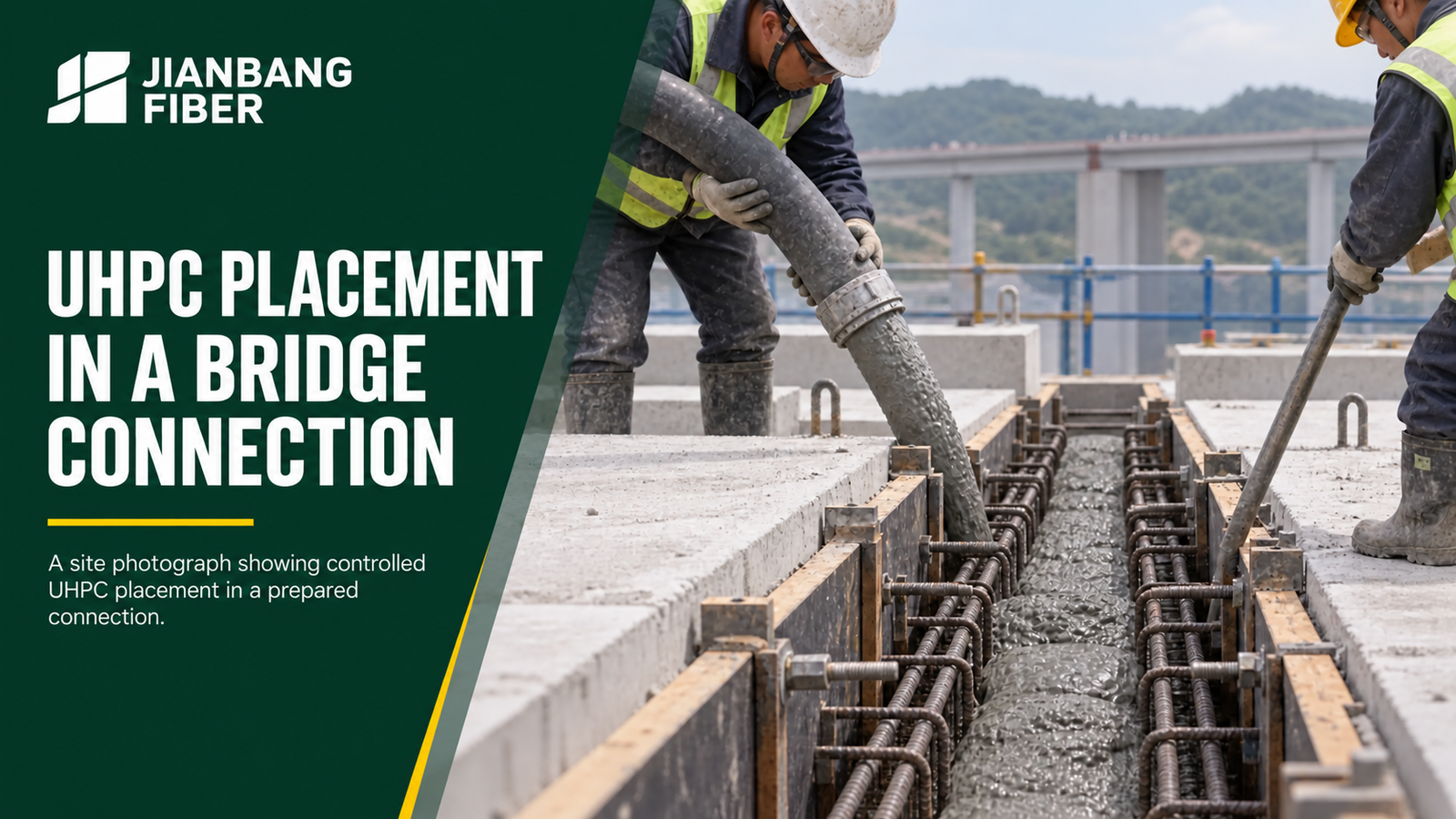
A practical bridge deck fiber concrete plan should include mix design, surface preparation, fiber mixing, placing, vibration, finishing, curing, and joint treatment.
Steel Fiber Concrete For Bridge Reinforcement
Steel fiber concrete can also be used in bridge reinforcement. It can support bridge deck panels, pier and abutment areas, pile tops, and other key parts.
At the pile top, fiber concrete can improve hardness and impact resistance. It can also support better local strength. This is useful in bridge structures that need better anti-impact behavior.
In bridge deck panels, steel fiber concrete can help prevent material peeling. It can also reduce surface crack development. In pier and abutment areas, it can improve reinforcement effect and support structural safety.
For bridge slopes and tunnel lining near bridge sections, fiber concrete can also be sprayed over a normal concrete base. This method can improve surface protection and reduce crack risk in poor geological conditions.
Shandong Jianbang found out that sprayed fiber concrete should use a suitable fiber type. The fiber must pass the spraying equipment. It should not create blockage. It should not rebound too much. It should form a dense and stable reinforced layer.
Mix Design Tips For Road And Bridge Fiber Concrete
Fiber concrete mix design should start from ordinary concrete, but it must be adjusted. Steel fiber changes the fresh concrete behavior. It increases internal friction. It can reduce flowability. It can also affect compaction and finishing.
A suitable mix design should consider the structure thickness, design strength, construction environment, loading condition, and placing method.
Steel fiber tensile strength should match the project demand. In many road and bridge applications, steel fiber tensile strength should be higher than 500 MPa. Fiber diameter should be controlled. A diameter above 0.38 mm is often used as a practical reference. Fiber dosage may be selected between 0.5% and 1.0% in many common applications, but the final dosage must come from testing.
The sand ratio should often be higher than ordinary concrete. This helps improve fiber dispersion and mixture cohesion. A water reducer may be needed to improve workability without adding too much water.
Shandong Jianbang found out that the best mix is not the mix with the most fiber. The best mix is the mix that gives the required performance while staying easy to place, compact, and finish.
Mixing Tips For Steel Fiber Concrete
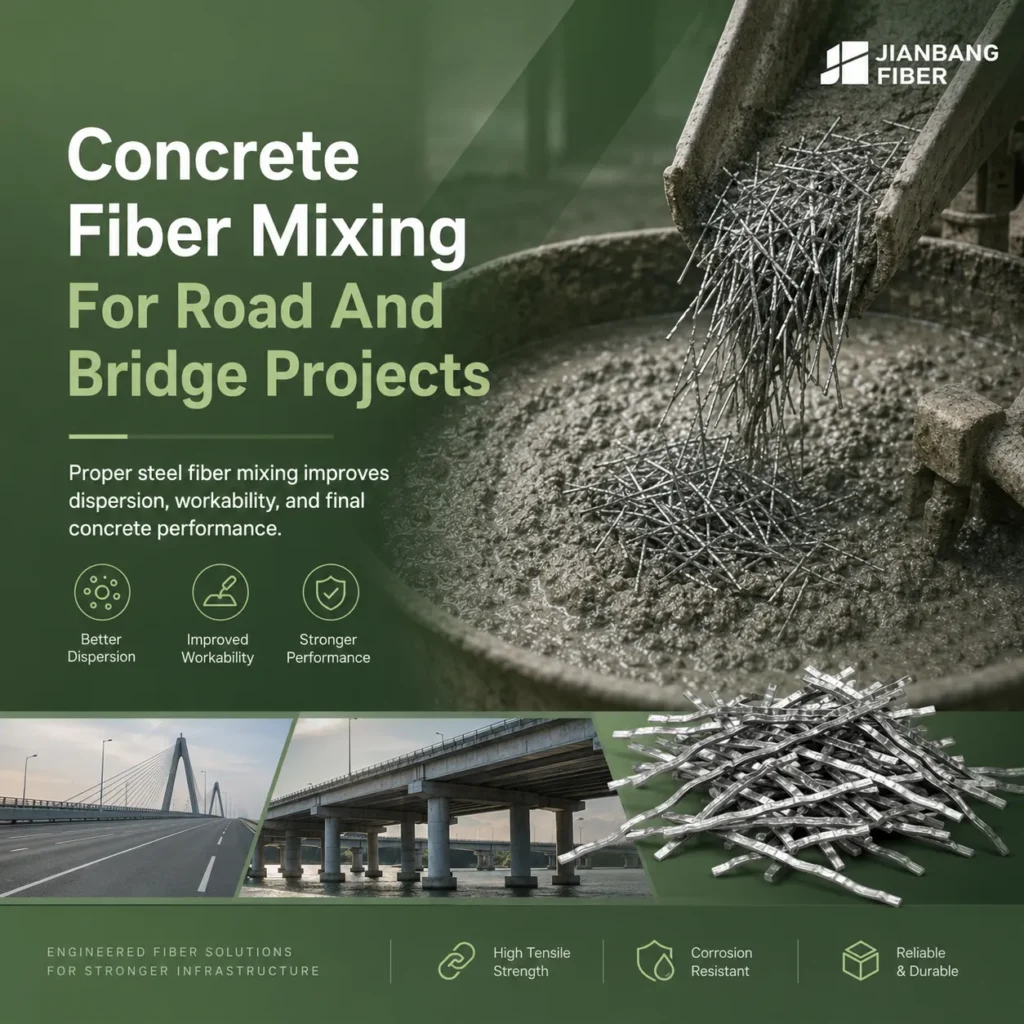
Mixing is one of the most important steps. Poor mixing can create fiber balls. It can create weak zones. It can reduce crack control performance.
A practical mixing order can be: add sand first, then add steel fiber and crushed stone, then add cement. Dry mixing should help the fiber spread before water is added. After water is added, the mixture should be mixed again until it becomes uniform.
Some construction experience uses around 15 minutes of dry mixing and about 3 minutes of mixing after water is added. The exact time depends on mixer type, batch size, fiber type, and concrete design.
The fiber should be added evenly. It should not be dumped into one position too fast. Fast fiber feeding can create clumps. Clumps reduce performance and create construction problems.
Shandong Jianbang recommends trial mixing before large-scale road or bridge construction. A trial mix can show if the fiber disperses well. It can also show slump, workability, finishing behavior, and early surface quality.
Placing And Vibration Tips
Placing and vibration decide the final construction quality. Even a good mix can fail if the concrete is not placed correctly.
For road and bridge construction, insertion vibrators or plate vibrators can be used. The equipment choice should depend on slab thickness, reinforcement condition, and construction area.
Corner areas need special attention. Concrete at corners can form honeycombs if vibration is not enough. The construction team should vibrate evenly after placing. After the structure is compacted, the surface should be leveled.
Construction joints should be planned in suitable positions. Continuous structure areas need careful connection treatment. Poor joint treatment can create weak areas.
Shandong Jianbang found out that fiber concrete needs enough vibration, but over-vibration should be avoided. Excessive vibration may affect fiber distribution or cause segregation in some mixes.
Why Choose Ecocretefiber™ For Road And Bridge Projects
Ecocretefiber™ is the concrete fiber brand of Shandong Jianbang Chemical Fiber Co., Ltd. We supply fiber solutions for road pavement, bridge deck paving, bridge repair, tunnel lining, shotcrete, precast concrete, industrial floors, and other infrastructure projects.
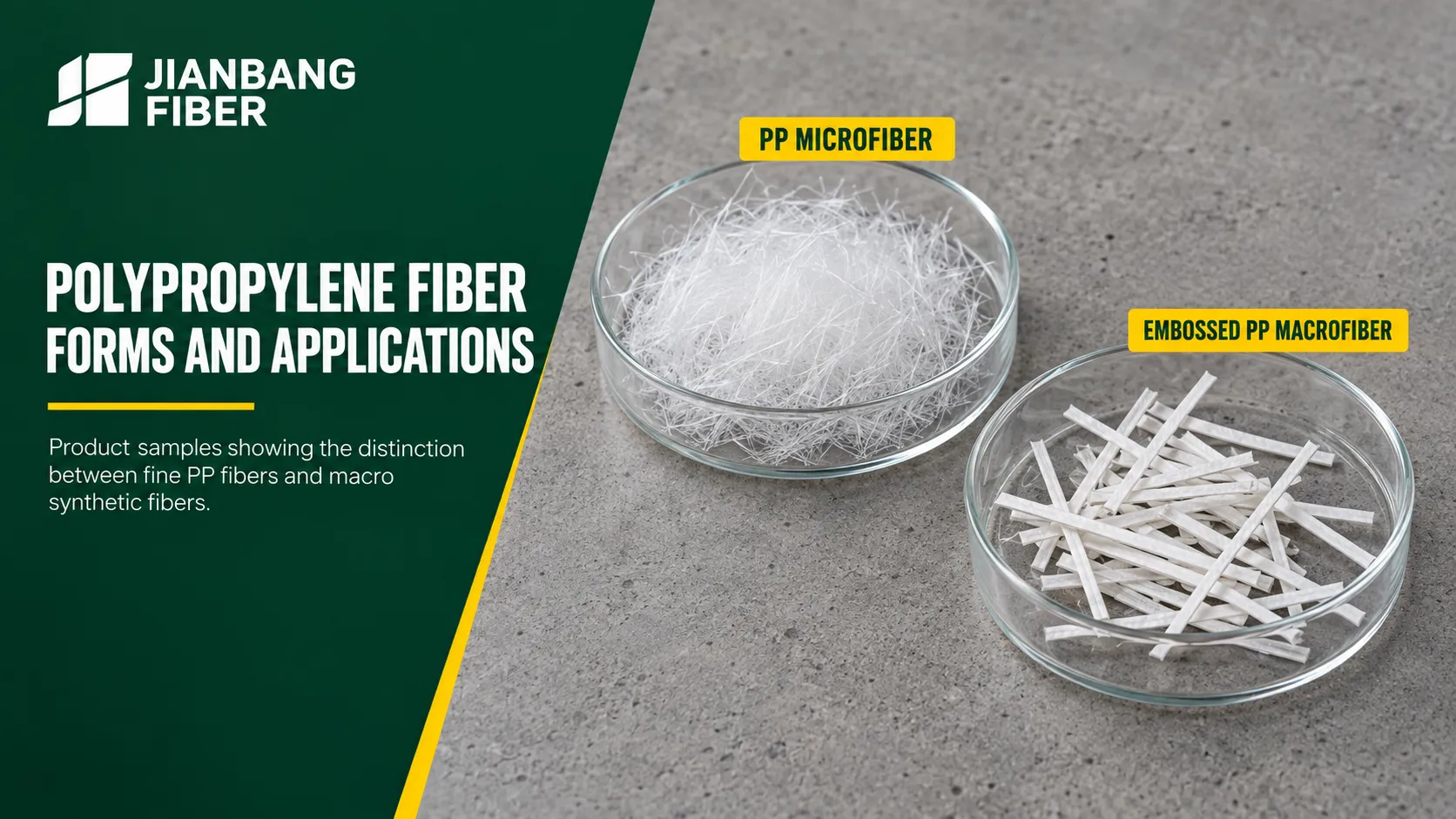
Our fiber product direction includes steel fiber, polypropylene micro fiber, macro synthetic fiber, and other concrete reinforcement fibers. We support customers who need crack control, impact resistance, freeze-thaw durability, post-crack toughness, and longer service life.
We do not recommend one fiber for every project. A road surface, bridge deck, pile top, tunnel lining, and repair overlay all have different needs. The right fiber depends on concrete grade, dosage, aggregate size, placement method, climate, and performance target.
Ecocretefiber™ can help buyers compare steel fiber and synthetic fiber options. We can also support OEM packaging, distributor product planning, and project-based technical communication.
Buyer Checklist Before Ordering Road And Bridge Concrete Fiber
Before buying concrete fiber, buyers should prepare several details.
| Question | Why It Matters |
|---|---|
| Is the project a road, bridge deck, overlay, or repair work? | Each application needs a different fiber solution. |
| What is the traffic load? | Heavy traffic needs stronger crack control and impact resistance. |
| Is freeze-thaw resistance needed? | Cold regions need better durability planning. |
| What concrete grade is required? | Matrix strength affects fiber bonding and final performance. |
| What is the target dosage? | Dosage affects performance, workability, and cost. |
| How will the concrete be placed? | Pumping, paving, spraying, and rolling need different workability. |
| Is surface finishing important? | Some fiber types can affect surface texture. |
| Is corrosion a concern? | Steel fiber and synthetic fiber behave differently in wet environments. |
This checklist helps reduce wrong selection. It also helps the supplier recommend a practical product.
Conclusion
Steel fiber reinforced concrete is a useful material for road and bridge engineering. It helps improve crack resistance, impact resistance, toughness, wear resistance, and freeze-thaw durability. It can be used in full-width pavement, composite pavement, roller-compacted pavement, overlay repair, bridge deck paving, pile top reinforcement, bridge panel repair, and tunnel lining.
Shandong Jianbang found out that the value of fiber concrete depends on both material selection and construction control. The fiber type, dosage, mix design, mixing order, vibration method, and curing process all affect the final result.
For road and bridge projects, steel fiber can be a strong choice when the project needs higher crack control and impact resistance. Polypropylene fiber and macro synthetic fiber can also be useful when the project needs corrosion-free reinforcement or micro crack control.
Shandong Jianbang Chemical Fiber Co., Ltd. supplies Ecocretefiber™ concrete fiber solutions for infrastructure customers. If your road, bridge, tunnel, or repair project needs better concrete performance, Ecocretefiber™ can help you select a suitable fiber solution and build a more reliable concrete system.