Why UHPC Needs Micro Steel Fiber
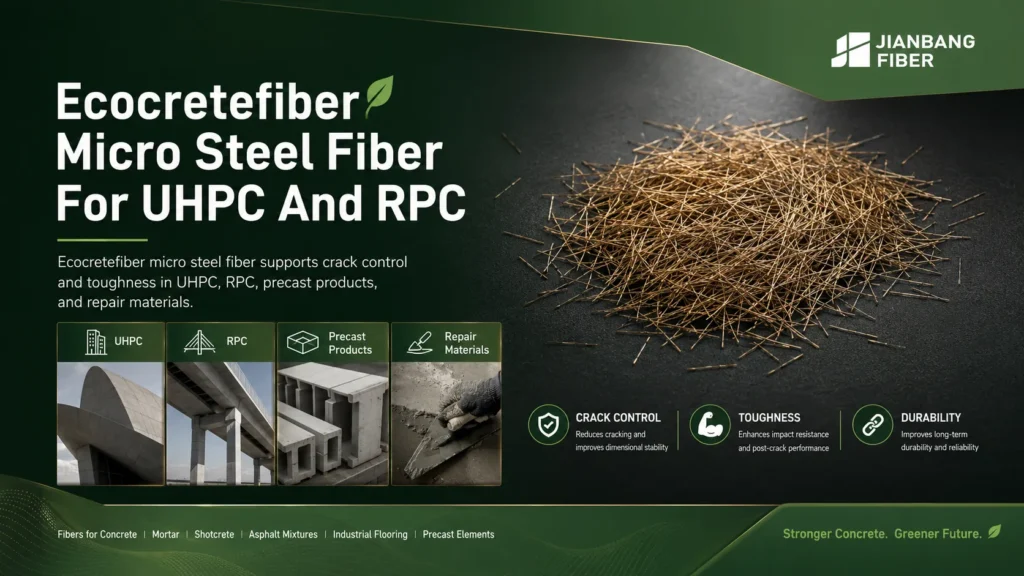
Ultra-high-performance concrete has a very dense cementitious matrix. It can achieve high compressive strength and very low permeability. But a dense and strong matrix can still fail in a brittle way when it is subjected to tension or bending.
This is why steel fiber is a central part of many UHPC systems.
Copper-coated micro steel fiber helps bridge cracks and carry tensile stress after the cement matrix begins to crack. The fibers do not simply increase compressive strength. Their main value appears in tensile behavior, flexural toughness, crack-width control, energy absorption, and residual load capacity.
Shandong Jianbang Fiber finds out that the size of the fiber is important. A typical UHPC micro steel fiber is much thinner and shorter than the hooked-end steel fibers used in many industrial floors. The fine geometry allows a large number of fibers to enter one cubic meter of concrete. This creates many potential crack-bridging points.
FHWA materials describe a commonly used UHPC steel fiber with a diameter of about 0.2 mm and a length of about 13 mm. The specified minimum tensile strength is around 2,000 MPa. Some UHPC systems use approximately 2% steel fiber by volume.
At Shandong Jianbang Chemical Fiber Co., Ltd., the Ecocretefiber™ product range includes micro copper-coated steel fiber for UHPC, RPC, precast components, repair materials, and other high-performance cement-based systems.
What Is Copper-Coated Micro Steel Fiber?
Copper-coated micro steel fiber is a short, fine, high-strength steel filament with a thin metallic coating on the surface. The market may also use terms such as brass-coated steel fiber, copper-plated steel fiber, or micro steel fiber.
These names should not be treated as fully interchangeable without checking the technical data sheet. A brass coating contains copper and zinc. A copper coating is mainly copper. The coating chemistry, thickness, adhesion, and manufacturing method can be different.
The steel core provides the main tensile strength and elastic modulus. The surface coating can support wire drawing, storage protection, handling, and surface consistency. FHWA states that the thin brass coating on common UHPC fibers provides lubrication during the drawing process and some corrosion protection for the raw fibers before use.
Shandong Jianbang Fiber finds out that buyers should always confirm five basic points:
| Parameter | Why It Matters |
|---|---|
| Core steel grade | Controls tensile strength and fiber rupture resistance |
| Coating chemistry | Determines whether the product is copper-coated or brass-coated |
| Fiber length | Affects crack bridging and workability |
| Fiber diameter | Affects fiber count and surface area |
| Tensile strength | Helps prevent fiber rupture during crack opening |
A buyer should not judge the product only by its copper color. The correct comparison should include dimensions, tensile strength, straightness, coating quality, batch consistency, and concrete performance.
How Micro Steel Fiber Works In UHPC
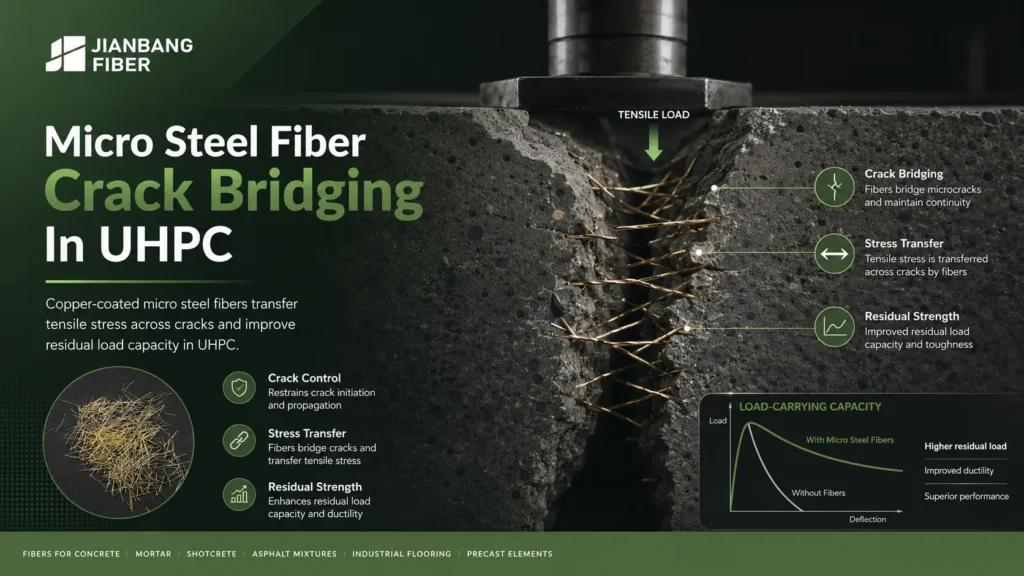
UHPC is strong in compression, but cracks can still form when tensile stress exceeds the strength of the cementitious matrix. Once a crack forms, the load must pass through the fibers that cross the crack plane.
The fiber transfers force through its bond with the surrounding matrix. This bond includes adhesion, friction, and mechanical interaction. The fiber begins to slip as the crack opens. The pull-out process absorbs energy.
This process changes the failure mode.
Plain high-strength concrete can crack suddenly. Fiber-reinforced UHPC can continue to carry tensile or bending load after the first crack. The material may develop several narrow cracks instead of one uncontrolled crack.
Shandong Jianbang Fiber finds out that three factors control this behavior:
Fiber count: Fine fibers create more individual reinforcement points at the same mass.
Fiber orientation: Fibers that cross the crack at a useful angle provide stronger bridging.
Fiber-matrix bond: A stable interface allows stress to transfer from the matrix to the fiber.
The strongest fiber is not automatically the best fiber. If the bond is too weak, the fiber pulls out too easily. If the bond is too strong, the fiber may rupture before it dissipates enough energy. A good UHPC system needs a controlled pull-out response.
Typical Dimensions And Mechanical Properties
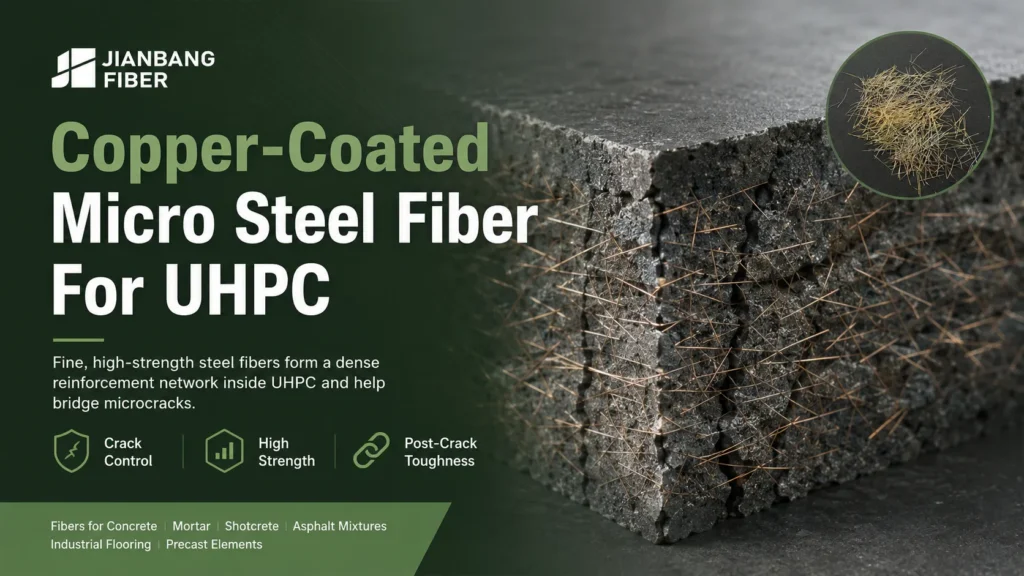
Copper-coated micro steel fibers are often supplied in short, straight forms. Common commercial dimensions are close to those used in UHPC research and bridge applications.
| Parameter | Common Product Direction |
|---|---|
| Diameter | About 0.18–0.25 mm |
| Length | About 12–25 mm |
| Aspect ratio | Commonly around 50–100 |
| Tensile strength | Commonly above 2,000 MPa |
| Elastic modulus | About 200 GPa |
| Shape | Straight cut or micro hooked-end |
| Density | About 7.8 g/cm³ |
The uploaded technical material presents a typical tensile-strength range of 2,850–3,200 MPa and a length-to-diameter ratio of 50–80. These values are realistic for some high-strength micro steel fiber products, but the supplier should support them with batch-specific testing.
FHWA has also reported UHPC fibers with minimum tensile strengths from about 2,000 MPa to 2,600 MPa, while other UHPC-class programs have used fibers reported at higher strengths.
A project specification should not copy the highest published value. It should define the minimum verified performance needed for the concrete design.
Copper-Coated Micro Steel Fiber Vs Hooked-End Steel Fiber
Micro steel fiber and conventional hooked-end steel fiber are both steel reinforcement fibers, but they usually serve different concrete systems.
| Feature | Copper-Coated Micro Steel Fiber | Conventional Hooked-End Steel Fiber |
|---|---|---|
| Typical diameter | About 0.18–0.25 mm | Often about 0.5–1.0 mm |
| Typical length | About 12–25 mm | Often about 30–60 mm |
| Common matrix | UHPC, RPC, fine mortar | Normal concrete and high-strength concrete |
| Aggregate system | Fine aggregate or very small aggregate | Can work with larger aggregate |
| Main anchorage | Surface bond and friction | End-hook mechanical anchorage |
| Fiber count per kilogram | Very high | Lower |
| Common applications | UHPC connections, thin precast parts, RPC | Floors, slabs, pavements, tunnels |
Micro steel fiber is normally selected for dense, fine-grained cementitious systems. Conventional hooked-end fiber is usually more suitable for normal concrete with larger aggregate and thicker structural sections.
Shandong Jianbang Fiber finds out that buyers should not replace one type with the other on a kilogram-for-kilogram basis. The fiber geometry changes the mixing behavior, crack bridging, pull-out mechanism, and dosage requirement.
Main Benefits In UHPC And RPC
Better Crack Control
Micro steel fibers form a dense three-dimensional network. This network can intercept microcracks before they develop into larger cracks.
Narrower cracks help the material maintain structural integrity. They can also limit the transport pathways available to water and chloride ions. The final durability still depends on the full UHPC matrix and exposure condition.
Higher Tensile And Flexural Performance
Steel fiber is much more effective in tension and bending than in compression. It carries load across cracks and improves residual strength.
A study of reactive powder concrete used straight copper-plated fibers with a diameter of 0.22 mm, a length of 13 mm, a tensile strength of 2,850 MPa, and an elastic modulus of 206 GPa. This is close to the typical specification described in the uploaded material.
Better Energy Absorption
The fiber pull-out process consumes energy. The concrete therefore needs more energy to open and propagate a crack.
This property is important in impact-sensitive components, bridge connections, thin precast panels, protective structures, and repair systems.
More Controlled Failure
Steel fiber changes the failure pattern from sudden separation toward a more gradual cracked response. UHPC testing has shown that fiber addition can change an explosive brittle failure pattern into a more ductile failure mode.
Main Applications
Field-Cast UHPC Bridge Connections
UHPC is widely used to connect precast bridge elements. The dense material fills narrow connection zones, while micro steel fibers provide crack bridging and tensile capacity.
FHWA guidance commonly references 13 mm long, 0.2 mm diameter high-strength steel fibers for field-cast UHPC connections.
Reactive Powder Concrete Products
RPC uses fine particles, low water-binder ratios, silica fume, high-range water reducers, and steel fibers. Copper-coated micro steel fiber can improve the tensile and flexural behavior of RPC railway components, covers, panels, pipes, and protective elements.
Thin Precast Components
Fine fibers are useful in thin components because conventional long steel fibers may be difficult to distribute within a narrow section. Micro fibers create many reinforcement points without requiring a large fiber length.
High-Performance Repair Materials
Micro steel fibers can be used in dense repair mortars and UHPC overlays. The repair system must still provide good bonding to the existing substrate.
Protective And Impact-Resistant Elements
High-strength steel fibers can improve energy absorption and crack control under impact loading. The project must verify the required response through representative tests rather than relying on fiber tensile strength alone.
Does Copper Coating Prevent Corrosion?
Copper or brass coating can provide a degree of protection during fiber production, storage, and handling. It can also improve the consistency of the fiber surface.
But it does not make the steel core permanently immune to corrosion.
If the coating is scratched, damaged, porous, or locally removed during mixing, the steel can become exposed. Cracks in the concrete can also allow moisture, oxygen, and chloride ions to reach bridging fibers.
Shandong Jianbang Fiber finds out that corrosion resistance should be evaluated at two levels:
- The corrosion behavior of the individual fiber or coating.
- The durability of the fiber-reinforced concrete system.
ISO 9227 can be used to expose metallic coatings to controlled salt-spray conditions. However, ISO explains that the test mainly helps detect coating defects and does not set a universal exposure time or service-life interpretation.
A product claim such as “500-hour salt-spray resistance” therefore needs its own acceptance criteria. The supplier should state the test condition, sample preparation, failure definition, and result.
Research comparing copper-coated steel fiber with hollow 304 stainless steel fiber also found that stainless steel fiber provided better durability after salt-spray and wet-dry exposure. Copper-coated fiber should therefore not be promoted as equivalent to stainless steel in highly aggressive environments.
Recommended Fiber Dosage
A common UHPC steel-fiber dosage is approximately 1.5%–2.0% by volume. Some specialized systems use higher or lower amounts.
FHWA used 1.5% fiber by volume in the development of a non-proprietary UHPC formulation and reports that field-cast UHPC systems commonly contain about 2% steel fiber by volume.
The mass dosage becomes high because steel has a density of about 7,850 kg/m³:
| Volume Fraction | Approximate Steel-Fiber Mass |
|---|---|
| 1.0% | 78.5 kg/m³ |
| 1.5% | 117.8 kg/m³ |
| 2.0% | 157.0 kg/m³ |
| 2.5% | 196.3 kg/m³ |
These numbers are mathematical conversions, not automatic mix recommendations.
The correct dosage depends on:
- Target tensile response
- Residual flexural strength
- Fiber dimensions
- Matrix strength
- Fiber orientation
- Mixing equipment
- Placement geometry
- Required flowability
- Total material cost
Shandong Jianbang Fiber recommends testing several dosage levels instead of assuming that more fiber always gives a better result.
Mixing And Dispersion
Micro steel fiber has a very high number of individual filaments per kilogram. This is useful for crack control, but it also creates a dispersion challenge.
The fiber should be added gradually. A large quantity should not be dumped into one point.
A practical sequence is:
- Dry-mix the premix and fine aggregate.
- Add most of the liquid and high-range water reducer.
- Mix until the UHPC reaches a stable fluid state.
- Add the micro steel fibers slowly.
- Continue mixing until no fiber clusters remain.
- Check flow before discharge.
The exact sequence depends on the mixer and commercial UHPC system.
Shandong Jianbang Fiber finds out that higher fiber length and dosage can reduce UHPC flowability. Mix adjustment should therefore focus on particle packing, water-reducer compatibility, mixing energy, and fiber feeding speed.
Extra water should not be added casually to solve poor flow. Excess water can reduce matrix strength and durability.
Quality Control
A micro steel fiber product should be checked before use.
Fiber-Level Checks
- Fiber length and diameter
- Aspect ratio
- Tensile strength
- Straightness
- Coating coverage and consistency
- Surface contamination
- Fiber bundles or fused fibers
- Batch weight
- Packaging moisture protection
ASTM A820/A820M-22 covers minimum requirements for steel fibers intended for fiber-reinforced concrete. It includes several steel-fiber manufacturing categories. It should be used together with the project specification and concrete performance requirements.
Fresh-Concrete Checks
- Flow or spread
- Mixing time
- Fiber clustering
- Air content where relevant
- Temperature
- Placement behavior
- Surface fiber accumulation
Hardened-Concrete Checks
- Compressive strength
- Direct or indirect tensile performance
- Flexural performance
- Residual strength
- Crack width
- Fiber distribution
- Durability indicators required by the project
ASTM C1609 evaluates fiber-reinforced concrete beams using a load-deflection curve. It reports first-peak, peak, and residual strengths and can also quantify specimen toughness. The method is suitable for comparing mixtures, monitoring quality, and checking specification compliance.
Conductive And Smart Concrete Applications
Steel fibers can create an electrically conductive network when enough fibers contact or approach each other inside the concrete. This property creates possible uses in:
- Antistatic floors
- Electrical grounding components
- Resistive heating
- Electromagnetic shielding
- Self-sensing concrete
- Structural health monitoring
Shandong Jianbang Fiber finds out that these are specialized applications. A normal UHPC fiber dosage does not automatically provide a defined electrical resistance or shielding level.
The project must test electrical resistivity, percolation behavior, frequency-dependent shielding, moisture sensitivity, fiber orientation, and long-term stability.
Research confirms that conductive metal fibers can improve electromagnetic shielding in cement-based materials, but the result depends on the complete material system and test frequency.
Claims such as “45 dB at 1 GHz” should only be published when they come from a named formulation tested under a defined method.
Copper-Coated Fiber Vs Stainless Steel Fiber
Copper-coated high-carbon steel fiber offers very high tensile strength at a competitive cost. It is widely suited to UHPC and RPC where the dense matrix helps protect the steel.
Stainless steel fiber offers stronger corrosion resistance but normally costs more.
| Factor | Copper-Coated High-Strength Steel | Stainless Steel Fiber |
|---|---|---|
| Tensile strength | Very high | Depends on alloy and processing |
| Elastic modulus | High | High |
| Initial cost | Usually lower | Usually higher |
| Corrosion resistance | Improved surface protection, but limited | Better in aggressive exposure |
| Common use | UHPC, RPC, high-performance precast | Marine, chemical, and high-durability systems |
| Main selection factor | Strength and cost efficiency | Corrosion resistance |
The project environment should decide the material. A dense indoor UHPC product and a permanently cracked marine structure do not need the same fiber.
Common Purchasing Mistakes
The first mistake is comparing only tensile strength. Tensile strength matters, but geometry, coating quality, dispersion, and matrix compatibility also matter.
The second mistake is confusing copper coating with complete corrosion immunity.
The third mistake is ordering by kilograms without checking volume fraction.
The fourth mistake is assuming that all copper-colored fibers have the same coating chemistry.
The fifth mistake is using normal-concrete mixing methods for UHPC.
The sixth mistake is judging performance only through compressive strength.
The seventh mistake is claiming that fiber can replace a fixed percentage of rebar without structural design and testing.
Shandong Jianbang Fiber finds out that a professional purchasing process should start with the required concrete performance, not with the lowest fiber price.
Why Choose Ecocretefiber™ Micro Steel Fiber?
Ecocretefiber™ is the concrete fiber brand of Shandong Jianbang Chemical Fiber Co., Ltd.
We supply micro copper-coated steel fiber and other concrete reinforcement fibers for UHPC, RPC, precast products, repair materials, industrial floors, bridges, tunnels, roads, and infrastructure projects.
Our product range also includes hooked-end steel fiber, glued steel fiber, milled steel fiber, macro synthetic fiber, polypropylene fiber, basalt fiber, PVA fiber, PAN fiber, cellulose fiber, and AR glass fiber.
For micro steel fiber projects, we can support customers with:
- Fiber specification selection
- Length and diameter comparison
- Tensile-strength requirements
- Packaging options
- OEM service
- Trial-order planning
- Dosage communication
- Application matching
We do not recommend one specification for every concrete system. A bridge connection, RPC cover, thin precast panel, repair overlay, and protective component may require different fiber dimensions or dosages.
Buyer Checklist
| Question | Why It Matters |
|---|---|
| Is the matrix UHPC, RPC, mortar, or normal concrete? | The matrix determines suitable fiber geometry. |
| Is the coating copper or brass? | The coating chemistry should match the product description. |
| What fiber length and diameter are required? | Dimensions affect dispersion and crack bridging. |
| What minimum tensile strength is required? | UHPC normally requires high-strength fibers. |
| What volume fraction will be tested? | Volume fraction determines fiber count and mass dosage. |
| What flowability must be maintained? | Fiber addition can reduce UHPC flow. |
| Is chloride or marine exposure expected? | Aggressive exposure may require additional durability measures. |
| Which flexural test will be used? | Performance should be verified in concrete, not inferred from fiber data. |
| Is conductive performance required? | Electrical properties need separate testing. |
| Does the supplier provide batch records? | Traceability supports stable production quality. |
Conclusion
Copper-coated micro steel fiber is a high-strength reinforcement material for UHPC, RPC, fine-grained repair materials, and high-performance precast concrete.
Shandong Jianbang Fiber finds out that its main value comes from the steel core, fine dimensions, high fiber count, and crack-bridging action. The fiber helps improve tensile behavior, flexural toughness, crack-width control, energy absorption, and residual load capacity.
A thin copper or brass coating can support manufacturing, storage, and surface protection. But it does not make the steel permanently corrosion-proof. Marine and chloride-exposed projects must evaluate the full concrete system and compare other options, including stainless steel or non-metallic fibers.
The best result does not come from selecting the highest tensile strength or the highest dosage. It comes from matching fiber dimensions, coating, matrix, dosage, mixing process, placement geometry, and performance testing.
Shandong Jianbang Chemical Fiber Co., Ltd. supplies Ecocretefiber™ micro steel fiber solutions for customers who need reliable UHPC crack control and post-crack performance. Our team can help contractors, precast manufacturers, distributors, and infrastructure buyers select a practical fiber specification for their concrete system.