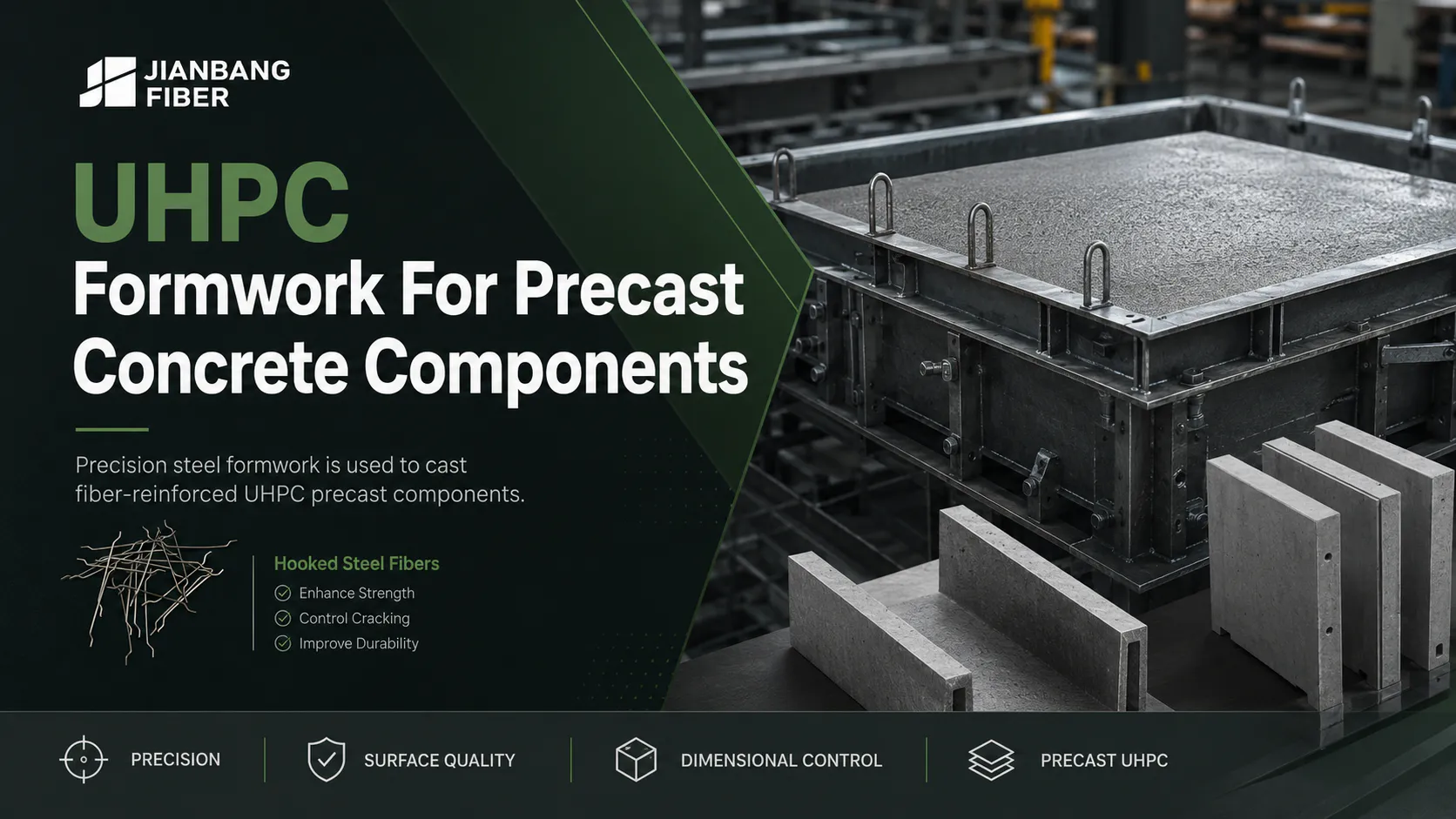
Warum UHPC-Schalungen einen anderen Konstruktionsansatz erfordern
Die UHPC-Schalung bestimmt weit mehr als nur die äußere Form eines Bauteils. Dies wirkt sich zudem auf die Leckage, die Oberflächenqualität, die Maßgenauigkeit, die Gießgeschwindigkeit, die Faserorientierung, die Aushärtungsbedingungen und die endgültigen mechanischen Eigenschaften des Materials aus.
Ultrahochleistungsbeton ist ein dichter zementhaltiger Verbundwerkstoff. Die FHWA definiert UHPC als einen Werkstoff mit optimierter Kornpackung und einem Wasser-Zement-Verhältnis von unter 0,25, interne, diskontinuierliche Faserverstärkung, eine Druckfestigkeit von über 150 MPa und eine anhaltende Zugfestigkeit nach Rissbildung von über 5 MPa.
Diese Eigenschaften bedeuten nicht, dass die Schalung der endgültigen Druckfestigkeit von 150 MPa standhalten muss. Die Schalung trägt den frischen UHPC, ihr eigenes Gewicht, die Lasten der Baugeräte, die Arbeiter sowie vorübergehende Baukräfte. Die größte Herausforderung für die Schalung geht vom frischen Material aus.
UHPC kann eine sehr hohe Fließfähigkeit aufweisen. Es enthält in der Regel sehr feine Partikel und wenig oder gar keinen groben Zuschlagstoff. Es kann in enge Zwischenräume eindringen, um Bewehrungsstäbe herumfließen und komplexe Anschlussdetails ausfüllen. Diese Fließfähigkeit kann jedoch auch zu hohem Seitendruck und erheblichen Undichtigkeiten führen, wenn die Schalungen instabil oder unzureichend abgedichtet sind.
Shandong Jianbang Fiber hat erkannt, dass der Erfolg eines UHPC-Bauteils bereits beginnt, bevor der Beton in die Schalung gelangt. Der Bauunternehmer muss die Schalung, den Einbauweg, das Stahlfasersystem, den Entformungsprozess und den Aushärtungsplan als einen einheitlichen Arbeitsablauf konzipieren.
Die wichtigsten Aufgaben von UHPC-Schalungen
Die Schalung muss die erforderliche Form bilden und den Frischbeton in der richtigen Position halten. Außerdem muss sie die Ausrichtung gewährleisten und die Baulasten aufnehmen. Der ACI definiert die Schalung als das gesamte Stützsystem für Frischbeton, einschließlich der Kontaktfläche, der Tragelemente, der Befestigungselemente und der Aussteifungen.
Bei UHPC hat das Schalungssystem sechs Hauptaufgaben.
Es muss dem Druck von Frischbeton standhalten, ohne sich dabei übermäßig zu verformen.
Es muss verhindern, dass feine Paste durch die Fugen austritt.
Es muss die erforderliche Oberflächenstruktur und -beschaffenheit erzeugen.
Es muss präzise Maße einhalten.
Es muss eine kontrollierte Befüllung ohne Lufteinschluss ermöglichen.
Es muss den geplanten Aushärtungs- und Abziehprozess unterstützen.
Eine Schwachstelle in einem dieser Bereiche kann den Wert des UHPC-Materials mindern. Selbst eine hochfeste Mischung kann eine undichte Fuge, eine verformte Platte, eine schlechte Faserausrichtung oder eine beschädigte Oberfläche nicht ausgleichen.
Warum UHPC-Schalungen wasserdicht sein müssen
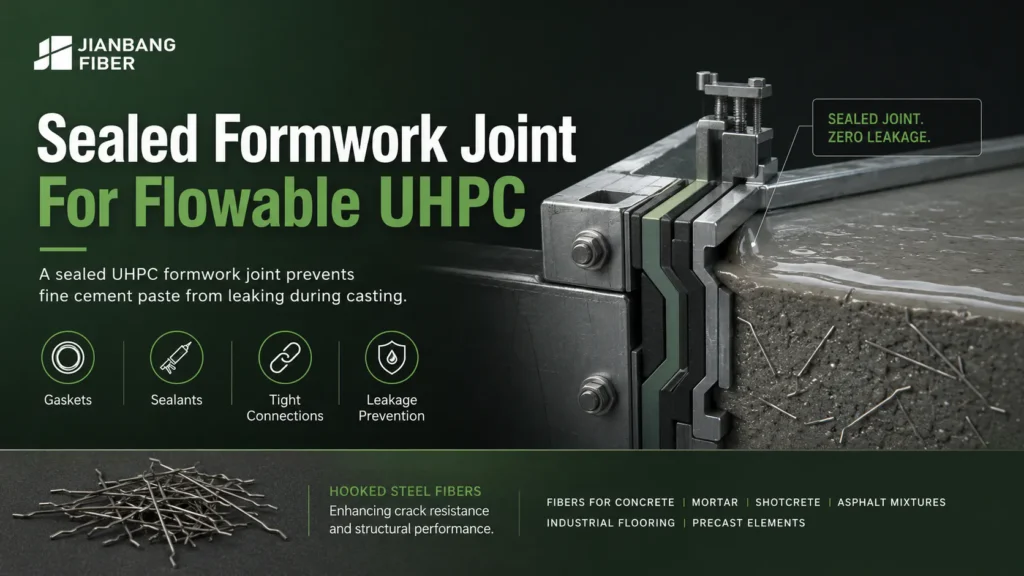
Die Vermeidung von Undichtigkeiten ist eine der wichtigsten Anforderungen an UHPC-Schalungen.
Die FHWA erklärt, dass vor Ort gegossenes UHPC erfordert eine strengere Kontrolle der Schalung als herkömmlicher Beton. Aufgrund seines selbstverdichtenden Verhaltens und seiner feinen Partikelstruktur kann es einen höheren Schalungsdruck erzeugen, und das Material kann leicht durch nicht ordnungsgemäß abgedichtete Schalungen austreten.
Selbst durch einen kleinen Spalt, durch den normaler Beton zurückgehalten werden könnte, kann UHPC-Paste dennoch entweichen. Der Verlust mag auf den ersten Blick geringfügig erscheinen, kann jedoch zu verschiedenen Problemen führen:
- Eine sichtbare Oberflächenlinie oder Vertiefung
- Lokaler Verlust von Zementpaste
- Reduzierte Abdeckung im Bereich der Bewehrung
- Ansammlung von Stahlfasern in der Nähe der undichten Stelle
- Unvollständige Befüllung einer Verbindung
- Schwankungen des effektiven Querschnitts
Der Auftragnehmer sollte jede Plattenfuge, jede Ecke, jedes Bolzenloch, jede Rohrdurchführung, jeden Einlass, jede Entlüftungsöffnung und jede Schnittstelle zum vorhandenen Beton überprüfen.
Zu den gängigen Dichtungsmaterialien zählen geschlossenzelliges Schaumstoffband, Gummidichtungen, geeignete Baudichtstoffe, Sprühschaum und sorgfältig angepasste Kantenstreifen. Auch in den Projektrichtlinien der FHWA werden Schaumstoffstreifen und Sprühschaum verwendet, um bei Brückenanwendungen wasserdichte Übergänge zu schaffen.
Das Dichtungsmaterial muss während des Gießvorgangs stabil bleiben. Es darf sich nicht ablösen und in den UHPC gelangen. Außerdem muss es den vorgesehenen Temperatur- und Entformungsprozess aushalten.
Ein Prototypguss bietet die beste Möglichkeit, die Dichtheit zu überprüfen. Die Bau-Checkliste der FHWA sieht vor, dass überprüft wird, ob die Schalung während oder nach dem Gießen dicht war und ob die Fuge bis zur vorgeschriebenen Höhe verfüllt wurde.
Verwenden Sie eine nicht saugfähige Auflagefläche
UHPC weist einen geringen Wassergehalt auf. Die Schalungsoberfläche sollte dem frischen Material keinen Teil dieses begrenzten Wasseranteils entziehen.
Die FHWA empfiehlt eine nicht saugfähige Oberflächenbeschichtung für Flächen, die mit UHPC in Kontakt kommen. Geeignete Optionen sind beispielsweise Stahl und harzbeschichtetes Sperrholz. Geöltes Sperrholz nimmt weniger Feuchtigkeit auf als unbehandeltes Sperrholz, kann jedoch dennoch etwas Wasser aus der Oberflächenschicht entziehen.
Die Wasseraufnahme kann das Aussehen und die Eigenschaften der UHPC-Oberfläche verändern. Dies kann folgende Auswirkungen haben:
- Farbunterschiede zwischen dunklen und hellen Tönen
- Eine trockene oder raue Oberfläche
- Lokaler Durchflussausfall
- Lochblenden
- Unzureichende Wiedergabe feiner Texturen
- Uneinheitliche Haftung bei späteren Beschichtungsarbeiten
Bei UHPC für architektonische Zwecke sollte der Hersteller die gesamte Kombination aus Plattenmaterial, Versiegelung, Trennmittel, Gussverfahren und Aushärtungsbedingungen prüfen. Anhand eines kleinen Musters lassen sich Oberflächenprobleme bereits vor Beginn der Serienproduktion erkennen.
Strength Is Important, But Stiffness Is Often More Critical
A form may be strong enough to avoid collapse but still be too flexible for precision UHPC production.
Thin UHPC panels, bridge deck units, façade components, and architectural shells often have tight dimensional tolerances. Small panel deflection can change the component thickness or create visible waves.
The formwork engineer should check:
- Panel bending
- Stud and rib spacing
- Tie forces
- Connection slip
- Corner opening
- Support settlement
- Local deformation around inlets
- Deformation during vibration or movement
The design should use realistic fresh concrete pressure and construction loads. The designer should not calculate formwork from the final compressive strength of the hardened UHPC.
Shandong Jianbang Fiber finds out that excessive form deformation can also affect the internal fiber system. A changing section alters the UHPC flow path. This can change the local speed and direction of the micro steel fibers.
Surface Finish And Release Performance
UHPC is often used for visible architectural components. The finished surface may remain exposed without plaster, tiles, or another decorative layer.
The mold surface becomes the negative copy of the final concrete surface. Every joint, scratch, patch, fastener, and texture can appear on the component.
Polished steel, stainless steel, coated steel, resin-faced plywood, HDPE liners, and carefully finished FRP molds can all produce high-quality surfaces. The correct choice depends on production volume, geometry, curing temperature, and the desired texture.
The release agent must be compatible with the UHPC and the next production step. Too much release agent can cause staining, air pockets, color variation, or weak adhesion of later coatings. Too little can cause sticking and edge damage.
A water-based or specially developed release product may be more suitable than a heavy oil coating for architectural elements. The manufacturer should apply a thin and uniform layer. Pools of release agent should not remain in corners.
The first production unit should be inspected before the full batch begins.
Main UHPC Formwork Materials
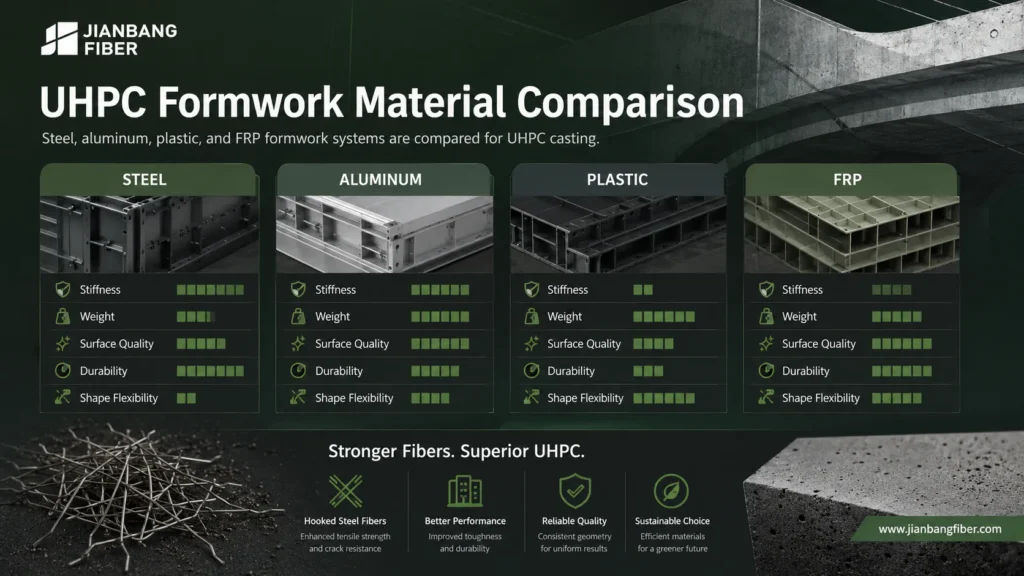
| Formwork Type | Main Advantages | Main Limitations | Suitable Applications |
|---|---|---|---|
| Stahl | High stiffness, high precision, good sealing, many reuse cycles | Heavy, higher initial cost, corrosion protection needed | Bridge units, repetitive precast products, large structural components |
| Aluminum | Lightweight, modular, fast assembly, recyclable | Local deformation risk, higher purchase cost | Standardized panels and medium-size precast elements |
| Plastic | Light, corrosion-resistant, smooth, easy release | Lower stiffness and limited temperature resistance | Small products, liners, decorative profiles |
| FRP composite | Lightweight, corrosion-resistant, easy to form into curves | Higher tooling cost and more difficult repair or recycling | Complex curves and custom architectural components |
| Permanent formwork | No stripping, can provide protection or composite action | Higher design complexity and permanent material cost | Composite shells, stay-in-place panels and specialized structures |
The source material compares these five systems and emphasizes that no single formwork material is best for all UHPC components.
Steel Formwork
Steel is often the first choice for repeated UHPC precast production.
A properly designed steel mold provides high stiffness and stable geometry. Welded or machined joints can achieve good sealing. The surface can also be polished to produce a smooth finish.
Steel molds make economic sense when a factory produces many identical components. The cost per unit falls as the number of casting cycles increases.
The main disadvantages are weight and corrosion. Large molds require lifting equipment. Steel surfaces must also be cleaned and protected during storage.
A steel mold should include accessible inspection points. Workers need to check corners, hidden cavities, bolts, and seals before every cast. Dried UHPC on a sealing surface can prevent the next form from closing correctly.
Aluminum Formwork
Aluminum formwork provides a useful balance between weight and rigidity. Workers can move smaller sections with less lifting equipment. Modular aluminum units also allow faster changeover between similar products.
The designer must still check concentrated loads and connection details. Aluminum has a lower elastic modulus than steel. A light panel may need closer ribs or additional supports to achieve the same deflection limit.
Heat is another consideration. Aluminum transfers heat quickly and expands more than steel. If the mold is part of a heated curing system, the designer should check temperature uniformity and dimensional movement.
Aluminum works best for standardized components with controlled production cycles.
Plastic And FRP Formwork
Plastic molds are useful for small components, detailed patterns, liners, and difficult release conditions. They do not rust, and many plastics provide a smooth surface.
Their main limitation is stiffness. A thin plastic mold may need an external steel or aluminum frame. Heat can also soften some plastics.
FRP molds offer more design freedom. They can reproduce double curvature, flowing shapes, repeated ribs, and customized architectural surfaces. They are also useful in corrosive production environments.
The factory must confirm the resin system’s temperature resistance and dimensional stability. A low-cost FRP mold may distort during warm curing or repeated use.
For complex products, the correct solution is often a hybrid mold. A steel frame can provide rigidity, while an FRP or plastic liner provides the required shape and finish.
Permanent UHPC Formwork
Permanent formwork remains in the completed structure. It can provide an outer shell, protective layer, architectural surface, or part of a composite structural system.
Thin UHPC panels can serve as stay-in-place formwork for conventional concrete in specialized designs. This method can reduce stripping work and create a durable outer surface.
However, permanent formwork requires structural coordination. The engineer must evaluate the interface, connection details, differential shrinkage, thermal movement, load transfer, fire performance, and durability.
It should not be treated as a simple replacement for removable formwork. It becomes part of the final structure.
How Formwork Changes Steel Fiber Orientation
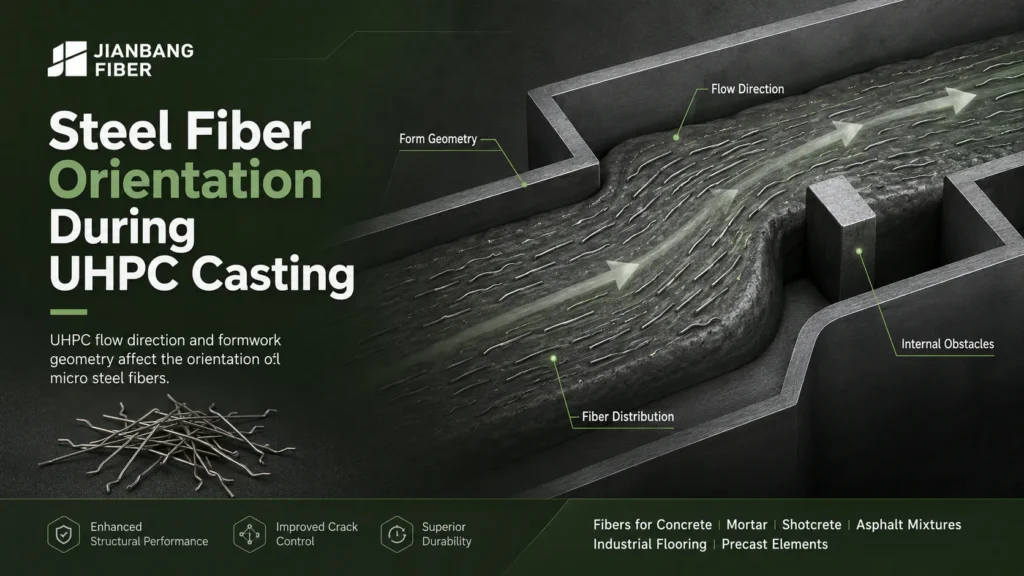
The formwork controls the path followed by fresh UHPC, and that path controls steel fiber orientation.
Micro steel fibers move and rotate as the UHPC flows. The fibers may align with the main flow direction. Corners, narrow gaps, reinforcement, abrupt section changes, and long flow distances can create local differences in orientation.
ACI educational material identifies casting method, member geometry, reinforcement layout, and UHPC rheology as important influences on fiber orientation.
This matters because fibers provide the strongest crack bridging when they cross the expected crack plane. A component may contain the correct total fiber dosage but still show weak local performance if most fibers align in an unfavorable direction.
The casting plan should therefore define:
- Where UHPC enters the mold
- The direction in which it should flow
- The maximum flow distance
- The location of vents
- The casting sequence
- Whether several inlets are needed
- Areas where reinforcement may block flow
- Areas where fibers may accumulate
The team should avoid moving the placement point without a plan. Random placement can create different fiber patterns between otherwise identical components.
Shandong Jianbang Fiber hat festgestellt, dass steel fiber selection should be coordinated with the mold geometry. Fiber length, diameter, dosage, and matrix flow must suit the narrowest sections of the component.
Filling, Venting, And Casting Direction
UHPC can fill complex spaces, but air still needs an escape path.
Closed forms need vents at high points and at the end of the flow path. A vent that is too small may become blocked by paste. A vent that is too large may allow leakage or fiber loss.
Transparent inspection windows can help workers observe critical areas. Pressure sensors or level sensors may also help on high-value molds.
For open-top molds, workers can observe the filling process more easily. However, exposed upper surfaces need protection after placement. FHWA checklists call for top forms or covers to be installed immediately after filling certain bridge connections.
The team should fill the mold in a way that limits unnecessary turbulence. Aggressive free fall or repeated relocation can disturb the fiber distribution.
UHPC often requires little conventional vibration. The exact process depends on the mixture. External vibration, light tapping, or controlled movement may be used to confirm filling, but excessive vibration can change fiber distribution and create surface accumulation.
Formwork, Temperature, And Curing
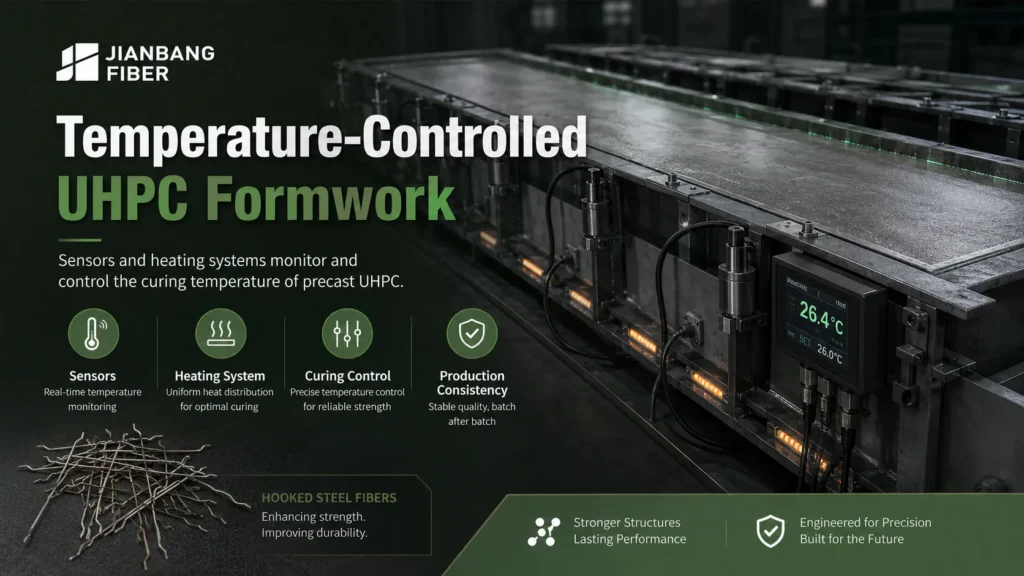
UHPC can develop strength under normal curing conditions. Some systems also use thermal treatment to accelerate development or improve selected properties.
FHWA describes a common steam treatment of about 90°C and 95% humidity for at least two days. This treatment often occurs after the component has been stripped from its mold.
This distinction is important. A factory should not automatically select a high-temperature mold because the UHPC supplier mentions steam curing. The production team must first decide whether the material will be cured:
- Inside the mold
- After early stripping
- Under an insulated cover
- In a separate steam chamber
- With embedded heating
- Under normal ambient conditions
If heat is applied while the component remains in the mold, the formwork must tolerate the temperature without distortion, softening, coating failure, or joint opening.
Temperature sensors can identify cold and hot areas. A controlled heating and cooling rate can reduce temperature gradients.
Match-cured test specimens can help confirm stripping strength and later performance. FHWA recommends match curing when specimens are used to evaluate the curing behavior of field-cast UHPC.
BIM, CNC, And Digital Formwork Design
BIM can improve coordination between the component, formwork, reinforcement, lifting anchors, inserts, inlet points, and support system.
The digital model can reveal clashes before manufacturing begins. It can also produce CNC data for cutting or machining mold components.
This is especially useful for:
- Curved façade panels
- Thin shells
- Repeated bridge elements
- Complex ribs
- Hidden connection pockets
- Components with many embedded parts
A digital workflow also improves traceability. The factory can connect each mold version with its production batch, inspection record, fiber type, casting direction, curing history, and final component number.
For custom components, 3D-printed molds or mold masters can shorten tooling time. The printed material must still provide enough stiffness, sealing, surface quality, and temperature resistance.
Quality Control Before Casting
A UHPC formwork inspection should cover more than general cleanliness.
The team should confirm that:
| Inspection Item | Required Result |
|---|---|
| Dimensions | Match approved drawings and tolerances |
| Alignment | Supports and mold faces are correctly positioned |
| Bracing | All braces and ties are installed and secure |
| Joints | Fully sealed without visible gaps |
| Contact surface | Clean, dry, and nonabsorbent |
| Release agent | Thin, uniform, and compatible |
| Inlets | Large enough and correctly located |
| Vents | Open and located at high points |
| Verstärkung | Fixed and clear of the intended flow path |
| Inserts | Correctly positioned and protected |
| Temperature system | Sensors and heating equipment tested |
| Trial casting | Completed where the geometry or process is new |
The UHPC flow should also be checked before casting. FHWA uses a mortar flow method to evaluate mixture consistency and suitability for placement.
Common UHPC Formwork Mistakes
The first mistake is designing the form based only on the final compressive strength. Fresh pressure and temporary construction loads control formwork design.
The second mistake is treating a small joint gap as harmless. UHPC paste can escape through gaps that would retain conventional concrete.
The third mistake is using untreated absorbent wood against the UHPC.
The fourth mistake is applying too much release agent.
The fifth mistake is ignoring the casting direction and steel fiber orientation.
The sixth mistake is providing no vents in closed or complex molds.
The seventh mistake is assuming that every UHPC mixture needs the same vibration method.
The eighth mistake is using a plastic or FRP mold without checking the curing temperature.
The ninth mistake is stripping based only on elapsed time instead of verified early strength.
The tenth mistake is beginning full production without a prototype casting.
How Ecocretefiber™ Supports UHPC Production
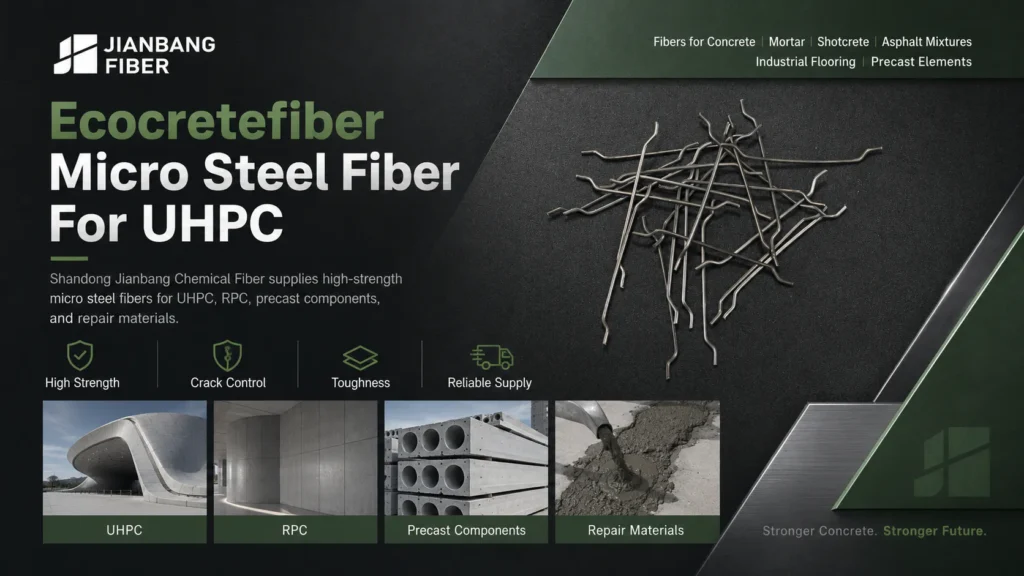
Shandong Jianbang Chemical Fiber Co., Ltd. supplies Ecocretefiber™ micro steel fibers for UHPC, RPC, vorgefertigter Beton, repair materials, and other high-performance cementitious systems.
Micro steel fibers provide the internal crack-bridging system that gives UHPC its sustained tensile and post-cracking behavior. FHWA notes that UHPC performance depends strongly on fiber type, quantity, dispersion, and orientation.
Shandong Jianbang Fiber finds out that fiber selection must match the formwork and casting process. A long fiber may provide stronger individual bridging, but it may be harder to distribute through narrow sections. A finer and shorter fiber creates more fibers per kilogram, but the matrix must keep them uniformly suspended.
For UHPC projects, buyers should confirm:
- Faserlänge
- Faserdurchmesser
- Seitenverhältnis
- Zugfestigkeit
- Surface coating
- Dosage by volume
- Mixing method
- Flow requirement
- Component thickness
- Expected casting direction
Ecocretefiber™ can support contractors, precast factories, UHPC producers, distributors, and infrastructure buyers with specification selection, trial-order planning, packaging, OEM service, and application communication.
Buyer Checklist For A UHPC Fiber And Formwork Trial
| Frage | Warum es wichtig ist |
|---|---|
| What is the narrowest component section? | It limits suitable fiber length and flow path. |
| Where will UHPC enter the mold? | The inlet controls flow and fiber orientation. |
| What is the maximum flow distance? | Long flow paths may create orientation differences. |
| Is the form fully watertight? | Leakage changes surface quality and local composition. |
| Is the contact surface nonabsorbent? | Water loss can damage the UHPC skin. |
| What fiber dosage will be used? | Dosage changes flowability and reinforcement density. |
| What flow value is required? | The mixture must fill the geometry without segregation. |
| Will heat curing occur before or after stripping? | The answer controls mold material selection. |
| Is the surface architectural? | Surface finish and release-agent control become critical. |
| Will a prototype be cast? | A trial reveals leakage, flow, fiber, and release problems. |
Schlussfolgerung
UHPC formwork is not only a container for fresh concrete. It controls geometry, leakage, surface quality, casting direction, fiber orientation, curing, and production consistency.
Shandong Jianbang Fiber finds out that the most important requirements are adequate stiffness, watertight joints, nonabsorbent contact surfaces, accurate dimensions, controlled release, and a planned filling path.
Steel formwork is suitable for repeated heavy-duty production. Aluminum reduces weight and speeds up modular assembly. Plastic and FRP molds provide value for smaller or complex shapes. Permanent forms can support specialized composite structures.
The formwork system must also work with the micro steel fiber system. Casting direction and geometry influence fiber orientation. Fiber orientation influences crack bridging and post-cracking performance. This means the mold designer, UHPC supplier, fiber supplier, precast producer, and contractor should coordinate before production begins.
Shandong Jianbang Chemical Fiber Co., Ltd. liefert Ecocretefiber™ micro steel fiber solutions for UHPC and RPC projects. A well-selected fiber and a well-designed formwork system allow the material to achieve better crack control, surface quality, dimensional accuracy, and production reliability.