Why UHPC Formwork Requires A Different Design Approach
UHPC formwork controls much more than the external shape of a component. It also affects leakage, surface quality, dimensional accuracy, casting speed, fiber orientation, curing conditions, and the final mechanical performance of the material.
Ultra-high-performance concrete is a dense cementitious composite. FHWA defines UHPC as a material with optimized granular packing, a water-to-cementitious-material ratio below 0.25, internal discontinuous fiber reinforcement, compressive strength above 150 MPa, and sustained post-cracking tensile strength above 5 MPa.
These properties do not mean that formwork must resist the final 150 MPa compressive strength. Formwork supports fresh UHPC, its own weight, equipment loads, workers, and temporary construction forces. The main formwork challenge comes from the fresh material.
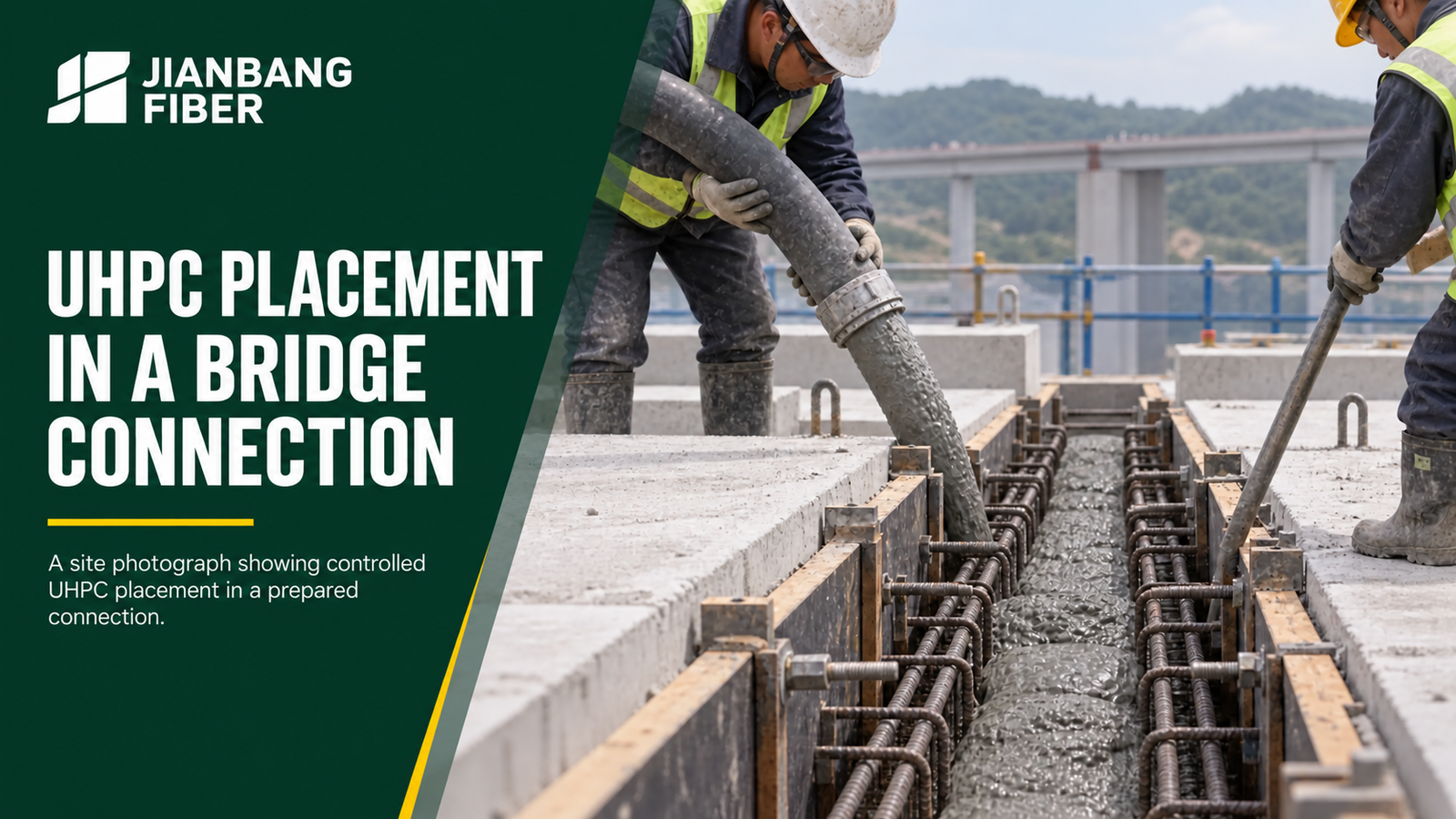
UHPC can be highly flowable. It normally contains very fine particles and little or no coarse aggregate. It can enter narrow spaces, flow around reinforcement, and fill complex connection details. The same flowability can create high lateral pressure and serious leakage if the forms are weak or poorly sealed.
Shandong Jianbang Fiber finds out that a successful UHPC component starts before the concrete enters the form. The contractor must design the formwork, casting path, steel fiber system, release process, and curing plan as one complete operation.
The Main Jobs Of UHPC Formwork
Formwork must create the required shape and hold the fresh material in the correct position. It must also maintain alignment and support construction loads. ACI describes formwork as the complete support system for fresh concrete, including the contact surface, supporting members, hardware, and bracing.
For UHPC, the formwork system has six main jobs.
It must resist fresh concrete pressure without excessive deformation.
It must prevent fine paste from leaking through joints.
It must create the required surface texture and finish.
It must maintain precise dimensions.
It must allow controlled filling without trapping air.
It must support the planned curing and stripping process.
A weakness in any one of these areas can reduce the value of the UHPC material. A high-strength mix cannot correct a leaking joint, a deformed panel, poor fiber orientation, or a damaged surface.
Why UHPC Formwork Must Be Watertight
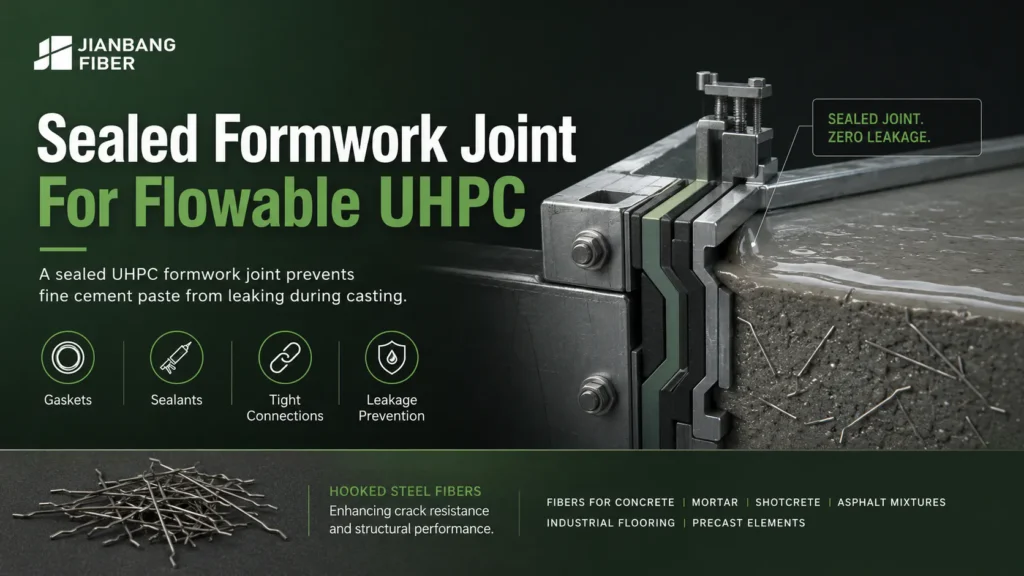
Leak prevention is one of the most important UHPC formwork requirements.
FHWA explains that field-cast UHPC requires tighter formwork control than conventional concrete. Its self-consolidating behavior and fine particle system can produce higher form pressure, and the material can easily leak through forms that are not correctly sealed.
A small gap that might retain ordinary concrete can still allow UHPC paste to escape. The loss may look minor at first, but it can create several problems:
- A visible surface line or cavity
- Local loss of cement paste
- Reduced cover around reinforcement
- Steel fiber accumulation near the leaking area
- Incomplete filling of a connection
- Variation in the effective cross-section
The contractor should inspect every panel joint, corner, bolt hole, pipe penetration, inlet, vent, and interface with existing concrete.
Common sealing materials include closed-cell foam tape, rubber gaskets, compatible construction sealants, spray foam, and carefully fitted edge strips. FHWA project guidance also uses foam strips and spray foam to create watertight interfaces in bridge applications.
The sealing material must remain stable during casting. It must not detach and enter the UHPC. It must also tolerate the planned temperature and release process.
A prototype casting provides the best way to confirm the seal. FHWA’s construction checklist includes confirmation that the formwork did not leak during or after casting and that the connection was filled to the correct level.
Use A Nonabsorbent Contact Surface
UHPC has a low water content. The form surface should not remove part of that limited water from the fresh material.
FHWA recommends a nonabsorbent finish on surfaces that contact UHPC. Suitable options include steel and resin-coated plywood. Oiled plywood absorbs less moisture than untreated plywood, but it may still remove some water from the surface layer.
Water absorption can change the appearance and properties of the UHPC skin. It may create:
- Dark and light color variation
- A dry or rough surface
- Local loss of flow
- Pinholes
- Poor replication of fine textures
- Inconsistent bond in later coating work
For architectural UHPC, the manufacturer should test the complete combination of panel material, sealer, release agent, casting method, and curing condition. A small mock-up can reveal surface problems before full production begins.
Strength Is Important, But Stiffness Is Often More Critical
A form may be strong enough to avoid collapse but still be too flexible for precision UHPC production.
Thin UHPC panels, bridge deck units, façade components, and architectural shells often have tight dimensional tolerances. Small panel deflection can change the component thickness or create visible waves.
The formwork engineer should check:
- Panel bending
- Stud and rib spacing
- Tie forces
- Connection slip
- Corner opening
- Support settlement
- Local deformation around inlets
- Deformation during vibration or movement
The design should use realistic fresh concrete pressure and construction loads. The designer should not calculate formwork from the final compressive strength of the hardened UHPC.
Shandong Jianbang Fiber finds out that excessive form deformation can also affect the internal fiber system. A changing section alters the UHPC flow path. This can change the local speed and direction of the micro steel fibers.
Surface Finish And Release Performance
UHPC is often used for visible architectural components. The finished surface may remain exposed without plaster, tiles, or another decorative layer.
The mold surface becomes the negative copy of the final concrete surface. Every joint, scratch, patch, fastener, and texture can appear on the component.
Polished steel, stainless steel, coated steel, resin-faced plywood, HDPE liners, and carefully finished FRP molds can all produce high-quality surfaces. The correct choice depends on production volume, geometry, curing temperature, and the desired texture.
The release agent must be compatible with the UHPC and the next production step. Too much release agent can cause staining, air pockets, color variation, or weak adhesion of later coatings. Too little can cause sticking and edge damage.
A water-based or specially developed release product may be more suitable than a heavy oil coating for architectural elements. The manufacturer should apply a thin and uniform layer. Pools of release agent should not remain in corners.
The first production unit should be inspected before the full batch begins.
Main UHPC Formwork Materials
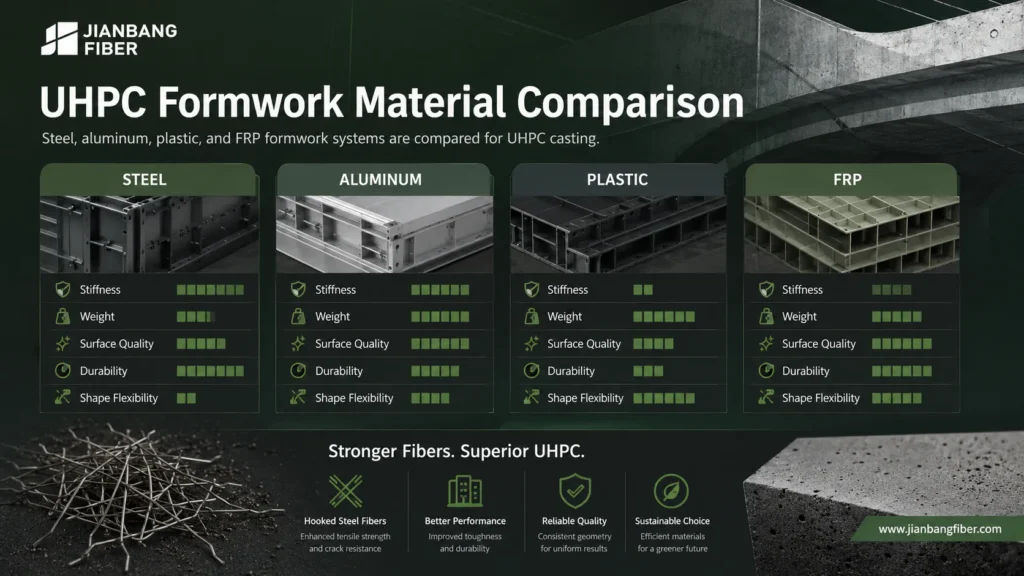
| Formwork Type | Main Advantages | Main Limitations | Suitable Applications |
|---|---|---|---|
| Steel | High stiffness, high precision, good sealing, many reuse cycles | Heavy, higher initial cost, corrosion protection needed | Bridge units, repetitive precast products, large structural components |
| Aluminum | Lightweight, modular, fast assembly, recyclable | Local deformation risk, higher purchase cost | Standardized panels and medium-size precast elements |
| Plastic | Light, corrosion-resistant, smooth, easy release | Lower stiffness and limited temperature resistance | Small products, liners, decorative profiles |
| FRP composite | Lightweight, corrosion-resistant, easy to form into curves | Higher tooling cost and more difficult repair or recycling | Complex curves and custom architectural components |
| Permanent formwork | No stripping, can provide protection or composite action | Higher design complexity and permanent material cost | Composite shells, stay-in-place panels and specialized structures |
The source material compares these five systems and emphasizes that no single formwork material is best for all UHPC components.
Steel Formwork
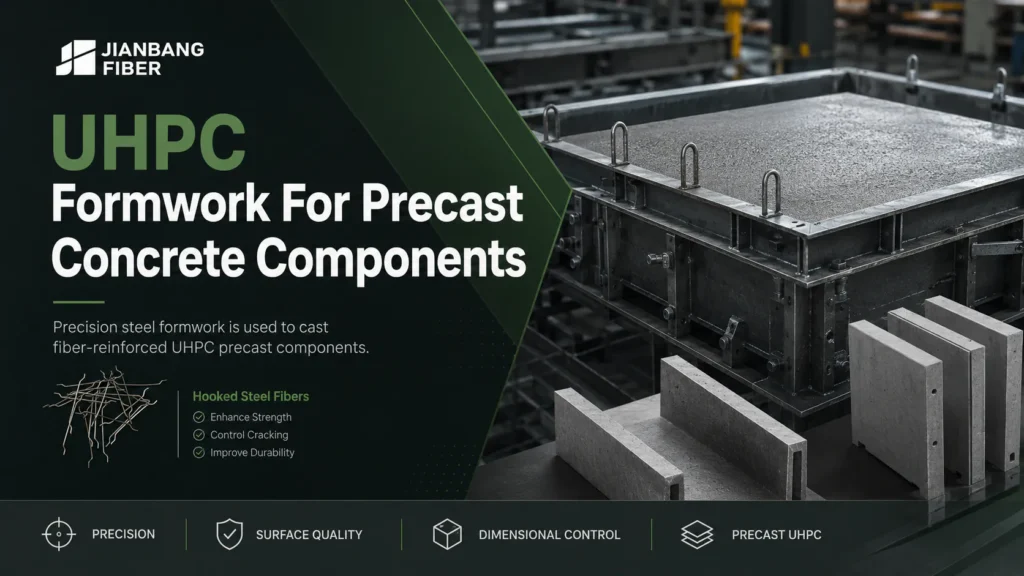
Steel is often the first choice for repeated UHPC precast production.
A properly designed steel mold provides high stiffness and stable geometry. Welded or machined joints can achieve good sealing. The surface can also be polished to produce a smooth finish.
Steel molds make economic sense when a factory produces many identical components. The cost per unit falls as the number of casting cycles increases.
The main disadvantages are weight and corrosion. Large molds require lifting equipment. Steel surfaces must also be cleaned and protected during storage.
A steel mold should include accessible inspection points. Workers need to check corners, hidden cavities, bolts, and seals before every cast. Dried UHPC on a sealing surface can prevent the next form from closing correctly.
Aluminum Formwork
Aluminum formwork provides a useful balance between weight and rigidity. Workers can move smaller sections with less lifting equipment. Modular aluminum units also allow faster changeover between similar products.
The designer must still check concentrated loads and connection details. Aluminum has a lower elastic modulus than steel. A light panel may need closer ribs or additional supports to achieve the same deflection limit.
Heat is another consideration. Aluminum transfers heat quickly and expands more than steel. If the mold is part of a heated curing system, the designer should check temperature uniformity and dimensional movement.
Aluminum works best for standardized components with controlled production cycles.
Plastic And FRP Formwork
Plastic molds are useful for small components, detailed patterns, liners, and difficult release conditions. They do not rust, and many plastics provide a smooth surface.
Their main limitation is stiffness. A thin plastic mold may need an external steel or aluminum frame. Heat can also soften some plastics.
FRP molds offer more design freedom. They can reproduce double curvature, flowing shapes, repeated ribs, and customized architectural surfaces. They are also useful in corrosive production environments.
The factory must confirm the resin system’s temperature resistance and dimensional stability. A low-cost FRP mold may distort during warm curing or repeated use.
For complex products, the correct solution is often a hybrid mold. A steel frame can provide rigidity, while an FRP or plastic liner provides the required shape and finish.
Permanent UHPC Formwork
Permanent formwork remains in the completed structure. It can provide an outer shell, protective layer, architectural surface, or part of a composite structural system.
Thin UHPC panels can serve as stay-in-place formwork for conventional concrete in specialized designs. This method can reduce stripping work and create a durable outer surface.
However, permanent formwork requires structural coordination. The engineer must evaluate the interface, connection details, differential shrinkage, thermal movement, load transfer, fire performance, and durability.
It should not be treated as a simple replacement for removable formwork. It becomes part of the final structure.
How Formwork Changes Steel Fiber Orientation
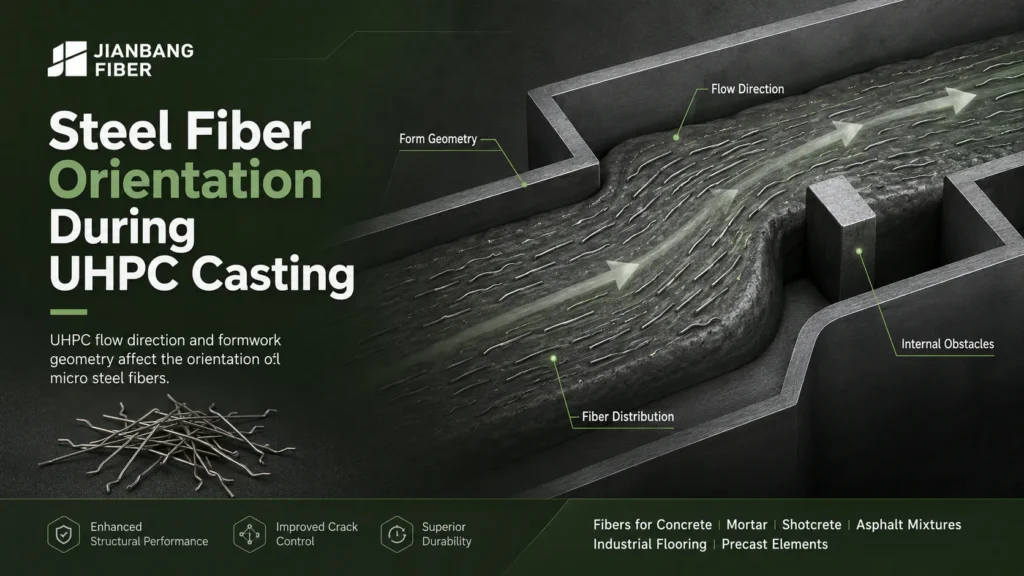
The formwork controls the path followed by fresh UHPC, and that path controls steel fiber orientation.
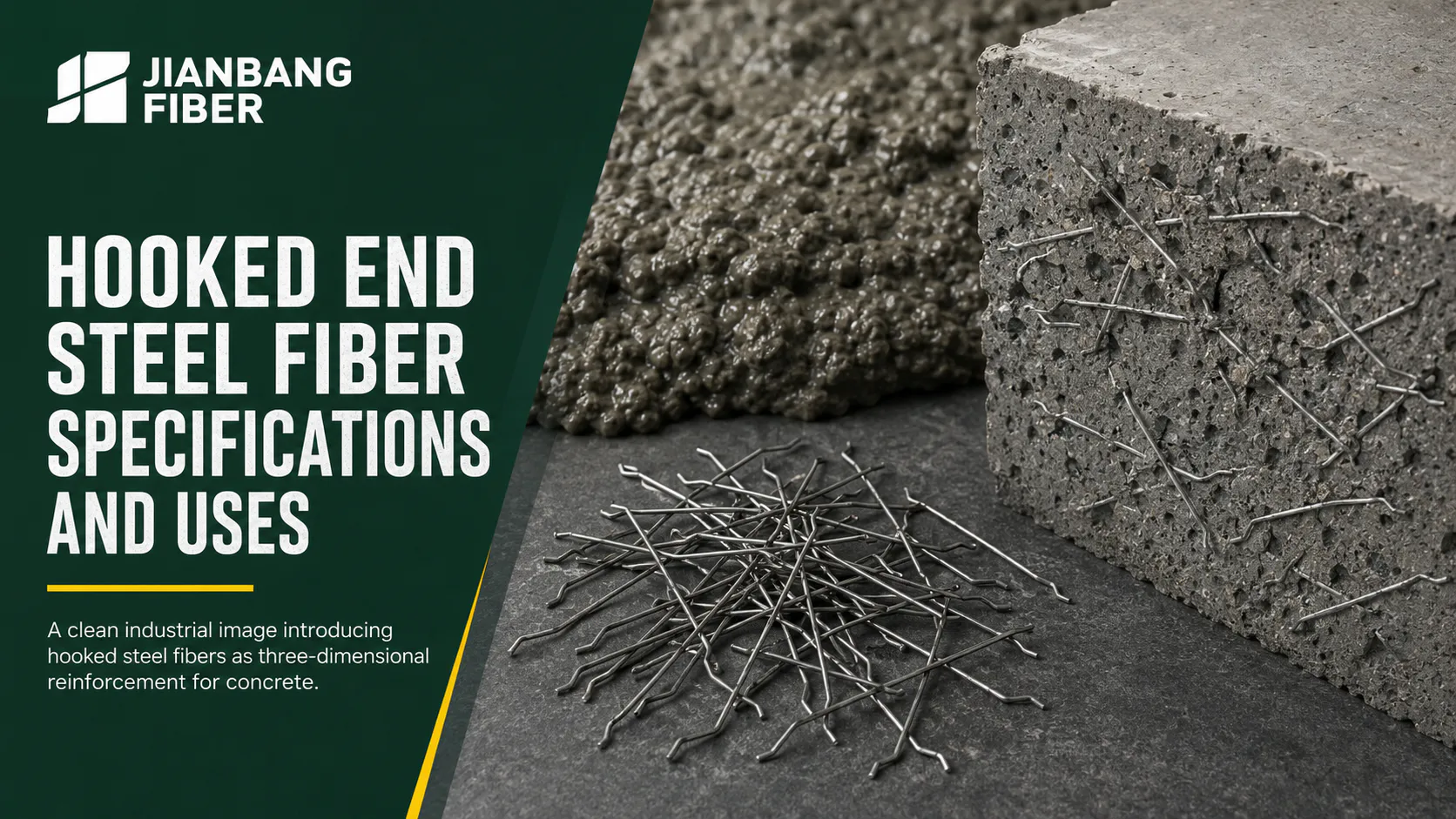
Micro steel fibers move and rotate as the UHPC flows. The fibers may align with the main flow direction. Corners, narrow gaps, reinforcement, abrupt section changes, and long flow distances can create local differences in orientation.
ACI educational material identifies casting method, member geometry, reinforcement layout, and UHPC rheology as important influences on fiber orientation.
This matters because fibers provide the strongest crack bridging when they cross the expected crack plane. A component may contain the correct total fiber dosage but still show weak local performance if most fibers align in an unfavorable direction.
The casting plan should therefore define:
- Where UHPC enters the mold
- The direction in which it should flow
- The maximum flow distance
- The location of vents
- The casting sequence
- Whether several inlets are needed
- Areas where reinforcement may block flow
- Areas where fibers may accumulate
The team should avoid moving the placement point without a plan. Random placement can create different fiber patterns between otherwise identical components.
Shandong Jianbang Fiber finds out that steel fiber selection should be coordinated with the mold geometry. Fiber length, diameter, dosage, and matrix flow must suit the narrowest sections of the component.
Filling, Venting, And Casting Direction
UHPC can fill complex spaces, but air still needs an escape path.
Closed forms need vents at high points and at the end of the flow path. A vent that is too small may become blocked by paste. A vent that is too large may allow leakage or fiber loss.
Transparent inspection windows can help workers observe critical areas. Pressure sensors or level sensors may also help on high-value molds.
For open-top molds, workers can observe the filling process more easily. However, exposed upper surfaces need protection after placement. FHWA checklists call for top forms or covers to be installed immediately after filling certain bridge connections.
The team should fill the mold in a way that limits unnecessary turbulence. Aggressive free fall or repeated relocation can disturb the fiber distribution.
UHPC often requires little conventional vibration. The exact process depends on the mixture. External vibration, light tapping, or controlled movement may be used to confirm filling, but excessive vibration can change fiber distribution and create surface accumulation.
Formwork, Temperature, And Curing
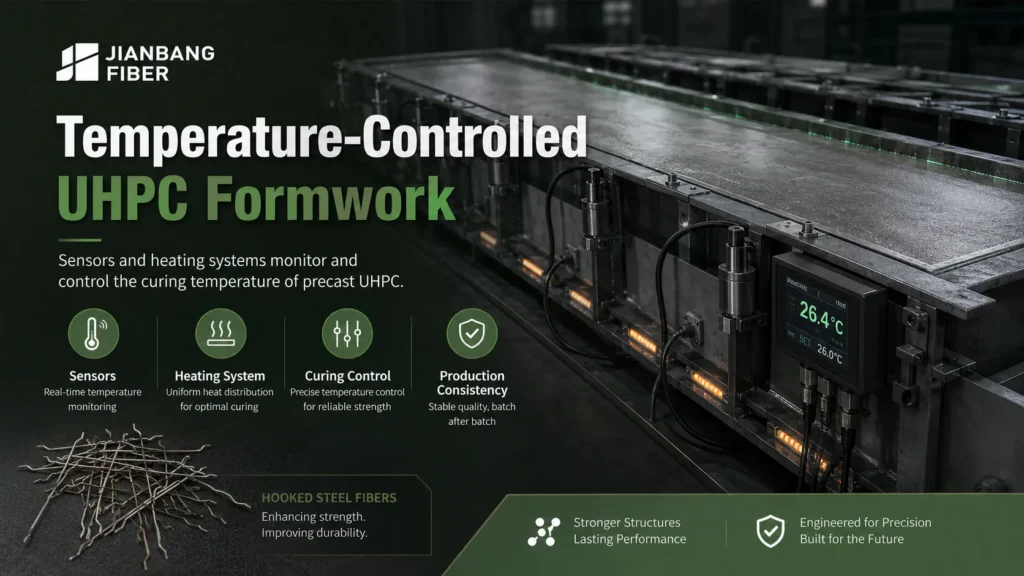
UHPC can develop strength under normal curing conditions. Some systems also use thermal treatment to accelerate development or improve selected properties.
FHWA describes a common steam treatment of about 90°C and 95% humidity for at least two days. This treatment often occurs after the component has been stripped from its mold.
This distinction is important. A factory should not automatically select a high-temperature mold because the UHPC supplier mentions steam curing. The production team must first decide whether the material will be cured:
- Inside the mold
- After early stripping
- Under an insulated cover
- In a separate steam chamber
- With embedded heating
- Under normal ambient conditions
If heat is applied while the component remains in the mold, the formwork must tolerate the temperature without distortion, softening, coating failure, or joint opening.
Temperature sensors can identify cold and hot areas. A controlled heating and cooling rate can reduce temperature gradients.
Match-cured test specimens can help confirm stripping strength and later performance. FHWA recommends match curing when specimens are used to evaluate the curing behavior of field-cast UHPC.
BIM, CNC, And Digital Formwork Design
BIM can improve coordination between the component, formwork, reinforcement, lifting anchors, inserts, inlet points, and support system.
The digital model can reveal clashes before manufacturing begins. It can also produce CNC data for cutting or machining mold components.
This is especially useful for:
- Curved façade panels
- Thin shells
- Repeated bridge elements
- Complex ribs
- Hidden connection pockets
- Components with many embedded parts
A digital workflow also improves traceability. The factory can connect each mold version with its production batch, inspection record, fiber type, casting direction, curing history, and final component number.
For custom components, 3D-printed molds or mold masters can shorten tooling time. The printed material must still provide enough stiffness, sealing, surface quality, and temperature resistance.
Quality Control Before Casting
A UHPC formwork inspection should cover more than general cleanliness.
The team should confirm that:
| Inspection Item | Required Result |
|---|---|
| Dimensions | Match approved drawings and tolerances |
| Alignment | Supports and mold faces are correctly positioned |
| Bracing | All braces and ties are installed and secure |
| Joints | Fully sealed without visible gaps |
| Contact surface | Clean, dry, and nonabsorbent |
| Release agent | Thin, uniform, and compatible |
| Inlets | Large enough and correctly located |
| Vents | Open and located at high points |
| Reinforcement | Fixed and clear of the intended flow path |
| Inserts | Correctly positioned and protected |
| Temperature system | Sensors and heating equipment tested |
| Trial casting | Completed where the geometry or process is new |
The UHPC flow should also be checked before casting. FHWA uses a mortar flow method to evaluate mixture consistency and suitability for placement.
Common UHPC Formwork Mistakes
The first mistake is designing the form based only on the final compressive strength. Fresh pressure and temporary construction loads control formwork design.
The second mistake is treating a small joint gap as harmless. UHPC paste can escape through gaps that would retain conventional concrete.
The third mistake is using untreated absorbent wood against the UHPC.
The fourth mistake is applying too much release agent.
The fifth mistake is ignoring the casting direction and steel fiber orientation.
The sixth mistake is providing no vents in closed or complex molds.
The seventh mistake is assuming that every UHPC mixture needs the same vibration method.
The eighth mistake is using a plastic or FRP mold without checking the curing temperature.
The ninth mistake is stripping based only on elapsed time instead of verified early strength.
The tenth mistake is beginning full production without a prototype casting.
How Ecocretefiber™ Supports UHPC Production
Shandong Jianbang Chemical Fiber Co., Ltd. supplies Ecocretefiber™ micro steel fibers for UHPC, RPC, precast concrete, repair materials, and other high-performance cementitious systems.
Micro steel fibers provide the internal crack-bridging system that gives UHPC its sustained tensile and post-cracking behavior. FHWA notes that UHPC performance depends strongly on fiber type, quantity, dispersion, and orientation.
Shandong Jianbang Fiber finds out that fiber selection must match the formwork and casting process. A long fiber may provide stronger individual bridging, but it may be harder to distribute through narrow sections. A finer and shorter fiber creates more fibers per kilogram, but the matrix must keep them uniformly suspended.
For UHPC projects, buyers should confirm:
- Fiber length
- Fiber diameter
- Aspect ratio
- Tensile strength
- Surface coating
- Dosage by volume
- Mixing method
- Flow requirement
- Component thickness
- Expected casting direction
Ecocretefiber™ can support contractors, precast factories, UHPC producers, distributors, and infrastructure buyers with specification selection, trial-order planning, packaging, OEM service, and application communication.
Buyer Checklist For A UHPC Fiber And Formwork Trial
| Question | Why It Matters |
|---|---|
| What is the narrowest component section? | It limits suitable fiber length and flow path. |
| Where will UHPC enter the mold? | The inlet controls flow and fiber orientation. |
| What is the maximum flow distance? | Long flow paths may create orientation differences. |
| Is the form fully watertight? | Leakage changes surface quality and local composition. |
| Is the contact surface nonabsorbent? | Water loss can damage the UHPC skin. |
| What fiber dosage will be used? | Dosage changes flowability and reinforcement density. |
| What flow value is required? | The mixture must fill the geometry without segregation. |
| Will heat curing occur before or after stripping? | The answer controls mold material selection. |
| Is the surface architectural? | Surface finish and release-agent control become critical. |
| Will a prototype be cast? | A trial reveals leakage, flow, fiber, and release problems. |
Conclusion
UHPC formwork is not only a container for fresh concrete. It controls geometry, leakage, surface quality, casting direction, fiber orientation, curing, and production consistency.
Shandong Jianbang Fiber finds out that the most important requirements are adequate stiffness, watertight joints, nonabsorbent contact surfaces, accurate dimensions, controlled release, and a planned filling path.
Steel formwork is suitable for repeated heavy-duty production. Aluminum reduces weight and speeds up modular assembly. Plastic and FRP molds provide value for smaller or complex shapes. Permanent forms can support specialized composite structures.
The formwork system must also work with the micro steel fiber system. Casting direction and geometry influence fiber orientation. Fiber orientation influences crack bridging and post-cracking performance. This means the mold designer, UHPC supplier, fiber supplier, precast producer, and contractor should coordinate before production begins.
Shandong Jianbang Chemical Fiber Co., Ltd. supplies Ecocretefiber™ micro steel fiber solutions for UHPC and RPC projects. A well-selected fiber and a well-designed formwork system allow the material to achieve better crack control, surface quality, dimensional accuracy, and production reliability.