Why Tunnel Segments Need Fiber Reinforced Concrete
Tunnel segments are not simple concrete products. They must carry ground pressure, water pressure, assembly force, shield jack pressure, transportation stress, and long-term service load. They also need stable dimensional accuracy, reliable joint performance, and good durability.
Ordinary reinforced concrete can meet many tunnel lining needs. But in many modern projects, designers also need better crack control, better toughness, better corrosion resistance, and better fatigue resistance. This is why fiber reinforced concrete segments are becoming more important in tunnel construction.
Shandong Jianbang finds out that fiber reinforced concrete can improve tunnel segment performance in several ways. It can improve toughness. It can reduce crack risk. It can improve fatigue resistance. It can improve corrosion resistance. It can also help the segment keep better integrity under repeated loading and difficult construction conditions.
At Shandong Jianbang Chemical Fiber Co., Ltd., our concrete fiber brand Ecocretefiber™ supplies steel fiber, polypropylene fiber, macro synthetic fiber, and other concrete reinforcement fibers for tunnel lining, precast segments, shotcrete, bridge deck, road pavement, and infrastructure concrete.
For tunnel segment projects, the fiber should not be selected only by price. It should be selected by performance target, mix design, structural demand, production method, and installation accuracy.
What Is A Fiber Reinforced Concrete Segment?
A fiber reinforced concrete segment is a precast tunnel lining segment made with concrete and short fibers. The fibers are mixed into the concrete before casting. After hardening, the fibers become part of the concrete matrix.
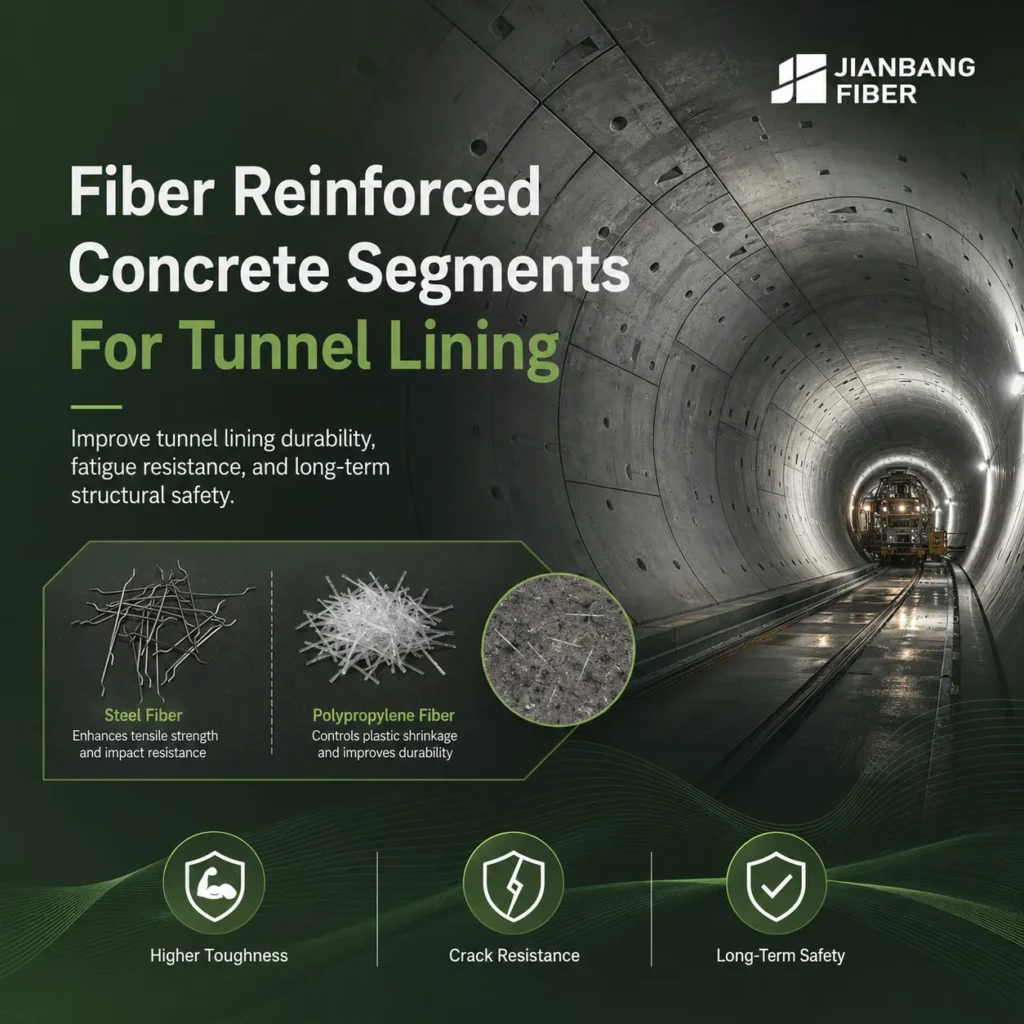
Steel fiber is often used when the segment needs higher toughness, better crack bridging, and stronger post-crack behavior. Polypropylene fiber is often used when the segment needs micro crack control or high temperature anti-spalling support. A hybrid fiber system can also be used when the project needs both mechanical reinforcement and micro crack control.
The key point is that fiber is distributed inside the concrete. It is not placed like a rebar cage. It works across many small crack paths. When cracks begin to open, fibers can bridge the crack and resist further growth.
This is very useful for tunnel segments. During production, transportation, lifting, installation, and service, a segment can suffer local stress and edge damage. Fiber reinforcement can help reduce brittle failure risk.
Main Advantages Of Fiber Reinforced Concrete Segments
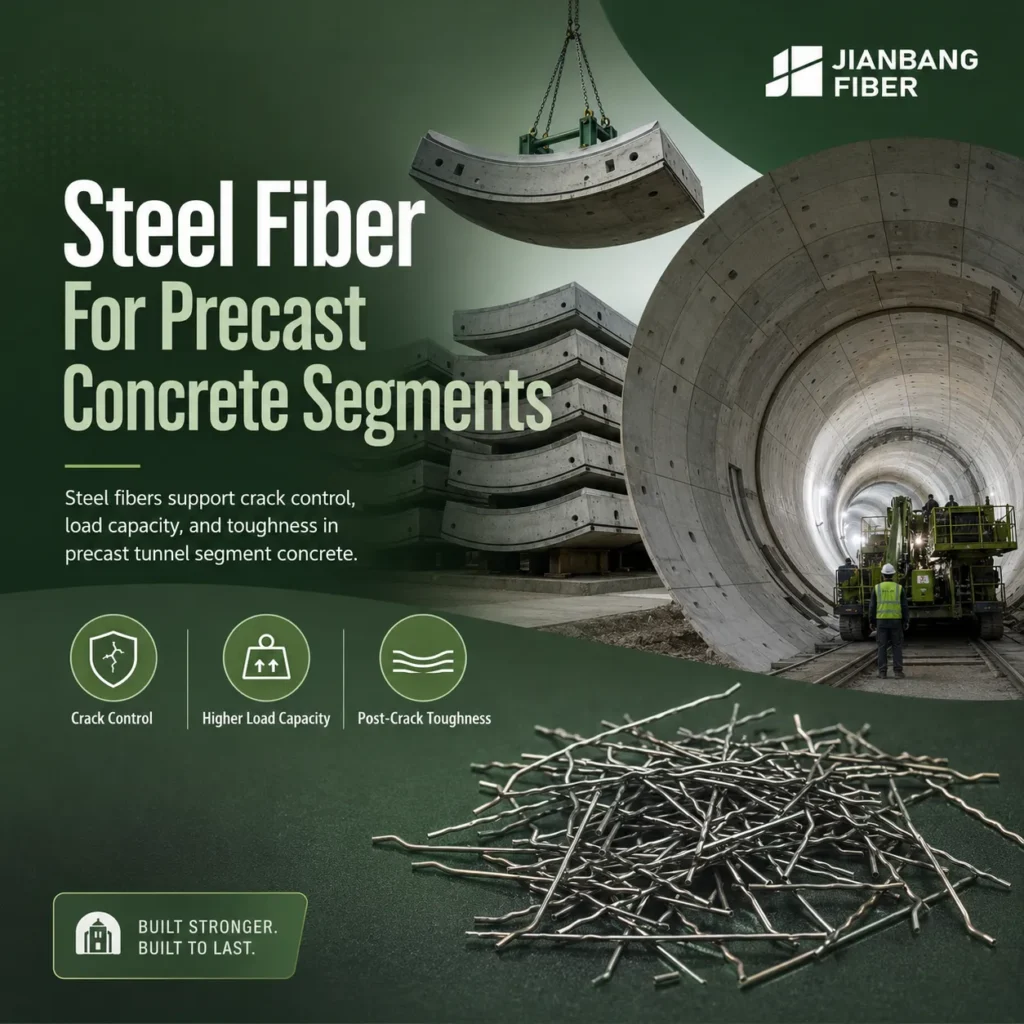
Shandong Jianbang finds out that fiber reinforced concrete segments offer several important advantages over ordinary concrete segments.
Better Fatigue Resistance
Tunnel segments face repeated forces during service. Train tunnels, metro tunnels, road tunnels, and utility tunnels can all face vibration and repeated load. Fatigue resistance is important because small repeated stress can create damage over time.
When fiber dosage is high enough and the mix design is stable, fiber reinforced concrete can show better fatigue performance than ordinary concrete. This means the segment can resist repeated load more effectively.
For project owners, better fatigue resistance means longer service life and lower maintenance pressure.
Better Corrosion Resistance
Tunnel environments can be wet, aggressive, or chemically active. Some tunnels face groundwater. Some face chloride exposure. Some face chemical attack. Ordinary concrete can crack, and harmful substances can enter through cracks. Once this happens, steel reinforcement corrosion risk can increase.
Fiber reinforced concrete can help reduce crack development. Better crack control can reduce the path for water and harmful ions. Some synthetic fibers, such as polypropylene fiber or macro synthetic fiber, also have corrosion-free properties.
Shandong Jianbang finds out that fiber reinforced concrete can support better resistance against water erosion, air erosion, chemical corrosion, and related durability problems.
Higher Strength And Better Toughness
Steel fiber can improve several mechanical properties of concrete. When steel fiber dosage is properly designed, concrete can show higher tensile strength, flexural strength, shear strength, and sometimes compressive strength.
For tunnel segments, this is important because the segment must resist bending, compression, local jack pressure, and handling stress.
But strength is not the only goal. Toughness is also important. A tough material does not fail suddenly after cracking. It can keep carrying load after the first crack appears. This post-crack behavior is one of the major reasons to use steel fiber reinforced concrete.
Steel Fiber Design For Tunnel Segments
Steel fiber selection is one of the most important parts of fiber concrete segment design. Shandong Jianbang finds out that high-strength cut steel fiber is a suitable direction for tunnel segment concrete.
Steel fiber can be supplied in different forms. Some steel fibers are supplied in row-bonded bundles. Some are supplied in loose form. The fiber form affects mixing, dispersion, and balling risk.
If the steel fiber is made from row-bonded steel wires, the dosage should be controlled to reduce the risk of fiber clumping. If the steel fiber is made from loose connected steel wires, the dosage should also be controlled with care.
In tunnel segment concrete, a dosage that is too high may create balling. Fiber balling can reduce uniformity. It can create weak zones. It can also make the concrete hard to place in the mold.
This is why a practical steel fiber dosage must balance three things: mechanical performance, workability, and production stability.
A good tunnel segment mix should make fibers disperse evenly. The concrete should fill the segment mold well. It should not segregate. It should reach the required surface quality and dimensional accuracy.
Polypropylene Fiber Design For Tunnel Segments
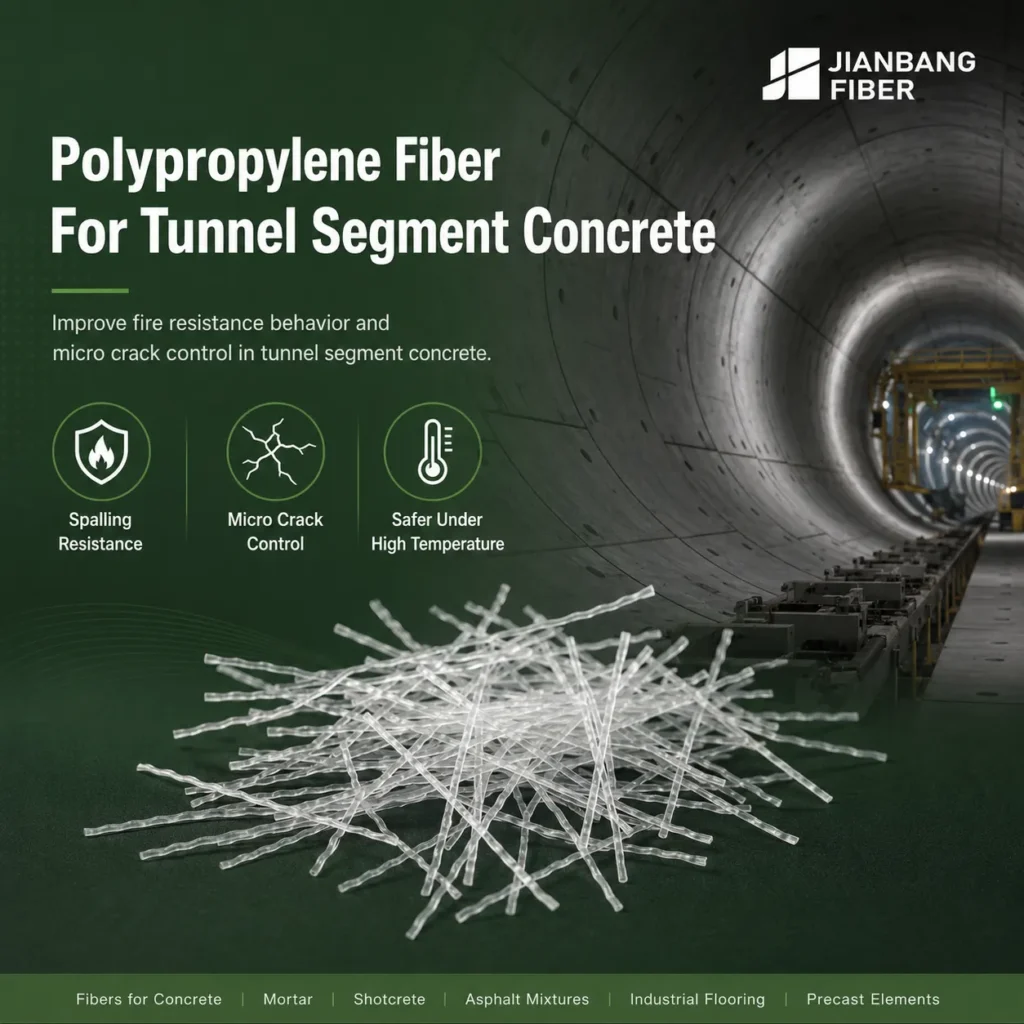
Polypropylene fiber can also be used in tunnel segment concrete. Its role is different from steel fiber.
Shandong Jianbang finds out that polypropylene fiber can be used to improve high temperature anti-spalling behavior. In tunnel fire conditions, concrete can face fast temperature rise. Water vapor pressure inside concrete can increase. This can cause explosive spalling in some dense concrete systems.
Polypropylene fiber can melt under high temperature. This can create small channels inside the concrete. These channels help vapor escape. This can reduce spalling risk.
Polypropylene fiber can also help with micro crack control. It is light, corrosion-free, and easy to disperse when the mix design is correct.
For tunnel segment design, PP fiber dosage should be selected based on anti-spalling requirements and concrete type. The dosage should not be increased blindly. Too much PP fiber can affect workability and may not improve structural capacity in the same way as steel fiber.
A common practical approach is to use steel fiber for mechanical reinforcement and PP fiber for fire-related anti-spalling support. This creates a more complete fiber system.
Water-Binder Ratio And Strength Design
The water-binder ratio has a strong effect on concrete strength, durability, shrinkage, and workability. For C50 tunnel segment concrete, Shandong Jianbang finds out that a water-binder ratio around 0.31 to 0.33 can be used as a practical reference.
A lower water-binder ratio can improve strength and durability. But it can also reduce workability. Since fiber increases internal friction, the mix must use a suitable admixture system.
Steel fiber concrete often needs a slightly higher admixture dosage than ordinary concrete. The goal is to keep workability stable without adding too much water.
The mix should not only pass strength requirements. It should also work in a precast plant. It must be easy to pour into the mold. It must compact well. It must keep fibers evenly distributed. It must not create honeycombs, edge defects, or segregation.
This is why tunnel segment fiber concrete should be tested before mass production.
Sand Ratio And Segregation Control
Fiber reinforced concrete can have a slightly higher segregation risk than ordinary concrete. When fibers are added, the concrete internal structure changes. The mix may become harder to flow. Sand and aggregate may move differently. Fiber may also gather in some zones if the mix is not stable.
Shandong Jianbang finds out that sand ratio should be increased properly to improve the stability of the mix. For C50 concrete, a sand ratio around 40% to 42% can be used as a practical reference.
A higher sand ratio can help improve cohesion. It can also help fiber dispersion. But too much sand can increase paste demand and reduce strength efficiency. The correct sand ratio should be verified by trial mixing.
Segregation control is very important for precast tunnel segments. A segment is a structural component. Uneven concrete can create weak areas. Uneven fiber distribution can reduce crack control performance. A good mix should keep the fiber, aggregate, and paste stable from mixing to casting.
Admixture Selection For Fiber Concrete Segments
Admixture selection must consider material compatibility, cost, shrinkage behavior, workability, and final performance.
Tunnel segments are usually precast components. They need accurate size and low early shrinkage risk. If early shrinkage is too high, cracks can form before the segment enters service.
Shandong Jianbang finds out that admixtures should help reduce early shrinkage and maintain workability. Modified melamine water reducer, polycarboxylate water reducer, and high-efficiency naphthalene water reducer can be considered based on the project and raw materials.
The best admixture should be selected through trial mixing. Cement type, mineral admixture, sand, aggregate, fiber type, and water-binder ratio all affect admixture performance.
A water reducer that works well in ordinary concrete may not work the same way in steel fiber concrete. Fiber changes flow behavior. The mix may need a different dosage or a different admixture system.
Mechanical Design For Fiber Reinforced Concrete Segments
Mechanical design should depend on the position and stress state of the segment. Shandong Jianbang finds out that different stress conditions need different design logic.
Small Eccentric Compression Segments
For small eccentric compression components, fiber reinforced concrete may show a limited but useful bearing capacity improvement. A practical reference is that the bearing capacity ratio between fiber reinforced concrete and ordinary concrete can be around 1.019.
This means designers can consider a small adjustment to the bearing capacity parameter when the project standard allows it.
Axial Compression Segments
For axial compression components, the improvement from steel fiber and polypropylene fiber may not be very obvious. In this case, the segment can be designed mainly according to the normal concrete structural design rules.
This is a useful reminder. Fiber is not magic. It does not improve every property in the same way. It is most valuable when crack control, tensile behavior, bending behavior, and post-crack toughness are important.
Large Eccentric Compression Segments
For large eccentric compression components, fiber reinforced concrete can show clearer advantages. This is because tensile stress becomes more important. The fiber can improve tensile behavior and crack control.
In this condition, designers should not only follow ordinary concrete design parameters. They should also consider the improved tensile strength of fiber concrete.
This is important for tunnel segments under bending and eccentric compression. Better tensile performance can support crack control and structural safety.
Engineering Application Of Fiber Reinforced Concrete Segments
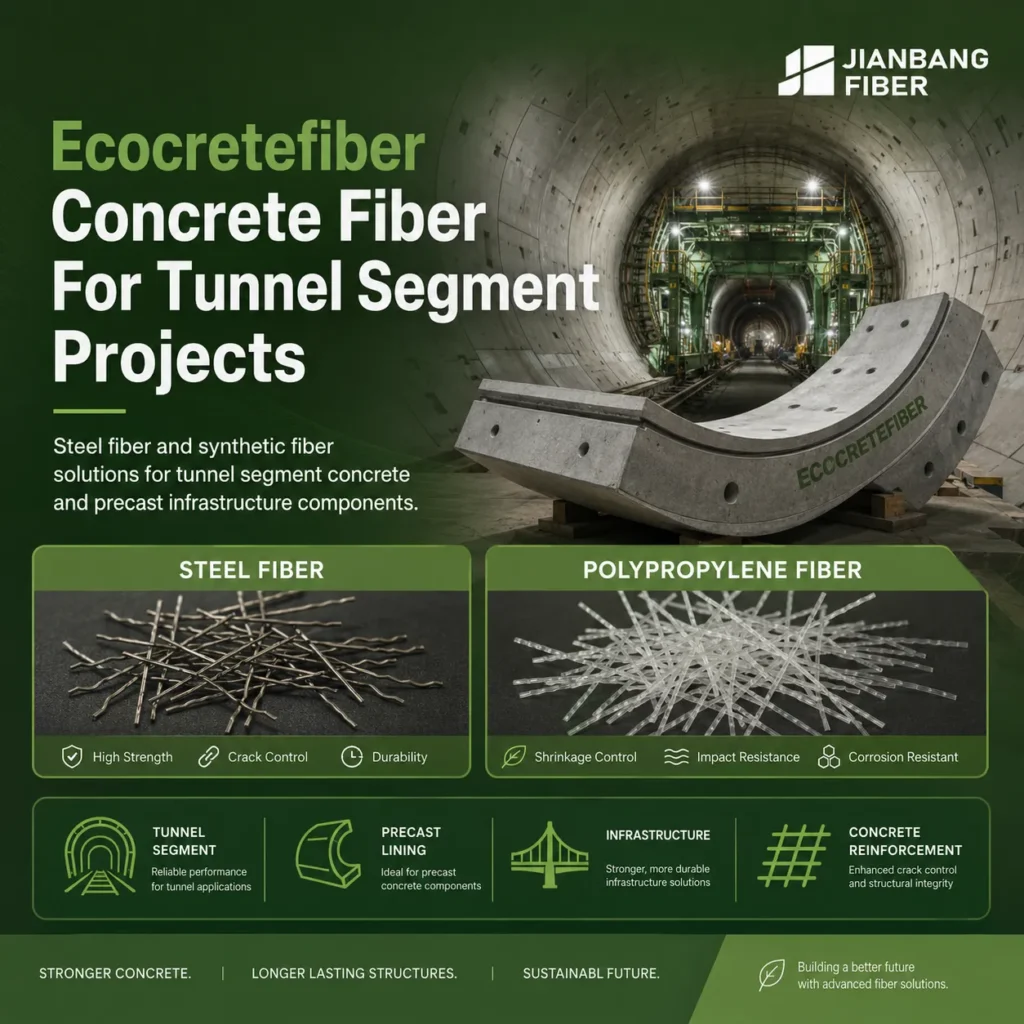
Shandong Jianbang finds out that fiber reinforced concrete segments can perform well in challenging tunnel construction conditions.
In one metro project case, the shield tunnel passed near bridge piles. The shortest distance to the bridge pile was about 3.62 m, and the influenced section length was about 20 m. This created a demanding condition for segment design.
Two types of fiber reinforced concrete segments were used in the scheme. One type used G56 concrete with steel fiber dosage around 36 kg/m³. Another type used G80 concrete with steel fiber dosage around 30 kg/m³.
The application effect was evaluated from three angles: segment stress, joint bolt force, and circumferential displacement.
Segment stress was checked under different construction stages. These stages included the assembled ring condition, the shield jack working condition, and the condition after the segment left the shield tail.
Bolt force was checked by placing measuring points around bolts. Circumferential and longitudinal bolt strain were recorded.
Circumferential displacement was checked by measuring the joint change between adjacent segments in the same ring.
Shandong Jianbang finds out that under local jack pressure, the segment internal stress and deformation stayed at a low level. This means fiber reinforced concrete segments can meet stress requirements in this kind of engineering condition.
Why Installation Accuracy Still Matters
Fiber reinforced concrete can improve segment performance, but it cannot solve every construction problem. Segment installation quality is still very important.
Shandong Jianbang finds out that if segment connection quality is poor, joint damage may occur under stress. This means the project team must control assembly precision.
Tunnel segments work as a ring. The whole ring must transfer load correctly. If one segment is misaligned, the joint can face local stress concentration. If bolt force is not controlled well, the ring may not work as designed.
This is why fiber reinforced concrete segment construction must focus on both material quality and installation accuracy.
A good material with poor installation can still create problems. A good installation with a poor mix can also create problems. The best result comes from both sides working together.
Practical Mix Design Checklist
Before producing fiber reinforced concrete tunnel segments, buyers and precast plants should confirm the following details.
| Design Item | Practical Check |
|---|---|
| Fiber type | Steel fiber, PP fiber, macro synthetic fiber, or hybrid system |
| Steel fiber dosage | Must balance strength, workability, and balling risk |
| PP fiber dosage | Should match anti-spalling and micro crack control needs |
| Water-binder ratio | Should meet strength and durability targets |
| Sand ratio | Should support cohesion and fiber dispersion |
| Admixture type | Should support workability and reduce shrinkage risk |
| Mixing process | Must prevent fiber clumping |
| Mold filling | Must ensure dense segment casting |
| Mechanical design | Must match compression, bending, and eccentric load condition |
| Assembly precision | Must reduce joint damage risk |
This checklist helps reduce technical risk before production.
Why Choose Ecocretefiber™ For Tunnel Segment Concrete
Ecocretefiber™ is the concrete fiber brand of Shandong Jianbang Chemical Fiber Co., Ltd. We focus on fiber solutions for infrastructure concrete.
Our products can support tunnel lining, precast segments, shotcrete, road pavement, bridge deck repair, industrial floors, and other concrete applications.
For tunnel segment projects, we can support customers with steel fiber, polypropylene fiber, macro synthetic fiber, and project-based fiber selection. We can also support OEM packaging and distributor product planning.
We understand that a tunnel segment is not just a concrete block. It is a precision precast structural component. It needs strength, toughness, crack control, fatigue resistance, durability, and assembly quality.
Ecocretefiber™ helps customers choose fiber based on the real project condition. We consider concrete grade, production method, dosage range, fiber dispersion, workability, structural demand, and long-term durability.
Buyer Questions Before Ordering Concrete Fiber
Before ordering fiber for tunnel segment concrete, buyers should prepare several key details.
| Question | Why It Matters |
|---|---|
| What is the concrete strength grade? | Strength grade affects water-binder ratio and fiber behavior. |
| Is the segment under compression, bending, or eccentric compression? | Stress state changes fiber value. |
| Is fire spalling resistance required? | PP fiber may be needed for anti-spalling design. |
| What steel fiber dosage is expected? | Dosage affects performance and workability. |
| What mixing equipment is used? | Mixer type affects fiber dispersion. |
| What is the target production cycle? | Precast production needs stable early strength and workability. |
| Is shrinkage control important? | Admixture and fiber system must be selected carefully. |
| What installation tolerance is required? | Segment assembly accuracy affects joint performance. |
These questions help suppliers recommend a more suitable fiber system.
Conclusion
Fiber reinforced concrete segments can improve tunnel lining performance in many ways. They can improve toughness, fatigue resistance, corrosion resistance, crack control, and bearing behavior. Steel fiber can improve mechanical performance and post-crack behavior. Polypropylene fiber can support micro crack control and high temperature anti-spalling performance. A hybrid fiber system can provide a more complete solution for demanding tunnel projects.
Shandong Jianbang finds out that fiber concrete segment design must be handled as a full system. Fiber type, dosage, water-binder ratio, sand ratio, admixture, mechanical design, production process, and installation accuracy all matter.
For small eccentric compression, fiber concrete may provide a modest bearing capacity improvement. For axial compression, the improvement may be limited. For large eccentric compression, the advantage becomes more meaningful because tensile behavior and crack control become more important.
Shandong Jianbang Chemical Fiber Co., Ltd. supplies Ecocretefiber™ concrete fiber solutions for tunnel segments, precast lining, shotcrete, road and bridge engineering, and infrastructure projects. If your project needs better crack control, better toughness, or a more reliable tunnel segment concrete system, Ecocretefiber™ can help you choose the right fiber solution.